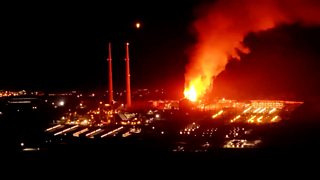
MOSS LANDING, Calif. — A fire is raging at the Vistra Energy battery storage plant in Moss Landing, one of the largest such facilities in the world. The blaze, which erupted late Thursday afternoon, has sent plumes of hazardous black smoke into the air, prompting evacuations, road closures, and a significant emergency response effort.

The fire broke out around 3 p.m. at the plant located on Highway 1 in Monterey County, officials report. Flames and smoke continue to emanate from the facility, which houses thousands of lithium batteries designed to store electricity generated during the day for use at night. The cause of the fire remains unknown.
Evacuation orders are in effect for areas south of Elkhorn Slough, north of Molera Road and Monterey Dunes Way, and west of Castroville Boulevard. Approximately 1,500 residents have been displaced. The Castroville Recreation Center at 11261 Crane Street is serving as a temporary evacuation center.
Highway 1 is closed in both directions between Highway 183 and Struve Road. Officials have not provided an estimated reopening time.
Monterey County spokesperson Nicholas Pasculli:
“It’s imperative that residents heed the evacuation order and take the direction of law enforcement and fire personnel,” Pasculli said. “This is a situation where we take the idea of protecting life and property very seriously. We implore people to heed the evacuation order and to go to a safe location.”
https://www.mercurynews.com/2025/01/16/moss-landing-power-plant-fire-evacuations-road-closures/
The plant, operated by Texas-based Vistra Energy, is a cornerstone of California’s clean energy strategy. Its massive capacity to store renewable energy is integral to the state’s transition to green power. The facility was expanded in 2023 to hold 750 megawatts of electricity, enough to power thousands of homes.
Lithium battery fires are notoriously difficult to extinguish due to the high temperatures and toxic gases they emit, which pose risks to respiratory health, skin, and eyes. All staff were safely evacuated, and emergency teams are working to contain the blaze within the plant’s concrete structure. Officials have stated that while the fire is extensive, it is “contained” to the building.
This is not the first fire at the Moss Landing site. Previous incidents in 2021 and 2022 were attributed to sprinkler malfunctions and system flaws, causing heightened scrutiny of battery storage safety. These incidents prompted California Governor Gavin Newsom to require battery plants to develop emergency response plans with local fire departments.
As authorities investigate this latest incident, concerns are rising over the safety of such facilities and their proximity to populated areas. This is a developing story, with updates expected as more information becomes available.
H//T JWG, doonman,
Why must they use lithium batteries? kwh/# and/or kwh/ft^2 does not seem important in this app. Fill me in.
Ed Miliband is filling big oil in, bob.
I aksed honestly. There are a few backwater engineers here with pockets of knowledge in this area. They hold forth on many other subjects, a la Musk et. al., but I wanted to give them the opportunity to write on this. Cliffie Clavin away, gents!
In my best Cliff Calvin impression.
It’s a little known fact that … Lithium batteries are preferred because they have a significantly higher energy density compared to other battery types, meaning they can store more energy in a smaller, lighter package, making them ideal for portable electronics and electric vehicles, while also offering fast charging capabilities and a long lifespan with relatively low maintenance needs compared to older battery technologies like lead-acid.
But their components are basically a full source and oxidized combined, one that can spontaneously combust if they come into contact with each other.
Aaah hate autocorrect/autoreplace…”full source” should be “fuel source”
That’s ok. I probably spelled Cliffie incorrectly. And thanks for the replies.
shouldn’t “oxidized” be “oxidizer”?
Had me puzzled for a minute.
This is not a portable application. In this application weight and size, as well as speed of charging considerations are secondary at best. Also, not all Li batteries are equal, LFP should be more safe.
We mostly know this. But do we need that energy density here? I’m thinking other reasons. Deliverability? Material availability? Gassing/safety? I still hope that one of the posters who actually has knowledge here replies.
Oddly (maybe crazily?) there is no advice (that I know of) available which defines the issues of design of unit spacing to ensure that one fire in any one part of such a huge unit cannot spread to the whole. It is certainly obvious that the world needs to devote very much more effort to making modern nuclear power systems.
Yes I have written a lot about this. The national fire prevention assoc is working on a standard for spacing but it might drive the facility costs way up. I have seen big arrays with 3′ spacing when it likely ought to be 20′ or more.
They should definitely erect concrete (CMU/fire brick) firewalls between the units to prevent the spread of.catastrophic events.
To bad that a LiIon battery isn’t more like Covid.
Then they could protect the batteries by placing 6′ distance circles on the ground and placing a PM2.5 mask over each unit.
Energy density is still a factor as it lowers both weight and total unit requirement to meet energy requirements. They may “Sit in place” but they do need to be trucked from manufacturing to installation sites and face a weight limit for trucking.
It was and is a reasonable question. One prospective alternative is the sodium ion batteries being made by Natron. LFP batteries also seem to be a better choice than Li-ion batteries, having a longer cycle life but lower specific energy, which is not an issue for a stationary battery.
My guess is that Li-ion batteries are more readily available than LFP batteries.
and a lighter weight for those 1100lb electric fuel tanks.
Backwater?? Douche.
Mr. Alberts: I noticed that, too. bob has mocked commenters here, and shown he can’t operate a gas station, now he has the nerve to ask for help?? And in the asking, casts shade??!! It’s testament to the generous nature of commenters here that he got a few good faith replies, he deserves only derision.
“Backwater?? Douche.”
Must’ve hit home. None I know of have over left their home state. The only one telling us where he matriculated, did so at a blah school. karlomonte aksed me about my creds, then when I told him and aksed back, radio silence.
And all use name calling as a substitute for view exchange. I indeed, hit home…
The only thing you hit was the d-bag meter. Automatically disparaging anyone you don’t even know.
And no, I’m not an engineer, just an average Joe, or Jeff, in this case.
Mr. Alberts: Took only five or so comments before true colors shown by this gaslighting fool. His “honest” search was a lie. And he’s laughing about being exposed. You hit the d on the b.
Obsession noted, blob.
BSEE
Eta Kappa Nu
Tau Beta Pi
ASTM Award of Merit
I could go on…
“Obsession noted, blob.”
“Obsesion”? Who aksed for cred first? Who dummied up for 2 weeks, after being replied to?
Please, “go on”….
FUA
/plonk/
Just what I was thinking. What’s the relative cost per kWh stored by lead acid or lithium batteries?
About half the cost with lead acid versus Li ion BUT….. they last half the time, 4 years vs 8 years, so its a wash, cost wise. The whole CAPEX of the batteries is necessary at the end of these periods….. AND the relative mass and volume is much larger so you need much more space, not a problem where there is land to use. BUT Lead acid are considered closed cycle because they are amost 100% recyclable as regards the lead. And they don’t catch fire, basically not combustibe and need oxygen supply for the cases to ignite. You might find my paper reviewing all this of interest…. it is of note this is more possible with sealed for life lead acid tech.
http://dx.doi.org/10.2139/ssrn.3274611
Thanks much. I opened in pdf form and will read today.
My lead acid battery in my Subaru (I bought 2nd hand with 18,000km on the clock) it seems lasted 7 years but yesterday a cell collapsed with all power loss stuck at a very busy intersection with traffic lights. Luckily no accident with people backing up and going around. It seems lead acid batteries should be replaced every 5 years if you want to avoid a cell collapse. I think fifty years ago the batteries had a longer life and the plates have been thinned.
When I traded in my 15 yo Mercedes a couple of years ago it was still using the original battery.
Answer….Cost per MwH of storage…obviously if lithium batteries burn up too often (a predictable problem when fuel and oxidizer are in the same container in the potential presence of electrical shorts), plain old lead acid batteries would become economical, but are a huge hazardous chemical (acid) risk as well….
Lead acid batteries can explode. H2 inside and a shorted cell. I have first hand experience with a car battery. The point is and high energy concentration carries risks. With Li, I only use them when given no choice (lap top, cell phone).
Everything that can store energy can explode. That’s why producing it as it is needed is such a better management solution.
I’ve used Lead acid batteries my whole life, well since 12 with my first motorcycle. 140+ motorcycles and 30+ cars/trucks later not one battery has malfunctioned in any way. I’m guessing I’ve dealt with a few hundred starter batteries; they just do their thing for 3-5 years and fade away.
Submarines (until recently at least) have use lead acid batteries for submerged running. H2 buildup there is absolutely a serious issue and dealt with – on an industrial scale lead acid battery storage is a long established process.
I believe it is more control circuit tech rather than battery tech. My experience for a couple of decades with automobile batteries was that lead acid batteries lasted 3 years, whether I purchased the cheapest or most expensive. I was always careful to keep the water level properly.
A new Toyota Corolla, purchased early in 2003, still running well, provided 11 years for the Toyota battery and 9 years for the Walmart replacement. It is on its 3rd battery now.
I purchased a new 2005 Corolla, battery lasted a long time but not 11 years! I think 5 or 6.
You must live in an area with very hot summers or very cold winters. Temperate areas should get 12 yrs out of a battery
Checking the water level? Gosh, I haven’t seen a car battery that wasn’t sealed for life in 30 years or more. But I live in Canada, perhaps that makes a difference?
Failure of Li batteries by itself does not make lead acid batteries economical.
That’s an unsupported fact free comment if ever there was one. free comment
This live California fire channel is eye catching, especially if one is a pyromaniac. (Live for some fires, some video is not.)
This is just common sense. Failure of Li batteries to be economical has no bearing on lead acid batteries. To be economical, lead acid battery solutions need to be profitable. If they are profitable, they are economical, if not, they are not.
That is the problem. The “Economy” of Li batteries needs to include not just the life span but also the failure of Li batteries and its resulting cost of fires every few years as part of the equation. As more and more Li storage units are built around the World, an expectation of fires per installed MW can be computed and compared to lead acid batteries.
Lead acid is hardly a limiting choice for a different battery than the most common Li battery type. A type using LI and iron is claimed to be a much less likely fire or explosive hazard. It is heavier per kilowatt hour than the popular LI type but it is even starting to be used in some BEVs. The higher weight and size is unlikely to be a major factor in a fixed storage facility. Electrical performance and battery life are claimed to be pretty much identical to the explosive type.
The Lithium Iron Phosphate batteries are widely used in caravans, where they have largely replaced deep cycle sealed lead acid batteries.
Apart from the obvious weight advantage, they can handle many more discharge/charge cycles, have a higher discharge/charge rate, work to a lower minimum charge level, and have a much lower voltage drop until almost discharged.
Yes, they also have an extremely low propensity to self-immolate.
Cars have a special duty cycle where they have very high load for a short period multiples times each day. Caravans have different needs , probably sitting unused for long periods and then average use and then unused again
Yeah, it’s horses for courses.
If you mean starter batteries, there are Lithium-based starter batteries available. They do seem rather expensive compared to lead-acid, and the weight saving is much less of a factor.
Yeah, most of them sit around unoccupied for long periods with the occasional long weekend and and school holidays. That’s why deep cycle sealed lead-acid batteries used to be used.
There are also a lot of grey nomads living off-grid while they do the big lap, so their batteries do get a regular workout.
I’m not sure what you mean by “average use”. The solar panel banks and house batteries seem to be sized to allow the batteries to charge during the day after getting down to around 40% capacity after breakfast before the solar panels are providing much power. Microwave ovens and air conditioners have quite a high current draw (approximately 100A peak), though lower than a car’s starter motor.
It’s funny. Solar panels and inverters are advertised in Watts, batteries are in Amp hours and chargers are in Amps. Presumably to make it harder for the customers to size the system and work out how long they can use appliances 🙂
I should have mentioned boat house batteries and 4wd house batteries as well. Those are similar to caravans.
Claims for lab testing of batteries isn’t the same as mass production for cars and storage.
The proponents of green energy “wind/solar plus storage” systems do not seem to like specifying storage capacity properly in Watt-Hour units. This leads to uniformed folks assuming there is far more energy than there really is. The post says this facility provides energy stored during the day for use overnight which might lead some to conclude that it can provide 750 MW for 12 hours or more (I.e. 9,000 MWH). However, it has been more common for these systems to be rated based on 4 hours of delivery. The Moss landing facility is, in fact, rated at 3,000 MWH. But many systems are only designed to provide frequency stability support to balance wind/solar short term fluctuation and may only have enough capacity to provide a few minutes of rated output.
Not specify capacity in Watt-Hour units is engineering malpractice. These MW ratings are certainly produced by politicians and PR departments.
I will grant PR departments also include advertising.
We all know bigger is better. Isn’t 8 Mbit better than 1 Mbyte?
1000 pJ is much greater than 1 nJ, right?
I “grew up” with A-Hr capacity definition. I have had to adapt to W-Hr. It is easier to comprehend a 3V, 1 A-hr spec over a 3 W-hr spec.
Doing engineering, one has to know what the voltage output of that 3,000 MWH battery system is. Also for the 750 MW spec?
Of course!
But 2 MNibbles* is even better.
(*Actually not kidding on this unit. It exists!)
Moss Landing doesn’t store 3000MWh any more.
Not to mention the greatly increased cost.
Proponents of Green Energy are usually scientifically illiterate, unable to understand the fundamental distinction between power (Watts) and energy (Watt-hours or Joules).
My first college engineering course had a lot of Dimensional Analysis: making sure the units were the same on both sides of the equation. It was known as a “weed-out” course, as some students couldn’t learn to do it. Anyone who has trouble doing things like converting to/from metric has no business trying to be an engineer, so I salute the college for checking for that first.
NASA and ESA supposedly found out about this the hard way.
They also don’t understand that energy use by say 1000 homes is probably only 1/3 of the actual requirement when you include retail, commercial, industrial, educational etc of those residents of 1000 homes
Three points but not all answers to your well-posed question
1) 750 MW is not a unit of energy but a unit of power. I can only assume they actually mean MW-Hr. This is a reflection of the lack of science education in journalism majors.
2) They used Li ion batteries because that is where the subsidies and kickbacks are. No one is going to get a tax break using a less flammable battery.
3) They mention a previous fire being caused by faulty sprinklers. Sprinklers don’t usually cause a fire, they put them out, or not if they are faulty. So what was the real causes of the past two fires? Perhaps this is intrinsic to this technology.
Not at all . The reverse is true
“Vistra installed 300 megawatts/1,200 megawatt-hours at the site in 2020,”
they seem to have factor of 4x , by some magic electrical engineering hocus pocus
Vistra later added a phase two with another 100 megawatts/400 megawatt-hours. And it subsequently expanded the facility again, in 2023, to a total of 750 megawatts/3,000 megawatt-hours. For all three phases, the company used NMC batteries manufactured by South Korea’s LG Energy Solution.”
And I believe they’ve had 3 fires in the 4 years of operations
If LiIon systems were Nuclear Generation they would all be shut down and decommissioned for their incident record
Presumably the older the installation the greater the risk?
Vistra Moss Landing energy storage system went into operation in 2020.
5 minutes seems enough
This is at least its 3rd major fire in 4 years. If the owners had to pay for cleanup of all the lithium pollution and other toxic emissions, they might well go BK.
750 megawatts? Or 750 megawatthours?
That is the important question.
750 MW with a 4 hour discharge rate so 750MW becomes 3 GWh
They’ve only been operating (phase 1) for 4 years or so, since the end of 2020 with the remaining 450MW installed later so the facility is quite young.
I saw no mention of the 4 hrs.
It could be 750MW for ten minutes
I had to look it up myself
According to the Great and Powerful Wizard on WIKI
Backwards 750 MW over 4 hours is 187.5 MWh, but throw away 10-20% for inverter and synchronization.
The difference is whether the 750 is counted as being storage capacity or output capacity. 750 MW output over 4 hours is indeed 3GWH, but all the documents I;ve read call it storage capacity, meaning the 750 is divided by 4 hours.
~188 MWh, or 750MW over 15 minutes, would put it more in line with other facilities.
The 3GWH figure would put it very much in line with other facilities and governments news releases (the source of the wiki piece).
Look at how wikipedia describes LCOE, before you decide which you’d believe.
This is from Vistra. 750 MW / 3000 MWh So it follows that its rating is based on 4 hours of duration.
https://investor.vistracorp.com/2023-08-01-Vistra-Completes-Milestone-Expansion-of-Flagship-California-Energy-Storage-System
4 hours.. So they are only designed to get through the evening peak demand period..
Not overnight.
Which is not an unreasonable design criteria for California by shaving off the worst parts of the “solar duck curve”. There still is a question whether that 4 hours is based on 100% to 0% discharge or a more realistic 80% to 20% discharge.
depends on the charge amount, which after a sunless day is not much.
At this point I’m guessing ZERO of either.
California is falling apart, burning up!
Next you are going to tell me that it is getting ready to slip into the ocean.
No body will miss it. It was beautiful but has been poisoned by the arrogant ignorant, despicable evil that is the democratic party, and the stupidity of the dumb assed people who vote for them and the social, environmental and economic suicide they want to impose on ordinary people. You can’t fix stupid. I will, but the California of the 60s and 70s I knew is long dead. Killed by the Democratic Party rule of the last 20+ years..
Been ready for decades. All that is missing is a bit of a nudge.
The State, literally, is turning red.
Nope, it’s turning black as the gangrene of single party fascist government works its magic on the populace, 33% of whom are on welfare. Productive people and those with a brain are fleeing the state in droves. That’s what happens every time a one party dictatorial government plans everything in advance for you.
Do we need any more proof that there is a God?
Or at least a god of fire.
Arthur Brown
Some say the world will end in fire.
Some say in Ice
From what I have seen of desire
I will side with fire.
But if it must perish twice
I will suffice.
( A Robert Frost variation)
I once visited the Moss Landing area, pre-batteries. I was visiting a company called Calera that was using CO2 from the now-demolished power plant to make “green cement.” I think Calera is now defunct.
I thought making cement released CO2.
It is possible that using CO2 to make the cement offsets the CO2 released over time by the cement. No data to support that speculation.
Limestone, primarily made of CaCO3, is one of the source materials of cement. It is heated, driving off the CO2 to form calcium oxide, CaO, which is sintered with other materials to produce clinker, an intermediate product. So you are correct that normal cement production involves releasing CO2.
But “green cement” involves reacting CO2 with an alkali, like NaOH, forming CaCO3. You can make it into a powder similar to cement that you can use for building. So the CO2 is then stored in the building material.
Sodium silicate used as a binder is hardened faster using CO2.
Not NaOH, to form CaCO3 it has to be CaO or Ca(OH)2, which are made by heating CaCO3 to drive off CO2. The whole thing is a zero-sum exercise, except for the fossil fuel energy that it uses.
Ah, you are correct, Mr. Rock, not NaOH but Ca(OH)2, a slip of the brain for me. However, if you can make Ca(OH)2 from brine (which they did) you can add captured CO2 from flue gas and produce CaCO3, essentially limestone.
These people did that and made tons of it. But getting income from “carbon” capture credits is key to the economics. Another challenge was getting people to accept CaCO3 as “cement,” most of the standards and specs are written for Porland cement.
Obviously caused by climate change – we need to act now! /sarc
Interested so see how the BESS advocates try to pass this off as teething problems or it’s a prototype or ……
Words of advice to journalists…
If you can smell an acrid odor near a burning LiIon battery you’re standing too close.
If you’re avoiding burning LiIon battery smoke borne toxins, those PM-2.5 masks won’t do much good. And the one you’re wearing will give you as much protection as buying an EV will reduce overall CO2 emissions.
Would have been amusing had you said buying an EV would protect you from Covid.
Gotta remember that quip
Guillotine is the best remedy for dandruff
Guillotine is a remedy for many ailments
Headaches
Migraines
Even Halitosis can be cured by Guillotine
Shampoo substitute for Head and Shoulders.
Oh dear.
How sad!…
…Never Mind.
Warning : This happened to “trigger” one of my pet peeves. “Sarcasm” and/or “snark” levels in this post may be elevated.
“[ Mega- / Giga- ] Watts” is a measure of instantaneous power ratings.
Electrical energy, AKA “capacity”, is measured in “[ Mega- / Giga- / Tera- ] Watt-hours“.
[ … breath in … breath out … breath in … Ommmmmmmm … ]
Checking the Wikipedia — usually OK for “dry facts” numbers — Moss Landing facility webpage gives us :
OK, so it’s a standard 4-hour frequency control / stabilisation facility, not what is often labelled a (to date purely theoretical) “grid-scale battery storage” system.
It can “store” enough “electricity” [sic] to “power thousands of homes” for … four hours … and then the blackouts can start.
Big whoop.
Further refining, 1 J = 1 W-sec so technically a W-Hr is 3600 Joules.
“It can “store” enough “electricity” [sic] to “power thousands of homes” for … four hours … and then the blackouts can start.”
From what source? Excess solar and wind? And when the sun does not shine, and the wind does not blow?
How many taxpayer dollars are now going up in smoke (and fumes)?
Probably none. It’s the shareholders and rate paying customers who have to bear the burden of Newsom and company’s nonsense.
Rate paying customers aren’t tax payers?
Different pocket. So no.
No subsidies?
We NEED MORE BRAINS….
(sorry. Return of the Living Dead…)
These projects often make little economic sense without government loan guarantees, grants, tax breaks, etc. I don’t know any details about this re: Moss Landing, but just recently, US DOE offered $15 billion in loans to PG&E.
https://www.energy-storage.news/doe-offers-us15-billion-to-california-utility/
All of them. California is now 40 billion in debt. But it’s worth it when you are saving the earth. Just ask Gov Newsom and he will tell you that we have to do more.
It’s much, much worse than 40 billion. Total CA state debt now stands at more than 1.6 TRILLION dollars.
As of 2022, this total was broken down as:
State long-term debt: $145 billion
Local debt: $361 billion
Unfunded pension liabilities: $882 billion
Other Post Employment Benefit liabilities: $184 billion
Deferred infrastructure maintenance: $67 billion
Thinking about moving to Cali? Think again!!
This is just so unnecessary. Toxic fumes and loss of investment and most likely, huge subsidies (tax payer funds) all up in smoke. All in the name of saving the planet. What a travesty.
No need to agonize about losses that were 100% predestined. This had to happen, and sooner is better than later. Hopefully, banks funding such projects will learn from this.
How much of the planet was saved by those flames, smoke, fumes, pollution, evacuations, etc.?
Like “reducing emissions”, mainly CO2, at great expense, then having it twice overturned by forest fires. CA remedy, don’t count forest fire CO2.
The huge Horse Heaven Hills 750 MW wind/solar/battery farm recently approved by Washington State’s renewable energy siting board is now being built fifty miles west of where I live here in the Middle of Nowhere, southeastern Washington.
South of the Horse Heaven Hills in northeastern Oregon is the Umatilla Army Depot where poison gas munitions and nerve agents had been stored for a number of years prior to the year 2000.
A billion-dollar chemical waste disposal plant was built onsite in the early 2000’s to burn all these chemical weapon materials. The campaign to dispose of them ran for a decade between 2002 and 2012.
Emergency response personnel in Oregon and Washington communities within a fifty mile radius surrounding the Umatilla Army Depot had to be trained and equipped to deal with any chemical release events which might occur while the Army’s decade-long chemical munitions disposal campaign was in progress.
As far as I am personally aware, no steps whatsoever are now being taken by local communities in those Oregon and Washington communities within a fifty mile radius of the Horse Heaven Hills wind/solar/battery farm to deal with a future battery fire and toxic chemical release which might occur at this new facility.
Because Lithium batteries are “safe and effective.”
/sarc
How many times have we heard that expression…
California which is the epicenter of Left Wing radicalism in the US is now reaping the rewards of its green policies. The people who provide the “Scientific Facts” that justify these projects and environmental polices need to be held accountable for the damage that they are causing. I group these “scientists” with the same scientists that “proved” smoking tobacco is not harmful. They are nothing but corporate shills.
I group them with the administration and garrison of the holocaust concentration camps.
Too many similarities.
A suit against them for “misinformation” of the type that was recently lost against the oil companies by NYC (because the NYC suit claims were all lies, according to the judge) might prevail by only claiming true fact backed up by solid evidence.
Don’t you just love all this green energy.
From the picture it looks more like red, orange, yellow, black, brown, and gray energy.
We should capture the smoke and harvest the lithium in it.
/s/
Makes me remember Cat Stevens and Moonshadow.
“Drone footage shows fire at one of world’s largest battery plants
00:29
Drone footage shows fire at one of world’s largest battery plants
Close
A fire has broken out at a Californian power plant housing one of the largest battery energy storage facilities in the world.
The blaze began in a building containing lithium-ion batteries on Thursday afternoon, an official at the Monterey County Sheriff’s office said.
The Moss Landing power plant, run by Vistra Corp, was evacuated, as were people in the surrounding area. No injuries were reported.
Officials are not actively fighting the fire, the Monterey Sheriff spokesperson said, and are instead leaving the building and the batteries to burn on the advice of fire experts.”
According to sources including the BBC and the Daily Mail.
Besides, all the fire hydrants are either empty or too far away.
Moss Landing is not part of the LA disaster.
So, add a /sarc, please.
…well it is a close cousin and human caused by the same mindset.
It is not possible to put out Li battery fire by water. They have to wait until it burns out itself.
If water is used as a coolant soon after a fire has started then it may prevent thermal runaway, if not then yes it would be useless.
Yeah, these fires force responders into damned if you do, damned if you don’t situations. Besides all of the lithium species being emitted, HF (hydrofluoric acid) emissions are particularly toxic and insidious.
The fluoride pollution will poison the land for decades or even centuries.
From what I read, it’s enough to power about 225,000 homes for one day. So if the grid is down longer than that, too bad.
EDIT – reading other commenters’ observations here, it might be only enough for 4 hours.
In the US, the average home uses 11MHh/year. So 225,000 homes would consume 6,781 MWh per day. At that rate, a 3000MWh facility could provide power for less than 11 hours. Of course, there are many variables, for example, what is the average power requirements for a home in CA, and at what time of year?
4 hours. Not sure about the 225,000.
Nobody in the MSM knows the difference between Energy and Power.
Vistra is 750MW or power, with 3GWh of energy. That’s 4 hours backup at maximum power. I don’t know the details of California’s energy requirements to know if that’s a a useful amount for a useful time.
Similar to the UK.
At the moment, we’re using ~ 40 GW, so 750 MW would cover roughly 1.5% – 2% of demand, and 3 GWh means that it could do that for 4 hours.
Now, bear in mind that a dunkelflaute can a last for a week or more, then you’d need 2,000+ of these units to provide even the most basic backup.
It is a waste of dollars deemed necessary because California promoted too much rooftop and industrial solar power to save the earth. The excess solar power generated when no one wants it has to go somewhere. Its either pay people to take it or store it somewhere for later.
They call this “green energy” and you can sign up to pay more for it and feel good about saving the earth.
Most people who understand power distribution and grid engineering call this a scam. But not in California which is a one party fascist state.
Well beyond merely MSM.
What is not known is if the EGWh is full range or the necessary 90% derating value.
Story tip –
And Suddenly, Gavin Newsom’s Electric Car Mandate Looks Pretty Dumb to LA Fire Victims – PJ Media
Even now, the homeless LA gliteratti, who soon may be allowed to sift through the ashes of their homes in hopes of finding the gold coins that looters haven’t dug up yet, wonder how they could have been so gullible. They bought Newsom’s climate change diktats hook, line, and gas can, and now their electric car doesn’t work. Their beloved Tesla and their neighbor’s Nissan Leaf are charred carbon hulks considered by the environment police to be portable toxic waste dumps. I’m sorry, sir, and you can’t move it until we’ve studied the environmental externalities of your charred car. Grab a number.
And where to put all those burn-out EVs !
Not like a ICE car that can be put through a crusher !
I should feel bad for the guy who wants to sell his Nissan Leaf for a car that will work during a power outage. Good luck.
Better off donating it back to the state. Since the state doesn’t want new construction, it can take all the used EVs no one wants, remove the batteries, and tow them to empty lots where they can be used as homeless shelters.
The batteries can be shipped up the coast and disposed of in that battery incinerator plant they opened this week.
Fire Characteristics
Its in total 3GW for four hours and is the biggest in the world. So lets apply this to the UK situation.
You need 40GW peak. So right there you’d need about 50 times the largest grid scale storage installation in the world. But you don’t need it for four hours, but for a week or ten days.
The 40GW is peak demand, so when calculating total capacity you can probably get away with 30GW average x 10 days.
You need installed battery power many hundreds times the largest in the world at present, and you need it by 2030. And not just that. You also need enough extra wind to recharge it when the wind picks up again.
Total fantasy.
Suggested edit… replace “Total fantasy” with “Outrageously expensive fantasy”
One CA report says $482,000 per MWh in 2024
Moss Landing was supposed to be a model for grid battery installations in the US but it keeps catching fire and burning. Will we learn from this or keep adding fuel to the fire?
I think it is a quite realistic model.
It was supposed to be their “flag ship” but seems more like a fire shit show.
Must be caused by climate change
Green & Clean ???
From the photos, it doesn’t look even close to “clean.”