A recent Dutch court decision has highlighted yet another chapter in the ongoing saga of climate litigation. These lawsuits, often celebrated by environmental groups as heroic stands against alleged corporate or governmental indifference, more frequently reveal themselves to be little more than vexatious attempts to impose ideological agendas through the legal system. The Dutch case fits squarely into this pattern, raising questions about the validity of such litigation and its broader consequences.
The Dutch Case: An Overview
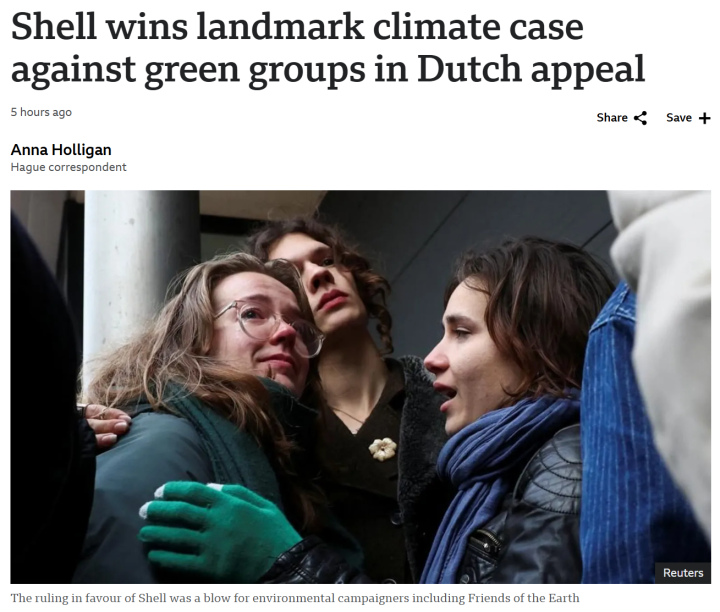
In this latest instance, a court in the Netherlands dismissed a climate-related lawsuit brought by activists targeting Shell. The suit alleged that the company had not done enough to reduce carbon emissions and protect the environment. Despite the plaintiffs’ claims of moral urgency, the court found the case insufficiently grounded in legal merit.
This is far from the first instance of activists leveraging the courts to advance their goals, but the Dutch case is emblematic of a deeper trend: the increasing use of climate lawsuits as tools for coercion rather than justice.
The Rise of Vexatious Climate Litigation
The Dutch case is part of a growing global trend of lawsuits aimed at holding corporations or governments “accountable” for climate change. However, many of these cases bear the hallmarks of being frivolous, ideological, or outright manipulative.
- Strategic Exploitation of Legal Loopholes: Plaintiffs often target corporations in jurisdictions with loose standing rules or sympathetic judges. These cases frequently stretch or redefine legal principles, demanding courts take on the role of policymakers.
- Litigation for Show, Not Substance: Such cases often generate massive media coverage, regardless of their legal merits. For activists, winning in the court of public opinion can be more valuable than winning in an actual courtroom.
- Undermining Judicial Integrity: By attempting to insert speculative climate models and projections as evidence, these lawsuits place the judiciary in the precarious position of ruling on matters far outside its expertise.
In the Dutch case, as in others, the goal appears less about achieving meaningful outcomes and more about harassing companies into compliance with activist demands.
A History of Questionable Cases
To understand the Dutch ruling in context, it’s worth examining similar lawsuits that have failed to deliver meaningful results:
- Juliana v. United States: Touted as a landmark case, a group of young activists sued the U.S. government, alleging constitutional violations for failing to address climate change. While the case garnered massive media attention, it was ultimately dismissed because the judiciary recognized it lacked authority to mandate sweeping policy changes.
- ExxonMobil and the Rockefeller Funding Nexus: ExxonMobil has faced numerous lawsuits alleging it misled investors about the risks of climate change. However, investigations revealed these lawsuits were often coordinated by ideologically motivated groups, such as the Rockefeller Family Fund, raising questions about their legitimacy.
- Australian Lawfare: In Australia, environmental groups have used legal challenges to delay mining and infrastructure projects. While framed as environmental justice, these lawsuits have cost billions in economic losses, without significantly advancing environmental goals.
Each of these cases reveals a troubling pattern: lawsuits designed to weaponize the legal system, not to solve problems, but to impose a particular worldview.
The Broader Consequences of Vexatious Lawsuits
These cases are not harmless. They impose significant costs—financial, social, and institutional:
- Economic Costs: Businesses targeted by these lawsuits face steep legal fees and reputational damage, even when cases are ultimately dismissed. These costs are inevitably passed on to consumers, raising prices and stifling innovation.
- Judicial Backlog: Vexatious lawsuits clog court systems, diverting resources from legitimate cases. Courts are not designed to function as substitute legislatures or scientific bodies, yet these cases demand precisely that.
- Chilling Effects on Business: The constant threat of litigation discourages investment and innovation, particularly in industries already grappling with tight margins and regulatory uncertainty.
- Erosion of Trust in the Legal System: When the courts are used as a political tool, public confidence in judicial impartiality declines.
The Dutch case adds yet another log to this growing fire, illustrating how legal systems can be exploited for ideological gain rather than justice.
Climate Activism as Legal Harassment
The rise of these lawsuits reflects a broader trend in modern climate activism: the use of coercive tactics to impose compliance. Whether through public shaming, regulatory lobbying, or vexatious litigation, the goal is the same—to bypass democratic processes and enforce top-down mandates.
The courts, however, are ill-suited to play this role. Climate models, policy trade-offs, and societal priorities are matters for public debate and legislative decision-making, not judicial fiat.
Conclusion: Time to Push Back
The Dutch court’s decision to dismiss this latest climate case should be welcomed as a step in the right direction. It serves as a reminder that the courts cannot and should not be hijacked to serve ideological agendas. However, it is not enough to celebrate isolated victories. Broader reforms are needed to prevent the legal system from being used as a weapon against economic freedom, innovation, and rational governance.
Climate lawsuits like the Dutch case reveal the folly of allowing ideologues to dictate policy through legal harassment. If left unchecked, this trend will do far more harm than good—eroding institutions, stifling progress, and undermining trust in the very systems that activists claim to protect.
H/T charlie
Dutch treat.
The blatant money-grabbing hypocrisy of these fraudsters is chilling. They all use FF every day, while they want to be paid well trying to get FF outlawed somehow, disgusting. Their logic is so twisted and their morals corrupt!
Perhaps a RICO prosecution of Sher Edling and their funders, including the Rockefeller Brothers Fund? Extortion is still a crime.
In a recent case in Australia an activist group the so-called Environmental Defenders Office (EDO) was able to temporary stymie an important off-shore gas project in the Northern Territory using “distorting and misrepresenting” evidence that the Federal Court dismissed ultimately but the activists achieved their purpose by causing delay and uncertainty.
In this case the court has approved for Santos Gas the project owner to access all EDO communications related to the case in order to recoup the costs caused by the activists’ delaying tactics; sadly EDO receives government funding so shareholders taxpayers and ordinary Australians are the loses whatever happens.
“environmental groups”
Yet those same “environmental groups” do nothing about the wholesale destruction of native habitat for the installation of wind turbines and solar industrial site.
Or species on the Endangered Species list.
Or farmland.
Or the slaughter of raptors, other birds, bats, insects and (heavy irony here) whales, all without a moment’s thought to the potential effect on ecosystems.
And the “Great Koala National Park”(to be) is being logged, according to the ‘Sydney Morning Herald’ headline.
Make them pay all court costs and legal costs. You file a frivolous lawsuit, you will pay. This kind of policy difference should be settled by the making of law
Agreed!
And might there be a way to ding the lawyers who take these cases that are deemed frivolous?
This is “lawfare”, where the process is the punishment, and could even scare individuals or companies away from doing what is both correct & legal.
There once was a time when a judge could rule a lawsuit frivolous and impose sanctions and penalties including covering all of the defendants’ costs.
If I was the judge I would require all documents be submitted using printed characters created with a fountain pen using natural India ink. Only natural fiber clothing would be allowed in the courtroom, paid for by the plaintiffs. Images must be created by hand or with actual photographs, no computer printed images using synthetic ink. There is probably other requirements I have missed that will illustrate how FF drive our current lifestyle.
The scum of Vexatious lawsuits is also applied to individuals such as the ridiculous lawsuits contrived against Trump in New York. None of these lawsuits will survive appeals to fare legal jurisdictions but by the time that occurs the political damage has accomplished its political purpose of undermining and damaging the credibility of its victim.
It’s a good post, Charles, but no-where does the term “lawfare” get mentioned. The process is the punishment (causing costs and delaying proposals) for those who don’t want the economies of the world to stay strong.
It’s like the IRA’s comment to Lady Thatcher, “you need to be lucky every time, we only need to be lucky once”. One loss in a first-world courtroom with an idiot judge will generate a precedent to force all future attempts at development to jump through a new set of hoops. I don’t think that the question is whether they hate us, I think it’s how much they hate us.
Turn the table and sue them back. Anything can be used as a purpose. They do it, why can’t the corporations? Why can’t lawfare work both ways?
“Turn the table and sue them back. Anything can be used as a purpose. They do it, why can’t the corporations? Why can’t lawfare work both ways?”
Generally won’t happen; most businesses are far too busy trying to do something useful in society.
There will come a time when out of self-preservation it starts.
The question is, how long?
The only ones needing punishment are the bottom feeders taking Shell to court. By their own admission they believe CO2 is having catastrophic consequences. Yet even knowing that they continue to use fossil fuels for transportation, for heating and cooling, for cooking, clothing, plastics, fertilizers, medicines, paving and on and on. How can anyone who believes the way they do put the planet at risk the way they do. They need serious jail time.
Anyone involved in these lawfare exercises should appear in court naked, not covered in oil.
While Rutte (now running NATO) was PM the suit against Shell would have stood a good chance of success. Remember his attacks on farmers and premature closure of the Groningen gas field. With the new government that include the BBB farmers’ party as well as Wilders’ PVV attacks on the wellbeing of the people are much less welcome. The frequent demonstrations at the start of the A12 (just a few blocks from where I used to live, and a few more from the Binnenhof parliament buildings or Huis ten Bosch – the royal residence – that used to attract Greta are no more. The mood has turned, and the courts know it.
Here’s an idea.
They think carbon dioxide at 400+ parts per million is an issue.
Give the vexious litigants a choice, either pay for all the legal costs or be sentanced to stay in a hermetically sealed airconditioned area with CO2 stableised at 180 parts per million, with all the hand tools and seeds to produce their own food, handed to them and see how long it is till they starve.
Isn’t it amazing that environmentalists all think that winning money in a lawsuit solves all the environmental problems?
If that were the case, then regulatory agencies would never have to strengthen the limits they set up initially to solve the problems. Winning the money would be enough to make the environment whole again.
It isn’t about winning money. It is all about bankrupting the corporations.
The concept is, if they go out of business, oil use stops.
Funny how they do not understand Darwinian Economics.
Huge decision holding that Council on Environmental Quality never had authority to issue the National Environmental Policy Act regulations that have been used for nearly half a century
https://x.com/EnergyLawProf/status/1856406808576889035
I could support suing a company that imports items from China manufactured with coal derived energy.
Not really but an amusing thought!
Looking at the news reports the supporters of the lawsuit look truly devastated that their case lost, tears running down their cheeks. It is a sad affair that the Dutch educational system failed to instill basic critical thinking that would have prevented them from being led so far astray. The protestors are victims of a death cult and they do not realise it.
We in the UK are doomed.
A legal challenge over the decision to give consent to the UK’s largest untapped oil field is taking place in Edinburgh.
A judicial review brought jointly by the environment groups Greenpeace and Uplift is being heard at the Court of Session
https://www.bbc.co.uk/news/articles/czd5rvgp830o
If left unchecked, this trend will do far more harm than good—eroding institutions, stifling progress, and undermining trust in the very systems that activists claim to protect.
THAT is precisely the goal.
The recent election may offer an example to follow. Over a billion spent by political activists to try and elect a “cardboard cutout of a politician” who couldn’t state what her policy was. All that money now wasted. We should advocate for a rule that, when frivolous activists litigation is dismissed, all costs are charged to the instigators and their attorneys. Just as a lot of liberal mega-donors will now think twice about funding the election of a useless idiot, cost of frivolous litigation would certainly be a major deterrent to launching any civil actions that have no real likelihood of succeeding on merit.
Story tip. From Judith Curry’s blog, a good review of the court case.
– – – – – – – – –
The climate case of the century
On the 12th of November, the Hague Court of Appeal ruled in the “climate case of the century” that Milieudefensie (“FoE”) filed against Shell in 2019. FoE demands that Shell reduce emissions throughout the entire chain by at least 45% by 2030. The foundation “Man & Environment” (M&E) joined the case to represent the interests of Dutch citizens.
The Court of Appeal was not impressed by FoE’s “go green or go extinct” rhetoric and rejected its claims.
https://judithcurry.com/2024/11/13/the-climate-case-of-the-century/