In the latest illustration of why you can’t rely on wishful thinking as a power source, the UK and Germany faced a harsh lesson in “Dunkelflaute.” For those not familiar with this charming German term, it means “dark doldrums”—or, in practical terms, a blackout in renewable power. While we’ve been lectured about the virtues of a green energy future, these countries got a taste of the reality: when the wind stops blowing, the entire grand plan goes belly-up.
This past Tuesday, Britain’s much-heralded wind farms managed to cover a pitiful 3-4% of electricity demand during peak hours. The National Grid had no choice but to ramp up gas-fired plants, which handled a whopping 60% of demand. Meanwhile, solar and biomass did their best to chip in, but as always, they came up short. Across the Channel, Germany experienced similar woes. Wind speeds dropped so low that turbines were spinning at a meager 7% of their theoretical capacity. Once again, it was back to coal and gas—those supposed relics of the past that are actually the backbone of modern energy security.
The “Green” Fantasy vs. Reality
Here’s what the climate evangelists won’t admit: renewable energy is a fair-weather friend. When the high-pressure systems settle in, the wind dies, and the sun disappears behind clouds, the whole green energy charade falters. Dunkelflaute is a reality every winter in Europe. Yet, this doesn’t stop policymakers from pushing for an energy system increasingly dependent on wind and solar, demanding that we double down with offshore wind farms and solar panels as if weather-dependent power will suddenly become reliable.
According to the UK’s National Energy System Operator (NESO), achieving “clean power by 2030” requires nothing short of a “Herculean effort.” We’re talking about doubling onshore wind capacity, tripling offshore wind, and quadrupling solar power. And even with all of that, there’s an acknowledgment that the system will need significant backup from nuclear power, battery storage, and, yes, gas plants. It’s as if they know this plan doesn’t hold up without fossil fuels lurking in the background, ready to save the day.
Unpacking the Fantasy Numbers
To prop up this fantasy, NESO envisions a massive expansion of not only wind and solar farms but also “system flexibility.” What does that mean? Well, they expect the public to adjust their energy usage based on availability. Imagine being asked to cook dinner at 2 p.m. because the wind happens to be blowing. This is the absurdity we’re being sold: an “eco-friendly” lifestyle where you’re at the mercy of the weather.
Then there’s the infrastructure needed. NESO’s pathway demands thousands of miles of new cables, pylons, and a reworked planning system to connect all these intermittent sources. And after all that, they admit gas will still be part of the equation, justifying its role as “backup.” In plain terms, gas will continue to do the heavy lifting during Dunkelflautes.
The Never-Ending Need for Fossil Fuels
Chris Stark, one of the government’s leading voices in this green campaign, recently acknowledged on social media that gas is, for now, the main “backup.” In his words, they hope to replace it with “low-carbon flexibility,” which is code for technology that doesn’t yet exist at the scale required. Meanwhile, we’re supposed to celebrate incremental shifts in “renewable generation,” especially in offshore wind—despite its sky-high costs and inconsistency.
Stark and his colleagues envision an elaborate future where energy storage and “flexibility” will reduce gas dependence. But let’s not kid ourselves. Even if small, “low-carbon” energy sources are developed, they won’t magically replace gas. We’re talking about filling a chasm of energy needs with a handful of experimental technologies.
Why This Matters
The truth here is painfully simple. Europe’s renewable dream relies on natural gas, coal, and nuclear. Without these, the entire system is a non-starter. Dunkelflaute is just the latest chapter in a long saga showing that renewables, as they stand today, cannot sustain a modern grid. And while the green lobby loves to demonize fossil fuels, they remain essential, especially when the wind stops.
The takeaway? We can’t afford to abandon reliable energy sources in favor of a pipe dream. If Europe and the UK want to avoid future Dunkelflautes, they’ll need to face reality and embrace a balanced, reliable mix of energy sources—one that doesn’t leave entire nations powerless in the dark.
Doldrums…nice…ships go nowhere that the tide doesn’t take them
Renewables…not doldrums… Droll Dumbs
I got curious about the word dunkelflaute, seems that a dunkelmann is an “obscurantist.” I know the type.
And in those times all waste, including Human waste went over the side, meaning ships-crews were floating on a cesspit of their own making.
And Net Zero means we are stuck in the same stuff.
Yep floundering in our effluence
“The National Grid had no choice but to ramp up gas-fired plants, which handled a whopping 60% of demand.”
So why is this a disaster? They had to burn some gas. Without investment in wind, they would be burning a whole lot more gas.
Because it is impossibly expensive to run two energy systems in parallel. The ‘investment’ gives no net return and thus is wholly wasted. Causes more environmental damage too.
Have you added up to see if that is true? We’ve been running multiple systems for a long time. Coal with gas, and particularly with gas peakers.
The thing is, wind and sun are free, so the fuel savings are very great, and can offset a lot of costs.
You keep saying this. I keep asking for a business case, and you keep failing to produce or link to one.
The argument is simple. Its that you have a system which will supply demand from conventional sources. The claim is that it is cost effective to add wind and solar to this, because the savings on fuel will more than pay back the additional investment.
This of course is a far cry from net zero. Its a proposal to supplement conventional by wind and solar, a very different proposition from that which animates the activists and the current UK government. Its not a proposition that is going to be able to show any material effect on emissions. But that’s another topic.
Take a case where there is readily available information, I suggest the UK. Do the business case. It should fit on one A4 page of Excel. Make sure you add in all the costs of the wind and solar, too. The transmission, the constraint payments, the storage, the maintenance for off-shore, the limited life and the de-commissioning costs.
I don’t believe you will be able to make the case. I don’t even believe the fuel savings will be very great, because you will have to have increasing amounts of rapid start gas as the proportion of wind in your generation mix rises.
But prove me wrong. Just produce a case. Or cite one. I think its no accident that you have not been able to cite an existing one so far. Its because no-one has been able to make the case.
Compare the case for tidal power. The tides are free. That does not mean its cost effective to harness them for generation.
“Its not a proposition that is going to be able to show any material effect on emissions.”
Of course it will. When VRE displaces burning of gas, that is a saving of emissions. And UK power sector emissions have reduced enormously
As to business case, my standard reply is that people are investing in it. They make the business cases and live with them. You should make a proper case for why they are wrong.
Carbon emissions are totally IRRELEVANT..
People are only investing because of the HUGE government subsidies and mandates they can scam from the general population.
A study done IEE Japan on the Vietnam grid shows that the implementation of wind and solar onto the grid is extremely expensive, even before you start adding in things such as loss of efficiency, materials, building and recycling
Coal disappeared in 2019.. we can ignore 2020 because of covid.
But let’s see what happen to UK non-domestic electricity prices since 2021.
This is, of course, exactly what the far-left scum like you want to happen .
All part of the Net-Zero agenda to destroy economies.
This is, of course, exactly what the far-left scum like you want to happen .
Unless you have some reliable evidence that you are able to discern Nick’s motives you should not be making statements like that. Just stick to the facts.
As to why Nick can’t see the difference between burning coal and gas at the same time and using fossil fuels to replace weather-dependent supplies when they aren’t available, I have no idea but I’m not going to invent one.
Comment history. We have YEARS of it.
People are only investing in it because of ridiculously high contract prices. See the latest UK auctions, and the previous failed one. If you took off the subsidies and forced purchases no-one would be investing. The proof is in the previous failed auction.
As to the reduction in emissions, no, as part of the addition of wind you end up adding rapid start generating, thus lowering efficiency and raising fuel consumption.
If you cannot produce a case its because there isn’t one.
And notice, again, you are not making the case for net zero, if you are making any kind of case. You are only making the case for adding an unspecified amount of wind and solar to a conventional system with the aim of reducing fuel costs. Not net zero at all.
“And notice, again, you are not making the case for net zero,”
Yes. Net zero is a government target. They have to do that in order to coordinate action. All I say is that the more you can displace gas with VRE, the more fuel costs you save, and the more emissions. Gas will stay as a backup if needed, but in that role to be displaced, first by hydro (somewhere) and by better interconnectors,, and possibly later by batteries.
And again I say, it’s really happening in South Australia.
“it’s really happening in South Australia.”
RUBBISH !!! Why the continued LIES?
South Australia regularly has to rely totally on GAS, DIESEL, and BROWN COAL electricity from Victoria.
The battery is used mainly for frequency control for the erratic wind crap…
… it is charged by GAS, and if asked to actually supply, only supplies a tiny amount lasts for a maximum of 20-30 minutes.
The more you attempt to replace RELIABLE supplies with weather dependent supply, the more UNSTABLE the grid becomes, and the higher the costs to the consumers.
It’s non-linear.
Since India has stated they plan on doubling the amount of coal they are burning in the next 15 years do you seriously think any of this will reduce global emissions by even a fraction of a PPM? I want to see you tell that to the Brits that lost their power bill aid and have to choose food or heat, I’d pay good money for that pay per view event.
Agreed
Somehow Brit Greens sleep better at night knowing they have pushed CO2 emissions for the goods they use away from the UK to places like India and China.
The Greens in America are just as silly. Nobody thoughtful can respect them.
“it’s really happening in South Australia.”
Nothing is really happening in South Australia,
that’s why we put it at the bottom of the map !! (;-))
OK, now we seem to have a further dilution of the claim. The claim is now reduced to, if we are not burning fuel to generate, because wind is generating, then we are saving that fuel.
Its trivially true. But what it does not address is how much the fuel savings are, and whether they more than pay for the cost of installing and maintaining the wind.
You may save a little fuel (how much?) but the question is whether these savings will fund the total cost of building and running the solar and wind capacity.
If we are doing this stuff as a matter of national policy there should be a business case someplace that either shows it pays, or argues that it doesn’t pay but the cost incurred is worthwhile.
Where is it?
But, but, but It’s got electrolytes!
We need more CO2 to promote flora and fauna, reduce desert areas, increase crop yields/acre
Net Zero is a suicide pact.
CO2 in near the lowest level in 600 MILLION years.
It is insane to reduce it.
From:
DEEP OCEAN SEISMIC EVENTS ADD ENERGY TO PERIODIC EL NINOs
https://www.windtaskforce.org/profiles/blogs/natural-forces-cause-periodic-global-warming
https://www.windtaskforce.org/profiles/blogs/hunga-tonga-volcanic-eruption
.
Regarding atmospheric CO2, human plus natural, it is near the lowest level in 600 million years.
Highly subsidized CO2 sequestering schemes and Net Zero schemes are super-expensive, ineffective suicide programs.
.
Plants require at least 1000 to 1200 ppm of CO2, as proven in greenhouses
Many plants have become extinct, along with the fauna they supported, due to a lack of CO2. As a result, many areas of the world became arid and deserts. Current CO2 needs to at least double or triple. Earth temperature increased about 1.2 C since 1900, due to many causes, such as long-term cycles, fossil CO2, and permafrost methane which converts to CO2.
.
CO2 ppm increased from 1979 to 2023 was 421 – 336 = 85, greening increase about 15%, per NASA.
CO2 ppm increased from 1900 to 2023 was 421 – 296 = 125, greening increase about 22%
.
Increased greening: 1) Produces oxygen by photosynthesis; 2) Increases world flora and fauna; 3) Increases crop yields per acre; 4) Reduces world desert areas
The ozone layer absorbs 200 to 315 nm UV wavelengths, which would genetically damage exposed lifeforms.
.
Energy-related CO2 was 37.55 Gt, or 4.8 ppm in 2023, about 75% of total human CO2.
One CO2 ppm in atmosphere = 7.821 Gt. Total human CO2 was 4.8/0.75 = 6.4 ppm in 2023. See URLs
CO2, human plus natural, to atmosphere was 421.08 ppm, end 2023 – 418.53, end 2022 = 2.55 ppm; to oceans 2.50 ppm (assumed); to flora and other sinks 1.35 ppm; natural CO2 increase is assumed at zero.
Mauna Loa curve shows a variation of about 9 ppm during a year, due to seasons
Inside buildings, CO2 is about 1000 ppm, greenhouses about 1200 ppm, submarines up to 5000 ppm
.
Respiration: glucose + O2 → CO2 + H20 (+ energy)
Photosynthesis: 6 CO2 + 12 H2O (+ sunlight+ chlorophyll) → 1 glucose + 6 O2 + 6 H20
Plants respire 24/7. Plants photosynthesize with brighter light
In low light, respiration and photosynthesis are in balance
In bright light, photosynthesis is much greater than respiration
.
https://gml.noaa.gov/webdata/ccgg/trends/co2/co2_annmean_mlo.txt
https://www.windtaskforce.org/profiles/blogs/new-study-2001-2020-global-greening-is-an-indisputable-fact-andhttp://wattsupwiththat.com/2015/05/05/anthropogenic-global-warming-and-its-causes/
https://www.windtaskforce.org/profiles/blogs/summary-of-world-co2eq-emissions-all-sources-and-energy-related
https://issuu.com/johna.shanahan/docs/co2_pitch_4-3-24_baeuerle_english
.
Oceans Absorb CO2
Sea water has 3.5% salt, NaCl, by weight.
CO2 molecules continuously move from the air into sea water, per Henry’s Law
CO2 and NaCl form many compounds that contain C, O, H, Cl, Ca
They sustain flora (plankton, kelp, coral) and fauna in the oceans.
.
At the surface, seawater pH 8.1, and CO2 421 ppm, the % presence of [CO2], [HCO3−], and [CO3 2−] ions is 0.5, 89, and 10.5; “Free” CO2 is only 0.5%; CO2 out-migration is minimal, given the conditions.
The oceans are a major sink of CO2 (human + natural)
https://tos.org/oceanography/assets/docs/14-4_feely.pdf
Tell us about the renewable reliability in Broken Hill.
$650M in wind, solar and batteries weer not enough to keep the lights on
As a businees case you will be paying to maintain redundant systems as long as they last which isn’t very long. But at least you won’t have to rebuild the gas backup every 15 years, right. Or you could just not replace the bird choppers when they die and just use the “backup” that can actually produce power 24/7 365. You could even use the dead bird choppers to mount large raptor aeries to encourage rebuilding the populations of raptors killed by the whirlygigs, probably their best use.
People are investing in subsidies, not generation. The moment that people wise up and require wind and solar to pay for their own backup, the investments will dry up.
Except, it has made the UK threadbare, but not the elites, who continue to live high on the hog, including the useless, titled Royalty Class.
It is rent seeking subsidy mining, so the fault lies with yahoo politicians.
You should apply for a staff position with Kamila Harris. You would fit right in.
People are not investing in solar or wind, they are investing in government based cash flows. Having had the pleasure of reading several business cases for solar start ups/expansions over the last 20 yrs I can state through experience that the profitability of every one of those businesses relied in some way on a government cash stream. These streams usually came from two directions, first was a start up subsidy where they could receive an investment loan (in some cases forgivable) or grant directly from the government and second the sales pitch to the end customer involved either a grant or a tax credit (frequently both). I will state this again clearly, WITHOUT THOSE REVENUE STREAMS THE BUSINESSES WERE NOT PROFITABLE.
I have solar on two houses. The first was handled through a PPA which resulted in a 20 yr lease note. The only way this was achieved is that the state of California subsidized the installation by Vivint (now sunrun) and I had zero out of pocket cost. This was done around 2015 and they have had to replace two panels already.
The second, only had the federal 30% tax credit that reduced the payback to about 17 yrs (this is an off grid system with full battery back up). Please note that is calculated based on the exorbitant .59c per KWh that PGE charges here in California to subsidize it’s goals of grid scale renewables. Also, I am in one of the most optimistic areas to generate solar where we have longer sun and our heat is not that excessive (though i still see the reduction in panel efficiency when ambient temps get over 108) so I didn’t discount the panel output when doing this calculation. The none cash decision factor here is that PGE has trouble keeping my power on and I experience 3-5 power outages a year ranging from 15min to 24+ hrs.
Un-subsidized projects typically have installation only paybacks in excess of 25yrs. Please note that is only installation costs, not maintenance and replacement costs as inverters go bad or panels lose their efficiency.
From experience I can tell you that most businesses are looking for a 2-3yr payback on equipment capital investments and rarely settle for longer than 5. They may depreciate the asset longer on their books but they want their money sooner.
People invest in government bonds for one reason and one reason only – absolutely guaranteed return.
Absolutely guaranteed return is NOT part of ANY actual business.
Nick,
the cost of the fuel, i.e. wind and sun are free you say.
Totally irrelevant.
The latest U.K. 2024 prices for wind and solar are higher than the median market price and the operators are guaranteed that price, that is what they get paid. An earlier round of auctions atracked not takers because the price the government offered was too low for them to be profitable.
“the operators are guaranteed that price, that is what they get paid”
You’re talking about a CfD strike price. It cuts both ways. It’s a minimum, but also a max. If market price exceeds strike price, as it did in 2022, wind is still limited to the strike price. The benefit goes to the counter party.
VRE implementation costs to a grid are VERY LARGE.
There is no benefit to anyone from wind and solar, except to the subsidy scammers.
Like Paul Homewood says in his article, Nick will just have to learn the hard way. Once you reach the “oasis” and discover it’s not there you realise it’s been a mirage all along.
How often does that happen?
Oil and gas are likewise free at source. For all energy what costs is getting it to you in a form you can use when you need it. For FF you have to add taxes and excise duties for renewable take off the subsidies for apparent cost to user.
And what do you propose we do if the green loonies finally get their way and shut down the remaining gas and coal plants?
Get the popcorn!
I hope you like un-popped popcorn.
“The thing is, wind and sun are free,”
Jockstrap, you are wrong … yet again;
The real thing is, So is Coal, Gas, Tides, Uranium, Wood !!
The cost comes in converting that potential energy into reliable useful energy at the point of use for the lowest cost; do the maths.
Wind & solar plus battery can be ideal for a mountain getaway shack or a sailboat, but is no use for powering a healthy industrial economy.
We should be using Appropriate Technology, not just any alternative technology.
As Mr. Scott would say, the right tool for the right job.
The costs of all renewable energy sources is the original capital costs, and the ongoing costs of maintenance. The costs are huge, and must be paid repeatedly during the life of most other energy sources.
So these costs are added to the cost of energy, whether or not the sun shines and the wind blows. Typically they work at around 25% capacity, and then, not always when wanted, making the costs very high over the useful generation time, so a high cost per unit of energy.
Conventional energy sources also have capital an maintenance costs. But these costs are spread out over the entire time the plant is working, say 90%. That reduces the overall costs per unit of energy.
Then renewable energy comes into the basket, and you say the fuel cost is lowered for conventional generators. Well, it may be, but that cost is relatively low, and this actually increases the cost per unit of energy, because the capital outlay still has to be paid off.
So your claim is completely invalidated, sorry. I’ve been involved with writing white papers for the UK government on this very issue, so I do know something of which I write.
I honestly cannot understand how intelligent, educated people could not understand this basic fallacy. Either ignorance or malevolence must be at play.
Its because they have never been within smelling distance of a business case, and don’t know how to do NPV analysis, and won’t learn. So they revert to business arguments that are no better than literary criticism.
The attachment to wind is quasi religious. Starts out with this imaginary energy transition. Then it turns out intermittency makes net zero impossible and unaffordable. So then we move to supplementing conventional systems with wind and solar.
The answer is wind. Now tell me again what the question was, and I’ll find some way of making wind the answer.
zig zag, maybe it’s due to ideology
Is that comic a copyright issue?
Is that Stokes on the right front?
Nail on head.
We await Stokes’ reply.
Wind and solar ARE NOT FREE.
They do not offset ANY costs..
Wherever they are implemented , electricity prices increase.
They are actually very expensive at each stage..
Manufacturing uses FAR more materials that have to be mined and also uses and creates large amounts of toxic chemicals.
They DESTROY the environment where they are installed.
They are basically NON-recyclable, and require renewing every several years.
Maintenance costs are extremely high,
Recycling is basically either impossible or very expensive for many components…
.. and their disposal is also extremely destructive of the environment.
You are showing, yet again, just how gullibly IGNORANT you really are.
Given that generation is only a third of the cost of the delivered electrons the arguement falls flatter than Cackles McKneepad’s campaign.
For normal people, more the the sun shines, the wind blows, the costs increase. Reflect why.
The sun and wind are not free, any more than oil, gas, water and uranium are free.
All electrical energy production requires investments to produce usable electrical energy to power the world. Be it land resources, mined minerals, oil and gas (where do you think all the plastics come from, and steel and aluminum), electrical power, cash and human capitol that could potentially be invested more effectively in other things.
Just like wind and solar, oil an gas are free at source. What costs money is getting the energy to you in a usable form when you NEED them. The difference between them is that oil and gas have royalties and duties whereas renewables have “incentives”. Despite that nature doesn’t always comply withe need part.
Yes, the wind and the sun are free.
But wind power and solar power are ruinously expensive.
If ruinables are so great, why does Britain have almost the most expensive electricity in the world?
Chris
Given wind and solar are free, why must we build such monstrosities to use them?
“why does Britain have almost the most expensive electricity in the world?”
IO don’t doubt it, but it should have a data source link or some words about “according to …”.
Wind and sun may be free, but harnessing them is expensive.
Nick,
Hydro, wind, solar, nuclear, etc., do not produce the feedstock needed to make the tens of thousands of products we use every day, such as asphalt, tires, clothes, cars, TVs, medicines, etc.
Wind and solar are hopeless without huge battery storage, but at 50% subsidies, the cost of owning and operating batteries systems adds about 35 to 40 c/kWh to the cost of every kWh sent through them, if operated at 40% annual throughput
That is unaffordable by even the richest of countries, including all BRICS countries, 9 members, 15 partners, 30 more applicants, including Turkey.
The world’s main alternative is several thousand standardized nuclear plants, each with 2, 3, or 4 1000 MW units
That way the world can reduce fossil fuel consumption and use them mostly for making the tens of thousands of products we use every day
I was an energy systems analyst for 40 years, now retired
From
BATTERY SYSTEM CAPITAL COSTS, OPERATING COSTS, ENERGY LOSSES, AND AGING
https://www.windtaskforce.org/profiles/blogs/battery-system-capital-costs-losses-and-aging
Utility-scale, battery system pricing usually is not made public, but for this system it was.
 ?itok=lxTa2SlF
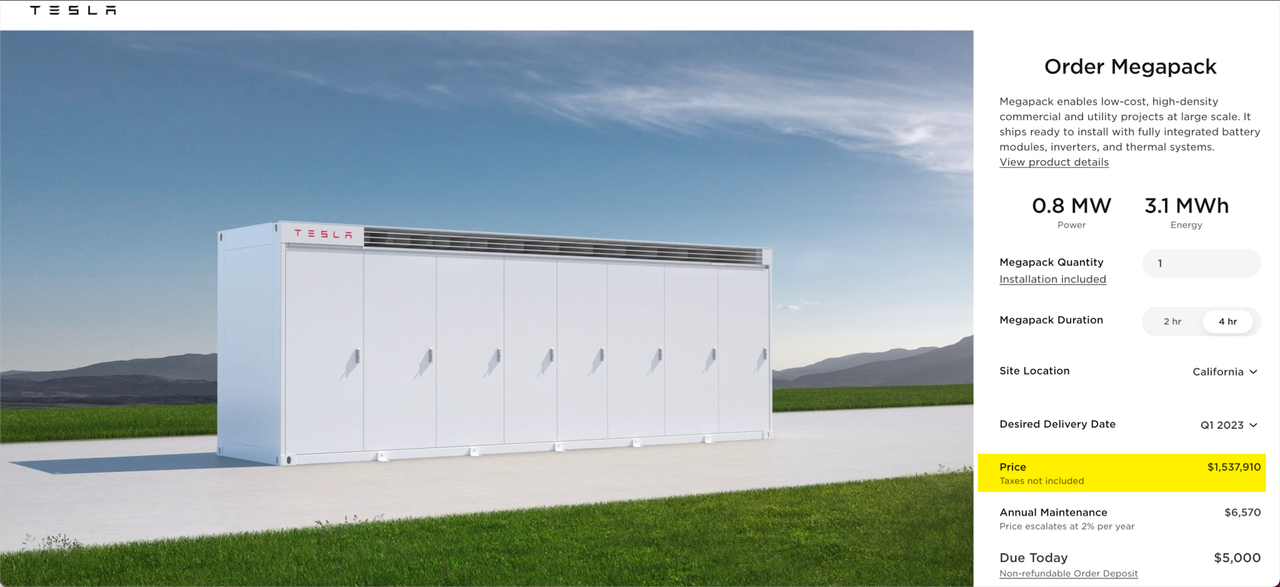
Neoen, in western Australia, has just turned on its 219 MW/ 877 MWh Tesla Megapack battery, the largest in western Australia.
Ultimately, it will be a 560 MW/2,240 MWh battery system, $1,100,000,000/2,240,000 kWh = $491/kWh, delivered as AC, late 2024 pricing. Smaller capacity systems will cost much more than $500/kWh
Example of Turnkey Cost of Large-Scale, Megapack Battery System, 2023 pricing
The system consists of 50 Megapack 2, rated 45.3 MW/181.9 MWh, 4-h energy delivery
Power = 50 Megapacks x 0.979 MW x 0.926, Tesla design factor = 45.3 MW
Energy = 50 Megapacks x 3.916 MWh x 0.929, Tesla design factor = 181.9 MWh
Estimate of supply by Tesla, $90 million, or $495/kWh. See URL
Estimate of supply by Others, $14.5 million, or $80/kWh
All-in, turnkey cost about $575/kWh; 2023 pricing
https://www.tesla.com/megapack/design
https://www.zerohedge.com/commodities/tesla-hikes-megapack-prices-commodity-inflation-soars
Annual Cost of Megapack Battery Systems; 2023 pricing
Assume a system rated 45.3 MW/181.9 MWh, and an all-in turnkey cost of $104.5 million, per Example 2
Amortize bank loan for 50% of $104.5 million at 6.5%/y for 15 years, $5.484 million/y
Pay Owner return of 50% of $104.5 million at 10%/y for 15 years, $6.765 million/y (10% due to high inflation)
Lifetime (Bank + Owner) payments 15 x (5.484 + 6.765) = $183.7 million
Assume battery daily usage for 15 years at 10%, and loss factor = 1/(0.9 *0.9)
Battery lifetime output = 15 y x 365 d/y x 181.9 MWh x 0.1, usage x 1000 kWh/MWh = 99,590,250 kWh to HV grid; 122,950,926 kWh from HV grid; 233,606,676 kWh loss
(Bank + Owner) payments, $183.7 million / 99,590,250 kWh = 184.5 c/kWh
Less 50% subsidies (ITC, depreciation in 5 years, deduction of interest on borrowed funds) is 92.3c/kWh
At 10% usage, (Bank + Owner) cost, 92.3 c/kWh
At 40% usage, (Bank + Owner) cost, 23.1 c/kWh
Excluded costs/kWh: 1) O&M; 2) system aging, 1.5%/y, 3) 19% HV grid-to-HV grid loss, 3) grid extension/reinforcement to connect battery systems, 5) downtime of parts of the system, 6) decommissioning in year 15, i.e., disassembly, reprocessing and storing at hazardous waste sites. The excluded costs add at least 15 c/kWh
COMMENTS ON CALCULATION
Almost all existing battery systems operate at less than 10%, per EIA annual reports i.e., new systems would operate at about 92.4 + 15 = 107.4 c/kWh. They are used to stabilize the grid, i.e., frequency control and counteracting up/down w/s outputs. If 40% throughput, 23.1 + 15 = 38.1 c/kWh.
A 4-h battery system costs 38.1 c/kWh of throughput, if operated at a duty factor of 40%.That is on top of the cost/kWh of the electricity taken from the HV grid to feed the batteries
Up to 40% could occur by absorbing midday solar peaks and discharging during late-afternoon/early-evening, which occur every day in California and other sunny states. The more solar systems, the greater the peaks.
See URL for Megapacks required for a one-day wind lull in New England
40% throughput is close to Tesla’s recommendation of 60% maximum throughput, i.e., not charging above 80% full and not discharging below 20% full, to achieve a 15-y life, with normal aging.
Tesla’s recommendation was not heeded by the Owners of the Hornsdale Power Reserve in Australia. They excessively charged/discharged the system. After a few years, they added Megapacks to offset rapid aging of the original system, and added more Megapacks to increase the rating of the expanded system.
http://www.windtaskforce.org/profiles/blogs/the-hornsdale-power-reserve-largest-battery-system-in-australia
Regarding any project, the bank and Owner have to be paid, no matter what. I amortized the bank loan and Owner’s investment
Divide total payments over 15 years by the throughput during 15 years, you get c/kWh, as shown.
There is about a 20% round-trip loss, from HV grid to 1) step-down transformer, 2) front-end power electronics, 3) into battery, 4) out of battery, 5) back-end power electronics, 6) step-up transformer, to HV grid, i.e., you draw about 50 units from the HV grid to deliver about 40 units to the HV grid, because of A-to-Z system losses. That gets worse with aging.
A lot of people do not like these c/kWh numbers, because they have been repeatedly told by self-serving folks, battery Nirvana is just around the corner.
NOTE: Aerial photos of large-scale battery systems with many Megapacks, show many items of equipment, other than the Tesla supply, such as step-down/step-up transformers, switchgear, connections to the grid, land, access roads, fencing, security, site lighting, i.e., the cost of the Tesla supply is only one part of the battery system cost at a site.
NOTE: Battery system turnkey capital costs and electricity storage costs likely will be much higher in 2023 and future years, than in 2021 and earlier years, due to: 1) increased inflation rates, 2) increased interest rates, 3) supply chain disruptions, which delay projects and increase costs, 4) increased energy prices, such as of oil, gas, coal, electricity, etc., 5) increased materials prices, such as of tungsten, cobalt, lithium, copper, manganese, etc., 6) increased labor rates.
FLOATING OFFSHORE WIND SYSTEMS IN THE IMPOVERISHED STATE OF MAINE
https://www.windtaskforce.org/profiles/blogs/floating-offshore-wind-systems-in-the-impoverished-state-of-maine
Despite the meager floating offshore MW in the world, pro-wind politicians, bureaucrats, etc., aided and abetted by the lapdog Main Media and “academia/think tanks”, in the impoverished State of Maine, continue to fantasize about building 3,000 MW of 850-ft-tall floating offshore wind turbines by 2040!!
Maine government bureaucrats, etc., in a world of their own climate-fighting fantasies, want to have about 3,000 MW of floating wind turbines by 2040; a most expensive, totally unrealistic goal, that would further impoverish the already-poor State of Maine for many decades.
Those bureaucrats, etc., would help fatten the lucrative, 20-y, tax-shelters of mostly out-of-state, multi-millionaire, wind-subsidy chasers, who likely have minimal regard for:
1) Impacts on the environment and the fishing and tourist industries of Maine, and
2) Already-overstressed, over-taxed, over-regulated Maine ratepayers and taxpayers, who are trying to make ends meet in a near-zero, real-growth economy.
Those fishery-destroying, 850-ft-tall floaters, with 24/7/365 strobe lights, visible 30 miles from any shore, would cost at least $7,500/ installed kW, or at least $22.5 billion, if built in 2023 (more after 2023)
NOTE: Norwegian floating offshore cost of $8,523/installed kW in Appendix 1
If Norwegian floating units were used in Maine, the production costs likely would be even higher, because:
Almost the entire supply of the Maine projects would be designed and made in Europe, then transported across the Atlantic Ocean, in European specialized ships, then unloaded at a new, $500-million Maine storage/pre-assembly/staging/barge-loading area, then barged to European specialized erection ships for erection of the floating turbines. The financing will be mostly by European pension funds paying pensions to retirees.
About 300 Maine people would have jobs during the erection phase
The other erection jobs would be by specialized European people, mostly on cranes and ships
About 200 Maine people would have long-term O&M jobs, using European spare parts, during the 20-y electricity production phase.
https://www.maine.gov/governor/mills/news/governor-mills-signs-bill-create-jobs-advance-clean-energy-and-fight-climate-change-through
The Maine woke bureaucrats are falling over each other to prove their “greenness”, offering $millions of this and that for free, but all their primping and preening efforts has resulted in no floating offshore bids from European companies
The Maine people have much greater burdens to look forward to for the next 20 years, courtesy of the Governor Mills incompetent, woke bureaucracy that has infested the state government
The Maine people need to finally wake up, and put an end to the climate scare-mongering, which aims to subjugate and further impoverish them, by voting the entire Democrat woke cabal out and replace it with rational Republicans in 2024
The present course leads to financial disaster for the impoverished State of Maine and its people.
The purposely-kept-ignorant Maine people do not deserve such maltreatment
Electricity Cost
Assume a $750 million, 100 MW project consists of foundations, wind turbines, cabling to shore, and installation at $7,500/kW.
Production 100 MW x 8766 h/y x 0.40, CF = 350,640,000 kWh/y
Amortize bank loan for $525 million, 70% of project, at 6.5%/y for 20 years, 13.396 c/kWh.
Owner return on $225 million, 30% of project, at 10%/y for 20 years, 7.431 c/kWh
Offshore O&M, about 30 miles out to sea, 8 c/kWh.
Supply chain, special ships, and ocean transport, 3 c/kWh
All other items, 4 c/kWh
Total cost 13.396 + 7.431 + 8 + 3 + 4 = 35.827 c/kWh
Less 50% subsidies (ITC, 5-y depreciation, interest deduction on borrowed funds) 17.913 c/kWh
Owner sells to utility at 17.913 c/kWh
NOTE: The above prices compare with the average New England wholesale price of about 5 c/kWh, during the 2009 – 2022 period, 13 years, courtesy of:
Gas-fueled CCGT plants, with low-cost, low-CO2, very-low particulate/kWh
Nuclear plants, with low-cost, near-zero CO2, zero particulate/kWh
Hydro plants, with low-cost, near-zero-CO2, zero particulate/kWh
Cabling to Shore Plus $Billions for Grid Expansion on Shore
A high voltage cable would be hanging from each unit, until it reaches bottom, say about 200 to 50
Coal and gas were not parallel systems. Coal ran continuously providing most of the base load and gas was complimentary, more responsive to changes in demand . It wasn’t a case of either/or as with unsustainables like wind/solar in the mix.
Two systems were maintained.
Two complimentary systems, whereas wind does not complement solar and vice versa, they operate independently and can both fail at the same time.
The reality is that regardless of source type all costs and some profit must be recovered through sales. Costs include capital and financing, operating, maintenance, insurance, outside services, taxes, and, of course fuel. The revenue is always based on the volume of product sold which in this case is Kilowatt-hours. With coal, nuclear, gas and large hydro production is in the 90%+ of capacity range (~8000 hrs/yr). With wind and solar the actual production is at best about 1/3 that of truly dispatchable sources (~2500 hrs/yr). Thus, even though the wind and sun are free, the price per KWh that must be charged has to be much higher to cover all the other costs and expenses. This difference could easily be far greater than fossil fuel costs. This is obviously the case as can be seem by the relative price of a KWh in markets with high vs low renewable penetration – E.g. $0.31 in California VS $0.13 in Florida.
“Prove my economically unsound idea doesn’t work”
Nope. Show me your solution is viable. You’re the one who advocates spending trillions. Don’t forget to show your work.
It actually isn’t my idea. But it’s happening.
You have been asked to present a business case for Wind and Solar several times, and you have failed.
Wind and solar are most definitely not free. They are also environmentally destructive in multiple ways.
“wind and sun are free”
What sort of joke is that?
If they were so “free” how come on my electricity bill they are clearly shown as an extra cost with a 20% subsidy…
You are clearly a clueless individual given to lying without expecting those lies to be called out!
You can’t work it out, Nick?
We can
I fear that Li’l Nickie’s eyes shine with the fervent light of ALL religious zealots! He can NOT be persuaded by arguments or facts to the contrary. Only the brutal reality of failing, once great states can wake him from his dark, Green nightmare; and even that may not be possible if his programming and mind infections are too strong! “I pity the fool!”- Mr. T
Nick appears to be shorthand for nitpicking.
Don’t you mean Nickpicking?
I allways ask me, what in Nicks childhood went wrong.
Maybe his parents should have tried to dissuade him from torturing small animals!
He was given a pinwheel rather than Lincoln logs to play with.
“they would be burning a whole lot more gas.”
So why is this a disaster?
They have had to pay for BOTH systems.. and are underutilising the Gas power plants.
WASTE on both fronts.
Just DUMB.. wouldn’t you agree. !!
The gas plants aren’t going to last forever, a lot of them are pushing 30 years old already, they’re not building any more, so when the current lot are gone, there won’t be any meaningful backup for intermittent energy sources.
“they’re not building any more …”
they are in Kansas !
Evergy building two now !
shh
But the government that did this will all be gone in 30 years, so wtf do they care?
And the net cost to consumers would be a whole lot less if we simply ceased investing in wind and solar and instead just let the private sector drill and produce more gas to meet demand. Or also let the private sector invest in more nuclear which is both clean and reliable base supply to the grid.
B*ll*cks, 10 days of this and mad Ed is planning on closing gas and replacing gas it with wind. How’s that going to work?
queue Sterling’s “no wind”, “uh, their factories” quote
So you don’t understand economics at all.
Nick, it is because wind and solar divert investment from reliable power sources, which we had a nasty reminder of in February 2021. Wind and solar do not provide much power in still air and freezing rain.
The gas-fired power stations burn gas all the time as they have to be ready as back-up.
Car drivers understand that driving at a constant speed burns less fuel than repeatedly slowing down and then accelerating.
The “disaster” is that with wind and solar in the mix, more gas is burnt but less electricity is consumed from its output, the cost of which ends up on my electricity bill.
Once again, NS has successfully incited a flame war.
We must endeavor to NOT feed the trolls.
Because having to back up weather-dependent electricity generation with a whole second system has to be paid for. This is massively expensive.
And so, all industry requiring electricity will tend to move away to places like China and India who do not give a fig about carbon emissions. Now, with Trump, the US is also about to stop self-destruction in submission to climate alarmism.
Germans and Britons and the whole European lot are right now being impoverished by Zero Carbon. It looks to get worse until the result is intolerable. Then sudden change will come, European style. It will not be pretty.
“they would be burning a whole lot more gas.”
You say this as if it is a bad thing
You seem to have an issue with reliable energy supplies
Solar PV anywhere is the least efficient of all existing generation technologies (Weissbach et al), in the UK with a load factor around 10% (Statista) it is pure insanity.
There is a marginal use case for it, in that wind and solar tend to be inversely correlated in the UK, with more wind in the winter, and more sun in the summer.
The biggest problem is this time of year, when we tend to get little wind, and little sun, such that we might be generating perhaps 5% of demand from renewables during the evening peak.
Whether we’d be better off (in CO2 terms) simply burning the coal needed to make the solar panels is another matter.
If you get 5% of your supply from renewables during a dunkelflaute, then you only need to build 20 times as much of them to make up the difference! Isn’t math fun? Wind and solar are free, so what is the big problem?
As they say, ‘nothing new under the Sun”. UK’s grid is getting more expensive and less reliable every day as more wind is added. It’s not complicated. Here’s a repost of a previous WUWT article:
The UN and the Biden Administration Want Net Zero for the U.S.—While China Opts for Energy Realism
Comments By Rupert Darwall
September 16, 2024
In capitalist economies, capital, just like labor and other inputs, is a real cost. Yet the metric commonly used to compare renewables and non-intermittent power stations, the Levelized Cost of Electricity, excludes the negative impact of adding more renewables on the capital efficiency of the whole system – one reason why claims about renewables being cost-competitive should be treated with a pinch of salt.
Having more renewables not only pushes up costs but also has the countervailing effect of degrading the value of the electricity they generate. Because renewables have no fuel input costs, on days when there’s lots of wind or sun, wholesale electricity prices trend towards zero. The way wholesale electricity markets work is that all generators supplying electricity into the grid at the same time get the same wholesale price. The effect of renewables on electricity prices is to kill new investment in conventional capacity.
For this reason, Britain’s decision to power past coal left the country dangerously ill-prepared when Vladimir Putin began to squeeze the price of natural gas ahead of his invasion of Ukraine in February 2022. That year, the average price paid by power stations for natural gas was more than five times higher than it had been two years earlier and 72 percent higher than the cost of coal, pitching Britain into its first energy crisis since the 1970s.
“wholesale electricity prices trend towards zero”
Sounds like a benefit for someone.
It’s at zero because nobody wants it!
Then why the worry about blackouts?
Nick, you are better than this.
Just tell me, its January 2030 a weekday evening 4pm in the UK. Temperature is about 5C, demand is about 55GW (up from 45GW today because of EVs and heat pumps). You have 90GW of wind installed and its producing under 5GW. It will be below 10GW for the next week. Solar is producing nothing from its 40GW. During the day it may get up to 2GW for a couple of hours, its basically not a player. Especially not when its dark, as it is at 4pm.
What are you going to do? Where is the missing 50GW going to come from? And if you get through tonight, which you won’t, how are you going to get through the next week?
And by the way, UK nuclear will have closed in 2027/8 so its not coming from there. And the gas plants are hitting end of life about the same time, with no plans to renew them. So where is the power coming from?
“with no plans to renew them”
If it really gets that bad, they will make plans.
I’m not at all sure they will (build out gas on the scale required). But if they really do, it wrecks your argument. Net Zero is out the window. You’re going to end up with a system which is around 50% gas supplied – a bit more or less depending how much wind you manage to build.
So there will be all this huge expense for transmission and offshore builds but little material impact on emissions.
I think you need to take a month off and rethink through most of what you think about energy planning for modern industrialized economies. You’re obviously running out of coherent arguments for the dream.
By ‘the dream’ I mean the idea that we can all move to EVs and heat pumps while at the same time moving to wind and solar and achieving net zero in power generation. Its just not going to happen. Even if it did, of course, it will have no material effect on global emissions, as long as China and India etc carry on as they are now.
Europe is seeing an example of why not right now – the massive high pressure calm. A bit early this year, but there will likely be another in January or February. When they happen after Ed has got rid of gas generation, there will be blackouts.
The attempt to realize the dream will result either in U-turns, or electoral wipeout. The one thing governments in democracies have to do is keep the lights on. You cannot do that and hit net zero. As people are waking up to – Germany, US, and you can see it coming to the UK too.
“Europe is seeing an example of now – the massive high pressure calm”
Yep you bet!
We have 2 weeks of thick fog and no wind.
The sun has scraped thru by 2pm to disappear again shortly afterwards.
The wind farms assembled nr Auxerre – ZILCH and the ones opposite flashing away on Jura between us and Mont Blanc – IDEM.
Ie. sweet nothing from both wind and solar 2 weeks, while by next week the temperature is going down to zero.
Without that NPP in Bugey, and without natural gas (Central heating, we have to fire up next week) we will freeze.
The house is already down to a cool 11-12C in the unheated rooms, so Nick Stokes can stuff his unreliables where the sun never shines!
“The Bingham Canyon copper mine in Utah is the oldest operating coal power plant in the United States. It has been running for 70 years and still uses its original equipment.”
Nick won’t understand what you are talking about because nearly all of Australia has high sunshine hours with only Melbourne of the major cities dropping below 4 hours a day in June
Dumbest comment of the day award winner.
“Then why the worry about blackouts?”
To Jockstrap,
We don’t, because we are prepped –
2 gensets, Batteries, independent gas, oil & wood heating with 12 mth fuel, 4 mth supply of food in freezers + tinned & dry food, & if the water goes off we have a well; loads of books & CDs (if we get bored we could always talk to each other).
BUT
most people are not prepped, if power fails their lives stop, no heating, lighting communication, transport; empty supermarkets ( in this just in time world, they tend to have only 36hrs of goods), even in a mild winter 1,000s will die.
In a compleat blackout, the cost to the economy will be 100s of £ billions, that’s the worry about blackouts.
Bad Nick-style question. In what universe do you live ?
Nick is just engaged in word games. He never does the math, but is always ready with a catchy quip. Unfortunately, catch quips don’t harvest crops or make the electric trains run, or keep people warm in their homes. They are nothing more than words.
You really are an ignorant shill , aren’t you Nick.
EVERYWHERE that wind and solar infect the grid PRICES RISE.
The benefit is to the subsidy scammers, no-one else.
Oh, and have you put in that application to have a wind farm installed on the hills around Moyhu?
Told the neighbours?
Or are you just a completely moronic hypocrite.
Both! Li’l Nickie claps like a seal when he sees billionaires getting richer off of Ruinable subsidy scams, especially when it pushes the poor into energy poverty!
Like ALL elitists he despises the common man!
You should know, prices go down when there is more electricity as needed, next step are negative prices and you can a) shut down production or b) give it away paying for it.
The producer gets his money in both cases.
What actually happens with overactive VRE is:
Public service note:
“nothing new under the Sun” is from Ecclesiastes
According to rabbinic tradition the book was written by King Solomon (reigned c. 970–931 BCE) in his old age, … latest possible date for its composition is 180 BCE.
Words older than windmills.
“renewable energy is a fair-weather friend”
.
No, it’s not even that. In July, average capacity factors for wind turbines are very substantially below the annual average, dropping below 10% for weeks at a time.
The real crunch for intermittent renewable energy is the summer months (the fair weather period, thus renewables are not fair weather friends) because this is the period when shortfalls in generation will have to be met from whatever energy storage system is in place, and there would be a constant drain on the energy storage system because there is rarely sufficient wind in summer to have surplus power to recharge the energy storage system.
At present, that energy storage system id gas/oil/coal. If they really want zero fossil fuels, then in future it will need to be a mix of nuclear, H2, batteries and pumped storage.
Oh yeah, weather patterns across Western Europe are very similar, there won’t often be surplus wind in one area available to make up for deficit in other areas.
Check out the EMHIRES dataset:
https://zenodo.org/records/8340501
EMHIRES Wind
The first version of EMHIRES dataset releases four different files about the wind power generation hourly time series during 30 years (1986-2015), taking into account the existing wind fleet at the end of 2015, for each country (onshore and offshore), bidding zone and by NUTS 1 and NUTS 2 region. The time series are given as capacity factors. The installed capacity used accounted for calculating the capacity factors are summarised in the annexes of the report.
https://setis.ec.europa.eu/emhires-dataset-part-i-wind-power-generation_en
It wasn’t just Tuesday’, it was more than a week. Only five gigawatts as I write.
To avoid anyone imagining NESO is an established energy specialist advisor organisation.
It was set up by this Labour administration as a support for Ed Miliband the Net Zero Minister. It is in fact simply Ed Miliband talking to himself he is the sole director of it. It is a fabrication of expertise comprising just Ed Miliband. He holds an arts degree in politics.
No doubt as with all these Quango organisations it will expand and become like the CCC (Climate Change Committee) a self proclaimed expert. Nothing is more ludicrous than government advisory bodies, that are set up by government to ensure they get the advise they desire.
NESO is just the latest example it won’t be the last though with Trump now taking over in Washington that may slow the Alarmists down for a while at least.
I don’t think NESO was set up by Mad Ed, it’s been around for many years, however one of the government’s first acts was to buy it and bring it into the public sector.
Much of the rest of your posts holds true, however it’s clear to me that the report is saying that NZ 2030 is impossible, while avoiding saying that directly for political reasons.
The longer NESO is in public ownership, the further it will drift from its true purpose of keeping the lights on.
To be fair NESO was set up by the UK Energy Act in 2023 by the previous Government. As Net Zero minister Miliband is sole director. But the organisation was previously the Electricity System Operator (ESO) and does have expertise in that area.
Better check your tenses there… Parasitic Leftists live to infest valuable institutions, hollow out the insides, and then proudly wear the skins.
There may be the name – but quite likely very little expertise under that cover.
Well Fintan Slye CEO of NESO was the former CEO of EirGrid in Ireland and NESO is chaired by the former EON CEO Paul Gribley.
Still no wind…
Over to Mr Stokes.
Now come on Strat, as I gaze out across the valley from my house here in Central England UK, I can see the stand of trembling Aspen finally trembling as they do, when wind speeds go above 2 MPH. The past four days they never moved and as Winter comes the Autumn leaves are becoming ever less. The lack of wind this week is not unique. The forecast for the next ten days is much the same with a couple of days when the wind will show up to provide some power output from our 30+GW fleet of white elephants, sorry, I mean our raptor chopping wind turbines, sorry about that.
The solar output this past four days has been equally unimpressive but it is November here at 52 deg. North, we should not expect much and we don’t.
As some wag at Guido Fawkes pointed out NESO stands for No Energy Sod Off.
No Energy Sod Off.
Government policy in 4 words
Now Ed, sod off
Its a religion I am afraid.
Climate catastrophe is not coming, and even if it were, wind and solar will not power a country, and even if they did, doing it will not lower emissions to make any difference. Because generation is a small part of emissions, and also because no-one outside the US, UK, Australia, maybe Germany, is doing it.
But nothing is going to stop them from demanding wind because climate. Its like the processions of flagellants in the middle ages. There was no catastrophe pending, and even were there, flagellating is not going to do anything to stop it.
But they keep on.
And like all religions it is based on a “belief system”; devoid of any factual basis.
Religious zealotry allows those with dark, sociopathic tendencies to wrap themselves in faux care and concern! GangGreen is a wolfpack wrapped in FF generated fleece!
“maybe Germany”
Is Germany investing in wind and solar?
NESO is a wholly owned company. The Owner is the Secretary of Energy Security, Ed Miliband. Watch this video to see the truth – https://youtu.be/9QzEUQYuy7o?si=6ceMd6uvRQ6z91dt
Even when wind and sun works 99% of the time you still need 100% back up for that 1%. Stupid and waste of money.
We have peak of 6GW/h, have 10GW solar installed and they want to double it to 20GW. You can not argue with those people. I don’t understand why taxpayers remain silent, it’s there money wasted.
It isn’t just that the whole scheme is a non-starter, this time the weather was mild. Blackouts in these conditions are deadly …
As a small child I lived through the terrible Winter of 1962-1963 in Britain. Even with ample supplies of coal the people suffered badly. Today, such a Winter would result in a national calamity with tens or even hundreds of thousands of deaths.
A brief thought on “system flexibility”, aka “demand flexibility”, aka power cuts.
The idea that we’re all supposed to be using heat pumps and BEVs is totally inconsistent with “demand flexibility”.
I cannot flex my heating, that is simply impossible (storage heaters maybe), BEVs only make sense if they can be charged in off-peak hours, but if that’s the case, then there’s no flexibility for anything else that could be flexed into off-peak (washing machines, dishwasher, storage heaters), so literally demand flexibility means that you can’t eat, can’t heat your house, can’t drive, probably can’t even post on here, unless the weather says so.
The left hand and right hand appear to have never met.
Second PSA re left and right hands:
Matthew 6:3, more 2000 year old words.
It wasn’t just the UK and Germany the Dunkelflaute covers all of Europe, North Africa and the Middle East
I think that the people that push and support this wind and solar crap should have smart meters installed and when there is no solar or wind power being generated their power is shut off
we’ll see how long they really support that when their wives bitching about being cold or too hot and not being able to cook food oh and no gas for them either
Anyone know what is the plural of the word Dunkelflaute ? Or is it already plural ?
In German it’s Dunkelflauten
Thanks, I thought it could be that, but then again it could’ve been a plural word already !
A dunkelflaute ‘dark doldrums’ or ‘dark wind lull’, plural dunkelflauten
Know your krautspeak!
However you spell it, it it still scheisse to ME!
If the direct translation is “dark doldrums”, that is plural already ? Doldrums is plural.
One of the few things I recall about German lessons is you have to learn the plural at the same time you learn the noun !
The Germans have a tough time of it. Male, Female and Neuter. I can’t say I enjoyed studying it at all.
Doldrum will do.
[this stuff got you banned previously. one warning]
The climate changers are in trouble with their looney energy prescriptions nowhere better demonstrated than in industrial powerhouse Germany facing the layoffs-
Germany’s government collapses into chaos as Chancellor sacks minister
The West has to decide whether it’s going to hand its industry over to coal fired China or not and Trump’s win is beginning to reverberate on that score as the deplorables/garbage have had enough of elites and their woke nonsense gaslighting them.
Yeah you don’t say with all those ‘cheaper’ renewables?
Regulator says “systemic change” needed to cut energy costs, embrace consumer renewables | RenewEconomy
Getting a bit expensive is it with the green windmills?
“Not always a great quality:” Leading wind developer may switch from western to Chinese turbines | RenewEconomy
But can we trust the coal fired spy turbines all of a sudden but you can get back to us on that-
(22) Australian CYBERSECURITY minister drives a CHINESE EV… | MGUY Australia – YouTube
The watermelons are between a rock and a hard place now.
The little people get squeezed first, though.
strat,
It looks more like the stomping boot of totalitarianism to me!
Maybe the gentle embrace of an anaconda, though!
You can just feel the lurv…
Kinda misses the point a bit.
To misquote David Mackay. DECC Chief Scientist till his untimely death…. in his final interview…. “If you can get through the winter on dispatchables, you don’t need renewables” (He was talking about nuclear, which is also zero CO2, but disliked because it solves the supposed problem without any easy money government guaranteed rackets for the monied elites and their politician cronies).
Renewables have never been anything except duplicative parasites on what works better and cheaper. Because the absolute and basic costed physics of low energy density intermittent sources do not allow it. These can’t be changed, so Renewables can never deliver their claimed benefits to those forced to pay for them. Only environmental blight and huge costs, from which the only beneficiaries are subsidy racketeers everyone is forced to pay by law.
Never, ever, an honest, science based policy. Always a knowing fraud. Legalised crime rackets run by an elected mafia. Created by evil people out of the UNelected UN for a wholly different reason to saving any planets, and certainly not to improve life for the people’s of the Western nations who raised the World out of feudal agrarian poverty using cheap plentiful enrgy. Rather the reverse.
I live in la-la-land and see many wind farms when I drive around the southwest USA, and most every time I pass a wind farm I see barely any of the fans turning, and I wonder just what amount of power is really being generated. Then in Santa Ana wind season, these windmills are feathered so the turbines don’t burn out from making too much power, again no useful electric generation on top of the fact PG&E and Edison shut the transmission lines to prevent wildfires when the lines topple.
The solution is simple. All of the European Union and European national politicians, bureaucrats and administrators have been caught red handed lying and cheating. Their punishment is to be reassigned to dismantle all existing solar and wind facilities. If some outfit wants to keep any of these systems they must buy them for what they cost to build. The money they pay will then be used to build new fossil fuel and nuclear generators. It absolutely will not go to any government, they have already screwed things up enough.
Here is mean wind power in the UK over the years for the months of Sept and Oct.
Not inspiring. Where is impact of the big build out of wind power we keep hearing about?
Everyone here has their respective heads bogged down in the detail.
In the absence of empirical evidence proving the case against CO2 (there isn’t any), then all that’s required is a sound, sensible Energy Policy that’s fair to all concerned, including the unreliables (ie wind & solar-PV’s).
An Energy Policy that is market driven & works from the consumers interests back, NOT from the energy industry’s interests forward.
A sensible Energy Policy that:
• Is technology agnostic (fears & favours none, including the unreliables);
• Removes anti-competitive subsidies favouring the unreliables – ie a level playing field;
• Requires industry to comply with clearly defined QOS (Quality of Service) standards of reliability & availability (i.e.; 99.98% reliability as per current AEMO specs in Australia);
• Invites industry to commit by way of auction (a day, week or a month in advance of the offered opportunity) to provide reliable 24/7, dispatchable base load power at their best competitive price(s);
• Imposes SUBSTANTIAL financial penalties upon power generators for failure to deliver in accord with mandatory QOS obligations (Force Majeure notwithstanding eg earth quakes, floods, bushfires, tornados etc);
• Requires a substantial bond to restore the environment (i.e.; recycle aged solar-PV’s & wind turbine blades etc as is already common place within the coal mining industry);
• Repeals any anti-competitive CO2 Legislation (i.e., in Australia; the Safeguard Mechanism, LRET, RET etc).
Thus, let market forces prevail on a level playing field.
Environmentalists & those so committed to electricity generated by way of the unreliables can readily invest in their perceived market opportunities, plus of course ‘firming’ (by way of batteries, Hydro whatever etc but at their cost) to meet mandatory QOS reliability obligations.
Whereas others might be more circumspect & elect to invest in traditional, reliable, base-load hydro-carbon (coal & gas) technology.
Longer term, investment also in nuclear power, assuming of course, (in Australia, the current legislative ban is repealed) nuclear is cost competitive V’s competing technologies.
If the power generating industry finds these sensible Energy Policy principles unpalatable, simply re-nationalize the industry & return it to whence it came (in Australia, the responsibility of respective State Govt’s) & be done with it.
Easy.
What happens is a lot more rubber boats come over from France.
Everyone here has their respective heads bogged down in the detail.
In the absence of empirical evidence proving the case against CO2 (there isn’t any), then all that’s required is a sound, sensible Energy Policy that’s fair to all concerned, including the unreliables (ie wind & solar-PV’s).
An Energy Policy that is market driven & works from the consumers interests back, NOT from the energy industry’s interests forward.
A sensible Energy Policy that:
• Is technology agnostic (fears & favours none, including the unreliables);
• Removes anti-competitive subsidies favouring the unreliables – ie a level playing field;
• Requires industry to comply with clearly defined QOS (Quality of Service) standards of reliability & availability (i.e.; 99.98% reliability as per current AEMO specs in Australia);
• Invites industry to commit by way of auction (a day, week or a month in advance of the offered opportunity) to provide reliable 24/7, dispatchable base load power at their best competitive price(s);
• Imposes SUBSTANTIAL financial penalties upon power generators for failure to deliver in accord with mandatory QOS obligations (Force Majeure notwithstanding eg earth quakes, floods, bushfires, tornados etc);
• Requires a substantial bond to restore the environment (i.e.; recycle aged solar-PV’s & wind turbine blades etc as is already common place within the coal mining industry);
• Repeals any anti-competitive CO2 Legislation (i.e., in Australia; the Safeguard Mechanism, LRET, RET etc).
Thus, let market forces prevail on a level playing field.
Environmentalists & those so committed to electricity generated by way of the unreliables can readily invest in their perceived market opportunities, plus of course ‘firming’ (by way of batteries, Hydro whatever etc but at their cost) to meet mandatory QOS reliability obligations.
Whereas others might be more circumspect & elect to invest in traditional, reliable, base-load hydro-carbon (coal & gas) technology.
Longer term, investment also in nuclear power, assuming of course, (in Australia, the current legislative ban is repealed) nuclear is cost competitive V’s competing technologies.
If the power generating industry finds these sensible Energy Policy principles unpalatable, simply re-nationalize the industry & return it to whence it came (in Australia, the responsibility of respective State Govt’s) & be done with it.
Easy. “story tip”
Everyone here has their respective heads bogged down in the detail.
In the absence of empirical evidence proving the case against CO2 (there isn’t any), then all that’s required is a sound, sensible Energy Policy that’s fair to all concerned, including the unreliables (ie wind & solar-PV’s).
An Energy Policy that is market driven & works from the consumers interests back, NOT from the energy industry’s interests forward.
A sensible Energy Policy that:
• Is technology agnostic (fears & favours none, including the unreliables);
• Removes anti-competitive subsidies favouring the unreliables – ie a level playing field;
• Requires industry to comply with clearly defined QOS (Quality of Service) standards of reliability & availability (i.e.; 99.98% reliability as per current AEMO specs in Australia);
• Invites industry to commit by way of auction (a day, week or a month in advance of the offered opportunity) to provide reliable 24/7, dispatchable base load power at their best competitive price(s);
• Imposes SUBSTANTIAL financial penalties upon power generators for failure to deliver in accord with mandatory QOS obligations (Force Majeure notwithstanding eg earth quakes, floods, bushfires, tornados etc);
• Requires a substantial bond to restore the environment (i.e.; recycle aged solar-PV’s & wind turbine blades etc as is already common place within the coal mining industry);
• Repeals any anti-competitive CO2 Legislation (i.e., in Australia; the Safeguard Mechanism, LRET, RET etc).
Thus, let market forces prevail on a level playing field.
Environmentalists & those so committed to electricity generated by way of the unreliables can readily invest in their perceived market opportunities, plus of course ‘firming’ (by way of batteries, Hydro whatever etc but at their cost) to meet mandatory QOS reliability obligations.
Whereas others might be more circumspect & elect to invest in traditional, reliable, base-load hydro-carbon (coal & gas) technology.
Longer term, investment also in nuclear power, assuming of course, (in Australia, the current legislative ban is repealed) nuclear is cost competitive V’s competing technologies.
If the power generating industry finds these sensible Energy Policy principles unpalatable, simply re-nationalize the industry & return it to whence it came (in Australia, the responsibility of respective State Govt’s) & be done with it.
Easy. “story tip”