By Anthony Watts and H. Sterling Burnett
An August 25th article in the New York Times (NYT), titled “What the Lobstermen of Maine Tell Us About the Election” claims “…as far as climate change goes, Maine’s lobster fishing community may well be America’s own canary in the coal mine,” implying that harm to Maine’s lobster fishing industry is an early indicator of the dangers from climate change. This is false. Multiple lines of data show that the Maine lobster industry is doing well. Amid a mild warming over the past century, record lobster hauls have been recorded in the last 10 years even as the number of licensed lobstermen has fallen significantly.
Climate Realism discussed the fortunes of the lobster fishery in the face of climate change previously in an October 2020 Climate Realism story.
“The Maine Department of Marine Resouces (DMR) reports that each of the 10 highest annual lobster catches occurred during the past 10 years,” reported the 2020 Climate Realism post. “Lobster catches in Maine are presently double what they were just 20 years ago.”
With two additional years of data, the story is still the same, recent years catches remain among the highest ever recorded.
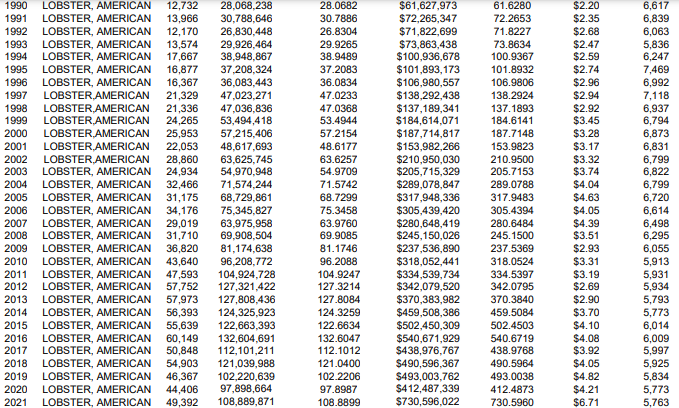
In fact, DMR data show that amid historically normal year to year variations in catch totals, over the past 34 year period of modest warming, Maine’s lobster catch has increased by approximately 288 percent since 1990, even as the number of licensed lobster fishers declined by almost 13 percent, largely due to stricter regulations raising the cost to operators. (See the table, below)
The NYT says in their article, “In part because of climate change, Ms. Guenther believes, the number of full-time lobster fishermen in Maine may decline by as much as one-half during the next decade.” If so that will likely be because of federal regulations limiting lobster operations ostensibly to protect endangered North Atlantic right whales even as the government promotes massive offshore wind complexes in lobster and whale habitat. Climate rules, not modestly warmer waters, are the biggest threat to the lobster industry.
A 2023 masonslobster.com article discussing the state of the industry, also directly refutes the NYT’s analysis:
Last year, Maine fishermen hauled ashore 124 million pounds of lobsters, six times more than what they’d caught in 1984. The $456 million in value those landings totaled was nearly 20% higher than any other year in history, in real terms. These days, around 85% of American lobster caught in the US is landed in Maine—more than ever before.
Even more remarkable than sheer volume, though, is that this sudden sixfold surge has no clear explanation. A rise in sea temperatures, which has sped up lobster growth and opened up new coastal habitats for baby lobsters, is one likely reason.
The National Oceanic and Atmospheric Administration (NOAA) has this to say about the state of Maine’s lobster fishery:
Maine’s economy has reaped the benefits of the lobsters’ move. In 2014, New England’s lobster industry was worth $564 million. Maine alone reported $459.6 million—81% of the total. The arrival of the lobster seems like a boon for Mainers, but the thing that pushed them north hasn’t gone away: warming ocean temperatures.
Clearly, warmer ocean temperatures, a common claim from climate change advocates, have, if anything, had the effect of increasing lobster hauls in Maine, rather than causing a significant decline. (see the graphic, below)
In 2021, the value of the Maine lobster catch skyrocketed:
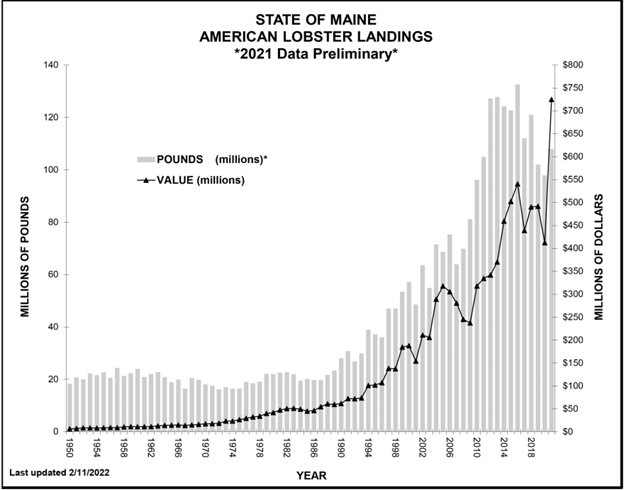
NewsCenter Maine recently cited DMR preliminary data for 2023 which suggests that the lobster haul fell in 2023 to 93,734,116 pounds of lobster, but that figure is in line with the historical interannual changes in the haul. It is still higher than every year prior 2010, even with a decline in licensed lobster fishers.
Despite the lower catch, the value of the lobster haul increased by $72 million from 2022 to 2023, reaching $461,371,720. This was due to a significant increase in the price paid to fishermen, from $3.97 per pound in 2022 to $4.95 per pound in 2023.
Rather than climate change, in fact, the NYT reports that invasive species are a likely reason for recent declines:
To begin, sea squirts are suddenly everywhere. Translucent, water-filled organisms known as tunicates and about the size of a golf ball, they can spread rapidly across the ocean floor, fouling oyster beds and leeching oxygen from the seawater. “After they die off,” Mr. Black said, “the bottom is dead.” Sea squirts were most likely imported in the bilge water of a foreign ship, and they can now thrive in the Gulf of Maine, whose water has warmed.
Sea squirts, brought in by a ship in bilgewater, have nothing to do with climate change.
Also, since climate change operates on long time scales, of 30 years or more, claims by the NYT of a climate connection to reducing catches in any single year are simply rank speculation with nothing to back it up. That’s probably why the NYT article was in the opinion section of the newspaper.
Contrary to the impression given by the NYT promoting the prescribed climate crisis narrative that climate change causes nearly every bad thing that happens, data show that Maine’s lobster fishery is doing well. It is profitable and the catch remains abundant. NYT’s story is shoddy journalism at best.
Getting the sign wrong is normal for climate reporting.
Climate Realism is doing the job that mythical journalists are supposed to: question claims, investigate, and report the whole story in context. The hacks at the New York Times and all leftist-dominated media aren’t journalists. They’re pea-brained, self-important activists chasing the dream of being the next Bob Woodward or Carl Bernstein and bringing down a Republican president or an Evil Corporation. Truth and context are hindrances to telling a compelling story that riles up the angry mob of like-minded pea brains.
The New York Times is a disgrace.
Maine may well be benefiting from its warming, but the lobster fishery in Long Island Sound has pretty much collapsed, part of a general shift to warmer species.
There is more to keep in mind than just warming. While https://portal.ct.gov/ceq/ar-20-gold/2020-ceq-annual-report-ebook/wildlife—lobster-and-fishes says that the decline is most likely due to warming, it does note several other factors:
https://longislandsoundstudy.net/ecosystem-target-indicators/lobster-abundance/ includes predation:
As for me, my daughter was visiting here in New Hampshire from Seattle. We predated on three of those Maine (or Massachusetts or Canadian) lobsters. Yum. Smaller than I’d like, but at $8.99/lb I’ll be having more.
“Maine may well be benefiting from its warming, but the lobster fishery in Long Island Sound has pretty much collapsed, part of a general shift to warmer species.”
Probably more due to pollution and past heavy fishing- not warming, IMHO.
“(See the table, below)”
The table doesn’t have column headers. The NYT article is paywalled. Some column I can guess, deduce, and maybe verify, but some numbers, e.g. the 5,763 at the bottom right are mysterious. What are the headers for that and the 49,392 near the start of that line?
Oh wait – the data isn’t from the NYT, but from maine.gov. I shoulda realized tonnes was one of them.
Looks like you have to click on my image to read it.
Wish there were headings for that first table with all the statistics from 1990 !!!
I clicked on it and still no headings!
Great article though ! Made me want to find some live lobsters here in Phoenix!
Just saw that someone asked the same thing! Headings??
A) Read my earlier comment and the .jpg I posted.
B) The main post has a link to https://www.maine.gov/dmr/sites/maine.gov.dmr/files/docs/lobster.table.pdf – It has data going back to 1880. Back when lobster sold for $0.02/lb. Those were the days.
“The arrival of the lobster seems like a boon for Mainers, but the thing that pushed them north hasn’t gone away: warming ocean temperatures.”
Have the lobsters been pushed north or have their breeding/(fishing) grounds been expanded? Have they disappeared from their usual habitats further south?
I read many years ago- can’t recall where- and this might not be true, but that in early colonial times, lobsters were extremely abundant and much, much larger. They were so abundant that they were given to prisoners in jails- and the prisoners objected to such “cheap” food.
References are easy to find, e.g.
Lobsters…lobsters everywhere…
When the Pilgrims arrived on these shores, the people who lived here used lobster meat as fertilizer and bait. Anyone could wade out into a bay or estuary, reach down, and snatch a large lobster weighing as much as 25 pounds. After a hard storm, lobsters might litter the shore in piles two feet tall.
The same was true in what’s now Canada. On visiting Newfoundland, the historian William Wood wrote of lobster: “Their plenty makes them little esteemed and seldom eaten.” Native Americans preferred other seafood, ideally bass. When they did eat lobster, they covered the carcasses with seaweed and baked them over hot rocks — perhaps the inspiration for the New England clambake.
Lobster was the food of last resort for the new settlers, more available even than bread. In 1622, Governor William Bradford of the Plymouth Plantation apologized to guests that the only dish he “could presente their friends with was a lobster…without bread or anything els but a cupp of fair water.”
This was not true worldwide. Back in England and Europe, the wealthy served lobster for elegant dinners. We can see in a record from the British diarist Samuel Pepys that in 1663, he served four lobsters at a dinner he hosted (along with fricassee of rabbit and chickens, carp, lamb, pigeons, and various pies).
I went to a fisheries meeting in Halifax in the mid 90s where there was a mostly ignored paper given about the “natural” shift that had taken place. Lobsters going up as your graph showed, others down. I went back in 1997 and spent a week in Nova Scotia. This happened before and was reported in the 1930s. There has been a long standing prejudice against commercial fishing and too much science ignoring the background which I posted about earlier from the late 1940s. There was a huge tilefish mortality in 1882 in the North Atlantic including lots of cod. [Collins, J. W. 1884. History of the tilefish. Report Commissioner U. S. Fish and Fisheries. 10(1882):237-292.]
Partly because of the complex there of opposing currents and topography and warming trends there has also been sparring since in the literature which I don’t know much about. One example from the 90s event —Myers, R. A. J. A. Hutchings and N. J. Barrowman. 1996. Hypotheses for the decline of cod in the North Atlantic. Marine Ecology Progress Series. 138:293-308. doi:10.3354/meps138293
Since there is absolutely no evidence or mechanism whatsoever where increased atmospheric CO2 can heat the worlds oceans, all speculation based on this false premise is dead on arrival.
You can repeat falsehoods over and over which demonstrates only that people are foolish in what propaganda they believe.
If dew point temperatures increase due to CO2 (and other factors that are generally ignored) then “dew” condensing on our cold New England oceans will release latent heat that will warm sea water.
If you ever see an Atlantic fog bank over the ocean, think about the physics involved.
BTW, if you’ve heard the phrase “fog eating snow,” I think that’s backward. It’s dew forming on snow (and developing fog) that releases the heat that eats the snow. I remember one humid March day when I walked by a retaining wall with a snow bank going uphill beyond the wall. Fog, formed by snow chilling the air, was flowing down the hill and over the wall.
I would have been happy to get Maine lobster for $3.67 per pound (as I read the numbers above) at one time, but I now follow a YouTube channel about Leon the lobster. A naturalist who raises all kinds of living things, both marine and terrestrial, decided he would use one of his spare salt water aquariums to see if he could keep a supermarket Maine lobster alive.
Well, he did it, and Leon the lobster has a big following. Leon clearly interacts with his keeper, and in one episode actually displayed an emotional response that startled me. He was given his favorite food (a clam) in his habitual feeding area, but in a plexiglas shot glass. The glass was too small for Leon to get his claw into, and he tried a number of ways to solve the problem, all unsuccessful. Finally, in frustration, he took the shot glass over to the wall of the aquarium (the first time you realize that he was aware of the walls), stood up against the wall as high as he could, and tried to throw the shot glass out. He didn’t quite make it, but it was a good effort. Then he stormed back to his feeding area, turned his back to the camera, and tucked his tail underneath him.
I won’t order Maine lobster anymore. Leon demonstrated too great an awareness for me to ever do that again. I commented on that to the channel’s creator, and he replied to the effect that “yeah, that freaked me out, too.”
But, hey, I don’t kill spiders in the house. I take them outside.
The Maine Reset is a great youtube channel for what’s going on in the lobster industryand it’s fight against Big Wind.
https://www.youtube.com/@TheMaineReset