By Robert Bradley Jr.
“Federal subsidies to support renewable energy formed nearly half of all federal energy-related support between fiscal years 2016 and 2022. Traditional fuels (coal, natural gas, oil and nuclear) received just 15 percent of all subsidies between FY 2016 and FY 2022, while renewables, conservation and end use received a whopping 85 percent.” (Mary Hutzler, below)
A fallacious argument in the energy/climate debate is that wind and solar are cheaper than fossil fuels in electric generation. It must be wrong because government subsidies are front-and-center for on-grid dilute, intermittent energies. And it is wrong if the federal accounting is examined (below).
Actually, the relatively small subsidies for oil, natural gas, and coal turn negative, dramatically, when the Biden Administration anti-fossil-fuel agenda is added, 225 actions worth.
Mary Hutzler of IER (and former acting head of the DOE’s Energy Information Agency) prepared this analysis less than a year ago for the Institute for Energy Research. “Renewable Energy Still Dominates Energy Subsidies in FY 2022” deserves amplification in the buildup for Fiscal Year 2023’s update. Hutzler’s August 9, 2023 post follows.
The Energy Information Administration (EIA), an independent agency of the U.S. Department of Energy, evaluated the amount of subsidies that the federal government provides energy producers for fiscal years 2016 through 2022, in its report Federal Financial Interventions and Subsidies in Energy, updating its previous subsidy reports.
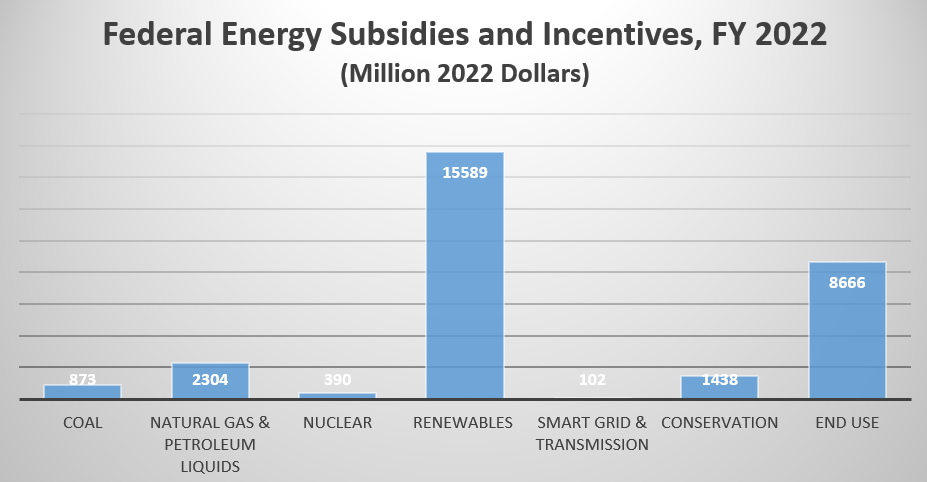
Federal subsidies to support renewable energy formed nearly half of all federal energy-related support between fiscal years 2016 and 2022. Traditional fuels (coal, natural gas, oil and nuclear) received just 15 percent of all subsidies between FY 2016 and FY 2022, while renewables, conservation, and end use received a whopping 85 percent.
Renewable subsidies more than doubled between FY 2016 and FY 2022, increasing to $15.6 billion in fiscal year 2022 from $7.4 billion in fiscal year 2016 (both in 2022 dollars). Federal subsidies and incentives to support renewable energy in fiscal year 2022 were almost 5 times higher than those for fossil energy, which totaled $3.2 billion in subsidies.
The subsidies in EIA’s report do not include state and local subsidies, mandates or incentives that in many cases are quite substantial, especially for renewable energy sources. EIA also did not include the massive subsidies authorized in the Inflation Reduction Act (IRA) since it was passed in August 2022. Goldman Sachs has estimated the costs of that bill at $1.2 trillion.
Source: Energy Information Administration
______
Fast Facts
- The Energy Information Administration found that subsidies for renewable energy more than doubled between FY 2016 and FY 2022, occurring before the Inflation Reduction Act (President Biden’s climate bill) became law in 2022 that increased renewable subsidies.
- Coal, oil, natural gas and nuclear received 15 percent of all subsidies in FY 2022, despite providing vastly larger amounts of energy than renewable energy—the largest subsidy recipient.
- End use subsidies that provide support for lower income Americans to help pay utility bills were the second largest subsidy category after renewable energy.
- Wind and solar combined represented 94 percent of the federal renewable electricity-related subsidies in FY 2022, while producing a combined 5.5 percent of primary energy.
______
Energy end-use subsidies (Low-Income Heating Assistance and other such programs) were the second highest category after renewable subsidies. Energy end-use subsidies increased from $7.9 billion in FY 2016 to $8.7 billion in FY 2022. The largest program of this category—the Low Income Home Energy Assistance Program (LIHEAP), administered through the U.S. Department of Health and Human Services (HHS)—slightly decreased its funding from $4.0 billion in FY 2016 to $3.9 billion in FY 2022, with a noteworthy one-year increase to nearly $10.0 billion in FY 2021.
In 2021, funding for the Low Income Home Energy Assistance Program, which assists with energy bills and other energy-related costs, saw a one-time doubling to nearly $10 billion, after Congress approved additional funding for the program under its COVID-19 relief plan that resulted in end use subsidies totaling $14.3 billion in FY 2021. The end use subsidy programs help people at the bottom of the economic ladder pay their rising utility bills, but do nothing to aid most taxpayers.
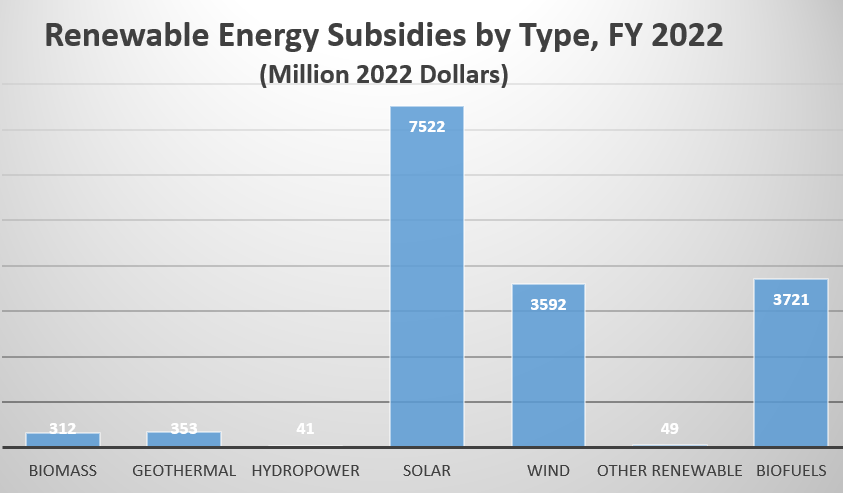
Most of the renewable subsidies were tax incentives, with solar applications making up the largest share of those subsidies. In FY 2022, solar subsidies totaling $7.5 billion overtook biofuel subsidies–the largest beneficiary of tax incentives in FY 2016, having total subsidies of $3.7 billion, with wind a close third at $3.6 billion in total FY 2022 subsidies.
These sources typically receive additional support at the state and local level, including credits in California for biofuels at $3.70 per gallon for its production rather than petroleum refining. Other benefits in some states include “net metering” for solar energy which requires utilities to purchase solar at a retail price rather than wholesale.
Source: Energy Information Administration
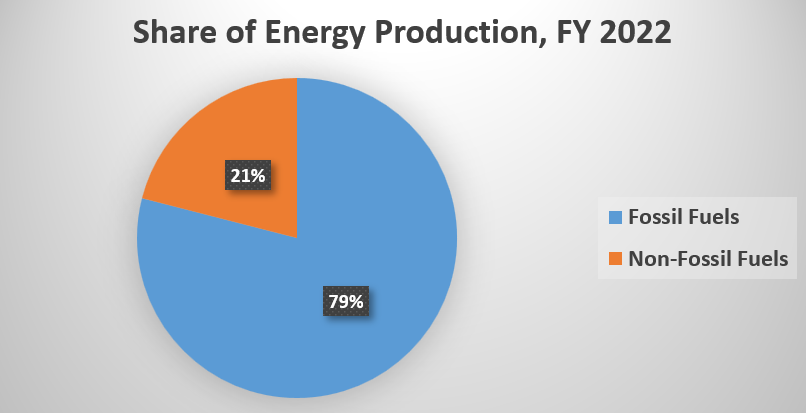
Despite renewable energy receiving over half the federal subsidies in FY 2022, EIA reports that fossil energy in the form of coal, oil, natural gas and natural gas plant liquids made up 79.1 percent of primary energy production in FY 2022. Nuclear power contributed 7.9 percent, followed by biomass at 5.1 percent, wind at 3.7 percent, hydroelectric at 2.3 percent, solar at 1.8 percent, and geothermal at 0.2 percent.
Source: Energy Information Administration
Federal Subsidy and Support for Renewable Energy
Renewable energy (including biofuels) comprised 53 percent of total energy subsidies in FY 2022–up from 41 percent in FY 2016. In FY 2022, tax expenditures accounted for 98 percent of total renewable energy subsidies. Biofuels represented 42 percent of total subsidies for renewable energy in FY 2022 while renewable energy used in electricity production represented the other 58 percent.
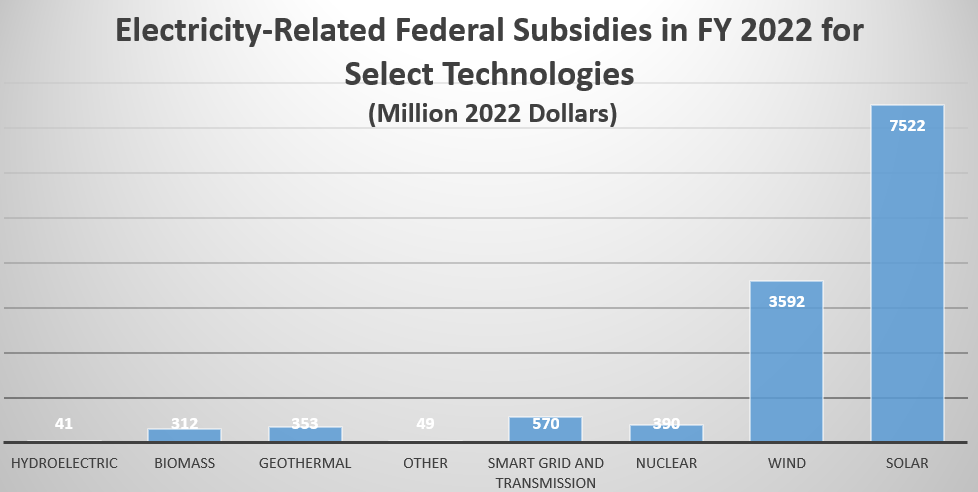
The largest electricity-related federal energy subsidies were for renewable energy since subsidies for wind and solar each exceeded subsidies for coal, natural gas and petroleum, and nuclear. Wind and solar combined represented 94 percent of the federal renewable electricity-related subsidies in FY 2022, while producing a combined 5.5 percent of primary energy.
Source: Energy Information Administration
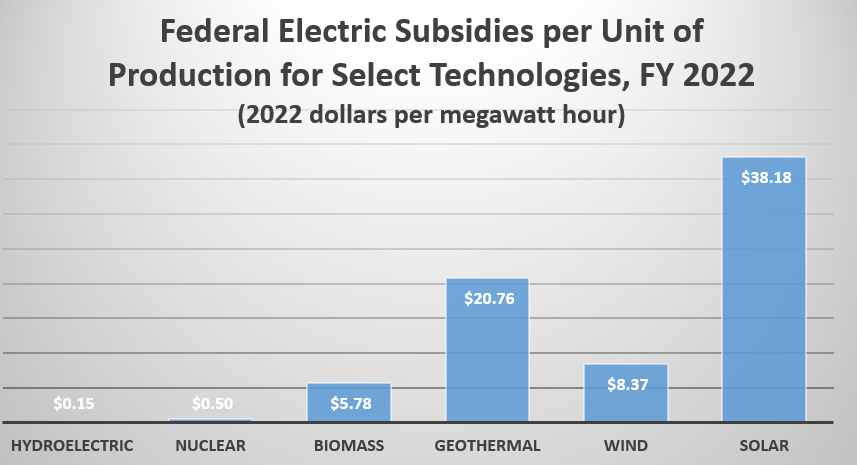
The Institute for Energy Research calculated the federal subsidies and support per unit of electricity production from the information provided in EIA’s report for renewable technologies and nuclear power for FY 2022. Because EIA did not break out the electricity-related subsidies for coal, natural gas and petroleum from their total subsidies, the subsidy per unit of energy produced could not be calculated for these sources of electricity. However, if one assumed that all of coal’s subsidies that EIA calculated were for electricity production in FY 2022, the subsidy cost per unit of production for coal would be $1.06 per megawatt hour.
The figure below provides the subsidy costs per unit of production for those technologies that EIA provided relevant data. On a per-dollar basis, government policies have led to solar generation being subsidized by over 76 times more than nuclear electricity production, and wind being subsidized almost 17 times more than nuclear power on a unit-of-production basis in FY 2022. Nuclear power is the largest source of carbon-free energy in the United States.
Source: Energy Information Administration
Conclusion
From FY 2016 to FY 2022, most federal subsidies were for renewable energy producers (primarily biofuels, wind, and solar), low-income households, and energy-efficiency improvements. From FY 2016 to FY 2022, nearly half (46 percent) of federal energy subsidies were associated with renewable energy, and 35 percent were associated with energy end uses. Federal support for renewable energy of all types more than doubled, from $7.4 billion in FY 2016 to $15.6 billion in FY 2022.
From FY 2016 to FY 2022, provisions in the tax code were the largest source of federal financial support. In FY 2016, the Internal Revenue Code (IRC)—with its 31 energy-specific tax provisions—provided greater financial support to energy than direct expenditures, including R&D expenditures. Total tax expenditures were 70 percent of the total federal financial support. Since FY 2016, tax expenditures have continued to grow, increasing to over 75 percent of total federal support in recent years.
On a total dollar basis and on a unit of production basis, solar energy had the highest federal electricity-related subsidies in FY 2022.
Unfortunately, many people still insist that renewable energy is cheaper than fossil fuels. If a lie is repeated enough times, no matter how outrageous it is, people will start to believe it.
but.. but.. the wind and the sun are free! /s
When you can get them….
So are blackouts.
(But they cost more than money.)
Except it costs a lot to get them onto the grid in any reliable fashion.
It’s 10AM and the sun has been up since 5:51AM. Its foggy and still outside and my solar panels are outputting ZERO kWhs.
That’s expensive as I have to pay $0.49 per kWh at all times for grid power except for 4PM to 9PM when I have to pay $0.59 per kWh.
So all that free solar is being blocked by water vapor which may or may not evaporate before sundown.
Well, if you exclude the construction costs, the transmission costs, the costs of building storage and the costs of having fossil-fuel back-up, it is cheaper.
Costs of renewables will only go up, they certainly won’t bring any bills down.
In case you haven’t noticed, the cost of everything will only go up, including added taxes, fees and additional charges that never existed before.
Or, you can also say that the value of everything remains the same and that the money is becoming worthless. It really amounts to the same either way.
In ‘Shorting the Grid,’ Meredith Angwin details several ways that solar and wind are subsidized. Among them are tax credits for construction and production offset operational costs for producers, price controls ensure that wind and pv electricity generators are compensated for watt-hours bid (but not necessarily produced), and systems of fees and licensing that creatte anticompetitive costs for ‘fossil’ fueled electricity production.
Another “big lie” is that this oligopolistic practice is called an open market.
O/T A masterclass in doublethink with Caroline Lucas
Caroline Lucas: Labour must pursue social justice while tackling climate crisis.
[Punchline] Outgoing Green MP calls for combined strategy to ensure net zero will not be done ‘on the backs of the poor’
That should be achievable, she added
the party must avoid mistakes that put costs on low-income families or that hurt people’s jobs
“The truth of it is that the policies that we need to get [greenhouse gas] emissions down are actually policies that will increase people’s wellbeing in any case,”
[Port Talbot etc] “Again and again there are concrete examples of where green policy is actually social justice policy, it’s one and the same thing.
Lucas warned that Labour was not putting enough money behind net zero to ensure that its ambition for a “just transition” to a green economy could be met.
https://www.theguardian.com/politics/article/2024/jun/29/caroline-lucas-labour-must-pursue-social-justice-while-tackling-climate-crisis
What Lucas meant was Labour was not putting enough “taxpayer’s” money behind net zero, which is destined to fail, anyway.
There’s going to be a whole lot of pain for absolutely no gain, whatsoever. That’s politics, everybody’s right… until they’re not.
For green leaning/ socialist people it is just a matter of wealth distribution. To make green energy cheap piles of public money have to be redirected from rich people to poor people and those in state jobs.
We seem to have an abundant amount of rich people just sitting there waiting for their money (taxes) to be taken, right?
Because we all know that the poor do not matter in any case, the middle classes must also be exempt from contributing because they DO matter. So, that’s the promise. Cheap abundant green energy net zero Utopia. The path to glory. Simple, innit?
What could possibly go wrong? No need to stretch your imagination..
“piles of public money have to be redirected from rich people to poor people “
Where is Robin Hoode? He’s busy raiding the poor to reward the nouveau riche. People like the odious David Tennant etc.
“we all know that the poor do not matter”
Some things never change. Although the poor do have a vote to be garnered once every five years – to help rearrange the deckchairs… and nothing more.
“piles of public money have to be redirected from rich people to poor people “
Where is Robin Hoode? He’s busy raiding the poor to reward the nouveau riche. People like the odious David Tennant etc.
“we all know that the poor do not matter”
Some things never change. Although the poor do have a vote to be garnered once every five years – to help rearrange the deckchairs… and nothing more.
And…why dont the Greens ask their donor friends to put up the money instead of financing lobby groups to make everybody else pay for it?
Of course it is the rich that are financing the activists who make the ridiculous claims.
I would like to see a list of the “subsidies” coal, oil and gas companies receive from the federal government.
Tax breaks are not subsidies. Tax breaks mean a company pays less money to the government in the form of taxes than it would without the tax break. A subsidy is when the government pays money to a company. Two completely different, opposite things.
Tax breaks are not subsidies.
Indeed, that should be patently obvious. An oil company pays handsomely for a licence to explore, then pays for that exploration and the eventual bringing of the resource to market, giving a government a new stream of revenue at no cost to that government. A win win, so to speak.
The only possible reply to this basic fact of life is to utterly warp and twist the meaning of words.
“The government has claimed Rishi Sunak’s new £1.9 billion tax break for fossil fuel companies is not technically a subsidy and so compatible with its climate plan.”
https://www.independent.co.uk/climate-change/news/rishi-sunak-oil-fossil-fuel-tax-break-b2106851.html
And even more disingenuously
“Global public subsidies for fossil fuels almost doubled to $700bn in 2021, analysis has shown, representing a “roadblock” to tackling the climate crisis.
…
“Fossil fuel subsidies are a roadblock to a more sustainable future”
https://www.theguardian.com/environment/2022/aug/31/fossil-fuel-subsidies-almost-doubled-in-2021-analysis-finds?_hsenc=p2ANqtz-_MnJUNH6CQji0bcD4eyW7Adq4gHJCGC6-EzZqYTaIC3FnZx4shWQ-UbWPTqDtbWTU2sE4z
Wordplay 101
‘Sustainable’, the magic word. Well, you might as well use it as a counterargument against Net Zero. Closer to reality anyway. Oops, sorry, i forgot, Climate Armageddon is just around the corner, panic mode required..
Strat:
Globally, the majority of government fossil fuel subsidies are to defray the energy costs to their citizens. Citizens would riot if they had to pay the real costs of energy [See Pakistan, or the 2019 gilets jaunes episode in France]
Recall that worldwide most FF industries are owned by the government. Public companies, like Shell, Exxon, Chevron, BP, etc only account for about 15% of total global production.
A lot of the left wing know nothings like to proclaim that depreciation is a subsidy. Nothing could be further from the truth.
When a company buys something like a ream of paper or a box of pens, it is presumed for tax purposes, that the paper and the pens will be used up during the year they were purchased. Therefore the company is allowed to decuct all of the cost of those purchases from its taxes in the year the purchase was made.
When a company buys something like a building or a vehicle, these are presumed to be long lived possessions. As a result, the company is required to deduct the cost of these purchases over the life of the product. How long this period is, is usually set by law.
As most people are aware, money now is worth more to people and companies than is money some time later. Obviously, these companies would love to be able to deduct 100% of the cost of purchase in the year of the purchase. They would have their money sooner, and could start doing something with that money. Having to wait 5, 10, 30 years in order to get their money back costs them money.
Rather than being a subsidy, being forced to depreciate the products, rather than straight forward deducting it, costs the company money.
As to depreciating the land where oil/gas/coal is found. Real estate generally is not deducted from expenses, because it is assumed that land doesn’t wear out. (Exceptions for things like erosion are beyond the scope of this discussion.) However when land that has oil/gas/coal under it, part of the value of that land is the oil/gas/coal. As the oil/gas/coal is extracted, the value of the land goes down. Allowing resource companies to deduct this drop in value is not a subsidy, nor is it any different from other types of depreciation. They all reflect the loss in value of an asset as it is used up.
If a special group get no taxes for something most every one else is taxed for, that tax break is a subsidy, like it or not.
If one is not engaged in a certain activity, like oil exploration, of course one cannot write it off. Name “something most everyone is taxed for”.
All companies are allowed to deduct normal business expenses. Are you going to argue that oil exploration is not a normal business expense for an oil company?
Let us just pretend a fantasy world where government provides various services necessary for societies to function in a reasonable way, services most people depend on. To provide those services requires money. Governments universally obtain that money with taxation and fees. Government can never get enough money this way, life is always hard for it.
Giving large tax credits to wind, solar, and related enterprises means these businesses end up with large positive financial balances that they could not possibly acquire in the course of any normal business activity. The taxes these sectors do not pay must be made up by the other business and by individuals of the society. To say these tax credits are not a subsidy is a strange, twisted mental operation.
I am in no way talking about deducting expenses incurred in the operation of a business.
The effect of the company’s bottom line is still the same. Either way, they spend less money.
For a company that gets a tax break, they do spend less of their money on taxes. That’s true.
For a company getting a subsidy, they don’t spend any of their money at all. Instead, they receive money from the government.
Do you see the difference?
One company gets no money from the government, instead they pay money to the government in the form of taxes. The other company does get money from the government/taxpayers. They pay nothing to the government.
The company’s bottom line is not relevant to this discussion.
If they do receive any taxpayers cash it will be to offset the damage that chucking taxpayers cash at windmills and solar AND insisting that their energy takes priority on the grid has done to the economics of operating the vital back up generation needed for when the wind doesn’t blow, the windmills freeze up and the sun doesn’t shine. It could even be that some of the money they get back was taken from them in carbon tax in the first place. In the UK and Germany, private investors are not interested in building vital new gas generation as government policy has rendered it uneconomic or giving a poorer return on investment than available elsewhere and so they will have to use taxpayers cash to solve a problem they created.
Wind and solar PV systems take more energy to produce and operate than they can deliver in their functional lifetimes. Prove me wrong, show me a single factory producing wind or solar systems solely with “renewable” power.
… I’ll wait…
All the cement that goes into the foundations for wind turbines takes a great deal of ff to produce. You have to cook limestone to make cement- and it takes a lot of energy to actually make the foundation- laced with rebar. Using big machines.
And when you “cook” limestone to the make Calcium Oxide to make cement, CO2 is released.
(Calcium Oxide is also used for many other things such as softening drinking water.)
Would a “Green Job” involve focusing the light from the Sun using a magnifying glass on a limestone to glean a speck of Calcium Oxide?
Does this report mean that it claims 15 of Federal subsidies were for FF and nuclear but doesn’t reveal what those subsidy amounts are or for what specifically they are? How about a breakdown of the billions and billions in large oil company subsides the activists always tell us about?
The claims of FF subsidies is widely claimed, and even more widely debunked.
There are no such subsidies.
The report claims 15% of some large sum for FF companies. Either that is a number plucked out of thin air or it is based on something. Green activists have ridiculous examples for some of their FF subsidy claims, such as payments to low income people in various parts of the company for winter heating and payments to bus companies that allow those companies to actually operate. Where does this report get its 15%?
Renewables for “ELECTRICITY” dominates the subsidies, BUT:
The Paradox – If the elite really cared about humanity, they wouldn’t ban fossil fuels to destroy our way of life.
Poorer nations need the same products enjoyed in wealthy countries that are based on fossil fuels to begin flourishing, concurrent with developed nations that only wish to live only on electricity from renewables!
https://www.americaoutloud.news/the-paradox-if-the-elite-really-cared-about-humanity-they-wouldnt-ban-fossil-fuels-to-destroy-our-way-of-life/
“Tax subsidies” are a peculiar class. Aside from the minor little feature that no government funds are paid out, there is the basic presumption that all income should go to the government. Largely, tax subsidies are accounting rules defining what income is taxable. Or what “income” is.
‘…there is the basic presumption that all income should go to the government.’
In other words, ‘from all according to ability, to all according to need’. Unfortunately for our budding socialists, even the most passive populations eventually resist confiscatory levels of personal taxation. This is why the preferred method of funding government expansion these days is to simply ‘print’ money via the banking sector’s purchase of government debt.
‘from all according to ability, to all according to need’.
Nice dream world Utopia.
The problem is there are people involved.
Many won’t contribute “according to their ability” but are more than willing to reap what others have “contributed”, willingly or taxes or by force.
They will reap according to their ability to reap.
(Whether they are “the poor” or “the rich” makes no difference. They will take whatever they are allowed or given the authority to take. Power, money, “free stuff.)
‘Many won’t contribute “according to their ability” but are more than willing to reap what others have “contributed”, willingly or taxes or by force.’
Yes, in real life there is an incentive problem with socialism, but the true believers insist that isn’t a problem. (I guess if they kill enough people they might have a point).
However, as noted first by Mises and later by Hayek, socialism can’t work because it lacks the basic information needed to perform economic calculation. In other words, no market prices means no way of knowing what to produce.
In the case of green energy companies, the rules that apply to the rest of society for what is income, what is taxable, are removed. If it is assumed that those rules, applied to most of society, are reasonable and just compensation for government services provide, they the special green energy exemptions are a subsidy.
Remove government mandates, tax preferences and subsidies and wind, solar and storage go away.
Bob:
Exactly! If renewable energy were truly cheaper, private enterprise would race in to make all that extra money that the alarmists insist is just lying around. DOH! Why didn’t l think of that? /s
It’s like ESG investing that the enviro fanatics insist is more lucrative than conventional investing.
Yet the first thing they had to do was to get rid of the fiduciary requirement that places the good of the investor ahead of all other issues. What a scam!