By Iddo Wernick
May 30, 2024
As a source of energy information for many global and U.S. policymakers, International Energy Agency (IEA) reports speak with great authority. In its report released in April, Batteries and Secure Energy Transitions, the agency charts out a path for massive growth in battery energy storage consistent with the goal of ‘Net Zero’ by 2050.
Batteries provide an essential lynchpin in plans to reduce global carbon dioxide emissions in the Net Zero vision. The dramatic global expansion of in-battery energy storage over the coming decades is deemed necessary to facilitate the growth of wind and solar power and electrified transportation, all essential elements in the ‘Energy Transition.’
The fact that batteries are critical to the energy system of the future is treated as a given. Data from the past decade showing rising investments and lower costs for batteries are commonly offered as proof of past market success and future market viability. Projections anticipate sharp and sustained increases in global battery energy storage capacity over the next decades. It is an open question whether transforming the global market for battery energy storage by 2050 will influence other parts of the energy system. Nonetheless, in line with the zeitgeist, the authors answer this question with confidence.
The starting point is 2050 and policies must work backwards from there. The argument assumes that rapidly eliminating the internal combustion engine will leave society with no choice but to use battery powered vehicles. Similarly, the unpredictable timing of sun and wind will force humanity to reckon with the need for batteries to compensate for the intermittent renewable energy resources of the future.
A little background: Despite the advances in battery technology and the decline in their costs, some scientific and engineering realities distinguish batteries from other forms of energy storage. Like fuels, batteries store their energy chemically. In practice, however, batteries store energy less efficiently than hydrocarbon fuels and release that energy far more slowly than fuels do during combustion. Absent major breakthroughs, the technologies for storing energy and providing power using electrochemical batteries require far more mass and volume than technologies that do the same using fuels. The energy density of a storage technology is defined by its ability to store energy in a given volume or with a given mass. It is relevant and more than ironic that the energy density of biomass fuels like straw and animal dung is twenty times greater than the today‘s best lithium-ion batteries, and gasoline has an energy density over 50 times greater.
In addition, the slower release of energy from batteries is evident in the long charging times of electric vehicles and the need for ultra-high voltages to speed up charging. The mass and volume of battery energy storage only expands when one includes the power conditioning equipment, such as inverters and transformers, and the transmission lines required to integrate distributed energy resources with these facilities and with the grid. These system features will profoundly affect the technical performance, and the economics, of battery energy storage in the future.
The report addresses the challenge of supplying the many critical minerals necessary for enormous increases in battery manufacturing, including a chart showing a projected five to 30 times increase in demand for the different battery metals by 2050. However, the authors hasten to characterize this, and other daunting challenges, as “obstacles” to be managed. As in an earlier 2021 IEA publication, The Role of Critical Minerals in Clean Energy Transitions, this report regards steep increases in demand for critical battery metals as inescapable and any difficulties arising from market pressures as manageable. With the complacent tone of bureaucrats that have reached consensus, the authors assume policy mandates and technical fixes will solve the complex problem of securing batteries minerals. They call for policy fixes to “create secure, sustainable supply chains” in order to meet the prospective growth in mineral demand. The prospect of raging geopolitical tensions and the immense scale of the necessary industrial build out are met with confidence-boosting adjectives.
Other potential drawbacks of a rapidly expanding global battery market get short shrift. The Chinese dominance in manufacturing batteries, and processing the minerals used to make them, is acknowledged but its implications left unexplored. Any mention of waste from batteries comes in connection with downstream wastes and the need for future recycling with little attention paid to the upstream wastes generated prior to battery manufacture. Passing mention of High-Pressure Acid Leaching avoids noting the recent massive implementation of this Chinese-financed, highly polluting, coal-powered process to manufacture battery-grade Nickel in Indonesia. There are no allusions to the other waste streams that would accompany enormous increases in battery manufacturing. The flammability of lithium-ion batteries, already a safety factor in aviation and maritime trade and in crowded urban areas, only merits mention in the context of new battery chemistries – Lithium Iron Phosphate (LFP) and Sodium-ion – that pose reduced fire risks are also far less energy dense.
In fact, the inherent bulkiness of battery energy storage quickly shows itself in real world applications. Using current technologies, half of the power produced by the battery pack of an electric vehicle goes to moving the batteries themselves, a basic problem for a mobile power source. Nonetheless, because battery costs play such a dominant role in the price of electric vehicles, manufacturers are turning to less expensive battery chemistries, like LFP, that exclude rare metals but have lower energy densities than current Lithium-ion batteries. For residential power grids, the volume of batteries needed to keep a city going for a full day is staggering. Consider the greater Seattle area. Powering the Seattle grid for 24 hours using batteries would require a cylinder over sixty meters in diameter at the height of the Space Needle (184 meters), filled with manufactured battery packs. Today, at the Kapolei Energy Storage outside Honolulu, over 6,000 tons of LFP batteries (enough to fill a pole one meter in diameter and the height of Mauna Loa (4170 meters)) can supply the electricity demanded by a sixth of the million residents of Oahu for three to six hours.
The report neglects options for incremental changes to the energy system that might reduce emissions more effectively and have greater potential for implementation. Consider the fact that increasing power production from natural gas and nuclear energy could reduce carbon emissions more effectively than building and maintaining the elaborate physical infrastructure necessary for solar and wind and batteries. Or the fact that hybrid electric vehicles require much smaller battery packs, leverage consumer familiarity, and may offer more promise for reducing aggregate vehicular emissions than do fully electric vehicles in the long run. Instead, the authors show a preference for algorithms that seamlessly manage real world residential and industrial energy systems. Enthusiasm pours out for “smart charging” to improve the efficiency of massive vehicle charging, “variable tariffs” to balance daily electricity demand, and “AI for innovation and sustainability.”
Climate ideology is now so pervasive that its assumptions are taken as global policy imperatives without reservation. The report ignores the sheer magnitude of industrial (and polluting) activity needed to support the market growth for battery technologies at the scale imagined, as well as the dis-economies of scale that result from the inherent limits of batteries as an energy storage technology. The lack of critical scrutiny is finally evident in the expectation that consumers and taxpayers will absorb the higher costs indefinitely through government subsidies.
In a world awash in international tensions and wars, modernizing the global energy system such that people everywhere have increasing access to affordable energy is vital to ensuring future peace and prosperity. Providing that energy abundance with the least amount of impact on nature requires confronting the realities of physics and chemistry. Massive increases in battery electric storage may be essential to an energy future imagined by resolute Net Zero technocrats. But closer scrutiny reveals serious defects in the technical basis for implementing batteries as a comprehensive solution. There are easier ways for humanity to avoid the problems that batteries are intended to solve.
Iddo Wernick is at the National Center for Energy Analytics.
This article was originally published by RealClearEnergy and made available via RealClearWire.
Electric car triggers half a million euro fire – Dramatic night for residents (blackout-news.de)
(use a translator, Google seems to work.)
Lots of link to other eFires.
eFire:: A fire from spontaneous EV battery combustion:: naming rights claimed unless already 😉
ICV fires on a per vehicle or per miles driven basis is several times that of EVs. Plus EV fires are slow acting, thus causing very few human injuries or fatalities amongst vehicle occupants, while combustion of gasoline is extremely rapid or even explosive, causing many injuries and fatalities amongst vehicle occupants.
You are utterly and completely wrong. https://www.youtube.com/watch?v=J_bZu1YN2CY
ICEs catch on fire after accidents
EVs can catch on fire while charging in a garage and sometimes at random, with no known fix.
Battery fires are more deadly than gasoline fires.
Remember that ICEs are an average of 12.5 years old while the average BEV is not that old and has been driven fewer miles.
Some ICVs do catch fire AFTER an accident but then it’s almost to be expected.
EVs catch fire for no apparent reason whether
Charging
Not Charging
Driving
Parked
Even while being shipped
ICV fires can be put out in minutes
EV fires take hours
EV fires can even restart hours to days later after being extinguished
ICVs are far more reliable even at 20 years old…and the capacity of their fuel tank doesn’t diminish over time
Lifetime miles of a gasoline vehicle is about 12.5 years x 12,500 miles/y = 156,250
Lifetime miles of an EV is about 8 years x 9,000 miles/y = 72,000 miles, at which point you need a new battery for at least $15,000 in an 8-y-old car, i.e., you have to be nuts to do that
Many comparative studies assume equal miles for gasoline and EV, which is totally bogus, and the eco-folks performing the studies know full well they are “stacking the deck”.
Go Woke, Go Broke: Ford Announces Mind-Boggling $100,000 Loss on Each EV Sold in 2024
https://www.windtaskforce.org/profiles/blogs/go-woke-go-broke-ford-announces-mind-bogglingly-100-000-losses-on
LEGISLATOR’s CHEVY BOLT CATCHES FIRE WHILE CHARGING ON DRIVEWAY IN VERMONT
https://www.windtaskforce.org/profiles/blogs/chevy-bolt-catches-fire-while-charging-on-driveway-in-vermont
BATTERY SYSTEM CAPITAL COSTS, OPERATING COSTS, ENERGY LOSSES, AND AGING
https://www.windtaskforce.org/profiles/blogs/battery-system-capital-costs-losses-and-aging
See part 2
All-in Turnkey Cost of Battery System to for a One-Day Wind Lull
At a future date:
Installed onshore/offshore wind systems would be 10,107 MW AC to provide 25% of NE grid load
Installed solar systems would be 23,766 MW DC to provide 25% of NE grid load
Wind annual average output would be 31,250,000 MWh/y x 1/8,766 h/y = 3,565 MW
Wind capacity factor 3565/10107 = 0.353
For analysis purposes:
1) Wind MW is assumed to become 0.15 x 3565 = 535 MW, during a one-day wind lull
.
2) Tesla recommends normal battery operation within 20% full to 80% full, to achieve a 15-y useful service life. We assume the batteries are at 70% full at start of wind/solar lull, and maximum drawdown is to an abnormal 10% full, for a 0.6 available capacity.
.
3) A more exact analysis would be on an hour-to-hour basis, instead of annual average basis
Required Megapacks: At least (3565 – 535) MW x 0.770 MW/Megapack x 1/0.6, available capacity x 1/0.926, Tesla design factor = 7,083 Tesla, 4-h Megapacks, arranged in parallel to obtain the desired MW
Each parallel train would have (10) 4-h Megapacks, arranged in series to obtain 10 x 4 x 0.6 = 24-h service
.
A total of 7083 x 10 = 70,830 Megapacks would offset a one-day wind lull
.
BTW, this assumes only batteries would offset the wind lull, i.e., no output from other power plants would be available.
Supplied by Tesla (7,083 x 10) Megapacks x $1.1 million each = $77.913 billion
.
Supply by Others $9,817 billion. See Part 1
.
All-in, turnkey cost about $77.913 b + $9.817 b = $87.729 billion, for a one-day wind lull
BATTERY SYSTEM CAPITAL COSTS, OPERATING COSTS, ENERGY LOSSES, AND AGING
https://www.windtaskforce.org/profiles/blogs/battery-system-capital-costs-losses-and-aging
Example of Turnkey Cost of Large-Scale, Megapack Battery System, 2023 pricing
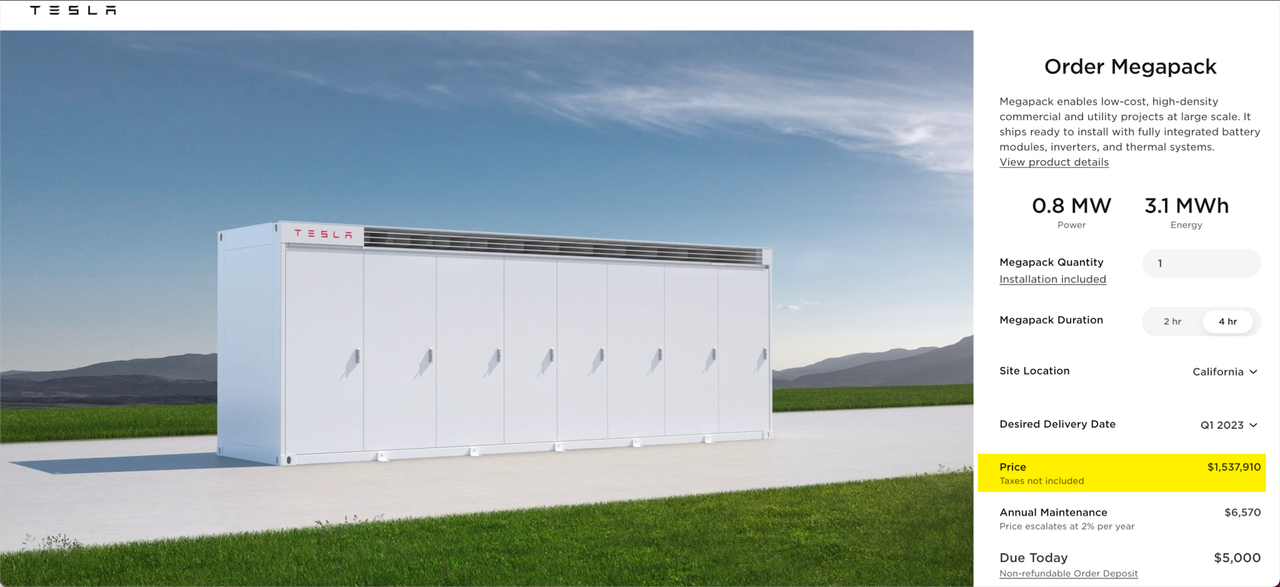 ?itok=lxTa2SlF
The system consists of 50 Megapack 2, rated 45.3 MW/181.9 MWh, 4-h energy delivery
Power = 50 Megapacks x 0.979 MW x 0.926, Tesla design factor = 45.3 MW
Energy = 50 Megapacks x 3.916 MWh x 0.929, Tesla design factor = 181.9 MWh
Estimate of supply by Tesla, $90 million, or $495/kWh. See URL
Estimate of supply by Others, $14.5 million, or $80/kWh
All-in, turnkey cost about $575/kWh; 2023 pricing
https://www.tesla.com/megapack/design
https://www.zerohedge.com/commodities/tesla-hikes-megapack-prices-commodity-inflation-soars
Annual Cost of Megapack Battery Systems; 2023 pricing
Assume a system rated 45.3 MW/181.9 MWh, and an all-in turnkey cost of $104.5 million, per Example 2
Amortize bank loan for 50% of $104.5 million at 6.5%/y for 15 years, $5.484 million/y
Pay Owner return of 50% of $104.5 million at 10%/y for 15 years, $6.765 million/y (10% due to high inflation)
Lifetime (Bank + Owner) payments 15 x (5.484 + 6.765) = $183.7 million
Assume battery daily usage for 15 years at 10%, and loss factor = 1/(0.9 *0.9)
Battery lifetime output = 15 y x 365 d/y x 181.9 MWh x 0.1, usage x 1000 kWh/MWh = 99,590,250 kWh to HV grid; 122,950,926 kWh from HV grid; 233,606,676 kWh loss
(Bank + Owner) payments, $183.7 million / 99,590,250 kWh = 184.5 c/kWh
Less 50% subsidies (ITC, depreciation in 5 years, deduction of interest on borrowed funds) is 92.3c/kWh
At 10% usage, (Bank + Owner) cost, 92.3 c/kWh
At 40% usage, (Bank + Owner) cost, 23.1 c/kWh
Excluded costs/kWh: 1) O&M; 2) system aging, 1.5%/y, 3) 19% HV grid-to-HV grid loss, 3) grid extension/reinforcement to connect battery systems, 5) downtime of parts of the system, 6) decommissioning in year 15, i.e., disassembly, reprocessing and storing at hazardous waste sites. The excluded costs add at least 15 c/kWh
COMMENTS ON CALCULATION
Almost all existing battery systems operate at less than 10%, per EIA annual reports i.e., new systems would operate at about 92.4 + 15 = 107.4 c/kWh. They are used to stabilize the grid, i.e., frequency control and counteracting up/down w/s outputs. If 40% throughput, 23.1 + 15 = 38.1 c/kWh.
A 4-h battery system costs 38.1 c/kWh of throughput, if operated at a duty factor of 40%.That is on top of the cost/kWh of the electricity taken from the HV grid to feed the batteries
Up to 40% could occur by absorbing midday solar peaks and discharging during late-afternoon/early-evening, which occur every day in California and other sunny states. The more solar systems, the greater the peaks.
See URL for Megapacks required for a one-day wind lull in New England
40% throughput is close to Tesla’s recommendation of 60% maximum throughput, i.e., not charging above 80% full and not discharging below 20% full, to achieve a 15-y life, with normal aging.
Tesla’s recommendation was not heeded by the Owners of the Hornsdale Power Reserve in Australia. They excessively charged/discharged the system. After a few years, they added Megapacks to offset rapid aging of the original system, and added more Megapacks to increase the rating of the expanded system.
http://www.windtaskforce.org/profiles/blogs/the-hornsdale-power-reserve-largest-battery-system-in-australia
Regarding any project, the bank and Owner have to be paid, no matter what. I amortized the bank loan and Owner’s investment
Divide total payments over 15 years by the throughput during 15 years, you get c/kWh, as shown.
There is about a 20% round-trip loss, from HV grid to 1) step-down transformer, 2) front-end power electronics, 3) into battery, 4) out of battery, 5) back-end power electronics, 6) step-up transformer, to HV grid, i.e., you draw about 50 units from the HV grid to deliver about 40 units to the HV grid, because of A-to-Z system losses. That gets worse with aging.
A lot of people do not like these c/kWh numbers, because they have been repeatedly told by self-serving folks, battery Nirvana is just around the corner.
re: “ICV fires on a per vehicle or per miles driven basis is several times that of EVs.”
.
The constant repetition of this bromide kind of indicates ‘you and a number of others do not understand what this statistic means, nor the conditions under which it may be operative’.
Has your claim been controlled for factors like socio-economic, age of vehicle, no non-factory options, class category?
I mean, comparing ICE vehicle fires including 20 year old customized off-road 4×4 in extreme conditions driven by some squirrely twenty-something year old to a leased big city lawyer’s EV garage ownership and dealer maintenance isn’t really a good comparison.
I don’t think that’s the right way to look at EV fires.
I don’t know if EV or ICE fires are more common, but what I would rather see, is look at energy of the impact and then determine what the chance or probability of fire of a fire is. I’d also like to see automotive standards that analyze where and how EVs are impacted and the likelihood an impact at those places on the car will result in a fire, such that there will be obvious best practices as a basis for where to place batteries in the car and what protection the battery need at that location. Suffice to say I’m agnostic if EVs pose extra fire risk during a vehicle accident.
But also, that’s not the fire problem EVs have. It’s not the EV that get into accidents and catch fire that has me worried the most. It’s the EVs that catch fire when there is no identifiable accident that is the bigger issue. Looking at vehicle fires per mile driven is fine and all, but EVs have a problem with driving zero miles and catching fire, and that issue is often not related to a motor vehicle accident at all. This is a critical failure and must be addressed before anyone can genuinely say EVs are inherently safe.
“This is a critical failure and must be addressed before anyone can genuinely say EVs are inherently safe.”
It can only be addressed at an additional cost, and only to certain extent. Fundamentally EVs can never be made inherently safe.
Completely false, but then you already know that.
EV fires are slow acting? Wow, just how delusional are you?
Duane obviously has no experience with car fires.
even explosive
You watch too many movies.
https://notrickszone.com/2024/06/02/half-of-german-e-car-buyers-regret-their-purchase-or-lease
Normal people just DON’T WANT THEM. !
Very nice. There is only one thing to consider here, the International Energy Agency. The IEA can go to hell. Nothing they say has any meaning. They are a bunch of international bureaucrats and administrators constantly interfering in our business. There is no climate crisis, CO2 is not the control knob for our climate, we are not going to reach a tipping point and suffer irreversible global warming. Wind and solar are not a substitute for fossil fuel and nuclear, build new fossil fuel and nuclear generators and remove wind and solar from the grid.
Life is a discovery process for EV lithium battery owners when nobody is in attendance and monitoring their fuel bowsers-
Leading EV charging network hampered by Telstra outage (msn.com)
I trust their bowsers aren’t running on 3G mobile now it’s being shut down for 4G and 5G?
Perhaps the only way unmanned EV bowsers will work in future is if they connect with bluetooth via the refueller’s phone and they bring their own copper cables to connect up? Oh and a wet towel for cooling it of course. LOL numpties.
“half of the power produced by the battery pack of an electric vehicle goes to moving the batteries themselves,”
Wrong
A 4000 lb. EV could have a 1000 lb. battery pack. It would take 1/4 of the energy to move the extra 1000lbs, not 1/2
And grid scale batteries do not have to move, so who cares?
The grid scale battery problems are price. lifespan and loss of capacity of perhaps 1% a year.
Could they last 20 years with up to a 20% loss of capacity like BEV batteries?
No one knows.
Will the batteries be charged to no more than 80% to 90% of maximum capacity to extend their lifespans?
Will the batteries always be 80% to 90% charged when they are needed?
How much will it cost to keep the batteries in a controlled temperature environment like a BEV battery case?
Why do Nut Zero Nutters think 4MWh of battery capacity is enough?
There’s little or no sunlight 12 hours a day and wind droughts for over four hours are quite common
There are wind droughts,
Solar droughts and
Compound wind and solar droughts.
“Energy Droughts” in Wind and Solar Can Last Nearly a Week, Research Shows | News Release | PNNL
That would be a lot more than four hours
And grid scale batteries do not have to move, so who cares
The climate changers sure should with burning up scarce lightweight lithium on stationary grid firming batteries but then they’re only for creaming off the top of punters’ power bills for piddling 2-4 hours max returns largely with FCAS.
Also wrong is stating that Li-ion batteries are inefficient – at least for time periods of a few days. OTOH, the environmental impact of producing the batteries needed to implement net-zero is likely to be much greater than relying on NG fueled combustion turbines. This doesn’t include the environmental impact of the “renewable” generation, where wind generation uses about 10x the materials per MW-hr as nuclear.
One tonne of lithium requires 2200 tonnes of fresh water, in the production process. The water is toxic waste.
Wind droughts can last a lot longer than a week. The Royal Society found that there are whole seasons that are calm. They went back 37 years. Surprisingly enough none of the renewable advocates seem to have thought to do this before now.
This, as well as the more common shorter low wind periods of a week or ten days, is why they estimated that to supply a country with peak demand of about 45GW would require about 100 TWh of storage. As they say, obviously impossible to do with batteries.
Quote from the report
“For this reason, some tens of TWhs of very long duration storage will be needed. For comparison the TWhs needed are 1000 times more than is currently provided by pumped hydro and far more than can be provided cost effectively by batteries”
However they later realised that they had underestimated the battery storage necessary because they had based their calculations on the UK’s electricity use in 2018 and used the same data 32 times (to 2050) without taking into account the much higher electricity use that will be required to electrify every thing.
Pretty sure batteries move all the time. Mostly from China, which is oceans away.
As with the global response to Covid the proposed solution is worse than the initial problem.
Thus do civilisations commit suicide.
“Lockdown” was at least arguably necessary, at least at certain times and particular circumstances.
Net-zero however, even if it were necessary, the policies being pursued simply do not work.
Nope, lockdown was an insane over-reaction to a bad cold virus. The damage inevitably caused has been massive, was predicted by many and never made the slightest sense to anyone with 10 functioning brain cells (it also revealed how few had them).
In the UK there were 40,000 in hospital with the virus during the peak of the second wave, how many more do you think the NHS could’ve absorbed?
This isn’t just about Covid, if every hospital bed is filled with Covid patients, what happens to all the traffic accidents, strokes, heart attacks, falls, etc? People who might live for another 50 years but only with the help of a functioning health system, if all the beds are filled with Covid patients they’re going to be left to die in the car park.
And just how many of those covid patients did not need to be admitted to hospital? Going to hospital or clinic triggered a covid test. Which were unreliable at best. In the US, every covid patient triggered a government subsidy.
There were existing broad-spectrum medications that were being used in quite a few developing countries to successfully treat the effects of COVID before the mRNA “vaccines” were rolled out.
IIRC groups of doctors from countries like Brazil, Africa and India were reporting very good results.
But strangely, these existing and available medications were proscribed for application to COVID symptoms in most Western countries (main supporters of the WHO).
The mRNA “wonder drugs” were deemed to be the only savior of humanity from the scourge of COVID.
But for many unfortunate souls, this policy became death by state fiat.
At the height of the pandemic, when everyone was avoiding the health system if they possibly could, likely very few.
If you want to argue about how reliable the tests were, then we’re into Bayes Theorem, short answer, more than reliable enough.
So in your opinion, hospitals were deliberately admitting patients who did not need to be admitted?
He is likely suggesting that hospitals admitted patients appropriately but then used a postive Covid-19 test as the reason for the hospitalization to garner more income [the government paid ~ 20% more for a covid admission] — even if the admitting diagnosis was not covid related.
Recall that a positive covid test does not tell you when you got infected, or whether you even have any symptoms.
As to lockdowns: they were expressly frowned upon in 2 consensus reports [Johns Hopkins & WHO] from 2019 [yes, prior to Covid-19 !].
Here is a link to the Hopkins report:
https://centerforhealthsecurity.org/sites/default/files/2023-02/190918-gmpbreport-respiratorypathogen.pdf
IIRC Hopkins also did a report in late 2022 on the effectivenes of lockdowns in the US and found they were mostly unhelpful [too many untoward consequences, that were actually predicted in their 2019 report].
That could have been the case, except for the fact that the total number of people being admitted was way up. Had they merely been admitting the same people as normal, but just reclassifying some of them as COVID admissions, the number of people being admitted wouldn’t have gone up.
This would be the “bad cold virus” that was causing hospitals to run out of beds?
Lockdowns were NEVER necessary. Period.
So there really weren’t 40,000 in hospital in the UK with the virus during the pandemic, or 100,000+ deaths, I must’ve just imagined that, good to know.
Most of those UK deaths we now know were caused by the wrong applicaftion of medical procedures, ie the use of end of life drugs on elderly patients and the overuse of incubation.
Plus as mentioned the ban on cheap old medicines by most of the western world that were proved to work from March 2020 onwards.
Add to that the policy of sending people home with nothing but paracetamol until they couldn’t breath and had pneumonia.
Do you have any kind of evidence to support your claims?
Richard Greene, as incompetent and pompous as ever, ignores the one sentence in the piece that negates all battery arguments completely –
“Consider the fact that increasing power production from natural gas and nuclear energy could reduce carbon emissions more effectively than building and maintaining the elaborate physical infrastructure necessary for solar and wind and batteries.”
Mr Greene is, as usual and in keeping with all the stupid people the piece makes reference to, blind to the bleeding obvious.
What is so difficult for people like him to understand that we have an environmentally friendly and assured solution which we know works efficiently and well and will not wreck the environment, the planet and/or bankrupt us as wind and solar will do?
You might not have noticed, while busy character attacking me, that batteries would only be needed because the Climate Howlers reject 100% natural gas backup for wind and solar.
And nuclear power is much more talk than action.
Natural gas and nuclear are not wanted by most Climate Howlers. Nuclear is not wanted by many investors because of the risk of losing money.
If it was not obvious to you that I am not in favor of batteries, then I will type slowly now so even you will understand: Nut Zero is not necessary — it’s a complete waste of money. In fact, Nut Zero is not even a real engineering project. It is a trojan horse political strategy intended to implement leftist fascism.
Wind and solar are absolutely not necessary… they are in fact a massive burden on electricity supply systems..
…. so batteries are totally unnecessary.
Coal, Gas, Nuclear.. and hydro as a niche where viable.
CO2 produced is small compared to natural CO2 flux, and absolutely beneficial to all life on the carbon-based planet of ours.
Fascism is always leftist. But I think you mean the German form of leftism what was not Fascism but Nazism.
Commie nazis at it again. Come on, at least learn a bit of history or political science.
Lusername can’t get anything right.
All you gotta do is abbreviate ZERO as “Z” and the picture is complete
Nut-Zero
Nut-Z
It’s Net-Zero, so it would be Net-Z
It’s Nut Zero because those that think its ever possible are NUTZ
The NSDAP, Fascism, and Marxist-Leninism are all flavors of socialism. Not everyone accepts the Stalinist definition of socialism.
I guess thats the american definition of communism – everything we don’t like.
As usual, LuserName prefers to stick with ignorant platitudes, rather than risk the dangers of reality.
Which two political ideologies share this common modus operandi –
“the state controls the means of production”
?
(Crony capitalism is a grifters or rent-seekers version of socialism / fascism when they know the citizens vehemently reject official socialism / fascism)
Even with your short incomplete quote you don’t get a common modus between fascism and communism.
The major difference is what type of BS is used to explain the system. In fascism, the fasci, local workers committees control the means of production. In Stalinism, “the people” control the means of production. Real world, minus the BS, the Party, a small oligarchy, controls everything in both systems. It is a matter of labeling for central planning.
https://www.britannica.com/question/Where-did-the-word-fascism-come-from
Non responsive to the question. Are you going to deny that the local worker’s committees were called fasci, or are you trying to deny the well documented fact that they controlled production.
Fascism, communism and socialism are 3 peas in the same pod.
All are various degrees of a top-down totalitarian system.
And note that you can get to be fascist both from the Left or Right.
Read Jonah Golberg’s “Liberal Fascism” — it is a history of the Italian fascist movement as an off-shoot of the Italian communist party.
https://www.amazon.com/Liberal-Fascism-American-Mussolini-Politics/dp/0767917189/ref=sr_1_2?crid=11PV5WBWJU7GS&dib=eyJ2IjoiMSJ9.e2MZYuloCJoF_P1I68N3JYUcFbw92ZQV3-G2nrnnVfIssTnq0U39BHCBr8cZYSVYyt9x_VpNYJ9YnTJrJ2vMMelGNtc-ORvJzsfVvj14ySO5NnaAYN6BRWrvAlqgtSOLdTSbmhl4TxYortHGJRBWJhWj4aQ-aqu0pX1ry8HQpccgpLQ1S8Dca19ofkjxvS9kQC1FJZdfyxiPnv6R8S2HLUCRp9dhYO21oOeXZxPh96M.Vvr1q__TpD7xadSKCl20OrsBAKtXfQMuwv_zXBWiY4s&dib_tag=se&keywords=jonah+goldberg+books&qid=1717478836&sprefix=Jonah+g%2Caps%2C251&sr=8-2
Government control of the economy is pure leftism.
That fascism is a form of socialism is realty.
That Nazis were fascists is also reality.
What is it about reality that makes it so offensive to you?
Because Luser knows that all those terms apply directly to itself.
Remember “Nazism” comes from “Nationalist Socialism” (or the corresponding German words).
Hitler was Leftwing, a socialist, who added nationalism to broaden his party’s appeal.
Nationalism can be rightwing or leftwing (Eg, Communist China’a Mao was clearly a nationalist).
It is fraud to label the Nazis rightwing. Same for Italy’s “fascists”. Mussolini was a leader of Italy’s Communist Party before splintering off to start his Fascist party.
https://www.britannica.com/story/were-the-nazis-socialists
You still fall for his propaganda.
This day and age it’s easy to spot the fascists, ANTIFA fights FOR them
Britannica is wrong. Communism and fascism are two sides of the same socialist coin.
The difference is, under communism the govetnment owns everything de jure, and under fascism the government owns everything de facto.
There are basically three phases to communism
Fascism: govt CONTROLS business and capital
Socialism: govt OWNS business and capital
Communism: The people (supposedly) own business and capital collectively.
There are all different combinations possible during transition periods.
Your de jure and de facto are pretty good descriptors.
“Communism: The people (supposedly) own business and capital collectively.”
But the “selected special few” make all the rules…
… a sort of “party” dictatorship.
Some are more “equal” than others.
Every aspect of their economic program was pure socialism.
That those on the left are desperate to pretend that Nazi’s weren’t socialists, has been well known for decades.
Solar output is largely predictable on a daily and seasonal basis, so can be backed up by CCGT. More correctly, it can augment CCGT.
Wind largely can’t be, so requires OCGT or reciprocating engine backup.
OCGT has around half the fuel efficiency of CCGT.
I believe I am not alone in wishing you would refrain from utilizing name-calling and insults in your replies/critiques…not necessary and undermines credibility of your content.
At my age, any attention from a lass is appreciated, whether positive or negative.
She may be cold today, but she might be hot tamale (lame weather lass joke).
You’re on the internet. It is not a safe assumption anyone is ever a lass.
You are obviously not familiar with Greene’s posts. This was much less abrasive that most of his.
Look forward to bnice posts. Although sadly they are not really creative 🙁
I see I now have “vacant occupation” between your ears.
You write something to 90% of my posts. Of course I need to mention my greatest fan 😀
Luser always need correcting… always wrong.
But I am in its mind even when I don’t comment.
Enjoy ! 🙂
That bnice has already responded to your posts, means that others don’t have to.
Battery technology is over 150 years old – but we are still promised the big break through when a battery the size of a peanut will be able to power London or New York for a whole year.
Create a problem; fix it with a theoretical solution not possible in practice. Net Zero in a nutshell.
I think batteries hit ‘Moore’s Law’ limit 150 years ago.
I agree with the author that battery technology is not where it needs to be to support full electrification of our transportation system on Earth per the “net zero” objective.. But he makes several overstatements that are not fair or “apples to apples” comparisons that are typical of EV critics.
Take the old “energy density” argument. True, the chemical energy density per unit mass of fossil fuels is many times higher than that of most storage batteries. However, that fails to account for the fact that only about 25% of the stored chemical energy in ICVs actually contributes to motive power at the wheels, whereas about 95-98% of the chemical energy stored in electric batteries translates directly to motive power at the wheels. The difference is combustion, which wastes about 75% of the energy to heat the environment around the vehicle instead of driving the wheels.
It is even moreso on a motive power to volume basis, since solid metal batteries are much denser than gasoline or diesel fuel
Regarding the author’s concerns about recharge time, typical high rate vehicle chargers can do a “fill up” (75-80% charge) on a typical auto battery in about 15-20 minutes. That’s longer than a typical gas or diesel fill up, but not that much longer. And that only applies to charging while on the road, rather than doing it at home where one simply plugs in the vehicle when they get home to get fully charged within a few hours – no great inconvenience at all for 95% of all driving situations. ICV drivers, of course, cannot fill their tanks at home.
As to the author’s statement that half the energy of a EV is used hauling around its battery is also exaggerated. The most popular EV on the road today is the Tesla Model 3. It’s battery weighs a little over 1,000 pounds, which is 1/4 the vehicle’s empty curb weight (not 1/2), and of course this constitutes a much smaller proportion of the loaded weight of a vehicle carrying passengers, baggage, etc. But the author implies that ICV engines are, what, weightless? The weight of the power train (engine, transaxle/transmission, differential, drive shafts, and u-joints is not nothing. In fact on average the drive train of the typical ICV vehicle is about 550 pounds. The electric motors, typically one or two, are relatively lightweight, on the order of 50-60 ponds.
Plus, a EV’s fuel weight is the battery itself. While the typical weight of a ICV fuel system (tank plus fuel) for a full tank is about 160 additional pounds. Thus bringing the total drive system plus fuel system weight for an ICV to about 710 pounds. With the curb weight of a typical passenger sedan (like a Toyota Camry) averaging about 3,400 pounds, the drive train weight as a proportion of total curb weight is 21% vs. 25% for the equivalent similar EV. That is a negligible difference.
The “bottom line” in energy efficiency on an apples to apples basis is that average EPA fuel mileage for today’s ICV sedans is about 30 miles per gallon, while typical EVs are rated on “gallon of gas equivalent” (i.e., measuring energy input vs. miles driven) that takes into account the curb weights of the vehicles, is approx. 130+ GGE. EVs are simply way more efficient than ICVs no matter how you may cherry pick favorable or unfavorable performance data.
The bottom line is the bottom line.
The author also brings up the old criticisms that EVs use a lot of minerals like lithium. As if motor vehicles did not use any such minerals that in turn impose environmental impacts. Not the least of which is the production, transport, and refining of crude oil, and the transport, storage, and distribution of finished fuels. Plus of course all the minerals required to produce the steel, aluminum, copper, plus electronics-related minerals. Not to mention the inevitable air pollution produced at the end of the tailpipe which remains a significant pollution source.
To be honest, you have to do a “net calculation” between options, and not pretend that only side of the comparison generates impacts.
Overstatement does not do any good for the net zero skeptics, of which I am one.
“And that only applies to charging while on the road, rather than doing it at home where one simply plugs in the vehicle when they get home to get fully charged within a few hours – no great inconvenience at all for 95% of all driving situations.”
In a modern large urban area, what percent of the population will have a residential situation where charging at home is possible?
See:
Agreed.
the Left claims to hate “suburban sprawl”. Yet, it is the only model they know when talking about EV’s.
As LuserName admits, the real goal is the elimination of personal transportation altogether.
Don’t forget that the battery can’t be charged at all if the temperature of the battery drops below 0C.
I count 25+ units there.
Imagine 25 EV’s being charged in an enclosed garage around the back somewhere. 😉
And what about the bus company that wants to garage its EV fleet underneath an apartment block!
The claim that most EVs can merely plug in at home and be fully charged in a few hours, is only true if they have spent the hundreds to thousands of dollars necessary to have a high powered charger installed. Those who have to rely on regular 120VAC need to wait a lot longer.
It also assumes that only one or two of your neighbors are also fast charging their cars at the same time. Otherwise there isn’t enough power available for everybody.
95% of the energy in batteries makes it to the wheels?
Not even close to being right. More like 70 to 75%.
Real cars get closer to 30 to 35% efficiency from their fuel.
When it comes to cars, is there anything you know that is actually correct?
Source for the numbers?
Let’s not forget that when it gets cold, the battery has to take some of the power from the battery to keep it warm. Otherwise the output from the battery drops to a trickle.
You’re at least 40 years out of date there.
Duane neglects to mention that the weight of the gasoline on board goes down over time. The battery stays the same weight forever. Unless it catches fire, then it gets lighter quickly.
A cigarette lighter:-)
Duane neglects to mention that the weight of the gasoline on board goes down over time. The battery stays the same weight forever. Unless it catches fire, then it gets lighter quickly.
That depends on the drive train.
The efficiency seems in the right range for the electric motors, so would apply to direct drive to the wheels.
Shaft drive through a differential is around 75% efficient, manual gearboxes are around 90 to 95% efficient. CVT is similar, but older automatic transmissions have greater losses.
The same applies no matter what is powering the drive train, but 95% to the wheels is a stretch in most cases.
95% won’t even get the energy out of the battery, much less get it all the way to the wheels.
I was giving him the benefit of the doubt, but, yeah, it looks to be much lower than that.
https://teslamotorsclub.com/tmc/attachments/motorcurve-gif.75172/
https://batteryuniversity.com/article/bu-808c-coulombic-and-energy-efficiency-with-the-battery
Haven’t you just overstated? “all the minerals required to produce the steel, aluminum, copper, plus electronics-related minerals”. Don’t EVs use those materials? They require more copper than an ICV. Additionally other minerals such as cobalt and nickel.
What about the 2200 tonnes of fresh water used to produce a tonne of lithium? Considering where it’s mined, in poorer countries, that fresh water is a very valuable commodity.
But, the real issue is being swept under the carpet. Where is all the electricity coming from to charge them? Especially when thinking about rapid charging.
A car can refuel in 5 minutes, at least 3 – 4 times faster than an EV. That short refuelling time, is why we don’t normally see queues forming at petrol stations.
I have a 3.5T motorhome, it has a 20 gallon tank. I can fuel up in 5 minutes, and under the right conditions get close to 700 miles.
There’s a guy on YT, his channel is called MacMaster. He’s just done a trip from Spain to the UK, in his EV. I admire his fortitude, if I’d been doing that journey, I’d’ve set fire to the b*gger and got the train home.
Among the many problems with BEVs – if even a significant fraction of US ICVs convert to BEVs, there will be a massive charging problem. The sheer time required to charge a battery, even if it is only for people driving longer distances, is going to require multiples of battery charging stations over and above existing refueling i.e. gas stations.
Fully refilling an ICV = 5 or 10 minutes to yield a driving distance of 400+ miles. Fully refueling a single BEV requires 6 hours or more; the scam used by the BEV “fast chargers” is that they only refuel up to 60%. Try it sometime when returning a rental car.
There are so many other scams: let’s say you live in a relatively high density city like I do. I did not have a parking spot for 17 years – so where would I charge a BEV at home? Furthermore, as my personal experience with renting BEVs amply demonstrates: the charging capacity in my city even with a couple dozen charging stations is less than a single gas station, plus the cost of charging is far, far higher. Why? Because the *actual* cost of electricity charged by said stations is multiples that of even the very high residential electricity prices charged, PLUS the fast charging stations all charge parking on top of that. The net cost of electricity for BEVs is actually about the same as refilling with gasoline – even with the outrageous gasoline prices in my state/city.
I am not against superior technology – but BEVs today are NOT superior to ICVs in any way except subsidy harvesting – and that includes pollution.
I-squared R is a killer:
They lose energy being charged.
They lose energy being discharged.
They also lose energy while idle.
Temperature is another killer.
Transporting your own mass while not contributing to momentum is another a great idea.
I have seen one estimate that AI alone will require 50% more electric power by 2030 – never mind EV requirements. China has recently discovered a new oil reserve – over a billion barrels….they will need it because solar/wind is not the future.
China gets almost no electricity from oil. Sinopec said last year they hit peak gasoline demand. So all they’ll do is use oil for the remaining years of the ice phase out, and for everything else oil demand will be much lower.
Although a billion barrel is a drop in the ocean anyways.
China is massively increasing coal-based energy. Chinese EV’s will be charged up using coal energy. Not really Green,huh?
Almost nobody gets much electricity from oil. Countries that care for their future use nuclear/coal/natural gas.
Sinopec says many things, all of which are politically correct, few of which are accurate.
South Australia fires up a fleet of diesel powered generators when the wind stops blowing, the sun goes to bed, and they can’t beg or borrow a cup of electricity from their neighbors.
But apparently in “wokeland”, diesel isn’t oil.
China energy sources.
China gets basically nothing from wind and solar.
Solar Passes 100% of Power Demand in California!
https://cleantechnica.com/2024/06/02/solar-passes-100-of-power-demand-in-california/
A lot about storage in there too.
Soon, solar will provide 150% of California power demand.
Yes, and California will soon become a net energy exporter. I can hardly wait for utopia to arrive. What a shame it didn’t happen in the 60’s when I was young.
“for part of the day ” << electricity from solar, wind, and water
I don’t think this means we can shut Path 65 down!
In the UK we regularly get articles, often in the Grauniad, claiming wind provided a new record percentage of total electricity generation. The percentage is always stated but never the fact that it was for a half hour period only.
Yeah just like the “hottest day ever” days –
by 0.002 C for 3 minutes somewhere next to an airport tarmac.
Not to mention the fact that the actual temperature sensor is only accurate to about 0.1 C.
It’s not just the resolution of the sensor but how that reading is recorded. Is it recorded officially in the tenths digit or in just the units digit? In the NWS ASOS system, temps are recorded in Fahrenheit rounded to the nearest degree. That is then converted to Celsius with the last significant digit in the tenths place. So you already have significant measurement uncertainty in just the way the official temperature is recorded!
Something else they don’t reveal Dave. When it hits a magical level, such as 40%, UK demand is very low, and that 40% very likely represents about 8GW, about a third of installed capacity. The bulk of the rest is coming from good ole nuclear and interconnects.
And once again, our favorite troll demonstrates that it knows nothing about how averages work.
Being able to meet 100% demand, for a few minutes, once, says nothing about what solar is actually capable of.
As to storage, why don’t you find a source that actually knows what they are talking about rather than relying solely on propaganda sites?
“For 55 days in a row, electricity from solar, wind, and water (hydro) power exceeded 100% of power demand on California’s main grid for part of the day.”
Just what I want, electricity for PART of the day.
Batteries are better suited for pairing with nuclear than with wind or solar. The energy source is concentrated in one place and there is a consistent supply of charging.
Pumped hydro is mostly used for this.
At least when they produce electricity
https://yle.fi/a/74-20091975
Er, have you spoken to Malcolm Turnbull lately about his Snowy 2.0 pumped hydro fiasco?
Results don’t matter. All that matters is what gets claimed in the latest press release.
Pumped hydro is tapped out. There are few places left in the world where it is possible.
And your buddies on the far left are trying to get many of the existing sites shut down.
Just like all the “low hanging fruit” sites for wind farms are mostly accounted for.
New sites need bigger and bigger blades to make them viable.
As these “farms” get bigger and necessarily closer together, they start interfering with each other. As a result the total amount of energy each individual turbine is capable of producing, goes down.
“At least when they produce electricity”
Mostly they just SUCK electricity. !
They will always use significantly more electricity than they produce.
The thing is, if you have the nuclear, what do you need the batteries for?
Many politicians act as if something like Moore’s Law applies to batteries. Not knowing or caring about the very real differences between batteries and microchips leads to sillyass proposals. Electronics are electronics, right?
The same politicians who talk about increased battery power are also opposed to mining.
Funny as they are also the same people who claim future generations will pay off the increasing debt they’ve accumulated.
re: “The Many Problems With Batteries”.
.
First, it should be stated (for the un-initiated in these matters) that batteries are NOT a primary energy source.
.
Coal, oil, ‘natural gases’ (incl methane, propane etc), nuclear, hydro, wind, solar (and one day Hydrino) are primary sources of energy.
.
Batteries are a chemical form of storage packaged such that it (the battery) allows portability of direct current (and AC upon use of an inverter, etc) supply of electricity (a supply of electrons ‘propelled’ by an EMF) in an end-user application.
And Coal, oil, ‘natural gases’, nuclear, hydro don’t NEED battery backup.
Stick with them and the grid scale battery problem is solved.
They still need backup powerplants, usually gas. Gas was also the transition backup until we have batteries.
In the UK over 22m homes (of the 28m) are on the gas network – that is not a “transition backup”
Actually, they don’t. Why don’t you try actually learning something about a subject, for once.
Most power plants are run at something like 85 to 90% capacity. This is done because mechanical devices last a lot longer if you don’t run them at the redline, all the time.
Your average fossil fuel/nuclear plant runs at better than 90% uptime, with almost all of the downtime being for regularly scheduled maintenance. The downtimes scheduled for a period when demand is normally low.
On the very, very, very rare occasion when a fossil fuel/nuclear plant needs to shut down unexpectedly, the other plants in the system increase their output a little bit closer to 100%, in order to make up the difference.
BTW, we will never have “batteries”.
The reason for that has to do with the short life of batteries, 20 years at best.
You simply can’t build batteries fast enough to both replace the ones wearing out and increase over all capacity.
When Australia was running on all COAL… there was no need for “back-up” plants.
When Germany was running all COAL and NUCLEAR… there was no need for back-up plants
Michael Dombroski: “Batteries are better suited for pairing with nuclear than with wind or solar. The energy source is concentrated in one place and there is a consistent supply of charging.”
Most light water reactors can ramp from 50% power output to 100% output in the space of two hours. However, the oncoming SMRs are designed to be more efficient at this task.
Suppose we need 900 Mw nameplate of true load-following capacity using ‘mostly’ nuclear power, and that we need to be able to ramp up from 0 Mw to 900 mw in the space of six hours. Do we need batteries to do this?
Option #1: Three GE-Hitachi BWRX-300 (300 Mw) SMR reactors, each paired with a single 50 Mw gas turbine unit, per GE-Hitachi specifications.
Option #2: Twelve NuScale VOYGR (77 Mw) SMR modules (six modules each in two reactor buildings), plus one 150 Mw gas turbine unit.
For the BWRX-300 option, the pairing of a gas turbine with each reactor allows for black start of the reactor and makes the transition to load-following mode easier.
A NuScale VOYGR 77 Mw SMR module doesn’t need an auxilliary gas turbine for black start, but pairing the NuScale reactor complex as a whole with a single 150 Mw gas turbine would simplify the process of quickly ramping up from 0 Mw output.
Canada is now funding full development of the BWRX-300 SMR design. That SMR design will be manufactured in Ontario and is now the one most likely to be the first to go live on the North American continent in the late 2020’s or the very early 2030’s.
However, we hear rumors that NuScale has backing from an AI customer to power one of their new data centers to be located here in the US. NuScale is tight-lipped about the details. The NuScale SMR module would be manufactured in South Korea.
IMHO, here in the year 2024, the NuScale design is technically closer to production than is the BWRX-300 design. Start-up of South Korean manufacture of the NuScale design could go forward in 2025 IF enough money could be found to build that very first batch of NuScale SMR modules.
In any case, a lack of sufficient energy to power the AI data centers is certain to throttle the greatly over-hyped AI revolution.
Nice SMR Fanfiction, as they will never see the real world. But at least they can scam some daydreamers.
Well, some rabid CAGW governments are certainly banking on SMRs coming to their rescue –
excerpted from the Canadian Defence Force’s NORAD Modernization Plan –
Quite replying to LuserName with facts. It makes him feel bad. You don’t want to be charged with abuse of the mentally disabled?
SMRs have a far better future than wind and solar,
Much of the current wind infection is getting to the “needs renewing” stage..
And it only takes one bad weather event to totally destroy an industrial solar installation.
So says the guy who still believes that government mandates is proof of consumer acceptance.
While ICE fires do happen the fuel does not spontaneously combust. An ignition source is needed and that is almost always electrical.
The vast majority of car fires start as electrical and stay that way until the flames reach the gas tank.
Last time I checked, EVs have more electrical wiring than ICEVs do.
I’ve reached one simple conclusion about batteries:
Batteries suck!
It doesn’t matter if it’s the batteries in my computer, UPS, watch, laptop, tablet, phone, car, cameras, flash guns, handvac, flashlights, kid’s toys, TV and associated remote controls, GPS, power tools, voltmeter, alarm system, bathroom and kitchen scales, or all the ones I’ve forgotten. They all suck.
I am supremely confident the grid scale batteries will suck too!
Most people believe batteries will solve the intermittency of power collected from solar and wind farms. “Batteries” is the common answer when confronted with the question of what happens when the sun doesn’t shine and the wind doesn’t blow. People have no clue about what it would take to accomplish a battery powered society and like AGW the MSM does nothing to inform them. The question is how much damage will occur before they realize batteries isn’t the answer.
The more I read about storing energy in batteries the more I realize that storing energy in gasoline or diesel really is “Supercalifragilisticexpialidocious.”
Frankly, what I want by 2050 is a nuclear-powered car with a minimum nameplate of 1,000 HP. Just in case.
Government wants me to have 100kWh battery EV instead of ICE car. 100kWh is enough to run my house for week. If it would be feasible to have 100kWh battery in each car (similar number to houses) it would be feasible to have 100kWh battery in each household. Such battery would bring practically 100% independency from grid and electrical self sufficiency.
Batteries do NOT generate electricity, so where are you getting it from to charge the batteries.
I have solar panels on my house. 4kWp, 12panels 24m2, during winter they are producing around 30% of my consumption, but during summer I don’t know what to do with electricity, I have hot tub which I can heat all sunny days half year, I have all my air conditioning for free.
Currently I have 5kWh battery only and with it I’m able to cover 70% of my yearly electricity consumption.
With 100kWh battery and 15kWp of panels I would be practically 100% self sufficient.
My yearly energy consumption is around 4.8MWh. 3,3MWh I’m getting from solar.
System is working third year, so I know already what to expect and what not. So far it returned 25% of its value.
Doubt.
My gains. Columns with light blue and dark blue means battery was full and I was not using all available solar energy.
My average daily consumption is around 11kWh.
Those columns reflect also my usage of hot tub. So daily consumption is between 15 – 21kWh.
This is ample 4kW solar system.
There is also visible total gain in around 1.5 year, 3870kWh.
My grand total is 7300kWh, e.g. 7.3MWh. In 2.5 year.
For those 7300kWh my battery did 500 cycles. What means 2500kWh.
So for 3kWh from solar I need 1kWh through battery.
Battery should be fine for 4000 cycles and 15 years.