Kirby Schlaht,
From Andy May (2024): “Roger Pielke Jr. posted this plot (below) of the 3-year frequency of global major hurricanes (he uses a simple count of them) created by Ryan Maue (@RyanMaue). Dr. Maue also posted this plot on his twitter. Looks like an inverse sunspot plot and overlaid the SILSO monthly sunspot count. In the figure, the blue is Maue’s plot, and the orange is a plot of monthly SILSO sunspots. The correlation, or strictly speaking, the anti-correlation is obvious and very interesting. I don’t think Ryan Maue’s plot has been formally published yet.”
Here is my speculation:
It appears that some extreme weather here on Earth might be influenced by changes in solar activity. If the Svensmark cloud hypothesis is correct, increased solar activity deflects more Cosmic Rays (CR) away from the inner solar system producing less ionization in the troposphere, producing fewer clouds with more solar radiation reaching the oceans. Warming oceans leads to a greater temperature differential between the poles and the equator which promotes more hurricane activity. The oceans have a significant thermal lag – it takes time to heat and cool this huge mass of water so we see a time lag of about 3 years after solar maximum until the hurricane frequency reaches its maximum. As we approach solar minimum more CR ionization occurs producing more clouds and a cooling ocean. The pole/equator temperature differential then, begins to decline with hurricane frequency also decreasing.

How about the weather on the other planets in our solar system? Might it be influenced by galactic cosmic rays just like here on Earth? The clouds of Neptune captured by the Hubble Space Telescope were obtained over nearly 30 years over which is plotted the solar UV radiation during the solar cycle. We see maximum cloudiness at solar maximum. Just the opposite of the Svensmark hypothesis, which says maximum cloudiness should occur at solar minimum where CR intensity is maximum. Seems a paradox here.

This sequence of Hubble Space Telescope images chronicles the waxing and waning of cloud cover on Neptune. This nearly-30-year-long set of observations shows that the number of clouds grows increasingly following a peak in the solar cycle – where the Sun’s level of activity rhythmically rises and falls over an 11-year period. The Sun’s level of ultraviolet radiation is plotted in the vertical axis. The 11-year cycle is plotted along the bottom from 1994 to 2022. The Hubble observations along the top, clearly show a correlation between cloud abundance and solar peak of activity. One theory says that the increased ultraviolet radiation from the Sun, during its peak of activity, causes chemical changes deep in Neptune’s atmosphere. After a couple years this eventually percolates into the upper atmosphere to form clouds.
NASA, ESA, LASP, Erandi Chavez (UC Berkeley), Imke de Pater (UC Berkeley)
https://www.sciencedirect.com/science/article/abs/pii/S0019103523002440?via%3Dihub
Neptune’s atmosphere is made up mostly of hydrogen and helium with a bit of methane. The clouds are primarily composed of ammonia and methane. Temperatures are cold, around -170 C. Green and blue areas are where the red light from the sun is absorbed by methane. The planet has hundreds of times more methane, ethane and acetylene at the equator than at the poles. Ammonia ice, water ice, ammonia hydrosulfide, and methane ice are also present.
Just above Neptune’s rocky surface lies the troposphere. As altitude increases, temperature in the troposphere decreases. But in the next layer, the stratosphere, temperatures increase with altitude. This is related to the motion inside of the planet’s core, which heats Neptune more than the rays from the distant sun. The next layer is the thermosphere, where pressures are lower. The very outer edge of the atmosphere is known as the exosphere.
The clouds of Neptune vary with the altitude. Cold temperatures allow methane clouds to condense in the highest layers of the troposphere. Farther down where pressures are higher, clouds of hydrogen sulfide, ammonium sulfide, ammonia, and water could exist. Clouds of water-ice may be found at pressures of 50 bars, with clouds of hydrogen sulfide and ammonia beneath them.
Neptune also contains a couple of haze layers at very high altitudes of the troposphere and the stratosphere. These smog-like clouds are made up of hydrocarbons. Much like smog over major cities on Earth, the face of Jupiter has an umber tone which waxes and wanes. The lower stratosphere of Neptune is foggy because of the condensation of hydrocarbons such as acetylene and ethane. The thermosphere of Neptune is very high and hot. The temperature is around 750 K. Scientists haven’t figured out how this heat gets generated as Neptune is very far from the Sun and hard to observe in detail.
If Svensmark’s cloud hypothesis works on Earth it should work on Neptune. Here we see a reverse phase, where minimum cloudiness occurs at solar minimum. This concurrence brings maximum cosmic radiation which should promote more clouds not less. Something else might be going on here.
” High-energy galactic cosmic rays (CR)can penetrate to deep levels within Neptune’s atmosphere to form a substantial ionospheric layer in the lower stratosphere and upper troposphere of the planet. Because cosmic ray modulation in the interplanetary medium creates an inverse relationship between cosmic-ray intensity and solar activity, the ionization rate in the lower atmosphere will vary with the 11-year solar cycle in such a way that maximum ionization will occur at sunspot minimum and minimum ionization at sunspot maximum. This variable ionization may, by the process of ion-induced nucleation, regulate the formation and optical properties of an upper tropospheric haze in the atmosphere of Neptune and could thus provide a mechanism for modulating the planet’s visual brightness over a solar cycle.”
https://agupubs.onlinelibrary.wiley.com/doi/abs/10.1029/GL016i012p01489
Both clouds and haze may be formed by a UV photochemical reaction, cosmic ray-initiated reactions or both. As the sun gets more active and builds up to its maximum, it begins to emit more powerful and intense ultraviolet (UV) light. It has been found that around two years after this UV emission begins, Neptune’s clouds begin to appear, indicating that this UV is perhaps responsible for cloud formation. The cloud-forming aerosols created by cosmic ray interactions are formed further down in the troposphere and may be slowly transported to higher altitudes within the atmosphere.
Question: During solar maximum, is solar UV light the primary catalyst for cloud condensation and responsible for the progress of the observed cloud modulation? Svensmark says that the cosmic radiation intensity at solar maximum is at the minimum thus producing less tropospheric aerosols and haze. At solar maximum we observe solar UV is at the maximum but assume centrality of CR in the creation of tropospheric haze which would then be significantly reduced. This would lead to increasing upper troposphere transparency revealing the clouds that had been there the whole time. It is not the clouds that are changing it is the modulation of the haze opacity by cosmic rays.
UV and CR exposure of the upper troposphere and stratosphere of Neptune ionizes methane which undergoes chemical reactions creating aerosols of complex hydrocarbons. These aerosols can form a complex network of obscuring haze. These aerosols can also act as cloud condensation nuclei which facilitate cloud formation. During high CR periods during the solar cycle (solar minimum) aerosol formation increases as the UV contribution decreases. During low CR periods (solar maximum) aerosol formation decreases while the UV contribution increases. White methane clouds predominate during solar maximum and disappear during solar minimum. If the haze is reduced during solar maximum the clouds would be revealed. The decreased CR during solar maximum generates significantly less aerosols in the troposphere decreasing the haze formation there. Cosmic Rays seem to be the primary driver of cloud and haze forming aerosols in the troposphere of Neptune.
Cosmic radiation induced ionization is the main mechanism for ionizing the lower atmosphere of Neptune. Their higher penetration power, in comparison with solar UV photons, allows cosmic rays to penetrate deep into the atmosphere, ionizing the neutral molecules and generating an ionosphere similar in magnitude to the ionosphere produced by solar radiation in the upper atmosphere. UV will be absorbed by the haze layers as it passes through the atmosphere, whereas highly energetic secondary cosmic rays, typically muons of several GeV, can readily penetrate the deep Neptunian troposphere.
Notes:

(above) Global-average temperature–pressure profile of the atmospheres of Uranus and Neptune, with major regions of the atmosphere labelled (modified from Moses et al. Thermochemical equilibrium prediction of the upper-tropospheric cloud structure on Uranus (modified from Hueso & Sánchez-Lavega. The predicted mass mixing ratios of condensable gases are shown as colored solid lines, and the maximum cloud density as solid black lines with color-shaded regions.
Maybe the sun makes a ‘donut’ out of the cosmic rays?
Thus, the rays that would have come through the centre of the solar system (say as far out as Jupiter) are concentrated into a ring shape much further out where Neptune is
Just the same as how Earth’s magnetic field creates the Ozone Hole, esp at the South pole, where (diamagnetic) Ozone is pushed away from the strongest part of the field (directly over the pole) and creates the doughnut shape the Ozone Holists’ so desperately try to hide
PS How does Neptune create a pressure of 50 Bar in its atmosphere – or are those ‘Neptune Bars‘
haha – just like Mars Bars?
That’s right, the geomagnetic field over Antarctica is very uniform and strong, unlike the geomagnetic field over the Arctic. And ozone is diamagnetic.
https://geomag.bgs.ac.uk/data_service/models_compass/polarsouth.html
https://geomag.bgs.ac.uk/data_service/models_compass/polarnorth.html
An article that observes what may be a spurious negative correlation spends most of it’s words speculating about the climate on Neptune.
This approach moves beyond strange, all the way to bizarre.
The chart claimed to be evidence seems to be data mined.
Sunspots have no observed effect on the global average temperature other than in the overactive imaginations of CO2 Does Nothing Nutters
Sunspots have been found to be an inaccurate proxy for top of the atmosphere satellite measurements of solar energy, as sunspots have been declining for the past two decades while TOA measurements are nearly steady. Sunspot counts are voodoo science and must be replaced by satellite data for serious science.
The strange three year sum of certain hurricanes is suspicious data mining
Why a three year sum when data are available for each hurricane / cyclone season?
Why only wind speed over 84 knots?
Why start in 1982?
Good typhoon data are ab available since the 1950s and good US hurricane data are available since the 1800s. The bias caused by the use of satellites is easily eliminated by counting only landfalling hurricanes / typhoons.
US landfalling hurricanes have been in a downtrend since the 1800s. Japan’s landfalling typhoons have been in a downtrend since the 1950s. Here is a related chart of typhoons formed:
The ACE index could have been used for post 2020. Before 2020 many tropical storms were not included in that index.
When I see the subject of hurricanes, I think of the US’s unprecedented 11-year period from 2006-2017 during which no major hurricane made CONUS landfall. That unprecedented period is completely hidden by the use of a global three year sum hurricane count, and I wonder why.
Also, there were no hurricane strikes in the continental United States for the years 1951, 1962, 1963, 1973, 1978, 1981, 1982, 1990, 1994, 2000, 2001, 2006, 2009, 2010, 2013, and 2015.
This article is speculation, much of which is about Neptune and a minimal amount of cherry picked data.
This is not good science.
By all means when considering global hurricane numbers, only use US figures.
Cherry picked data, not good science – pot, meet kettle.
My comment included US hurricanes, Japanese typhoons and the global ACE index. You must have a reading disability.
There is no explanation why the US would not be hit by a major hurricane for 11 years while the rest of the world did not have that trend. Do solar cycles only affect some hurricanes but not all hurricanes?
A three year global sum is hiding huricane details that could be important. Just like a global average temperature hides important details of the warming.
And why ignore hurricanes under 94 knots?
Too much data mining here
This is junk science speculation.
Real science starts with a theory and then collects relevant data. This article starts with cherry picked data and then tries to invent a theory based on the climate on Neptune.
No. Real science starts with observations and finds a theory to connect the dots. Theories come and go, observations are reality.
As usual, little-dickie has zero idea what real science actually is.
Has it totally bass-ackwards.
What he describes is like AGW-science.. where they start with a conjecture, then twist the data to match.
The anti-science is strong with this one !
Solar Activity, Weather, and Climate: The Elusive Connection
No mechanism for tropospheric decadal change can be considered to be definitely established, but for the day-to-day time scale there is clear observational evidence for clouds responding to solar wind–induced current flow (JZ) in the global electric circuit, due to changes in ionospheric potential, and independently from Forbush decreases of the cosmic ray flux. The responses to JZ also correlate separately with ionospheric potential changes due to changes in day-to-day thunderstorm activity. The identified mechanism is for electric charge effects on in-cloud scavenging, and this implies a decadal response, in view of decadal changes in JZ.
Weren’t there measurements taken at several planets showing a temperature increase following that on earth ?
I’ve certainly read that about Mars.
Perhaps Neptune makes a good subject for a couple of reasons there are photos of it. Neptune’s atmosphere is composed primarily of hydrogen and helium, along with traces of hydrocarbons and possibly nitrogen, but contains a higher proportion of ices such as water, ammonia and methane. Similar to Uranus, its interior is primarily composed of ices and rock;both planets are normally considered “ice giants” to distinguish them from gas giants
Pluto warmed
Changing Temperatures in Saturn’s stratosphere
Evidence of Recent Climate Change on Mars
What Caused the Sudden Heating of Uranus’s Atmosphere?
We can’t get agreement on the global average temperature on this planet and you think there are accurate global average temperatures for other planets?
As the planets temperature are measured in a different way than on earth I don’t have a lot of problems. I have a problem with your view on science. 😀
Btw. that’s not me working on planets temperature, and there are no SUVs on the menitoned planets. That’s why I have some confidence that the data are less or not biased. 😀
+10 on the comment. Plus I don’t think we would have to have a UHI adjustment, unless those clouds are just night light reflections from vast cities
.
Richard, Science in progress isn’t necessarily quickly ended in an answer. Think of identifying more pieces of a puzzle without having any idea how they fit into the puzzle, that is, you need to discover some more pieces of the puzzle to have any real chance at reaching an answer (reaching a theory, as it is known in Science). The correlation is interesting, and might lead somewhere.
Sun-nutters may read here:
Solar variability and terrestrial climate
In the galactic scheme of things, the Sun is a remarkably constant star. While some stars exhibit dramatic pulsations, wildly yo-yoing in size and brightness, and sometimes even exploding, the luminosity of our own sun varies a measly 0.1% over the course of the 11-year solar cycle.
There is, however, a dawning realization among researchers that even these apparently tiny variations can have a significant effect on terrestrial climate. A new report issued by the National Research Council (NRC), “The Effects of Solar Variability on Earth’s Climate,” lays out some of the surprisingly complex ways that solar activity can make itself felt on our planet.
UV varies much more than TSI. It’s qualitatively different from less energetic spectra, as it makes and breaks ozone, among other differences.
‘Sunspots have no observed effect on the global average temperature other than in the overactive imaginations of CO2 Does Nothing Nutters’
This sentence in your reply leads me to two conclusions:
A Grand Solar Minimum has just started so we will find out what effect lack of sunspots has on solar output of different kinds and their effect on the Earth. NOAA has the Sunspot Number starting to drop starting in 2025 and continuing to drop until it reaches zero in 2040 when their forecast ends.
https://www.swpc.noaa.gov/products/predicted-sunspot-number-and-radio-flux
Nope. There’s no grand solar minimum. SC25 has more activity than SC24 and we will know SC26 will have more activity than SC25 when we reach the next solar minimum in about 6 years. We are in a centennial minimum, like in the early 1900s.
Like Sven told me here several years ago when I asked for the accepted scientific definition of a “Grand Solar Minimum”, “You’ll know it when you’re in one”.
Since longer term solar activity projections are at best sketchy, I’ll believe it when I see it.
The Earth is in a 2.5 million ice age named the Quaternary Glaciation, in a cold interglacial period that alternates with very cold glacial periods. Around 10 times as many people die from cold-related causes as heat-related causes. When it is cool or cold the blood vessels in the lungs constrict to reduce heat loss, which causes increased blood pressure resulting in many more strokes and heart attacks in the cooler months. The ice age won’t end until all the natural ice melts
It is so cold outside of the tropics that people have to live in heated houses and apartments, drive heated cars, and ride heated buses, work in heated factories and office buildings. In the winter they probably spend less than an hour per day outdoors.
The cost that Bloomberg’s green energy research team estimates to stop warm by 2050 is $200 trillion. There are about 2 billion households in the world with 90 percent of them not able to afford anything extra. That leaves about 200 million households to share the $200 trillion cost or about $1 million per household.
Almost all households would rather have $1 million in the bank and a degree or two of warming than not have the money and have it stay the same temperature.
An ice age is defined as a period in the planet when there are permanent ice sheets over continental land. The present ice age started 34 million years ago when Antarctica froze. It became a bipolar ice age 2.5 million years ago when Greenland froze. Its proper name is the Late Cenozoic Ice Age. It will not end for many millions of years.
So what. They do correlate with hurricanes. Your comments are off the mark.
Several places well away from the great big ocean heatsink DO have solar cycle signatures.
Dickie seems totally ignorant…
Richard Greene calls people who reject CO2 alarmism “CO2 Does Nothing Nutters.”
What an ignoramus. There is broad agreement on all sides that a doubling of CO2 has a temperature forcing effect of about 1 degree C.
The debate is over climate sensitivity (the magnitude of water vapor feedback effects), where climate realists, following the evidence, estimate water vapor feedback effects to net-out as small (little amplification) or negative (dampening rather than amplifying forcing effects).
The real nutters are those who think climate sensitivity is high, and it would have to be quite high for human increments to CO2 to cause enough warming to be anything but beneficial.
What is the point of trying to keep it cold?
Outside of the tropics, everyone has to live and work in heated buildings and use heated transportation. That costs trillions of dollars each year.
Each year about 4.6 million people die from cold-related causes compared to about 500,000 from heat-related causes. Cold or cool air causes our lung blood vessels to constrict causing our blood pressure to rise causing increased strokes and heart attacks in the cooler months. You can Google it and there are lots of studies and hospital reports that point this out.
The cost that Bloomberg’s green energy research team estimates to stop warm by 2050 is $200 trillion. There are about 2 billion households in the world with 90 percent of them not able to afford anything extra. That leaves about 200 million households to share the $200 trillion cost or about $1 million per household.
Almost all households would rather have $1 million in the bank and a degree or two of warming than not have the money and have it stay the same temperature.
Cost/Benefit says let it warm a degree or two.
I watch this YouTube channel daily Suspicious0bservers , It gives you updates on the suns activity and our planets interaction with it. Suspicious0bservers – YouTube
Wouldn’t mind a couple more cycles of the Neptune image.
Can the author of this post identify himself? BTW, very interesting post.
Sorry, I fixed it.
One thing you can say with total confidence is ‘the science’ is far from settled.
Each planet is somewhat unique even if only by its distance from Sol. Every now and then I check in on Voyager – 77 was a good year – which records cosmic ray data; both charged particles from the Sun and from interstellar space
https://voyager.jpl.nasa.gov/
Interestingly, Voyager 1 exited the Sol system before Voyager 2 and is now something like 15.1 billion miles away, while Voyager 2 is ~12.6 billion miles distant. Yet Voyager 1 is recording a higher incidence of Sol particles compared to Voyager 2 and has done for quite some years.
Maybe that’s Peta’s donut?
The Solar System is moving at about 230km/s relative to the center of the Milky Way and in an orbital plane inclined about 60° to the galactic plane . . . therefore, might Voyage 1 just be more deeply embedded in the interstellar “tail” of solar wind from the Solar System?
I understand that Voyage 1 and Voyager 2 are on widely different trajectory vectors into interstellar space.
From the article: “Just above Neptune’s rocky surface lies the troposphere.”
Neptune does not have a rocky surface.
https://science.nasa.gov/neptune/facts/
“Neptune does not have a solid surface. Its atmosphere (made up mostly of hydrogen, helium, and methane) extends to great depths, gradually merging into water and other melted ices over a heavier, solid core with about the same mass as Earth.”
end excerpt
And what is that solid core made of?
The same thing the Earth’s solid core is made of. You don’t call the Earth’s core its surface, do you?
When solar activity declines, ozone production in the stratosphere also declines. Paradoxically, this causes the temperature in the troposphere to rise in the tropics over the oceans. UVC radiation is completely absorbed by stratospheric oxygen. The situation is different with UVB, which is absorbed by ozone. When ozone production decreases, more UVB radiation reaches the lower troposphere, which is absorbed by water and water vapor. This probably has an impact on the increase in ocean surface temperature at the equator and the development of El Niño, which occurs after the peak of solar activity.
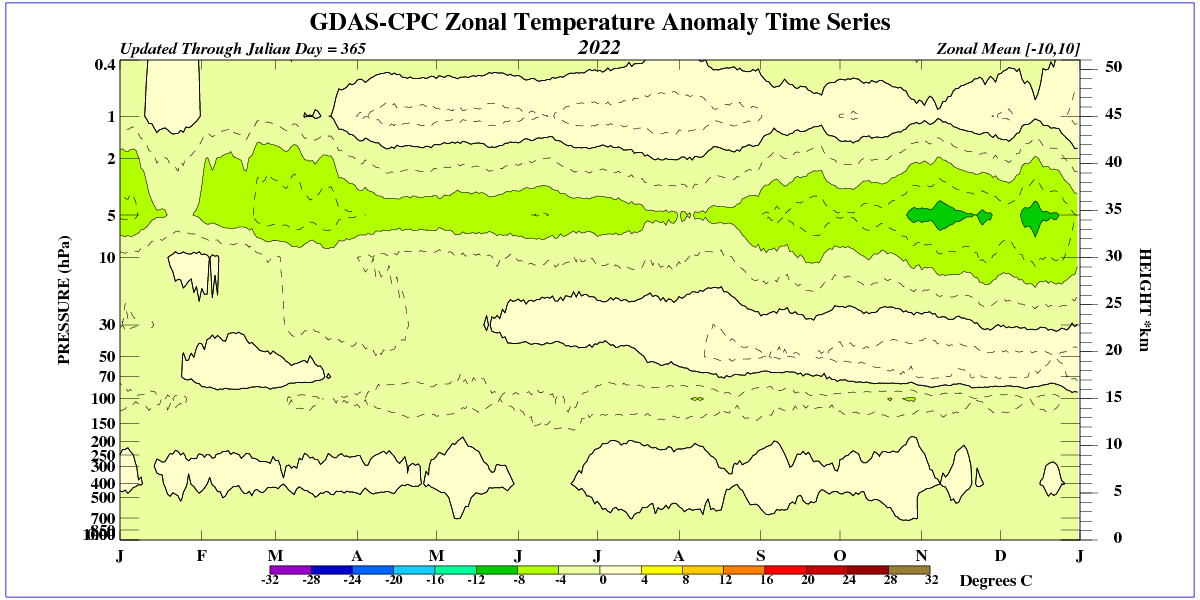
That’s what Landscheidt found out, the correlation sun/El Niño and he conditions to enable him to predict 3 El Niños.
You know Nir Shavivs work ?
Using the oceans as a calorimeter to quantify the solar radiative forcing
Over the 11-year solar cycle, small changes in the total solar irradiance (TSI) give rise to small variations in the global energy budget. It was suggested, however, that different mechanisms could amplify solar activity variations to give large climatic effects, a possibility which is still a subject of debate. With this in mind, we use the oceans as a calorimeter to measure the radiative forcing variations associated with the solar cycle. This is achieved through the study of three independent records, the net heat flux into the oceans over 5 decades, the sea-level change rate based on tide gauge records over the 20th century, and the sea-surface temperature variations. Each of the records can be used to consistently derive the same oceanic heat flux. We find that the total radiative forcing associated with solar cycles variations is about 5 to 7 times larger than just those associated with the TSI variations, thus implying the necessary existence of an amplification mechanism, although without pointing to which one. Citation: Shaviv, N. J. (2008), Using the oceans as a calorimeter to quantify the solar radiative forcing, J. Geophys. Res., 113, A11101, doi:10.1029/2007JA012989.
There may also be a correlation to Forbush Decreases
one of several papers …
I, too, was intrigued by the May/Pielke Jr. plot several days ago. This Jupiter information further deepens the mystery to me. It’s hard to believe that it’s a simple phase lag relationship. A seemingly precise 180 degree shift would be unusual, but one on earth and another on Jupiter that are both precisely 180 degrees is highly unlikely if it’s due to a simple phase shift.
For instance, here in Texas, the lag between temperature and sunlight is about 15 days (degrees). In Michigan, it’s about 30 days. A simple change in latitude cuts the phase lag in half. Comparing earth to Jupiter, with its mass, distance from sun, atmosphere, surface, etc. etc. differences, it would be astonishing that the shift would happen to come to the same in both places, much more astonishing that the shift would be precisely 180 degrees. I have no clue what the explanation might be, I’m just ruling out chance as being likely. It certainly is worth understanding as a likely influence on climate.
Most of the difference in the lag has to do with how much open water is available in the local environment. Michigan has a lot more than does most of Texas.
Open water would be significant only if it makes its way into the atmosphere. I think we need to know about atmospheric moisture, not just open bodies of water.
The electrons passing up and down the atmosphere have a lot to do with cloud formation, high and low pressure and it all. When the Sun is active it is throwing out all kinds of energy in the form of CME’s and flares which ultimately interact with the Earth’s magnetic field which in turn modulates the Earth’s atmosphere. And this is more or less instantaneous; when a CME hits the Earth it immediately changes everything.
Studies have shown low pressure systems will intensify rapidly during a solar storm for instance. Everything is electric and I’m really not sure why more research isn’t thrown into this, especially as our magnetic field wanes over the next decades.
The intriguing correlation between earthquakes and cosmic radiation:”For the observed correlation, we obtained more than six sigma, which means a chance of less than one in a billion that the correlation is due to chance.”
https://phys.org/news/2023-06-intriguing-earthquakes-cosmic.html
Thank you Harri.
The article shows a correlation between two phenomena, but they have no idea what causes the two phenomena.
With the periodicity of 22 +- year solar cycle and it’s know variations WRT to the motions of the gas giants and Saturn due to gravitational influences (that is the Sun’s movements WRT to solar system barycenter), what effects do the magnetic and gravitational fields of the Sun and the gas giants have on the Earth, its core and its magnetic field?
What type of tidal forces may the other planets induce on the Earth and what effects do these forces have in the Earth’s core and thus its magnetic field?
There is a LOT going on in our solar system. Landscheidt and after his death, Smith, gave a predictive model for the Sun’s periodicity that HAS predicted the current low level of activity, but what ELSE can be predicted? WAY too complicated for ME.
If massive amounts of research grants were not being wasted on the pseudoscientists of the “settled science” of climate change, there could actually be great progress made toward the understanding of magnetic and gravitational interrelations of this solar system. A much better use for the computing power wasted today on the “Manns” of the world.
IOW, end the government funding of the field of “climate science” and expand the funding of the fields of gravitational and magnetic study of the solar system. Jose, then Landscheidt, then Carl Smith were progressing on a theory that seems to have died with Smith, that could by now have provide a more extensive understanding of solar system dynamics, and may have, by now, shown that transfer of “energy” from the Sun to the Earth may well be much more than just “light” and that the magnetic interactions my well be energizing the Earth’s core, thus creating the actions discussed in the linked article.
So much of today’s science is like today’s medical *(drug company) practices, study (treat) a symptom, not the actual cause (disease).
I find most intriguing that the correlation is not precisely specified, and a total absence of any graphs. “There is a clear statistical correlation between global seismic activity and changes in the intensity of cosmic radiation.” – hmm, please show it to me.
With a 15 day delay between observation at earth’s surface of cosmic radiation and eruption of earthquakes of magniture 4+. The correlation is touted as 6-sigma.
Given Neptune’s distance from the sun and the inverse square law of radiation fluence, wouldn’t this weaken the effect of Svensmark’s shielding from cosmic rays on cloud formation in Neptune’s atmosphere, allowing it to be dominated by other processes?
Any chance the sunspot-hurricane inverse correlation is due to modifying the WIND SHEAR conditions?
Every year, there is plenty of sufficiently warm water in the hurricane formation areas to fuel hurricanes. I don’t think adding a tenth of a degree would make a measurable difference in hurricane formation.
However, the hurricane activity is highly dependent on wind shear aloft! When the winds aloft are blowing the tops off of the tropical disturbances near the surface, we have a quiet season. When the winds aloft are not shearing, then the surface tropical disturbances can readily progress into major hurricanes, even when they are not over the absolute warmest water.
Are there any available data records for wind shear across the tropics during hurricane season? That might be interesting to compare to the sun spot data.
Kirby Schlaht,
I noticed a similar correlation three years ago when an article on ACE (accumulated cyclone energy) was posted on WUWT.
Below is my comment to that article:
‘dh-mtl
January 15, 2021 3:43 pm
There is a very good correlation between annual ACE (Global) and ENSO (13 mo Centered Average centered on August of the same year). R=0.54, R^2=0.29. Because the variations are coincidental, it looks like ACE and ENSO both have a common driver.
It also looks as if the ACE (Global) cycle follows the solar cycle with a delay of about 5 years, i.e. peak cyclone activity followed the peaks in the last three solar cycles with a delay of about 5 years.’
As is stated in my comment above, both ACE, a good proxy for major hurricane frequency, and ENSO (El Nino) strength peak about 5 years after the peaks in the solar cycles. This coincides with your 3 1/2 year delay, after the peak in the solar cycle, of the 3 year running total for major hurricane frequency, given that the 3 year running total includes an implicit 1 1/2 year delay.
I also noted that because the peaks in ACE and ENSO were coincident they were not a cause and effect but the result of a common cause, which would be variations in the solar cycle.
“peak about 5 years after the peaks in the solar cycles”
That pretty much aligns them with the solar minimum, doesn’t it ?
.. perhaps this is being looked at the wrong way.
Perhaps we should at happens to the energy coming in during a solar minimum, or happens between max and min.
After all… it is when things are changing, that other things happen.
Here is a follow-up comment I made 3 years ago to the same question.
‘dh-mtl
Reply to PCman999
January 16, 2021 7:36 am
No, not really. More like the cyclone activity coincides with the back half of the solar cycle.
For example:
So in all three cases, high ACE (Global) showed up about 4 years after the high activity in the solar cycle began, but 2 – 3 years before the trough in the solar cycle.’
In other words, the peaks in ACE and ENSO align with the back half of the solar cycle, but prior to the minimums. This suggests a pro-cyclical response to the solar cycle with a 4 – 5 year lag, rather than an anti-cyclical response as you are suggesting. This makes sense given the tremendous thermal inertia of the oceans.
Solar input going up or coming down is when things are “changing”.
That is basically all I was trying to say… just the beginning of an idea.
I hadn’t really looked at the actual timing that much..
… certainly a delayed response is much more likely than a pre-response..
… (which would be very interesting to say the least) 😉
“…ACE and ENSO both have a common driver…which would be variations in the solar cycle.”
We’re in agreement there. I posted this graphical analysis in Sept 2019 that I later made more rigorous with a different technique in 2022, both times presented in my Sun-Climate Symposium posters.
It calls for generally higher than average ENSO and ACE after decadal sunspots exceed 95 SN; all three circumstances were reached in 2023.
This isn’t just bad science. This is horrible, terrible science.
First off, there are lots and lots of what I call “pseudocycles” in many natural phenomena. These are cycles that appear, persist for a while, and then disappear. Willis’s Rule Of Cycles to avoid these is as follows:
And even then, you can get fooled. I was once told that sunspots correlated with sea levels, and when I looked there were 5 cycles with decent correlation … but when I expanded the window to look at a longer time period, the correlation disappeared.
In this study, he’s claiming a correlation based on two or three cycles … BZZZT! Next contestant, please!
Next, this analysis makes unsubstantiated claims like the following:
To start, I know of no authoritative study that says that the mass of the ocean, or even the global ocean surface, heats and cools in phase with sunspots. I just checked the Reynolds OI SST data … no ~11-year cycles. And here’s the comparison of the cycles in the sunspots and the HadISST sea surface temperature data.
Note the strong 11-year cycle of the sunspots (black), with a smaller amount of energy in the 13-year cycle.
Note that there is almost nothing at all in that frequency in the SST data (red). There’s a long-term pseudocycle at 55 years, but that’s about a third of the length of the dataset so I wouldn’t put any weight on that.
Next, the “mixed layer” of the ocean is the top ~ 100 meters or so. It overturns every night and is mixed by the action of winds and waves. As a result, there’s no three-year lag in the warming and cooling of the layer. And that layer is what drives the hurricanes, not the underlying great mass of the ocean.
And why a three-year lag? Why not one year, or five? This is special pleading.
There’s more, but reading this nonsense makes my head hurt …
Best to all, the Pineapple Express has brought us copious rain, what’s not to like?
w.
AMO SST anomalies are constrained by solar cycles. But the task is in explaining the phase reversals, rather than deciding how you think cycles should behave.
If you want to try to explain the AMO cycles you need to start by considering the factors that affect the cycle.
Global atmospheric temperatures reflect, more than anything, global ocean temperatures. Global ocean temperatures in turn are shown to be cyclical (or multi-cylical), with periodicities ranging from a few years to many decades (centuries?), and amplitudes that have an unknown rate of decay. The global ocean temperature cycle is subject to many cyclical forcings, both direct and indirec, of varying periodicity, varying lag times and mostly unknown magnitudes.
As one can appreciate, from the above, that the problem of trying to explain ocean temperature cycles is extremely complex. Perhaps that is why I haven’t seen anybody even try to take it on.
People guess at a 60-70 year envelope for the AMO by measuring the last two cycles. While millennial scale proxy studies suggest a mean 55 years. The reason for that is that every other warm AMO phase is during a centennial minimum. The last two cycles were 60 and then 70 years long because the previous centennial solar minimum began 130 years before the present one.
El Nino episodes drive lagged major warm pulses to the AMO, but only during a warm AMO phase, peaking usually in August following the El Nino episode. As in the Augusts of 1998, 2005, 2010, 2016. The coupling is via a negative influence on the North Atlantic Oscillation by the El Nino conditions. There is also a claimed cooling effect on the AMO from La Nina episodes during a cold AMO phase, via a positive influence on the NAO.
https://psl.noaa.gov/data/correlation/amon.us.data
The main forcing is the solar wind, where we can see the strongest solar wind states of the space age in the mid 1970’s, mid 1980’s, and early 1990’s, associated with the coldest AMO anomalies, and generally weaker solar wind states since 1995 associated with the warm phase of the AMO.
Correlations of global sea surface temperatures with the solar wind speed:
https://www.sciencedirect.com/science/article/pii/S1364682616300360
Solar plasma temperature and pressure:
There is a possible indication of AMO cycles in the Icelandic sea ice index.
We don’t have to consider AMO cycles. Nobel prize laureate Mike Mann has decreed that the AMO does not exist anymore!
AMO and sunspots show no relationship. They might seem like they do, because the AMO’s largest cycle is 9 years, with a smaller cycle of 10 years. It’s also not a clean cycle like the sunspots—it’s a pseudocycle, it comes and goes.
And over the same period, the sunspots’ largest cycle is 11 years, with a smaller cycle of 12 years. Here’s the CEEMD analysis:
Because of this, they will go into and out of phase with each other … but that does NOT mean some cause/effect relationship is going on. It also doesn’t mean that there is a “phase-reversal”.
It’s what you get when you compare two cycles with periods that are close to each other … they go into and out of phase.
w.
Sunspots are also a quasi-periodicity, with highly variable period and amplitude, and they also disappear during grand solar minima.
AMO cycles are constrained by centennial solar minima because every other warm phase of the AMO is during a centennial solar minimum.
AMO anomalies are constrained by sunspot cycles, as we can see in the woodfortrees chart. The AMO anomalies are in phase with sunspot cycles during a cold AMO phase, and anti-phase to sunspot cycles during a warm AMO phase. With a phase transition period of about half a sunspot cycle.
The phase relationship you have described is specious as that would rely on the AMO sub-cycles being a regular length, which they are clearly not. There are full phase reversals within HALF of a sunspot cycle.
Smarter people here may realise that the AMO index can be used as an inverse proxy for the solar wind strength, or the NAO index as a direct proxy. This is also useful for solar science.
Willis, I have told both you and Leif this several times in the last ten years, that the major lows in the solar wind in 1969 and 1979-80, at sunspot maximum, are associated with relatively warmer AMO anomalies due to negative NAO regimes. The solar wind was strongest around sunspot minimum in the mid 70’s and mid 80’s, with positive NAO regimes driving cold AMO anomalies. From the 1990’s, the major lows in the solar wind shifted to around a year past solar minimum, and with the stronger solar wind states now at and just after sunspot maximum instead. That is the reason for the phase shift in the AMO index versus sunspot cycles.
Ulrich, as I’ve said many times including up above, I don’t believe in correlations involving cycles unless I have at least five of them … and even then I’ve been fooled.
With the AMO, we have two. That’s far too few to draw any conclusions.
You’re free to build castles on sand.
Me, I’ll pass.
w.
There are 13 solar cycles there, and the AMO sub-cycles remain locked to them.
Those same phase changes have been noted in several papers, with the NAO index, Greenland temperatures, UK temperatures, though none provided an explanation.
You were building the sand castles, I am providing a rational explanation for the observed phenomena.
Thanks, Ulric. Sorry for my lack of clarity. There are only two AMO cycles there. That’s far from enough to make any comparisons.
As to the “same phase changes” wrt the other indices, no idea what you mean.
Regards,
w.
Willis said:
“the AMO’s largest cycle is 9 years, with a smaller cycle of 10 years”
So we were discussing the AMO sub-cycles, not the two full AMO cycles since the late 1800s. You’re engaging in obfuscation and being deliberately obtuse.
Ulric, I am an honest man. It appears you are not familiar with the breed. I do not obfuscate, nor am I deliberately obtuse. Seems you’re thinking of your friends, or maybe looking in a mirror.
And honest men like me don’t stand for people falsely accusing us of dishonesty. Piss off. This discussion is over. Come back when you’ve learned to keep a civil tongue in your mouth.
w.
I don’t think it is actually bad science…
They found a rather interesting [anti]-correlation and suggested a hypothesis to explain it.
That is how science starts.
It is not very advanced hypothesis… but it is now open to scientific discussion, verification, whatever.
Their hypothesis has an in-built “prediction”
We now wait for the next cycle(s)… and see what happens.
“copious rain, , what’s not to like?”
Ok… you come and mow the grass… every second day !!! 😉
Move to Utah! lol.
I agree with Kirby CDC on how Svensmark’s theory could lead to Ryan’s observed anti-correlation. That was my first thought as well. Less cloud cover warms the lower latitude oceans the most, increasing zonal temp difference.
Actually seems like pretty good support for Svensmark’s theory.
As for this:
“If Svensmark’s cloud hypothesis works on Earth it should work on Neptune.”
One thing to take into account is how the strength of the solar wind’s deflection of cosmic radiation will fall off by more than inverse square of the distance from the sun, and Neptune is a lot further out.
If solar wind speed didn’t fall off with distance from the sun then the fall off in deflective force would be inverse square (falling off commensurate with the decreasing particle density of the solar wind), but wind speed does fall off, further weakening the deflective force.
That graph clearly argues against Joe Bastardi’s early forecast statement that the this year we’re going to have “the hurricane season from hell”.
It will be interesting to see what happens and why?
As I said above.
It has a sort of in-build prediction..
Problem is , 1 single year can’t test it… we need to wait for a while.
The graph shows multiple years. But this year Joe has multiple reasons for forecasting a severe season well in advance.
Joe gave some of the reasons for that forecast today in a post on the premium site.
Coming La Niña that he believes will be strong by the time the season rolls around with analogs and a more diffuse pattern of elevated SSTs in the North Atlantic instead of the more or less blanket of elevated SSTs we had last year.
Says a more in depth look at the MDR is on the way.
Anyway I think a season when meteorological conditions argue for an active seasons while it seems solar influence argues against an active season will be an interesting test.
If the peak of the next hurricane cycle is about half way down the solar cycle 25 decline..
…. , and the next minimum in hurricanes lines up with the solar maximum. ..
that would certainly give the hypothesis a nudge. 🙂
“If Svensmark’s cloud hypothesis works on Earth it should work on Neptune.”. That’s a big stretch. Neptune is way closer than Earth to the outside of the Heliosphere, hence gets much less protection from cosmic rays, and its clouds are nothing like Earth’s clouds.
Agreed. We don’t have enough knowledge about cloud formation on Earth, much less on Neptune. They may involve very different mechanisms. What is becoming clearer as data accumulates is that Neptune clouds follow the solar cycle. We don’t have that type of evidence for Earth’s clouds but we know from satellites that there is no obvious change with the solar cycle.
It is obvious that if Neptune’s climate strongly responds to the minute changes in energy of the solar cycle, the Earth’s climate could do so.
Only the timing correlates. Not the amplitude.
There is something very small in HadSST3, Maybe Had is too big a joke for an 11 year cycle to show up properly but it does look to be much smaller than the change in the past 50 years, and there is no increasing trend in hurricane activity.
My guess. Less ionisation leads to greater supersaturation before condensation.
Maybe the oceans are too big an energy sink to show any 11 year cycles . 🙂
The oceans show an 11-year cycle in the tropical ocean upper layer’s heat budget, as White et al. demonstrated in 1997 & 2000.
Is the amplitude large compared to the increase overall in the past 50 years? To fit the hypothesis, there should be an increasing trend in hurricane activity.
No. Hurricanes have little to do with sea temperature. There were lots of Hurricanes during the Little Ice Age. One sunk one of Columbus’s three ships on his first voyage. Hurricanes are produced by the atmosphere, not by the ocean. The tropical ocean temperature is always enough for hurricanes.
Then the hypothesis sinks as well.
From the above article:
“If the Svensmark cloud hypothesis is correct, increased solar activity deflects more Cosmic Rays (CR) away from the inner solar system producing less ionization in the troposphere . . . Seems a paradox here . . . Something else might be going on here.”
Yeah, I too have problems with Svensmark’s hypothesis, as stated above, for the following reason:
the Sun’s output of particle and photon radiation also has an amount of very high energy particles/photons that can likewise create ionization deep in Earth’s atmosphere, hypothetically leading to an increase in cloud formation similar to that predicted from galactic cosmic rays.
“Solar energetic particles (SEP), formerly known as solar cosmic rays, are high-energy, charged particles originating in the solar atmosphere and solar wind. They consist of protons, electrons and heavy ions with energies ranging from a few tens of keV to many GeV.”
— https://en.wikipedia.org/wiki/Solar_energetic_particles
So, while a period of “increased solar activity” might deflect more galactic cosmic rays away from Earth and the solar system (due to the associated increase in the strength of the solar wind) it would at the same time increase the flux of SEPs penetrating down to Earth’s troposphere, thereby creating more ionization that theoretically leads to increased cloud formation. Despite its distance from the Sun, one would expect Neptune to also receive increased SEPs from the Sun at the time of increased solar activity.
In this regard, one needs to consider that UV photons from the Sun have energies generally less than 10 eV, whereas as mentioned above SEPs are a thousand to a billion times more energetic.
The above article seems to support that the increase in SEPs in more important than the decrease in galactic cosmic rays in forming clouds/hurricanes during periods of increased solar activity (within the identified time-lag constants).
Svensmark’s cloud hypothesis might still be viable if modified to account for SEPs.
During very strong eruptions on the Sun, there is a strong gamma-ray flare in the stratosphere.