From NOT A LOT OF PEOPLE KNOW THAT
By Paul Homewood
h/t James Mason

It’s strange that scientists were not panicking about going into an imminent ice age in 2014, when Antarctic sea ice was at a record high!

https://nsidc.org/data/seaice_index/images/s_plot_hires.png
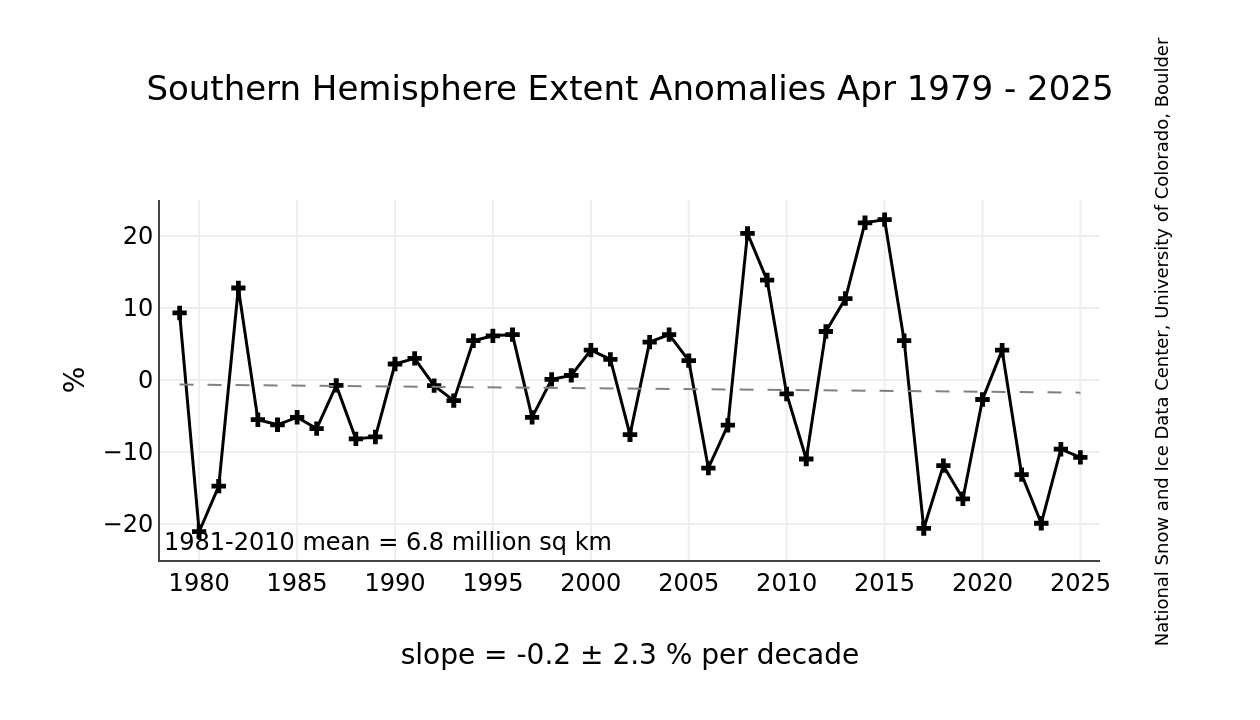
Large variations from year to year often occur, and they are usually the result of wind patterns, which either blow away from the continent, thus pushing ice outwards, or towards it.
We only started collecting data in 1979, so the idea that any of this is unprecedented or concerning is nonsense. In fact, the claims of a six-sigma event are fraudulent; you would need thousands of years of data to calculate the statistical significance of this event.
Meanwhile, aforesaid scientists seem to have gone very quiet about their favourite scare, the Arctic, where the ice refuses to disappear as ordered:

For more on Oceans, Antartica, and Sea Ice visit EverythingClimate.com
If you go to earth.. nullschool and change the settings to see ocean surface temps, the water around the edges of the seaice are above -1.8 C. So it seems to me the question is why are ocean temps around Antarctic warmer than normal. Ocean heat loss around Antarctic will be greater than normal due to less ice.
I normally only update my “Sea Ice” spreadsheets at the beginning of April (Arctic max / Antarctic min in March) and October (Arctic min / Antarctic max in September), but this article piqued my curiosity enough to update it to June.
As we are (supposed to be ?) talking about “global warming”, the attached graph is of the sums of extent, i.e. the Arctic plus the Antarctic sea-ice numbers for each month, as downloaded from the NSIDC website.
Starting URL : https://nsidc.org/data/g02135/versions/3
There was a definite step down in 2015/2016, mostly due to a fall in Antarctic sea-ice levels while the Arctic continued the “zero trend” it has been on since ~2007, but global behaviour since then has been fairly stable.
So far, at least, 2023 doesn’t really look out of the ordinary.
NB : Monthly data, dashed line = 12-month trailing averages.
Two 2016 Antarctic weather events plus super El Niño of 2015-16 caused the step down from huge high ice in 2014.
Scientists Are Worried About Antarctica’s Unprecedented Lack of Sea Ice Growth
Worried? I’d say this one has gone downright insane!
Climate researcher: ‘We are witnessing the sixth great extinction’ | Watch (msn.com)
The only great extinction is good scientists and what we have instead are emotional activists.
It’s a good thing they’re not worried about the big ozone hole over Antarctica.
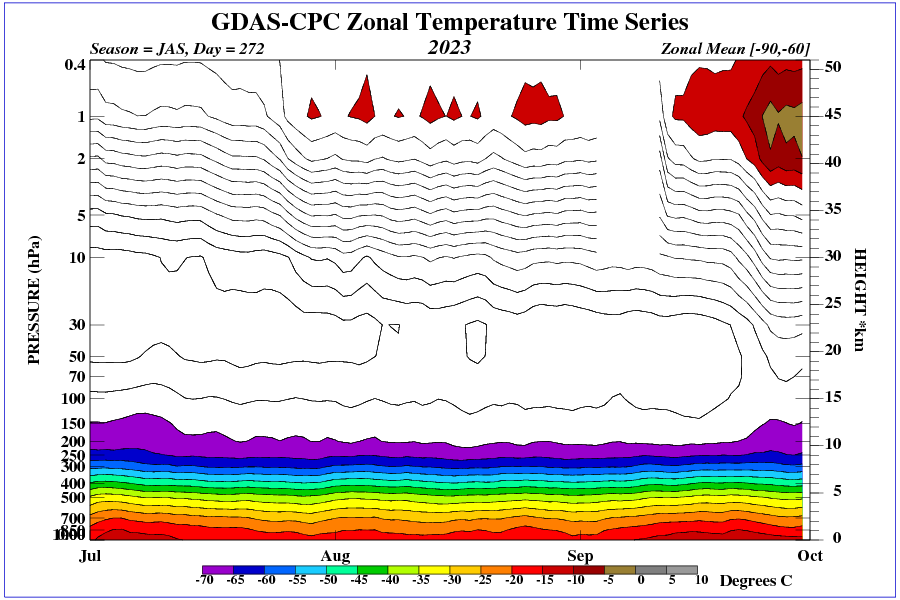
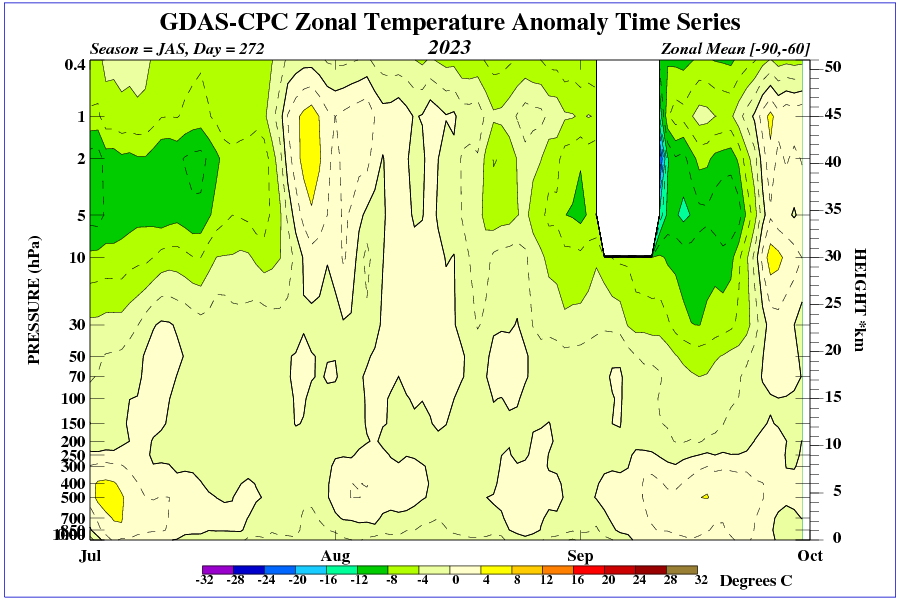
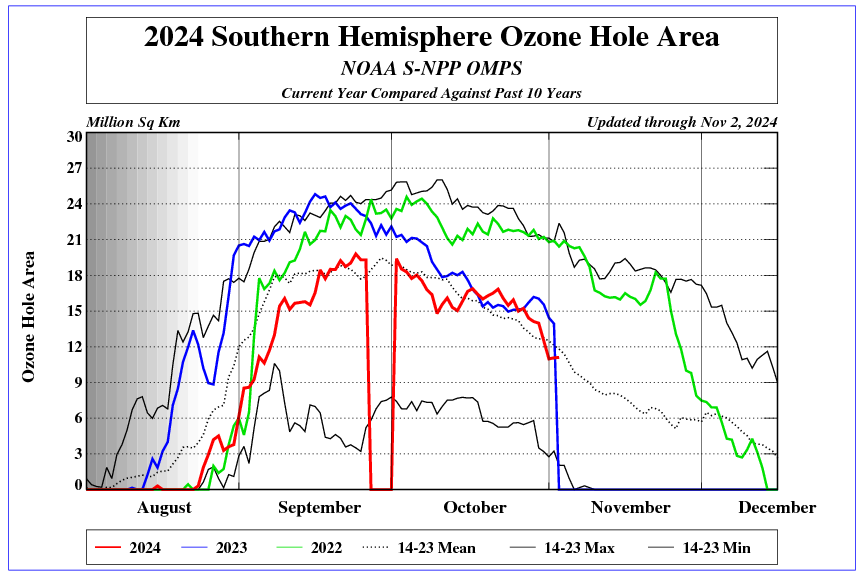
Interestingly, strong waves in the polar vortex can be seen, which could bring weather anomalies to the southern hemisphere.
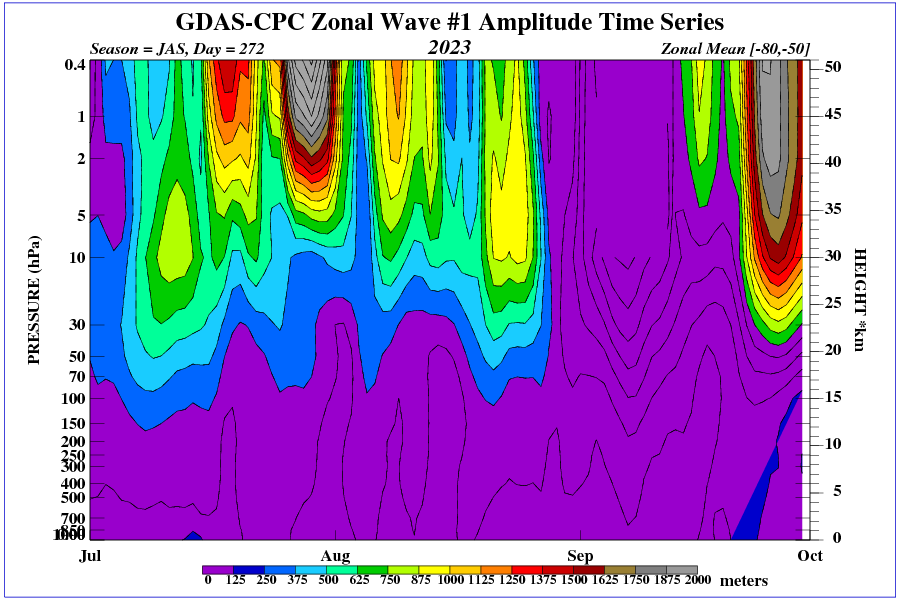
I registered at Bloomberg’s site to read the article and find out *why* “Scientists are worried”. But sadly, the scientists were so excited about the large deviation from a small sample that they failed to give any reason why having less sea ice would be a problem for anyone reading the article. But they did have thier own personal slice of horror: it’s a bad year for scientists trying to put equipment on sea ice. Why, two post-doctoral students put their equipment on “what little ice there was” by the Peninsula, and a storm came through, broke it up, and they lost their equipment. It’s not clear to me how the ice extent growing more slowly than usual caused the storm….
Let me start, I’m not a scientist. But, I once stayed at a Holliday Inn Express. There seems to be a crap ton (scientific unit of measure) pissing and moaning about the melting poles. The thing I will also point out that I am a 65 year old retired man who has struggled through life with just a High School Diploma (graduated Class of 1975). As I see it, there is a shit load of ice in the north and the south. There is also a metric butt ton (another unit of measure) of liquid water that has to my great joy, filled in the low parts. Now, there is a point where the wet comes in contact with the not wet, and that tends to move around a bit. My solution to the dilemma don’t get too close to the wet. MOVE. It is my understanding that it is a bit of the ‘burrr’ in the north and south. Is it getting less burrr there? Don’t know, don’t care. By the time it becomes a problem, if (a big if) becomes a problem, it won’t be MY problem. Or yours.
I wise man once said, it’s rather arrogant of us to think that man can control this planet’s thermostat. So, what’s the point.
As with all things, your milage may vary.