We’ve covered Dixson’s and Munday’s work on ocean acidification and fish behavior previously and how it broke down under scrutiny.
And here.
Now the University of Delaware has concluded:
…that marine ecologist Danielle Dixson committed fabrication and falsification in work on fish behavior and coral reefs. The university is seeking the retraction of three of Dixson’s papers and “has notified the appropriate federal agencies,” a spokesperson says.
This article in Science goes into detail.
Finding against Danielle Dixson vindicates whistleblowers who questioned high-profile work on ocean acidification
A major controversy in marine biology took a new twist last week when the University of Delaware (UD) found one of its star scientists guilty of research misconduct.
A major controversy in marine biology took a new twist last week when the University of Delaware (UD) found one of its star scientists guilty of research misconduct. The university has confirmed to Science that it has accepted an investigative panel’s conclusion that marine ecologist Danielle Dixson committed fabrication and falsification in work on fish behavior and coral reefs. The university is seeking the retraction of three of Dixson’s papers and “has notified the appropriate federal agencies,” a spokesperson says.
Among the papers is a study about coral reef recovery that Dixson published in Science in 2014, and for which the journal issued an Editorial Expression of Concern in February. Science—whose News and Editorial teams operate independently of each other—retracted that paper today.
The investigative panel’s draft report, which Science’s News team has seen in heavily redacted form, paints a damning picture of Dixson’s scientific work, which included many studies that appeared to show Earth’s rising carbon dioxide (CO2) levels can have dramatic effects on fish behavior and ecology. “The Committee was repeatedly struck by a serial pattern of sloppiness, poor recordkeeping, copying and pasting within spreadsheets, errors within many papers under investigation, and deviation from established animal ethics protocols,” wrote the panel, made up of three UD researchers.
Dixson did not respond to requests for comment. She “adamantly denies any and all allegations of wrongdoing, and will vigorously appeal any finding of research misconduct,” Dixson’s lawyer, Kristina Larsen, wrote in an email to Science. Larsen describes Dixson as a “brilliant, hardworking female scientist” who was “targeted” by a group of scientists who “chose to ‘convict’ Dr. Dixson in the court of public opinion” by sharing their accusations with a Science reporter last year. “Their vigilante approach all but assured Dr. Dixson would never be able to receive a fair and impartial review elsewhere,” Larsen writes. UD says it will not comment on Dixson’s future there.
The accusations against Dixson have sharply divided marine ecologists, with some scientists suggesting the whistleblowers acted out of professional envy or to advance their own careers. The accusations were “stalking and harassment” and “one of the most disgusting and shameful things I‘ve ever seen in science,” John Bruno, a marine ecologist at the University of North Carolina, Chapel Hill, tweeted in March. (Bruno—who wrote a commentary accompanying Dixson’s 2014 Science paper—did not respond to an email informing him of UD’s findings.)
UD “did a decent investigation. I think it’s one of the first universities that we’ve seen actually do that,” says ecophysiologist Fredrik Jutfelt of the Norwegian University of Science and Technology, one of the whistleblowers. “So that’s really encouraging.” But he and others in the group are disappointed that the committee appears to have looked at only seven of the 20 Dixson papers they had flagged as suspicious. They also had hoped UD would release the committee’s final report and detail any sanctions against Dixson. “That is a shame,” Jutfelt says.
https://www.science.org/content/article/star-marine-ecologist-committed-misconduct-university-says#.YvKM57NC73Y.twitter
Read the complete article at Science Mag here.
It’s a start.
Hope for science if academic success is finally less important than removing mistaken assumptions.
Removing mistaken assumptions, theories with a frame of reference, and models with caveats.
“Coral reefs can communicate with fish, and many of them are crying for help“
“When you’re in the open ocean, there’s actually very little to orient yourself to,” Dixson says
https://theworld.org/stories/2014-08-21/coral-reefs-can-communicate-fish-and-many-them-are-crying-help
She clearly needs help or at least something sensible to orient herself to.
But on the Reef no-one can hear you scream!
Dixson as a “brilliant, hardworking female scientist”…
___________________________________________
“Female” has nothing to do with science. Neither does eye color, hair color, height, attached ear lobes or any other aspect of human form you can think of.
A true scientist does not make the findings support the hypothesis!
Maybe after she gets fired from being a marine biologist, she can get a high-paying job working on Global Warming?
I believe she has a certain set of skills that most universities find highly desirable for THAT job.
In physics there is an old saying: If you keep your data base short enough it will fit your theory
In Leftist, woke CliSciFi it hugely matters. Remember the Feminist Glaciology clown show?
And of course we’re soon to have the “first woman on the Moon” thanks to NASA’s wokeness. Gender will be chosen above all other concerns. I expect she’ll plant a flag with Greta’s image too.
Nothing at all wrong in my opinion with female astronauts, and they may well be better than men at many tasks, but NASA should always choose on ability not sex for every mission. That is where true pride for any group that may feel left out/oppressed will come from.
What is the value of a woman on the moon?
Aside from the value to Marxists in working to destroy the fundamental principles of Our Prevailing Society, there is value.
I am going to depend on some pretty recent concepts (last 15 years) about the nature of memory to make a point.
There eventually will be a set of eligible candidates. Say, 20. Only a few, say 3, will go to the moon. If a female is otherwise qualified, why not send her? If we do, we actually may be helping other females envision a future that they may not yet envision. This is one of the purported values of having “diversity” in prominent positions.
To be role models. Turn out, this may really work.
Schacter is a leading researcher on memory. Some of you know this. He developed the “seven sins of memory,” to help us realize what memory is and is not. And how it can be in error.
He, and other researchers have examined memory very well. With a very big push from the false memory cases of the 1980s and 1990s “satanic ritual abuse” panic.
How could we rush down this path so foolishly? Many researchers decided to examine memory to figure this out. They have made a lot of progress. One principle is that it is very clear that memory does not work like a video recorder, but instead memory works to re-compose scenes form various pieces.
By hacking the system in research studies, researchers have figured out how to experimentally create memory errors. Quite reliably.
Fine. Good to know.
The next frontier. “Why is our memory like this? Why do we have memory at all?”
An answer: “To predict danger and outcomes of opportunities, including some that may be risky.”
So, there is now a big body of research that says this is true: we have our memory apparatus not just to be able to reminisce about pleasant days gone by. but the same brain apparatus and system is used to form guesses about what might happen if we do this, that, or the other.
As we “recall” memories in this reconstruction type manner, we take things and concepts and form a “memory” of the future, or a guesstimate,” and examine how likely it is to have this or that outcome.
“If I grab this rattler by the tail, how likely am I to get bit?”
“If I study for this test, how likely am I to pass?”
We use our history, our memory, to get those different ingredients. If we can conjure up a good outcome in our imagination, then we are more likely to give something a try.
If we cannot readily conjure up the good outcome, or if a bad outcome comes too easily – like an often-recalled memory – then we down-vote the idea.
So, I say to my single-digit-age daughter, as she plays, and we chat about what she wants to be when she grows up. I ask about “astronaut.”
She goes through this future-testing scenario. Her brain cannot easily put a female in the vision of an astronaut. She decides: that is not a worthwhile idea; “it is not worth pursuing, because I tried to estimate and imagine it, and the image did not have a feeling of being very realistic or possible.”
Sure enough: all of the memory stock in her mind has men as astronauts.
Unless there is a female or two in there. Then, a young female, upon hearing a STEM presentation, can imagine herself as an astronaut.
Now, we, collectively, might one day have a great set of potential moon-walkers. The best available. Some male, some female.
Schacter and others are going so far to say “we evolved memory in order to be able to make pretty accurate, reality-based predictions about the likelihood of the outcomes of some possible action or effort.”
I am white. As a grad student, I went to a research conference with fellow students, some white, some black. Plenary Speaker was Dr. Satcher, Surgeon General. Who is Black. Sure the talk was OK. Not notably memorable or inspiring to me. Heard stuff like that before.
But to my two good friends / colleagues there who were Black, they had a look on their faces. Both went right up and spoke to him after the talk was over.
They took yet another image of a successful Black person and sustained the idea, the vision, that they could be a highly educated and accomplished professional and intellectual.
So, I believe this type of diversity can be well done, and at times be almost obligatory.
https://www.harvardmagazine.com/2013/07/the-social-life-of-memory
The “she’s a female scientist” is a huge ‘tell’ from her lawyer. It’s the hub of her gender card defence. After all, her accusers are (toxic) male researchers in Norway. I can also tell what the lawyer had for breakfast and who she voted for but that’s too easy!
With any luck toxic masculinity is on its way out.
You are an eclectic scholar, Pat! Moreover, even though social psychology is largely a foreign language to me, you made the topic understandable. Jordan Peterson argues convincingly that choice of fields of study is clearly statistically different between men and women, that men tend to be more interested in things and women in people.
When I went into engineering about 65 years ago, Sputnik had just been launched and enrollment was some 400 – for our university the norm was under 100. Only one woman enrolled. By 2nd year half had dropped out and much fewer than a hundred reached graduation. The woman, who was super smart, was one of the graduates. Years later, I learned she was in sales for some equipment company.
There was no barrier to get in and she seemed to have friends among the students. My selection was geological engineering and and we numbered only 3 in the final 2 years, so we were the aardvarks.
Universities today have more women than men overall. There are more women in STEM than in earlier years but the majority are still male. The larger enrollment of women probably has something to do with coercive campaigns by ideologue shapers of society. They hate that they haven’t succeeded in wiping out the dominance of males in these fields. So they attribute awful behavior of men as a reason.
This is why they cook up phoney studies about epidemics of rape and unfriendly demeanor. As with consensus climate science, outcomes have to be what they would like them to be.
If they let the Portland anarchists go free, then adding the female label helps toward that end here.
What a surprise, I tought we do not have women/female anymore in the woke world.
Obviously, one of the lawyers moonlights as a biologist.
Casting the mendacious climate ‘scientists’ as “hardworking dedicated people” and “victims of unwarranted abuse” is nothing new to the climate change cabal – every single time they are caught in a lie they trot it out.
This was a case of gross misconduct. However, it is also true that the majority of published papers do not stand the test of scientific rigor especially in re to modeling. Seldom is scientific proof provided or addressed. All of the climate models fail in this regard esp. because they are known to not include all of the relevent variables and they cannot be tested except in a very long time frame.
Our trolls routinely tell us that peer review in top journals is the gold standard by which papers are to be judged. Those that have passed peer review cannot be questioned. Those that haven’t passed such peer review must be ignored.
Fools gold standard.
Peer review is not taken as a “gold standard,” you are presenting a straw man argument. Peer review is taken as a minimum bar to be cleared. If a paper has not undergone peer review there is no record of it ever having been scrutinized with even the smallest iota of rigor.
You don’t have to accept peer reviewed papers as fact, but you absolutely shouldn’t view papers that can’t even pass this bare minimum standard with much credibility.
Why?
When The Lancet reports that > 70% of published medical research can’t be replicated.
And this is MEDICAL research, where human lives are the basic currency, not climate “science” where ooga- booga media headlines & clicks are the main currency.
So you think that non-peer reviewed medical research is more replicable than the peer reviewed literature? I eagerly await a source.
What proportion of (specifically) published medical research is non-peer reviewed? I eagerly await your answer.
I don’t think there is much. Do you think that if non-peer reviewed medical research literature existed, that it would be more replicable than peer reviewed research?
I’d also note that those who tend to bleat on about peer-review don’t, as a rule, give any caveats, so your response is just as much a strawman.
It could hardly be any worse than the track record of ‘peer reviewed’ papers.
Oh, I bet it could.
When 70% of published reports can’t be replicated in spite of having passed the ‘hurdle’, then what purpose the hurdle?
I’m not sure how familiar you are with the peer review process, but the reviewers do not attempt to replicate the piece of research they are reviewing. Peer review is not intended to replicate research, but to assess whether the methodology as described is sensible.
Which they fail way too often to the point of being pathetic.
Well Alan, with the odd 50 publications and having been a reviewer myself and at the receiving end of it I still have to be convinced that it serves a vital purpose. And the replication problem is, obviously, not for the reviewer, but relates to other researchers who try to reproduce it, sometimes many years later.
Nope!
The “peer review” process is a gateway used by pals and cronies to block inconvenient or contrary research.
There are plenty of written accounts of inconvenient/contrary research being blocked from publishing for years.
So take a paper using modelling like many climate science and medical papers do. You can have perfect methodology but the conclusions are as stupid as the assumptions made.
This is probably the issue you need to have this discussion on a paper by paper case you can’t generalize.
There’s a lot of sensible science fiction out there.
One should note that the 70% not replicable claim, was from a small subset of medical research papers.
The replication authors researched and tested as well as they could with their small team.
Somewhere in that writeup, the amount of tested research that indicated it could be replicated numbered in the single digits.
That 70% unable to be replicated is likely far too generous.
Virtually none of the companies or governments have devoted any effort or monies to investigating research fraud.
There is a paper some two decades hence by John Ioannidis which basically says that most of what is published is wrong. “Why most published research findings are false”. Most, not just a small subset.
Alan, you miss the whole point of CliSciFi and its pal review processes. In marine ecology it appears some people are trying to clean up after the serial abusers whereas in paleoclimatology scientific misconduct is actively encouraged. [BTW, whatever happened with Marcott and his massaged data? Rud, has anything changed since your reveal in your ebook Blowing Smoke?]
Who was it who stated that he was going to prevent skeptic papers from being published, even if he had to change the definition of “peer review”?
IIRC, that was Dr Jones of East Anglia University / CRU.
I don’t know if you are as ignorant as you make yourself sound, but my characterization of what the trolls claim is accurate.
Regardless, you belief that pal review only rejects papers with obvious flaws is as ignorant as your other claims.
These days, peer review serves as the gate keeper, preventing papers that those on the inside don’t want to be seen, from being published.
As I have said before, the review that gets done to papers at places like WUWT is infinitely superior to the so called “peer review” that is done at any journal
If I’m a researcher looking at a non-reviewed paper I have no idea if it has undergone any level of expert scrutiny whatsoever, no matter how lit the comments at WUWT might have been (particularly if I’m not an avid WUWT reader).
Every crank believes they’re being persecuted by the establishment.
And how would you know if such ‘expert’ scrutiny is indeed by those who know what they are on about? The author of the paper you know, the reviewers you do not. So, you are trusting blindly that it is kind of ok. Plus that you never see what has not passed the review of that particular reviewer, and you have no information why. A colleague even older than I put it like this: I have seen highly praised research ending in the dustbin of history and saw rejected papers leading to a Nobel Prize.
You might not know, but the alternative is no possibility of expert scrutiny whatsoever, so this is preferable. This notion that quality control might not do a good job so no quality control is better is so asinine I don’t even know where to begin.
AlanJ,
Quality control includes measures such as the calculation and display of the uncertainty of numbers in groups, like daily temperatures. Errors and uncertainties are supposed to be calculated in particular wats such as described in detail by the Paris- based International Bureau of Weights and Measures group BIPM. In the US there are mandated ways to conform to this type of quality control, but government agencies seldom seem to check.
Large parts of quality control methodology are able to proceed without peer review. The big problem here is when peer reviewers have no idea that some procedures are required and so review lacks a good ingredient.
You do not seem to understand that in a field of research, chosen reviewers can be as incompetent as the authors are. Geoff S
”is preferable” is an opinion, a matter of taste. There may be no good way of doing quality control, except keeping your fingers crossed, but that is no argument for using a method of which we know that it is wide open to subversion. Review has been used to obstruct fundraising by ones competitors, to act as gatekeepers Lysenko style to protect a cherished narrative, and even to misappropriate other’s ideas. i’ve seen it all.
Well aren’t they?
Go ahead and prove they are not.
“Just because you’re paranoid doesn’t mean they aren’t out to get you.”
~Alfred Wegener
Beat me to it.
Corollary: Just because you are a conspiracy theorist, doesn’t mean there isn’t a conspiracy.
Just ask TRUMP!, or any conservative up against the FBI and DOJ.
The problem then is that you do not have sufficient knowledge of the data and procedures that went into the study. In many cases, ala Mann, that is protected and in the end, replication is impossible as is deciding if the paper is valid.
Here is one for you. Why do so many papers end up blaming “climate change” for results seen with no, and I mean none, showing of a functional relationship between local temperatures and the subject being studied. It has become a joke that studies from everywhere and on everything claim “global warming” as the cause of any result. We know that not everywhere is warming the same and that some places have not warmed at all. Yet how can “global warming” affect everywhere?
Why do the reviewers let these unsupported claims remain in a paper?
But alanj accepts claimed findings in a “peer reviewed” paper, because some “expert” accepted the claims as “sensible”.
The old Logical Fallacy, canard, “argument from authority”, “Argumentum ad Verecundiam”.
A logical fallacy based upon authority subversion while denying proper science and the scientific method.
You have managed to miss the point by such a margin that you’ve sailed clean round the world and come up again upon the very fallacy I’m arguing against. It is so inane I’m not sure if you’re just taking the piss or if you’ve swallowed your own con. I don’t “accept” peer reviewed papers because they are peer reviewed – I view peer review as the bare minimum standard a paper should meet. It needs to do an awful lot more than pass peer review to be “accepted.”
If you’re a researcher looking at a non-reviewed paper, Alan, you should be able to critically decide for yourself whether the work is any good or not.
If you can’t do that, you’re not a researcher.
If you’re a diner in a restaurant you should be able to perform your own inspection of the kitchen to verify whether food safety regulations are being followed, but that big letter in the window is awfully helpful, too. Advocating for having no standards whatsoever is asinine.
This is funny. The reason you aren’t allow in the kitchen is FOOD SAFETY REGULATIONS!
Ah yes, the favorite of climate trollops, demand obeisance to ‘authority’.
What the matter? Are you unable to spot quality papers within minutes of reading the paper?
Utter tosh!
Gentlemen: Mr. J is a troll. He gaslit us by starting out with “nobody calls peer review the gold standard (they do, but not worth digging up, it’s gaslighting) a strawman, then he decides to sit at his computer and respond to every comment with strawmen comments defending his gold standard (he need not use the word. He contributes nothing- less than nothing- to the subject. Note how all critics of peer review are told that they are somehow for doing no work at all. He evidently doesn’t inspect his food on the plate at restaurant because they won’t let him in the kitchen! He thinks this is a reasoned allegory??!! I called him from the jump- not as smart as he thinks.
Peer review acts as a form of authority support, and therefore is all too frequently accepted uncritically precisely because it has supposedly been reviewed and approved. By the same token, I wish I had a dollar for every time some alarmist has told me that they refuse to even read something that hasn’t passed peer review.
What passes for so-called peer review is really a ‘gate keeping’ function to help maintain the reputation of the journals by screening for the equivalent of ‘perpetual motion machines.’ It has been said that if ‘peer review’ had been in vogue in the early-20th century, Einstein probably would not have been able to get published.
However, the real peer review process occurs after publication, when the subscribers have an opportunity to evaluate the claims.
A thesis should stand alone on its merit, being judged by the facts and logic. I can’t imagine anyone whose time is so valuable that they can’t at least read an abstract and decide if further reading is warranted. Refusing to read a paper that hasn’t been anointed by a ‘gate keeper’ strikes me as being an all too convenient excuse for not reading something that goes against their beliefs.
Said but never evinced.
Never evinced, but totally true.
It is the reason Einstein was working as a patent clerk at the time. He was denied a position working in his field.
Instead of the specious “peer review” Einstein published his paper without the aid of universities or alumnae.
Einstein responded to the 100 or more critical “peer reviewers” of his theories with –
“Why 100?
It only takes one to prove me wrong.”
A ringing endorsement of peer review by one of history’s greatest scientific minds, well done.
Not even close.
This vignette clearly demonstrates that peer review even back then was not worth a cupful of cold p1ss.
Even when the reviewers expounded their critiques publicly.
Wrong!
There was zero “peer review” back then!
…
…
The book was filled with people who hated Einstein’s theory because it ruined their expertise, beliefs, research.
No peer reviewers!
No specious argument from authority!
Facts and findings are left for destiny, not for armchair scientists looking for prejudged papers by publications dependent upon researchers paying large fees for publishing a paper.
Peer review was meant to assist those publications in deciding which papers fit in their areas of publication expertise.
Pal reviewers decided that “peer review” was essential for every paper and that if they blocked inconvenient papers, they earned more money and gained more glory.
Nothing at all to do with science, scientific method, research or genuine findings. Which is why so many climate deluded love program models. They can run them endlessly seeking the few that prove their assumptions.
Sounds like there shoulda been peer review back then.
Let me know if you need an even bigger shovel.
Gentlemen: Here, Mr. J plays the happy warrior declaring victory. The “peer review” he promotes was around back then, just not coined as a term. The “peer review” he promotes was also abused back then- commenters note that it kept Einstein out of the field for a tiime. Peer review abused is what the 100 scientists were doing. The abuse of peer review is the problem, he ignores it and pretends we’re the ones digging.
Mr. J: No response? Guess I hafta put another token in the whack-a-mole machine for you to pop up.
Peer review came into being precisely because for a long time science was a good-old-boys club in which men of aristocratic heritage controlled all avenues of scientific discourse. As ATheoK notes above, having a system of peer review in place to ensure that all research have an opportunity to be fairly evaluated and published would have made Einstein’s life a lot easier.
Mr. J: The “good ole boys” club you describe was the peer review of its day, calling the modern day a “system” of peer review simply uses words to obscure the truth- people used a system to exclude ideas with which they did not agree.
So let’s go back to your facsinating restaurant. Did you look at the food before you put it in your mouth? Didn’t ask any expert to look at it first? So you ate without using “peer review”? And survived? Folks, this is a racehorse, but not a very good one. I wonder if he used to post under anther name?
Right, so peer review, as we know it, did not exist at the time. Thank you for confirming.
And you can absolutely look at the food. Will you necessarily be able to tell if the chef washed their hands before preparing your salad? Will you know if they kept the dressing on the shelf past its expiration date? Will you know they aren’t preparing raw vegetables near raw meats? I think you think you’ve got a real good point here lol but you’re just destroying your own argument.
Mr. J: What a perky response! Not even wrong, though, as I said it existed before it was named. You don’t care that anyone reading your response can see you altered mine because you have no response.
I won’t know those things by looking at the food- and neither will your “peer reviewers”. This lame comeback, attempting to extend your very poor allegory, is proving my point- you don’t have a point, you just come here to gaslight.
You are mostly right AlanJ….in real science if papers don’t pass peer review of people experienced in the field, they probably aren’t worth publishing. Unfortunately many climate papers are puff pieces for more research money or another free trip-of-a-lifetime grant, that are far from actual science. In this case, peer review is much more like a restaurant review in the newspaper.
The value of peer review is as they say settled science
https://youtu.be/kVk9a5Jcd1k
Who would down vote this?? These academics who showed that the peer reviewers their fake articles passes were activist, not scientists, and they have been persecuted by their universities for doing so.
Speaking of specious straw man arguments.
Climategate emails proved that influential climate fraudsters actively threaten publisher editors and wage campaigns against those editors that allow any contradictory research to be peer reviewed.
For the last thirty years, the whole “publish or perish” mandate has driven real science from the many publications dependent upon “publisher fees” for papers.
Still a specious straw man argument.
Basically all medical research prior to 1960 was not dependent upon ‘passing peer review’.
Returning to the author and papers described above in the article, it is notable that supporters of the misconduct proven author spend most of their time slandering and stigmatizing those who blew the whistle along with the teams investigating the papers.
So scientific… NOT!
Meanwhile you are presenting a non-sequiter argument
I am sure there are plenty of papers out there that are not peer-reviewed that do stand up. Peter Higgs is a classic where he was a cast as a nutcase and derided struggling to get published. He was right and then his detractors and some journals are now shown to be the washed up losers they acted like.
All you hope peer-review does is hopefully filter out some junk but it has dangers as does any filter process.
To assign peer-review a any sort of credibility standard is dangerous and stupid.
Remember, none of Albert Einstein’s papers were ever peer-reviewed.
Peer review is a recent innovation of very questionable value.
In theory, you might be correct. But as “Climategate” and other examples have shown us, the peer review process can be rigged. Who you choose, and why you make that choice, controls the process.
You talk about a “bare minimum” of peer review as if it’s important. In an ideal world, certainly. But if the politically correct editors of these journals are choosing how that bare minimum is applied, then your minimum standard has no value.
Corruption of the peer review process calls both ends of the scale into question. Not only is every article like Dixson’s suspect, but we should expect that any research done by someone who isn’t politically connected is suppressed, valid or not valid. Who would know?
Climategate showed nothing of the kind. This seems to be a popular myth around these parts. The emails showed a single scientist venting that he wanted to keep a couple of (admittedly bad) papers, not from being published, but from being cited in the IPCC report. Both papers were cited in the IPCC report. I guess venting to colleagues in a private email isn’t enough to subvert the entire scientific process.
Part of the point of peer review is that it takes the job of deciding what research to publish out of the sole discretion of the journal editor.
Alan, I fear you have not educated yourself about Climategate. Here’s the actual inside story of what happened.
How do I know you’re wrong? How do I know what happened?
‘Cause I’m the guy whose Freedom of Information Act request set the dominoes falling that led to Climategate. I’m mentioned in the Climategate emails, and not favorably.
Please read my post on Climategate before making further incorrect claims.
Thanks,
w.
It is fascinating that reviewers could not find misconduct in other cases because of missing notebooks and other research documentation. The smart crook learns to never leave a paper trail.
Just ask Hllbillery.
Climate models can be tested in real time.
Reminds me of the corrupt marine biologist Jane Lubchenco.
While enriched and living large she concocted tall tales about AGW ocean dead zones and “Osteoporosis of the sea” acidification, resigned from NOAA after falsifying fisheries endangerment and cheated with the peer review process.
WASHINGTON, D.C. – The American Accountability Foundation (AAF) sent letters to the Office of Science and Technology Policy (OSTP) and the National Academy of Sciences (NAS) calling for the immediate removal of Jane Lubchenco from her post as the Deputy Director for Climate and Environment, and for an investigation into her previous ethical failings and conflict of interest violations.
“Anyone who is in charge of our federal government’s science and technology policy should be a good steward of scientific integrity and ethical standards,” AAF Founder Tom Jones said. “Instead, Jane Lubchenco’s previous conflict of interest and ethical violations should be immediately disqualifying for any role in our government.”
Yesterday, Lubchenco co-authored a piece on Science.org lecturing readers on scientific integrity and criticizing the former Trump administration for their scientific standards. However, while there is no evidence that the Trump administration violated scientific integrity standards or protocols, Lubchenco has a checkered past herself within the scientific community.
AAF discovered serious violations in Lubchenco’s previous peer review efforts and conflict of interest violations. In reviewing a paper for the Proceedings of the National Academies of Science (PNAS), Lubchenco engaged in a stunning failure to be a fair and objective peer reviewer, violated the NAS Code of Conduct, and even accepted clearly dishonest science.
Lubchenco’s shortcomings in this peer review process were so extreme that PNAS editors were recently forced to take the extreme step of retracting an article for conflict of interest. In fact, Lubchenco should have never been reviewing the article for approval because one of the authors is her brother-in-law, and she is a colleague and co-writer with him and other authors on the paper.
Not only did AAF send a letter to the OSTP, but they also called for NAS to investigate the conflict of interest violations and potentially expel Lubchenco based on their findings.
But, but, but… menstruating people do not lie.
One down. Thousands to go.
To Aussie readers of WUWT: What is it about JCU that attracts charlatans and then protects them? Based on the Rudd saga, it also appears your court system encourages academic and institutional misconduct.
Oh, I forgot: FJB
This is a glimpse of an important component of the end game of the Crisis Global Warming meme. We have had the recent about turn by coral scientists at AIMS in Australia who only last year gave eulogies for the dead and dying GBR. Today with great fanfare, they announce that since 2014, the reef cover has expanded 30%! It is no coincidence that this follows two events that shone a bright light into the darkness of ideolgue research.
First, firing Peter Ridd from Cook University for criticizing the sloppy work and wrong conclusions of the coral researchers attracted global attention because of a million dollar GoFundMe campaign for a Peter’s lawsuit. Second, biologist Jennifer Morohasy investigated the state of the reef following Peter’s firing, photographing, releasing a film and starting diving tours for young people to see its glory at various locations along its length. The jig was up for Terry Hughes and his Crisis Global Warming team.
One other happening, was NASA’s math modeling guy, Gavin Schmidt Head of GISS who last year admitted (after it was clear from observations over a decade ago) that “models were running a way too hot and we don’t know why.
The good thing about this is the fear it engenders in the rest of the ideologue scientists. The galloping Policy-Caused global economic, and human disaster that these evil folk enabled in Western governments, will rank with crimes against humanity as the worst of it hits over the next few years. It’s already baked in.
Every one of these retractions is a vindication of Peter Ridd. But don’t hold your breath waiting for an apology from the Cooked-up chancellor. Cowards is as cowards do.
The whistleblowers should sue Dixon’s lawyer for defamation.
This is certainly the case for the majority of “climate science” studies. She just overdid it too much, and now the “authorities” can say (after the errors were pointed out for years), “See, we perform proper peer review”. Yeah, right.
“She went on to obtain her Ph.D. in 2012 . . . at James Cook University, Australia.” [Wiki]
Maybe the bigger issue is what goes on at JCU.
Anyway, I’m always skeptical and a bit more so when the phrase “ocean acidification” comes up in climate/CO2 writings. I’m fine with specific local changes in pH, and think such are worthy of investigation.
She indicates there will be a vigorous rebuttal of her detractors (seems many, but they could all be wrong). I hope WUWT will cover her side of this kerfuffle.
“Ocean Acidification” is the tip off. There are many language tip offs in all scams, and you have to be aware of their intentional usage in order avoid them.
It’s supposedly residue of Neuro Linguistic Programming, taught by major university psychology professors in the 1970’s to affect behavioral control and since abandoned as pseudo-science.
What it really is all about is the “Big Lie” used in repeated propaganda tactics. It’s usage isn’t arrived at by accident. It’s intentional, researched for impact and suddenly repeated over and over again in media releases. Thats the tip-off. In other words, it’s designed for political impact, not science advancement.
They use focus groups, and pool resources to come up with what we in sales call “$100 words” to grab people’s attention
What could be worse and easily visualized than ocean becoming acid? Plus feeds off people being conditioned by acid rain.
Her frequent co-author is Philip Munday, who was cited by the IPCC dozens of times.
https://principia-scientific.com/ipcc-expert-behind-eight-discredited-ocean-acidification-papers/
Several of those papers had the Guardian’s climate acolytes cock-a-hoop with climate fervour. Don’t expect any of this to appear on page 5.
All scientists need lawyers now. It’s part of the scientific method.
In my country the lawyers are one step ahead: they determine in the courts what the science is.
It’s unsurprising that UNC Prof. John Bruno is untroubled by her misconduct.
https://sealevel.info/climate/bruno_rebuttal_2012-06-16.html
When does she get a promoting and endowed chair at Penn State?
When does she get the Presidential Medal of Honor from Biden in the Delaware club of dishonor?
Simpke corruption for money or career, or corruption by Noble Cause, saying/believing her lies assisted government action on climate change?
Of, course, both can be true: Al Gore and ethanol from corn: admitted it is bad, but does nothing to end its promotion.
I’ve been saying this for over a decade. Good to see that mainstream science is finally catching up with WUWT … my work on the subject of the slight ocean neutralization (NOT acidification) is here.
Regards to all,
w.
Exactly right.
Rainwater and freshwater lakes and rivers are often somewhat acidic. The ocean never is. Seawater is always caustic (alkaline): That is to say, its pH is always above seven, except, rarely, and very locally, in places with very unusual local influences, such has hydrothermal vents & seeps.
Such places are significant, however, because they demonstrate that corals can thrive even in waters where pH levels vary with “intense sudden changes down to pH 6.8 and up to 8.1” within hours. Here’s a paper:
https://www.geochemie.uni-bremen.de/pdf/pichler/2019%20MPB%20Pichler.pdf
Excerpt:
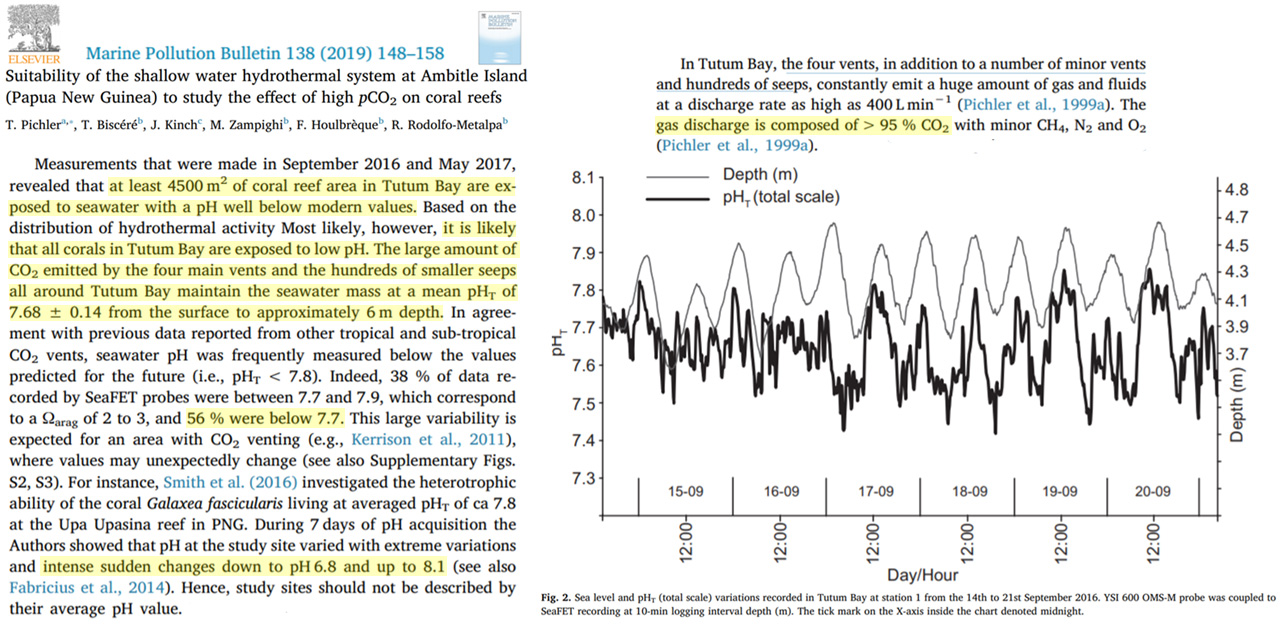
Rising atmospheric CO2 levels do slightly lower the pH of seawater near the surface of the ocean. But that’s precisely the part of the ocean which is most caustic:
Australia’s Great Barrier Reef (GBR) is about 20 million years old. It has withstood CO2 levels both higher & much lower than present, temperatures both substantially warmer & much colder, and water levels both significantly higher & much lower, than present.
https://twitter.com/ncdave4life/status/1531022373067137024
Neither “ocean acidification”[sic] nor warmer temperatures threaten coral. Most coral thrive best in warmest water. Even the very warm southern Red Sea is dotted with healthy coral reefs (unlike the cooler Mediterranean). Reef locations are mostly clustered around the warm equator:
At 7:20 in this BBC video you can hear how wonderfully healthy the coral are in warmest part of the very warm southern Red Sea, off Eritrea:
t=7m20s
That water is MUCH warmer than the GBR.
The GBR in it current location is much younger than that.
“Australia’s Great Barrier Reef (GBR) is about 20 million years old.”
No way. It is about 10,000 years old. Before that it was a limestone range. It was also a coral reef for about 10,000 years during the previous interglacial 125 000 years ago. And so on.
It actually started forming about a million years ago, as the Earth shifted from 40 000 year glaciations to 100 000 year glaciations. This seems to apply to all large reef complexes that have been studied.
https://www.researchgate.net/publication/43508898_The_Great_Barrier_Reef_in_Time_and_Space_Geology_and_Palaeobiology
The retracted paper is about the “smell” of a pristine reef vs a damaged reef, not acidification. The acidification studies are also in the firing line.
OK, so don’t address the “did she or didn’t she falsify the work” issue, just throw out an unjustified comment with no evidence to back it up.
Who do you think you are, a climate scientist?
Quick check, she appeared at the White House and is a very public lesbian. How many assistant professors at a middle tier university appear at White House for briefings?
She clearly ticks all the right boxes, diversity hire.
And she produced the required science needed on demand.
Look for her to leave this Uni and show up in govt.
And the Nobel Prize for form-fit agenda science goes to……..
Thanks for that!
Mr. Guy: That award will be named the “‘I won a Nobel’ Mann Prize.”
Who cares WHY they blew the whistle? She was found guilty of research misconduct, not of being unlikable.
She is a warmist/alarmist what did you expect to get from one except a barrage of lies to push a nonexistent climate emergency stupidity.