Independent KU Leuven university study, commissioned by EU industry, echoes IEA warning of severe global competition for several metals needed in Europe’s energy transition away from fossil fuelsReports and Proceedings
KU LEUVEN / EUROMETAUX
Meeting the European Union’s Green Deal goal of climate neutrality by 2050 will require 35 times more lithium and 7 to 26 times the amount of increasingly scarce rare earth metals compared to Europe’s limited use today, according to a study from Belgian university KU Leuven.
The energy transition will also require far greater annual supplies of aluminium (equivalent to 30% of what Europe already uses today), copper (35%), silicon (45%), nickel (100%), and cobalt (330%), all essential to Europe’s plans for producing the electric vehicles and batteries, renewable wind, solar and hydrogen energy technologies, and the grid infrastructure needed to achieve climate neutrality.
The good news: By 2050, 40 to 75% of Europe’s clean energy metal needs could be met through local recycling if Europe invests heavily now and fixes bottlenecks, says KU Leuven’s “Metals for Clean Energy” study, commissioned by Eurometaux, Europe’s association of metal producers.
But Europe faces critical shortfalls in the next 15 years without more mined and refined metals supplying the start of its clean energy system. Progressive steps will be needed to develop a long-term Circular Economy, which avoids a repeat of Europe’s current fossil fuel dependency.
On March 8, European Commission President Ursula von der Leyen called for European independence from Russian oil, coal and gas, saying “we simply cannot rely on a supplier who explicitly threatens us. We need to act now to… accelerate the clean energy transition. The quicker we switch to renewables and hydrogen, combined with more energy efficiency, the quicker we will be truly independent and master our energy system.”
The independent KU Leuven study is the first to offer EU-specific numbers related to the International Energy Agency’s warning in 2021 of looming supply challenges for the enabling metals needed to help end fossil fuels.
The study says that by 2050, Europe’s plans for producing clean energy technologies will require annually:
- 4.5 million tonnes of aluminium (an increase of 33% compared to today’s use)
- 1.5 million tonnes of copper (35%)
- 800,000 tonnes of lithium (3,500%)
- 400,000 tonnes of nickel (100%)
- 300,000 tonnes of zinc (10-15%)
- 200,000 tonnes of silicon (45%)
- 60,000 tonnes of cobalt (330%)
- and 3,000 tonnes of the rare earths metals neodymium, dysprosium and praseodymium (700-2,600%)
“Although the EU has committed to accelerate its energy transition and produce a great deal of its clean energy technologies domestically, it remains import dependent for much of the metal needed” the study says. “And there is growing concern about the security of supply.”
Supply risks
According to the study, Europe could face problems around 2030 from global supply shortages for five metals especially: lithium, cobalt, nickel, rare earths, and copper. EU primary metals demand will peak around 2040; thereafter, increased recycling will help the bloc towards greater self-sufficiency, assuming major investments are made in recycling infrastructure and legislative bottlenecks are addressed.
Liesbet Gregoir, lead author at KU Leuven, commented: “Europe needs to decide urgently how it will bridge its looming supply gap for primary metals. Without a decisive strategy, it risks new dependencies on unsustainable suppliers”.
Coal-powered Chinese and Indonesian metal production will dominate global refining capacity growth for battery metals and rare earths. Europe also relies on Russia for its current supply of aluminium, nickel and copper.
The study recommends that Europe link with proven responsible suppliers managing their environmental and social risks, questioning why the bloc has not yet followed other global powers like China in investing into external mines to drive ESG standards directly.
Local challenge
“A paradigm shift is needed if Europe wants to develop new local supply sources with high environmental and social protections. Today we don’t see the community buy-in or the business conditions for the continent to build its own strong supply chains. The window is narrowing; projects really need to be taken forward in the next two years to be ready by 2030”.
The study says there is theoretical potential for new domestic mines to cover between 5% and 55% of Europe’s 2030 needs, with largest project pipelines for lithium and rare earths. But most announced projects have an uncertain future despite Europe’s comparatively high environmental standards, struggling with local community opposition and permit challenges, or relying on untested processes.
Europe would also need to open new refineries to transform mined ores and secondary raw materials into metals or chemicals. Europe’s energy crisis makes new refining investment challenging and skyrocketing power prices have already caused the temporary closure of nearly half the continent’s existing refining capacity for aluminium and zinc, while production has increased in other parts of the world.
Global concerns
Coal-powered Chinese and Indonesian metal production is projected to dominate global refining capacity growth for battery metals and rare earths in the next decade. In the spotlight after the Ukraine invasion, Europe also relies on Russia for much of its imported supply of aluminium, nickel and copper.
The study recommends that Europe links with proven responsible suppliers managing their environmental and social risks, also questioning whether the bloc should support investments into external mines to drive ESG standards directly.
The metals in scope today contribute around 3% of the world’s greenhouse gas emissions. Metals and mining operations must manage their local biodiversity impacts, waste, and local pollution potential, while securing human rights.
Recycling
The study finds that by 2050, locally recycled metals could produce three quarters of Europe-made battery cathodes, all its plans for permanent magnets production, and significant volumes of aluminium and copper.
“Recycling is Europe’s best chance to improve its long-term self-sufficiency. It’s a step-up that our clean energy system will be based on permanent metals which can be recycled indefinitely, compared with today’s constant burning of fossil fuels”. The bloc, however, “must act strongly now to raise recycling rates, invest in the necessary infrastructure, and overcome key economic bottlenecks.”
The study notes that metals recycling, on average, saves between 35% and 95% of the CO2 compared with primary metals production.
Recycling “will not provide a viable EU supply source to Europe’s electric vehicle batteries and renewable energy technologies until after 2040, however,” the study clarifies. “These applications and their metals are only just being put on the market and will not be available for recycling for the next 10-15 years.”.
Technology developments and behavioural changes will also have an important influence on metals demand after 2030, but could not be assessed in the study due to a lack of scenarios.
* * * * *
About
KU Leuven
The Katholieke Universiteit Leuven is a research university in Leuven, Belgium. It conducts teaching, research, and services in computer science, engineering, natural sciences, theology, humanities, medicine, law, canon law, business, and social sciences.
Eurometaux, the European Association of Metal Producers
Based in Brussels, Eurometaux represents Europe’s non-ferrous metals producers and recyclers, promoting sustainable production, use and recycling of non-ferrous metals and a supportive business environment.
METHOD OF RESEARCH
Systematic review
FACTS on the internet.
Final energy consumption in the EU in 2020 amounted to 37 086 PJ, ( 35.15 Quads) 5.6 % less than in 2019 (Figure 9). Final energy consumption was slowly increasing from 1994 until it reached its highest value of 41 445 Mtoe in 2006
1.634 million mi² Area of the EU,
Electricity consumption in the United States was about 3.9 trillion kilowatthours (kWh) in 2021.
In 2020, U.S. fossil fuel energy consumption, totaling 73 quads, was at its lowest level since 1991. Among U.S. non-fossil fuel energy sources, renewable energy consumption increased slightly from 11.4 quads in 2019 to a record high of 11.6 quads in 2020.
3,794,100 mi² Area of the US
Take the numbers provided above and determine how much each of the and determine how much each of the 10 metals listed in the article will require, Basically you can do it for the EU and then multiply by two for the US, However that would not consider that the US is twice the size, and the Grid would be twice the size and need twice the length of transmission line and twice the amount of substations and associated breakers to provide a reliable grid.
Pleas have smelling Salts handy when you see the result of the two. and that is just the US and EU, about 1/3 of the globe.
Local Small Nuclear reactors greatly reduces the cost, GREATLY, Also Greatly increases reliability. My utility is already 1/3 “Renewable.” as a result there is an average of one outage every month long enough to cause me to reset all clocks all routers, WiFi system, From 1st grade till I graduated from college i rarely experienced one outage a year, and that was from an automobile accident. Was the same here until we got rid of our NPP.
YOU Must take the time to educate your government representatives.
SMRs might be great – but the Rolls Royce ones in the UK will amount to no more than 2.5 GW by 2035… not significant
Unlike wind & solar devices, the more SMRs installed, the more power is reliably generated.
Installing more & more wind & solar does not guarantee more power being being reliably generated.
Why? Because at night the sun does not shine, and frequently, the wind does not
(oh why am I bothering still trying to get thickheads to grasp these basic facts?)
Because it feels so good when you finally stop
More homework needed from you Griffo on the meaning of “fit for purpose”
Let me again call for a national museum of bad ideas so we can stop making the same mistakes.
Thirty years ago we did studies so our ‘leaders’ could make good choices.
The best good choice is waste biomass to energy. I can find many examples that are 30 years old and counting. Many of these projects also improved local environment because waste biomass is natural source of pollution.
The second best good choice is nuclear power. Looking at the assumptions made in the studies, nuclear power exceeds assumptions by at least 100%. For example, nuclear power plants were assumed to last 30 years. A reasonable assumption 30 years. The Clinton administration predicted nuclear share at 0% by now when it is actually still 20%.
Power companies plan now for 80 year life. I will not live to see it but 20 years from now they will looking at 100 years.
Solar is the worst of the bad ideas. The solar industry talks about expected performance but measures is zero kwh more often than not. The only purpose of solar is a picture for greenwashing.
Depending on location, wind is just a poor choice compared to solar. In the PNW, wind farms suck money out of California. I am for that.
When I look at 30 years of ‘leadership’, I am not worried about find raw materials because we will recycle the bad ideas using more energy than they produce.
The problem with waste biomass is that there is insufficient waste to produce a decent quantity of energy to power society so “waste” becomes “Harvested” AND burning it to produce energy still releases far more CO2 daily than is absorbed by sinks daily SO it isn’t net zero. If it takes 100 years for the sink to grow the replacement tree that is burnt in a day, that is 36,525 trees/days worth of burning
Oh I don’t know – I know of at least one source of waste biomass that has yet to be used as a source of energy and, as far as I know, it’s virgin territory for the enterprising green entrepreneurs. And it’d be far better than trying to turn it into Soylent Green…..
Metals are the least of their problems. Attached, from today’s UK Telegraph, is the UK Climate Committee’s plans for UK Electricity.
Just think how much storage, and of what kind, will be needed to implement this madness.
They are at the same time doubling or tripling the demand for power, due mainly to heat pumps and EVs, and trying to take generation to wind and solar.
Pure, insane fantasy. They have no idea how to do this, and yet these are the great and the good, a serious Parliamentary Committee, and they have every intention of persuading the government of the day to go ahead and keep on with it.
Well the govt just spent £6.7 million on 24 pilot projects for long term storage, there is a large new pumped storage site proposed, there is apparently a pipeline of 32GW of grid scale storage…
There is no way all UK EVs are going to need to be plugged in every night (and anyway there will be a smart charging system)
There is no way everyone with a boiler will be made to rip it out for a hea tpump: the trials with a 20% hydrogen mix are ongoing.
And we continue to build HVDC links to mainland Europe.
shouldn’t be any problem.
How many GWh is that?
32GW of grid scale storage is not a meaningful measure. GW is the amount that can be delivered instantanously, but the question is for how long. That is GWh
I don’t even believe 32GW is in planning. Enough storage to deliver 32GW for even a few minutes is way beyond anything installed or planned anywhere.
To deliver it for the length of time a calm evening in winter in the UK would require? At least 5 hours. To cover a week or more of calms in winter? You’d need two weeks of it. Its not remotely possible to build it. If you could build it you couldn’t afford it.
And anyway, even if you could build and afford it, it wouldn’t lower global emissions at all.
But hey, if I am wrong, just cite the study where the GWh is specified.
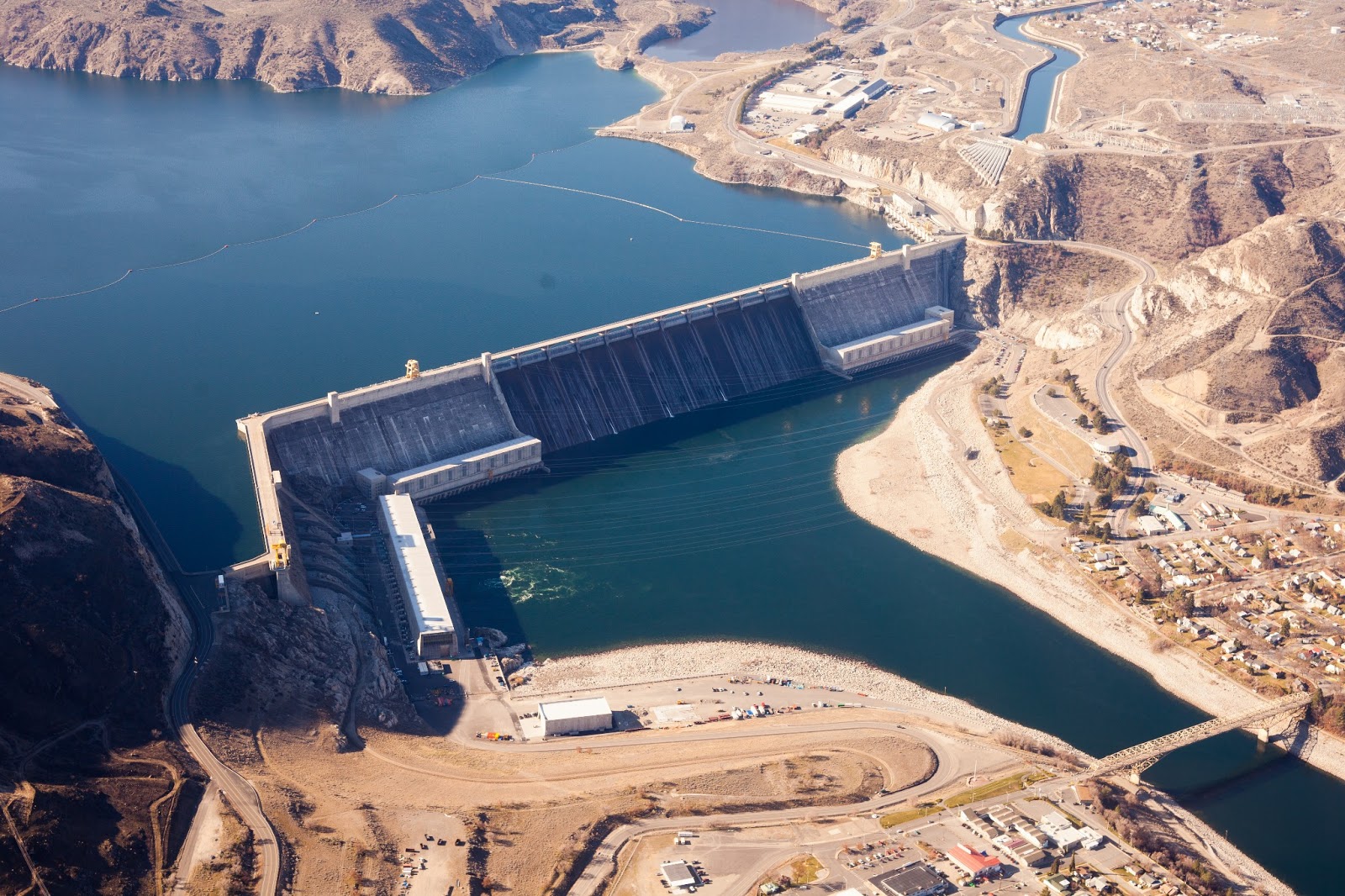
Grand Coulee dam generates 7.2 GW, and it harnesses one of the largest river flows on the planet.
Where exactly do they have enough water to pump back and forth between two reservoirs to produce over 4 times that output?
The late great McKay, writing in ‘Renewable Energy without the Hot Air’ estimated that for the UK to move to renewables it would have to flood (from memory) Wales and the Lake District for pumped storage. It might just have been Wales, don’t recall exactly. At any rate, its that sort of scale.
And then you have to have enough renewable energy to restore it, once you have used it in a cold calm winter week or so.
So the task is not just to find enough mountain area for the pumped storage (if that’s how you provide it).
It is also to provide enough renewable that when the calm eases and you go back to meeting regular demand through wind, you at the same time can recharge the storage. Because the next calm cold spell could happen any time.
The problem isn’t just that its not possible to provide enough storage. Though my graphic above shows clearly enough that the scale needed really is impossible.
Its that even could you do that, you’d have to almost duplicate your base load installation to have enough generation to be able to use it properly.
The whole project of moving to a renewable grid is impossible, the attempt would be an economic and social disaster, and even were it possible, there would be zero effect on global emissions, the alleged motivation for this insanity.
The moment you start actually working through a few days hour by hour and note when the solar actually produces and how intermittent wind actually is, is the moment you realise the gigantic overcapacity of everything you need to build.
And how much energy is going to be lost moving it here and there, through all sorts of processes which have unavoidable inefficiency built in.
Clarification –
“Brit taxpayers were soaked for 6.7 million quid”.
Governments don’t have any funds that don’t come from soaking taxpayers.
That’s 280k per storage pilot
Rounding errors
Hey griff I think you missed the point (as usual) the point this time being the decimal one. Are you sure that’s not 3.2 GW which is what is in the pipeline for short term prospects?
Most of these sites range from 5-10MW to 30+MW with only four approaching 50MW
and another reason why UK will have enough power..
Energy crisis: UK deal struck with Morocco for ‘game-changing’ underwater cables | Science | News | Express.co.uk
I get a blank page from that link.
(Quote from the developers in your linked article)
So, the Brit govt has signed a deal, but they won’t be putting any money down.
I see.
At least Solyndra in the US managed to graft $570 million off Obama before they pulled the plug.
(pardon pun)
Do keep up griff. The UK along with the mud countries is doomed as the economic power shifts to the nations of abundancy-
Sand crisis looms as world population surges, U.N. warns (msn.com)
Sahara-world-most-part-Africa.jpg (1600×1067) (britannica.com)
Now I have these shares in a solar powered sand mining company to get you in on the ground floor with.
Your overlords are driving the entire world economy over a cliff, Griff.
The next recession may make the housing collapse/great recession look like a bikini beach barbecue party by comparison.
If and when that happens, and in the aftermath it becomes known to everyone on the planet it was not done for any purpose that was based on any thing necessary, it is likely to get real ugly for a lot of people.
The project is the only sensible way to provide solar power – put your panels someplace where there is year round sun. Quite why you would also locate your wind turbines in Morocco is a mystery.
But the thing that doesn’t get a single mention in the piece is, as usual, storage. You have according to this 4 hours a day when there’s little or no power. So you have to have 4 hours worth of storage of something like 40GW. Maybe more, its not clear if it supplies 10.5 + 3.6 or just 10.5.
This is 160 GWh. Which you have to be able to draw down totally, and that is going to require overprovision of batteries. 100%? 50%? Where is there a working installation that provides that kind of quantity of power at that kind of draw rate? How much will that cost?
And even when you get through all this, you have still only, on these optimistic estimates, provided for 8% of UK power needs in 2030. If you look at my chart above, both demand and renewable supply are proposed to surge dramatically after 2030. You’ll be lucky if this project delivers 2% of demand in 2040 or 2050, assuming it works at all.
Every link you supply in support of the feasibility of Net Zero in the UK actually is proving, over and over again, the exact opposite. It is not doable, if it were doable it is not affordable, if it were affordable it would anyway not have any effect on global emissions.
However, if over 90% of vehicles and trucks are removed completely and all supplied are delivered to remotely controlled sites (some sort of tracked system), a lot of this demand is also removed. Remember, their goal is to prevent the population from moving around. They want us all to live day to day in our little communities and have no real lives. They want our consumerism to be lowered hugely.
Yeah, demand is less also when you sterilize the population with gene-therapy jabs and lower the number of consumers. That works.
Rare earth metals? Pfft. No one would be getting useful quantities of steel, alumin(i)um, copper, or silicon at net zero. The rare earth metals are essentially useless without the more common sort that is fossil-fuel expensive to produce and always taken for granted.
So they took into consideration all of the battery farms for unreliable energy to last us 30 to 90 days, all vehicles including trucks, all heavy work trucks, all planes, ships, all other new uses of lithium batteries?
The numbers do not sound at all realistic. Maybe if they multiplied by 10 or so…
President von der Leyen saying this “The quicker we switch to renewables and hydrogen, combined with more energy efficiency,”
the first part will not happen and linking hydrogen and efficiency in that sentence is laughable.
Efficiency is a good idea, if appropriate (Insulating old British houses to modern standards is not) but producing and storing green hydrogen is very inefficient and very wasteful.
Who advises politicians?
Really?
There are a lot of high quality refiners recycling lithium in Europe? Refiners that can cheaply maintain lithium purity levels?
Their recycling estimates appear based upon costs to recycle sorted steel and aluminum.
Yup…big difference when it is lumps of elements such as a refined metal, than if is a low concentration of a chemical compound, such as the way lithium is used in batteries.
Recycling can be tricky. Sometimes contaminants from a finished product create problems that are more difficult and expensive to solve than when starting with the common ore.
Europe wants to be independent from supplies of Russian gas and oil. I think that they should also be independent from supplies external to Europe for all these minerals they need to achieve their other goals. Mine it in Europe, you independent pompous asses!
So basically it’s not happening.
Recycling technologies are far from easy to develop. Lead acid batteries for instance require many steps to reuse every component part. Dry battery recycling is complex and the Sumitomo/ Batrex plant in Spiez Switzerland may not yet be fully debugged and operational. Galvanised steel recycling generates steel plant dusts loaded with zinc requiring furnace/ zinc splash condenser combinations which are very difficult. Sump oil or used lube oil refining using steam distillation breaks down additives producing hydrochloric acid in the distillate requiring glass/ glass steel condenser systems. The list is endless .Primary zinc smelters which can also be run on 100% recycled zinc materials are shutting down in Europe on environmental grounds although leaching tests have shown that the granulated slags produced are safe to use in building projects. Separation of combined metals and other materials in finished products makes them very difficult to separate and recycle. Elctricarc/plasma arc and electric induction furnces have been developed but requre abundant cheap electrical energy to run.
These recycling processes require experienced metallurgical, chemical, mechanical, electrical and civil engineers in this specific field – particularly the first two for any chance of success. I fear they are not there in sufficient numbers.
Aluminium smelters because of the Alcan cells consume large amounts of electrical energy. Unless cheaper hydroelectrical power is available the smelters have closed. In the UK Rio Tinto’s Keyser aluminium smelter was forced to close by the green lobby even though it had a captive coal fired power station on site in Anglesey. In the UK there is no stopping this extreme left wing green lobby similarly in the US where even the Republicans seem to be powerless. In the UK the Tories are powerless and Boris Johnson has morphed into e Green Socialist and all the Prince of Wales wants to do is plant trees.
correction – Al smelters have closed due to heavy electrical energy costs.
Rio Tinto’s Al smelter in Scotland was also closed by Scottish Nationalists and Greens refusing the request for Scottish Powers ‘cheaper’ hydroelectric power. Scotland’s Bolshevik government refusing to supply any subsidized power.
Incidentally Rio Tinto also own Canada’s Alcan paying over the odds at the top of the cycle as the white knight purchaser when Alcan were about to be swallowed by the giant Alcoa. They almost bankrupted themselves being in turn saved from a chinese partial takeover by sacking the CEO and intervening with a gallant shareholder rights issue increasing the share base by 50%.
I presume that this study is based on the conversion of the automobile fleet to 100% EVS. I see a growing number of Teslas in my area. These cars haul around more than a half ton of batteries, most of which capacity is unused on a daily basis. A far more practical approach would be the adoption of hybrids and plug-ins that take advantage of the best features of the internal combustion engine and battery powered propulsion without requiring massive amounts of rare metals. The Toyota Prius Prime hybrid gets over 60 miles per gallon. My Ford Escape PHEV has reduced my gasoline consumption by 85%. We need to think rationally. Fossil fuels are a precious resource we should use wisely.