Guest Post by Willis Eschenbach
Among blue-water sailors like myself, the area of the ocean from 40° South to 50° South is called the “Roaring Forties” because of the strength of the winds that blow there so often.
And the next ten degrees south of that? They are called the “Furious 50’s”, followed by the “Screaming 60’s” (thanks to the commenters who corrected my names). There, the winds can blow unimpeded around the globe.

Figure 1. The cold pole.
Compared to the South Pole, the North Polar weather is far less complex. The North Pole is underlain by the Arctic Ocean, ice-covered most of the time. The South Pole, on the other hand, has a continent in the middle. And it’s mostly a high elevation permanently frozen chunk of rock. It sheds icy winds and glacial chunks into the surrounding ocean. Due to the constant winds and storms, the “mixed layer” around Antarctica is deeper than anywhere in the world.

Figure 2. Mixed layer depth.
And why is this of note? Well, I was asked to take a look at a recent peer-reviewed study called “Simulated Twentieth-Century Ocean Warming in the Amundsen Sea, West Antarctica“.
And where is the Amundsen Sea when it’s at home? It’s off of the coast of Antarctica, down below 60°S.

Figure 3. Oceanic warming trends, showing the Amundsen Sea.
A short digression. Roald Amundsen was one of my heroes when I was a kid. He was a famed polar explorer. He led the first expedition to reach the South Pole. He was also the first man to sail the Northwest Passage from the Pacific to the Atlantic over the top of Asia and Europe. As a boy I remember seeing his ship “Gjøa”, the one that he used for the Northwest Passage, up on blocks in Golden Gate Park in San Francisco. Even as a young inexperienced sailor, I was amazed at how small it is, only 70 feet (21 meters) long. Amundsen definitely had albondigas of pure brass … but I digress
The press release about the study is”Researchers demonstrate new link between greenhouse gases and sea-level rise“. Inter alia, it says (emphasis mine):
A new study provides the first evidence that rising greenhouse gases have a long-term warming effect on the Amundsen Sea in West Antarctica. Scientists from British Antarctic Survey (BAS) say that while others have proposed this link, no one has been able to demonstrate it.
Well … in a word, no. The study doesn’t provide any evidence at all, not one scrap. What it provides instead are the results of computer models using another computer model as input.
Sigh. Look, if computer models were “evidence”, I’d be a very rich man based on my 1980’s evolutionary-based computer model of the stock market … but computer model results are not evidence. They are merely the understandings and more importantly the misunderstandings of the programmers made solid.
The study itself says:
Our simulations are performed using the Massachusetts Institute of Technology general circulation model including components for the ocean, sea ice, and ice shelf thermodynamics. Here we build on the Amundsen Sea configuration, which has been updated and re-tuned to provide best agreement with observations when forced with the latest ERA5 atmospheric reanalysis.
The “ERA5 atmospheric reanalysis” is a computer climate model which is forced with whatever data is available. The model then fills in the blanks where there is no actual data … like say the Amundsen Sea, where people only venture very rarely, and even then only in modern times.
Let me take a heel-turn to the question of the performance of the climate models. This study is about sea levels and ocean temperatures. Folks keep telling me that the climate models have done well for decades. So I looked at the first IPCC Assessment Report. Here are their sea-level projections:

Figure 4. Sea level projections from the IPCC AR1 Report.
And here is a close-up of that figure, with the actual sea level rise overlaid on the graph.

Figure 5. Actual sea level rise, compared to the IPCC projection.
Oops …
Moving to more modern models, here are model estimates of the post-1981 sea surface temperature (SST) rise from a number of CMIP6 models. These are the computer outputs of the sea surface temperature identified in the CMIP6 models as the variable “TOS”, the temperature of the ocean surface. Below I’ve compared them to the Reynolds OI SST observational dataset.

Figure 6. Modeled and observational sea surface temperature (SST) rise, 1981 – 2021
As you can see, the models are … well … let me call them “much less than accurate” and leave it at that.
To return to the Amundsen Sea, here are some of the complexities that affect the weather there.

Figure 7. Amundsen Sea.
As you can see, the sea temperature and the weather are affected by the Circumpolar Current, circumpolar winds, the Antarctic Slope Current, the Amundsen Sea Polyna (open water) in the middle of the Amundsen Bay sea ice, the varying ocean depths, and the ever-changing sea ice. It’s a most intractable and complex area to model.
To return to RealWorld from ModelWorld, here’s a look at just where and how the ocean has warmed and cooled since 1981.

Figure 8. Decadal trends in sea surface temperature (SST), Reynolds OI observational dataset.
As you can see, there’s been a bit of cooling in the SST in Amundsen Sea in this 41-year period.
Moving on, how well do their model results agree with the ERA5 reanalysis? Here’s their graphic:

Figure 9. Original Caption: “Timeseries of conditions in the Pacific Pacemaker Ensemble (PACE) simulations (blue) and the ERA5 simulation (red). Thinner blue lines show the 20 PACE ensemble members, while the thicker blue line is the ensemble mean. (a) Zonal wind (m/s) averaged over the shelf break. (b) Temperature (°C) averaged over the Amundsen Sea continental shelf between 200 and 700 m. (c) Basal melt flux (Gt/y) for ice shelves between Dotson and Cosgrove inclusive.
YIKES! Their own models don’t even begin to approximate the ERA5 reanalysis, which is the information that is used as an input to the models. And like the Reynolds OI SST, the ERA5 reanalysis shows slightly cooling temperatures in the Amundsen Sea, where the models claim warming … bad models, no cookies!
Oh, yeah, almost forgot. I did an analysis looking for what I call “weasel words” in their study. These are words that show their conclusions are weak. They include “could”, “may”, “might”, “possibly”, “plausibly”, “potentially”, “suggests”, and “assumed”. Those words are used a total of 34 times in their study … no bueno.
In closing, the study itself says (emphasis mine);
Rapid ice loss is occurring in the Amundsen Sea sector of the West Antarctic Ice Sheet. This ice loss is assumed to be a long-term response to oceanographic forcing, but ocean conditions in the Amundsen Sea are unknown prior to 1994. Here we present a modeling study of Amundsen Sea conditions from 1920 to 2013, using an ensemble of ice-ocean simulations forced by climate model experiments.
“Simulations forced by climate model experiments” for a location where ocean conditions are “unknown prior to 1994” … it’s models on top of models all the way down, what could possibly go wrong? It’s clearly destined to be a lead article in the “Journal of Irreproducible Results“.
I weep for the death of science.
Finally, let me mention that the Amundsen Sea is only 0.085% of the total ocean area … it appears that what we have here are scientists with models looking for funding. Not saying that’s a bad thing, just that it can easily lead to … well … this kind of study.
Here, I’ve just spent three days (well, part-days, I’m retired) mowing a couple of acres of steep hillside in our opening in the forest … and today, rain, marvelous rain. Life is good, what’s not to like?

My best wishes to you all,
w.
AS USUAL: When you comment, please quote the exact words you are responding to, so we can all be clear on your subject.
I wonder if the word ‘will’ could be added to the list of weasel words.
Lots of bad things apparently _will_ happen because of our evil FF burning ways. I take that to mean these bad things _haven’t_ happened.
How would you then write a honest prophecy?
Willis, you look at Figure 8 (Decadal trends in sea surface temperature (SST), Reynolds OI observational dataset) and see the cooler bits. I see the areas with excessive warming. You will notice that the cooler areas are big and if I were to guess it would be that cooler deep water is being brought to the surface. Cooling is easy.
Look instead at the warming areas. In particular look at the little red patch that is the Black Sea, warming at 5 deg C per century, five times faster than can be explained by the CO2 warming hypothesis. Next to the Black Sea is the Sea of Marmara (not visible) which is warming even more rapidly. The large warming patches in the Pacific look like gyres, but most of the really anomalous areas are associated with civilisation: the Sea of Japan, a very industrialised shoreline; the Red Sea, a lot of tanker traffic; the Eastern Med; the Arabian Gulf, ditto. The River Plate has a warming area where it flows into the South Atlantic. Etc, etc.
A poster above carried out an experiment to see if oil pollution on water led to warming but found nothing, With all due respect – a commitment to experiment is an attitude that the IPCC could well emulate – I suggest that the experiment was on too small a scale. Oil/surfactant/lipid from oleaginous phytoplankton warms by albedo reduction and reducing evaporation. (There’s some odd data somewhere about falling pan evaporation rates in the 20th century which I would attribute to airborne pollution, see SeaWifs ‘Up in Smoke’) Israeli fish farmers use the effect on fish ponds and Chinese farmers used to warm their rice paddies using the same.
Marmara is in a hell of state with vast blooms of diatoms. Wonderfully oily little beggars, diatoms when they die release their lipids – I have an image of a smooth running from abeam Porto to a couple of hundred miles short of Madeira which I can’t imagine came from human pollution, unless the blooms are aided by dissolved silica run-off from modern agriculture, sewage and associated nutrients. Thank you, Dr Haber.
Enough. Let’s have a Feynman guess. There is a contribution to global warming from localised pollution by oil/surfactant/lipids which lower albedo, warming, reduce evaporation, warming, and by suppressing wave breaking reduce the availability of salt aerosols so less low level stratus, warming. [Note for old maritime people: the Madeira smooth suppressed wave breaking up to Force 4/5: personal observation from 40,000ft.]
There are two educational/research establishments I’d love to see involved in explaining these local warming areas, Michigan U because it’s right next door to them and UEA because Broad Lake in their grounds shows a beautiful smooth in a readily available image – right under their noses. As Sherlock tells us, ‘you look but you don’t see.’ Let’s dub the results ALW, Anthropogenic Local Warming.
Some measure of pollution smoothing is now possible – see Ruf and Evans and a paper Effects of microplastics and surfactants on surface roughness of water waves, Sun, Ruf, Bakker, Pan.
Anomalous warming areas cannot be caused by the well-mixed CO2, so there are other warming factors. Perhaps those factors will constrain the more extreme predictions of AGW.
Anthony has a lot more in this vein from me, including a couple of nice images.
JF
JF
Have you read my report.? I Did do a test with oil but it was a small scale experiment. I just checked and it appears that there are many mud volcanoes in and around the Black Sea. This further strengthens my theory about the origin of global warming.
Thanks
Thanks, Julian, always good to hear from you. I’ve often wondered, not about whether such an oil/lipid effect exists, but a) how big it is and b) how to measure it. No real insights into either one.
w.
For lakes there might be a correlation between warming and population density on their shores but it would be very flaky. Michigan U could usefully send some undergrads out in canoes with some blotting paper to test for pollution.
I can’t post images, but the Broad Lake smooth at UEA makes me chuckle — to think of Tom Wigley hammering down the blip and never seeing the reason outside his window. He’s not alone, there are smooths everywhere and I can’t look at a seascape without scanning it for the giveaway shades. Most people just don’t see them.
Ruf and Evans have the ability to measure large smooths all over the oceans — they were looking at microplastic pollution and got side-tracked into surfactants as they occur together — the most significant advance in decades: if someone ties in total area of big smooths with some sort of measured SST on an experimental lake then we might have some estimate of the total amount of ALW. The other paper I referenced has shown the albedo effect in a tank — I think — so that could be a place to start. Salter’s cloud ships had maths behind them, but without aerosol sampling over smoothed and unsmoothed ocean there’s no read across.
It’s all out of my league. I make the Feynman guess and others look at the data. My work here is done.
JF
Hi-yo Silver! Away!
JF
Willis Compliments on insightful explorations.
On detecting lipids on the Sea of Marmara, may I suggest exploring the potential for using Quad-Polarimetric SAR data to detect Oil Spills. Researchers Wang D. et al. ~75% accuracy using deep learning models.
Wang D et al BO-DRNet: An Improved Deep Learning Model for Oil Spill Detection by Polarimetric Features from SAR Images.
Remote Sensing. 2022 Jan;14(2):264
https://www.mdpi.com/2072-4292/14/2/264/htm
Good posting.
Wouldn’t it be interesting to know exactly when in the process, from proposal through final report, that the summary was written?
Models are software. Software that doesn’t provide correct resuts is a failure–for a given value of correct.
What a gorgeous image to retire to.
In your figure 8, there is a small patch off the SE coast of Australia where the SST has risen 1.2C in the last 40 years. Now that baffles my tiny mind given that the current flows south down the East coast. What am I missing?
Check for volcanic activity.
Look for run-off from agriculture. Dissolved silica is a limiting nutrient for lipid releasing diatoms. Look for run-off from urban development. Oil and surfactant smoothing lower ocean albedo.
Is that what is happening? Until someone looks we’ll never know.
JF
Is it possible that the current is bring warm equatorial water south and then the current is slowed down or turned when it interacts with the strong currents around Antarctica – letting the heat affect the area more?
Thank you, Willis.
“I must go down to the Seas again, to the lonely sea and sky.
and all I ask is a tall ship, and star to steer her by.”
_John Masefield -”Sea Fever.”
Fair winds, sir.
Thank goodness for Willis’ intelligent data analysis article after what seems like dozens of anti-media-hype caterwaul articles. Thanks W.E.
Ah, simulations!
There was a recent article on Slashdot about some online forum called Pinterest was seeking to cleanse itself of Climate Disinformation.
This provoked a spirited discussion because there remain a non-trivial number of people who question received wisdom on Slashdot, whether of climate or other scientific and social controversies.
Slashdot bills itself as “News for nerds”, and among largely computer nerds there is a strong, highly opinionated faction claiming “you are an uninformed moron if you question Climate Change — it is a fact.” Some may have experienced this attitude in the workplace when asking for help with an office computer — many on Slashdot live up to that stereotype. I took a chance that I too would be labeled a moron and risked responding to such a comment.
My three responses to claims that climate skepticism is flyover-country Know-Nothingism were 1) yes, temperatures are increasing but at the low end of the ensemble of computer models, 2) claims of temperature proxies not showing the Medieval Warm Period and the Roman Climatic Optimum may be the result of careless (to put it charitably) application of Principal Components Analysis (PCA) and 3) whereas CO2 trapping heat can be considered a fact, the dire predictions of Climate Emergency are derived from computer models that assume a substantial multiplier effect from increased atmospheric moisture content, the magnitude of which is largely speculative at this point.
What is interesting is that my post was up-moderated to a 5, the highest level. There must be people on Slashdot receptive to these arguments. What was also interesting was that I was subsequently down-moderated to a 4, still a high level, but the down-moderation suggesting suppression of this viewpoint.
What is also of note that a reply to my post dismissed my claim of actual temperatures being at the low end of the model ensembles, counter-claiming another source “fact-checking” this as false. I also got a “citation please” regarding the Steve McIntyre critique of the Hockey Stick along with ’tis ‘taint back-and-forth regarding the accuracy or lack-thereof of Hansen’s 1998 predictions.
There are many other arguments to make about climate alarmism, but in giving a short answer as to why “denial of climate change” is not necessarily “misinformation”, do I have those three main points right, or would people here express them differently? I hate it when people support a position in a controversy with glib “talking points”, but I think a small number of defensible points are useful when engaging someone who insists there is no basis to question claims of a Climate Emergency.
I am not going to bother with this at the Thanksgiving dinner table, but I am talking about a setting like Slashdot that hasn’t yet become completely dominated with climate alarmism. If you cannot discuss scientific controversy with people who self-identify as “nerds”, where can you have such a discussion?
What say others here on WWUT?
What do people who are digging their own graves do when their shovels reach the center of the earth?
Carry on chaps, we’re half way there now.
I say you make good, defensible points that “fact-checkers” would have a hard time disproving. There are innumerable graphs on the internet and her at this site to show how models are not following current temps properly. Water content in the atmosphere MUST show an increase if GHG theory is correct, and the fact checkers should be able to show that is the case.
For fun, go the opposite route – tell them they are doomed! According to IPCC data any of the Herculean climate emission reductions demanded by Kyoto, Paris, or COP26 or Net-Zero 2050 will lead to microscopic temperature attenuations. Since we are already at the 5 minutes to doomsday level of about 1.2°C, and since there is a huge amount of reliabled fuelled power plants planned or already under construction, enough to dwarf all the current emissions of so-called developed countries, then there is no chance of of holding things down to 1.5, or 2.0 or any number you like.
So it’s not worth the trouble of protesting or other political action if it has no effect.
See if their heads explode.
It’s interesting to note a recent swarm of 85,000 volcano-tectonic earthquakes since August 2020, observed occurring at a location close to the Orca submarine volcano near Antarctica:
https://www.nature.com/articles/s43247-022-00418-5
“Scientists from British Antarctic Survey (BAS)”
Well there’s yer problem. The Brits are still pissed that Amundsen handily beat Scott, and didn’t lose a single man.
I’ve often thought that that must have been one of the saddest moments in exploration history, when Scott’s ill-prepared, poorly organized expedition finally made it to the South Pole via superhuman efforts … only to find the Norwegian flag planted there and Amundsen come and gone.
Seems like that would take all the starch out of a man.
w.
A Beautiful Idea Murdered by Ugly Facts?
“Under the wide and starry sky,
Dig the grave and let me lie.
Glad did I live and gladly lie,
And I laid me down with a will.
This be the verse you grave for me:
’Here he lies where he longed to be;
Home is the sailor, home from the sea,
And the hunter home from the hill.’”
-Requiem,Robert Louis Stevenson.
Great poem.
Thanks again for your contributions,Willis.
Hi Willis, as sharp as ever, as usual.
“my 1980’s evolutionary-based computer model of the stock market” Attracted my special attention. I recently published my modelling of such which I did 50 years ago. I produced a formula for prices of investment quality stocks. This is it’s first presentation.
This may be of interest:
https://www.obooko.com/free-business-and-management-books/shares-that-grow
Willis
Somewhat O/T
Eric Newby (a UK writer of a book or four on travel and other things) was a midshipsman on one of the clipper ships in the last great grain race from Australia to the UK towards the end of the 1930’s.
https://en.wikipedia.org/wiki/Eric_Newby
https://en.wikipedia.org/wiki/The_Last_Grain_Race
Such nautical leanings got him into the SBS in WW2
https://www.eliteukforces.info/special-boat-service/
And into a POW camp
Not a Midshipman, an Apprentice.In the Merchant Navy I believe the only British company to have Midshipmen was Blue Funnel, all others were Cadets or Apprentices.
The strong temperature drop of the Peruvian Current promises to strengthen La Niña.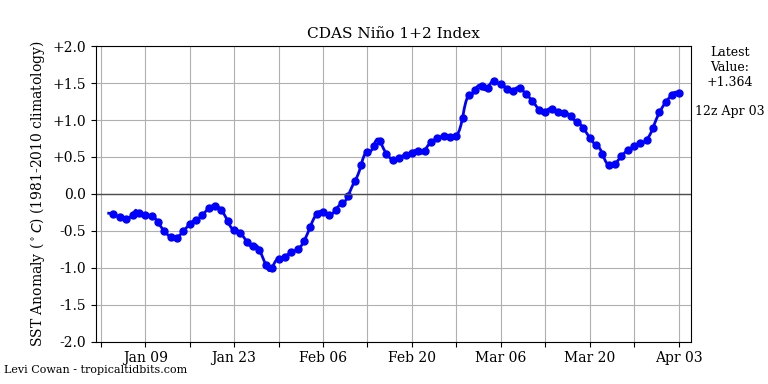
Salvacetti et al 2018 showed the Humboldt current to be at its coldest in the entire Holocene, having sharply cooled in the last century:
https://agupubs.onlinelibrary.wiley.com/doi/full/10.1029/2018GL080634
“Oh, yeah, almost forgot. I did an analysis looking for what I call “weasel words” in their study. These are words that show their conclusions are weak. They include “could”, “may”, “might”, “possibly”, “plausibly”, “potentially”, “suggests”, and “assumed”. Those words are used a total of 34 times in their study … no bueno.”
This was published before your article about peer review, but is a good demonstration of why no amount of changes to peer review can improve bad science.
There is no substitute for doing the leg work and using the brain, even briefly, to actually assess what is presented. Expecting others to “fact check” is just mental laziness.
Funny how the video gamers, er, I mean climate scientists chose to zero in on that tiny region of warming in the shallow bay and ignored all that light blue cooling wrapping its way all around the continent and reaching northwards to Africa and especially South America.
True science is dead, long replaced by political science propping up the party line.
Bouna Pasqua Willis and same to everyone here who you graced with your intelligence and wisdom.
A good friend and frequent visitor to The Great Southern Ocean referred to them as the Furious Fifties and The Screaming Sixties.