The Impact of CO2, H2O and Other “Greenhouse Gases” on Equilibrium Earth Temperatures
By David Coe
The cries of Climate Emergency are becoming ever more strident. We are bombarded on a daily basis from almost every section of the media with stories of impending doom unless we take immediate and decisive action to prevent a climate catastrophe. This action includes the rapid adoption of a “zero carbon economy”. But what does this actually mean?
Carbon is the atom which, above all others, is the basis of life on this planet. Its unique atomic structure enables it to combine with other atoms to produce the amazing variety of complex molecules necessary for all forms of life.
Of course ,what is meant by “zero carbon” is actually zero carbon dioxide, the molecule which has been “fingered” as the demonic source of global warming, now known as climate change, climate emergency, climate catastrophe or whatever the next superlative tag can be attached to the word climate.
Just how does carbon dioxide come to be the instigator and chief cause of global warming? I say chief cause, because other gases are also in the frame as contributors, namely methane and nitrous oxide, for which the global agricultural sector is shouldering the blame, because of methane liberated by cattle and nitrous oxide from fertilisers. The story goes like this.
The atmosphere contains 400 parts per million (ppm), 0.04%, of carbon Dioxide (CO2) which is known to be a strong “greenhouse gas”. A “greenhouse gas” is one which is transparent to incoming solar radiation, but which is a strong absorber of outgoing infra-red energy radiated by a warming earth. The more CO2 in the atmosphere, the more outgoing radiation is absorbed and the warmer the planet gets. Simples!
Carbon Dioxide
Carbon dioxide just happens to be the vehicle for providing the carbon for the production of the complex organic molecules necessary for life, through the process of photosynthesis in plants which in turn provide the feedstock for all other forms of life. Without CO2 in the atmosphere there will be no life on earth. Photosynthesis extracts huge quantities of CO2 from the atmosphere on a seasonal basis. As a result, atmospheric CO2 concentrations exhibit a significant seasonal variation as shown in Figure 1, with the effect that CO2 levels undergo a rapid reduction in the northern hemisphere in the spring and summer as vegetation awakes from its winter slumbers and bursts into life with massive regrowth from the CO2 sequestered from the atmosphere.
In addition to this seasonal variation there is an underlying persistent increase in CO2 levels, which has been attributed to the release of CO2 into the atmosphere from the combustion of fossil fuels which have powered the industrial economies since the start of the industrial revolution some 200 years ago. Since that time CO2 levels have risen from 280ppm to over 400ppm. It is also worth noting that the seasonal variation itself increases with latitude so that the seasonal variations in the arctic circle are some 10 times greater than the annual increase attributed to the combustion of fossil fuels, underscoring the role that nature plays in the atmospheric presence of CO2.
Figure 1:- annual variations in CO2 concentrations at latitudes up to 82°N

It is this annual increase, however, which is fuelling the concerns over the warming of the planet. At first sight these concerns appear to be well founded and should not be dismissed. Equally, neither should the economic consequences of a “zero carbon economy” be ignored. It was absolutely right therefore for the United Nations to take a lead in determining the exact nature of the causes and implications of “anthropogenic global warming” by setting up the “Intergovernmental Panel on Climate Change” (IPCC) in 1988. Their mandate was and still is to identify the evidence to support the concept of global warming and seek methods to mitigate its impact.
The IPCC set about its task with exemplary determination in seeking evidence to support the concept of anthropogenic warming, while, unfortunately, studiously ignoring any and all evidence which might suggest an alternative narrative. There is thus an inbuilt bias in the terms of the IPCC and certainly in the manner in which it operates.
After some thirty years of extensive efforts by thousands of climate scientists around the world and the expenditure of billions of dollars, granted to universities and others for the research work, there is still considerable uncertainty about the impact on global temperatures of the so called “greenhouse effect”. This is summed up neatly by the UK MET office in its website “What is Climate Sensitivity?”, in referring to Equilibrium Climate Sensitivity (ECS), which is a parameter invented by the IPCC to represent the increase in average global temperature caused by a doubling of the atmospheric CO2 concentration.
“As there is no ‘perfect’ way of estimating climate sensitivity, it remains a hotly debated area of science and there remains a wide range of estimates of what the ECS could be.”
In fact, estimates of climate sensitivity throughout the years have varied between 1°C to over 6°C, settling down at this moment in time to a band between 1.5 and 4.5°C, still a factor of three variation. Why is there such uncertainty? Well, the atmosphere, while a relatively thin layer of gas around 50km thick, is an incredibly complex entity, often described as a non-linear chaotic system.
The Greenhouse Effect
The composition of the atmosphere has varied over history, but at this time comprises nitrogen(77%), oxygen(21%), argon(1%), Water vapour 1%, CO2 0.04% (400parts per million) with trace levels of methane (1.8parts per million) and nitrous oxide (0.32parts per million). Of these gases CO2, water vapour, methane and nitrous oxide are considered to be greenhouse gases. That is, they absorb some of the infra-red energy being radiated by the earth into space, while freely transmitting solar energy down to the earth’s surface.
The earth’s average temperature is determined solely by the energy balance at the top of the atmosphere. The radiation emitted by the earth is a function of its temperature. The warmer the earth, the more radiation it emits. When the energy radiated by the earth into space is equal to the solar energy received from the sun, the earth temperature will have reached equilibrium and will be stable. When some of this radiated energy is absorbed by the atmosphere, the energy balance is disturbed, and the earth warms in order to restore the balance. The question is, by how much?
Effective Earth Temperature
The starting point for this question is, what would be the temperature of the earth if no atmosphere existed and the earth’s radiation was emitted through to space without any absorption? From a knowledge of the intensity of solar radiation received by the earth and the infra-red radiation emissions as a result of the earth’s temperature, it is widely accepted that the average earth temperature would be a chilly -18°C.
Atmospheric Absorption
The current average earth temperature is generally reckoned to be a comfortable +15°C and so the total impact of the atmospheric greenhouse effect is to produce a warming of 33°C. What we need to know is precisely the impact of each of the “greenhouse gases”, particularly that of CO2. How do they each contribute to this warming? The answer to this requires a detailed knowledge of the infra-red absorption characteristics of these gases.
We are, therefore, fortunate to have HITRAN, a free access data base of molecular spectrographic data available to us. HITRAN was first introduced almost 50 years ago and has developed since then, particularly over the past 20 years, into the foremost repository of gaseous molecular spectra. From this dataset we can now calculate with high precision the radiation absorption characteristics of these “greenhouse gases”.
First, however, it is necessary to know the nature of the radiation emitted by the earth. All bodies radiate energy, the hotter the body, the higher the emitted radiation intensity. Figure 2 shows the intensity and wavelength of the radiation emitted by the earth at its current average temperature of 15°C. This radiation spectrum extends from the near infra-red (3micron) to almost microwave (100micron) wavelengths. Micron is a common unit of radiation wavelength equal to one millionth of a metre. Visible light, for example, extends from blue light at 0.4micron to red light at 0.65micron, and is emitted in copious amounts by the sun as a result of its high temperature in excess of 5000°C. The 15°C temperature of the earth results in emitted radiation at much longer wavelengths up to 100micron.
Figure 2

Absorption due to CO2
Figure 3 shows the transmission of the earth’s emitted radiation through the current 400ppm of atmospheric CO2 across the radiation emission spectrum shown in Figure 2.
Figure 3

The small amount of atmospheric CO2 takes a large slice out of the emitted radiation, absorbing some 18.7% of the total radiated energy.
Absorption due to Water Vapour
The most abundant greenhouse gas is water vapour. The concentration of water vapour in the atmosphere, unlike the other greenhouse gases, is determined solely by temperature and pressure, taking it out of the influence of mankind. Figure 4 shows the spectral transmission of the radiated energy to space through the atmospheric water vapour.
Figure 4

Water vapour takes an absolutely huge bite out of the radiated energy, absorbing 67% of that energy, including all energy at wavelengths beyond 20micron. This would imply that the combined absorption due to CO2 plus water would be 18.7% + 67.0% = 85.7%. This would also be wrong!
If you compare Figures 3 and 4 it will be apparent that the absorption bands of the two gases overlap to a large degree. In particular, because the water spectrum dominates, the impact of CO2 is much reduced so that when the two spectra are combined the absorption is as shown in Figure 5. In effect the two gases fight over the common absorption wavelengths, and of course due to its much higher abundance, water vapour wins.
Figure 5

The result is that the total absorption by the combination of CO2 and water vapour is 72.6% and the impact of CO2 on absorption is thus to increase the absorption due to water alone from 67% to 72.6% an increase of just 5.6% not the 18.7% due to CO2 on its own. This has a major bearing on the role of CO2 with respect to its global warming potential.
Absorption due to Methane
The role of methane is important, not simply because it is a “greenhouse” gas, but because it has been identified as a “major contributor” to climate change, to the point that there is now pressure to refrain from eating meat and to adapt to a vegetarian diet. This is on the basis that farm animals, and cattle in particular, are major emitters of methane. It would therefore be quite interesting to determine exactly the contribution made by methane to the atmospheric absorptivity.
Figure 6 shows the transmission of radiation through the 1.8parts per million (ppm) of methane currently in the atmosphere.
Figure 6

It has a much smaller absorption profile than CO2 providing a total absorption of 1.6%. So much for the erroneous claims that methane is 100 times more powerfull a greenhouse gas than CO2. As with CO2, the absorption bands overlap with those of water vapour and also those of CO2, so that the impact of 1.8ppm of methane increases the total absorption from 72.6% to 72.8%, an increase of only 0.2% The inescapable conclusion is that current methane levels have minimal impact upon atmospheric radiation absorption.
Absorption due to Nitrous Oxide
Atmospheric nitrous oxide concentrations at 0.32ppm are the lowest of the four commonly encountered greenhouse gases. Its absorption spectrum is limited to a small region of the radiation transmission as seen in Figure 7 with an absorption of 1.7%, similar in fact to the absorption of current levels of methane. Its absorption bands, also like methane, are overlapped by those of water vapour and CO2, resulting in a contribution to absorption also of 0.2% bringing the total atmospheric absorption of radiated energy to 73.0%.
Figure 7

Resultant Atmospheric Absorption
The combined total effect of greenhouse gas absorption is put into perspective in the pie chart of Figure 8, demonstrating the dominance of water vapour in the absorption of emitted radiation.
Figure 8

Section 1 blue – Absorption by CO2 5.6%
Section 2 orange – Radiation transmitted through the atmosphere 27.0%
Section 3 grey – Absorption by Water Vapour 67.0%
Section 4 yellow – Absorption by Methane + Nitrous Oxide 0.4%
It is clear from this chart that water vapour is by far and away the most powerful absorber of the earths radiated energy.
Absorbed Radiation – where does it go?
So far the data presented on the absorptivity of greenhouse gases is based upon the well documented gaseous spectral data in the HITRAN database and known atmospheric composition, without any conjecture or assumption.
The issue now is to compute the impact on global temperature of this atmospheric absorption of energy. First, however, we must answer one vitally important question. What happens to the 73% of radiated energy absorbed by the atmosphere?
It is not unreasonable to believe that the atmosphere itself will warm as a result of this energy input, and if so, will reradiate some of this energy into space, while the remainder will be retained by the earth thereby warming it. The question then is – how much of the absorbed energy is ultimately retained by the earth? Failure to provide an accurate answer to this question has resulted in the wide variation in estimates of the climate sensitivity to CO2 and uncertainty in the predictions of global warming to the present date. Attempts to answer this by computer modelling the complex atmospheric processes, while proving very lucrative for an army of climate scientists and universities over several decades, have been essentially futile.
There is, though, despite the pronouncements of the UK Met Office, a simple method for the determination of retained energy that requires no knowledge of, or assumptions about, the complex atmospheric processes, that will enable us to accurately determine the climate sensitivity of all greenhouse gases.
Current Earth Temperature
We know the solar energy reaching earth. It is the same value as used to calculate the Effective Earth Temperature of -18°C, with no atmosphere. It is also generally agreed that the average earth temperature is 15°C or thereabouts. From that temperature it is possible to calculate the amount of energy radiated by the earth. It is in fact the sum of the energies over the spectral range 3 to 100 micron shown in Figure 2. Now some of that energy will be absorbed and retained by the atmosphere. The rest will be transmitted through to space. It is a simple calculation, using the energy balance at the “top of the atmosphere” to show that, in order to maintain a temperature of 15°C only 61.5% of the radiated energy will be transmitted to space. Thus, a total of 38.5% of the radiated energy must be absorbed and retained by the atmosphere/earth.
This is not conjecture. It is a simple fact.
However, we have determined that the atmosphere currently directly absorbs 73% of the outgoing energy, therefore it is a further simple calculation to realise that only 52.7% of this absorbed energy is actually retained by the earth and its atmosphere (52.7% of 73% = 38.5%).
This figure of 52.7% of absorbed energy retained does not differentiate between which gases are responsible for the energy absorption. It applies equally to all the absorbed energy no matter which gas is responsible. This enables us to determine how much energy absorption and retention can be attributed to each greenhouse gas. It is simply 52.7% of the absorption values shown in Figure 8.
We can now look at the total radiation transmission and absorption budget in Figure 9

Figure 9

Section 1 blue – Absorption by CO2 3.0%
Section 2 orange – Absorption by Water 35.3%
Section 3 grey – Total Radiation transmitted through to space 61.5%
Section 4 yellow – Absorption by methane + nitrous oxide 0.2%
We see immediately that only 3% of the energy radiated by the earth is actually absorbed and retained by the CO2 in the atmosphere.
Impact on Temperature
The total energy absorbed and retained by the atmosphere (38.5%) produces the warming of 33°C to provide us with the current temperature of 15°C. Because we now know the absorption contribution for each of the greenhouse gases we can allocate their individual contribution to the 33°C warming ( Figure 10 ).
Figure 10

1 Blue – Methane + Nitrous Oxide 0.3°C
2 Orange – CO2 3.3°C
3 Grey – Water Vapour 29.4°C
Some 90% of the current warming, a total of 29.4°C can be directly attributed to water vapour. CO2 contributes just 3.3°C while the combined impact of methane and nitrous oxide is a barely measurable 0.3°C.
Not only can we attribute the present warming to individual greenhouse gases, we now have a method of predicting the warming resulting from increasing levels of individual greenhouse gases from their respective infra-red absorption spectra and the HITRAN database.
Warming due to the Increase in CO2 from 280 to 420ppm
It is believed that prior to the industrial revolution, atmospheric CO2 levels were typically 280ppm. Since then CO2 levels have increased to 420ppm. From the absorption spectra we can calculate that the absorptivity of the atmosphere will have increased from 72.7% to 73.0% during that period, due to this increase in CO2 levels. The increase in temperature resulting from that increased absorption of energy is 0.24°C. It is generally accepted that over this period the earth has actually warmed by around 1°C. It is therefore completely wrong to attribute this increase totally to anthropogenic global warming. Only 25% of that warming can be attributed to the increase in CO2 levels. More and more evidence is coming to light, that the earth undergoes regular variations (in geological timescales) in temperature, unrelated to atmospheric CO2 levels, possibly linked to the earth’s primary source of energy, the sun.
Warming Due to Future Increases in CO2 Concentrations
The following graph (Figure 11) shows the increase in absorptivity if CO2 concentrations were to increase up to 1600ppm, some 4 times higher than current concentrations. As can be seen from the graph, increasing CO2 concentration has only a small impact on total absorptivity, because of the near complete absorption of the emitted radiation corresponding to the greenhouse gas absorption bands. Adding more and more CO2 to the atmosphere has less and less influence on atmospheric absorption and hence global temperatures. This massive increase in CO2 would increase the atmospheric absorption from 73% to just 74.6% of the earth’s radiated energy.
Figure 11

This would result in an increase in temperature of just 1°C ( Figure 12 ).
Figure 12

Climate Sensitivity to CO2
Climate sensitivity is the measure of the impact of greenhouse gases introduced by the IPCC. It gives a value for the temperature increase caused by a doubling of greenhouse gas concentrations. This value may be deduced for CO2 from the previous graph of earth temperature v CO2 concentration. At current CO2 concentrations the climate sensitivity for a doubling of CO2 concentration from 400 to 800ppm is just 0.45°C implying an average earth temperature of 15.45°C when CO2 levels reach 800ppm, which at the current rate of increase of atmospheric CO2 concentration of approximately 1.5ppm per year (see Figure 13), will not occur for another 250 years. So much for the current climate emergency and hysteria.
Figure 13

Climate Sensitivity to Methane and Nitrous Oxide
The media are full of reports on how climate change can be tackled by restricting meat consumption on the basis that farm livestock, particularly cattle emit methane from their digestion of grasses. It is interesting to note exactly what the climate sensitivity is for methane. This is shown in the graph below (Figure 14).
Figure 14

Doubling the current methane concentration from almost 2ppm to 4ppm will increase global temperatures by 0.06°C. In the face of this, just how many people would be prepared to switch from eating beef to eating insects in order to “save the planet”, particularly when methane increases are limited by the natural oxidation of methane into carbon dioxide and water vapour within the atmosphere.
The climate sensitivity to nitrous oxide is little different
Figure 15

Doubling the current levels of nitrous oxide will increase temperatures by a total of 0.08°C.
These levels of potential temperature increase are so small as to be almost unmeasurable. Yet according to the all-knowing cadre of climate scientists and fawning media they pose an existential threat to the climate and to our future.
Climate Feedback Effects
Of course, when presented with data that suggests that there is no problem, the climate change enthusiasts will enlist the claim that the warming caused by these gases will be amplified by the feedback effects of water vapour. As stated earlier the concentration of water vapour in the atmosphere is dependent uniquely on atmospheric temperature. As temperature increases, the concentration of water vapour will also increase, and that increase will in turn increase atmospheric absorption and hence increase further the temperature in a never-ending cycle. It is easy to argue that this process will ultimately lead to a “tipping point” and runaway temperatures. A real climate emergency!
It is always useful to argue from a basis of fact.
Fact 1 Water vapour concentration exists predominantly in the lower atmosphere because of its relationship to temperature and pressure. Temperature and pressure both reduce with altitude, and so does water vapour. This is clearly seen in the accompanying graph in Figure 16.
Figure 16

Very little water vapour exists above 10km altitude.
Fact 2 The rate at which water vapour concentration (expressed as Saturation Vapour Pressure SVP) increases with temperature also varies with altitude, tailing off to almost zero above 10km. The largest change occurs at sea level and is typically 0.088% concentration per °C of temperature increase (Figure 17).
Figure 17

Fact 3 Water Vapour is a very, very powerful absorber of infra-red radiation. Even if the water vapour were to reduce to a tenth of its current atmospheric level the atmosphere would still absorb over 50% of the earth’s radiation (Figure 18). Paradoxically if water vapour was to increase by 20% from its existing level to a level of total atmospheric saturation the atmospheric absorption would increase only slightly from its current 73.0% to a value of 73.9% resulting in a temperature increase of just 0.5degC. This is because small amounts of water vapour quickly absorb most of the radiation in its absorption bands leaving very little effect for further increases in water concentration and consequently little effect on temperature.
Figure 18

Fact 4 From these known characteristics of water vapour, the water vapour feedback effect would not lead to a runaway temperature but would result in an increase in a temperature of 1°C being increased by 12% to a temperature of 1.12°C. There is not, and never can be, a climate tipping point. The earth, to a large extent, owes its temperature stability to the characteristics of water vapour over which we have absolutely no control or influence. Large variations in water vapour concentrations have relatively little effect upon atmospheric absorption and hence earth temperatures.
Conclusions
As a direct consequence of the greenhouse effect the earth is 33°C warmer than it otherwise would be. Without the greenhouse gases to warm the earth we would not be around to fret about the consequences. Of the 33°C warming, 29.4°C is entirely due to the absorptive effects of water vapour. 420ppm of CO2 delivers just 3.3°C of that warming, while methane and nitrous oxide are responsible for a mere 0.3°C combined.
Contrary to the blitz of propaganda, there is no climate emergency or even any significant increase in temperature due to increasing levels of CO2. The climate sensitivity to a doubling of CO2 is 0.45°C which increases to 0.5°C when the feedback of water vapour is taken into account. A four-fold increase in CO2 concentrations to 1600ppm will increase temperatures by 1°C and it would take around 800 hundred years to reach that point at the current rate of CO2 level increases. It would however offer multiple beneficial effects, such as increased crop yields and greening of desert areas. The adoption of a zero-carbon economy, at a cost of not just billions of dollars, but trillions, will have no discernible effect upon the climate whatsoever, even assuming that all nations would adopt such a policy. The IPCC pronouncements, which form the basis for the headlong stampede to “zero carbon” are simply wrong. Their estimates of climate sensitivity are out by a factor of at least three and possibly ten!
The fearmongering over methane emissions from cattle is just that. The climate sensitivity to a doubling of methane is just 0.06°C. And for this we are asked to restrict the consumption of beef and even replace it with insects and mealworms. No thank you!
Variations of earth temperature of many degrees Celsius, over millennia, are known to have occurred caused by entirely natural phenomena, particularly solar radiation intensity variations. The medieval warm period and little ice age are two recent examples. Scientific concern could perhaps be better focussed on the possibility, ne probability, that we are approaching the end of an interglacial period at which point the earth will enter a new ice age. Our impotance to influence the climate will then be clearly and painfully realised.
The data for this article is derived from the paper “The Impact of CO2 and Other Greenhouse Gases on Equilibrium Earth Temperature” published in the International Journal of Atmospheric and Oceanic Science.
The link to the paper is http://www.ijaos.org/article/298/10.11648.j.ijaos.20210502.12 .
What effect does water vapor have on surface temperature? Just look at the height of the tropopause (negligible temperature gradient) over North America.
During the winter season, water vapor carries heat from the ocean over the continents. Stratospheric intrusions contain negligible amounts of water vapor.
“In satellite imagery, Stratospheric Intrusions are identified by very low moisture levels in the water vapor channels (6.2, 6.5, and 6.9 micron). Along with the dry air, Stratospheric Intrusions bring high amounts of ozone into the tropospheric column and possibly near the surface.”
https://www.cpc.ncep.noaa.gov/products/stratosphere/strat_int/
The average earth temperature is determined solely by the radiative balance at the top of the atmosphere. That radiative balance is affected by the IR characteristics of the so called greenhouse gases. At the earth’s surface all manner of things are happening, At any one time the surface temperature extremes of the earth will very from -50degC to +50degC. This results from the complex thermodynamics of the atmosphere of a rotating planet. If we try to determine average temperatures from an analysis of such a complex system we will end up with a huge variation in climate sensitivity predictions. Exactly what we have from the IPCC in fact.
Wrong – solid water dominates the radiative balance on Earth whether it is on the surface or in the atmosphere. It sets the maximum temperature of tropical ocean to 30C. Solid water can prevent 90% of the the incoming insolation from thermalising as it is highly reflective. All outgoing long wave radiation leaving tropical oceans exists via the atmosphere and predominantly from solid water. On average 50% of the incoming insolation over tropical oceans is never thermalised – just reflected.
Monsoon cloud can turn day into night:

Talking about “greenhouse gasses” is just nonsense compared to the power of water solid in the atmosphere.
There is a concept of “snowball” Earth where the surface is turned to ice and becomes highly reflective. The fact is, that process occurs in the atmosphere on a daily basis to limit the maximum ocean temperature to 30C. No matter what the “greenhouse gasses” do, they can never alter the energy balance such that open ocean temperature can exceed 30C.
You have to be careful when talking about the top of the atmosphere. You can clearly see that the lowest temperature occurs at about 100 hPa. The temperature in the stratosphere only shows upward radiation.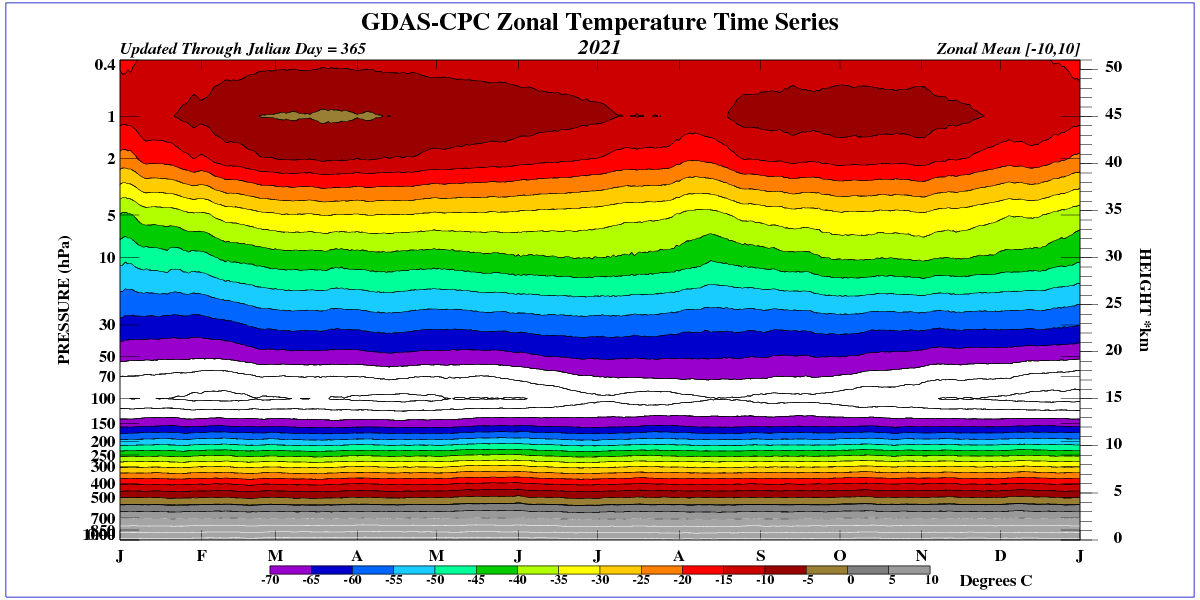
“It was absolutely right therefore for the United Nations to take a lead in determining the exact nature of the causes and implications of “anthropogenic global warming” by setting up the “Intergovernmental Panel on Climate Change” (IPCC) in 1988. ”
I disagree. The intent should never have been to determine “the exact nature of the causes and implications of “anthropogenic global warming””. That presupposes the answer. The IPCC should have been charged with determining:
But given its charter, it was natural to determine that it is anthropogenic glabal warming that is the problem.
But given its charter, it was natural to determine that it is anthropogenic glabal warming that is the problem.
And of coarse that was the sole intent. Maurice Strong has a lot to answer for. No wonder he fled to China.
David, To understand the history and purpose of the IPCC you need to understand Maurice Strong. The purpose of the IPCC is control, not climate, though it has certainly wrapped itself in the cloak of science. The fact that so many scientific organizations have bought the “Climate Crisis” meme hook, line, and sinker is a very sad tale. It will be interesting when in the coming decades there is no climate crisis to watch them backtrack.
Maurice Strong, The ‘NWO Father’ Of Global Warming And Agenda 21 Is Dead – TheWatchTowers.org
For me it is a nice summation of a very specific topic area. Even if one does not hold to the general idea of the “Greenhouse Effect”, what this paper does is show that for those that do hold to the “simple” greenhouse effect theory, all else aside, an increase in CO2 from here will have minimal effect, so I think it is a good starting point when discussing these issue with the general public in order to point out some very obvious issues in their thinking.
Having said that, many of the alarmists then shift focus to the issue being the shifting of the height of the TOA and hence a change in the distance/adiabatic lapse rate. It would be good to see a simple step by step argument similar to this one, covering that topic as that seems to be the alarmist two prong approach when one of the theories is challenged.
David, there are parts of the Earth’s surface that are warming two or three times faster than the average over the last thirty years. Do they have an exceptional amount of greenhouse gases confined above them or is some other effect in operation?
Examples, the Black Sea, Lake Superior, Michigan, Lake Tangyanika. Best of all, the Sea of Marmara.
I think I know and I think I can explain ‘Why the blip’, the famous protest from Professor Tom Wigley who had just finished adjusting down the temperature excursion from 1940 to 1945. Thoughts?
JF
My answer, I am afraid, is that I simply do not know. I think it is important to separate long term effects such as Equilibrium Earth Temperature, from localised short term events which result from the non linear chaotic system that is the earth’s atmosphere. The alarmists of course make a great issue of the highest or lowest temperature ever, or the wettest, or driest. Need I say more.
David, my take on anomalously high temperatures in various lakes/seas all round the planet is that they have been warmed by a common cause and it can’t be CO2, the well-mixed gas.. My guess (Richard Feynman said that even someone with no qualifications is allowed to guess as science doesn’t start until after the guess.) These outliers aren’t the usual alarmist 0,01 record, they are consistent continuous rates of warming above the average. All over the world, not just halfway up the jet pipe of an Airbus.
Did you look at Marmara?
My take is at wwwdotconservativewomandotcodotuk/cold-comfort
JF
Every climate alarmist should be forced to read these four sentences in your conclusion. Thanks so much for a great explanation of the realities of the greenhouse effect and why CO2 is not the control knob of the earth’s temperature…
“Of the 33°C warming, 29.4°C is entirely due to the absorptive effects of water vapour. 420ppm of CO2 delivers just 3.3°C of that warming, while methane and nitrous oxide are responsible for a mere 0.3°C combined.
Contrary to the blitz of propaganda, there is no climate emergency or even any significant increase in temperature due to increasing levels of CO2. The climate sensitivity to a doubling of CO2 is 0.45°C which increases to 0.5°C when the feedback of water vapour is taken into account.”…
People who believe in the GHE and the ECS and the significance of the mean global temperature are just plain nuts.
What should we believe in next?
Mean global rainfall?
Mean global heatwave?
Mean global drought?
Mean global snowfall?
Mean global telephone number?
Mean global climate?
Lukewarmists on WUWT just give credibility to warmist alarmists that they don’t deserve. Why do they do that? Are they closet warmists?
It doesn’t matter how many articles WUWT produces that discredit alarmist claims it won’t have any effect whatsoever.
They (you know who I mean by They) own all the cameras, all the microphones, all the media (nearly), all the schools, all the universities, all the civil services (or equivalent), and the vast majority of governments and parliaments and congresses and whatever it is they are called in other world administrations.
If you believe we are winning, send me $10.
YES, WE ARE WINNING!!!
A bit harsh – people are entitled to their beliefs. The failing is consensus science and inability of independent thought.
There are people here who actually believe oceans can be heated radiatively from the surface down – how bizarre is that! Jim Hansen is still looking for his missing heat in the oceans. The climate clowns even believe the increase heat retention in deep oceans over the last 50 years is a sign of oceans gaining heat from the surface – simply ridiculous; beyond any physical reality.
Another crank.
Crank.
As usual, no meaningful answer from Dave Unfair.
He is living proof of my post above.
As they say here in Scotland:
Awa’ ‘n’ boil yer heid, ya numpty!
But what are you winning, exactly?
(I’ve emailed ‘They’ and They’ve promised to up the surveillance on you)
But what are you winning, exactly?
Nothing, griff. That was my point.
We have lost to They.
Your side will always win because our side is split between lukewarmists and realists. Lukewarmists are rife on WUWT.
Lukewarmists believe in the GHE and the ECS.
Lukewarmists are idiots.
ok, that’s it for CO2/climate change. Now what are we going to chat about? Maybe how unworkable wind and solar are because battery storage for a few days of cloudy and calm costs 10x more than the panels and turbines?
And then there are those things called clouds.They can’t accurately model the water system, which has a far greater effect on the Earth’s albedo.
To which I’ll add, “They couldn’t model their way out of a wet paper bag. I hate wet paper bags”. Thank you Douglas Adams.
And, according to the above analysis and every climate model, are unresponsive to surface temperature! Give me a break.
climate sensitivity to methane graph has a minor typo, 2nd column with feedback should be 0.08 or 0.01 less height.
The IPCC, from its founding, has been required “only” to use temperatures caused by human actions. This is directly in its founding documents. Changes caused by “natural” causes are supposed presumably to be ignored. Since most of the changes in the atmosphere that introduce heat seem to be ignored the result is almost all changes in the atmosphere seem to be mandated.
If this requirement is actually being implemented there appears to be no need for research since the change is already mandated.
Is the IPCC actually doing this? Or has it been mandated to do something else. I haven’t been able to deterimine what applies.
[Please fix the missing letter in your email address that is cached in your browser and you will not keep being flagged for moderation–cr]
A “greenhouse gas” is one which is transparent to incoming solar radiation, but which is a strong absorber of outgoing infra-red energy radiated by a warming earth. The more CO2 in the atmosphere, the more outgoing radiation is absorbed and the warmer the planet gets. Simples!
Hold on! Not so simples!
Do you think gases can only absorb heat via IR? Try conduction and convection (eg winds). Put your hand out. All the air molecules surrounding you are at much the same temperature. (You can invoke the Zeroth Law of Thermodynamics if you must.) Therefore, most of the atmosphere’s heat – the Greenhouse Effect – is held by the non-IR gases, nitrogen, oxygen and argon. Water vapour is way back at (an almost constant world-wide) about 1%, with carbon dioxide a tiny .05% – and that’s about its contribution to Earth’s GE.
Outstanding.
An interesting paper, well worth reading, but I recommend reading the original (free web access at end).
Like with many derivative articles (the majority by far on WUWT) I always go to the original source (if given) to avoid any editing bias. WUWT rarely has pieces of any originality, they have become mainly boring repetitions of hackneyed themes.
And while I am on a rant, please get rid of that annoying moving banner at the top that makes the intro. look like a 3rd rate advertisement.
” It is not unreasonable to believe that the atmosphere itself will warm as a result of this energy input, and if so, will reradiate some of this energy into space, while the remainder will be retained by the earth thereby warming it.”
One question I have, is this not a continuous process and a portion of the heat radiated back to earth is subsequently radiated again outward and back continuously (reducing in magnitude) especially through the night, when the sun is not radiating any new energy into the system. I don’t see that the system is retaining all that energy. It appears that the steady state model often used is simplified
I am not expert on this subject so what am I missing.
The fact is that most of the atmosphere is warmed through conduction, either from contact with the surface soil and water or from contact with CO2. According to most studies, CO2 does not reradiate much energy at the surface since it much more likely to collide with an N2/O2/H2O molecule and transfer its energy away. Otherwise surface thermometers would only be reading the temperature of CO2 and not the total atmosphere.
This is what causes convection current upwards where energy is expended moving upwards and eventually transferring whatever energy is left back to a CO2 or H2O molecule for radiating to space.
I have to take issue with the idea that all 33 degrees of warmth over and above the blackbody TOA temperature are due to a “greenhouse effect” principally involving IR absorption. This is absolute horse-mucking idiocy and anybody who believes this should be feeding pigs for a living, not writing articles about climate change.
The fact is, the warmth of the atmosphere is due to the warmth of the atmosphere, to its thermal mass, not to IR absorption. The air gets warmed all day by conduction from the surface, by convection throughout its depth, and by the release of latent heat from condensing water vapor. This is what produces a comfortable surface temperature.
At night, when the radiative input is eliminated, the atmosphere begins to lose energy logarithmically. At best, IR absorption is just going to shift this curve a few minutes further down the x-axis. It’s not going to increase the surface temperature at all.
What do satellites above the 60th parallel show? Heating from the surface.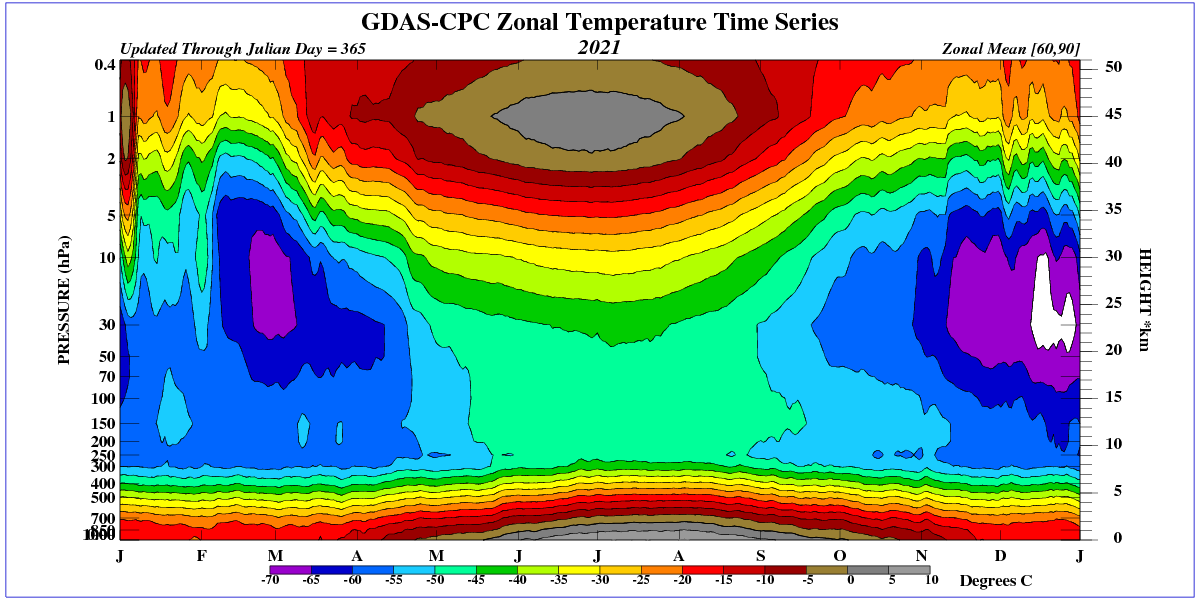
And those idiots believe that the sun cannot melt ice or form clouds but ghgs can.
When a CO2 molecule interacts with a photon, it is said in shorthand that it gets hot and by extension makes the atmosphere hotter.
But, this is not so. By interacting, it makes the photon unavailable to interact with other molecules, in effect resulting in a “cooling” of the rest of the atmosphere. Of course, this as a dynamic system and one has to look at the overall rather than the particular and changes over timespans.
The same applies to the “blanket” analogy, which is said to heat the body under the blanket by delay of heat release. But, this trapping under the blanket again means that the atmosphere outside the blanket is now cooler than it might have been.
We are not generating energy and its companion heat. We are redistributing it.
So, it is not alarming that the TOA radiation balance should be zero, unless there is a change in overall energy, such as by changes in the solar output and its path from Sun to Earth.
We still seem to lack publicity about simple experiments where containers of gas are subjected to light of various wavelengths to examine if any heat is produced and how much. One wonders at the confidence of scientists who go far into theory without the customary practical alongside. As with modelling cloud physics. Geoff S
Fig.3 is wrong. There is no absorption of CO2 at 10 um. The net effect of more CO2 is cooling rather than warming.
Thanks for this great write up.
Now do Mars!
I read the referenced article when it was first published. I checked the theoretical foundation. This is a seminal paper. The method proposed is original, correct – in my opinion – and effective.
It places the CO2 debate in the right perspective. Link that to Patick Moore’s book “Fake Invisible Catastrophes and Threaths of Doom”, and you will be very well equiped to understand what is really going on.
There is no consideration on adiabatic induced lapse rate and, therefore, lower atmosphere temperature – the 15 degC mentioned as the average.
David Coe, your description contains the same fundamental error that is inherent in standard climate views of the atmosphere. It ignores the effects of the boundary layer. Almost all of the warming that comes out of your calculations would occur in the boundary layer. However, since the boundary layer is in thermodynamic equilibrium with the surface the energy is simply returned back into the atmosphere to maintain equilibrium. No real warming occurs.
Once this is recognized, the way to correct it is to examine only the surface radiation that is absorbed above the boundary layer. According to Dr. Heinz Hug and based on experimental studies, CO2 absorbs 99.94% of surface radiation within 10 meters of the surface. There’s really little reason to look at that last .06% as it can only have an insignificant warming effect.
This is probably why the Seim/Olsen 2020 paper couldn’t describe any significant warming in their experiment.
Look at my comments in response to JCM to understand what really happens in the atmosphere.
This report was nicely presented, and it makes sense. But have we really identified the problem? Is it greenhouse gases? I say no, it has nothing to do with greenhouse gases.
When I was trained in six-sigma problem solving, I was taught this:
The IPCC has done none of these. It has no problem statement, so it doesn’t know what it is trying to fix. It doesn’t know the root cause of the problem it can’t state, it appears to be trying to solve a symptom, and it has no solution. Why can no one identify the problem the IPCC is supposedly trying to solve? Who knows the real root cause?
Occam’s Razor states: “the simplest solution is almost always the best.” It’s a problem-solving principle arguing that simplicity is better than complexity. Named after 14th-century logician and theologian William of Ockham, this theory has been helping many great thinkers for centuries.
There is a much simpler answer to why the earth’s temperature is what it is, rather than the calculated so-called ‘black body’ temperature. First, earth isn’t a black body anyway, but that is beside the point.
First, a mind experiment. Under the following conditions. ask yourself whether the earth would be warmer or colder if:
Under the first instance, we would see hotter days and colder nights, BECAUSE there would be no heat stored in atmosphere. All heat energy would be radiated from the surface directly to space during both the daytime and nighttime. (But there is a special circumstance, mentioned below.)
In the second instance, earth would become warmer, BECAUSE the atmosphere would be heated by the surface, just as it is today, but it would be UNABLE to radiate any of that heat to space, forcing the surface temperature to increase to radiate away ALL OF the day’s heat. That is a process that would be slow because the atmosphere would be forced to return each day’s heat to the surface, by conduction alone. Heated air rises due to convection, and conduction heats the molecules around heated ones, but the reverse is not true. Conduction is the only method by which heat could be returned to earth’s surface.
In the third instance, the earth would become cooler, because all of the day’s heat would be radiated to space both from the surface and from the entire (radiative) atmosphere. The surface, would have to be cooler because it would not be required to radiate ALL of the day’s heat energy as in conditions 1 and 2.
Note that we can make these distinctions because we have taken things to their extremes to validate our reasoning. This should enable us to invalidate the current ‘scare’ over CO2. It can ONLY be helping cool earth, although its effect would be miniscule, as is the percentage of our atmosphere that is CO2.
Finally, the rotisserie effect. We take days and nights and seasons for granted. We think we know how they affect ‘weather’, but make some sort of a silly notion of climate as being something that we can ‘see’ rather than completing the puzzle of how physical things work together.
Another mind experiment: Scale earth down to the size of a ham. Place it in a vertical rotisserie, which is designed to have adjustable end points. In other words, the axis could be parallel or either end could be nearer or farther from the heat source. The rotation speed would also be adjustable. The heat source, instead of being under the ham, would be from one side, and it could be a wideband energy source, such as you might get from white-hot steel, radiating through a completely transparent window’ to heat the ham. Place a surface thermometer on the ham at the ‘equator’. Start the rotisserie, and monitor the surface temperature. Vary the rotation speed. Note that as it spins faster, it won’t become as hot at the surface nor as cold at the surface in one full rotation. (a day) Slow it down. It will get hotter during one rotation and it might not get as cool on the dark side. Why?
Tilt the ends. The readings will change again. Why?
Make the mental jump that earth is that rotisserie and the sun is the heat source. Voila – we have days and nights, and seasons as the axis is adjusted. If day and night are of equal length, the surface temperature adjusts to radiate each day’s heat energy gain within the 24 hours of a day. We see this nearest the equator when our axis is most perpendicular to the sun. Does it ever freeze at the equator at sea level? No. Why? Because the atmosphere contains energy in ALL of its molecules. The surface stabilizes at a temperature that permits the previous day’s energy gain to be lost at night, but that never includes getting to freezing, because it would have to radiate for a LOT longer in order to get that cold. The atmosphere is an insulating blanket that we walk around in.
Switch to either pole. Now, there are periods when heat is supplied by the sun, but much longer periods when there is little or no sun. The conditions now rarely get ABOVE freezing, because the surface temperature needed to offset the day’s heat gain is much lower, resulting in a lower surface temperature at the poles, always.
Finally, realize that most of us live somewhere between the poles and the equator, and therefore share a proportional share of heat gain/loss based on the latitude at which we live, our altitude, and the tilt of the earth at that time. Rotation speed is assumed to be constant.
No CO2 molecules were harmed in these mind experiments. CO2 is as important as oxygen to us – we could not exist without either of them.
The intent here is simply to show that earth’s temperature is not necessarily a result of any specific gases. All gasses follow the same gas laws. And since earth’s average temperature (a measurement that is not actually possible) can be shown to be a result of earth-sun alignments, this simplest explanation is probably the best. Thanks, Ockham!
Regardless of the atmosphere, a higher rotational velocity of each planet will decrease the difference in temperature between the illuminated side and the dark side and increase the global minimum temperature.
Good comment, John.
2. With atmosphere but no greenhouse gas: Surface heats the air (conduction and convection), but that cools the surface and then there is less IR-radiation from it. Same average temperature as with no atmosphere? – my guess.
Not a very good guess. The surface with no greenhouse gases would be far hotter. ALL of the sun’s energy would strike the surface. Yes, atmosphere would be heated, and yes, the surface would cool as a result, but that lack of greenhouse gases would heat the surface far beyond what it does today.
Would it? What heats the surface today is the sun and conduction/convection, not different from (2), as there is no downgoing radiation from today’s greenhouse gases. In today’s atmosphere all IR-photones (except those in the ‘window’) are catched within hundred (?) meters from the surface and they are not reemitted – the energy is instead used to heat up N2 and O2 molecules as they collide with the greenhouse gas molecules billions of times per second. They steal all the energy. and atmosphere warms up – convection begins.
There is a rather serious logic error presented in the above article by David Coe, which otherwise would is a good overall presentation.
That error is revealed in the following statements found in the second paragraph under the subsection titled “The Greenhouse Effect”:
“The earth’s average temperature is determined solely by the energy balance at the top of the atmosphere. The radiation emitted by the earth is a function of its temperature. The warmer the earth, the more radiation it emits. When the energy radiated by the earth into space is equal to the solar energy received from the sun, the earth temperature will have reached equilibrium and will be stable. When some of this radiated energy is absorbed by the atmosphere, the energy balance is disturbed, and the earth warms in order to restore the balance.” (my underlining emphasis added).
First, there is the statement that the energy balance is determined at the top of the atmosphere, thereby implying that following descriptions of the “earth” include both the land and sea surface areas and the atmosphere. However, the last sentence quoted above departs from this simple two-body source/sink balance by then treating the atmosphere as a third entity that is completely separate from the land and sea surface “earth definition”. In essence, the author slips in a three-body (space, atmosphere, land and sea surfaces) thermal exchange problem while at the same time establishing that the fundamental basis of his energy balance argument is only the two-body problem (space-TOA of Earth).
Clearly, it is impossible for the atmosphere to absorb energy (i.e., to warm) without it also increasing its thermal radiation to deep space.
And to be more specific, “earth’s average temperature” is ALWAYS comprised of varying degrees of absorption of incoming radiation . . . on a daily basis, on a seasonal basis, and on a solar cycle basis, and on the basis of Milankovitch cycles, not to mention on the basis of random events such as volcano emissions. This fact is true for variations in solar input absorption by land (e.g., time of day, degree of foliage, cloud coverage), by sea (e.g., time of day, wave action, cloud coverage), and by atmosphere (e.g., time of day, suspended particulate matter, cloud coverage).
These issues are what has always bothered me about the energy balance depictions of the Earth surface-atmosphere system—how can such simple planet-wide averages give insight into what really happens? It is a spherical 4D problem. Not to mention that all of the models differ from each other.
Simple averages ignore that radiation is based on T^4. The tropics that receive the most insolation will also have the most radiation, the most water vapor, and the highest temps. If CO2 is well mixed, then the largest “back radiation” should occur here and we should be seeing large temperature growth here.
Jim, one needs to account for how Earth’s average radiation varies as a function of latitude, especially between northern and southern hemisphere, and especially as a function of the seasons in both hemispheres.
In reality, radiation is based on e*T4 (not just T^4), where the emissivity factor (e) for outgoing radiation over any give areal segment at TOA varies significantly with factors such as underlying cloud coverage and degree of foliage cover.
And on the other side of the equation, Earth’s albedo is nowhere near constant due to changing cloud coverage and season variations of snow/ice ground coverage, so there is no such thing as constant insolation at ground level and any given latitude at any given time of year.
The big problem in the quoted statement is that it is mixing equilibrium and non equilibrium situations. The claim that the “Earth warms” when you block some upward radiation from the surface is actually not completely true. It’s only true when in non-equilibrium situations.
For example, consider a perfect sphere with a standard Earth atmosphere and no gravitational field. The atmosphere is held in place by a force field that does not interfere with EM radiation. Energy absorbed at the surface will be absorbed by the atmosphere. It will warm, but eventually it will become isothermal. The top of the atmosphere and the bottom will be the same temperature. It will be no warmer on the surface.
Most people will initially disagree, but think about it. All altitudes have the same number of molecules. Energy flow will warm the atmosphere until it all reaches the same temperature throughout. At that point the radiation from the top of the atmosphere will equal that received at the bottom of the atmosphere. The lack of a gravitational field essentially maintains the same heat capacity at all elevations. If the source of energy is constant then the flow of energy will also be constant.
A good analogy is a pipeline. The flow out at the end of the pipeline is equal to the flow into the pipeline. The pressure eventually equalizes over the entire length. Pressure in this case is the equivalent of temperature in my hypothetical planet.
What would happen if we double the CO2 in this situation? Nothing. CO2 radiates equally in all directions. The temperature would remain the same.
The reason Earth is warmer at the surface is because of the gravitational field. Gravity doesn’t add in any energy, it just distributes it based on the density. The same logic applies to the planet with gravity, add in more CO2 and it won’t warm either.
“All altitudes have the same number of molecules.”
You might want to rethink this.
Why? I stated there is no gravity.
With “no gravity” the Earth would not have an atmosphere. And, consequently, humans would not exist to ask such questions.
It IS that simple.
Because at altitude there are more cubic meters and if all cubic meters have the same number of molecules then there will be more molecules as you go up in altitude.
Gravity causes a particle with higher kinetic energy to lose it to potential energy.
No, the “something” that creates a change in elevation of any given object or substance having mass within a gravitational field is what causes a change in potential energy, independent of the kinetic energy that the object or substance may have at the moment of such elevation change.
Gravity is just there, as a static field.
“Energy absorbed at the surface will be absorbed by the atmosphere.”
That statement is positively NOT true. Please look up, among many other things, “atmospheric window” and “ocean heat content” and “enthalpy of phase changes of water”.
There’s a reason I said “a perfect sphere”. I intentionally wanted to avoid those issues. The atmospheric window would still exist though. It would just reduce the amount of radiation/conduction producing the warming.
The ‘earth warms to restore the balance’ is also wrong. As earth radiates, it cools. If some of the radiation is captured in greenhouse gases, the surface doesn’t somehow ‘warm’ to restore a balance. It just keeps radiating and cooling, which is what it is ALWAYS doing, based on the 4th power of temp. Every single molecule of earth’s surface, from water to ice to plants, is ALWAYS radiating, constantly. That radiation increases as incoming thermal energy is received and causes the surface to warm.
As per my separate comment to another poster above, radiation from Earth’s surface is a function of e*T^4, not just T^4 . . . and e (emissivity) is highly variable temporally and spatially over Earth’s surface.
That is a lot of nonsense here, and I am not polite enough to leave it uncommented.
First of all the author does not understand what the GHE is.
“Effective Earth Temperature
The starting point for this question is, what would be the temperature of the earth if no atmosphere existed and the earth’s radiation was emitted through to space without any absorption? From a knowledge of the intensity of solar radiation received by the earth and the infra-red radiation emissions as a result of the earth’s temperature, it is widely accepted that the average earth temperature would be a chilly -18°C.”
No! Without atmosphere the surface, as it is, would take on a temperature of ~280K (+7°C). I know there are a lot of people saying “without atmosphere Earth would be 255K”, but that is an undue simpification, and no one competent would ever say so, nor is it “widely accepted”. It is troublesome if one takes such quotes unreflected without understanding what they actually refer to.
One could say however, the “effective (emission) temperature” of Earth was 255K, since it radiates as much as a perfect black body with that temperature. Yet it is not much of meaningful statement.
Second: The GHE is not about “absorption”!!! In fact how much radiation from the surface is absorbed by GHGs (and clouds) is totally irrelevant. What matters instead is the delta in emission temperature. For instance CO2 in its main absorption band will consume all radiation emitted by the surface. High up in the atmosphere, where CO2 is eventually scarce enough to become transparent and emit into space, it has only about 220K. For this reason, CO2 will reduce emissions by 1-(220/288)^4 = 66% there. It is a much stronger reduction in emissions than vapor could ever cause, since the emission altitude of vapor is relatively low.
Third: Overlaps can not be dealt with arbitrarily. With regard to the attribution of the GHE to the single agents, one must respect overlapped components as they are. You can not split them up, or arbitrarily allocate them to CO2 or vapor for instance as you like. They are overlaps and that what they stay.
Fourth: When it comes to adding a GHG like CO2, the forcing will exclude the overlapped component. That is extremely important, since it mitigates the forcing (and feedback) potential of any agent. Also this is the primary mistake in consensus ECS estimates, which use figures only true single agents, thereby wrongly stacking up overlaps.
Fifth: There is no possible relation between “radiation absorbed” to the magnitude of the GHE. Again, because absorption is irrelevant.
Sixth: If done correctly, ECS is indeed very low. A 0.45K figure is pretty accurate, though just incidentally. A lot important issues here, leading to the right result, were not even considered (like lapse rate feedback). So the “result” is ok, but everything else is wrong and does not promote the understanding of science.
https://greenhousedefect.com/the-holy-grail-of-ecs/a-total-synthesis-the-ecs-estimate
Well, we seem to have come up with the right answer, if for all the wrong reasons. I guess we were just lucky.
It is not a coincidence. HITRAN is based on observations and so effects in the real atmosphere are embedded in the data. The trouble comes from interpreting the spectral transmittance, temperature, pressure, density, and optical path length as resulting solely from radiative process. The empirical conclusions are correct, such as CO2 v Temperature, but the discussion is lacking the full perspective of mechanisms involved.
Here is a very simple illustration, that everyone should be able to understand instantly. Why is there such a trough at the CO2 bandwith, while vapor bandwiths remain relatively shallow?
This is not related to how much the respective GHGs absorb, but at what temperature, or altitude respectively, they emit. Very simple, very obvious, every layman can understand it.
The actual problem is, as I see it, that not everyone here instantly realizes your lack of understanding the most basic physics. Sorry..
And again, your “result” is nothing but a lucky guess, totally random.
Due to Kirchhoff’s law (absorption = emission) in a heated object otherwise conservation of energy is violated. That means at a given temperature a molecule can only emit what has been absorbed, not more and not less.
If a molecule emits less because it is cooler, then it also absorbs less.
Planck_Intro (arizona.edu)
Kirchhoff’s law of thermal radiation – Wikipedia
What happens to the remainder of the radiation that passes a cold CO2 molecule. Does it go on to space?
No, the first defintion is wrong. Kirchhoff’s law does NOT state that absorption = emission, rather it states that absorptivity = emissivity!!! If the first was true, changes in temperature would be impossible. That is an important difference.
Your is question is based on wrong assumptions.
“”Another important radiation property of a surface is its absorptivity, α, which is the fraction of the radiation energy incident on a surface that is absorbed by the surface. Like emissivity, value of absorptivity is in the range 0 < α < 1.""
""In general, the absorptivity and the emissivity are interconnected by the Kirchhoff’s Law of thermal radiation, which states:""
""For an arbitrary body emitting and absorbing thermal radiation in thermodynamic equilibrium, the emissivity is equal to the absorptivity.""
""emissivity ε = absorptivity α""
https://www.nuclear-power.com/nuclear-engineering/heat-transfer/radiation-heat-transfer/emissivity-emissivity-of-materials/
Not just my definition. You'll have to provide a reference defining the difference you are discussing. I have given you several references for my comments.
As I understand it, when an amount of energy is absorbed, the same amount of energy is emitted when it radiates. It certainly can not emit more than is absorbed. If it radiated less than what was absorbed, it would remain excited and have a higher temperature. Yet this also means that there is an intermediate state of excitation available. Not sure this is possible.
You have a knot in your brain! Once more:
WRONG: emission = absorption
RIGHT: emissivity = absorptivity
Obviously you need to learn the difference..
I gave you a reference. Please be respectful and do the same.
I tend to agree with this.