Guest Post by Willis Eschenbach
There’s an old saying about models—“All models are wrong, but some models are useful.”
It’s often used to justify the existence of climate models. However, the obvious corollary to the old saying is “All models are wrong, and some models are useless.”
I’ve been told several times that it’s not enough for me to put together my theory that a variety of often-overlapping emergent phenomena act to govern the temperature of the planet. I also need to show that this is not already included in mainstream climate theory and expressed in climate models. And it’s true, I do need to do that. Hence, this post.
Let me digress for a moment to explain my theory. When I began seriously studying the climate 25 years ago now, everyone was looking at why and how much the global average surface temperature was rising. But because of my experience with a variety of heat engines, I was struck by something completely different. I looked at the earth as a gigantic heat engine. Like all heat engines, it has a hot end (the tropics) where the energy enters the system. It then transports the energy to the cold end of the heat engine (the poles), where it is rejected. In the process it converts some of the energy into physical work, driving the endless motion of the atmosphere and the oceans.
Now, when you analyze a heat engine, say to determine its efficiency or any other reason, you have to use the Kelvin temperature scale. That’s the scale that starts at absolute zero (-273.15°C, or -459.67°F). The units of the Kelvin scale are called “kelvins” (not “degrees kelvin”), and one kelvin is the same size as one degree Celsius, which is also called one degree Centigrade. The kelvin is abbreviated “K”.
With that as a prologue, here is the oddity that attracted my attention. Over the entire 20th century, the temperature of the planet varied by less than 1°C, which is to say, less than 1K. And with the surface temperature of the planet being about 288K, that represents a variation of about a third of one measly percent … I found this stability to be quite amazing. The cruise control on your car can’t keep your car speed within that small a variation, well under 1% peak to peak.
Note that this stability is not due to thermal mass, even the thermal mass of the ocean. At 45°N in the mid-Pacific, the sea surface temperature sometimes changes up to 5K (5°C, 9°F) in a single month. And the land changes temperature even faster than the ocean.
So I started thinking about what kind of governing mechanism could keep the temperature so stable over an entire century full of El Nino events and volcanic eruptions and all kinds of things you’d expect to disturb the temperature. Because I was looking for something that would lead to long-term stability, I spent a long time contemplating slow processes like the gradual weathering of the mountain rocks changing the CO2 content of the atmosphere, and the buffering of the CO2 content of the ocean via calcium carbonate precipitation.
During this time I was living in Fiji … hey, the waves aren’t going to surf themselves, someone has to do it. And hanging out outdoors a lot in the tropics, I got to noticing the repeating daily weather pattern. I realized that I was looking at the hour-by-hour emergence of various phenomena that put a cap on how hot it could get. And I realized that if there are emergent phenomena that prevent a day from overheating, they will also prevent a week, a year, or a millennium from overheating
Let me borrow an explanation of what I saw from a previous post of mine.
At dawn, the tropical atmosphere is stratified, with the coolest air nearest the surface. The nocturnal overturning of the ocean is coming to an end. The sun is free to heat the ocean. The air near the surface eddies randomly.

Figure 1. Average conditions over the tropical ocean shortly after dawn.
As you can see, there are no emergent phenomena in this regime. Looking at this peaceful scene, you wouldn’t guess that you could be struck by lightning in a few hours … emergence roolz. As the sun continues to heat the ocean, around ten or eleven o’clock in the morning there is a sudden regime shift. A new circulation pattern replaces the random eddying. As soon as a critical temperature/humidity threshold is passed, local “Rayleigh-Bénard” type circulation cells spring up everywhere. This is the first transition, from random circulation to organized circulating cells that characterize Rayleigh-Bénard circulation.
These cells transport both heat and water vapor upwards. By late morning, the Rayleigh-Bénard circulation is typically strong enough to raise the water vapor to the local lifting condensation level (LCL). At that altitude, the water vapor condenses into clouds as shown in Figure 3.

Figure 2. Average conditions over the tropical ocean when cumulus threshold is passed.
Note that this area-wide shift to an organized circulation pattern is not a change in feedback. It has nothing to do with feedback. It is a self-organized emergent phenomenon. It is threshold-based, meaning that it emerges spontaneously when a certain threshold is passed. In the wet tropics there’s plenty of water vapor, so the major variable in the threshold is the temperature. In addition, note that there are actually two distinct emergent phenomena in the drawing—the Rayleigh-Bénard circulation which emerges prior to the cumulus formation, and which is enhanced and strengthened by the totally separate emergence of the clouds that mark the upwelling columns of air in the circulation.
Note also that we now have several changes of state involved as well, with evaporation from the surface and condensation and re-evaporation at altitude.
Under this new late-morning cumulus circulation regime, much less surface warming goes on. Due to the increasing clouds, the earth’s albedo (reflectivity) increases, so more of the sunlight is reflected back to space. As a result, less energy makes it into the system to begin with. Then the increasing surface wind due to the cumulus-based circulation pattern increases the evaporation, reducing the surface warming even more by moving latent energy up to the lifting condensation level.
Note that the system is self-controlling. If the ocean is a bit warmer, the new circulation regime starts earlier in the morning and it cuts down the total daily warming. On the other hand, if the ocean is cooler than usual, clear morning skies last later into the day, allowing increased warming. The system is regulated by the time of onset of the regime change.
Let’s stop at this point in our examination of the tropical day and consider the idea of “climate sensitivity”, the sensitivity of surface temperature to radiative forcing from either the sun or from CO2. The solar forcing is constantly increasing as the sun rises higher in the sky. In the morning before the onset of cumulus circulation, the sun comes through the clear atmosphere and rapidly warms the surface. So the thermal response is large, and the climate sensitivity is high.
After the onset of the cumulus regime, on the other hand, much of the sunlight is reflected back to space. Less sunlight remains to warm the ocean. In addition to reduced sunlight, there is enhanced evaporative cooling. Compared to the morning, the climate sensitivity is much lower. The heating of the surface slows down.
So here we have two situations with very different climate sensitivities. In the early morning, climate sensitivity is high, and the temperature rises quickly with the increasing solar insolation. In the late morning, a regime change occurs to a situation with much lower climate sensitivity. Adding extra solar energy doesn’t raise the temperature anywhere near as fast as it did earlier.
Moving along through the day, at some point in the afternoon there is a good chance that the cumulus circulation pattern is not enough to stop the continued surface temperature increase. When the temperature exceeds a certain higher threshold, another complete regime shift takes place. Some of the innocent cumulus clouds suddenly mutate and grow rapidly into towering monsters. The regime shift involves the spontaneous generation of those magical, independently mobile heat engines called thunderstorms.
Thunderstorms are dual-fuel heat engines. They run on low-density air. That air rises and condenses out the moisture. The condensation releases heat that re-warms the air, which rises deep into the troposphere.

Figure 3. Afternoon thunderstorm circulation over the tropical ocean.
There are a couple of ways to get low-density air. One is to heat the air. This is how a thunderstorm gets started, as a strong cumulus cloud. The sun plus GHG radiation combine to heat the surface, which then warms the air. The low-density air rises. When that Rayleigh-Benard circulation gets strong enough, thunderstorms start to form.
Once the thunderstorm is started, the second fuel is added to the fire—that fuel is water vapor. Counter-intuitively, the more water vapor there is in the air, the lighter it becomes. The thunderstorm generates strong winds around its base. Evaporation is proportional to wind speed, so this greatly increases the local evaporation.
This, of course, makes the air lighter, and makes the air rise faster, which makes the thunderstorm stronger, which in turn increases the wind speed around the thunderstorm base, which increases the evaporation even more … a thunderstorm is a regenerative system, much like a fire where some part of the fire’s energy is used to power a bellows to make the fire burn even hotter. Once it is started, it is much harder to stop.
This gives thunderstorms a unique ability that, as far as I know, is not represented in any of the climate models. A thunderstorm is capable of driving the surface temperature well below the initiation temperature that was needed to get the thunderstorm started. It can run on into the evening, and often well into the night, on its combination of thermal and evaporation energy sources.
Thunderstorms can be thought of as local leakages, heat pipes that transport warm air rapidly from the surface to the lifting condensation level where the moisture turns into clouds and rain, and from there to the upper atmosphere without interacting with the intervening greenhouse gases. The air and the energy it contains is moved to the upper troposphere hidden inside the cloud-shrouded thunderstorm tower, without being absorbed or hindered by GHGs on the way.
Thunderstorms cool the surface in a host of ways, utilizing a combination of cold water, shade, wind, spray, evaporation, albedo changes, and cold air.
And just like the onset of the cumulus circulation, the onset of thunderstorms occurs earlier on days when it is warmer, and it occurs later (and sometimes not at all) on days that are cooler than usual.
So again, we see that there is no way to assign an average climate sensitivity. The warmer it gets, the less each additional watt per meter actually warms the surface.
Finally, once all of the fireworks of the daytime changes are over, first the cumulus and then the thunderstorms decay and dissipate. A final and again different regime ensues. The main feature of this regime is that during this time, the ocean radiates about the amount of energy that is absorbed during all of the previously described regimes. How does it do this? Another emergent phenomenon … oceanic overturning.

Figure 4. Conditions prevailing after the night-time dissipation of the daytime clouds.
During the nighttime, the surface is still receiving energy from the GHGs. This has the effect of delaying the onset of oceanic overturning, and of reducing the rate of cooling. Note that the oceanic overturning is once again the emergent Rayleigh-Bénard circulation. Because there are no clouds, the ocean can radiate to space more freely. In addition, the overturning of the ocean constantly brings new water to the surface, to radiate and to cool. This increases the heat transfer across the interface.
As with the previous thresholds, the timing of this final transition is temperature-dependent. Once a critical threshold is passed, oceanic overturning kicks in. Stratification is replaced by circulation, bringing new water to radiate, cool, and sink. In this way, heat is removed, not just from the surface as during the day, but from the entire body of the upper “mixed” layer of the ocean.
There are a few things worth pointing out about this whole system.
First, this is what occurs in the tropics, which is where the largest amount of energy enters the hot end of the great heat engine we call the climate.
Next, sometimes increases in incoming energy are turned mostly into temperature. Other times, incoming energy increases are turned mostly into physical work (the circulation of the ocean and atmosphere that transports energy to the poles). And other times, increasing energy is mostly just moved from the tropics to the poles.
Next, note that this whole series of changes is totally and completely dependent on temperature-threshold-based emergent phenomena. It is a mistake to think of these as being feedback. It’s more like a drunk walking on a narrow elevated walkway. The guardrails are not feedback—they are a place where the rules change. The various thresholds in the climate system are like that—if you go over them, everything changes. As one example of many, the ocean before and after the onset of nocturnal overturning are very different places.
And this, in turn, all points to one of the most important control features of the climate—time of onset. How much energy the ocean loses overnight depends critically on what time the overturning starts. The temperature of the tropical afternoon depends on what time the cumulus kick in, and what time the thunderstorms start
With the idea of emergent thunderstorms and cumulus fields in hand, let me note that we can determine where this phenomenon is happening. In areas in the tropics, the warmer it gets, the more clouds appear—first the cumulus fields, then the tropical thunderstorms. As a result, the warmer it gets, the higher the tropical albedo gets, and the more energy is reflected back to space instead of warming the surface. In other words, in the tropics, the albedo and the temperature are positively correlated.
Outside of the tropics, the opposite goes on. The colder it gets, the more we get storms, ice, and snow. As a result, the colder it gets, the higher the albedo gets. Outside the tropics, the albedo and the temperature are negatively correlated.
And this is clearly revealed in the CERES satellite dataset, as shown in Figure 5 below.

Figure 5. Correlation of albedo and surface temperature. Perfect correlation, where both variables move in total unison, has a correlation value of 1.0. Perfect anti-correlation, where one variable increases whenever the other decreases, has a correlation value of -1.0. A correlation of zero means no relationship between the two variables, albedo and temperature.
Some things of note about Figure 5. As predicted by my theory, in much of the tropical ocean the albedo is positively correlated with the temperature, but this is true only in a few isolated areas outside of the tropics. The arctic and antarctic are strongly anti-correlated (negative correlation), with a correlation of ~ -0.6. In the tropics, on the other hand, the average correlation is zero. Land overall has a strong negative correlation, ~ -0.5.
The tropical correlation of zero is of interest because this is what we would expect if the tropics are regulating the temperature—the earth would warm until a slight increase in temperature pushes the albedo/temperature correlation positive, whereupon the earth would tend to cool.
And that brings us to the question of how useful the models are. I went and got the historical runs of the MIROC-ESM model, which covers the period from 1850 to 2005. To compare with the CERES data, I looked at four separate 21-year periods, the same time span as the CERES data. Here is the first of those periods, 1850 – 1870, showing the results in model-world. I’ve included the real-world data (left graphic) for comparison.

Figure 6. As in Figure 5, but using data from the MIROC-ESM climate model
The most obvious difference is that in model-world, the polar and sub-polar regions both have some areas of positive correlation that do not occur in real-world. There is also much less positive correlation in the tropics, model-world correlation of -0.15, versus a real-world tropical correlation of 0.0.
Another way to look at the differences is by averaging the correlation by latitude. Figure 7 shows that result.

Figure 7. Average correlation of albedo and surface temperature, by degree of latitude, CERES and MIROC data.
As you can see, model-world is very, very different from real-world.
My next question was, just how stable over time is this correlation between albedo and temperature, both in the real world and in model-world. To investigate this, here are the first and second halves of the CERES dataset.

Figure 8. Correlation of temperature and albedo, first and second halves of the CERES dataset.
Note that all of the correlations of different geographical areas, and of land and sea, are within 0.01 or so of each other. So this is a very stable relationship. Next, here are four different 21-year periods from the start to the end of the MIROC model output.

Figure 9. Correlation of temperature and albedo, four 21-year periods of the CERES dataset.
As with the CERES data, these are all very close. Here are the average correlations by latitude of the four MIROC model results and the two CERES results.

Figure 10. Correlation between albedo and temperature by latitude, four 21-year periods from the MIROC model results (1850-1870, 1900-1920, 1950-1970, and 1985-2005) and two 10-year periods from the CERES satellite data (2000-2009, and 2010-2019).
The relationship between albedo and temperature in both real-world and model-world is very stable, even over a period as short as 10 years, indicating that this relationship between albedo and temperature provides a meaningful insight into how the climate system actually works. And all of the model results are very different from the CERES satellite data.
Conclusions:
• My theory that the temperature control of tropical albedo via emergent phenomena exerts a thermoregulatory effect is supported by these findings.
• The gridcell size of current climate models is far too large to simulate individual thunderstorms. For this among other reasons, it is unlikely that the models incorporate realistic representations of the thermoregulatory effects of tropical thunderstorms.
• At least in the case of the MIROC-ESM model, the model representation of the correlation of temperature and albedo is quite unlike what happens in the real world.
• The geographic stability of the correlations over time, in both the real world and in model-world, indicates that this is a persistent diagnostic feature of the climate.
w.
MY USUAL: I can defend my own words and am happy to do so. I cannot defend your understanding of my words, so please, when you comment quote the exact words you are referring to.
Willis: Great post. Very well presented and convincing. Just one typo alert – Figure 9 caption should be MIROC not CERES.
Great stuff Willis as expected.
“My theory that the temperature control of tropical albedo via emergent phenomena exerts a thermoregulatory effect …”
But of course there are other associated agents of cooling in addition to albedo that you mention, winds, work done in moving the air and sea currents, cold rain… This doesn’t mean you are wrong about albedo itself having a large T regulating effect,
Also, could this finding from Ceres not be employed to improve models?
I see a number of folks claiming that everything I’ve done is already known. The Sud et al. was referenced. It lists the following phenomena:
I find this quite simplistic. This is only a small number of the cooling phenomena I have discussed with respect to thunderstorms, viz:
Next, my hypothesis is far wider-ranging than just the tropical Pacific Ocean. It encompasses a whole host of emergent phenomena that are occurring all over the planet. These include things like:
DUST DEVILS
Dust In My Eyes 2014-02-13
I was thinking about “dust devils”, the little whirlwinds of dust that you see on a hot day, and they reminded me that we get dulled by familiarity with the wonders of our planet. Suppose, for example, you that “back in the olden days” your family lived for generations in…
The Details Are In The Devil 2010-12-13
I love thought experiments. They allow us to understand complex systems that don’t fit into the laboratory. They have been an invaluable tool in the scientific inventory for centuries. Here’s my thought experiment for today. Imagine a room. In a room dirt collects, as you might imagine. In my household…
Into The Vortex 2017-09-08
I came across a lovely photograph of a “fire devil”, also called a “fire whirl”. I liked it because the photo perfectly exemplified what is wrong with the current generation of climate models. What is wrong with the models is that they don’t include any of the vortex-based emergent atmospheric pheno…
EL NINO/LA NINA
The Tao of El Nino 2013-01-28
I was wandering through the graphics section of the TAO buoy data this evening. I noted that they have an outstanding animation of the most recent sixty months of tropical sea temperatures and surface heights. Go to their graphics page, click on “Animation”. Then click on “Animate”. When the new…
Why El Niño and not the AMO? 2013-01-17
On another thread, a poster got me thinking about the common practice of using the El Nino 3.4 Index to remove some of the variability from the historical global average surface temperature record. The theory, as I have heard it propounded, is that the temperature of the Earth is “signal”,…
In The Land of El Nino 2015-09-26
While I was involved in an interesting interchange with David Douglass here, I stumbled across an interesting discovery. Before I get to that, though, I have to give high marks to David and his co-author, Robert Knox, for showing up on WUWT
Weather Two Months From Now 2015-12-17
A while back, folks noticed that a couple of months after the El Nino kicked in across the Pacific, the earth would warm up a bit. Since then, people have engaged in what they describe as “removing the El Nino signal” from the global temperature record. A while…
Boy Child, Girl Child 2020-11-08
I’ve said before that I consider myself a climate heretic rather than a climate skeptic. A skeptic doubts parts of things. A heretic questions the basic assumptions underlying the whole field. My heresy is that I do not think that temperature is a linear function of greenhouse gas forcing. I think …
Sea Levels in the Nino Nina Cycle 2020-11-23
In a recent post entitled “Boy Child, Girl Child” I discussed my functional analysis of the El Nino-La Nina phenomenon. I noted that the Nino-Nina alteration functions as a giant pump moving water from the equatorial Pacific towards both poles. In that post I used this image from NOAA: In Figure 1 y…
Under The Equator 2020-11-25
Inspired by my previous posts, Boy Child Girl Child and Sea Levels in the Nino-Nina Cycle, I decided to take a look at what is happening below the sea surface along the Equator. A commenter pointed me to an Australian archive of past sub-surface analyses, with an unfortunate URL that includes “ocean…
The La Nina Pump 2018-07-16
Sometimes a chance comment sets off a whole chain of investigation. Somewhere recently, in passing I noted the idea of the slope of the temperature gradient across the Pacific along the Equator. So I decided to take a look at it. Here is the area that I examined. I’ve…
Clouds and El Nino 2018-05-09
After the turn of the century, I became interested in climate science. But unlike almost everyone else, I wasn’t surprised by how much the global temperature was changing. As someone with experience with heat engines and engine governors, I know how hard it is to keep…
OTHER EMERGENT PHENOMENA (Arctic negative feedback, action of plankton, large-scale oscillations like the PDO and the AMO, drying of the atmosphere, etc.)
Plankton Cause Hurricanes! Urgent Action Required! 2010-08-15
When people say that we understand the unbelievably complex climate system well enough to project scenarios out a hundred years, I point out that new things are being discovered every week. The latest scientific finding is that plankton cause hurricanes. I know it sounds like a headline in The Onion,…
Which way to the feedback? 2010-12-11
There is an interesting new study by Lauer et al. entitled “The Impact of Global Warming on Marine Boundary Layer Clouds over the Eastern Pacific—A Regional Model Study” [hereinafter Lauer10]. Anthony Watts has discussed some early issues with the paper here. The Lauer10 study has been controversial because it found that…
Further Evidence for my Thunderstorm Thermostat Hypothesis 2011-06-07
For some time now I’ve been wondering what kind of new evidence I could come up with to add support to my Thunderstorm Thermostat hypothesis (q.v.). This is the idea that cumulus clouds and thunderstorms combine to cap the rise of tropical temperatures. In particular, thunderstorms are able to drive…
It’s Not About Feedback 2011-08-14
The current climate paradigm believed by most scientists in the field can be likened to the movement of balls on a pool table. Figure 1. Pool balls on a level table. Response is directly proportional to applied force (double the force, double the distance). There are no “preferred” positions—every position…
A Longer Look at Climate Sensitivity 2012-05-31
After I published my previous post, “An Observational Estimate of Climate Sensitivity“, a number of people objected that I was just looking at the average annual cycle. On a time scale of decades, they said, things are very different, and the climate sensitivity is much larger. So I decided to…
Sun and Clouds are Sufficient 2012-06-04
In my previous post, A Longer Look at Climate Sensitivity, I showed that the match between lagged net sunshine (the solar energy remaining after albedo reflections) and the observational temperature record is quite good. However, there was still a discrepancy between the trends, with the observational trends being slightly larger…
Forcing or Feedback? 2012-06-07
I read a Reviewer’s Comment on one of Richard Lindzen’s papers today, a paper about the tropics from 20°N to 20°S, and I came across this curiosity (emphasis mine): Lastly, the authors go through convoluted arguments between forcing and feedbacks. For the authors’ analyses to be valid, clouds should…
Observations on TOA Forcing vs Temperature 2012-06-12
I recently wrote three posts (first, second, and third), regarding climate sensitivity. I wanted to compare my results to another dataset. Continued digging has led me to the CERES monthly global albedo dataset from the Terra satellite. It’s an outstanding set, in that it contains downwelling solar (shortwave) radiation (DSR), upwelling solar radiation (USR), and most…
A Demonstration of Negative Climate Sensitivity 2012-06-19
Well, after my brief digression to some other topics, I’ve finally been able to get back to the reason that I got the CERES albedo and radiation data in the first place. This was to look at the relationship between the top of atmosphere (TOA) radiation imbalance and the surface…
Emergent Climate Phenomena 2013-02-07
In a recent post, I described how the El Nino/La Nina alteration operates as a giant pump. Whenever the Pacific Ocean gets too warm across its surface, the Nino/Nina pump kicks in and removes the warm water from the Pacific, pumping it first west and thence poleward. I also wrote…
Slow Drift in Thermoregulated Emergent Systems 2013-02-08
In my last post, “Emergent Climate Phenomena“, I gave a different paradigm for the climate. The current paradigm is that climate is a system in which temperature slavishly follows the changes in inputs. Under my paradigm, on the other hand, natural thermoregulatory systems constrain the temperature to vary within a…
https://wattsupwiththat.com/2018/08/27/of-water-and-albedo/
Air Conditioning Nairobi, Refrigerating The Planet 2013-03-11
I’ve mentioned before that a thunderstorm functions as a natural refrigeration system. I’d like to explain in a bit more detail what I mean by that. However, let me start by explaining my credentials as regards my knowledge of refrigeration. The simplest explanation of my refrigeration credentials is that I…
Dehumidifying the Tropics 2013-04-21
I once had the good fortune to fly over an amazing spectacle, where I saw all of the various stages of emergent phenomena involving thunderstorms. It happened on a flight over the Coral Sea from the Solomon Islands, which are near the Equator, south to Brisbane. Brisbane is at 27°…
Decadal Oscillations Of The Pacific Kind 2013-06-08
The recent post here on WUWT about the Pacific Decadal Oscillation (PDO) has a lot of folks claiming that the PDO is useful for predicting the future of the climate … I don’t think so myself, and this post is about why I don’t think the PDO predicts the climate…
The Magnificent Climate Heat Engine 2013-12-21
I’ve been reflecting over the last few days about how the climate system of the earth functions as a giant natural heat engine. A “heat engine”, whether natural or man-made, is a mechanism that converts heat into mechanical energy of some kind. In the case of the climate system, the…
The Thermostatic Throttle 2013-12-28
I have theorized that the reflective nature of the tropical clouds, in particular those of the inter-tropical convergence zone (ITCZ) just above the equator, functions as the “throttle” on the global climate engine. We’re all familiar with what a throttle does, because the gas pedal on your car controls the…
On The Stability and Symmetry Of The Climate System 2014-01-06
The CERES data has its problems, because the three datasets (incoming solar, outgoing longwave, and reflected shortwave) don’t add up to anything near zero. So the keepers of the keys adjusted them to an artificial imbalance of +0.85 W/m2 (warming). Despite that lack of accuracy, however, the CERES data is…
Marginal Parasitic Loss Rates 2014-03-26
There is a more global restatement of Murphy’s Law which says “Nature always sides with the hidden flaw”. Parasitic losses are an example of that law at work. In any heat engine, either natural or manmade, there are what are called “parasitic losses”. These are losses that tend to reduce…
Arctic Albedo Variations 2014-12-17
Anthony has just posted the results from a “Press Session” at the AGU conference. In it the authors make two claims of interest. The first is that there has been a five percent decrease in the summer Arctic albedo since the year 2000: A decline in the region’s albedo –…
Albedic Meanderings 2015-06-03
I’ve been considering the nature of the relationship between the albedo and temperature. I have hypothesized elsewhere that variations in tropical cloud albedo are one of the main mechanisms that maintain the global surface temperature within a fairly narrow range (e.g. within ± 0.3°C during the entire 20th Century). To…
An Inherently Stable System 2015-06-04
At the end of my last post , I said that the climate seems to be an inherently stable system. The graphic below shows ~2,000 climate simulations run by climateprediction.net. Unlike the other modelers, whose failures end on the cutting room floor, they’ve shown all the runs …
The Daily Albedo Cycle 2015-06-08
I discussed the role of tropical albedo in regulating the temperature in two previous posts entitled Albedic Meanderings and An Inherently Stable System. This post builds on that foundation. I said in the latter post that I would discuss the diurnal changes in tropical cloud albedo. For this I use…
Problems With Analyzing Governed Systems 2015-08-02
I’ve been ruminating on the continuing misunderstanding of my position that a governor is fundamentally different from simple feedback. People say things like “A governor is just a kind of feedback”. Well, yes, that’s true, and it is also true that a human being is “just…
Cooling And Warming Clouds And Thunderstorms 2015-08-18
Following up on a suggestion made to me by one of my long-time scientific heroes, Dr. Fred Singer, I’ve been looking at the rainfall dataset from the Tropical Rainfall Measuring Mission (TRMM) satellite. Here’s s the TRMM average rainfall data for the entire mission to d…
Tropical Evaporative Cooling 2015-11-11
I’ve been looking again into the satellite rainfall measurements from the Tropical Rainfall Measurement Mission (TRMM). I discussed my first look at this rainfall data in a post called Cooling and Warming, Clouds and Thunderstorms. There I showed that the cooling from th…
How Thunderstorms Beat The Heat 2016-01-08
I got to thinking again about the thunderstorms, and how much heat they remove from the surface by means of evaporation. We have good data on this from the Tropical Rainfall Measuring Mission (TRMM) satellites. Here is the distribution and strength of rainfall, and thus …
The Warmer The Icier 2016-02-25
A WUWT commenter emailed me with a curious claim. I have described various emergent phenomena that regulate the surface temperature. These operate on time scales ranging from minutes to hours (e.g. dust devils, thunderstorms) to multi-decadal (e.g. Atlantic Multidecadal …
Rainfall and El Niño 2016-06-10
In a recent post here on WattsUpWithThat, the claim was made that the El Nino influences rainfall. They showed a correlation between various historical proxies and El Nino/La Nina. So I thought I’d take a look at the modern correlation between rainfall and the El Nino. As a measurement of the El Ni√±…
Cloud Feedback 2016-09-04
In the comments to Christopher Monckton’s latest post, Nick Stokes drew attention to Soden and Held’s analysis of feedback in the climate models. I reproduce their Table 1 below: I found several amazing things in this table. The first is the huge range of values for the various parameters. While all…
Who’ll Stop The Rain? 2017-01-03
I haven’t posted here at WUWT in a bit. I’ve been preoccupied writing for my own blog, Skating Under The Ice. It’s a work in progress. However, my climate work continues. There’s a paper out about a year old, unfortunately paywalled, regarding precipitation with some interesting conclusions. [UPDAT…
Estimating Cloud Feedback Using CERES Data 2017-05-25
.As usual, Dr. Judith Curry’s Week In Review ‚Äì Science Edition contains interesting studies. I took a look at one entitled “Cloud feedback mechanisms and their representation in global climate models”, by Ceppi et al., hereinafter Ceppi2017. The paper looks at the cha…
Evaporation Redux 2017-06-11
I got to thinking again about the question of evaporation and rainfall. I wrote about it here a few years ago. Short version‚Äîwhen the earth’s surface gets warmer, we get more evaporation and thus more rainfall. Since what comes down must go up, we can use the Tropical…
The North Atlantic Seesaw 2017-06-24
In my peripatetic meandering through the CERES satellite data, I’ve been looking at the correlation between the temperatures in the NINO3.4 region and the temperatures of the rest of the planet. The NINO3.4 region is an area in the equatorial eastern Pacific Ocean. It…
Temperature and Forcing 2017-07-13
Over at Dr. Curry’s excellent website, she’s discussing the Red and Blue Team approach. If I ran the zoo and could re-examine the climate question, I’d want to look at what I see as the central misunderstanding in the current theory of climate. This is the mistaken id…
The Rainmakers 2017-08-08
For more than a decade now I’ve been saying something without getting much agreement, which was: “When you cut down the trees, you cut down the clouds”. I based my saying on my own experience, first growing up in a ponderosa pine and fir forest, and later living in a …
Driving Forces 2017-09-03
There’s a new paper published in Nature Scientific Reports called “Identification of the driving forces of climate change using the longest instrumental temperature record”, by Geli Wang et al, hereinafter Wang2017. By “the longest instrumental temperature record” the…
Drying The Sky 2020-01-07
Eleven years ago I published a post here on Watts Up With That entitled “The Thermostat Hypothesis”. About a year after the post, the journal Energy and Environment published my rewrite of the post entitled “THE THUNDERSTORM THERMOSTAT HYPOTHESIS: HOW CLOUDS AND THUNDERSTORMS CONTROL THE EARTH’S TEM…
In addition, none of the mainstream climate scientists seem to be even aware of the Constructal Law in relationship to the climate:
CONSTRUCTAL LAW
The Unbearable Complexity of Climate 2009-12-27
Figure 1. The Experimental Setup I keep reading statements in various places about how it is indisputable “simple physics” that if we increase amount of atmospheric CO2, it will inevitably warm the planet. Here’s a typical example: In the hyperbolic language that has infested the debate, researchers have been accused…
The Constructal Law of Flow Systems 2010-11-15
One of the most fundamental and far-reaching discoveries in modern thermodynamics is the Constructal Law (see the wiki entry as well). It was first formulated by Adrian Bejan in 1996. In one of his descriptions, the Constructal Law is: For a finite-size (flow) system to persist in time (to live),…
Constructal GDP 2010-11-16
Encouraged by the response to my post on Adrian Bejan and the Constructal Law, which achieved what might be termed unprecedented levels of tepidity, I persevere. Here’s a lovely look at the energy use of the United States: Figure 1. US 2002 Energy production and consumption by sector. There are…
A Chain Of Effects 2021-01-21
In looking at the climate I’m often reminded of Sufi stories. The Sufis are an ancient mystical sect. They are often associated with Islam, and many were Muslims, but the sect preceded Islam. The Sufis often taught their knowledge by means of most curious stories about life. The Sufis said that ever…
Now, to return to the subject, I’m accused of not reading the literature. However, I know of NO ONE who has said that the temperature of the entire globe is thermally regulated to a very narrow range (e.g a variation of less than ± 0.5% over the entire 20th century) by a variety of overlapping emergent phenomena operating under the constraints of the Constructal Law.
That’s my hypothesis. If anyone knows of someone else who has put forward that theory, please let me know, and I will gladly cite them and read their work. However, despite extensive literature searches, I just haven’t been able to find anyone putting forward that hypothesis, much less adducing the wide and deep variety of evidence that I’ve amassed supporting the hypothesis.
w.
Willis,
Indeed – thanks for the listing.
I do wonder (and you probably have talked about this in the past) – how does the relatively highly chaotic water vapor and temperature environment over land relate to (largely) land based emergent phenomena like tornadoes? I don’t believe there are tornadoes in the Pacific or significantly offshore in the Atlantic.
I can see how typhoons and hurricanes can be 2nd order emergent phenomena above the thunderstorms.
I can also see how modelers – who never leave their air-conditioned ivory towers – would fail to take into account anything beyond their equations.
Willis,
I always enjoy your posts. They consistently tie theory back to the real world data. I spent 30+ years as a systems engineer in space systems and was occasionally surprised by those engineers that failed to check their models against the real world. In that business, too much was at risk (reputation, money, future business) to be that careless with the engineering analysis. Mistakes were generally too catastrophic to be easily hidden.
Your writing style is clear and well thought out. Too often engineers/scientists try to impress others with their technical vocabulary rather than try to educate others. You avoid that trap nicely.
Thank you and keep up the great work.
Thanks for your kind words, Bob. My goal is to write for someone I call “the educated layperson”, someone who can follow logic, arguments, and ideas, but who may have little knowledge of the climate.
From what you said, it sounds like I’m succeeding, but as Richard Feynman said, “The first principle is that you must not fool yourself, and you are the easiest person to fool.”
w.
Willis
Compliments and excellent explorations of the data with novel realistic models.
May I recommend asking Anthony Watts to add a tab at the home page to list posts by author, beginning with your list.
Best David
David, in addition to your suggestion, there’s an index to my work here. At least up until some time in 2021 …
w.
On falsification….
There’s one clear forecast which this theory and maybe Lindzen’s similar one makes, which is contrary to the consensus and most of the models.
If these theories are correct, then there is a limit over which the global average temperature will not go no matter how much atmospheric CO2 increases. At least, at possible levels of CO2 increase. These theories must predict that as ppm increases to (for instance) 1,000, temperatures rise by some modest amount and then plateau. I don’t have a clue what that amount will be, but the theories clearly imply that there is going to be some plateau level.
Whereas the models and the consensus seem to imply that every doubling will have the same forcing effect, and that the same forcing effect will have the same feedback effect through increased water vapor, and that there is therefore no plateau over which temps will not rise.
The only contribution CO2 makes to the 30C upper limit on surface temperature is added atmospheric mass. It is minute addition relative to the total atmospheric mass.
Once you understand that tropical open water is limited to 30C by a powerful atmospheric process that has slight dependency on surface pressure then you know that the only way the globe can get warmer is for more of the surface to reach 30C. That is currently happening due to perihelion moving progressively later than the austral summer solstice.
The oceans have temperature limiting processes at either extreme. -1.8C under sea ice and 30C in open tropical oceans. These control the rate of energy loss and energy uptake with no involvement from CO2. Oceans always give up energy to land via transport of latent heat in the water cycle. If there was more water over the surface than the global temperature would be higher. The global surface temperature is a result of the temperature limiting process and the distribution of oceans and land masses.
Willis, good article.
A number of folks pose the question, if the tropics have an upper temperature limit, then what changes to give us our slow recent warming.
Since heat is injected in the tropics and ejected at the poles, it much travel across the greater landmass of the earth.
Land use changes, with farmers industrializing since WW2 have caused massive change in surface characteristics.
I wonder in LANDSAT et al, series of satellites show any correlation between land use and temperature.
Could be worth a peep.
It is well-known that land use changes alter the reflectivity. Soils are usually (but not always) less reflective than vegetation, are closer to Lambertian (plants typically have a polarized, specular component), and have much lower near-IR reflectivity. Bare soils also lack the transpiration of forests or grasslands, which carries heat upward.
In short, bare soils are typically warmer than vegetated surfaces.
the CERES shortwave data is headed for the memoryhole
trillions already spent, trillions more on the line
fates of numerous political parties, reputations of thousands of institutions depend on this not being true
Some people talk about parameterization as if it’s an immediate disqualifier for modeling, and climate modeling in particular. While it is true that parameterization can produce flawed models, I can’t imagine doing any climate modeling without using empirical methods. There is nothing wrong with empiricism- as long as it works. Climate models have a long way to go in this regard.
Thank you Willis for your work.
My interest has always been the ability to predict. Can this work be used to predict global temperature or other parameters? If so, what?
I developed this following predictive model years ago, only to find others (Bill Illis and?) had preceded me. (So few new ideas under the Sun.)
Nino34 SST’s remain in La Nina territory, and that suggests a cold, very late Winter and Spring, on average. As always during times of low solar activity, deviations toward the equator of the polar vortex cause the greatest havoc to weather and crops via localized cooling. I’ve asked Joe D’Aleo at Weatherbell to inform me if he sees these deviations developing, especially for the UK and Germany, where excess investment in wind power generation has compromised the grid and driven up energy costs (extreme “energy stupidity” by those governments, driven by false CO2-climate alarmism). If such strong cold periods occur in those countries, there could be major loss of life. That has been my published concern since 2002.
Best regards, Allan
Background Information:
This formula works reasonably well back to 1982, which is the limit of my data availability. The Sato index is a function of century-scale volcanoes.
I doubt that the recent Hunga Tonga eruption is big enough to affect global temperatures – but it certainly blew high enough.
CO2, GLOBAL WARMING, CLIMATE AND ENERGY
by Allan M.R. MacRae, B.A.Sc., M.Eng., June 15, 2019
https://wattsupwiththat.com/2019/06/15/co2-global-warming-climate-and-energy-2/
[excerpts]
5. UAH LT Global Temperatures can be predicted ~4 months in the future with just two parameters:
UAHLT (+4 months) = 0.2*Nino34Anomaly + 0.15 – 5*SatoGlobalAerosolOpticalDepth (Figs. 5a and 5b)
6. The sequence is Nino34 Area SST warms, seawater evaporates, Tropical atmospheric humidity increases, Tropical atmospheric temperature warms, Global atmospheric temperature warms, atmospheric CO2 increases (Figs.6a and 6b).
Note: Atmospheric CO2 changes LAG temperature changes at all measured time scales. The future cannot cause the past. (MacRae, January 2008).
Inputs:
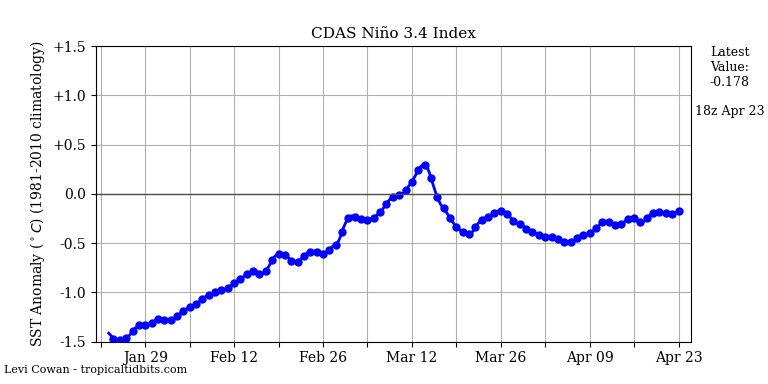
Nino34 Index below -0.5 indicates a la Nina condition.
Note the cold blue across the Pacific equator. That is the region of the Nino34 area.
Solar activity has increased (possible X-class flares) and SOI is increasing again.
https://www.longpaddock.qld.gov.au/soi/
Thanks! So thunderclouds themselves are local positive feedback excursions. With accelerating airmass buoyancy from water vapour – who knew?
Some would say that the above submitted theory is very testable. That is if the CO2-driver dogma can be dispensed of instead of tested for (all the time).
Hurricanes / cyclones also appear to be an emergent phenomenon with temperature regulating effect. The strong winds over ocean impel a huge amount of upwelling in their wake, which cools the surface of a patch of ocean by several degrees C as well as causing phytoplankton blooms from the nutrient transport to the surface.
https://agupubs.onlinelibrary.wiley.com/doi/full/10.1029/2005GL023716
This was acknowledged by the authors as being an “immediate negative feedback”.
Could cyclones be an extreme form of thunderstorms, in the context of your theory?
RickWill
is correct that the ocean surface temperature is limited by the mass of the troposphere.
The Lunar mean global surface temperature likely varied even less through the 20th century. Though Earth has a much smaller diurnal range due to thermal reservoirs.
Thanks, Ulric. Some complicating factors:
First, the earth is NOT acting as a blackbody or graybody as the moon is. By that I mean, the moon’s average temperature is basically calculable from the Stefan-Boltzmann equation, but the earth’s temperature is not.
Next, the earth’s temperature is strongly modified by one of the most ephemeral things imaginable … clouds. A priori, there’s no reason for the number, kind, and duration of the clouds to act in such a way as to maintain a ~ constant temperature for a whole century.
Next, the earth’s temperature is strongly modified by snow, ice, and rain … and again, a priori there’s no reason for their area and quantity to act in such a way as to thermoregulate the temperature.
Next, the moon has no volcanoes, dust clouds, or organic and inorganic aerosols to modify the temperature.
What all of this does to the earth vs the moon can be seen in a multi-thousand run ensemble of climate model results from climateprediction.net. Note that the entire system is so delicately balanced that a large number of the computer model runs spiral either into snowball earth or Thermageddon …
… but the real earth does nothing of the sort. It changed less than one degree C, which is less than half a percent, over the 20th century.
And that is why your suggestion that the moon is a valid parallel for the earth simply doesn’t work. The moon is a barren chunk of space rock. The earth’s climate is an unimaginably complex system with six major subsystems—atmosphere, hydrosphere, lithosphere, cryosphere, biosphere, and electrosphere. All of these subsystems have internal resonances, feedbacks, and unique processes, and all of them interact with all of the others. As a result the climate has critical processes at temporal scales from picoseconds to millennia and spatial scales from nanometers to planetary. The idea that the moon is parallel to that simply won’t fly.
Best regards,
w.
Willis:
You show the correlations. What if you had a table showing the weight of the tropics and the other zones? The poles are not too far from -1.0. But they are small. The tropics are shown as only about 0.2. But they are large. The tropics smaller value of about 0.2 should be upweighted I think to make them comparable to the poles.
I’ve area-weighted the correlations shown in the averages at the top of the various maps of the earth.
w.
Thank you. I think I see that in your Globe, NH and SH number. As more of a lesson you could show the weighting math in a table. As I thought about it some more, we have an average Sun angle at the surface of the Earth. I am at about 45 degrees in MN. I think that means my average % of overhead Sun is about 70%. 0.7 squared times 2. How much does my albedo matter? 70%. Further North it matters less. This could be an additional weighting that I cannot do, but perhaps you could.
We hear that the Arctic signals something bad. It’s small and its albedo doesn’t have the same importance as it does in Lutefisk eating MN.
The gridcells are 1°lat x 1°long. I weight them by 1° latitude band.
Here are the weights for the 90 degrees of latitude from 89.5°N to 0.5°N. They’re comma-separated for easy import into say Excel.
0.000077,0.000231,0.000384,0.000538,0.000691,0.000844,0.000997,0.001149,0.001301,0.001453,0.001604,0.001755,0.001905,0.002054,0.002203,0.002351,0.002498,0.002645,0.00279,0.002935,0.003078,0.003221,0.003363,0.003504,0.003643,0.003781,0.003918,0.004054,0.004189,0.004321,0.004453,0.004584,0.004713,0.00484,0.004966,0.00509,0.005213,0.005333,0.005453,0.00557,0.005686,0.0058,0.005912,0.006023,0.006131,0.006237,0.006342,0.006445,0.006545,0.006643,0.00674,0.006834,0.006927,0.007017,0.007105,0.007191,0.007274,0.007355,0.007434,0.007511,0.007586,0.007658,0.007728,0.007796,0.007861,0.007923,0.007984,0.008042,0.008097,0.008151,0.008201,0.00825,0.008295,0.008339,0.00838,0.008418,0.008454,0.008487,0.008518,0.008546,0.008572,0.008595,0.008615,0.008633,0.008649,0.008661,0.008672,0.008679,0.008685,0.008687
The CERES solar data includes the factor of the sun’s angle to the surface, so the poles receive less per square meter than the tropics.
Regards,
w.
It’s interesting. Let me say it a different way. The albedo punch is in the tropics. I think I figured the 60 degree north position gives 50% of ideal overhead shortwave incoming. A more extreme example is the albedo at the North Pole on 12/20/21. The albedo weight of any square meter of the surface decreases as one move towards the poles.
Personal income tax returns await my addressing. That’s what I do. Thank you.