Separating myth from reality about extreme weather events, today and over the centuries
Paul Driessen
Deadly floods in Germany and Belgium have put climate change back in the news in time for the COP-26 climate gabfest in Glasgow. Not surprisingly, government officials again blamed fossil fuels, greenhouse gases and manmade climate change for the calamities, to deflect attention from their official incompetence – as they did with SuperStorm Sandy and recurrent wildfires.
They’re blaming the very fossil fuels that power Europe’s economy; build, heat and electrify homes; and power the boats, ambulances and other equipment that were used to rescue people, recover bodies, and nurse survivors back to health.
They’re the same officials who could and should have prepared their communities for floods like those that hit Germany and Europe every few decades. But failed to do so. They were warned days in advance that the rains and floods were coming – and were told almost exactly where and when the rains and floods would hit. But did nothing.
They were supposed to warn people – and get them out of harm’s way. But they failed to warn their citizens that they, their homes and their children would be swept away by raging waters, if they didn’t evacuate immediately.
No wonder they want to blame manmade climate change – for almost every extreme weather event. They want to avoid accountability and protect their political and financial stakes in Climate Crisis, Inc. About the last thing they want people to see are the climate realities that would confound their myths and fear-mongering, put today’s extreme weather events into proper context, and keep their constituents from being bamboozled by future climate lies.
FLOODS are not uncommon, they are not unprecedented, and they are not kind to people, civilization or nature. Indeed, devastating rains and floods occur with regularity, and the more concrete, asphalt and buildings we put in cities, the less drainage we have, and the more flooding we get – in Europe, Houston, New York City and everywhere else.
The great Arno River flood of 1966 impacted much of Florence, Italy and damaged or destroyed many magnificent works of art. The 2002 Vltava River flood left high water marks 10 feet up on buildings, and 30 feet above the river’s normal water line; 1784, 1845 and 1997 Czech floods were even worse.
What caused all those floods? the deadly German floods of 1790 and 1910? the Johnstown, Ohio Flood of 1889? the 1976 Big Thompson Canyon flash flood that roared down a narrow Colorado gorge, leaving residents and campers few avenues of escape? All those floods were natural, but today’s are manmade?
HURRICANES are also common, recurring, devastating and deadly. It’s fashionable to blame Harvey and Irma and other recent hurricanes on fossil fuels, carbon dioxide, and us humans. But it’s ridiculous.
Between Hurricane Wilma in 2005 and Harvey and Irma in 2017, the United States enjoyed a 12-year major hurricane drought: 12 years without one Category 3-5 hurricane making US landfall. It was the longest period in recorded history that America was not hammered by a major hurricane.
If we’re going to blame every modern era hurricane on fossil fuel emissions – shouldn’t we also thank fossil fuel emissions for that unprecedented 12-year absence of truly deadly hurricanes? (It wouldn’t be honest science, but it would be honest politics.) A far better approach would be to prepare better for all of Mother Nature’s future onslaughts.
US property damage in raw dollars from hurricanes has certainly increased – because more people are building more expensive homes along our coasts, where hurricanes strike with regularity and intensity. But death tolls are way down, because buildings are built better, and (unlike in Germany and Belgium recently) people get warned far enough in advance to get out of harm’s way.
Equally positive, global property damage from weather-related disasters, as a proportion of global gross domestic product, went down significantly since 1990, largely for the same reasons. Deaths are down too.

TORNADOES. A Washington Post chart makes it abundantly clear that violent F4 and F5 tornadoes have been less frequent the last 35 years than they were during the 35-year period 1950-1985. Even more amazing, for the first time in history, the United States was not hit by a single violent twister in 2018. Was that because of fossil fuel emissions?
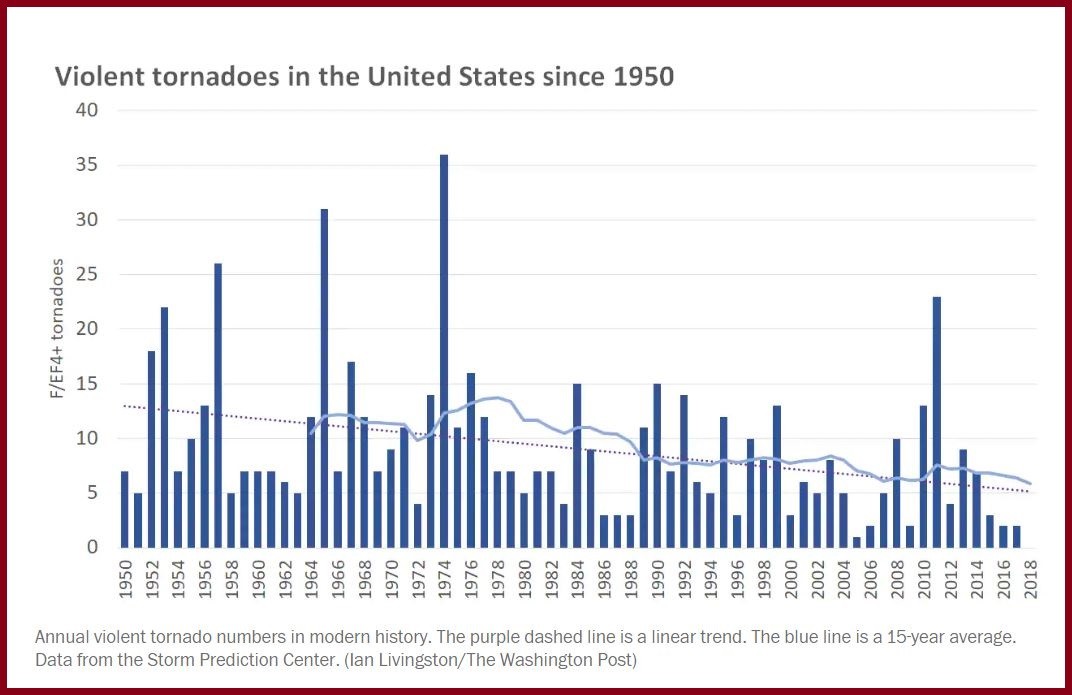
Indeed, very few tornadoes compare to the horrific Gainesville, Georgia tornado of 1936, which killed 450 people – or the even more horrendous, record-setting the Tri-State Twister of 1925. That one lasted 3.5 hours, traveled 220 miles, obliterated entire towns, and killed nearly 700 people
BLIZZARDS are also common. But predictably, almost every big winter storm nowadays gets blamed on “carbon” (CO2) emissions, and we’re told to expect far more if we don’t end fossil fuel use.
Climate con artists want us to forget the Nebraska School Children’s Blizzard of January 1888, when a relatively warm day, with snow melting all around, suddenly became a vicious storm. In less than three hours, Midwestern temperatures plummeted from plus-35 to minus-20 and even minus-40. Winds howled down from the North, bringing several feet of heavy snow. The storm killed some 500 people across several states, most of them in Nebraska. Many were children trying to get home from collapsing schoolhouses, and parents out looking for their children.
That blizzard made US and international news. But it was soon overshadowed by the Great Mid-Atlantic Blizzard of March 1888. That one buried New York City and much of the East Coast under mountains of snow, and killed over 400 people. Dozens of New Yorkers weren’t found until days later, when their frozen remains were dug out of massive snow drifts.
TEMPERATURES. The dawn of the industrial age coincides with the end of the Little Ice Age, so the warming is mostly natural.Climate models predict much higher temperatures than we’re experiencing. And average global temperatures have barely budged since 2002, except during El Niño events.
People once learned important lessons from extreme weather events. Midwesterners invested in stronger homes and schools, developed better weather forecasting, made sure they kept winter clothing with them and their kids even when the weather looked balmy, and built tornado warning systems and shelters. New York City built a subway system, enabling people to travel underground, safe from deadly cold and snow.
Today, too many government officials prefer to collude with activists, subsidy-seekers and media sidekicks to blame “manmade climate change” for every disaster. They ignore their own roles in the property damage and death from natural disasters like SuperStorm Sandy. They pretend they can control the climate and weather – while getting richer and more powerful embracing anti-fossil fuel policies.
After countless millennia of natural disasters, we’re supposed to believe extreme weather events are now manmade, and temperature changes, droughts and storms are now our fault. At humanity’s most technologically advanced level in history, we’re supposed to be unable to cope with, adapt to or recover from climate and weather events.
We cannot afford to be bamboozled by climate con artists – who for their own selfish reasons claim we must immediately get rid of the fossil fuels that provide 80% of America’s and the world’s energy … and then magically replace those fuels with expensive, intermittent, weather-dependent, land-intensive and raw materials-hungry wind, solar and battery power.
If we let ourselves get deluded, electricity prices will skyrocket, blackouts will become commonplace, our jobs will disappear, our living standards will plummet, our lives will be at greater risk, our environment will be destroyed – and we’ll deserve what we get. It’s time to fully and honestly reassess “the science” behind this supposed “climate crisis.”
Paul Driessen is senior policy analyst for the Committee For A Constructive Tomorrow (www.CFACT.org) and author of books and articles on energy, climate change, human rights and economic development.
Climate Change is a get out of jail free card for all incompetent, lazy, stupid, time serving civil servant, manager, Bureaucrat or man who should be clearing the drains
Paasau on the Danube puts the history right on the side of a public building. This flood reportedly did not top 1501…when there was far less upstream development to accelerate runoff.
I was going to comment on this article but I’m afraid some idiot will hijack it and make it about peak oil..
But, but, but Al Gore told his we were all going to die!
Surely Al wasn’t wrong?
BTW how many Wadhams of ice is there at the North Pole right now?
Thanks to EU directive 2007/60/EC we had floods in the Somerset Levels. There are quite a few directives and frameworks.
“But they failed to warn their citizens”
Personally, I don’t buy into the incompetence argument. Even the trees stand to attention in Germany.
I’ve made similar points many times – if they’re going to “blame” so-called “climate change” for “bad” weather. they also have to credit “climate change” for all the good weather.
As I like to say, that “longest period on record” without a major hurricane hitting the US is unprecedented, and during the period when “climate change impacts” are supposed to be “seen.” Ditto for the only year (2018!) on record without a single violent tornado (F3 or higher), despite better tools to identify and observe such storms than ever. Ooops!
I take some pleasure in using their own stupid (and in their case misused) “buzzwords” for good “weather news.” 😛
In my experience as a structural engineer & who has worked on many a civil engineering project, (when you’re self-employed one cannot be too choosey what work you accept to undertake), most drainage issues are a result of poorly or inadequately designed drainage infrastructure in designated catchment areas. There is of course societal changes in residential areas where to reduce maintenance, grassed areas are paved over either for saving grass mowing, or to provide parking areas for one, two, or more cars in domestic situations, requiring redesign of drainage locally but which rarely gets done!!! So yes, these things are manmade!!!
Any news on those electrically powered Jumbo-Jets yet, have they solved the rubber band issues yet, or are they just going to be for the peasant classes, & the real useful liquid fuels will be reserved for the wealthy ruling intellectual elites??? They’ve GOT to reduce the World population somehow!!! Perhaps some communist country somewhere might produce a laboratory created deadly virus that could do it!!! Who knows???
just for the sake of it, Dutch KNMI (now well known for extreme weather event attribution) were honest enough to report that they could not find a climate signal for the 2013 Central European flooding
https://www.knmi.nl/kennis-en-datacentrum/achtergrond/central-european-flooding-2013
from the website above:
Climate change
Since 1950 (the start of the E-OBS dataset for Europe) the 4- and 10-day precipitation amounts in the Elbe and Danube basins reached peak values between April and September at or above the current May/June 2013 values several times (Figure 10). There is no clear indication of clustering of the more extreme events towards the end of the time series. Therefore, the data do not indicate that these extreme events occur more often now than in the 1950s as a result of a warming climate.
Other indicators for changes in extreme precipitation in this area do not show any clear climate change signal either (source: ECA&D). The station trends in the number of days with (very) heavy precipitation do not indicate wide-spread positive values in the region since 1950. Figure 11 suggests a trend towards more heavy precipitation days in May while the opposite seems the case in June, but non-significant station trends (green circles) generally dominate the map.
A similar pattern emerges when the trends for the shorter period since about 1980 are considered (not shown). This is different from the winter season in which a significant shift towards wetter conditions dominates in this region.
In conclusion, there is no convincing evidence of a tendency towards more extreme precipitation events in this region during the warm season.
Floods are a man-made problem. Chinese dams have large number of casualties. Zoning regulators drive construction to the river banks and beaches. Wet areas are drained with small ditches, pipes and rivers.
Does anyone know if the Obama’s mansion on Martha’s Vinyard is being subsidized by tax payers thru flood plain insurance?
They realy seem to be worried…
It doesn’t matter what causes a flood, if you get warnings, you should pay attention to them and act!
A bit off topic, but well in line with government wanting to make sure that the citizens don’t know enough to object:
https://www.foxnews.com/us/oregon-governor-signs-bill-suspending-math-reading-proficiency-requirements-for-hs-graduates
1966 did not it just Florence, but also Venice and her region up to the Alps, with a record (for XXth and XXIst century) “high water” in the city and flooding everywhere in the region. 55 years later, not enough was done yet and in case of a recurrence of this event, we would be badly affected again. Maybe even worse, because now we are richer, more industrialized and with more houses and infrastructures around. But for sure the CO2 emitters will be blamed.
Correction: the 1889 flood hit Johnstown, Pennsylvania. Earthen dam break.
They’re the same officials who could and should have prepared their communities for floods like those that hit Germany and Europe every few decades.
but the recent floods were NOT the ‘floods that hit Germany and Europe every few decades’: they were far more intense and damaging and widespread than those: that’s the whole point.
One of the Dutch towns worst hit had had really extensive floodproofing following previous record floods: the whole Dutch ‘room for the river’ philosophy applied. And it still flooded, this time in summer.
The heavy rainfall in the south of North Rhine-Westphalia and north of Rhineland-Palatinate in Germany produced accumulations which averaged 100 to 150 mm (3.9 to 5.9 in) in 24 hours, equivalent to more than a month’s worth of rain. In Reifferscheid, 207 mm (8.1 in) fell within a nine-hour period while Cologne observed 154 mm (6.1 in) in 24 hours. Some of the affected regions may not have seen rainfall of this magnitude in the last 1,000 years.
That’s the issue: nobody could have prepared sufficiently for widespread summer 1 in 1,000 year floods after that scale of rainfall.
And those floods WERE caused by climate change, those floods show climate change is here, now, and damaging right now
The 2019 south Yorkshire flooding near Doncaster was of course blamed on you know what. The river Don was a bit full and a place called ‘Fishlake’ was under water. Some bright spark noticed the clue in the name.
So, what I take out of all of this is that the work “unprecedented” now means a perfectly normal event. Read in that context all of the alarmism makes perfect sense!
Precedented handmade tales to avoid responsiblity for weather without mystery and predictable progressions.
Paul, your position is hopeless.
People never mention good news.
The bad news, on the contrary, they mention immediately, and they need someone to blame for those bad news.
Beware you are not that scapegoat!
Let’s not forget the California flood of 1862, when the whole Central Valley was under water.
Epic. Nearly a Cc of my, earlier today, little rave about Australia.
Certainly to my mind is to get Some People, to actually Carry The Can, to Accept The Buck when it lands on their desk.
Politicians AND Scientists both.
Most especially here, about planting homes on flood plains but mainly, differentiating between Heavy Rain and Flooding
In a way similar to why Earth atmosphere is seemingly warming up.
Atmosphere may be getting exactly the same amount of energy as it always did but the temperature depends on how the atmosphere ‘handles’ energy.
For any given energy amount, If it is wet it will achieve a lower temp than if it was/is dry
So it is with rain and floods.
For any given amount of rain, it depends how the land/soil/dirt handles that water which determines: Flood vs No Flood
Two main reasons why any given patch of ground alters its handling of water:
And it is the people who put those things where they are that should be carrying the buck – not everybody else via crazed imaginings about properties of the Contemporary Phlogiston
This article is a shame to be published in a science blog. It is nothing more than an opinion piece with a few random facts thrown in. Lets look at what the Author is claiming:
Let’s not let this science blog get watered down with propaganda, even if we agree with it.
JGrizz
The poor residents of towns along the River Elbe were just about recovering from the flooding in 2002 when they had more flooding to contend with in 2006.
Swelling Rivers Force Hundreds to Flee in Central Europehttps://www.dw.com/en/swelling-rivers-force-hundreds-to-flee-in-central-europe/a-1951914
Interestingly, that article makes no mention of climate change/disruption/emergency/catastrophe.
The 1889 Johnstown flood occurred in Pennsylvania, not Ohio.
Man-made flooding. Through bad planning. A case in point is the city of Cologne on the river Rhine, prone to flooding when the Rhine has to shift large quantities of water from the catchment areas upstream. Reason: the creeping narrowing of the riverbed by development on the river banks. Result: flooding of cathedral square and low laying parts of the city.
A similar mistake had been made in the city of Nijmegen on the river Meuse/Waal which suffered serious flooding in the 1990s. Then it was decided to reverse the encroachment on the river bed and actually widen it by digging an extra channel to be used as a bypass when needed. They still have the quayside under water occasionally but by far not as bad as before.