Guest “Gizmodo must be Latin for ‘dumb as a shoe'” by David Middleton
EARTHER
EXTREME WEATHER
The U.S. Wheat Crop Is in Trouble
Spring wheat could see some of its lowest wheat yields in decades due to widespread drought and heat.
Molly Taft
Yesterday 12:10PMWheat farmers across the country are facing lower yields as 98% of the country’s wheat crop is in areas experiencing drought.
In the Northern Plains, the Department of Agriculture said Monday that farmers were projected to harvest their smallest crop of spring wheat—crops planted in the spring and harvested in the autumn—in 33 years.
[…]
The Pacific Northwest saw ground temperatures rise to 145 degrees Fahrenheit (63 degrees Celsius) during the heat wave worsened by climate change earlier this month, with the worst readings in the parts of Washington and Oregon where wheat is grown.
[…]
This summer’s wheat woes are a look into how crop yields may start to sputter more regularly, even as agriculture makes technological advancements. Ortiz-Bobea coauthored a study published in Nature Climate Change earlier this year that found that climate change has already made global farming productivity 21% lower than it could have been—the equivalent of making no improvements in productivity for seven years.
[…]
“This is going to become more frequent,” he said. “Climate change is already slowing down productivity at a global scale. It’s already happening but we don’t see it because this is a bad year compared to the previous one. We’re comparing today versus yesterday because we’re not thinking about what could have been.
Molly Taft
Writing about climate change, renewable energy, and Big Oil/Big Gas/Big Everything for Earther. Formerly of the Center for Public Integrity & Nexus Media News. I’m very tall & have a very short dog.
Gizmodo
US Wheat Production has actually been declining since 1981… Largely due to the fact that world wheat production has skyrocketed, reducing demand for US exports.
Wheat data in plots including 2021 are mid-year numbers.
US Wheat Production Peaked in 1981 (Peak Wheat)

US Wheat Exports Peaked in 1981 (Peak Exports)

World Wheat Production Has Nearly Doubled Since 1981

Wheat Appears to Like Warmer Weather

Wheat Appears to Like Plant Food

If Not For Climate Change…
This summer’s wheat woes are a look into how crop yields may start to sputter more regularly, even as agriculture makes technological advancements. Ortiz-Bobea coauthored a study published in Nature Climate Change earlier this year that found that climate change has already made global farming productivity 21% lower than it could have been—the equivalent of making no improvements in productivity for seven years.
Gizmodo

Mr. Data Likes to Laugh at Gizmodo and Earther Articles

David Middleton
Writing about climate change, reliable energy, Gizmodo articles and geology for Watts Up With That? Currently part the Climate Wrecking Industry. I’m fairly short & we have 10 very short dogs... Although the Corgis think they are legless German Shepherds.
Fig. 4 typo, Wheat Appears to Like Warmer Wetaher.
(Fixed!) SUNMOD
D’Oh! I’ll have to edit the PowerPoint… I probably won’t get to this until tomorrow morning.
It looks like the only thing, up to 2018 dataset, affecting total wheat harvest (the decline since 1981) is the fact that, per figure 1, harvested acreage has more than halved from 80.60 million acres in 1981 to less than 39 million acres in 2018. Despite the reduction in harvested acreage the production still increases linearly
The declines in US production and harvested acreage pretty well track the decline in wheat exports. My guess would be that much of that acreage has been shifted to other crops.
That would most likely corn for the subsidized ethanol program
Russia seems to be doing very well with their wheat exports.
That would be my first guess… Soybeans would be my second guess.
USDA July outlook cuts spring wheat forecast from June estimate, but still far from a crop failure:
https://www.ers.usda.gov/webdocs/outlooks/101641/whs-21g.pdf?v=928.2#:~:text=Wheat%20Tightens%20Supply%20Outlook%20for,in%20forecast%202021%2F22%20production.
Worse for durum than for other varieties.
Keep in mind that Spring wheat is not near harvest. USDA is generally negative on crop forecasts tending to underestimate crop yields.
Durum wheat acreage is down 13% from 2020 and that affects the total yield. It is likely the land is planted in other crops.
Nothing wrong with buying larger bags of flour and stocking up on noodles and frozen pasta.
Lots of farmers here in east central Kansas planted rye instead of winter wheat in order to help the soil. Wheat prices just didn’t justify doing anything else. Have to see what wheat futures do before making any predictions for next year. The hard red winter wheat crop here did just fine in east central Kansas.
We started moving to alfalfa a few years ago and milo. I remember an article about wheat not handling higher temperatures put out by the Pottsdam Institute that said wheat could not germinate above 90 F or something, obviously not an actual ag school.
Huge advance’s in modern wheat breeding science has been a major factor in increased yields.
YES!
Progress in breeding and farming technology. That must be the main factor behind the growth of the productin of wheat (and other cereal crops). That and, of course, the introduction of modern production technology in underdevelopped countries.
“Molly Taft
Writing about climate change, renewable energy, and Big Oil/Big Gas/Big Everything for Earther. Formerly of the Center for Public Integrity & Nexus Media News. I’m very tall & have a very short IQ.”
There, fixed that.
I inherited my mother’s corgi, which was dominant enough to intimidate my Golden Retriever, which was more than a foot taller and 65 pounds heavier.
They literally are German Shepherds with extremely short legs… 😆
Considering that Corgis were bred to herd cattle, that sort of personality is appropriate.
Hoof biters?
Low riders.
Queen Elizabeth has Corgis.
Judging by her flock, obviously not as good at herding as advertised.
They’re very good at herding… You just can’t tell them what to herd.
Ours try to herd the swimming pool… https://www.facebook.com/david.h.middleton/videos/10214658546129172
The last male Corgi I had (he was a big one) chased me across the yard on Thanksgiving Day, in pursuit of a drumstick.
Oh great. Now Griff has ANOTHER thing to get paranoid over. Of course Griff will only read the headline as his worries will take over faster than his suspected climate change.
So global wheat production is actually up? Darn, I thought we would have to switch to Bison Ribeyes and stuff made from sugar. By the way, eastern Colorado, my home state, is in great shape right now. D0 on the drought monitor.
Unusual that the Rockies are keeping the dry air to the West. I’ve never seen the wild grasses so high and still green. In fact, I just went over the nearest ditch and the water was running high and fast. Usually it’s dry by the end of June.
Just back from central Kansas, where my brothers, and the other area farmers, just finished a very good harvest. This in spite of excessive rain at times, and a late frost. The Dakotas were having some drought problems, though that may have recently changed. Drove up from far south Texas, and the biggest problem is too much rain. My recollections of wheat production don’t include much from the NW. Canada has massive spring wheat production near the US border – not sure what’s happening with rainfall up there.
Interesting comment from one of my Kansas farming brothers on absorption of CO2. He commented the US corn crop absorbed as much CO2 as the rain forest. All this gets rolled over into the soil every year. Interested to read others viewpoints on that.
In wheat production, Washington State ranks third or fourth among U.S. states, (depending on which website you read). Kansas and North Dakota rank first and second respectively.
Most of that CO2 will be released back into the atmosphere when the corn is eaten.
My understanding is that once “the rain forest” is established, it doesn’t sequester very much carbon at all.
If you assume that the stalks will go to animal fodder, but there’s a certain amount plowed under.
YYes, the carbon will be oxidized when eaten by humans (HFCS) or livestock.
The rest is likely burned as fuel when blended with gasoline in cars.
Yeah, those ignorant farmers. Molly can teach them a thing or two.
They need to be comparing the yield per acre over identical areas if they want to try to see if there is a detrimental weather effect.
You expect “journos” have a brain? Logic thinking?
And only change one variable, so same variety every year.
Must find a climate disaster. Anyone seen a climate disaster lately? Nobody? Well, I guess I will just have to make one up! Well here we go! The US isn’t producing as much wheat as it once did. There is my disaster! Never mind that global Cereal Grain production has been growing every year! The rubes that read this stuff and believe it don’t care about facts like that.
Piling on the agony, Yahoo just reproduced this new disaster to come from USA TODAY, reprinted from Nature Climate Change courtesy of guess who? NASA. Apparently, “the moon’s orbital wobble will cause flooding on every coast in the USA, no less.
https://www.yahoo.com/news/moons-wobble-2030s-cause-decade-231205266.html
It was raining cats and dogs in El Paso.
The one thing nobody is talking about is China’s crops. They are under water probably not ding well
Jimmy Carter can be thanked for destroying the US wheat export market with the wheat embargo to Russia in 1980. With that move the US became an unreliable source for wheat. He also destroyed some wheat farmers.
Lots of the land that used to produce wheat now produces soybeans.
Soy beans don,t do as well, or not at all where dry wheat farming in practiced. Dry farmed wheat needs 10-18,” soybeans 18-20″ of water. The biggest danger to farmers appears to be loose cannon politicians, more than anything to do with weather or climate.
While you’re right, the economics and new soybean and corn varieties has resulted in wheat losing acreage in Central Kansas. Something I never saw growing up.
I know of what I speak first hand,
I used to run a small company that provided and installed ceramic abrasion resistant linings far various industries. Believe it or not, soybean husks are quite abrasive and so the large elevators and processors were a primary customer. We spent weeks in S, Dakota installing linings in the spouts (that is what they call the chutes that handle solid product in that industry) in elevators that once handled wheat but were filling their huge silos primarily with soybeans.
That is why some irrigate. But if you are going to irrigate, why not plant corn?
Lots of Farmers here in Indiana alternate between corn and soybeans.
…And/or canola, sunflower, alfalfa, flax, sometimes sugar beets. Depends on soil, irrigation, the markets, the farmer, weather (not climate) and luck.
I love to, and often do, blame little Jimmy for just about everything, but the USDA and lopsided subsidies destroyed wheat farming through overspecialization and market manipulation. Carter just knocked ’em all in the head when other people’s money ran out.
“I’m from the gub’mint, and I’m here to help you.”
Yeah, but PEANUTS???
Actually you can blame the Russians for invading Afghanistan for the embargo. So it’s the communists fault.
Yeah. It was the French failure in Vietnam that got us involved. Then it was the Soviet’s failure that got us into Afghanistan. We will never learn.
True for Viet Nam. We helped the Afghans get rid of the Soviets. 9/11 got us back in.
The correlation of CO2 and World Wheat Crop productivity under the Heading “Wheat Appears to Like Plant Food” is absolutely stunning and perfect. It puts any attempts by Warmistas to correlate CO2 and World Temperature into a very unfavourable light. Get that CO2 out there.
Correlation is not causation.
Only when it is politically unfavorable.
Except there is no question about the correlation between increased CO2 concentration and greater plant growth. That’s why greenhouse growers pump CO2 into their glass houses … and not to make them hotter.
I think that little detail may have slipped passed joe
Pretty much everything slips past joe. Both of them.
If you applied that maxim to the rest of your mythology, bats, you’d have nothing left to annoy us. But I guess that grasping the irony is too much for your greentarded mind.
You are right!
Actually, causation of yield by CO2 has been established long ago, not with “models” but with empirical, experimental plant physiology!
And the graphic illustrates very well (through a very good correlation) that this physiological causation can be observed not only in the laboratory, not only in experimental fields, but that we can see its expression at the world scale!
Wrong target, belford! Next time, do your Plant Physiology 101 before starting to post…
The fact that all plants grow better when more CO2 is present in the atmosphere is well documented, using actual science.
I live in the Eastern Midwest and our farmers (I’m surrounded! I’m in the outer ‘burbs where there are more farms than neighborhoods. That will change eventually.) have brought in a good wheat crop.
Those doing corn this year are sitting pretty. It’s chest high or higher here in mid-July. The saying “knee high by the 4th” (July) has been well surpassed.
The beans (soy beans) are in the ground and looking really good.
I my neck of the woods, wheat, corn, and soy beans are in for very good yields this year. Records? We’ll just have to wait and see. Every year doesn’t have to be a record. The farmers just need a good yield. Wheat and corn are looking good for that. Beans? Wait and see.
H. R.,
Shouldn’t that be the mid Midwest, or the mid Mids? I think the east and west cancel each other out!
I may not know beans about farming, but I hope the corn and wheat crops prosper; I need lots of bread and bacon for BLAT sandwiches! That’s a BLT with my homegrown tomatoes and some avocado added to make it more nutridelicious! And yes, my tomatoes are very happy with their extra CO2 ration and the nice balance of heat and moisture the summer monsoon has brung!
Cornfusing, ain’t ‘er?
Sometimes East in this context means East of the Missouri/Mississipi, but usage of Midwest is funny. I live not far from a part of a street that is listed on maps almost everywhere as East Northwest Parkway, that is incidentally on the South side of town.
You got it, dk_. I’m not smack in the middle of the Midwest. I’m not in the Western portion of the Midwest. I’m in the Eastern part of the Midwest.
But as far a the Climarati Elites are concerned, I’m in flyover country and they don’t want to be bothered with the finer details. To them, flyover country is like those old, old maps with big blank spaces on them labeled Unknown. There be Dragons here.
Wun er dem places dat b’gins wit a vowel.
I was harvesting corn by 4th of July.
Original Post (O.P.) is a flawed presentation. The crucial issue of USA wheat farmer’s yields relates to wheat grain yield per area planted – which can definitely be negatively impacted by either, or both, drought and unfavorable high temperature at key times of the crop.
O.P. ignores water & temperature’s well understood agronomic parameters by only highlighting and graphing total wheat yields, and not once elucidates that (total yield) is distinct from yield per unit area. This comment makes no issue, nor opines, of whether there is a climate change pattern or essentially weather variability involved in USA wheat farming water and temperature environment(s).
In the USA it was 1956/1957 when all kinds of wheat combined began to yield over 20 bushels/acre; it was 1969/1970 when all USA wheat combined began to yield over 30 bushels/acre; and it was 1998/1999 when all kind of USA wheat combined began to yield over 40 bushels/acre.
Since that last yield pattern of over 40 bushels of USA total wheat began there were, to date, only 2 periods when it’s yield was less than 40 bushels/acre – 2002/2003 & 2006/2007. While there were 2 periods, to date, when the total USA wheat yield was greater than 50 bushels/acre – 2016/2017 & 2019/2020.
Data culled from USDA records available on-line going back into the late 1880s. And the more modern era data also included the acreage of wheat planted in each year set, as well as the resultant acreage ending up being actually harvested. The data also elaborates individually the same parameters for each of the assorted kinds of USA grown wheat for different years – too extensive for me to break down in this comment.
Source on-line is “Wheat Data” consisting of “3 Data Sets” (3 pdfs = Wheat-Data-Recent, Wheat-Data-All Years, and Historical Data) on website of Economic Research Service ( ers.usda.gov ). My above abbreviated synopsis of yield/acre is from “all years” pdf.
Excellent smackdown of the climate propaganda liars. They have no shame.
Farmers in the U.S. have more to worry about nationwide from greentards and nuvo-trotskyites than from drought.
But Gizmodo is only wrong to hysterically blame it on climate change. USDA Farm Journal Ag-web reports low yield, too. https://www.agweb.com/news/crops/wheat/spring-wheat-crop-quality-tumbles-some-farmers-abandon-fields. Rather than being abnormal, this is offten what happens in a bad crop year for one crop, and well within normal historic variation. This is why farming is risky, especially to centrally planned agricultural economies, which is the alternative offered by greentards and trotskyites.
Many of those drought areas (map) in Central California and in the Northern plains states are served by great irrigation projects that have been shut down or hampered by eco-activism, lawfare, and priveleged idiots with more regard for nearly extinct (or sometimes fictional) species than for their fellow humans.
If you want a commercially paid biased review of software, computer hardware, or IT, then go to Gizmodo. On any other subject it is a source of only ignorant, biased opinion, unencumbered by facts or the thought process.
Minor update: USDA reports across the entire Midwest winter wheat harvest is a little behind, and will remain so due to heavy rain. Kansas is experiencing a bumper crop, so far.
Next week, Gizmodo can panic about too much rain — still within normal historical range.
Fig 6 is hilarious … terrified of a productive healthy world.
Got to wonder why Gizmodo is trying so hard to make-up lies to fan confirmation-biases?
Oh … the answer was in the question.
Figure 5 is bogus. Posting it is evidence you don’t know the difference between correlation and causation. Like the figure doesn’t show how much land was in production.
No wonder gizmodo has more traffic than this site.
Since you are so convinced the figure is bogus, why don’t exercise a few of your moribund brain cells and look up the data to prove it.
Unless of course actually proving your claims is beyond your meager mental powers.
Dear MarkW, anyone with more than your one brain cell knows that the more land you cultivate with wheat, the greater the number of bushels of wheat you get at harvest time. Figure 5 does not indicate the number of hectares in production. If you plant 5 hectares you get more wheat than if you pant 1 hectares.
…
So please view figure 5 and exercise your solitary brain cell, then tell us how much land was cultivated in 1970 versus 2010.
Ha ha, you didn’t answer his question, maybe you don’t really know after all.
LOL Tommy, Mark is a big boy, let him respond.
.
PS, can you tell us how many hectares were planted in 1970/2010 as depicted in Figure 5? If you can, then we’ll know if the increase in wheat production was due to CO2 or to the amount of land cultivated.
”If you can, then we’ll know if the increase in wheat production was due to CO2 or to the amount of land cultivated.”
What is it about tons per hectare that you don’t understand?
We KNOW that some of the increase will be due to co2 increase and the rest probably added N P K and H20 and possibly the very slightly higher temps.
Recheck the dimension of the y-axis on figure 5
Look at Figure 6… It will help you avoid continuing to appear like a trollish retard.
Pure sophistry with logical fallacy red herrings spread like fertilizer.
Arable land is arable land.
Given the growth of cities, arable land has declined.
Yet, so few countries actually tracked arable land or misreported arable land back in the 1970s, your demand is ridiculous on the face. That data is unavailable and/or unreliable.
Wheat production however has been tracked, well except for the countries who consider their harvests secret.
Figure 5 is based upon wheat production. Not not your red herring arable land.
Your demand to know arable land utilization back in the 1970s utterly specious.
You however are welcome to find and try to verify arable land. It does not matter to the article above or to comments in this thread.
@Joe Kirklin belford – in the 1970s, all throughout the 1980s and 1990s until 1998/1999 USA wheat yielded on average over 30 bushels/acre; whereas in 1998/199, all through the 2000s to 2015 USA wheat yield averaged over 40 bushels/acre (except for 2002/2003 & 2006/2007). I posted this data earlier under my own comment thread above.
So you are on the right track. Using just your 1970 & 2010 mentioned years: if a year of wheat area (acre) harvested in 1970 was compared to a year of the same area (acre) of wheat harvested in 2010 the data point would show more wheat production/acre in 2010 – this supports your premise. [And, since 2010 wheat yield is greater than it was in 1970, farmers can (plant) harvest proportionately less wheat in 2010 than in 1970 yet none-the-less get the same yield, or greater, on proportionately less land.]
You make a lot of noises about it, but fail to back it up, thus you are into babbling zone.
Still no answer from about it either, while you insulted him about it.
You are looking really small in my view.
So, you can’t tell from figure 5 how much land was cultivated.
Anyone who isn’t a trollish retard would have noticed Figure 6.
David,
Ol’ Joe is starting to give trollish retards a bad name!
I’m beginning to believe we need think of his ilk as toadstools. Like a mushroom, kept completely in the dark and fed a steady diet of manure (BS;) but exceedingly poisonous and potentially fatal if contacted or consumed!
Time to take your pills, bats.
The answer is in figure 1
In 1970 43 million acres were planted
In 1981 80.60 million acres were planted
In 2018 39 million acres were planted
If you want figures per hectare, divide by 2.47
So, even though 2018 saw less than half the planted acres of 1970 the harvested tonnage more than doubled from 1.5 m to 3.5 m per hectare
Bats, you dolt! You’re the one who made the claim. You’re the one to back it up. This is not like when you’re hungry, so you just yell up from the basement, “Ma! Make me my chicken nuggets and apple slices!”
Figure 5 is bogus, total wheat production depends on a lot more than the atmospheric concentration of CO2
The claim in the Gizmodo article was that CO2-driven climate change has harmed wheat output. Figures 1 through 6 demonstrate that this claim is false.
Your comment is a Straw Man… I never made the argument that increased atmospheric CO2 and warmer temperatures were the only reasons why wheat production has steadily improved.
But but but CO2 increases HAVE harmed Wheat Crop output.
In the Leftist drivel ecotard narrative, CO2 increases have lead to an increase in Non-Wheat crop planting, thereby diminishing wheat harvests so
wethey can flatten CO2 output and thereby stabilize the climate.Don’t be stupid, belford! Just take a look some inches below, at FIG. 6 (figure SIX) and you will have an answer… if your single cell brain is not overwhelmed by the amount of thinking necessary.
I see that joe has admitted that he is incapable of doing independent research. Instead he just spews ever more insults.
Typical liberal.
Hey, dummy, do you understand WTF yield means? Look at Fig 1 and Fig 5 and fig it out.
Fi1 1 and Fig 6
joe, since you want causation, you might want to go back to high school and learn a little about CO2s impact on plant growth. There is direct causation not some obscure theory from a wacko ethereal scientist nearly 200 years ago.
CO2 DOES have a direct, causative impact on plant growth. However, that has nothing to do with figure 5.
Good fracking grief! Look at Figure 6.
Figure 6. “Climate change has already made global farming productivity 21% lower than it could have been…”Really? (Our World in Data)
Does this help you out joe?
Tonnes per hectare is UP world wide.
Figure 5 does not show tons per hectare, it’s showing bushels .
See Figure 6.
Figure 6. “Climate change has already made global farming productivity 21% lower than it could have been…”Really? (Our World in Data)
I’m beginning to think joe can’t count above 5. He’s really fixated on that one chart.
I’m guessing that joe’s last remaining neuron has given up the ghost.
There is a simple, linear relationship that allows one to convert bushels to tons.
But then thinking is not what joe wants to do.
belford, see my other post:
“Actually, causation of yield by CO2 has been established long ago, not with “models” but with empirical, experimental plant physiology!
And the graphic illustrates very well (through a very good correlation) that this physiological causation can be observed not only in the laboratory, not only in experimental fields, but that we can see its expression at the world scale!
Wrong target, belford! Next time, do your Plant Physiology 101 before starting to post…”
It is not the author who does not know a difference, it is YOU who does not know the difference between opinion and fact, right and wrong, false and true, superstition and science.
I repeat my advice: Next time, do your Plant Physiology 101 before starting to post!
Joe is right. Figure 5 says nothing, and leaves an erroneous impression.
Good fracking grief! Look at Figure 6.
Figure 6. “Climate change has already made global farming productivity 21% lower than it could have been…”Really? (Our World in Data)
…so, everytime the result of a calculation is presented, there must be shown the multiplication table that everyone has learned (?) in primary school?…
Molly Taft would likely do better discussing something she does understand … and that certainly ain’t climate. Perhaps she’d do better with needle work or home cooking.
Wow. Just unbelievable.
I’m sorry peeps, I am soooo sorry but if this essay doesn’t demonstrate the incredible power of Magical Thinking. will-full self-imposed ignorance and blindness, nothing does.
and you rave about Joe Biden
Fig 1 and a bit of search is all you need.
Fig 1 tells us a per acre yield of circa 40 bushels.
Barely over one tonne per acre. (##)
Why Do You Bother? To describe that as:
doesn’t even come close.
You are soooo busy looking at the sky, watching (cherry picked & rising) trend lines = things that would see a Warmist laughed out-of-court around here.
And while doing so, haven’t noticed, don’t want to see/notice, that there is now nothing under your feet. You are marching off a cliff-edge while counting mosquitoes above your head.
One day coming very soon, your wheat farmers are gonna visit their haha fields and find completely NOTHING there.
Perfectly nothing bar a big cloud, rapidly fading, of red coloured dust in the sky.
Climate Change has everything and nothing to do with it.
The wheat and all other arable farmers changed the climate – exactly by doing what they do…
Do you see now what the other trend lines are showing you?
i.e The Exact opposite of what you Magically Think they are showing you.
Your arable farmers are creating a desert and climate is simply doing what climate does.
Do Not Pass The Buck onto Ma Nature for your own greed and stupidity.
Over to you, search ‘wheat’
One of the first things you’ll find is this:
Quote:”Believe it or not, it’s illegal to grow wheat at home. … Commercial wheat operations are often very traumatic to otherwise fertile land because they rely heavily on commercial pesticides and fertilizers for production.20 Oct 2013”
(Not my emphasis – mine would be very traumatic to otherwise fertile land)
You will also find you need a seed rate of about 40 to 50kg per acre, of treated seed which will be 3 or 4 times the price of what you grow and sell.
Bang goes 20% of your crop just for seed. Is this Roundup Ready seed? Nicely explains the next bit, the grotesque over-use of fert.
(There are NO Free Lunches out there)
You will also find that wheat likes its fertiliser, Google says:
Nitrogen: 100kg per acre
Phosphorus 150kg per acre
Potash 40kg per acre
Make it easy, call that to be, in total, 300kg per acre at what cost, 1st guesstimate says £300 per tonne for fert.
Do you get £100 per tonne for the crop,?
Wow again, you’ve blown £110 per tonne (£20 on seed and another £90 on fert) so what’s left?
Minus £10 already before pesticides. machinery and labour
Never mind the money – mind The Dirt instead.
How can you be so blind to the disaster staring you right in the face – if only you looked down for an instant instead of up
It is entirely obvious why you (like to) grow corn (maize)
It is a ‘new’ crop for your soil/dirt and as such, has a little way to go before before it hits its limiting nutrient.
The same will happen to it soon tho. It will hit its Liebig Limit and then what?
The End is a whole lot closer than anyone wants to imagine – this essay tells it Loud and Clear.
ty
## If UK farmers get less than 4 tonnes per acre, they d!e of embarrassment and or bankruptcy.
What don’t you understand about a continuously rising wheat harvest?
And a rising everything else harvest as well?
How is it that farming business is continuing if it is continually losing money?
I don’t know any of the costs or returns but I do know that the general result of costs exceeding returns, often for only one year, is losing the farm.
I do think that having a bad year, vis a vis, poor crop yield, while bad for the farmer, is not in the least a new thing.
Wrong.
Yes, part of the premise for passing the legislation was soil conservation, but implementation and the court cases were about regulating commerce.
That is, the government has the right to limit crops to prevent price fluctuations.
Nothing about who can grow what crop.
Nor is the government heavily invested in controlling the price of wheat or corn these days.
Many crops require adequate fertilizer. Much of which is controlled by use of crop rotation and the plowing of plant detritus and stalks back into the ground. Land testing allows farmers to identify nutrition and mineral levels so they can add supplements.
Apparently you missed that this is a global chart and that wheat yields were under twenty bushels of wheat per acre up to the 1960s.
Improved crop practices, irrigation, harvest equipment and CO₂ have increased those global averages almost every year.
Your bizarre ignorant rant about farmers destroying their land is seriously deranged. Stop believing things Mother Jones prints.
Then there is your equally bizarre rant about 1 ton of wheat per acre.
A) Different wheats, and there are many, weigh differently.
B) According to “Our world in Data”, America gets 3.2 tons per hectare. England gets 7.75 tons per hectare, Ireland gets 8.74 tons per hectare.
Nowhere do they define critical aspects regarding the wheat; e.g. variety and dryness levels.
England’s damp climate likely prevents full drying before harvest and further drying is required after harvest or they get ergot infested wheat.
Each hectare is equivalent to 2.47 acres.
In America , that 1.3 tons per acre. In England that is 3.13 tons per acre before additional drying.
Since UK’s farmers do not get over 4 tons of wheat per acre, they must all be dead of embarrassment or no longer farmers, per your own specious claims and insults.
That is, the government has the right to limit crops to prevent price fluctuations.
Governments have the power to limit crops. Preventing price fluctuations is the excuse.
There’s a big difference between having the power, and having the right.
tons are not the same at tonnes. That said, 4 tonnes is approximately 4.4 (short) tons, so it makes it worse.
I get that this is your obsession, but if there were anything to it, where are the dust bowls today? And how, if fertilizer is constantly applied is the process not sustainable? You’ve heard of hydroponics I assume?
Peta has this belief that deserts aren’t caused by a lack of rain, but rather repeated fires that destroyed the soil.
What planet do you live on? Having grown up on a wheat farm and still owning it today, nearly everything you say is some total fantasy.
Maybe a comparison how much land is now used up for the production of ethanol would be useful. A lot of grain may have switched over as the returns wouldbe better.
I may just write a post on this subject.
Any/everyone that says “CO2 is plant food” needs to understand the definition of an autotroph.
..
https://www.nationalgeographic.org/encyclopedia/autotroph/
..
If CO2 was plant food, then a plant would not need sunlight, because it would get it’s “food” from the atmosphere.
..
If you think that CO2 is “food” for a plant then you would have to admit that H2O is “food” for animals.
…
Why does a potato store starch in it’s roots, and not CO2?
Remove 100% of the CO2 … see what happens to said potato plant.
Same as what occurs if I remove 100% of your oxygen supply.
Remove 100% of Co2 and basically all life on earth will be dead before then. At 150ppm you might as well put your head between your knees………
Does that mean you no longer will say CO2 is a “greenhouse” gas? after all it isn’t really a true greenhouse gas at all.
LOL.
As you point out, plants are autotrophs. They don’t consume “food” in the normal sense, they produce food from simple ingredients.
Just as a factory must be metaphorically “fed” raw materials in order to produce gizmos, so a plant needs raw materials in order to produce food.
CO2 is a raw material that plants “consume”. It is a metaphorical plant food.
6CO2 + 6H2O → C6H12O6 + 6O2 + 6H2O
If a steak was human food, then a human would not need grains, because he would get his “food” from the prairie.
While I’ve always though that calling CO2 plant “food” is strange, that doesn’t change the facts of its importance to plants. I just assumed the label “food” was used because too many people are so ignorant of how things actually work that using some less familiar, but more correct noun would confuse the general public.
Don’t play into his sophistry. CO2 is a necessary and limiting input to plant growth. Pedantic quibbling over a distinction between a raw material or “food”, or “fertilizer” is just a distraction tactic that bats is trying to employ to deny that agriculture is booming, and the earth is greening due to our contribution to the life-giving carbon cycle.
CO2 is plant food in much the same way that wheat is people food.
Plants make “food” out of CO2, H2O and sunlight.
https://ssec.si.edu/stemvisions-blog/what-photosynthesis
People make food out of wheat… https://eatwheat.org/learn/from-field-to-table/
H/T to the trollish retard Belford for necessitating this explanation of the metaphorical use of the phrase “plant food.”
If you Google “CO2 is plant food,” you’ll get several pages of Skeptical Science-like websites ostensibly debunking a climate denier myth.
You actually have to Google “CO2 is plant food -climate” to cut through the Google misinformation.
It’s hilarious to see how much effort these trollish retards put into “debunking” memes and metaphors.
That doesn’t follow. Just because an organism needs one thing, doesn’t exclude its need for other things as well.
Why? All living things need water.
Why organisms store energy in various locations has numerous answers. Your question is non sequitur. You might as well ask why a camel has a hump.
You’ve created a straw man by misusing the word “food”, then ask questions that don’t reflect the point you’re trying to make … that plants make their own food. If you knew more you would ask such silly questions and act like such an ass.
Apparently joe takes ignorance to new levels.
e.g. potato starch, “Chemical Formula: C₆H₁₀O₅”
That is, potato starch is a complex molecule of carbon, oxygen and hydrogen stored in molecules easily utilized by the plant. Meaning the plant does store co₂, only in a form that the plant can easily use.
Which is what chlorophyll does, it uses CO₂ and builds complex sugars and starches for the plant’s use.
Look up how carbon dioxide was discovered!
Comprehension. Not your strong point, is it?
Are you really that dense?
Was that a rhetorical question?
joe belford, would you prefer the term “precious air fertilizer“? That’s what Scientific American called anthropogenic CO2 emissions, back in 1920. According to the dictionary, the term “plant food” is a synonym for “fertilizer,” and according to this 1920 Scientific American article, anthropogenic CO2 is “precious air fertilizer.”
Gradenwitz A. Carbonic Acid Gas to Fertilize the Air. Scientific American, November 27, 1920. doi:10.1038/scientificamerican11271920-549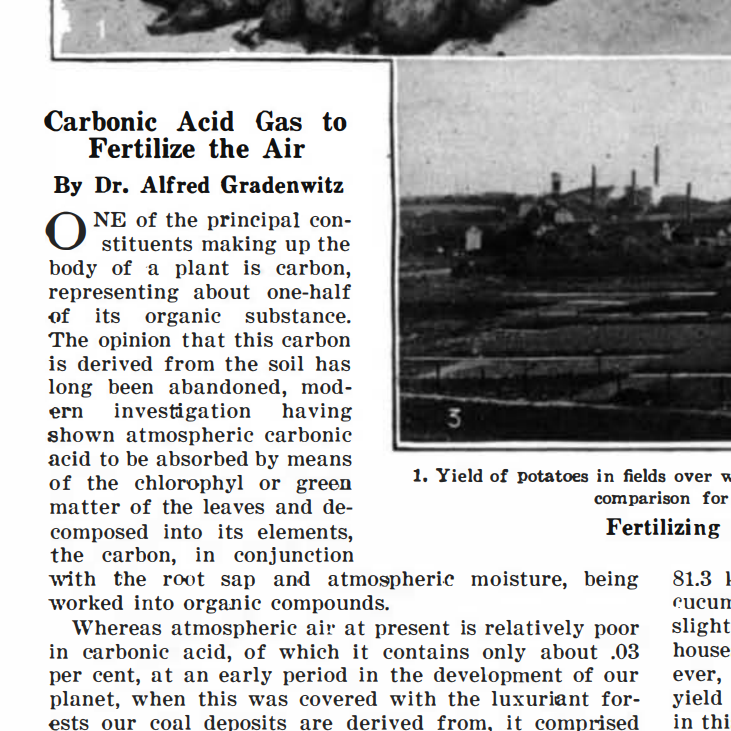
(Like “precious air fertilizer,” “atmospheric carbonic acid” is another term for CO2.)
All life on Earth is carbon-based, and, as you can learn from the lead paragraph of that article, all of the carbon in photosynthetic plants comes from CO2 in the air. CO2 is the fundamental building block of hydrocarbons which is usually in shortest supply. (Hydrocarbons include the starch that you asked about.)
You asked about potatoes. As it happens, the benefits of elevated CO2 for potatoes have been studied for more than a century, and, in fact, they were one of the crops studied in the research reported by the aforementioned Scientific American article. Here’s an illustration from that article:
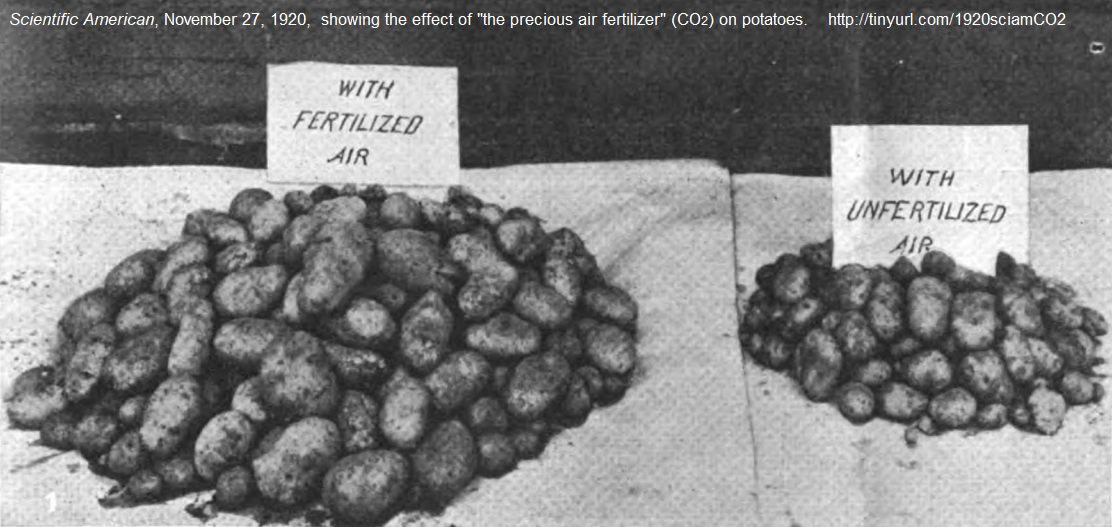
The potatoes on the right were grown in ambient (“unfertilized”) air. The potatoes on the left were grown under the same conditions, except with extra CO2 supplied, which the researchers obtained from the exhaust of a nearby blast furnace (“fertilized air”).
The beneficial effects of elevated CO2 for crops like potatoes have enormous practical consequences. One of them is that they make famines less likely. These photos were taken in India, which used to be periodically stricken by horrific famines.
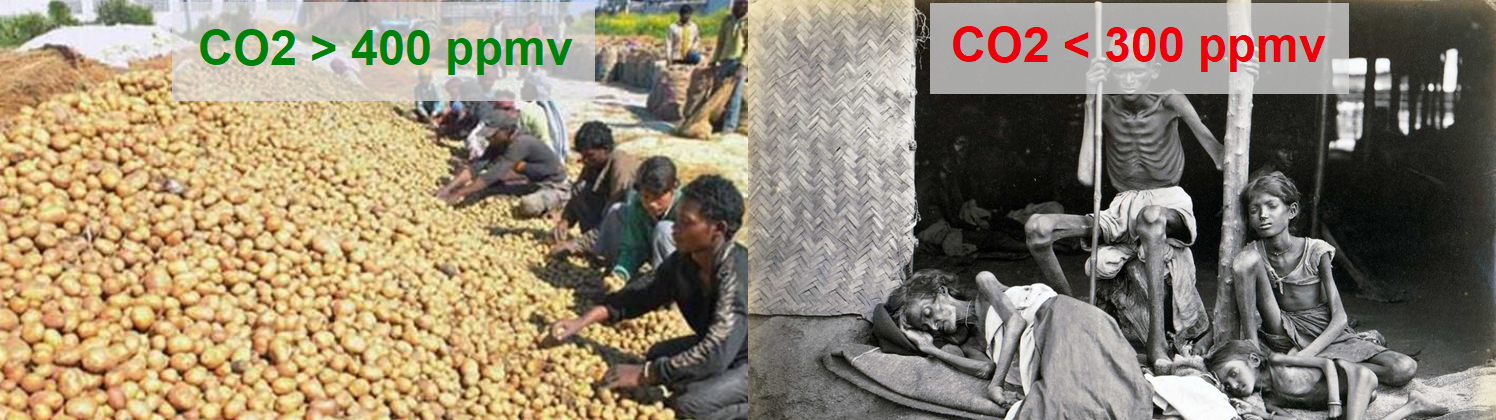
I don’t really care very much what you call that CO2: carbon dioxide, atmospheric carbonic acid, plant food, or “precious air fertilizer,” as long as it’s truthful. Just don’t pretend that it isn’t good for plants, and just don’t call it “carbon pollution.”
Obviously, corn is not a food for people, because people also need water and air. (Not to mention protein and various other nutrients.
Additionally, why do people store fat in their cells, and not corn?
Is it possible for joe to make himself look any dumber?
I’m certain that he will manage it any time now
I’m becoming convinced that joe is a fake account who posts here with the express purpose of making CAGW believers look bad.
“If CO2 was plant food, then a plant would not need sunlight, because it would get it’s “food” from the atmosphere.”
That has got to be one of the most ignorant comments I’ve seen on this site, and I’ve seen a lot. Your understanding of basic botanical facts appears to be comparable to a typical 3-year-olds’, that is: zero.
Buck Fiden.
He’s not in charge of anything except which flavor of jello the WH cafeteria serves him.
I find getting away with my 2 dogs difficult. I can’t imagine 10 dogs.
But then these days, I don’t go anywhere without my dogs.
For some reason, folks give me wide pass when I’m walking my two Malinois.
A big P/U Truck and an RV trailer sees to that.
Our Malinois saved my wife and daughter from a group of hard-cases at a freeway rest stop. Great breed.
We don’t “get away” any more. We also have 1 foster dog at this time. 4 of the 11, including the foster, are special needs dogs, with serious health issues.
Well that’s the end of eating grains I reckon. No point anymore in reducing our carbon footprint. Pedal to the metal boys, we’re all gonna die very soon anyway.
What did I tell you?
https://breadonthewater.co.za/2019/09/22/revisiting-the-87-year-gleissberg-solar-cycle/
USDA issues weekly crop reports throughout the growing season.
1) USDA tends to be very negative until harvest time. At harvest time, USDA ends up increasing their estimates until they match actual harvest yields.
As of July 12th, 2021:
Reduced yield estimates are because of the wet spring conditions over the Midwest wheat growing areas.
Estimates are based upon a few field inspections and local reports. Reality comes later as wheat matures, ripens and is harvested.
Winter wheat is planted during autumn and harvested earlier in the year. Durum and other Spring wheats are planted in Spring and harvested later in the year.
Yes, flooded acreage does hamper/harm plantings. It’s called weather!