Reposted from Dr. Judith Curry’s Climate Etc.
Posted on April 10, 2021 by curryja |
by Judith Curry
“Like a magnetic field that pulls iron filings into alignment, a powerful cultural belief is aligning multiple sources of scientific bias in the same direction. – policy scientist Daniel Sarewitz
Statistician Regina Nuzzo summarizes the problem:
“This is the big problem in science that no one is talking about: even an honest person is a master of self-deception. In today’s environment, our talent for jumping to conclusions makes it all too easy to find false patterns in randomness, to ignore alternative explanations for a result or to accept ‘reasonable’ outcomes without question — that is, to ceaselessly lead ourselves astray without realizing it.”
Psychologists Richard Simmons et al. find that researcher bias can have a profound influence on the outcome of a study. Such ‘researcher degrees of freedom’ include choices about which variables to include, which data to include, which comparisons to make, and which analysis methods to use. Each of these choices may be reasonable, but when added together they allow for researchers to extract statistical significance or other meaningful information out of almost any data set. Researchers making necessary choices about data collection and analysis believe that they are making the correct, or at least reasonable, choices. But their bias will influence those choices in ways that researchers may not be aware of. Further, researchers may simply be using the techniques that work – meaning they give the results the researcher wants.
The objective of scientific research is to find out what is really true, not just verify our biases. If a community of scientists has a diversity of perspectives and different biases, then the checks and balances in the scientific process including peer review will eventually counter the biases of individuals. Sometimes this is true—but often this does not happen quickly or smoothly. Not only can poor data and wrong ideas survive, but good ideas can be suppressed.
However, when biases caused by motivated reasoning and career pressures become entrenched in the institutions that support science – the professional societies, scientific journals, universities and funding agencies – then that subfield of science may be led astray for decades.
Biases caused by a consensus building process
Consensus is viewed as a proxy for truth in many discussions of science. A consensus formed by the independent and free deliberations of many is a strong indicator of truth. However, a consensus can only be trusted to the extent that individuals are free to disagree with it.
A scientific argument can evolve prematurely into a ruling theory if cultural forces are sufficiently strong and aligned in the same direction. Premature theories enforced by an explicit consensus building process harm scientific progress because of the questions that don’t get asked and the investigations that aren’t undertaken. Nuzzio (2015) refers to this as ‘hypothesis myopia.’
If the objective of scientific research is to obtain truth and avoid error, how might a consensus seeking process introduce bias into the science and increase the chances for error?
‘Confirmation bias’ is a well-known psychological principle that connotes the seeking or interpretation of evidence in ways that are partial to existing beliefs, expectations, or an existing hypothesis. Confirmation bias usually refers to unwitting selectivity in the acquisition and interpretation of evidence.
Philosopher Thomas Kelly (2005) provides the following insight into confirmation bias. As more and more peers weigh in on a given issue, the proportion of the total evidence which consists of higher order psychological evidence of what other people believe increases, and the proportion of the total evidence which consists of first order evidence decreases. Kelly concludes that over time, this invisible hand process tends to bestow a certain competitive advantage to our prior beliefs with respect to confirmation and disconfirmation.
Allen et al. (2020) demonstrate how dependence, pressure, and polarization can force a consensus, making reliance on consensus as an indicator of truth unreliable. As a result, a consensus can only be trusted to the extent that individuals are free to disagree with it, without repression or reprisal. Similarly, when strong incentives favor affirmation of a position, a consensus affirming it becomes almost inevitable, and therefore all but meaningless.
Communication theorist Jean Goodwin argues that once the consensus claim was made, scientists involved in the ongoing IPCC process had reasons not just to consider the scientific evidence, but also to consider the possible effect of their statements on their ability to defend the consensus claim.
The IPCC’s consensus-building process arguably promotes groupthink. ‘Groupthink’ is a pattern of thought characterized by self-deception, forced manufacture of consent, and conformity to group values. Janis (1972) describes eight symptoms of groupthink:
- illusion of invulnerability
- collective rationalization
- belief in inherent morality
- stereotyped views of out-groups
- direct pressure on dissenters
- self-censorship
- illusion of unanimity
- self-appointed mind guards
Many defenders of the IPCC consensus − both scientists and consensus entrepreneurs − show many if not all of these symptoms.
Thomas Gold (1989) discussed the dangers that ‘herd behavior’ poses for scientists, potentially leading to an inertia-driven persistence of false consensus opinion within the sciences. While herd instinct has value in sociological behavior, it has been a disaster in science − in science what we generally want is diversity. When people pursue the same avenue all together, they tend to shut out other avenues, and they are not always on the right ones.
It is not just the herd instinct in the individuals that is of concern. If support from peers and moral and financial consequences are at stake, then staying with the herd is the successful policy for the individual; however, it is not the successful policy for the pursuit of science. Mental herd behavior, even if it does not actually put a clamp upon free thinking, insidiously applies pressure to follow the fashion. The institutions that support of science − financial support, the journals, the judgment of referees, the invitations to conferences, professional recognition − are all influenced by herd behavior.
Economist William Butos (2015) characterizes the IPCC as a ‘Big Player’ in science in that it possesses all of the attributes characteristic of Big Players in markets: bigness in terms of influence, insensitivity to the usual constraints, and discretion in its ability to promote a favored direction of research. This characterization of the IPCC as ‘Big Player’ is similar to economist Richard Tol’s characterization of the IPCC as a knowledge monopoly. The IPCC’s influence in climate science is pervasive, allowing it to largely ignore the usual scientific constraints on the acceptance of hypotheses. Professional success in climate science has become more tied to the acceptance of the IPCC’s pronouncements than with the exploration of contrary possibilities.
The existence of the IPCC as a ‘big player’ and a ‘knowledge monopoly’ on climate change can lead to premature canonization of IPCC conclusions. Premature canonization refers to widespread scientific belief in a false or incomplete conclusion, which leads to suppression masquerading as rejection. Suppression occurs when the fear of social sanctions prevents ideas from being explored or empirical findings from being presented in scientific or public forums. In science, rejection occurs when an idea has been explored and the evidence has been found wanting. A classic, relatively recent case of premature canonization involves the scientific identification of causes of ulcers.
So what are the implications of these concerns for the IPCC’s consensus on human-caused climate change? Cognitive biases in the context of an institutionalized consensus building process have arguably resulted in the consensus becoming increasingly confirmed, and even canonized, in a self-reinforcing way. An extended group of scientists derive their confidence in the consensus in a second-hand manner from the institutional authority of the IPCC and the emphatic nature in which the consensus is portrayed. This ‘invisible hand’ marginalizes skeptical perspectives. Overconfident assertions by the ‘Big Player’ take away the motivation for scientists to challenge the consensus, particularly when they can expect to be called a ‘denier’ for their efforts and see their chances diminish for professional recognition and research funding.
The consensus building process acts to amplify personal biases, and marginalizes disagreement from either a majority opinion or the opinion of the loudest or most motivated person in the room. One can only speculate on the magnitude and importance of the biases introduced into climate science by the IPCC’s consensus seeking process.
As I noted on the thread at ClimateEtc:
The authors of the post are misinformed. They discuss the IPCC as if it was a scientific entity. It has never been one. The IPCC was formed by the UN to support the UNFCCC, which clearly have anti-capitalist, anti-growth and anti-American agendas.
Regards,
Bob
How many words here, in Part 2 good grief!
Only 2 words are required.
We all know by now, symptomatic of the long-term use of chemical depressants in the Human Diet.
viz:
AGW: Manage and Control
Were I wrong, one would be enough. Einstein.
Okay, but we should also at least mention the fool climate change industrial complex out there helping this process along. The harder it pushes with ridiculous claims the more it awakens skeptics.
Questions that aren’t asked
Two of my favorites:
When is this acceleration of rising seas going to begin to happen?
By 2100, methane is on course to increase global temperature by how much?
The first paints an image of flooded coastal cities.
The second is already seeing damaging regulation that outlaws usage of natural gas.
The Ruling Theory quagmire. Beware.
The UN and IPCC are political organizations.
It has been long known to cognitive researchers that the human brain only sees what is important to it. There are way too many things going on all around us to attend to every one of them all the time, so our brains designate most of it as irrelevant for the current moment and ignore them. But that can leave us blind to things that we are not aware could be important. This is how illusionists fool us so easily. It also explains confirmation bias and many other cognitive biases. This is a problem for the scientific method, but one that can’t really be completely overcome because this is just how our brains work. It can however, be mitigated to some extent by being aware of it and encouraging independent thinkers and ideas, even if they seem pretty “fringe”. After all, it is frequently these fringe thinkers that make the huge leaps in the advancement of human knowledge, not the consensus seekers.
The past proves the future.
Once upon a not so long-ago time published, peer reviewed, scientific consensus included:
phlogiston,
caloric,
luminiferous ether,
spontaneous generation,
water filled Martian canals,
plane Vulcan,
medical humors,
four elements of matter,
cold fusion……..
And they all turned out wrong.
RGHE theory is going to join them.
Simply ‘splain how/why I am wrong?
1) Without the atmos/albedo the earth becomes much like the moon which contradicts greenhouse theory. Yes or no?
2) Where do the GHGs get the warming energy that they trap/absorb/intercept/delay and re-emit?
I have demonstrated they can’t get it from the surface upwelling as a BB, so, what’s your explanation?
I’m still waiting to see when people will recognize that “climate change” itself is a logical fallacy. It’s an appeal to ambiguity that can only lead to a confused discussion. Either CO2 is the temperature control knob or the whole discussion is pointless. Change should never have been an issue. We’re either dangerously warming the planet or there’s nothing to talk about.
I agree that culture has much to do with it.
Science “consensus” includes univariant equations that yield binary results. (there are a myriad of other factors, but I think this has a rather large influence)
Presently, because of several generations of government education, emotion has substituted thinking. Another way to put this: far too many have a child-like understanding of the world around them; life is a series of univariant equations with binary results. We see it all the time.
Eating beef will cause global warming.
Driving an ICE SUV will cause global warming.
Reading Shakespeare endorses white supremacy.
Anything other than ultra low Sulphur fuels will cause acidic lakes.
Global warming kills off polar bears.
Wearing a mask saves grandma’s life.
And the list never ends. It is usually one variable, that itself is binary and the results are binary. Doesn’t matter if there are a thousand univariant equations, each and every one independently yields a binary result.
Listen to talk radio when a person suffering from this condition gets into a low level debate with the host, its like chasing a squirrel around the yard with a tennis racket. They throw out on univariant equation at a time, responding to challenges by quickly changing to another one.
Unfortunately, it seems that this is the case within academia; maybe its the publicists who distill more complicated findings into a general public consumable sound bites which are mangled even further with each retelling which ends up being a remarkably simplistic and naïve explanation of the most recent event.
That is why I love this site. The retired contributors have nothing to lose and thus seem to be able to speak more freely outside of the editing room of the institution’s publicity department.
Does anybody else find this to be insulting as hell?
“This is the big problem in science that no one is talking about: even an honest person is a master of self-deception.”
Then they amplify it.
“accept ‘reasonable’ outcomes without question — that is, to ceaselessly lead ourselves astray without realizing it.”
This sort of thing paints us all, that is *all of us*, as intellectually feeble, weak minded fools who cannot tell fact from fiction. This sort of thinking may have a place in soft fields like sociology and psychology perhaps, but I can find no place for this in the physical sciences.
The whole of the enterprise of science was specifically designed to avoid such problems.
Does empirical experimentation and objective measurement ring any bells???
For Myself:
I went into science because I wanted to know how things work. I do not care how you think some system works. I do not care how he thinks that system works. I do not care how she thinks that system works.
I want to know how that system *really* works.
As it turns out, empirical experimentation and objective measurement proved to be really good tools for that goal.
So what is all the verbiage in this article all about?
This one and so many others like it, I feel, are simple apologetics for the absolute corruption of various fields of science.
“Its human nature”
“We can not help it”
“Everybody is susceptible”
BULL FRITTERS!
J. Curry dances around the issue, but finally mentions the true problem, if only tangentially.
“support from peers and moral and financial consequences are at stake”
BINGO!
Full stop
“financial consequences are at stake” Along with your career.
Climate Science is not science, it is “science”. Climate Science is purely driven by policy, 100% by policy. At this point, I think it is fair to say facts have nothing to do with it. Agree with the policy and you will be well rewarded. Disagree and you will find your career destroyed in short order.
And everybody knows it!
And this is the real problem.
Things like “confirmation bias” and “consensus” are real enough, but have nothing to do with the corruption of the sciences. They are just used as excuses to try to hide the real cause.
If anyone wants to explore this phenomenon more deeply, I really recommend this article, it just came out:
Persuasion and the Prestige Paradox: Are High Status People More Likely to Lie?
https://quillette.com/2021/04/03/persuasion-and-the-prestige-paradox-are-high-status-people-more-likely-to-lie/
I never really realized that people attend University and become STEM majors for the “social status” (duh! …this seems like a foolish oversight now, given the number of pre-meds I have taught over the years) verses wanting to really know something as a “truth seeker“. So, if you run into a STEM person, you have to really figure out why they are in the profession to understand what position they will take on a controversial issue. If they entered for “social status” then of course they will fall on the side of climate alarm… it is so obvious now.
So, I can envisage a reversal of CAGW alarm occuring, when all of a sudden being seen as “rebel” becomes the most fashionable/ trendy thing.
Thanks for the OP !!!
Climate Liars are masters of deceiving others.
AR5:
“The global mean surface temperature change for the period 2016–2035 relative to 1986–2005 will likely be in the range of 0.3°C to 0.7°C (medium confidence). This assessment is based on multiple lines of evidence and assumes there will be no major volcanic eruptions or secular changes in total solar irradiance”
Doh!!
Many of the same criticisms in the article can be made against the reliance upon peer review of studies.
Here’s a thought –
since the “career” climate industry has not managed to resolve ECS more precisely than a whopping range of 1.5C – 4.5C in the 40-something years they’ve been chasing this holy grail, why not throw this field of study over now to the “non-career” researchers?
I mean, when you watch someone have 20 attempts at opening a jar, but can’t pull it off, you usually ask someone else to give it a try.
The Wason selection task is a good test of critical thinking:

Truer words were never spoken:
There’s a very easy way to understand their BS and nonsense over the last few decades and that is population increase and how much wealthier/ healthier we are today compared to say 1970 and 1990.
In 1970 population was 3.7 bn and life (world )expectancy about 59, yet today pop is about 7.8 bn+ and life exp about 72.
The poorest continent Africa in 1970 pop was 363 mil , life expect about 47 but today another billion more people or total of 1.35 bn and life exp about 63.
Shellenberger, Lomborg, Koonin etc know there is no existential threat or crisis or apocalypse etc and they’ve used IPCC data to prove their case.
Of course the world pop has increased by 4.1 bn + in just the last 50 years, so when do we start to wake up?
OH and the world is greening because of the extra co2 in the air.
Here again is Dr Hans Rosling’s BBC 200 countries in 200 years stats video. This takes just 5 minutes of your time and covers 1810 to 2010.
Here Dr John Christy puts their so called CAGW claims to the test and it’s all so much nonsense.
Plenty of data and evidence, point by point.
https://www.thegwpf.com/putting-climate-change-claims-to-the-test/
https://www.thegwpf.com/putting-climate-change-claims-to-the-test/
The “greenhouse effect” myth is the modern day “flat earth” theory. A good portion of the commenters on this site believe this unscientific rubbish.
Anyone who believes in the “greenhouse effect” has to completely disregard the fact that all three tropical oceans develop warm pools that regulate to 30C. That is not the result of some delicate global energy balance easily upset by the addition of small components to the atmosphere.
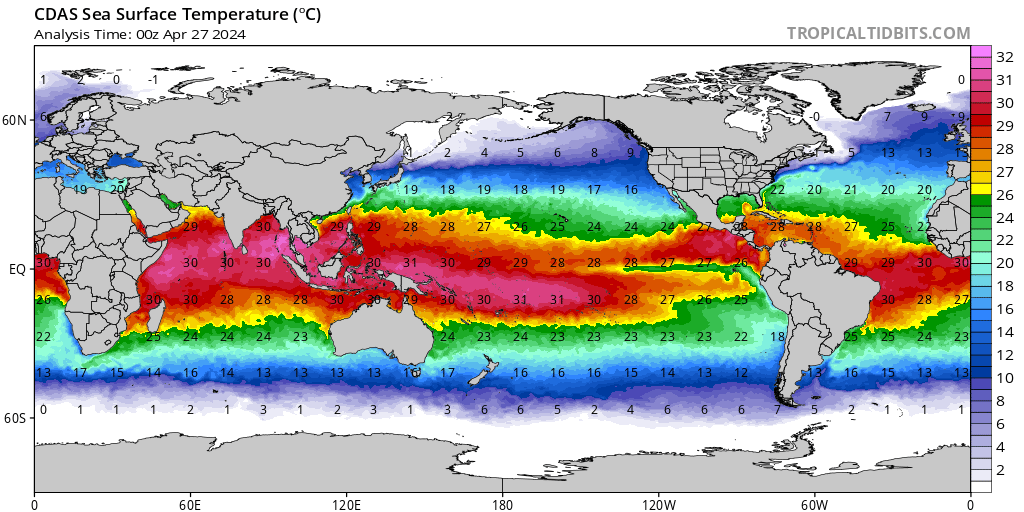
The unbridled stupidity of climate modellers who publish completely ridiculous warming trends where there can be none. That means they have to cool the past to utterly stupid levels to get a warming trend where there is none. This nonsense has to be called out. It is a sad reflection on the entire scientific community.
So why do we need to have net zero emissions by 2040 or ’50 and how is this possible?
Well Pres Biden the leader of the most powerful country tells us in this video that we are facing an existential threat for humans and he actually mentions this a number of times in a couple of minutes. He also tells us we can “feel this in our bones” , but I seem to have missed that feeling.
I certainly understand the data since 1800, 1900, 1950, 1970, 1990 etc and of course the human race is today much healthier, wealthier and has a life expectancy of about 72 years. All 7.8 bn of us and that average is made up of Africa ( 63) China (76) wealthy countries like Australia ( 83) etc.
And the Pres of the UN loves the EXIST….. word and always seems to use it in any number of interviews about SLR or whatever.
Here’s 2 minutes of nonsense from the Biden donkey.
Perhaps it’s simply a case of everyone experiencing lots of virtual weather on the touchscreen in their pocket nowadays-
Cold snap sees heavy snowfall in Victoria (msn.com)
Cyclone Seroja destroys 124-year-old jetty and popular tourist resort (msn.com)
Now that’s really weather events over a continental island that spans weather influences from the Antarctic to the tropics but if you get bombarded with it 24/7 it’s not going to be hard to believe in climate change coming on top of drought induced bushfires followed by flooding rains. For the vast majority of Australians predominantly living in cities you seldom actually experience any of Nature’s vicissitudes but virtually you do all the time. Fertile ground for imagineering.