Guest Post by Willis Eschenbach
For the last couple of decades since I started seriously studying the climate, I’ve been hearing Americans of all kinds claiming that the United States is suffering terribly from “global warming”. Over and over, from American educators, government officials, and media, the claim is made that the US is heating up fast, and that the dreaded and endlessly warned of US Thermageddon is just around the corner.
So I decided to do some research. There is a bunch of gridded surface temperature data out there, typically on a 1° latitude by 1° longitude grid. So first, I had to figure out just which gridcells are in which countries. That involved what we used to call a “SMOP”, a “small matter of programming”, which only took about a day of locating the country borders data and then actually writing the code to convert it to a usable form … but at the end of it, I knew which gridcells are in which countries.
Then I pulled up the temperature information from Berkeley Earth and from the CERES satellite data and graphed it up … here’s the result:

Figure 1. Temperature trends for what in Alaska is called the “Lower 48”, meaning the US less Alaska and Hawaii.
Cooling … not warming.
Cooling.
Now, before anyone starts yelling “But that’s just the contiguous US, not the globe!”, yes, I know that. I’m just saying that if you think the US temperature has gone up over the 21st century, you’re wrong. The US has cooled over that time.
And this reveals a deep truth, which is that if it were not for accurate thermometers, hundreds and hundreds of US surface temperature station sites, and satellites, we’d never know if the US had warmed or cooled over the last two decades … the changes are far too small and too widespread for our human senses to register. Millions of US citizens have been firmly convinced that the US has been warming in the 21st century, when in fact it has been cooling.
That’s it. Short and sweet. And no, it’s not an April Fools joke, it’s actual data.
Not only is it April Fools Day today, but it’s also my gorgeous ex-fiancee’s birthday, so we’re going for a lovely bike ride for a birthday treat.
My very best wishes to all,
w.
I host the website co2questions.com, the first question of which links to a short video I think must also totally nullify the idea that the globe is warming.
Sarah Palin will be angry at you Mr. Eschenbach. Your cherry picked definition of “America” by leaving out Alaska will infuriate her.
.
https://19january2017snapshot.epa.gov/sites/production/files/2016-09/documents/climate-change-ak.pdf
.
But then, you are correct that “America” is not burning if you ignore the part of America that is burning.
Oh yeah, if you want to talk about “burning”……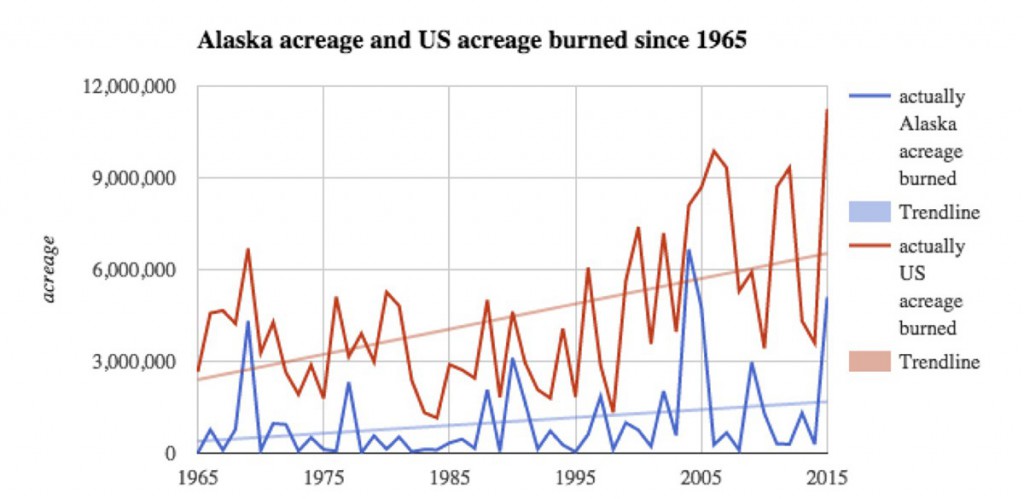
I’ve shoes older than 1965, go back 300 years and then report
Result of forest mis-management that’s been documented for many decades & continues at the present.
Your chart reminded me of the news a few days ago blaming Alaskan earthquakes on global warming. But I remember 1964, the year before your chart starts: Great Alaskan Earthquake
Alaska average temperature is about minus 3 C and the lower 48 average temperature is about 11 C.
If Alaska average temperature was 14 degree warmer, would Alaska have less problems with forest fires?
“burning”
ROFLMAO
March UAH temp is out… -0.01 anomaly.
Down below the line, huh?
How strange. CO2 concentration keeps going up. It truly is a magical gas as it is now obvious that it heats and cools at the same time.
CO2 up, temperatures down.
That’s not the way things are supposed to go, according to the alarmists. They claim that increases in CO2 equal increases in temperatues, but that appears not to be the case.
It depends on the phase of the moon.
Any article by Willis is well worth the read as we all need a regular dose of logical common sense. Thanks Willis.
The temperature trend since 2000 is of interest but, to me, is far less interesting than the trend over the past century or more when there have been many long records of thermometer data.
Furthermore, I prefer to see plots of max and min temperatures at specific stations rather than an average country-wide figure.
I have recently plotted the long-term Annual, January & July mean Max & Min temperatures at 15 stations in the contiguous USA. There are definite long-term trends and, although these vary in magnitude, they are all surprisingly linear. What do you think?
https://briangunterblog.wordpress.com/2021/01/27/usa-east-temperatures/
https://briangunterblog.wordpress.com/2021/01/27/usa-west-temperatures/
I think the graphs show why it is so misleading to cram temperature data from independent sites together to try and come up with some regional or global “average”. Altitude and geography play such an important role in the temperature profile yet get totally ignored by cramming temperatures from independent locations into one data set.
Tim,
On the other hand, if the question is “What is the average global land temperatures?”, then the only appropriate approach is to average all surface land temperatures without regard to confounding factors. That would be in contrast to a more theoretical question, “What would the average temperature of Earth be if all land were at the average topographic height of land?” The latter would require applying the universal gas law or lapse rate to come up with a theoretical value. The approach should be dictated by the intended use of the calculated number.