Over in the Tweetosphere, where I’m @WEschenbach, I read that we’re in for rainy times:
The atmosphere cools and shrinks when the Sun gets sleepy. Rain is wrung out of it like a sponge. We have been entering a solar grand minimum since 2008. The bottom of it will be around 2035.
There are two parts to that claim. One is that in times of low solar activity (signified by low sunspots) the atmosphere, in particular the troposphere where the weather occurs, will cool down. The other is that when the troposphere cools down, we’ll get significantly more rain as the water is “wrung out of” the troposphere. So let me look at the parts separately.
First, does the troposphere cool down during times when low sunspots signify low solar activity? If so, nobody told the troposphere. If temperatures actually dropped when sunspot numbers dropped, then temperatures and sunspot numbers would be positively correlated … but here’s the reality:

Figure 1. Correlation between UAH MSU monthly lower tropospheric temperature anomaly in various areas of the planet and monthly sunspots, Dec 1979 to June 2020. Blue is positive correlation, red is negative. Latitude bands as follows: Global -85 to +85 latitude
Hemispheric 0 to +/- 85 latitude
Extratropics +/- 20 to +/- 85 latitude
Polar +/- 60 to +/- 85 latitude
Note that there are no negative correlations between tropospheric temperatures in different parts of the world. When the world warms or cools, it seems the motions of the troposphere and ocean must move the heat around the planet fairly rapidly. The only area in Figure 1 where the troposphere is relatively uncoupled from the rest of the planet is the South Pole.
But not one part of the troposphere is positively correlated with sunspots as the claim would require.
Now, the absence of evidence is not evidence of absence. So all I can say is that once again, I find no evidence that sunspots and atmospheric temperatures are significantly positively correlated as the theory requires. This agrees with my previous research on the subject as put forth in the 24 or so posts listed here …
Next, let’s examine the claim that we’ll have lots more rain because it would get “wrung out of” the cooler troposphere. I’ve not run the numbers yet, but that seems highly improbable. The amount of rainfall is a function of the amount of water leaving the surface, passing through the clouds, and returning to the surface. It’s not so much a function of the amount that the atmosphere can hold at a given instant.
Here’s a way to envision it. If you think of the hydrological cycle as a giant waterwheel lifting water from the surface to the clouds and then returning the water back to the surface as rain, the amount of rain is a function of how fast the waterwheel is turning, not just the size of the buckets.
So, having considered what I might expect to find, I ran the numbers. Virtually all atmospheric water is in the troposphere, the lowest level of the atmosphere. The amount of water in the troposphere is called “total precipitable water” or “TPW”, with units of kilograms of water per square metre (kg/m2) of surface area. Globally, the average TPW is about 28 kg/m2.

Figure 2. Distribution of total precipitable water.
(Unfortunately, I can’t find numbers for global TPW. However, TPW above the ocean is bound to be greater than TPW above the desert or in the mountains. So the values above represent a maximum possible value for the global TPW.)
Now, the metric system is lovely. One liter of water weighs one kilo. And one millimetre of rainfall over one square metre is one liter of rainfall. So if every drop of the 28 kg/m2 of precipitable water were squeezed out of the sky, we’d get 28 mm (about an inch) of rainfall. And since the global average rainfall is about 1 metre (39 inches) per year, the atmosphere only holds water to the amount of about 2.8% of average annual rainfall. A small amount. As I said, the amount of rainfall is not a function of atmospheric capacity.
But wait, that’s converting all 28 kg/m2 of the precipitable water to rain. The amount squeezed out by a temperature change is far less than that. Per the discussion here, the change in TPW at the global mean temperature of about fifteen degrees C is on the order of one kg per degree.

Figure 3. Scatterplot, Remote Sensing Systems (RSS) total precipitable water (TPW) versus the ReynoldsOI sea surface temperature data.
So if the troposphere were to cool by say 2°C, it might squeeze 2 kilos of water per square metre, which is 2 mm of rain, out of the atmospheric sponge … and that’s a one-time 2 mm increase spread out over the entire 15-year period of projected cooling. So it would be much less than a millimetre per year.
And that’s a change in annual rainfall of much less than a tenth of one measly percent—not even detectable.
Conclusions? The claims that decreasing solar activity
- will bring tropospheric cooling, and that
- the cooling will “wring” a significant amount of water out of the troposphere,
both fail to find any observational or theoretical support in the tropospheric temperature and TPW datasets considered above.
Best to all, stay safe, stay well,
w.
PS—When you comment, please quote the exact words you are discussing, so we can all understand just exactly what and who you are referring to.
Willis-
Always enjoy your posts. they keep me exercising my mind. My question concerns this statement:
“But not one part of the troposphere is positively correlated with sunspots as the claim would require.”
I have been retired for 20 years, and it was a few years before that when I last looked at a correlation table, so please bear with me. When I look down the column labeled “sunspots” in your correlation matrix, I see nothing but pale pink dots. As I understand it, red is positive correlation, blue negative. So the way I read the table, every area has a positive correlation with sunspots, albeit a very poor positive correlation. What am I missing?
Willis-
okay, yes now I see, BLUE is positive.
30 deg C SSTs gridcell averages over 27 years?
willis, I have asked this before, currently the global maps are heavily centered on the Pacific where nobody lives, could you please modify your maps to a central meridian of zero degrees longitude so that the 500 million Europeans are not squeezed on the edge of the maps and all continents are still visible?
Thanks.
Hans, while people live and where the interesting weather happens are very different locations. In any case, hang on … OK, here you go. We’re nothing if not a full-service website.
w.
PS—The other reason is, I lived for 20 years in “the Pacific where nobody lives”, so it’s of great interest to me.
Willis. Your map of TPW invites a few questions. Is this map only Lower Troposphere?
Since the atmosphere is thickest around the equatorial zone, one wonders what causes the de-centering measured with greatest TPW?
Just eyeballing it, the Indian Ocean region appears to be most equatorial centered, while
Atlantic has a more Northerly shift. But the Pacific to Indian Oceans has the most. The wildest extremes!
Clearly, Ocean-landmass interactions have a great deal to do with the flaring or wider spread seen in this graphic. However, the apparent influence of South Pacific island masses on the blob-spread is remarkable if not incredible!
Can many lands so tiny exercise such a considerable influence on moisture aggregates in the Sky? I
mean, to suppose it a priori would seem mad. But just look. There it is!
Or am I somehow mistaken? Or perhaps someone else can explain what we’re seeing here?
Orson, the water generally is found in the Inter-Tropical Convergence Zone where the two great circulations, those of the Northern and Southern Hemispheres, come together.
And as you point out, this is generally not right on the Equator … dang that nature!
w.
No. We have not been entering a solar grand minimum. According to Usoskin et al., 2016 “Solar activity during the Holocene: the Hallstatt cycle and its consequence for grand minima and maxima”, solar grand minima must correspond to a SN value below a threshold value of S N = 20 for at least 30 years. The Wolf, Spörer and Maunder minima were solar grand minima. The Dalton minimum was not a solar grand minimum.
We are not in a solar grand minimum, we are just in a centennial-type minimum of the kind Joan Feynman (sister of the famous physicist) has been studying. See Feynman & Ruzmaikin 2014 “The Centennial Gleissberg Cycle and its association with extended minima”. It usually involves just two 11-year minima, in this case the 2008 one and the 2019 one.
This centennial minimum is pretty much done and SC26 should already have more activity than SC25. We should know for sure in about 9 years when we should be able to peak at SC26 with the polar-fields method.
Willis,
In Fig 3 you say “yellow line shows calculated values”
Calculated how?
Discussed in the link above the graphic. Basically it’s curve fitting so I can understand the shape, not a first-principles calculation.
w.
Same question…
ok, willis responds whilst i ….but anyway i will integrate Goff-Gratch assuming the surface temp on the graph and a relative humidity equivalent to normal 28 mm and say 6C lapse rate and see where it fits against fig. 3
I don’t know about the specifics,
but this surely seems to be lining up with SVENSMARK.
Thanks, Paul. Svensmark posits a solar effect on clouds via cosmic rays mediated by the 11-year sunspot cycle. Theoretically solid … problem is, I’ve looked at lots of cloud datasets and I can’t find anything remotely resembling an 11-year cycle. And the studies saying that there is one have turned out to have a host of problems, statistical and theoretical. If you know of a good study, point it out.
See e.g. here for a look at a long-term cloud dataset … no sign of an 11-year solar signal.
All I do is look to see if such a signal exists, and if so, does it correlate with the sunspot cycles (which vary from 9 to 15 years).
Best regards,
w.
When persuading people facts don’t matter. It works on both sides of the debate.
The increased magnetic activity of the Sun will cause latitudinal course of the jet stream and enable the development of La Niña.
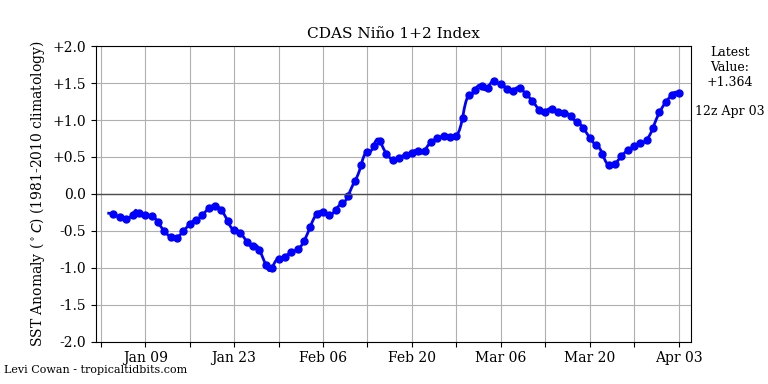
https://www.longpaddock.qld.gov.au/soi/
Exactly. At the position of the solar cycle we are currently there is a very high chance that there will be a La Niña next year.
https://judithcurry.com/2019/09/01/enso-predictions-based-on-solar-activity/
La Niña will be here sooner than that
http://www.bom.gov.au/climate/enso/#tabs=Pacific-Ocean
If any of you guys end up being right I’ll be there to congratulate you.
Javier, ren, and Bob.
Peter Webster’s new 500 page textbook on Tropical Meteorology is out (see Judith Curry.com for links to contents, descriptions, etc.).
I’m sure I’ll find it heavy going as a book. But simply to see the state of the art and science of ENSO explained, expertly summarised, and generally handled? For that alone, I need this book.
And has anyone seen Bob Tisdale? Speaking for others — not just myself — I’m sure we’d enjoy his presence in any regards.
Javier, ren, and Bob.
Peter Webster’s new 500 page textbook on Tropical Meteorology is out (see Judith Curry.com for links to contents, descriptions, etc.).
I’m sure I’ll find it heavy going as a book. But simply to see the state of the art and science of ENSO explained, expertly summarised, and generally well-handled? For that alone, I need this book.
And has anyone seen Bob Tisdale? Speaking for others — not just myself — I’m sure we’d enjoy his presence in any regards.
Steven Mosher says
(on the effect of CO2)
that would be what we call…..
wrong
May be Steven can explain how it is getting cooler here(not only now, but also over the past 40 years)
https://breadonthewater.co.za/2020/07/07/brrr-it-is-getting-colder/
Is it perhaps because we here in South Africa are already carbon NEGATIVE?
LOL
Are you getting rid of all the carbon-based life forms?
heh??
Take a look at “prevented planting acres” to the solar minimum sunspot count.
It might open your eyes..This season I’ve experienced frost on my roof every morning
at least one day per week all summer. I’ve never seen that in 50 years of farming. In
Glacier National Park the Going to the Sun Road is still not open—they’re still
plowing snow. When it finally opens it will be either the latest opening or the second latest
opening.
Dan
Not sure where you live, exactly?
God I love Virga!
Wouldn’t a “shrinking” of the atmosphere also result in more solar energy “missing” the earth? Seems to me that suggests a good chance for some cooling due to solar minimum as well. All in all an 11 year cycle may not be long enough to feel the difference. A 40-50 year minimum may be a completely different story.
Insignificant.
jbfl, that longer period to register an effect is rather what I’m implying in my post above.
Nice map to view current global precipitable water among other things:
https://climatereanalyzer.org/wx/DailySummary/#pwtr
Willis,
You state that you suspect ocean TPW is higher than over land. But the NH TPW is 32.1 whereas the SH TPW is 24.6. Yet the NH has twice the land area as the SH. So, one would expect that the SH TPW should be higher with its greater ocean area. What’s wrong with that logic?
Willis, you say
‘I’ve also seen claims that the GB cycle is 102 and 107 years.
Now, think about this. We have a purported cycle, and the people studying it the hardest cannot decide if the length of the cycle is 55, 58, 65, 78.8, 87, 95, 102, or 107 years long … seriously?’
If you had read my report you would have seen that various people in the past have investigated and reported on an apparent 80-90 year cycle. I gave references to 20 reports. That is not including me, who picked up the cycle, completely by accident, by studying Tmax in Alaska. It is difficult to give an exact number here, as the cycle varies in years, by a few years, apparently depending on the position of the ‘stars’ (planets)
If you want me to, I can mention another 10 reports?
It seems you only mention 2 reports (of yourself)
Click on my name to read my report, and be worried about the coming droughts, as I am sure the pendulum in the USA hits the top and will take some time ( ca. 7 years) before it comes down again.
The ocean is still warm (big heat capacity).
The atmosphere is shrinking and cooling (solar minimum)
The result is a faster water cycle and we can see this in the empirical data. Global average daily rainfall has been increasing since we passed the peak of solar cycle 23 and entered the Lanscheidt minimum. Last time it happened was when the Sun got sleepy in the Dalton minimum, one De Vries cycle previous. Willis dismisses empirical evidence and cyclic phenomena with a wave of his hand. But there it is.
http://clivebest.com/blog/wp-content/uploads/2018/06/Compare-rain-temp-1024×614.png
Willis posts a plot of the sea surface temp (observed) showing the amount of water vapor suspended in the atmosphere. He calculated the amount of rainfall if it were all ‘squeezed’ out for perspective. Good commentary followed. A lot of discussion about how the end result was achieved/caused. Bottom line is the maximum end result.
Being a country boy I would be concerned about the absolute maximum my rope could withstand. I will provide a reasonable safety factor based on wear, knots, effect of failure, etc. But I want to know what the absolute maximum capacity is regardless of any other factors. An 800 pound load on a 400 lb rope is insanity unless you are just testing the rope or effect of a knot or splice. What matters is what are the outer limits?
Good work Willis, as usual!
Tallbloke
Where does that rainfall data come from, exactly>? How is the spread? Did you sample the weather stations equal number NH and SH and balance them out to get to zero latitude?
I note that at certain weather stations around the equator it has become cooler, meaning it must have become more cloudier there, e.g. temperature in Hato in Curacoa dropped by ca. 4K.
As far as I remember we already had major flooding in Brazil, Philippines, Indonesia, a few Caribbean countries and other islands and some African countries near the equator.
This is exactly as I predicted: more rainfall around the equator and less at the higher latitudes.
http://breadonthewater.co.za/2019/09/22/revisiting-the-87-year-gleissberg-solar-cycle/
I predict serious drought time coming up on the higher latitudes.
(@Willis: I also do like your posts as they always bring up food for thought….or should I say: extra cycling exercises…..)
Why is TPW rising 13X faster than US precipitation since 1988 (R=.12), 5X since 1998 (R=.24)?
TPW/precipitation and solar activity correlations vary with location:
TPW = ??
Total Precipitable Water.
Regards,
w.
TPW = ?? From the post:
The data are here; be sure to update the year/month:
http://data.remss.com/vapor/monthly_1deg/tpw_v07r01_198801_202006.time_series.txt
TPW is governed by the equatorial Pacific Warm Pool and Nino34:
The recent drop in eq Pac anomalies has made drought grow in the SW US and elsewhere:
http://www.cpc.ncep.noaa.gov/products/analysis_monitoring/enso_update/ssta_c.gif
I had hoped to keep the personalities out of this, because the person who made the statement that started this off is Rog Tallbloke. Rog banned me from his site some years ago because he didn’t like my scientific claims. Well, first he banned Joel Shore for his scientific claims. Since I’d made exactly the same claims that Joel made, I banned myself from his site.
But then, in a subsequent interaction, Rog himself banned me from his site. He’s never rescinded the ban. So we have some history. I wanted to keep it focused on the claims that were made.
But unfortunately, Rog has decided to make it personal. He’s put up a post where he starts out by falsely claiming that he is currently being censored here, choosing to interpret the usual moderation delay as being directed at him personally … ego much?
He must be thinking of himself, since he censored me permanently, and obviously he is NOT censored here, since his comment is above. But then projection is common on Roger’s planet …
Over at his website, instead of dealing with my actual claims, Roger fires off a bunch of personal attacks at me. I’ve become used to that from Roger, since he knows I cannot respond on his website. I leave you to judge the morality of attacking someone in a forum where the person cannot respond … it’s not what I do, that’s for sure.
And more to the point, he also doesn’t back up his claim that contraction of the atmosphere due to sunspots causes a significant increase rain. Instead, he spends almost his entire post establishing that rainfall has increased … which is something I didn’t discuss at all or comment on in any fashion.
Not sure why he’s gone off on this sidetrack, except that it looks all sciency.
Roger also claims that I use “the wrong datasets, at the wrong timescale, with the wrong granularity, in order to obscure the truth.”
Here’s the truth. I don’t do ANYTHING to obscure the truth. I do my utmost to tell the truth as I see it. I publicly admit when I am wrong, and I answer more questions and comments than most other climate bloggers. Sounds like more projection on Rog’s part …
And please note, he didn’t say what is wrong with my datasets, timescale, or “granularity”. He just waves his hands, declares that these are “wrong” as if those were obvious facts, and moves on.
Ah, well. When you’re taking flak, it means you’re over the target.
Finally, let me return to Roger’s claim:
Here’s the bottom line—nothing that Roger said provides evidence that the troposphere, the home of the rainfall, shrinks and expands in harmony with the sunspots … nor has he disputed my numbers about how much rainfall would occur from that shrinkage if it were to happen. All he did was call me names and say that rainfall has increased recently …
w.
Willis,
I am an avid reader at WUWT, rarely comment – 2 or 3 in 10 yrs.
Thanks to your exhaustive work, is one of the reasons I’m compelled to read. Your “daily coronavirus page” was a true gift to this much needed site.
Thank you from a layperson.
Thanks for your kind words, Bruce, appreciated.
w.