Dr. Roy Spencer writes on Facebook:
Wayne Rowley has asked me to explain how a cold atmosphere can warm the Earth’s surface (which is what happens in global warming theory), a question I’ve been asked many times in the last 20+ years.
First of all, the temperature of anything depends upon the rates of energy GAIN and energy LOSS. When those 2 are equal, temperature remains the same; if they are unequal, the temperature changes.
Everyone knows that increasing the rate of energy gain increases temperature: e.g. turn up the heat under a pot of water on the stove, or turn up the thermostat in your house in winter.
But you can also increase temperature by reducing the rate of energy LOSS: put a lid on the pot of water while keeping the flame under it constant, adding insulation to the walls of a heated house while keeping the rate of furnace heating the same.
Now, note that in these examples, the lid is *cooler* than the heated water, and the walls (in winter) are cooler than the heated home interior, yet they can make the warmer object even warmer still. Your clothes in winter (or summer) keep you warmer than if you had no clothes on, even though the clothes are cooler than your body temperature. The examples are literally endless.
So, for the atmosphere, the net flow of infrared radiation from the surface to the “cold” depths of outer space is greatly reduced by the atmosphere (the so-called “greenhouse effect”), keeping the surface warmer than if the atmosphere was not there, absorbing and emitting its own infrared radiation. (An interesting side effect is that while the greenhouse effect keeps the surface and lower layers of the atmosphere warmer, the upper atmosphere is actually made colder. The same happens if you add more and more insulation to the walls of a heated house.)

How does this apply to global warming? Adding CO2 to the atmosphere from fossil fuel burning slightly enhances the atmosphere’s ability to keep the surface warmer by reducing the rate of energy loss by the surface. The question is, by how much? The *direct* effect of a doubling of atmospheric CO2 is small, only about 1 deg. C. But indirect changes in the atmosphere resulting from that direct warming (“feedbacks”) can either amplify it or reduce it. I believe those feedbacks will limit the warming to considerably less that what we are being told by climate modelers.
I made a diagram for Geothermal Deniers:
But deniers will continue to deny.
“But you can also increase temperature by reducing the rate of energy LOSS: put a lid on the pot of water while keeping the flame under it constant, adding insulation to the walls of a heated house while keeping the rate of furnace heating the same.”
“So, for the atmosphere, the net flow of infrared radiation from the surface to the “cold” depths of outer space is greatly reduced by the atmosphere (the so-called “greenhouse effect”), keeping the surface warmer than if the atmosphere was not there, absorbing and emitting its own infrared radiation.”
Since when is the atmosphere like a pot or a kettle with a lid?
This whole greenhouse effect idea is utter GARBAGE. The atmosphere does not contain but distributes solar and surface energy both vertically and laterally to lose that energy at higher altitudes and higher latitudes with the effect of moderating the temperature extremes. The reducing pressure and molecular spacing with altitude, air circulation to around -100C in the mesosphere, the seasonal effects, and the polar see-saw prevents all warming effects from being cumulative. The precipitation of CO2 as H2CO3 within weeks and the recycling of CO2 through the ocean prevents that from being cumulative too.
In summary, other than warming close to the surface in aid of photosynthesis that helps CO2 separate from H2O there it has no warming effect. Earth’s 3 sources of energy are insolation, tidal friction, and geothermal heat. Life on Earth temporarily stores solar energy but loses that at the end of life.
For more info see https://www.quora.com/What-are-the-major-errors-made-by-scientists-in-approaching-a-climate-change-problem
“How a cold atmosphere can warm the Earth’s surface”
This is correct. And if I hold my head to the side and squint really hard I can see pixies in the bottom of my garden.
I’m still trying to get my head around this so I punched in the following question…
….Does the heat transfer rate depend on the temperature difference between the objects?
Answer….”Short Answer:…
The greater the temperature difference, the greater the rate at which heat transfers”.
If I understand this correctly, it means that as an object heats up, it’s rate of radiation (heat loss) increases in direct proportion.
Now, if the cold atmosphere warms the Earths surface as Roy’s heading claims, then by warming the surface the rate of heat loss would simply increase cancelling out the ”supposed” warming as it would also do in the atmosphere. So, please tell me how the hell extra co2 will hold extra heat when the temp of space remains the same and the sun’s input remains the same.
“how the hell extra co2 will hold extra heat when the temp of space remains the same and the sun’s input remains the same.”
Added CO2 ppm closes Earth’s atmosphere IR window from the surface out to deep space a little more.
I wonder if Zoe Phin actually is Naomi Seibt?
Anyway, it seems they are both brilliant in understanding that we all depend on CO2 for eating and drinking and that it does not warm the earth much.
I tried to calculate the effect of CO2 myself, here:
https://1drv.ms/w/s!At1HSpspVHO9pwx0EPc_q0yoFNKR?e=4Qmgfx
I left out the fact that CO2 also has absorption in the UV (which is how we can measure it quantitatively on other planets) and between 1 and 2 um (which is why we can pick it up in the earthshine bouncing off the moon):
I think it does not matter for the end result which shows that the warming effect is nothing much.
If somebody thinks my calculation is wrong, I’d really like to hear from you how exactly to correct it.
Carbon dioxide does indeed absorb infrared. But the energy is not “trapped”. Nor did anyone show that CO2 LWIR absorption makes the atmosphere more opaque to LWIR (as claimed by greenhouse gas theory protagonists). No study shows that; studies show no change in opacity. After LWIR is absorbed by CO2, it will be thermalized immediately. So the LWIR ‘energy’ is shared with all the other air molecules. As we know, all matter emits blackbody radiation. N2 and O2 will emit the energy absorbed in thermalization, but at different frequencies to which the LWIR was first absorbed by CO2. Reality contradicts many of the assumptions of greenhouse gas theory: GHGE ignores the effect of thermalizaion, and ignores emission of LWIR by O2 and N2. Also note that thermalization is a equilibrium process: CO2 can absorb energy form faster O2 and N2 molecules. This reverse thermalization can take KE from O2 or N2, use it to promote an electron to a higher energy orbital in CO2, the promoted electron can decay with the emission of LWIR. In a nutshell, I can’t see how the modellers correctly modelled their greenhouse gas effect while ignoring what’s really going on!
Summary. The greenhouse gas effect cannot possibly be correct because they miss-modelled reality.
True. Is what I also say.
So the gas that reduces the warming by sunshine by nearly a third (clouds) and cools the surface by evaporation (latent heat) warms the surface 33ºC by slowing down the radiative cooling of the surface?
From my point of view, the Trenberth diagram is misleading : it mixes energy and radiation.
Radiation can go in either directions (ground to atmosphere and atmosphere to ground), while energy can only go from the hotter to the colder (i.e. ground to atmosphere (and cosmos))
It gives the impression that the surface of the ground receives 163.3 + 340.3 = 503.6 W/m2, while, in terms of radiative energy, it receives only 163.3 and can only send back 398.2 – 340.3 = 57.9 W/m2.
This energy imbalance heats the surface until the temperature is high enough for evaporation (mostly) and convection (also), to compensate it.
(which proves that evaporation is a negative feedback)
In terms of energy, the Trenberth diagram should only show one radiative 57.9 arrow upwards from ground to atmosphere and cosmos.
Jacques-Marie Moranne,
Radiation IS a form of energy… That energy can go from hot to cold and from cold to hot, there is no restriction in what is received or emitted. That doesn’t mean that the second law of thermodynamics is violated, as the overall energy by EM emissions from a warmer object are higher than reverse, as long as there is no internal (a filament) or an external (the sun) adds extra energy. In the latter case, the surface of the earth is heated by the sun and what the surface emits is partly recycled by GHGs back to the surface.
The part that GHGs absorb and re-emit has very specific wavelengths that have nothing to do with the vibration (“temperature”) of the whole molecule and thus are independent of the temperature of the surroundings where that photon is emitted.
Both incoming and outgoing LW radiation are measured in lots of places. These are average over 300 W/m2, see:
https://scienceofdoom.com/2010/07/17/the-amazing-case-of-back-radiation/
You are obviously convinced that the Radiation coming from CO2 molecules are not subject to the temperature of the molecules.
Well you need to tell NASA.
Because they disagree with you.
They use the 15 micron band at the 16km level to estimate the Tropopsheric temperature with Satellite measurements.
So you are saying that they have been doing it wrong since 1966 when this was written.
https://books.google.co.uk/books?id=3jkgAAAAIAAJ&pg=PA59&lpg=PA59&dq=what+is+the+equivalent+temperature+of+CO2+emitted+radiation+at+15+microns&source=bl&ots=fqGEezMWIQ&sig=ACfU3U1q4bFqYF1U0izr85MqNyU1kucI8w&hl=en&sa=X&ved=2ahUKEwiWx5yep5vqAhVLQkEAHdUNAD0Q6AEwD3oECAkQAQ#v=onepage&q=what%20is%20the%20equivalent%20temperature%20of%20CO2%20emitted%20radiation%20at%2015%20microns&f=false
About just over half way down under meteorological program
A C Osborn,
There is no discrepancy between the two statements: CO2 captures and emits IR at specific wavelengths independent of its own vibration (“temperature”), while at the same time the speed of falling back to the ground state is influenced by a higher temperature and the possibility of a collision and the intensity of that collision (and thus excitation and de-excitation) with other (inert) molecules also is influenced.
That may give changes in intensity of the overall IR radiation of CO2 at that height thus indirectly of the temperature of that height.
BTW, as far as I remember the MSU chanels use oxygen EM waves to measure atmospheric temperatures, not CO2. Just ask Dr. Spencer why they do that…
Not in 1966 they didn’t.
OK, let’s say “heat transfer” instead of energy.
If I put my two hands face to face, they will radiate towards each other, but they won’t exchange heat (otherwise, they would burn each-other) ; the heat transfer is null.
I don’t claim that those 340.3 DWR do not exist ; but I claim that they do not heat the surface ; they just prevent this part of the 398.2 UWR from cooling the surface.
So, the heat transfer is upward only (398-340=58 W/m2).
… Just to say that the Trenberth diagram is not strictly false ; it is just misleading.
Just to add : from my point of view, back-radiation is a nonsense : the ground surface receives 161 W/m2, and thus cannot re-emit more than that ; thus, even if it exists, no back-radiation could exceed 161 W/m2.
Otherwise, you create energy from nothing.
Jacques-Marie Moranne,
The 300+ W/m2 up and down IR is measured, not fiction…
It is misleading to talk about heat transfer, as we measure energy transfer up and down, as well as for SW as for LW. The net effect must be zero, on the ground and on TOA, or there is an energy unbalance and then you have a surface that heats up or cools down to restore the balance.
There is nothing wrong with the 300+ W/m2 back radiation, that is simply recycled energy from the solar input: part of the outgoing energy is sent back to the surface and to get rid of that, the outgoing energy must go up to get the same total energy out as the incoming SW + LW energy together. The only way is by increasing the temperature of the surface. That gives more outgoing LW energy, more recycling,… until everything again is in equilibrium.
I don’t deny those 340 W/m2 radiation ; I just deny that those are back radiation : back radiation could not exceed the radiation received (161 W/m2) ; otherwise, you must explain how you create this energy.
I also deny that those 340 heat the ground, since the heat transfer can only go upwards (from hot to cold).
The 340 all-sky emission incident on earth is composed of the returning thermodynamic internal energy from downdrafts, rain, and balance of atm. Planck downwelling radiation. When the 340 is already in equilibrium, you are correct to “deny the 340 heat the ground”. If the 340 do increase and hold above equilibrium, then there will eventually be a new higher equilibrium T. This is happening multiannual now with an overall observed imbalance on the order of about 0.6 W/m^2 being absorbed in L&O.
Jacques-Marie Moranne June 25, 2020 at 8:47 am
I don’t deny those 340 W/m2 radiation ; I just deny that those are back radiation : back radiation could not exceed the radiation received (161 W/m2) ; otherwise, you must explain how you create this energy.
Unfortunately you are mistaken, consider a black surface over which you have placed a dichroic mirror which transmits visible and reflects 50% of IR. Shine 100W/m^2 of visible through the mirror. Initially the surface will heat up until it is emitting 100W/m^2 of IR. 50% of that IR will be reflected back to the surface causing the surface to heat up until 150W/m^2 is emitted. Now 50% of that 150 will be returned to the surface (75W/m^2) which will heat up until 175W/m^2 of IR is emitted. Since this is a convergent series ultimately a balance is reached (200W/m^2 emitted from the surface, 100W/m^2 reflected and 100W/m^2 transmitted via the mirror). Energy has not been created it has been recycled, a concept familiar to chemical engineers.
I also deny that those 340 heat the ground, since the heat transfer can only go upwards (from hot to cold).
Radiation doesn’t have a temperature, in the case of the dichroic mirror the ultimate source of the back reflected light is the surface temperature. When the reflected light reaches the surface it must be absorbed by the surface and therefore the surface must heat up.
Even if you were right (which I still contest) : the ground surface receives 161 W/m2 and re-emits 51 to the cosmos.
So, only 110 W/m2 are concerned by your reasoning.
So, following you, you get 55 + 27.5 + 13.75 + … = 110 which are back-radiated by the GHGs, … and 110 which are radiated outside ? But where (through the GHGs opacity) ?
161 (received from the sun) + 110 (back-radiated) = 271, not 340.
Furthermore, the ground surface is not heated by this back-radiation, but by the imbalance between what it receives (161 W/m2) and what it reemits (50 W/m2) (until the difference is compensated by evaporation (latent heat) and convection).
And, anyway, the atmosphere cannot be compared with a dichroic Mirror, because we are inside.
Just a quick post to share this bit of very interesting lapse rate science from other planets as well as our own. NASA says.
https://www.dropbox.com/s/3ayvamq0h5bg7ei/Greenhouse_Effect_at_work.pdf?dl=0
The lapse rate is fairly typical across the solar system, varying similarly with pressure AKA the number of gas molecules around, regardless of the composition of the volatile gasses, and hits the notch at 0.1Bar as with our particular atmosphere. I hope I read this correctly.
Obviously the gravity holding the different gasses onto the planet at very different temperatures is very different, as is the solar insolation, so the altitudes are not comparable, but the lapse rate seems fairly typical and a clear function of gas density, and not the mix. Gas laws again.
I have yet to think this through but again, GHE CHNAGE THAT WE OBSERVE DOESN’T AFFECT NATURAL SST CONTROL, because the evaporative feedback in response to SST change controls ocean cooling and the incoming solar energy through clouds as the dominant feedback. Within thsi control system the variability of GHE is a small effect within the overall heat transfer system and well balanced out by the dominant control .
You are not allowed to present contradictory facts.
You must bow down to 100+ year old Theories that of course do not explain said facts.
Just like the modern facts are not explained by 100 year old physics & astrophysics, but god help anyone that disagrees.
“Only one 33C greenhouse theory can be correct, either the 33C Arrhenius radiative greenhouse theory (the basis of CAGW alarm and climate models) or the 33C Maxwell/Clausius/Carnot/Feynman gravito-thermal greenhouse effect, since if both were true, the surface temperature would be an additional 33C warmer than the present. As we have previously shown, the Arrhenius greenhouse theory confuses the cause (gravito-thermal) with the effect (radiation from greenhouse gases).”
https://hockeyschtick.blogspot.com/2015/07/physicist-richard-feynman-proved.html
Peter KEITH Anderson, you say
‘Increase of atmospheric CO2 is, in this way, a cooling process.
(This is a quick outline, leaving the reasonable reader to join some dots.)’
I cannot add any dots but my results seem to confirm what you are saying.
I found that with the increase in CO2 over time, T min has been dropping.
You can click on my name to read my reports.
It is perhaps interesting to tell everyone here where the whole idea of a ‘green house’ has come from. In Dutch the word is ”broei kas”. On a particular hot summer’s day, it happens often that clouds move in during the late afternoon or evening. At that time, you can actually feel the heat from the ground bouncing against the clouds coming back to you below. My mother then used to say: it (the weather) is ‘broeierig’; I think she meant you could feel the ‘green house’ around you. I think that is where this whole idea came from……
As I was still busy investigating the problem, about 10 years ago, I found that they summarily suddenly removed clouds and rain in the definition of the GH theory. Originally it also included clouds and liquid and solid particles. I say that I think clouds should be included as the spectra of liquid water and water vapor look very much the same and it is logical to conclude from this that sun rays are affected the same way, either by clouds or by water vapor. I can prove this, also by a simple experiment.
Now, here where I live, in winter, we seldom have clouds. But if they do arrive, I note that Tmin always goes up and Tmax goes down. When this happened here the other day I kept good record. Tmin went up by about 5K whilst Tmax went down by 6K. It was the first time this winter that I had to put the heater on during the day, so you follow why I came to the conclusion:
The cooling effect of water and water vapor (during the day) is somewhat bigger than the warming effect during the night.
[you can also prove with a simple experiment that Tmax drops as RH rises]
Together with my finding that increasing CO2 does not cause warming (click on my name) it follows that it appears that the net effect of more Gh gases is cooling rather than warming.
My advice is that we should always check theory with empirically obtained results.
So, the GH theory fails my test…..clearly it is something else that heated the oceans, which subsequently heated the atm.
But how is that quantified? If the effect is like 0.1 °C per doubling of CO2 then it does not matter. That would be close to a greenhouse gas effect calculated by some models which use mean free path calculations to model LWIR loss to space.
Why do we never see a numerical, scientifically rigorous, description of this greenhouse gas effect, backed by observational and/or experimental evidence? All we seem to get are fairy stories: such as CO2 “traps heat“. If I didn’t know better, I might think these fairy stories are written to fool school dropouts such as Greta Thunberg.
”Why do we never see a numerical, scientifically rigorous, description of this greenhouse gas effect, backed by observational and/or experimental evidence?”
Evidence news just in: Satellites measure 255K, thermometers near the ground 288K.
This has nothing to do with any GH effect : it is just Lapse Rate (6,5°C per km altitude) : this only means that the mean OLR altitude is (288-255)/6,5 = 5 km.
You can replace the CO2 by any other gas : you will get the same result.
If the CO2 and all other IR active gases were replaced by IR inactive N2,O2, Earth GHE reduces hugely since OLR reduction less than 1 W/m^2 at TOA meaning the surface global T would be little higher than 255K and the mean OLR altitude would be slightly above the surface much reduced from 5km.
In that case, satellites still measure 255K no change in TOA balance at steady state equilibrium. NB: clouds of water droplets still exist; liquid water is not a gas.
If there is no water vapor (thus no cloud), the Lapse Rate will be around -9.8°C/km (instead of -6.5), but will still exist, probably just over the intertropical zone, where the earth surface is mostly heated by the sun, rather than by the ozone layer radiation.
Yes Earth lapse would still exist, the midlatitude tropics tropopause would be much lower so isothermality layer in the stratosphere would begin much lower in the event of nil IR active atm. gas.
Planes wouldn’t need fly as high to find the smooth air to keep paying passengers from complaining about the ride. And more people would live in the midlatitude tropics instead of the snow covered north. Ex hockey players who would form more pond hockey leagues and happier parents wouldn’t need pay for indoor ice time.
Trick June 25, 2020 at 7:53 am
The 255K must the the BB temperature belonging to the ensemble of surface radiation that goes directly to space through the atmospheric window plus all other radiation that is directed towards space from all parts of the atmosphere. The surface without atmosphere would radiate some 390 W/m^2, so all this indicates is that the atmosphere reduces energy loss to space, the Insulation Effect.
In no way does this prove a GHE, which claims that the atmospheric backradiation “further heats” the surface above the infamous 255K. (Lacis ea 2010)
It most certainly does not explain why our deep oceans are already ~20K WARMER than this 255K.
Ben, there are many purported GHE definitions. Here is decent one as atm. opacity does reduce OLR:
“the atmosphere reduces energy loss to space, the Insulation Effect.”
If there were no planetary GHE (however ill defined), satellites and surface thermometers would register the same temperature which for Earth they do not. Any GHE definition that includes “further heats” should be looked at with suspicion, that word “heat” confuses so many, ex Clausius.
Trick June 25, 2020 at 12:58 pm
If you’re not familiar with Lacis ea 2010:
https://www.researchgate.net/publication/47429333_Atmospheric_CO2_Principal_Control_Knob_Governing_Earth's_Temperature
(co-author ao Gavin Schmidt)
Afaik it is considered a landmark GHE publication.
Essentially the GHE is an attempt to explain why the surface temperatures on Earth are higher than solar alone can achieve. (~33K above Te of 255K)
Imo all confused discussion stems from the misconception that the ~50% of TSI that actually reaches the surface is incapable of creating our observed surface temperatures.
In reality solar is perfectly capable of warming the upper ~200m of our oceans a few degrees once one realizes that the heat content of the deep(er) oceans is 100% from geothermal origin. Now the atmosphere only has to reduce the energy loss to space, which must be an acceptable premise for almost everyone.
So no GHE but an Insulation Effect.
I could live with that, too.
Ben, ok now there’s the GIE. Abyssal ocean thermodynamic internal energy change is accounted for in the energy imbalance above. It is not very much, Purkey & Johnson 2010 is still cited, not very much research interest to update because the change is so little: “the rate of abyssal (below 4000 m) global ocean heat content change in the 1990s and 2000s is equivalent to a heat flux of 0.027 (±0.009) W m^-2 applied over the entire surface of the earth. Deep (1000–4000 m) warming south of the Subantarctic Front of the Antarctic Circumpolar Current adds 0.068 (±0.062) W m^-2.”
Trick June 25, 2020 at 3:52 pm
No, I suggest we stick with the Lacis ea 2010 definition, or the 2013 remake which had James Hansen as co-author.
In both papers they claim that the atmosphere “further heats” or is “providing additional warming” over and above the direct heating by solar radiation.
https://pubs.giss.nasa.gov/docs/2013/2013_Lacis_la06400p.pdf
If you agree with me that this is nonsense, great, then we can dismiss the whole GHE and move on to the real reason why the avg surface temperatures on Earth are some 90K higher than the average surface temperatures on our moon.
And yes, the atmosphere does exhibit an Insulation effect, so without atmosphere it would be colder. But the atmosphere does not “further heat” the surface not the oceans.
The actual wording is “further heating”, not as bad as your further heats. Provide additional warming is fine though.
The 90K increase is from a different baseline, nil atm. pressure moon. Atm. pressure increase alone can add IR band opacity even when gas species are not IR active. So, you get 57K from 1bar of pressure alone + 33K from IR active gas added to 1bar surface pressure for the full 90K over the moon.
Realize though that moon T is from reasonably assumed regolith optical properties, may be ok or way off. My research shows moon brightness temperature 197K could be low as much as 50K or more from the unknown thermometer temperature field slightly down in the regolith powder. The moon surface equilibrium thermometer temperature field will long remain unknown as no interest to go get it any time soon.
Trick June 26, 2020 at 1:28 pm
Realize that on the moon ~90% of TSi is involved in warming the surface. On Earth due to the atmosphere (on average) >50% of TSI is not involved in direct surface warming.
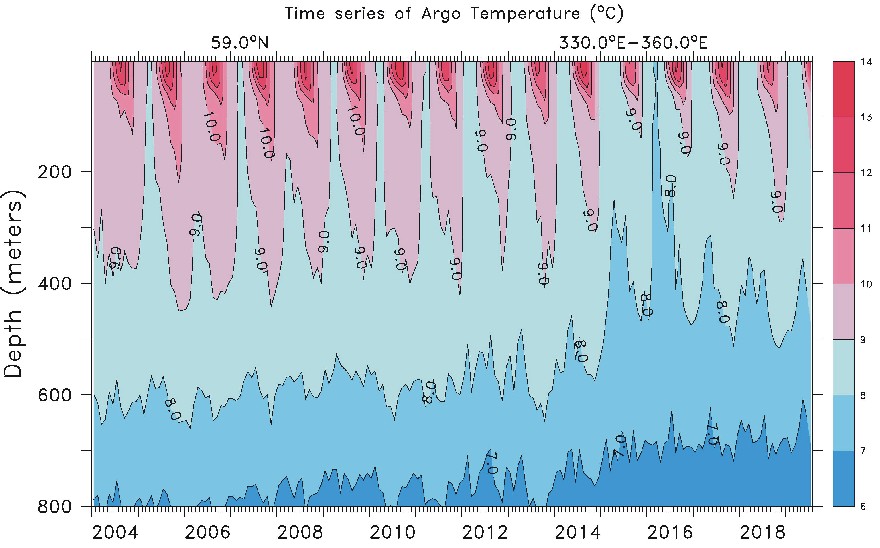
Whatever warms the upper ~400m in this example, it has no influence further down to the ocean floor. Seasonal warming is followed by seasonal cooling, resulting in ~zero gain in heat content of the surface layer.
How does the 1 bar of pressure plus IR active gasses explain the temperature of the deep oceans, some 75K above the avg lunar surface temperature?
The deep oceans have sparse thermometer measurements, the moon surface has none. Your 75K is a brightness temperature difference based on assumed regolith optical property & the deep ocean sparse kinetic temperature field. The actual kinetic temperature difference could very well be closer to 33K given large scale equilibration by ocean circulation over several billion years.
The real answer is unknown to any sort of statistical accuracy and there is no interest in further research at present.
Trick June 27, 2020 at 6:44 am
Agree, but I assume you agree that even the coldest water in our oceans (AABW) is ~270K or warmer. Water below ~2000m is between this 270K and 275K.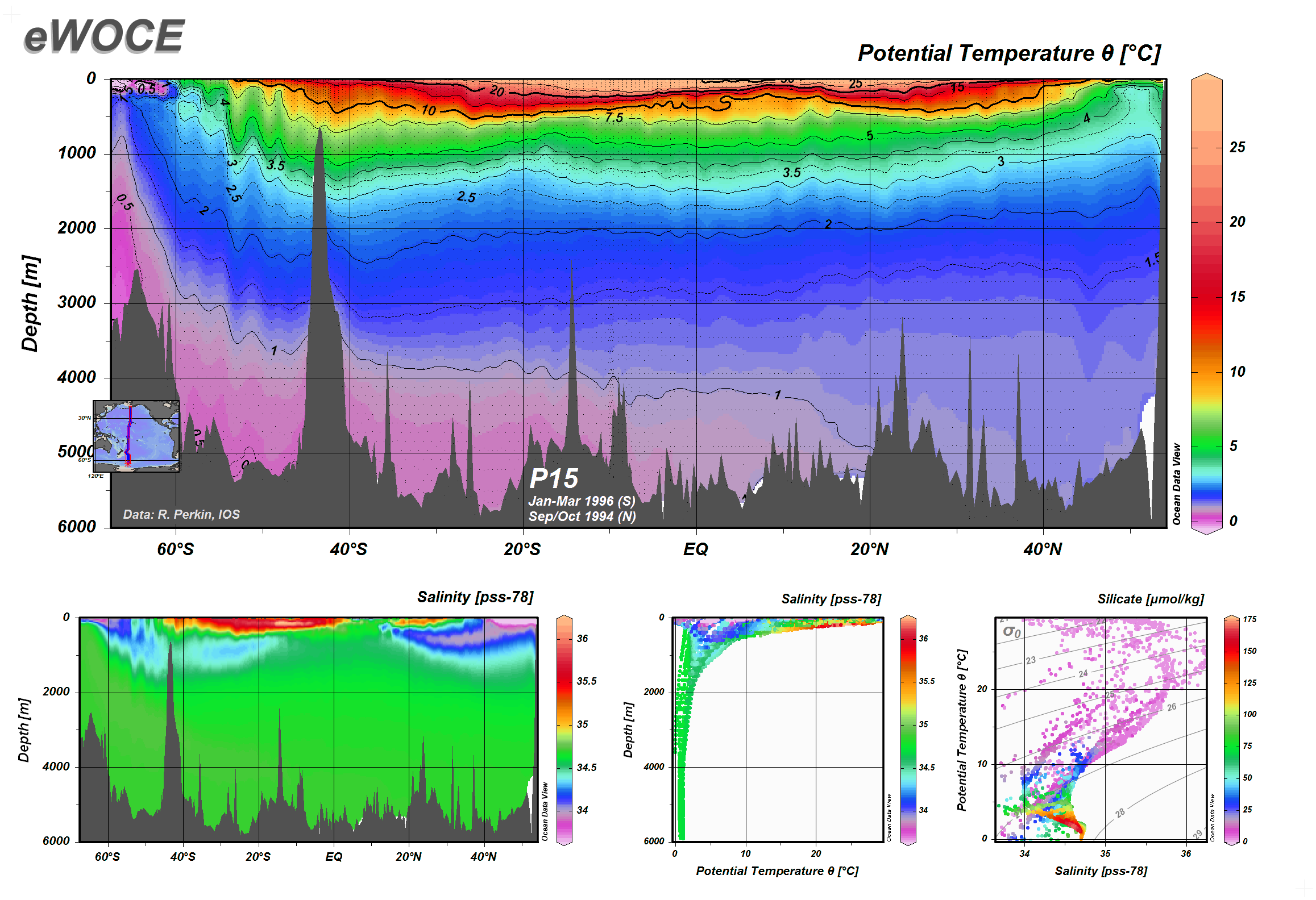
eg.
This is considerably warmer than any reasonable estimate for the lunar avg surface temperature or the (in)famous 255K Earth is supposed to be without GHE.
Again, lunar surface receives ~90% of TSI, while Earths surface receives less than 50% due to reflection and absorption higher up in the atmosphere.
So my question remains: what in your opinion caused the (rel) high temperatures of the deep oceans on Earth.
My answer obviously is geothermal energy, which includes the (nearly) bare magma that constituted Earths surface when the oceans started to develop.
Realize that the current ~100 mW/m^2 of geothermal flux into the oceans is enough to warm the avg column 1K in around 5000 years, and delivers the entire oceanic heat content every ~1,5 million years.
Hi Ben
I understand your argument and I fully support it.
I am also finding a strange contradiction in the fact that minimum temperatures here, and indeed it seems in the whole of the SH, have gone down, whilst in the NH they have gone up. Particularly it seems Tmin has gone up quite sharply in the arctic. A reasonable explanation for this IMHO is that it is due to the movement of the magnetic NP i.e. earth’s inner core, which has been moving NNE. In fact, it seems that that movement has been quite dramatic over the past 100 years.
Otherwise, up thread I have listed a number of possible reasons for the warming of oceans which in turn caused an increase of Tmean in the atm. That subsequently obviously also caused an increase in LWR 14-15 um in the atm. (Both water vapor and CO2 have absorption and subsequent re-radiation in that area of the spectrum of the molecule).
Cause and effect.
(I could not find any warming by more CO2, click on my name to read that report)
Ben, a few icy moons in the solar system show evidence of liquid oceans with (rel) fainter solar illumination and (rel) higher albedo so Earth with 1bar N2,O2 atm. cooler surface would still have liquid oceans due the thermodynamic internal energy of system formation having not totally dissipated as of our epic.
Trick June 28, 2020 at 7:34 am
Yes, and on Earth we have lake Vostok, liquid water under a thick ice layer.
No solar is needed if the ice is so thick that the surface radiates the same energy to space as geothermal inputs at the oceans floor.
On Earth we have perfectly insulated deep oceans. Insulation provided by the shallow solar heated surface layer. Only at high latitudes the surface has the same temperature as the deep(er) oceans, and geothermally warmed water can exchange this energy with the atmosphere.
So we have
– 1) geothermally heated deep oceans
– 2) solar slightly increasing the temperature of the mixed surface layer
– 3) oceans surface warming the atmosphere from below
– 4) atmosphere reducing surface energy loss to space (Insulation Effect)
Do you agree with these points? If not, which ones notand why?
”perfectly insulated deep oceans”
No perfect insulation exists. If the sun hadn’t been around last few billion years, then deep oceans would equilibrate to the new normal.
Ocean’s surface in last couple decades being warmed by a system out of equilibrium condition of about 0.6W/m^2 ASR due mostly ENSO and sea ice coverage changes. This imbalance of thermodynamic internal energy is circulating its way to the deep oceans by the amounts measured and quoted earlier (2010).
Trick June 29, 2020 at 8:41 am
For water warmed by the geothermal flux on the ocean floor it certainly does. warmed bottom water can NOT convect or conduct through the thermocline and the even warmer surfcae waters to the surface. This water has to be physically transported to (mostly) around Antarctica before it can surface and exchange energy with the atmosphere.
By what mechanism? The only water that sinks into the deep oceans is cold, salty water like AABW or NADW. These waters sink because they have COOLED enough to sink into the deep oceans.
Any increase in deep OHC must be from geothermal origin.
Henry Pool June 28, 2020 at 5:33 am
I see a simple mechanic explanation for the jigsaw cooling/warming of the oceans surface in NH and SH. Don’t see a geothermal origin like a moving core.
As you can see it costs enormous amounts of time and patience to make people understand that our cold thin atmosphere can’t warm 4 km deep oceans, but that the deep oceans are part of Earths hot interior, just like the continental crust.
True. Cannot believe that there are so many learned scientists who cannot see the truth of what you and me are saying. We are having a cold winter here.
”For water warmed by the geothermal flux on the ocean floor (perfect insulation) certainly does (exist.)”
Ben, you ought to mine that perfect insulation of yours and sell it at the Home Depot (my toy store). The tall gas column guys would be a great customer, they need some with which to experiment. The Earth core has cooled over time which would not happen if what you wrote were true.
When the cooled water sinks it displaces existing water upwards. The energy circulates to equilibrium over time
Trick June 25, 2020 at 7:53 am
Given your historical knowledge a related question:
where does the term “Blackbody” radiation come from?
I can understand a BB absorber, that appears black when 100% of incoming radiation is absorbed.
All things radiating however are linked to a color. eg red hot iron etc.
Kirchhoff defined his black body in a paper in 1860. Planck removed from that def. the rays being absorbed in an infinitely thin layer, to the BB should possess certain min. thickness absorbing the incident “rays” passing into the interior not just at the surface. Cavity radiation would be presumed dark inside so black.
G. Kirchhoff, Pogg. Ann., 109, p. 275, 1860. Gesammelte Abhandlungen, J. A. Barth, Leipzig, 1882, p. 573
Ben, also color is fascinating. A spectrum of a red apple shows almost as much green, yellow intensity so it is our brains that color that red apple red and choose green apples over red ones if our taste suits. Digging into color is a subfield of optics all on its own and you quickly get into how the eye/brain works too.
Ok thanks. I was wondering why outbound SB radiation is called BB radiation while eg a piece of iron radiates more and more while its temperature increases, and changes color in the process.
Jacques-Marie Moranne
Ferdinand has no ‘own’ measurements to either prove or disprove the theory of man made warming by CO2. Like Roy Spencer, he ‘wants’ to believe it. In my discussions with him I find he does not even understand that all of the GH theory is just based on a correlation of Delta T versus Delta [CO2].
To make this less obvious they have translated Delta T (K) with Delta Forcing (in W/m2)
Henry,
You don’t need to do your own measurements, if these are done by others in the past (except if you don’t trust – or don’t like – the results)…
Both the CO2 increase and the back radiation W/m2 increase were measured for the period 2000-2010 and 22 ppmv CO2 extra gives 0.2 W/m2 extra.
If that gives extra warming and how much warming remains to be seen, but that more energy is back radiated to the surface by more CO2 is measured and has nothing to do with whatever correlation.
See Feldman e.a.
Ferdinand
as I told you…
that report is just another like the one before….
they measured Delta T (aka Delta W/m2) versus Delta [CO2}
Henry,
I thought that was what you asked for: real measurements compared to real measurements, which show that an increase of CO2 increases the W/m2 of downward radiation? As the extra W/m2 are proven from the extra CO2 and not from water or other GHGs and not from temperature itself, what proof do you accept?
If you don’t accept real measurements then we can’t have a discussion…
This is only the observation of a possible correlation : heating can have other explanations beyond extra CO2.
I will feel much more comfortable when somebody can explain the Medieval Warm Period mecanism.
Yes that is why the temperatures dropped between the 1940s and the 1970s because the CO2 levels were dropping.
Oh wait.
That is why Ice ages were initiated when CO2 was at 4000-6000ppm.
oops not that isn’t right either.
In Holland we have an old saying that always applies in situations like this:
meten is weten!
= To measure is to know.
My advice to everyone here: don’t talk unless you have actual measurements to back up whatever you are saying….
What is interesting is that nobody here is asking (me) what it is I think is the cause of the oceans and the atm is getting warmer
From the 1970s to 2000 it should be the reduced Tropical cloud cover. As they are anti correlated.
If it isn’t please provide your theory.
@AC Osborn
I think hat is definitely one (1) probability, reason{?]
also (2) : more UV into the water due to less O3, HxOx & NxOx {reason: reduced ozone/ solar factor & could be partially due to the CFC problem]
also: more organic contamination (oil), e.g. to warm the fish pond at a nursery they add an organic surfactant that keeps heat in. I was amazed the other day to find that a serious drowning accident had resulted from too much foam on the sea water….(how serious is this contamination problem?)
(3)
(4) increased salinity of the waters due to human waste water (+ phosphates, sulphates, nitrates, chlorides) from 7 billion people / factories etc
Must say, there is strong evidence from my own experience that more of (4) leads to more algae formation which also warm the oceans (5) just like more terrestrial vegetation also leads to warming of the atm.
Ferdinand & them refuse to see that CO2 is a red herring.
@AC Osborn
I think that is definitely one (1) probability, reason{?]
also (2) : more UV into the water due to less O3, HxOx & NxOx {reason: reduced ozone/ solar factor & could be partially due to the CFC problem]
also: more organic contamination (oil), e.g. to warm the fish pond at a nursery they add an organic surfactant that keeps heat in. I was amazed the other day to find that a serious drowning accident had resulted from too much foam on the sea water….(how serious is this contamination problem?)
(3)
(4) increased salinity of the waters due to human waste water (+ phosphates, sulphates, nitrates, chlorides) from 7 billion people / factories etc
Must say, there is strong evidence from my own experience that more of (4) leads to more algae formation which also warm the oceans (5) just like more terrestrial vegetation also leads to warming of the atm.
Ferdinand & them refuse to see that CO2 is a red herring.
How a cold atmosphere can warm the Earth’s surface is, in my opinion, somewhat misunderstood. If you have a warm body, and approach it to a cold body, both bodies exchange energy untill the temperature is equal in both.
In the case of the Earth, the Earth is constantly radiating energy into space. When the body of the atmosphere is getting warmer, yet still cooler than the Earth surface, the Earth surface must heat up as the other cooler body is getting warmer. If the temperature difference between two bodies are 100 °C, the warmer body will lose heat faster, and cool down more, than if the two same bodies are 10 °C apart.
Since the warmer body (The Earth) is constantly being fed by the Suns energy, the temperature of that body will at some point stabilize, untill the cooler body (atmosphere) change its temperature, and/or if the Sun change its energy supply.
I do my internship at https://www.brooklynz.com.sg/ and have my research work on the greenhouse effect and sustainable building. This post threw light into various aspects of global warming and how sustainable living can affect the world by reducing the greenhouse effect. Thanks for sharing this post, I will follow you for more details on the subject.
BenW
How much do you estimate geo thermal factor?
They say it is only 0.1W/m2….
Henry Pool July 2, 2020 at 4:45 am
Most quoted numbers for the geothermal FLUX (GF) is ~100 mW/m^2 for oceanic crust and ~65 mW/m^2 for continental crust.
Without sun and atmosphere this would result in a surface temperature of ~50K to continuously radiate this flux away. The cont. crust is hot in spite of the small flux because the sun maintains a high surface temperature. The crust has cooled from much higher temperatures until the flux can “escape” during winter time and a stable geothermal gradient developed. Sun only warms the upper 10-20 m or so.
70% of Earths surface is ocean, so the oceans determine the surface temperature of Earth.
Mechanism is different from continents, since the GF and solar warming are separated by some 3000m water. I’m convinced that the heat content (~temperature) of the deep(er) oceans is entirely of geothermal origin.
Compare this to a hot water boiler. It takes a lot of energy to warm all that water to eg 80C. Once at that temperature only the energy loss through the insulation has to be supplied to MAINTAIN that temperature.
Our oceans were (very) hot during their creation, since they developed on (almost) bare magma.
Once they cooled to more “normal” temperatures the sun warms a shallow surface layer during spring an summer, during autumn and winter this layer cools again. (except in the tropics).
Solar influence reaches down to max. ~500m. Below that no solar signal. This solar heated surface layer provides the insulation layer that prevents any warming at the ocean floor from reaching the surface, except at high latitudes where the surface temperatures are ~equal to the temperatures of the deep(er) oceans. This implies that every liter of bottom warmed water has to be physically transported to high latitudes before it can release its energy to the atmosphere. This is the Thermohaline circulation, which can is driven by cold water mostly around Antarctica (AABW) that sinks into the deep oceans, replacing the previously warmed water.
The temperature of the deep oceans is around 280K, the sun adds on average ~10K to this temperature to reach the observed surface temperatures.
So 280K from geothermal, 10K from solar.
Atmosphere just reduces the energy loss to space, no heating of surface or deep oceans.
Ben
Many thx. I am going to keep this comment. OK?
This is so common sense to me.
How so many people can believe that radiation of 15 um can ‘heat’ the oceans and the earth is beyond me.
The current opacity atm. increases surface T to higher equilibrium from a nearly transparent atm. As atm. opacity increases from today, a higher equilibrium temperature results. Never a need to use the word ‘heat’.
Many other cyclic drivers of equilibrium T result in no smooth T increase observed.
Trick
Same opacity leads to more deflection of sunlight to space. And nobody has made a proper balance sheet of each gh gas ….
Anyway. It is common knowledge that the cold atmosphere cannot heat the warmer oceans?
Do you not see the logic of Ben s arguments?
Opacity is not albedo Henry. If the oceans are too cold out of equilibrium, the atm. will be a player to warm them back to equilibrium T but NOT above equilibrium T.
Trick,
now you say
Opacity is not albedo Henry.
Of course it is. It is part of albedo. Let us look at CO2 as an example. Did you know it also has absorption and subsequent re-radiation in the UV? That is how we can measure it on other planets. In fact, the strength of that back radiation tells us something about the quantity of CO2 on other planets.
Studying the radiation that came from the sun and hit the earth and subsequently bounced back via the dark side of the moon, we find absorption in the 1-2 um range. Note the green line fig 6 (bottom).
http://astro.berkeley.edu/~kalas/disksite/library/turnbull06a.pdf
There is also very strong absorption at 2.7 and 4.3 um where the sun shines dominantly. In fact I used to measure CO2 in N2 at 4.3 um.
So if CO2 is increasing you will also get more SW back radiation from the CO2 going to space, You get that?
Apart from that you must realize that the sun also still gives radiation 10-20 um, where the earth shines pre-dominantly.
So, where is your report showing the balance sheet for warming and cooling for each gh gas in the correct dimensions?
The atmosphere cannot warm the oceans : have you tried to warm a bathtub with a hair dryer ? : good luck !
Actually, the atmosphere is warmed by the oceans, … which are warmed by the unbalance between what they radiatively receive from the sun (about 162 W/m2) and what they can radiate back (about 45 W/m2 : half to the cosmos, half to the atmosphere : water vapor continuum).
… until they reach a temperature causing enough evaporation (latent heat) + convection (sensible heat) to compensate this unbalance.
Henry, ”So, where is your report showing the balance sheet for warming and cooling for each gh gas in the correct dimensions?”
You could start with Clough & Iacono 1995, plate 2. You have to pull the paper at the library because on-line ref.s have modified the chart. Subsequent papers have improved the method to account for all the IR active gases with results within 1C of measured clear sky atm. temperatures surface up through the stratopause (the important regions).
”So if CO2 is increasing you will also get more SW back radiation from the CO2 going to space, You get that?”
From 1938 to 2013, we know how much CO2 ppm increased, how much more SW back radiation from that added CO2 going to space should I reasonably get? Was it missed in the top post energy balance?
——
Jacques, warming the bathtub with my hair dryer works fine, it uses a fuel. The bathtub water was warmed by my water heater with the same principles.
Sure, the atm. is warmed by the oceans if the oceans are out of equilibrium colder. And vice versa. Neither ocean nor atm. can warm the other above equilibrium because neither burn a fuel. The surface oceans radiate globally at global temperature, about 398.2 shown in the top post.
In recent times, there is an ASR imbalance of about 0.6 (energy/sec per m^2 from something that does burn a fuel) absorbed in the system so the entire system is warming a bit above equilibrium T.
ASR ? (excuse-me, I am french, and not familiar with all those abreviations)
ASR = absorbed solar radiation.
Your explaination is only qualitative ; if you want to quantify, you will need to reason in terms of heat transfer balance.
On earth, heat can be transfered to the atmosphere via :
– radiation difference (and not radiation alone, except to the cosmos, supposed at 0K),
– convection (sensible heat), up to the tropopause,
– evaporation (latent heat), up to the top of clouds.
You must have an equilibrium both at ground level (~162 W/m2) and at TOA level (240 W/m2).
Sure, the atm. is warmed by the oceans if the oceans are out of equilibrium warmer seems to make more sense. The atm. warms the oceans globally if the ocean gets out of equilibrium on the cold side.
Oh. Trick. This is so funny. You are saying that the atm cannot heat the oceans. It is just the extra CO2 in the atm that does it??
I did not use the word ‘heat’ Henry.
Jacques, qualitative yes, see the top post for the quantitative discussion. The sum balance at the surface is not 162 though, it is at around global T 289K or with L&O emissivity as measured 398.2 with a small but statistically meaningful +0.6 system imbalance. The downwelling energy/sec per m^2 transfer sum radiation, convection, and rain are all lumped into the 340.3.
Again, you are confusing Radiation and Heat transfer :
The only heat source for the ground surface is the sun, and the surface receives 163 W/m2 energy from it.
There is no other heat source.
The problem is that the Ground surface cannot evacuate those 163 W/m2 (but only 40), … so, it warms.
… which causes evaporation and convection
… until those can evacuate the 123 W/m2 difference in the upper troposphere
… which occurs when the surface temperature reaches around 15°C.
“The only heat source for the ground surface is the sun, and the surface receives 163 W/m2 energy from it.”
So Jacques has a heat source radiating at 163, and an “evacuation” at 163 steady at 15C. Do you not see this as a problem Jacques?
The problem, to me, seems to be your evacuation is at the upper troposphere steady not at 15C and the surface is receiving the sun’s energy steady at 15C. There is something in between lapsing in temperature with height for several reasons which needs to be considered as all mass radiates/absorbs as shown in the top post.
you said that and it shows you are incapable of understanding the argument by Ben and myself.
it seems from my reports that the CO2 is not doing anything, except cooling the atm.
Henry, a self cite is never convincing. And you didn’t answer my questions:
From 1938 to 2013, we know how much CO2 ppm increased, how much more SW back radiation from that added CO2 going to space should I reasonably get? Was it missed in the top post energy balance?
Trick says
From 1938 to 2013, we know how much CO2 ppm increased, how much more SW back radiation from that added CO2 going to space should I reasonably get? Was it missed in the top post energy balance?
That was the question I was asking you. Why are you asking me. If you do not have the answer, I would advise you to do the same as me, namely to test the theory that more CO2 causes warming.
This winter here is cooler again as last year. This is part of a trend for the last 40 years..
Click on my name to read my report. I you look carefully, perhaps you would realize that the net effect of more CO2 is that of cooling, rather than warming.
”Why are you asking me.”
Henry, you stated added CO2 results in more SW back radiation. I was asking you to quantify how much more SW (albedo) from added ppm CO2 increased in the period noted. I have the reasonable answer, wanted to see if you knew. Was it missed?
Trick
My research shows that Tmin is affected by vegetation. It rises when you turn a desert into an oasis e.g. Las Vegas and it goes down where they chopped the trees e.g. Tandil ARG.
There is a report about this from Christie. Somewhere in California. The CO2 is a just a red herring.
Henry, the radiation measurements in top post include all the daily Tmin’s over 4-12+ annual periods. These include all the deserts turned into oases & vice versa, chopped trees & tree growth, your region, so forth during the observation periods.
In the satellite era, the largest observed changes reported through 2018 are from ENSO and sea ice coverage. CO2 has had a smaller effect; those IR active gas related natural effects will take longer to discern. This is why I selected a long enough period 75 years so you ought to be able to quantify the effect of SW albedo changes from CO2 to be convincing instead of just writing the answer is “somewhere in California”.
Henry Pool July 2, 2020 at 2:27 pm
Seems common sense is a rare commodity in climate science. I prefer good old fashioned meteorology (from before radiation madness struck)
To give some geothermal numbers :

the GF of 100 mW/m^2 is capable of warming the average ocean column 1K every ~5000 year.
It takes ~1 million km^3 magma erupting into the ocean to do the same.
Let’s call this energy needed to increase the oceans temperature 1K an Ocean Heat Unit (OHU).
From 125 mya to 75 mya around 300 million km^3 magma erupted into the oceans.
Good for ~300 OHU.
In the same period the 100 mW/m^2 GF delivered some 10.000 OHU.
Peak deep ocean temperature was around 85 mya, since that time the deep oceans have been cooling down, eventually resulting in our current Ice Age that started some 34 mya with the formation of the Antarctic ice cap.
To me it is obvious that the regular geothermal input into the oceans is insufficient to maintain their temperature. It takes large magmatic events to increase the oceans temperature.
Since the creation of the oceans we have seen several of these warming/cooling cycles.
PS
https://woodfortrees.org/plot/hadsst3gl/from:1979/to:2021/trend/plot/uah6/from:1979/to:2021/trend/plot/none
Here is the trend graph showing that the warming of the atmosphere follows the warming of the oceans. More heat came into the oceans or was produced inside / or insulated from the cold atmosphere (organic contamination on top?).
Not the other way around…it cannot happen like that.
CO2 is a red herring. It is a pity that so many still believe in this nonsense.
1
“Downward longwave radiation (DLR) is often assumed to be an independent forcing on the surface energy budget ….
Our results suggest that surface DLR is tightly coupled to surface temperature; therefore, it cannot be considered an independent component of the surface energy budget.”
from: https://agupubs.onlinelibrary.wiley.com/doi/abs/10.1029/2019GL082220
2
“…the main transport of heat in the troposphere is carried out by some other mechanism than radiation. The mechanism is obviously convection,….
In low latitudes,….water vapour in the atmosphere acts as a blanket on the outward flow of radiation, and by keeping the energy at low levels, gives the general circulation of the atmosphere time to carry it away to high latitudes.”
from
“Physical and Dynamical Meteorology ” by David Brunt
3
“…air moves a thousand times faster than water but carries only about 1/1000 as much heat per unit volume, which suggests that water is approximately of equal importance to air in moving heat over the planet.”
https://meteor.geol.iastate.edu/gccourse/ocean/text.html
Jacques-Marie
The atmosphere cannot warm the oceans :
True. I am so glad of a few people here who understand why the theory of man made warming by CO2 is so ridiculous.
I must warn you all (in the USA) of the coming drought time, as it has already started in Europe. It is not due to man made warming, but if people will still believe that when the heat begins to strike?
Click on my name to read my report on that.
A few final notes
https://woodfortrees.org/plot/hadsst3gl/from:1979/to:2021/trend/plot/uah6/from:1979/to:2021/trend/plot/none
The red line is the average temperature for the oceans and it is always a little warmer than the atmosphere… So it makes sense that as the oceans get warmer, you’ll have more LWR up. Everything just cause and effect. CO2 is a ‘red herring’.
The reasons why the oceans are getting warmer, (and therefore also the atmosphere), may be
1) more incoming solar (look especially UV)
2) more human waste (esp. phosphates, carbonates, chlorides and sulfates). Those ions hold heat, through mass and absorbing.
3) organic pollution. It has been proven that a very small oil- or surfactant layer on top of the water acts as an insulator and keeps heat inside. They do this deliberately at fish farms. How much is that pollution? When I think of that accident in NL recently with those people who drowned because of all the foam on the water, I think this problem is very underestimated.
4) warming of river and sea water by using it as cool water for all factories and electricity’s power plants. Here in Koeberg, the fish died because of the heat of the cooling water from the atom power plant that was dumped in the ocean around it.
There is a real need to investigate these points, but as long as everyone continues to believe in this CO2 nonsense, that will never happen. CO2 doesn’t do anything. At least not here. It is getting cooler here.. We’re having a very cold winter. About 2 degrees colder than normal. Click on my name to read my report on cooling here in ZA.
BW
So sorry, @ur momisugly BenW.
I totally forgot
5) More volcanic action on the bottoms of the oceans.
Do you think that this is indeed a very good possibility?
Henry Pool July 4, 2020 at 6:27 am
I do, but not on human time scales. It took some 50 million years to bring warm the oceans 10 maybe 20 K. It took ~85 million years to cool down to the current temperatures.
Rapid warming/cooling is only possible for the very shallow surface layer. The sun does this every year 😉
Look at decreasing cloud cover to explain the recent global warming.
Rapid geothermal warming could be magma erupting close to the surface, but this will be a local effect. Also relevant is magma erupting under sea ice like what happens in the Arctic ocean.