| From the “remember, thou art model” department. Multiple climate factors indicate above-normal activity is most likely An above-normal 2020 Atlantic hurricane season is expected, according to forecasters with NOAA’s Climate Prediction Center, a division of the National Weather Service. The outlook predicts a 60% chance of an above-normal season, a 30% chance of a near-normal season, and only a 10% chance of a below-normal season. The Atlantic hurricane season runs from June 1 through November 30. NOAA’s Climate Prediction Center is forecasting a likely range of 13 to 19 named storms (winds of 39 mph or higher), of which 6 to 10 could become hurricanes (winds of 74 mph or higher), including 3 to 6 major hurricanes (category 3, 4 or 5; with winds of 111 mph or higher). NOAA provides these ranges with a 70% confidence. An average hurricane season produces 12 named storms, of which 6 become hurricanes, including 3 major hurricanes. 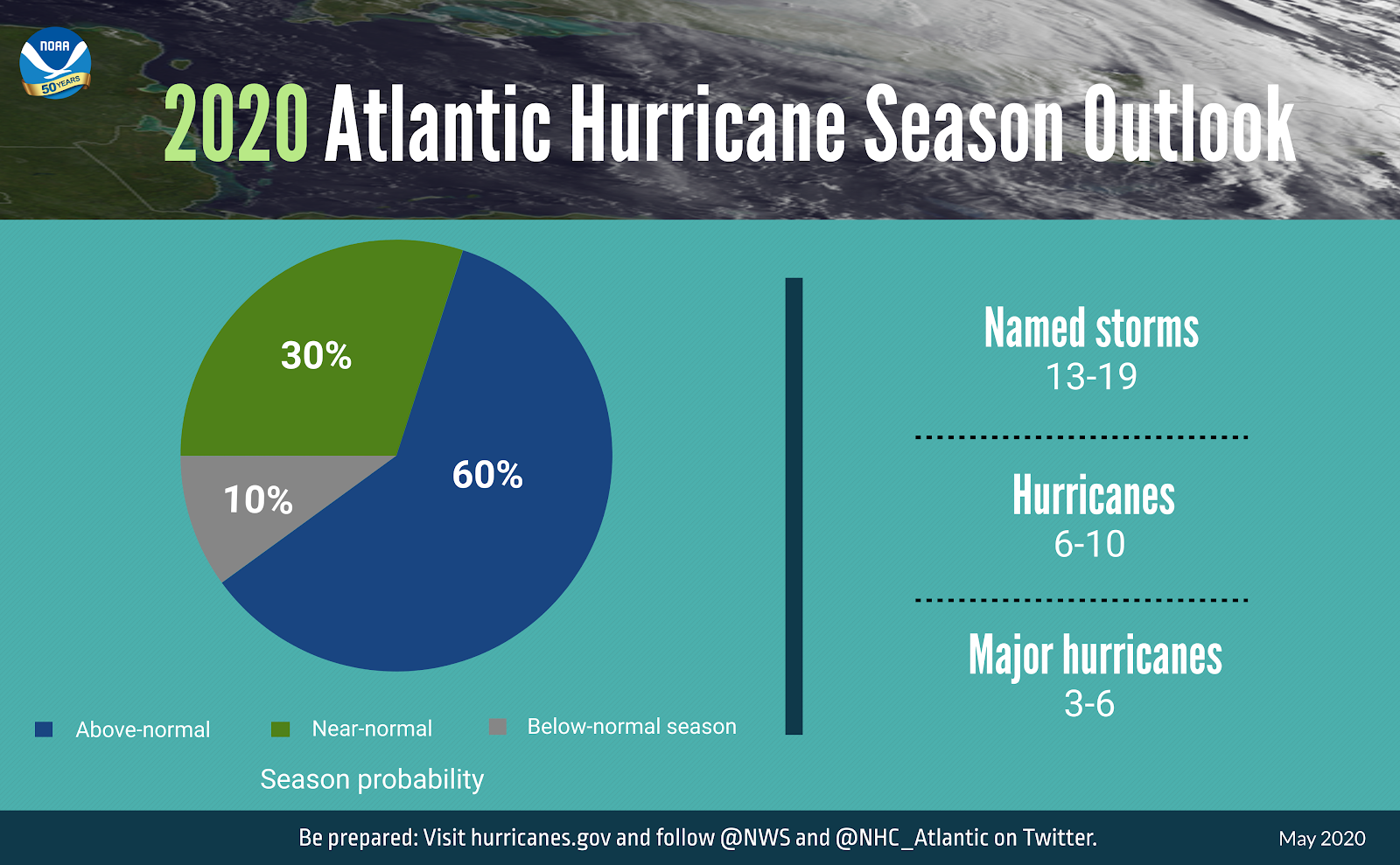 “As Americans focus their attention on a safe and healthy reopening of our country, it remains critically important that we also remember to make the necessary preparations for the upcoming hurricane season,” said Secretary of Commerce Wilbur Ross. “Just as in years past, NOAA experts will stay ahead of developing hurricanes and tropical storms and provide the forecasts and warnings we depend on to stay safe.” The combination of several climate factors is driving the strong likelihood for above-normal activity in the Atlantic this year. El Nino Southern Oscillation (ENSO) conditions are expected to either remain neutral or to trend toward La Nina, meaning there will not be an El Nino present to suppress hurricane activity. Also, warmer-than-average sea surface temperatures in the tropical Atlantic Ocean and Caribbean Sea, coupled with reduced vertical wind shear, weaker tropical Atlantic trade winds, and an enhanced west African monsoon all increase the likelihood for an above-normal Atlantic hurricane season. Similar conditions have been producing more active seasons since the current high-activity era began in 1995. “NOAA’s analysis of current and seasonal atmospheric conditions reveals a recipe for an active Atlantic hurricane season this year,” said Neil Jacobs, Ph.D., acting NOAA administrator. “Our skilled forecasters, coupled with upgrades to our computer models and observing technologies, will provide accurate and timely forecasts to protect life and property.” This year, as during any hurricane season, the men and women of NOAA remain ready to provide the life-saving forecasts and warnings that the public rely on. And as storms show signs of developing, NOAA hurricane hunter aircraft will be prepared to collect valuable data for our forecasters and computer models. In addition to this high level of science and service, NOAA is also launching new upgrades to products and tools that will further improve critical services during the hurricane season. NOAA will upgrade the hurricane-specific Hurricane Weather Research and Forecast system (HWRF) and the Hurricanes in a Multi-scale Ocean coupled Non-hydrostatic model (HMON) models this summer. HWRF will incorporate new data from satellites and radar from NOAA’s coastal Doppler data network to help produce better forecasts of hurricane track and intensity during the critical watch and warning time frame. HMON will undergo enhancements to include higher resolution, improved physics, and coupling with ocean models. As the hurricane season gets underway, NOAA will begin feeding data from the COSMIC-2 satellites into weather models to help track hurricane intensity and boost forecast accuracy. COSMIC-2 provides data about air temperature, pressure and humidity in the tropical regions of Earth — precisely where hurricane and tropical storm systems form. Also during the 2020 hurricane season, NOAA and the US Navy will deploy a fleet of autonomous diving hurricane gliders to observe conditions in the tropical Atlantic Ocean and Caribbean Sea in areas where hurricanes have historically traveled and intensified.  As with every hurricane season, the need to be prepared is critically important this year. “Social distancing and other CDC guidance to keep you safe from COVID-19 may impact the disaster preparedness plan you had in place, including what is in your go-kit, evacuation routes, shelters, and more. With tornado season at its peak, hurricane season around the corner, and flooding, earthquakes and wildfires a risk year-round, it is time to revise and adjust your emergency plan now,” said Carlos Castillo, acting deputy administrator for resilience at FEMA. “Natural disasters won’t wait, so I encourage you to keep COVID-19 in mind when revising or making your plan for you and your loved ones, and don’t forget your pets. An easy way to start is to download the FEMA app today.” In addition to the Atlantic hurricane season outlook, NOAA also issued seasonal hurricane outlooks for the eastern and central Pacific basins. NOAA’s outlook is for overall seasonal activity and is not a landfall forecast. The Climate Prediction Center will update the 2020 Atlantic seasonal outlook in August prior to the historical peak of the season. Hurricane preparedness is critically important for the 2020 hurricane season, just as it is every year. Keep in mind, you may need to adjust any preparedness actions based on the latest health and safety guidelines from the CDC and your local officials. Visit the National Hurricane Center’s website at hurricanes.gov throughout the season to stay current on any watches and warnings. |
Note – from Joes Saturday Summery
https://www.weatherbell.com/
Past Hurricanes being reannalysed(down graded?)
Headline Hurricanes getting stronger
Isn’t this what was said last season, and the one before that, and,,,,,,,,, well, all the way back to 2006? Every year just before Memorial Day weekend we get the usual”everyone is going to die in a firey flood!!!!” and yet it never quite pans out.
Haven’t they made the same prediction every year since Hurricane Katrina?
are these spinning a wheel with numbers on it??
With each year’s NOAA hurricane forecast, I always remember the very significant contribution to the field made by Dr. William Gray, who through the practice of diligent observation and traditional scientific method helped transform our knowledge from something more closely akin to witch doctors to somewhat informed deductions.
My geomagnetic Ap spikes-Atlantic basin hurricane hypothesis predicts the 2nd half of July is going to be quite active.
Prediction is based on likelihood of significant vigorous solar active regions forming from the end of June through July driving Ap spikes and putting the Atlantic basin in favorable condition for TS formation.
On the topic of this government NOAA statement, I find this amusing:
““Social distancing and other CDC guidance to keep you safe from COVID-19 may impact the disaster preparedness plan you had in place, including what is in your go-kit, evacuation routes, shelters, and more. With tornado season at its peak, hurricane season around the corner, and flooding, earthquakes and wildfires a risk year-round, it is time to revise and adjust your emergency plan now,” said Carlos Castillo, acting deputy administrator for resilience at FEMA. “Natural disasters won’t wait, so I encourage you to keep COVID-19 in mind when revising or making your plan for you and your loved ones, and don’t forget your pets. An easy way to start is to download the FEMA app today.” “
now picture a COVID-19 social distancing demands in a typical Gulf Coast hurricane shelter full of people (see link below from Hurricane Irma in 2017) … LOL.
http://www.trbimg.com/img-5caf833c/turbine/fl-1555006264-an0mays8wj-snap-image
picture caption: Many South Florida residents sought shelter when Hurricane Irma blew through the region in 2017. These individuals were in a West Boynton shelter in Palm Beach County. File photo(Jim Rassol / Sun Sentinel)
We should be building herd immunity while the weather is nice.
“’It’s tough to make predictions, especially about the future’” is attributed to a baseball-playing philosopher, Yogi Berra.
Same for Hurricane predictions from what I have seen in the past.’
– JPP
It’s when I read “…since the current high-activity era began in 1995.” that I realized it is just wishful thinking.
The key sentence is: “NOAA’s outlook is for overall seasonal activity and is not a landfall forecast.”
Let me repeat the critical portion, …”not a landfall forecast”.
Stay safe and healthy, all.
Bob
Does anyone keep track of annual projections vs what actually happened?
It would be interesting to see the projection track record accuracy ( or lack of.)
If only the track let me bet a spread like this.
This is typical at this time of year. But it doesn’t matter what they predict. It only takes one to ruin you life if you are not prepared. Prepare for the worse, hope for the best and get on with your life.
It can be different?

Best to wait to see what Dr. Judith Curry has to say.
I have not updated my 8 years old prediction graph for the a year or two (still ‘valid’ for another 6-7 years)
http://www.vukcevic.co.uk/ACE4.htm
but if it is any good, it shows slightly above normal, whatever that happened to be.
Meh. I don’t really understand the point of these forecasts. First, in the 17 years I’ve lived in Florida almost every year has been forecast to be above average. Secondly, all it takes is one strong hurricane to hit your house to make the season miserable, so you need to prepare properly regardless of the forecast.
Busy Atlantic hurricane season predicted for 2020
Multiple climate factors indicate above-normal activity is most likely
That depends on the definition of the word “Busy” doesn’t it?
Repent! If you don’t “believe” in the worst case scenario, Gaia will SMITE you!!!
I notice that they don’t mention how well their model has performed. Does anyone have some quick data on predictions versus reality for the last two decades? I can look up the results but not the predictions.
“ Similar conditions have been producing more active seasons since the current high-activity era began in 1995. ”
Haven’t we been in a historical low period for hurricanes?
Klotzbach’s April-based model explains about 40% of the interannual variability in named storm frequency. The remaining 60% is not small. While it’s kind of cool to be able to quantify an in-advance signal, in operational reality–i.e. what it means for people–it has very little utility. One big hurricane in a season with few storms costs the insurance industry (and the taxpayers) the same as some middling ones in a season with a lot of storms.
Serve them right if this year there are a near record amount of hurricanes but none of them got much over tropical storm force, and most blow-out before reaching land.

Don’t forget to rate the storm …
If there is a 70% confidence of a 60% chance of an above-normal season does this mean the answer is 42.
From wikipedia: “The number 42 is, in The Hitchhiker’s Guide to the Galaxy by Douglas Adams, the “Answer to the Ultimate Question of Life, the Universe, and Everything”, calculated by an enormous supercomputer named Deep Thought over a period of 7.5 million years. Unfortunately, no one knows what the question is.”
Now we know what the question is, or was.
I will finish my wine and go to bed.
Cheers.
When the season becomes “below normal” this will have been compatible with their models, do not forget.
No hurricane is needed for a flood to occur in the east of the US. This is indicated by jetstream.
http://tropic.ssec.wisc.edu/real-time/mtpw2/product.php?color_type=tpw_nrl_colors&prod=conus×pan=24hrs&anim=html5
With the gaping wiggle room in these numbers, its hard not to be right?