Guest Post by Willis Eschenbach
[UPDATE—
Well, I got up today and fired up the weed wacker and went out to sweat a bit in the sun. You can see the mowed part at the bottom and the much larger unmowed part behind … I limit my fun to one tank of gas per day, makes my hands shake afterward.

And while turning tall grass into short grass, I thought …
Rats! I asked the wrong question!
The question is not “Do Lockdowns Work”? The answer to that is obviously yes. All different types of those restrictions, from the mildest to the most draconian, will have some effect on the speed of transmission. So “Do lockdowns work?” is meaningless.
The real question is, “Is Extending Lockdowns Worth The Cost?”
That is to say, will any further extension of the lockdowns make any difference? From what people say below, we don’t see the effects of the lockdowns for three weeks or so after the imposition of the sanctions. Now, thanks to a most interesting site provided by my generally aggravating friend Steve Mosher, the future of the US looks like this (the site also has individual states):

If the peak is in two weeks, and the effects of what we do today won’t be visible for two weeks, and at this point the possible changes are small, is that worth the huge damage this lockdown is doing?
The problem that I see is the cost. One week of lockdown has cost us two trillion dollars, along with thousands of failed businesses, people unable to retire because their 401Ks are in the toilet, hundreds of thousands unemployed, a big uptick in domestic violence, and lots of jobs lost.
Now, I estimate that something on the order of 80,000 people will die in the US from this virus. (Curious me, I also looked up the estimate from the model above … 93,000.) Suppose the “flattening the curve” saves 10% of them. By all indications, it won’t, but let’s use that number.
That means that we have spent two trillion dollars to save maybe 8,000 people.
And that, in turn, means that we’ve spent a QUARTER BILLION DOLLARS PER PERSON, most of them over 70 like me but unlike me with other diseases, and put our economy in the crapper in the bargain. I may be wrong, but somehow I don’t think my life is worth a quarter billion dollars.
Now, think about the alternative—voluntary self-isolation, particularly of geezers like me, along with putting two billion into field hospitals, quarantine hospitals, accelerated doctor and nurse training in quarantine procedures, ventilators, masks, quarantine ambulances, drug production of antibiotics, chloroquine, and whatever drugs we need, instructional videos on social distancing, and the like.
I’d say there’s a good chance that we could save more than the 8,000 people by that method, and no matter how many we saved, we’d end up with a) a medical system second to none, b) a humming economy that just had two trillion poured into increased production, c) on-shoring our drug-production industry, d) no business losses, unemployment, or job losses, and e) no uptick in domestic violence.
Call me crazy, but I do NOT want to spend another two trillion dollars to prop up a mostly “feel-good” lockdown ..
Given the general ineffectiveness of these various lockdown-type interventions in the Western countries, and given that a couple weeks of lockdown have already cost us a trillion dollars and hundreds of thousands of vanished jobs and failed businesses and unemployed workers …
… given all of that, I have to ask … is yesterday too soon to end the lockdowns?
Don’t give up. Just end the stay-at-home shelter-in-place regulations. Leave a strong VOLUNTARY self-isolation on geezers like myself, retired folks. Test incoming visitors to the US. Keep washing hands. START WEARING MASKS!.
Let’s get the country back to work before any more people go bankrupt or are unable to pay their rent.
Anyhow, that was my morning. How was yours? I’ve changed the title of the post, and left the original title as well, for searching purposes. And now, here’s my original post.
Best wishes to all for good health,
w.]
Before this $%^&* lockdown started, I said “SPEND THE $1 TRILLION ON OUR HEALTH SYSTEM AND DON’T LOCK THE UNITED STATES DOWN”!!!
(See, back then they were only talking one trillion. But it’s politicians spending OPM, so of course now it’s two trillion.)
And from everything I’ve seen up to now, I was right. Near as I can tell, the lockdowns in various countries have done little & our health system is still inadequate. However, that’s just anecdotal. So here is some harder data on the question.
First, almost every country has implemented some forms of health interventions, ranging from the mild to the Chinese-style totalitarian clampdowns.
And as the Koreans have shown, this can work … but only if people are willing to have quarantines enforced with GPS locations and a surveillance state and GPS contact tracing that shows everywhere you’ve been in the last two weeks. As far as I can see, you have to be Korea or China to pull that one off, and no western country has even tried it.
And as a result, there is very little difference between the spread of disease and the concomitant rate of death in any of the western countries. Figure 1 shows the tragic trajectory of death in the 14 countries with the highest death rates.

Figure 1. Coronavirus deaths versus the number of days since the country went over 10 deaths per million people.
As you can see, there is very little difference in the death rates between the various countries, despite the fact that they all have differing levels of health interventions to try to prevent the spread. They’re all following the same trajectory.
Now, other than lockdowns, what kind of health interventions am I referring to? Glad you asked. Over at ACAP you can download a dataset of the different kinds of measures used by different countries. They list no less than 33 different types of health interventions being used to fight the coronavirus, viz:
- Additional health/documents requirements upon arrival
- Amendments to funeral and burial regulations
- Awareness campaigns
- Border checks
- Border closure
- Changes in prison-related policies
- Checkpoints within the country
- Complete border closure
- Curfews
- Domestic travel restrictions
- Economic measures
- Emergency administrative structures activated or established
- Full lockdown
- General recommendations
- Health screenings in airports and border crossings
- Humanitarian exemptions
- International flights suspension
- Introduction of quarantine policies
- Limit product imports/exports
- Limit public gatherings
- Lockdown of refugee/idp camps or other minorities
- Mass population Testing
- Military deployment
- Obligatory medical tests not related to COVID-19
- Partial lockdown
- Psychological assistance and medical social work
- Public services closure
- Schools closure
- State of emergency declared
- Strengthening the public health system
- Surveillance and monitoring
- Testing policy
- Visa restrictions
So I used that to see if countries with more of those restrictions fared better. Here, for example, are the restrictions imposed by South Korea over time. Some are listed twice because they were expanded or made more rigorous over time:
- Health screenings in airports and border crossings
- Limit public gatherings
- Visa restrictions
- Visa restrictions
- Introduction of quarantine policies
- Schools closure
- Introduction of quarantine policies
- Additional health/documents requirements upon arrival
- Surveillance and monitoring
- General recommendations
- Additional health/documents requirements upon arrival
- General recommendations
- Partial lockdown
- General recommendations
- Introduction of quarantine policies
- Psychological assistance and medical social work
- Introduction of quarantine policies
- Surveillance and monitoring
Quarantine, then surveillance, then more rigorous quarantine, then even more rigorous surveillance and quarantine. I don’t believe that Americans would put up with that.
However, being a graphically minded sort of person, I then made a scatterplot of the number of distinct kinds of restrictions a country has imposed versus the number of deaths per ten million in that country. Figure 2 shows the result:

Figure 2. Scatterplot, number of kinds of restrictions to try to prevent viral spread versus coronavirus deaths per ten thousand.
As you can see, the number of restrictions seems to have little to do with the number of deaths. For example, here’s what Switzerland has done. These are the different restrictions they’ve applied.
- Limit public gatherings
- Border checks
- Visa restrictions
- State of emergency declared
- Schools closure
- State of emergency declared
- Border checks
- Visa restrictions
- General recommendations
- Strengthening the public health system
- Awareness campaigns
- Testing policy
- Limit public gatherings
- Border closure
- Limit public gatherings
- Economic measures
- Limit public gatherings
- Partial lockdown
- Full lockdown
- Partial lockdown
- Economic measures
- Economic measures
- Limit product imports/exports
- Military deployment
- Limit public gatherings
- International flights suspension
- Limit public gatherings
- Strengthening the public health system
- Visa restrictions
- Economic measures
So the lack of visible effect is not from a lack of restrictions. Nor is the lack of visible effect because the restrictions haven’t been in place long enough. Switzerland imposed the first restrictions forty days ago, on the 21st of February. They closed the schools. On the 24th of February, the government declared an “extraordinary situation,” and banned all private and public events and ordered restaurants and bars to close. At that point, they had no coronavirus deaths. [UPDATE: A couple of people said that Switzerland’s restrictions had not been in place that long. Upon rechecking my sources, I find they were right and I was 100% wrong. However, my point remains—the different restrictions haven’t made any detectable difference to date, and the crunch is coming in one or two weeks for most countries. So any effect will be minimal, if not detectable, and meanwhile the economic and human cost is horrendous.]
They currently have 433 deaths from coronavirus. Forty days of sanctions with no effect.
Meanwhile, the Swiss have about the same number of deaths per ten million population as say Netherlands, and here’s all that the Dutch have done:
- Introduction of quarantine policies
- Limit public gatherings
- Schools closure
- Public services closure
- General recommendations
- Economic measures
- Emergency administrative structures activated or established
No lockdown, neither partial nor full. No limitations on import/export. No suspension of flights. No visa restrictions. No state of emergency. No border checks.
And despite that … they are on a par with the Swiss, despite all of the Swiss containment measures.
Or you could look at it another way. Germany, the US, Portugal, France, and Spain have all instituted the same number of restrictions … but their deaths go from low to high.
So it seems that my intuition was correct. Unless you are willing to impose a full-blown police and surveillance state, these measures do very little. The problem is that this bugger is so insidious. It has a long incubation period when it is infectious but asymptomatic. And it can live on surfaces for days. As a result, in terms of government restrictions, nothing but a major Korean-style full-court press, with surveillance and strict quarantine and a populace willing to follow restrictions to the letter, will cut down the number of cases.
And Americans simply won’t do that. In fact, it’s impossible to get Americans to just shelter in place. If you go out into the streets of the US, there are lots of people working, lots of people going from place to place, grocery stores full of people … control the virus?
I don’t think so.
But regarding controlling the virus, here’s another graph. It’s exactly the same as Figure 2, but it contains Japan as well.

Hmm … they’re in the danger zone, near to Korea and China, so what extreme health measures are they practicing? Here you go …
- Health screenings in airports and border crossings
- Visa restrictions
Whaaaa? That’s all the restrictions? … my only conclusion from that is simple.
WEAR A MASK.
The one virus health practice that distinguishes Japan from most of the world is that they all wear masks in public. Even the liberal US news media is noticing the effectiveness of masks—a CNN story is headlined “Face masks and coronavirus: Asia may have been right and the rest of the world is coming around” … seems the US specialists were wrong again. Go figure.
A mask cuts transmission down in two ways. First, it keeps you from touching your mouth or nose. This both protects you until you can wash your hands, and if you are infected it keeps you from spreading the virus onto hard surfaces to infect others.
Next, it keeps you from sneezing or coughing a billion virus particles into the air. It’s less effective at preventing you from inhaling such particles, although it helps with that as well. And it is that sneezing and coughing that is the major way that the virus is spread.
And overall, as Japan is showing us, wearing a mask cuts the transmission rate way down.
We’re starting to get there, but it may be too little too late. I see that the genius medical experts who recommended the ineffective drastic lockdown are now thinking about recommending that Americans wear masks. The headline in Politico says “Fauci: Mask-wearing recommendation under ‘very serious consideration’” … under consideration?? They’ve destroyed the American economy without looking back, but a simple recommendation to wear a mask in public requires “very serious consideration”?
Sigh …
We can see above that there’s very little upside to the American lockdown … so let’s look at the downside. First, the economic damage from the current insane “shelter-in-place” regulations designed to thwart the coronavirus is already huge—lost jobs, shuttered businesses, economic downturn, stock market losses. This doesn’t count the personal cost in things like increased suicides and domestic and other violence. The people who made the decision obviously were led by doctors, which was good, but they did not listen to economists or social scientists, which was lethal.
To partially compensate the populace for those stupendous economic losses, we’ve just thrown two TRILLION dollars in the general direction of the problem. That’s trillion with a “T”. Most people have no idea how much a trillion dollars is. Consider it this way.
Suppose you were an immortal who made so much money that you were able to spend a million dollars a day forever. In the first week, you buy 350 ventilators at $20,000 each and give them to the various states. The next day you buy 200,000 face masks at $5 a pop, epidemic prices. Then you decide to take a year and buy a field hospital every day, 365 of them at a million dollars each. That feels so good that you decide to set up full hospitals. They’re something like 1.5 million dollars per bed. So you can buy a 250-bed hospital per year. You spend the next two hundred years doing that, two hundred new hospitals, 50,000 new beds.
Now that’s only about a hundred years of spending a million bucks a day. Suppose further that you started spending one megabuck per day, that’s a full million dollars each and every day including weekends, back on January First way back in the Year One. And imagine that you spent a million dollars a day every day right up to the present, buying medical equipment, expanding medical schools, purchasing test kits, a million dollars a day from the year 1 right up to the year 2020.
Guess what …
…
… you still would have spent far less than a trillion dollars, only about three-quarters of a trillion. And to spend two trillion, you’d have to spend a million dollars a day for 5,500 years.
Can you imagine what our medical system would be like if we spent a million dollars a day on it for fifty-five-hundred years?
Instead, we’ve pissed the two trillion away on repairing the damage caused by the lockdown without getting the economy started again, plus wasting it on all the pork that got loaded onto the bill.

Consummate financial idiocy that only politicians could ever think was reasonable, logical, or practical. Mark Twain was right when he said “Suppose that you were a Member of Congress. And suppose further that you were an idiot. But I repeat myself.”
So … how about we all put on masks, keep washing our hands, give up our steamy midnight rendezvous (rendezvous?) with pangolins, increase testing particularly of our medical personnel, start testing for antibodies, and end this stupid lockdown? The pluted bloatocrats in Congress are already dreaming up a new appropriations bill to waste another trillion dollars or so that we cannot afford. Me, I say, let’s quit while we’re behind and get back to work.
Here on my forest hillside where the redwood trees scratch the sky, it’s my great fortune that my daughter, her husband, and my infant granddaughter have come to spend the lockdown in the woods … and both I and my gorgeous ex-fiancée are overjoyed that they are here. They’re working from home, and we’re retired, so all is well chez nous.

So stay well in these parlous times, dear friends. I see that Chloroquine has been approved in India for Covid-19 treatment. I had malaria four times, so I know that drug up close and personal. Plus I took it once a week for a year as malaria prophylaxis. And I used to take three weekly doses per day for three days in a row if I felt malaria coming on, and that would stop it in its tracks. So I’d take it again in a minute.
And I also saw that the advisor to the Italian Health Minister has said that only 12% of the Italian deaths were actually deaths FROM Covid-19, and the rest were deaths WITH Covid-19. So things may be looking up.
Regards to everyone,
w.
The Usual: When you comment please quote the exact words you are discussing, so we can all be clear who and what you are referring to.
Discover more from Watts Up With That?
Subscribe to get the latest posts sent to your email.
a possible complication with the idea of comparing countries in this way and interpreting differences in terms of policy is that there are other differences among these countries and their citizens.
Masks have been the subject of many comments on this thread. No one has mentioned the non-particulate aspects of wearing one.
Simple masks create a more humid environment for the wearer. This is anathema to corona-viruses’ virulence. There was a very recent WUWT guest post where I mentioned this.
For readers still checking this thread I’ll merely repeat my informative source: “Low ambient humidity impairs barrier function and innate resistance against influenza infection” ; free full text is on-line.
Illiteral nonsense.
Of course, the lockdowns work.
Even Italy and Spain report much reduced rates of new infections.
Counting dead is plain wrong. These are retarded by 2-3 weeks.
Agreed, I’ve pointed this out several times. To conclude that there is no effect you need to have a method which would show an effect if one existed.
Or maybe the disease picks off the weak and dies out?
Counting deaths seems logical. Unknowns like false positives or negatives otherwise skew results.
It is logical in retrospect, once the epidemic is over . It is totally useless until you are 2 or 3 weeks into a shutdown to assess whether it is working !! In 3 weeks you’ve done a lot of damage.
Cases data are contaminated by many factors like levels of testing but unless you think there is less testing, or figures are being suppressed to falsify an effect, a slow down in cases can not be put down to testing changes.
the lower slope ( slower doubling time ) starts BEFORE the shut down but there are lumps in the data which mean that is probably not significant.
you have to wait to draw conclusions. after one week or two you can draw very different conclusions.. but frankly i don’t know..
and may be lockdown was too late.. two many people infected in the population..
but i very much doubt lockdown is enough to avoid deaths..
Blocking measures are needed to contain a pandemic. Economic evaluations may also suggest that the correct way is to increase the response of the health system, the correct way is to accept a certain number of deaths (residual damage), and more as expressed in the article. But there are some considerations to consider:
1) it is not fully known (even now) how it works and the potential of coronavirus;
2) to increase the yield of the health system it takes time (… and time is missing, even for the United States);
3) if a State does not adopt measures of social distancing or does not stop its industries it would be obliged to close the transport from and to the States that do not adopt the blockade;
4) a state that does not adopt social distancing as the pandemic progresses would still have problems guaranteeing safe work for its workers in its industries;
5) there would be huge problems regarding the ethical evaluation of the choice not to operate social distancing (with huge political frictions in a democratic state);
6) I doubt that “going back to work immediately” for the United States will solve all the economic problems triggered by social distancing (at least until more than half the world applies social distancing measures).
I strongly agree with the reference to the use “without if and without but” of the masks. The use of devices such as masks or devices capable of guaranteeing similar protection must be compulsorily imposed on the population.
Could I just post this with just a ‘WTH’
https://youtu.be/5pIMD1enwd4
The problem is that cases are still on the rise. If these same types of videos are out there showing the same thing in a couple of weeks, then we have a problem.
Tangentially related, I can suggest this document for a proposal of how to implement a contact tracing system that still respects privacy:
https://medium.com/@ganileni/a-policy-proposal-for-digital-contact-tracing-during-the-coronavirus-outbreak-5c1c22f852b9
My county ha been in lockdown now for 2 weeks. Yesterday we had 10 new cases being total cases to 53.
There are 220k people here.
Of the 10 cases, 8 were reported to be community spread. That to me is crazy, but we have large college community so maybe this from students socializing and not abiding by lockdown.
The grocery stores, bank drive throughs, hardware stores, restaurant drive throughs are open.
Of the 10 cases, 8 were reported to be community spread. That to me is crazy,
you blame that on the large college community but ignore the fact that “grocery stores, bank drive throughs, hardware stores, restaurant drive throughs are open” (all potential sources of community spread). Is your “large college community” even open? From what I’ve seen most schools at all levels have been closed in areas that are in lockdown (not to mention most colleges tend to be on spring break around this time of year, at least here in NA).
You also don’t seem to have considered the possibility of community spread from neighboring communities. Essential workers (Doctors, Nurses, grocery store employees, etc.) don’t all live in the counties they work in, not to mention that some people might live in a county that’s in lockdown but work in a county the isn’t (or is at least one that is less restrictive) and might skirt the lockdown in order to continue going to/from work everyday. Short of blocking all travel in/out of the county and pulling over every car on the roads to verify that only essential personnel are traveling about, there’s not much that can be done about that.
John ,The police in UK are pretty much pulling over all cars, they have been issuing fines to people who have no valid reason to travel, there doing this by road blocks, drone surveillance (although they have been ticked off about drone surveillance) even dying ponds at local beauty spots black, all national parks are on lockdown with car parks locked, coastal areas patrolled by the police.thats the state of play here.
BdC
Are they afraid of infecting the local wildlife? It seems that they have lost sight of the purpose of “lockdowns” — social distancing! If someone, or even a couple that live together, are walking on the beach, they are not a threat to others.
Clyde
It’s a them and us situation, they really dont believe people are capable of keeping 2 meters apart.
Is there any data that shows that taking Chloroquenene does any good, either in blocking it, or as a treatment.
VK5ELL MJE
search hydrocholroquine and Prof Didier Raould
Greg
Then there is this, for what it is worth:
https://news.yahoo.com/small-trial-finds-hydroxychloroquine-not-124054137.html
Professor Ferguson of Imperial in the UK told parliament last week that as many as 2/3rds of coronavirus deaths would have happened anyway – if it hadn’t have been CV it would have been something else. That might be an underestimate. There are huge differences in the number of deaths reported because some countries say any death in which CV was present, others only those directly attributable to CV.
So the data graphed above is meaningless. It mixes and matches different bases. What you are actually graphing is (largely) the growth in testing as it catches up with the infection rate amongst those who die each day anyway. That will reach a peak and as the infection naturally goes away, because it has infected so many people it cannot continue to grow, it will decline.
Seems you missed on important country… Taiwan… and apparently they have had very good control because they acted earlier than everyone else…
I’ve added the following update to the head post, and struck through my error but left it so it is clear what I’ve done.
w.
You have yet to explain how your method would detect an effect were one to be present. Since deaths will take typically incubation + 2 weeks illness produce deaths which of those lines on your fat spaghetti graph is supposed to show the effect ?
This method shows there is a change, ( which is not the same as attribution ) so you can look at what the cause of that change was. Did Cuomo engineer a down turn by throttling back tests ?

Greg
You overlook the fact that those being locked down will be in all stages of incubation/asymptomatic disease and non-infected. That is, some will be at the end of their incubation and almost immediately show symptoms. Whereas, others (the majority) will be protected from infection and not develop it. Therefore, over a 2-week period, there should be a gradual decline in the rate of new infections showing up. What Willis is saying is that he isn’t seeing a decline that should theoretically be present.
Leredo Texas now mandating masks:
The Laredo City Council passed a mandate obtained by Reuters dictating that beginning Thursday, “all persons over the age of five (5) are required to wear some form of covering over their nose and mouth, such as a homemade mask, scarf, bandana, or handkerchief, when: entering into or inside of any building open to the public; when using public transportation, taxis, or ride shares; or when pumping gas.”
Is a Niqāb OK ??
Probably won’t go over well n Texas.
Italy and Spain lockdowns are clearly working. Italy has now a doubling of deaths of 9 days, from about 3 days a couple of weeks ago. Spain has a doubling of deaths of 6 days, after a couple of weeks of lockdown. I think the health authorities in both countries are pleased with this development. US has now a doubling of deaths pr 3 days.
Thanks, nobody. If that slowdown were from something other than the previous progression of the disease, which in Spain and Italy has been slowing for a while. we’d see a bend in the death numbers, a “kink” where the slowdown changed. Please point out the kink in the curve.
w.
Hmmm. There is an estimate of a total of 100,000-240,000 US deaths from the virus. Let’s consider the worst case. Take the estimated US population 320 million. 240,000/320,000,000 = 0.075%. Less than one tenth of one percent killed by the virus. No holocaust here.
I would not expect a “kinck” in the curv from Italy, Spain and most other countries in Europe. I would expect that lock-down makes a bend. The reason for this is that thousand of people were already infected before the governments reacted. There were even thousand of asymptomatic and presymptomatic cases. People living together were infected in great numbers, for days and weeks. The virus had already infected a lot of hospitals and health institutions, without the health authorities recognize it. It was a big train driving in high speed without brakes. We need a better analysis than looking for the kinck to understand what has slowed it down.
I am often impressed with your analysis Willis. But not this time. There are great differences in the development of the illness, and you have not given me the answers why.
Australia isn’t included in your analysis but it imposed travel restrictions from China on 1 February as did the US and has continued with further interventions.
Australia recorded its first case of COVID-19 on 24 January and had fifteen cases on 15 February. Germany also had fifteen cases on 15 February after recording its first case on 26 January. Six weeks later (30 March), Germany has over 60,000 cases or about fifteen times as many as Australia. Even if we equalise for population differences, Germany has more than four times as many cases per million inhabitants as Australia after identical starting points for both countries in January.
According to the Worldometer Coronavirus site, Germany had 77,981 cases and 931 deaths on 2 April equating to 11 deaths per million inhabitants. Australia had 5,137 cases with 25 deaths equating to 1 death per million inhabitants. Taiwan’s performance is even better with only 339 cases, 5 deaths and 0.2 deaths per million inhabitants.
Full article available at https://www.linkedin.com/pulse/comparing-coronavirus-curves-ii-mark-loney/
Just rereading Sir James Bisett’s “Tramps and Ladies ” and he writes of arriving in New Orleans in 1905 aboard the SS Texan and the Pilot informing them that 200 people a day were succumbing to Yellow Fever.
Mother Nature is certainly tough.
Willis
is deaths/10^7 really a valid measure of social distancing effect?
Using this metric Luxemberg with a population of 364000 and 2 deaths without increase for last 10 days has a staggering 555 deaths/10^7.
most of Europe is densely populated and social distancing will have more effect if there is one
Russia and most US is low pop density so social distancing measures will have little effect
Willis,
It appears most of the need in the US to “lock it all Down!!!!!” is being generated from 1 website:
Covidactnow.org
Dallas county for sure is using this website, because we are subjected to daily monotone press conferences using graphs directly from covidactnow.org instead of weather and other news (at least they cut away when Wheel of Fortune comes on).
I am not a model expert, but the models on this website appear to be complete crap, If I’m reading it right, even with social distancing 69% of a state gets it in 3 months. They also appear to use the same rates of transmission for Nebraska as they would be in NYC. Currently they are advising South Dakota to lock everything down for 3 months…or else….Really? Why?
The models are open source on the website. Everyone needs to check them out.
Willis
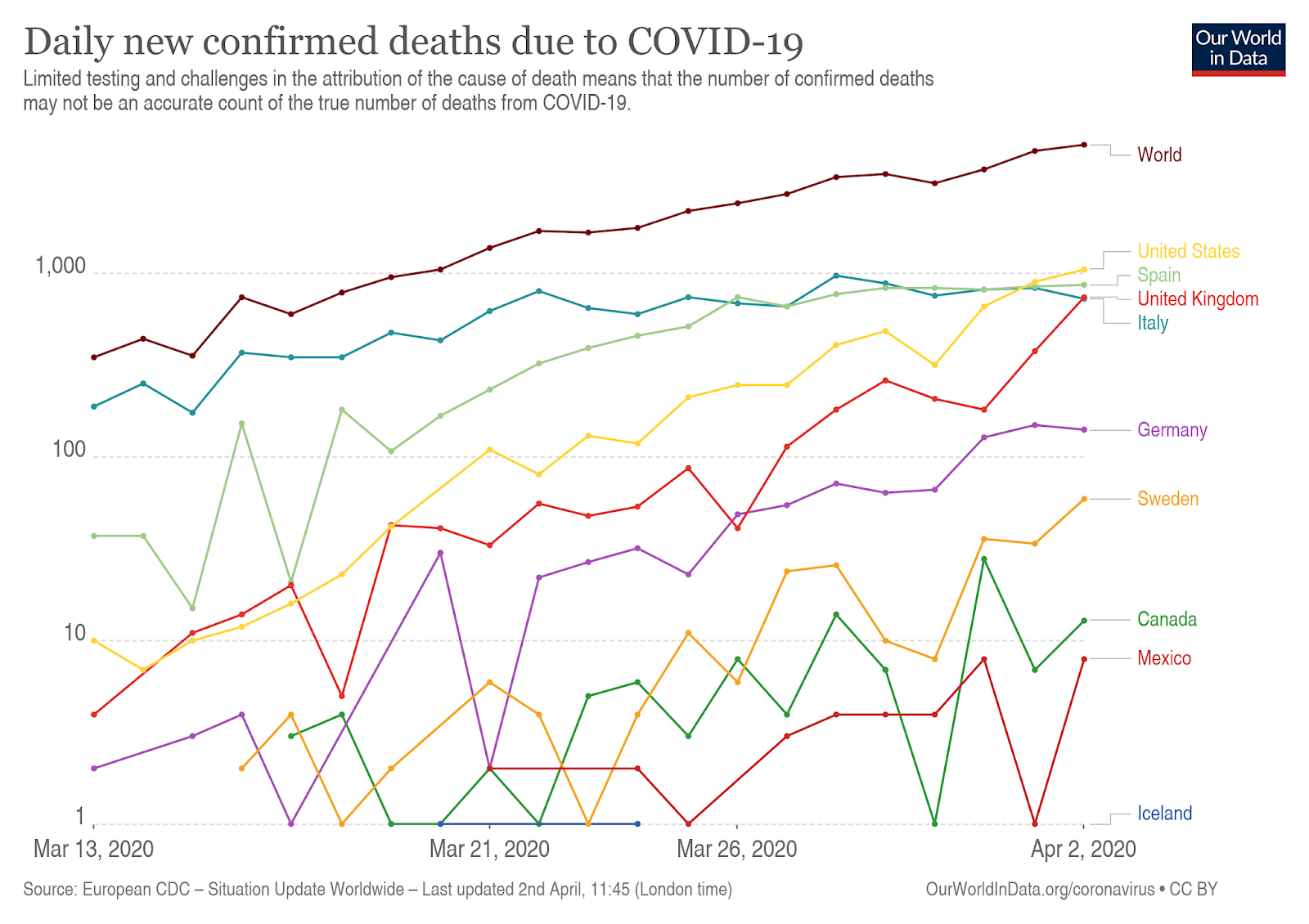
Looking at latest data lockdowns in Italy and spain seem to be the only places showing levelling of deathrate. Data is sparse for some countries and therefore noisy but make your own judgement from this plot
What self quarantine is like
1. Someone at her husbands work came down with covid.
2. he was classified as a close contact because he spent 1 minute in the guys presence.
3. She is classified as close contact.
4. they are confined to home for 2 weeks, subject to a fine.
5. the health worker calls them 3 times a day.
6. they get a care package and instructions.
That is how a modern liberal democracy does a “lock down”
Thank you for this great article. I agree with you, killing the economy is not the right solution.
On your Graph 2 it will be good to plot South Korea.
I am puzzled by Japan as I read this article today: https://www.japantimes.co.jp/news/2020/04/02/national/abe-two-masks-social-media/#.XoXRc6gzaUl where it seems masks is also a problem.
An interesting case also is Iceland , the country that did most tests (5% of the population) so they identified very early the positive asymptomatic cases. However they also moved more and more on lockdown even with only 2 deaths so far, ie 6/ millions.
Here in Belgium recomendations are no masks and so called “experts” can’t agree. However one University professor and specialist on infectious diseases is part of a recomendations that people should wear mask and make them . He is part of an association presenting how to produce your own mask which will be FFP2, N95 in the US. I give you the link here : https://www.opensourceagainstcovid19.org/
I believe that citizen and textile industry should start producing these masks that can be reused and washed, I am going to buy some for 5€ each. It is as you said a very small cost that will protect us and allow most of us to be able to continue working. IF these masks were sold for € 5 to €10 then 1) soon it will give business for a lot of people, 2) it will allow people to get back to a social life and 3) soon it will allow back to work for everybody.
Austria is now making masks compulsory to shop ! Nothing better to go back to normal life without to much restrain to our private life and right ! https://www.ft.com/content/f68f3063-5024-4654-9389-bcc7ee1efd8e
Lockdowns working
John says: “Things which have proved to be right in the past”
Like their work on Creutzfeldt-Jakob
then he waffles on for about 20min without actually saying anything about the models used or anything which provides deeper understanding. He just promotes the claim that UCL think shut downs are working.
I could have read the same amount of information in about 90s !!
Didn’t Japan close all schools and aren’t the schools still closed, and wasn’t school closure one of the major factors shown to be effective in the 1918 Pandemic?
Recent work published in the Journal of the American Medical Association suggests social distancing guidelines are based on outdated research, as summarized in this post: https://healthy-skeptic.com/2020/04/01/social-distancing-and-the-virus/ My concern is that all the mitigation measures have some level of futility, given that, like most viruses, this one will or has become community dwelling. Mitigation that only spreads infection rates isn’t preventing deaths, just delaying them. Meanwhile, the economic damage is certain, and has serious health consequences as well. We are making very, very unbalanced and bad choices
” Mitigation that only spreads infection rates isn’t preventing deaths, just delaying them.”
That is all the shut down can achieve, a little breathing space for a totally inadequate health system.
well, not sure the evidence supports that notion. New York clearly doesn’t have mitigation down very well, and while a lot of it is jerry-rigged and not a good way to deliver health care, so far no one is attributing any deaths to the inadequacy of health resources. I have worked in health care for 45 years and New York City has about the worst public hospital system in the country, mismanaged for years and it is hanging in there. While it could still be overwhelmed, the US health system has the most ICU beds per capita in the world, so we are as well prepared as anyone. The biggest risk I think, is health care worker fatigue and infection.
And I think people do not generally understand that all the damage being done by the lockdown is to delay deaths not prevent them. The only way it saves deaths is if there is an inability to provide care that would have saved a life, or if the infection spread is deterred long enough to get to a vaccine, which is a year out at best, according to Dr. Fauci. Think we can lock down for even two months much less a year?
Two european countries with similar population and similar early infection history, Sweeden and Denmark. Sweeden with little lockdown and a doubling of deaths of about 3,5 days. Denmark which has closed down many working places and institutions, and doubling of deaths of 6 days.
And Sweeden admit some failure:
“It is the Stockholm region that is most severely affected by the corona pandemic in Sweden. It was also revealed that over 90 Swedish municipalities have had or suspect that they have had coronas infection at their nursing homes. This corresponds to every third home in Sweden, writes Swedish Radio. Based on those figures, the state epidemiologist admits to having failed partially with Sweden’s corona strategy, according to Aftonbladet. When asked by the Swedish Radio during the press conference on Tegnell, the authorities believe that they have sufficiently managed to spare the elderly population from the corona center, Tegnell replies: – No, we obviously haven’t done that. It’s very unfortunate, because that’s exactly what we’ve been trying to prevent, says Tegnell, according to Aftonbladet.”