Guest Post by Bob Vislocky, Ph.D.

CBS news recently reported a 50% decline in the number of chinstrap penguins residing on Elephant Island and a 75% decline of those living on Penguin Island all because of ….. drum roll please ….. global warming!
As the article above states, the nearly 3* C of global warming over the last 50 years caused a reduction of sea ice, which in turn results in a reduction of krill that eat the algae and other organisms that live underneath in the sea ice. As the krill population declines so does that of the chinstrap penguin since krill is their favorite food.
Ironically, the journal article below from a 1991 study claimed that the chinstrap penguin population increased during the 1900s *because* of global warming. So apparently global warming can both increase and decrease the penguin population. Wish the climate community would get their story straight!
https://marine.rutgers.edu/dmcs/ms606/2011%20fall/Fraser%20et%20all%201992.pdf
Adding even more confusion, the following informational page from the Australian Department of Environment states that the chinstrap penguins have lower breeding success when there is more sea ice as it restricts access to the sea for foraging adults.
But the original CBS article says that more sea ice means more krill and a higher population of chinstrap penguins.
http://www.antarctica.gov.au/about-antarctica/wildlife/animals/penguins/chinstrap-penguins
So let’s sum this all up:
- Global warming = decline in the # of chinstrap penguins
- Global warming = increase in the # of chinstrap penguins
- More sea ice = lower breeding success of chinstrap penguins
- More sea ice = increase in the population of chinstrap penguins
So basically no matter what happens to the penguin population, climate change has all the bases covered. Expect anything different?
Back to the recent CBS article, the argument of “global warming = less sea ice = fewer krill = penguin decline” is not relevant for the Antarctic where sea ice has actually held its own or even increased over time (figure 1) based on a recent PNAS study. So if there is a local change in sea ice near Elephant and Penguin Islands, then it’s more likely due to a regional fluctuation rather than a CO2-induced global change.

Figure 1. https://www.pnas.org/content/116/29/14414
So what does better explain the decline in chinstrap penguins that the CBS article conveniently fails to mention? Overfishing!!
https://psmag.com/environment/overfishing-krill-in-antarctica
Penguins have obviously failed to achieve true diversity. It’s all there in black and white.
There is actually a fair amount of yellow and orange in several species. And Adelie penguins have blue eyes which is of course a bit suspect from a diversity viewpoint.
What nearly 3* C of global warming over the last 50 years ?
They just make stuff up
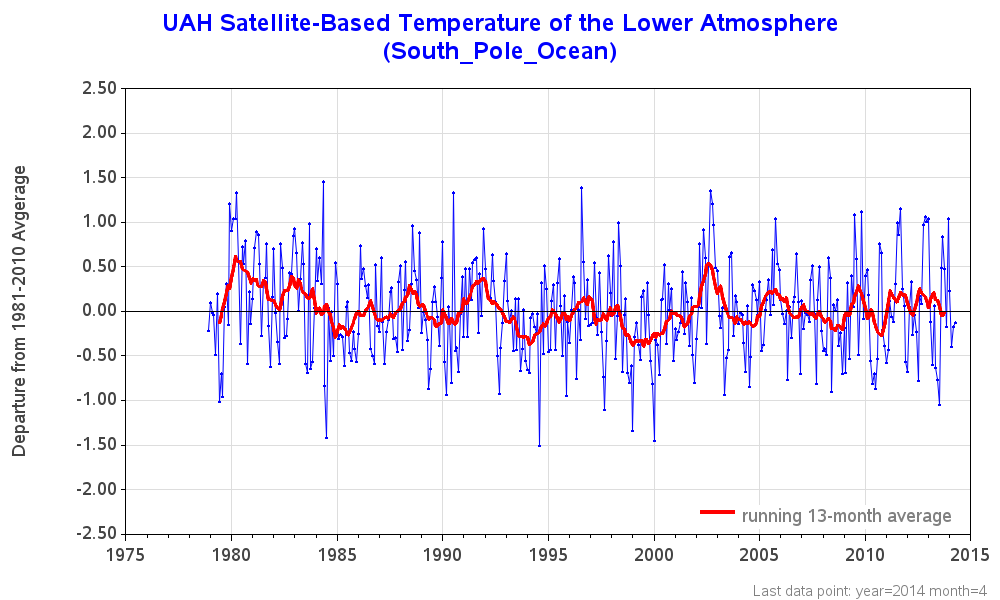
Probably depends on the location, but as a whole it look like no significant change on the Antarctic continent:
Different penguins, same story. Wash, rinse, repeat.
1. Looked up Penguin Island. Only found one and its off Australia and is a tourist hot spot. No mention of Chinstraps though but some other penguin species are common. Doubt sea ice is a factor there.
2. Elephant Island is one of dozens of islands scattered around Antarctica but it is not mentioned as a primary location for Chinstraps. The penguins are listed as common throughout the southern ocean and are listed as “least concern” regarding population.
I did notice that both islands are tourism cruise destinations. Perhaps researching penguin populations is a good way to get an exotic vacation cruise paid for by your grant (not to be cynical or anything).
Chinstraps are an arctic species not found in Australia. There is any number of Penguin Islands in the Southern Ocean.
Warmistas have also recently reported a 50% decline in the number of elephants residing on Penguin Island and a 75% decline of those living on Elephant Island because of a loss of sea ice preventing elephants from walking there, all caused by global warming!
Maybe I misunderstood something here not being scientifically minded, but I think the fact the Gentoo are increasing at the same time as the Chinstrap decline (if they haven’t just moved on to better areas) would demonstrate greater “adaptability”.
Probably a good lesson for all penguins if only they read these publications
From:
https://oceanwide-expeditions.com/to-do/wildlife/chinstrap-penguin
Chinstrap Penguin
Though armed with the “stonebreaker” nickname and a quarrelsome reputation, these gentoo relatives are fading from the Antarctic – probably due to climate change
Yet, farther down the same page:
Conservation status: Least Concern.
“So let’s sum this all up:
Global warming = decline in the # of chinstrap penguins
Global warming = increase in the # of chinstrap penguins
More sea ice = lower breeding success of chinstrap penguins
More sea ice = increase in the population of chinstrap penguins
So basically no matter what happens to the penguin population, climate change has all the bases covered. Expect anything different?”
Yes sir. The science of this apparent contradiction is explained here:
https://tambonthongchai.com/2020/01/13/human-pollution-the-planet-is-doomed/
For years now I have postulated that increased CO2 causes larger human teeth, just look your grandchildren.
Penguins do not have teeth, so are disadvantaged by climate change=more CO2 and by classic Darwinian selection. Geoff S
I take it the polar bear ‘crisis’ is so last decade?
It’s the humpback whales eating all the krill so the poor penguins starve. Each one eats about 2000kg of krill and small fish per day. Over 30,000 whales migrate from Antarctica up the east coast of Australia every year, increasing by 10% each year. And thats not counting probably similar population migrating along South Africa and south America When whaling was banned in the 1970s there were suposedly only about 5000 humpbacks remaining world wide.
Great story, Bob Vislocky, Ph.D. !
Amazing,
a Ph.D., President & Owner With 18 years experience in the fields of meteorology, computers, and statistics, / without a Journalism Degree
does
what the whole pack of journalists, the bunch of journalists can’t deliver:
The right facts, and only the right facts, objective and balanced.
As always a n.b.
Great story, Bob Vislocky, Ph.D. !
Amazing,
a Ph.D., President & Owner With 18 years experience in the fields of meteorology, computers, and statistics, / without a Journalism Degree
does
what the whole pack of journalists, the bunch of journalists at CBS news can’t deliver:
The right facts, and only the right facts, objective and balanced.
____________________________________
OTOH – sure that’s applicable to almost every pack of journalists, bunch of journalists and journalist crowds.
____________________________________