People sometimes ask me why I don’t believe the endless climate/energy use predictions of impending doom and gloom for the year 2050 or 2100. The reason is, neither the climate models nor the energy use models are worth a bucket of warm spit for such predictions. Folks concentrate a lot on the obvious problems with the climate models. But the energy models are just as bad, and the climate models totally depend on the energy models for estimating future emissions. However, consider the following US Energy Information Agency (EIA) predictions of energy use from 2010, quoted from here (emphasis mine):
In 2010, the U.S. Energy Information Administration projected that in 2019, the U.S. would be producing about 6 million barrels of oil a day. The reality? We’re now producing 12 million barrels of oil a day.
Meanwhile, EIA projected oil prices would be more than $100 a barrel. They’re currently hovering around $60 a barrel.
EIA had projected in 2010 that the U.S. would be importing a net eight million barrels of petroleum by now, which includes crude oil and petroleum products like gasoline. In September, the U.S. actually exported a net 89 thousand barrels of petroleum.
In 2010, EIA projected that the U.S. would be producing about 20 trillion cubic feet of natural gas by now. In 2018, the last full year of annual data, we produced more than 30 trillion.
The EIA had projected that coal electricity would remain dominant in the U.S. and natural gas would remain relatively stable — even drop slightly in its share of power supply. The opposite is happening. Coal-fired power is plummeting and natural gas has risen significantly.
Now remember, we are assured that these energy projections are being made by Really Smart People™, the same kind of folks making the climate predictions … and they can’t predict a mere ten years ahead? Forget about predicting a century from now, they are wildly wrong in just one decade. The EIA projections above missed the mark by 100% or more and sometimes didn’t even get the sign of the result correct … but as St. Greta the Shrill misses no opportunity to remind us, we’re supposed to totally restructure our entire global economy based on those same shonky predictions.

But I digress … Dr. Roger Pielke Jr. recently posed an interesting question—how can we fix what he called “apocalyptic” projections of future climate?
My response was:
My fix would be for all climate scientists to stop vainly trying to predict the future and focus on the past.
Until we understand past phenomena such as the Little Ice Age, the Medieval Warm Period, etc. to the point where we can tell why they started and stopped when they did and not earlier or later, pretending to understand the future is a joke.
For example, the Milankovich astronomical cycles that have correlated well with episodes of glaciation in the past say we should be in a full-blown “Ice Age” today. These cycles change the amount of sunlight in the northern hemisphere. And when the world went into the Little Ice Age (LIA) around the year 1600, there was every indication that we were headed in that direction, towards endless cold. The same fears were raised in the 1970s when the earth had been cooling for thirty years or so.

Gosh … another failed climate prediction. Shocking, I know …
Regarding why the Milankovich cycles indicated an ice age, here are Greenland temperature and solar changes in the Northern Hemisphere for the past 12,000 years or so.

But instead of the Little Ice Age preceding us plunging into sub-zero temperatures and mile-thick ice covering Chicago, the earth started to warm again towards the end of the 1700s … why?
Well, the ugly truth is, we are far from understanding the climate well enough to answer why it was warmer in Medieval times; why we went from that warmth into the LIA in the first place; why the LIA lasted as long as it did; why it didn’t continue into global glaciation; or why we’ve seen gradual slight warming, on the order of half a degree per century, from then to the present day.
And until scientists can answer those and many similar questions about the past, why on earth should we believe their climate/energy predictions for a century or even a decade from now?
The only thing that seems clear about all of those questions is that the answer is not “CO2”. Here’s another look at Greenland, this time with CO2 overlaid on the temperature:

My Dad used to say “Son, if something seems too good to be true … it probably is”. I never realized until today that there was a climate corollary to that, which is “Son, if something seems too bad to be true … it probably isn’t”.
So my advice is to take all such predictions of impending Thermageddon, drowned cities, endless droughts, and other horribly bad outcomes by 2100, 2050, or even 2030, with a grain of salt. Here’s what I’d consider to be the appropriate size of salt grain for the purpose …

My best to everyone,
w.
The ever growing list of the past now 30 years of wrong climate predictions has two ineluctable consequences.
It continues to strengthen the easy skeptical case against CAGW model consequences.
It continues to force warmunists into ever longer term predictions, less capable of being embarassingly falsified when ‘by now’ arrives—since it won’t in their lifetimes. But to be sufficiently scary so far out, predictions are also ever more exaggerated and reliant on ‘tipping points’ when nothing yet has tipped.
As I have shown in my papers the solar irradiance AND solar wind determine the temperatures in earth. People usually forget to look at solar wind when they look at the sun. They only take into account the solar activity and solar irradiance. As I have shown the solar wind is decisive. It manipulates the geomagnetic field and cloud covering. Temperatures oscillate according to the sun. By adding the AMO index oscillation (that counts for internal system variability) to the two solar constituents, we get an extremely accurate temperature projection. As soon as AMO turns negative we shall experience a strong cooling. That is one degree cooling by 2100 finally.
”As soon as AMO turns negative we shall experience a strong cooling. That is one degree cooling by 2100 finally.”
And probably more ”extreme” weather with it.
Simple common sense suggests that a Millennial Solar activity peak was reached in 1991 +/- and a corresponding global temperature peak and turning point from warming to cooling was reached at 2004+/-.It’s not “rocket science” or a “wicked problem” in the long term. Multidecadal to Millennial forecasts with usable probabilities for success can be made and should be part of the discussion by policy makers. Shorter term weather forecasting is much more difficult.
Here is the Abstract from my 2017 paper linked below
“This paper argues that the methods used by the establishment climate science community are not fit for purpose and that a new forecasting paradigm should be adopted. Earth’s climate is the result of resonances and beats between various quasi-cyclic processes of varying wavelengths. It is not possible to forecast the future unless we have a good understanding of where the earth is in time in relation to the current phases of those different interacting natural quasi periodicities. Evidence is presented specifying the timing and amplitude of the natural 60+/- year and, more importantly, 1,000 year periodicities (observed emergent behaviors) that are so obvious in the temperature record. Data related to the solar climate driver is discussed and the solar cycle 22 low in the neutron count (high solar activity) in 1991 is identified as a solar activity millennial peak and correlated with the millennial peak -inversion point – in the RSS temperature trend in about 2003. The cyclic trends are projected forward and predict a probable general temperature decline in the coming decades and centuries. Estimates of the timing and amplitude of the coming cooling are made. If the real climate outcomes follow a trend which approaches the near term forecasts of this working hypothesis, the divergence between the IPCC forecasts and those projected by this paper will be so large by 2021 as to make the current, supposedly actionable, level of confidence in the IPCC forecasts untenable.”
These general trends were disturbed by the Super El Nino of 2016/17. The effect of this short term event have been dissipating so that “If the real climate outcomes follow a trend which approaches the near term forecasts of this working hypothesis, the divergence between the IPCC forecasts and those projected by this paper will be so large by 2021 as to make the current, supposedly actionable, level of confidence in the IPCC forecasts untenable.”
See my 2017 paper “The coming cooling: Usefully accurate climate forecasting for policy makers.”
http://journals.sagepub.com/doi/full/10.1177/0958305X16686488
and an earlier accessible blog version at
http://climatesense-norpag.blogspot.com/2017/02/the-coming-cooling-usefully-accurate_17.html
And /or My Blog-posts http://climatesense-norpag.blogspot.com/2018/10/the-millennial-turning-point-solar.html ( See Fig1)
Fig 1
and https://climatesense-norpag.blogspot.com/2019/01/the-co2-derangement-syndrome-millennial.html
also see the discussion with Professor William Happer at http://climatesense-norpag.blogspot.com/2018/02/exchange-with-professor-happer-princeton.html
“These general trends were disturbed by the Super El Nino of 2016/17. The effect of this short term event have been dissipating so that “If the real climate outcomes follow a trend which approaches the near term forecasts of this working hypothesis, the divergence between the IPCC forecasts and those projected by this paper will be so large by 2021 as to make the current, supposedly actionable, level of confidence in the IPCC forecasts untenable.”
For the current position check the RSS data at http://images.remss.com/data/msu/graphics/TLT_v40/time_series/RSS_TS_channel_TLT_Global_Land_And_Sea_v04_0.txt
I pick the Millennial turning point peak here at 2005 – 4 at 0.58
I suggest that if the 2021 temperature is lower than that (16 years without warming ) the crisis forecasts would obviously be seriously questionable and provide no secure basis for restructuring the world economy at a cost of trillions of dollars.
The El Nino RSS peak was at 2016 – 2 at 1.2
Latest month was 2019-11 at 0.71
However the whole UNFCCC circus was designed to produce action even without empirical
justification. See
https://climatesense-norpag.blogspot.com/2019/01/the-co2-derangement-syndrome-millennial.html
” United Nations Framework Convention on Climate Change, later signed by 196 governments.
The objective of the Convention is to keep CO2 concentrations in the atmosphere at a level that they guessed would prevent dangerous man made interference with the climate system.
This treaty is a comprehensive, politically driven, political action plan called Agenda 21 designed to produce a centrally managed global society which would control every aspect of the life of every one on earth.
It says :
“The Parties should take precautionary measures to anticipate, prevent or minimize the
causes of climate change and mitigate its adverse effects. Where there are threats of serious or
irreversible damage, lack of full scientific certainty should not be used as a reason for postponing
such measures”
Apocalyptic forecasts have been used to create the current state of climate crisis and hysteria and the demands for enormous CO2 reducing investments such as those in the new IPCC SR1.5 report .
The establishment’s dangerous global warming meme, the associated IPCC series of reports, the entire UNFCCC circus, the recent hysterical IPCC SR1.5 proposals and Nordhaus’ recent Nobel prize are founded on two basic errors in scientific judgement. First – the sample size is too small. Most IPCC model studies retrofit from the present back for only 100 – 150 years when the currently most important climate controlling, largest amplitude, solar activity cycle is millennial. This means that all climate model temperature outcomes are too hot and likely fall outside of the real future world. (See Kahneman -. Thinking Fast and Slow p 118) Second – the models make the fundamental scientific error of forecasting straight ahead beyond the Millennial Turning Point (MTP) and peak in solar activity which was reached in 1991.These errors are compounded by confirmation bias , academic consensus group think and the built in human need to feel virtuous by saving the world.
When talking about anything climate-science related these days, I think “regression to the mean” is better explained by starting with the alternative phrase of “reversion to mediocrity”. Even Wikipedia does sometimes produce a gem.
Quoting a quote in support of a quibble: “EIA had projected in 2010 that the U.S. would be importing a net eight million barrels of petroleum … the U.S. actually exported a net 89 thousand barrels of petroleum.”
I’m enough of a snowflake to be triggered to melt-down by mixed scale numbers like that. The EIA or journalists doing the comparison should no more compare millions to thousands than apples to oranges. Nor should single digit precision compare to double. Bad wording turns numbers to mush.
Saying about 8000 thousands to about 90 thousands, makes the comparison more comprehensible.
It wouldn’t be unfairly misleading to compare 8000 thousand to 80 thousand, or being off by a factor of one hundred.
Climate Science is primitive and still in a bloodletting phase.
Of course since belief in Politics – which is the new religion – staunchly needs it, it will continue.
I agree, with Willis-san.
There is strong evidence that: a) 1,000-year Warming Periods occur (Minoan, Roman, Medieval, Modern), b) the LIA (1280~1820) was likely caused by Granda Solar Minima Events, (Wolf, Sporer, Maunder, Dalton—although Willis doesn’t concur on this), c) The 1933~1996 Grand Solar Maximum event (the strongest sunspot activity in 11,400 years) contributed to 20th Century warming, d) ENSO (especially Super El Niño’s) add a lot noise to short term Global temp noise, e) global temps closely follow 30-year PDO/AMO warm/cool ocean cycles, e) CAGW’s ECS prediction of 3C~5C is impossible to explain by physics/empirical evidence, and is most likely around 0.6C, f) Milankovitch cycles closely follow glacial/interglacial warm/cool cycles, and g) the 1.33 billion KM^3 of ocean water is one gigantic heat sink that thankfully only gives up its stored heat reluctantly due to the laws of entropy.
CAGW is already a disconfirmed hypothesis given the already huge disparity between global warming projections vs reality, and it’s untenable to still believe CO2 is the climate control knob.
The coming 30-year PDO/AMO cool cycles, combined with low sunspot activity will soon make the CAGW hypothesis even more of a joke than it already is…
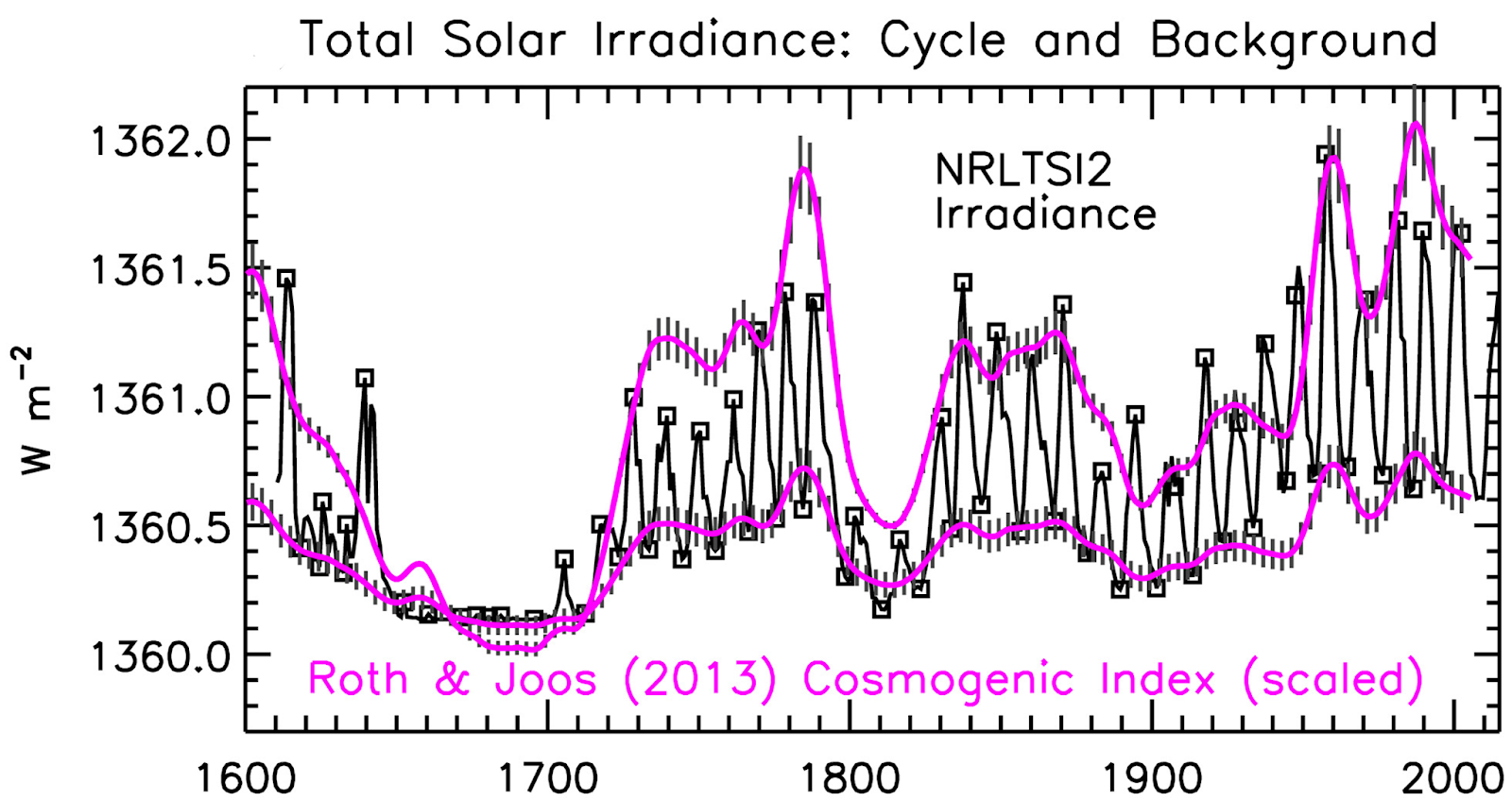
Measurements of oxygen isotopes in Greenland and Antarctica ice cores allow reconstruction of ancient temperatures back 800,000 years and measurements of radiocarbon and Beryllium-10 indicate the intensity of cosmic rays entering the Earth’s atmosphere.
Sunspots are a reflection of the strength of the sun’s magnetic field, which acts as shield for cosmic rays approaching the Earth. When the strength of the sun’s magnetic field is reduced, more cosmic rays enter the atmosphere. In every case, when sunspot numbers are low, the Earth’s climate is cool, and whenever sunspot numbers are high, the Earth’s climate is warm.
The intensity of incoming cosmic rays determines the rate of production of beryllium-10 and radiocarbon. Radio‒carbon is taken in by plants and other life forms and preserved for thousands of years where it gradually decays. Age measurements based on the amount of remaining 14C can be compared with independent calendar years, allowing determination of 14C production rates. Measurement of production rates 14C can be used to determine the intensity of cosmic rays reaching the Earth in the past.
Beryllium-10 is produced in the upper atmosphere by collision of cosmic
particles with oxygen. The higher the incidence of cosmic rays, the more 10Be is produced. Beryllium-10 falls out of the atmosphere with snow and is incorp‒orated in glacial ice. Thus, measurement of the amount of 10Be in ice cores can be used to determine the intensity of cosmic rays in the past. High amounts of 10Be in ice cores means high levels of cosmic rays in the atmosphere then.
Sunspot numbers, indicating solar magnetic strength, and 10Be and/or radiocarbon production rates, indicating cosmic ray intensity, were examined for every period of cooling or warming for which data are available. In every case examined in this study, whenever sunspot numbers were low and/or 10Be and/or radiocarbon levels were high, the Earth’s climate was cold. In every case when sunspot numbers were high and/or 10Be and/or radiocarbon levels were low, the Earth’s climate was warm . Thus, what these data show is that fluctuations of the strength of the sun’s magnetic field is the principal control of the Earth’s climate, including the origin of the Ice Ages.
Don Esterbrook, what you did not mention is that the cosmic rays interacting with the atmosphere cause cascades of muons (high energy heavy electrons) that interact with the lower atmosphere to produce the micro particles that are necessary for cloud production. These lower level clouds reflect sunlight thus cooling the earth. Also, in general the cosmic flux that the solar system sees depends on where the sun is in the galaxy. Nearby supernova also affect the degree of cloudiness. None of these effects are quick. Greta does not have to worry.
One of the problems with condensation (clouds) on ionic particles is that they need to be big enough for condensation to occur. A lot of ions created need to be enlarged to sizes large enough to promote clouds. Svensmark showed that this indeed does happen.
The astonishing (at least to me) about this process is that EVERY CLIMATE CHANGE I could find in the last 800,000 years coincided with increased 10Be production, even extremely abrupt climate changes in the Ice Age. There were no exceptions. The data are in my new book on Amazon.com
Don, there’s another reason for the correlation of 10Be and the weather, but you might not like it …
w.
https://agupubs.onlinelibrary.wiley.com/doi/pdf/10.1029/2005JD006764
Willis,
Like you, there isn’t any data I ‘don’t like.’ I go wherever data takes me, regardless of where it leads.
The URL above doesn’t work. Don’t keep me in suspense–what’s the other reason?
Have you looked at the data in my book? In EVERY climate change I could find over the past 800,000 years 10Be was exactly coincident, without exception, even the abrupt climate changes of the D/O events. That tells me there is a cause-and-effect relationship.
Don
Thanks, Don, and glad to hear your statement on following the data.
How bizarre, though. The link works fine for me, just tested it.
The study is entitled:
Evidence for climate modulation of the 10Be solar activity proxy
JOURNAL OF GEOPHYSICAL RESEARCH, VOL. 111, D21105, doi:10.1029/2005JD006764, 2006
w.
2019 Marketed Gas Production in the U.S. will be something like 35.8 TCF.
Saw an article on CNN the other day, fretting about how no one is alarmed about the climate emergencyexcept young people, and why haven’t people been convinced by all the catastrophe going on all around us?
The answer is because there is no climate catastrophe happening, and they’ve been saying there is one about to happen any minute now for decades. Only youth believe it because only youth can be convinced that in ten years something bad will happen – once you are over 30 and see ten years go by and nothing happens, you get angry about being lied to and start ignoring them.
This is it, exactly. I don’t understand how anyone who lived through the Al Gore era can look back and honestly say, “Well, they were wrong about ALL that stuff, but they’re right this time!” And even young people should be able to look back on those past predictions (since they’re all on the internet), and realize there’s not just poor/weak modeling going on, but an outright agenda of misinformation.
It’s not just climate and energy. Food production was another huge fail, by Paul Ehrlich. He’s still at the doom and gloom wheel attempting to drive the bus off a cliff. Related, Ehrlich predicted population would outgrow that food production causing mass starvation. Ehrlich, like many other people, didn’t and couldn’t account for emerging technologies to increase production and reduce manpower. Fossil fuels are the same thing. New technologies have emerged allowing us to extract products we couldn’t before or were too expensive to make practical. We also have empirical evidence showing that as societies industrialize, people tend to have less children. It’s estimated that our population will peak, and then eventually even drop somewhat as more countries industrialize. The bottom line there is that if you want to control population, we need to proliferate fossil fuels around the globe to help continue industrializing every country. The attendant benefits emerging from industrialization are too numerous to count.
wow people are finally waking up to the fact that weather forecasting has become political propaganda. shows what kind of evil people run the tv networks. they think it is better to lie to advance the political agenda then to tell the truth.
How can more CO2 warm the earth’s surface? I don’t think it can. Let’s follow IR photons as they rattle around from CO2 molecule to CO2 molecule until they hit the surface or reach space.
By my calculations, 99.925% of IR photons that can interact with CO2 (let’s call them ‘P’) are returned to the earth’s surface before they can reach space. The mean free path of P is about 33 meters at sea level (based on Google searching). The distance to space is about 100km, which is too far for a random wandering IR photon to reach. P is almost certain to be returned to the surface before it reaches space. Only 0.075% of P will reach space. Adding more CO2 to the atmosphere will not change the amount of P that is returned from the atmosphere back to the earth’s surface. Therefore, adding more CO2 will not “trap” or “add” any more energy to the surface.
I have built a C++ model to simulate how an IR photon randomly rattles around to track where it goes. I have 35+ years of experience in physics-based software modeling, so I don’t think I’m a complete hack. This model uses a spherical earth, an earth-centered earth-fixed coordinate (ECEF) system, a random number generator to pick a random direction (ground bearing & elevation angle), and a Chi-squared probability function to randomly compute the distance traveled. The mean free path traveled is a function of atmospheric density, which is a function of altitude. The higher up in the atmosphere the farther the photon can travel. After simulating millions of photons, this model shows that only a tiny fraction of the photons from the surface can make it to space. Instead, 99+% hit the surface and are re-absorbed.
A different and simple mathematical model matches fairly close to my more complex C++ model. Assume that an IR photon travels upwards 33 meters from the surface and hits a CO2 molecule. From that point there is a 50/50 chance it goes up 33 meters or down 33 meters. If it goes down then it hits the surface and is absorbed. Therefore, only half the energy from the surface goes up to 66 meters. From there, half will go up 66 meters and half will go down 66 meters and hit the surface. Only 25% of the energy from the surface makes it up to 132 meters above the surface. Then half will go up 132 meters and half will go down, and so on until space is reached at 100km. This halving rate prevents almost all the IR energy in CO2’s band from reaching space.
Once the IR energy is absorbed by the ground, it will be re-emitted at some wave length per the earth’s blackbody radiation spectrum. About 30% of this energy is in the transparent atmospheric window (TAW). Since the speed of light is very fast and the distance traveled in the atmosphere is short, energy outside the TAW is quickly returned and absorbed. It does not take many cycles for that energy to be guaranteed to end up in the TAW and freely exit to space.
I think much of the IR flux measured at the earth’s surface is the same energy cycling between the surface and the atmosphere. That little quantum of heat energy becomes an IR photon, rattles around, hits the ground and is absorbed. It becomes heat again, and the cycle repeats. The same quantum of energy has been converted to an IR photon and heat many times, until ultimately the photon is in the TAW and escapes to space. I think trying to estimate the impact of CO2 in terms of flux is not correct. We should be following a single photon around and see how long it takes to reach space as the amount of CO2 changes.
Where am I mistaken, if I am?
RHAPV (Reality has a persistent voice).
Where am I mistaken, if I am?
In assuming that the only mode of IR energy exchange is radiative and ignoring the collisional deactivation of the excited CO2 molecules.
Willis,
I got the paper you referenced and read it, but I’m not at all unhappy with it. Everyone has recognized that differing rates of snow accumulation can affect the significance of measured 10Be production rates. The question is, do short-term irregularities mean that long-term 10Be measurements are not reliable? The authors of this paper recognize this and say “Further research is required to quantify this climate influence on 10Be over longer term records and at different sites.” I completely agree.
So how do we test the relevance of long-term 10Be changes? The most direct way is to compare 10Be levels with radiocarbon levels of the same age. Production rates of radiocarbon, like 10Be, are governed by incoming cosmic radiation, so if the two are the same, then there is no problem with long-term 10Be levels. There is one such comparison in my book showing that the levels of 10Be and 14C are almost exactly coincident over a 2,000 year period, which is enough for me to trust 10Be levels as a measure of incoming cosmic radiation. Other time intervals can also be compared, but I think the result will be the same.
Is this enough to convince you that the 10Be levels I cite in my book are useable?
With best regards,
Don
Don, I’ve never been overly happy with either the 10Be or the 14C measurements. My problem with them is that they do NOT have any 11-year cycles in them. Why would they record long-term cycles and not short-term cycles, particularly since the short-term cycles are much longer than the long-term cycles? Yes, there may be lags. But lags don’t destroy an 11-year cycle, they just smooth it and mush it forwards in time.
Hang on, let me see, seems we discussed this in the past … OK, I find a few things. First, here’s Leif Svalgaard responding to … well … you:
lsvalgaard April 12, 2014 at 7:58 am
and this:
lsvalgaard April 12, 2014 at 8:11 am
It “misbehaves” … not encouraging … and this (emphasis mine):
lsvalgaard August 20, 2015 at 7:59 am
Finally, I discuss the problems with the 10Be measurements in a post called “Cosmic Rays, Sunspots, and Beryllium“.
My best to you, my friend,
w.
I’m baffled by the plane on cover of Science News. Hadn’t the editors and illustrators seen what airliners looked like in 1975?
OK, so they got those wrong. But mark my words. We’re doomed. Definitely doomed.
Willis,
I recall reading your post “Cosmic Rays, Sunspots, and Beryllium” in which you point out “If the 10Be deposition rate is claimed to be a proxy for the long-term small changes in overall levels of cosmic rays … why is there no sign in these datasets of it responding to the much larger 11-year change in cosmic rays?” I was just as puzzled as you were so decided to take a hard look at the long-term data. If 10Be is not a good proxy for incoming cosmic rays then long-term data should be all over the place with no consistent correlations with other cosmic ray proxies or climate.
As you pointed out in your post, the numbers of cosmic rays (and presumably 10Be flux rates), vary inversely with 11-year sunspot cycles so why do we not see this in long-term records? How can we check the validity of long-term 10Be levels? Radiocarbon is produced in the upper atmosphere by incoming cosmic radiation and, like 10Be, production rates are a function of the amount of cosmic radiation. Comparison of 10Be and 14C levels over the past 2,000 years show almost exact coincidence, verifying the validity of 10Be as a measure of incoming cosmic radiation.
Another line of evidence is the remarkable correspondence of 10Be and climate changes. I looked at every climate change (for which I could find data) over the past 800,000 and without exception, every climate change corresponded exactly with spikes in 10Be levels. The most astonishing were the exact coincidence of 10Be spikes with every extremely abrupt D/O climate change. This could not be true if 10Be levels were not valid. I’ll send you some of the data by email so you can see for yourself.
Why the short-term 11-year cycle is apparently damped out in long-term measurements remains a mystery but does not invalid the long-term record.
With all best regards,
Don
First, the correspondence of 10Be and 14C may be because they both respond to the sun. Or, it may be because they both respond to the weather … and since we know for a fact that 10Be DOES respond to the weather, well …
And for me, not finding the 11-year cycle in 10Be DOES invalidate the long-term record, until such time as we can explain it.
I think we’ll have to let this one go, not going to convince each other.
Pleasure chatting with you, as always,
w.
Willis,
Yes, fun to discuss these issues. I always learn things from our discussions. I think we approach science the same way.
Best to you for a happy New Year.
Don
One of the most annoying doomcastings is that of the endless cries that the Maldives are disappearing as the sea level rises and swamps them. It was predicted that the Maldives are supposed to be nearly swamped by this year. SURPRISE! THE MALDIVES ARE STILL THERE! Lord give me strength but hurry (Forgive me Father for this language, but these loonies that are trying to mess up Your Father’s world are really starting to tick me off and then some.) I would love to speak to the people of the Maldives and ask them if all the hysteria of their atolls disappearing is making them look bad. The people of the Maldives need to speak out and call for the senseless hysteria of their atolls disappearing to stop!
“For example, the Milankovich astronomical cycles that have correlated well with episodes of glaciation in the past say we should be in a full-blown “Ice Age” today. These cycles change the amount of sunlight in the northern hemisphere.”
We can hold the Milankovich astronomical cycles responsible for: the 4 seasons, nothing less.