News Release 4-Dec-2019
Migratory birds shrinking as climate warms, new analysis of four-decade record shows
University of Michigan

ANN ARBOR–North American migratory birds have been getting smaller over the past four decades, and their wings have gotten a bit longer. Both changes appear to be responses to a warming climate.
Those are the main findings from a new University of Michigan-led analysis of a dataset of some 70,000 North American migratory birds from 52 species that died when they collided with buildings in Chicago.
Since 1978, Field Museum personnel and volunteers have retrieved dead birds that collided with Chicago buildings during spring and fall migrations. For each specimen, multiple body measurements are made.
The research team analyzed this remarkably detailed dataset to look for trends in body size and shape. The biologists found that, from 1978 through 2016, body size decreased in all 52 species, with statistically significant declines in 49 species.
Over the same period, wing length increased significantly in 40 species. The findings are scheduled for publication Dec. 4 in the journal Ecology Letters.
“We had good reason to expect that increasing temperatures would lead to reductions in body size, based on previous studies. The thing that was shocking was how consistent it was. I was incredibly surprised that all of these species are responding in such similar ways,” said study lead author Brian Weeks, an assistant professor at the U-M School for Environment and Sustainability.
The senior author is Benjamin Winger of the U-M Department of Ecology and Evolutionary Biology and the Museum of Zoology. Weeks worked on the project as a postdoctoral researcher in Winger’s lab. Co-authors include David E. Willard, the Field Museum ornithologist and collections manager emeritus who measured all 70,716 birds analyzed in the study.
The new study is the largest specimen-based analysis of body-size responses to recent warming, and it shows the most consistent large-scale responses for a diverse group of birds, Weeks said.
Several lines of evidence suggest a causal relationship between warming temperatures and the observed declines in avian body size, according to the researchers. The strongest evidence is that–embedded within the long-term trends of declining body size and increasing temperature–there are numerous short-term fluctuations in body size and temperature that appear to be synchronized.
“Periods of rapid warming are followed really closely by periods of decline in body size, and vice versa,” Weeks said. “Being able to show that kind of detail in a morphological study is unique to our paper, as far as I know, and it’s entirely due to the quality of the dataset that David Willard generated.”
“It’s really been a herculean effort on the part of Dave and others at the Field Museum, including co-author Mary Hennen, to get such valuable data from birds that might otherwise have been discarded after they died from building collisions,” Winger said.
Within animal species, individuals tend to be smaller in warmer parts of their range, a pattern known as Bergmann’s rule. And while the possibility of body size reduction in response to present-day global warming has been suggested for decades, evidence supporting the idea remains mixed.
The uncertainty is likely due, in part, to the scarcity of datasets like the Field Museum trove.
For each bird, Willard measured the length of a lower leg bone called the tarsus, bill length, wing length, and body mass. In birds, tarsus length is considered the most precise single measure of within-species variation in body size.
The data analysis revealed that:
- Three measures of body size–tarsus length, body mass and PC1, a common measure of overall body size that combines several key body-part measurements–showed statistically significant declines. Tarsus length declined 2.4% across species.
- Wing length showed a mean increase of 1.3%. Species with the fastest declines in tarsus length also showed the most rapid gains in wing length.
- Mean summer temperature was significantly negatively associated with bird body size–meaning that body size decreased significantly as temperatures warmed. Temperatures at the birds’ summer breeding grounds north of Chicago increased roughly 1 degree Celsius (1.8 degrees Fahrenheit) over the course of the study.
Studies of plant and animal response to climate change often focus on shifts in the geographical range of a species or the timing of events such as springtime flowering and migration. The consistency of the body-size declines reported in the new study suggests that such changes should be added to the list of challenges facing wildlife in a rapidly warming world, Weeks said.
“It’s clear that there’s a third component–changes in body size and shape–that’s probably going to interact with changes in range and changes in timing to determine how effectively a species can respond to climate change,” he said.
Long-distance bird migration is one of the most impressive feats in the animal kingdom. The extreme energetic demands of flying thousands of miles have shaped the morphology of migrating birds–their form and structure–for efficient flight.
The authors of the Ecology Letters paper suggest that the body-size reductions are a response to climate warming and that increased wing length may help offset the body-mass losses.
The researchers plan to test that idea in a follow-up project, which will again make use of the Field Museum dataset. They’ll also look further into the mechanism behind the body size and shape changes and whether they are the result of a process called developmental plasticity, the ability of an individual to modify its development in response to changing environmental conditions.
The birds analyzed in the study are small-bodied songbirds that breed north of Chicago in the summer and migrate through the region in high numbers. Several species of sparrow, warbler and thrush make up the majority of the dataset, with thousands of individuals of each species documented as lethal collisions.
The observed changes in avian body size and shape are subtle–at most a couple grams’ difference in body mass and a few millimeters in wing length–and are not detectable with the naked eye. The Field Museum bird collision dataset highlights the value of natural history museum specimen collections, which help scientists understand how nature changes through time, the authors note.
“When we began collecting the data analyzed in this study, we were addressing a few simple questions about year-to-year and season-to-season variations in birds,” said the Field Museum’s Willard. “The phrase ‘climate change’ as a modern phenomenon was barely on the horizon. The results from this study highlight how essential long-term data sets are for identifying and analyzing trends caused by changes in our environment.”
###
The authors of the Ecology Letters paper, in addition to Weeks, Winger, Willard and Hennen, are Marketa Zimova of the Institute for Global Change Biology at the U-M School for Environment and Sustainability, former U-M undergraduate Aspen A. Ellis, and Max L. Witynski of the Field Museum.
Funding for the study was provided by the Field Museum and the University of Michigan’s Department of Ecology and Evolutionary, Museum of Zoology, and Institute for Global Change Biology.
More information: April 2019 Michigan News release about nocturnal flight calls and building collisions.
Image link: https://drive.google.com/drive/folders/1u6DxrzXGE7bk48Vi_DefaX_W2eBkwxvs
Perhaps the hevier birds have been chopped down in numbers due to accelerating numbers of man made wind turbine parks? 😉
Heavier/bigger is storing energy to migrate….
Planet greening means more food is available…they can be smaller/lighter and still migrate…
The opposite would also hold….less food would select for the bigger birds..smaller birds would have less energy stored
Isn’t nature marvelous! How organisms are able to evolve with changing environmental conditions! A true marvel!! Why the glum faces?
“Life uh…. finds a way.”
— Dr. Ian Malcolm
Nature has certain laws that govern all creatures and plant life. One of them is that warm weather makes everything easier–more plants grow, more seeds set, longer growing season, more food for birds and animals. Birds and animals adapt to these kinds of minor, incremental changes seamlessly and automatically. Especially when they enhance the conditions of life. Human civilization follows exactly the same patterns historically.
I believe the alarmist hysteria is at a fever pitch right now because:
(1) We are at the beginning of a solar minimum, slated to bring a 30-year cooling cycle; this junk crystal-ball “science” will become harder to sell with each cooler year.
(2) It’s all the desperate global-socialist elites in the Democratic Party have–trying to spook the populace into some kind of stampede to their side via scary stories of doom.
Might fool teens raised on “dystopian” novels; adults over 40 not so much.
Most of this crap can be debunked in 5 minutes online–for instance, the Victoria Falls were this dry on February 1, 1950! (Credit–Steve Milloy)
Possibly the second best movie line of all time next to “All those moments will be lost in time, like tears in rain. Time to die.”
For warm-bloodied species, homeotherms, as with birds, colder temperatures mean more calories spent on maintaining and thus less growth. Things grow larger when they spend less on maintenance.
With cold blooded species, poikilotherms, lower temperatures means more calories spent on growth, which is why the fish on the Grand Banks grow so large.
Most mallard ducks migrate south for the winter. Those that do are visibly larger than those who spend the winter in the north living off what they can find or from humans. There are clearly tow different populations defined by size.
Respectfully – migratory birds that do not migrate are not migratory birds.
The species not the individuals. Mallards are a migratory species but some individuals may not migrate. Same thing happens with many other species (e.g. Canada geese).
Migratory birds that do not migrate are almost a separate sub-species. In 50 years of living here and observing the nearest city park lake and the nearest power plant cooling lake, where there is always a population of ducks and geese that don’t migrate, I don’t remember ever seeing any newly hatched ducks or geese from the static population. Those individuals in the static populations obviously have such a low instinctual drive to breed and migrate that they truly are a separate sub-species.
I don’t see any way of knowing how old these birds were when their particular window collision occurred. Could it be that recent years have been quite successful for urban bird populations, and more 1st year adults are hitting windows?
The great increase in number of people feeding birds has definitely had an impact. Feeder bird populations have increased, birth rates and survival are up, and some birds have enough food they’ve stopped migrating. At least according to the Cornell ornithology folks.
Of course if warming is to blame for a 40 year decline in bird size, how is that possible when nearly 20 years of that were “The Pause” when temperatures flatlined?
It doesn’t have to be planet greening. It could be sprawling suburbia with more bird feeders.
Smaller bodies, longer wings, fly easier.
“Smaller bodies, longer wings, fly easier.”
An albatross has a very long wing span compared to its body. Ever see one take off?
Long wings are good for soaring the way a buzzard does. Not so good for evading prey like a sparrow does.
Conversely it may be that during the Little Ice Age which ended in the late 1800s that bird species had increased body mass and decreased wing span to combat the cold.
This study could equally have proposed that.
The LIA was 2C and more colder than normal, making 1850 as an LIA year a very convenient date for the IPCC to choose to demonstrate ” global warmjng”, hard not to find warming as earth recovers from a very cold period – quite naturally.
yep…..less food along the way selects for birds with larger body mass…which selects for shorter stubbier wings to get their fat a$$es off the ground faster…they still have to move fast enough to escape predators, move fast enough to catch bugs, etc
conversely….smaller and longer wings is more energy efficient for long migrations…but they don’t have as big a reserve to draw on…so they have to be able to find more food along the way
…what they are really saying is evolution happens a lot faster than what they want to believe..and global warming is not the big threat they try to make it out to be
Why would short wings be adequate for a fat ass?
Wouldn’t you need larger, more powerful wings?
“Why would short wings be adequate for a fat ass?
Wouldn’t you need larger, more powerful wings?”
Ask someone who hunts upland game birds if they have large, powerful wings or shorter, powerful wings. The wings on a quail are small compared to the whole body, same for pheasant. Both of these bird species have explosive takeoffs, rising quickly to 15′ to 20′. Ever see a buzzard take off from the ground? Or a red-tailed hawk? Or a barn owl?
10-4 Tim G, Watch how slow a Heron or a Loon gains speed and altitude taking flight and you’ll see why small wings powered by big muscles rule birdland.
It’s why shooting ducks on a pond is way easier than quail in a meadow.
The first point is that US temperatures have been cooling these past 90 years. The 1940s are the warmest period in the US.
Oh my God, they are melting in the unrelenting heat! As their bodies melt their wings seem longer. The horror of it all, will nothing in nature stay constant as Gaia intended?
The future of Falconry.
https://youtu.be/LvrcdQWzH-8?list=RD_hXi9Gxbuds&t=40
hmm, Migratory birds are in decline for many reasons – of course climate change is thrown in for funding etc.
“General factors underlying declines of migratory taxa include land-use change, barriers to migration, overexploitation and climate change”
Safe to say that those that do survive probably dictate that smaller and with longer wings survive better.
Darwin’s book, Origin of Species, page 83 onwards illustrated how quickly species change when the environment changes. I don’t think he mentions climate change.
decline in SIZE
this is simple. It was predicted. Now observed.
lighter body weight….and longer wings….makes it easier and more energy efficient to migrate
Is climate change being confused with UHI??? Last time I checked, Chicago is a UHI and these birds obviously spend time in Chicago. Need to run some controls using dead birds outside of a UHI. Way too many variables here to conclude climate change.
My take….
Greening of the planet mean more bird food….they don’t have to be as large to store body weight/reserve..to migrate..there’s more food available
It was, your evidence? That’s right…none.
Steven, watch, learn…
Anne Elk?
Didn’t she have a new theory? That was hers?
I have a nice, useful book on my shelves, title “Climategate – The Crutape Letters.” Published 2010. Written by Thomas W Fuller and a guy called Steven Mosher.
I don’t think Steve was ever a sceptic, let alone a nasty ‘denier’. But he did seem to think honesty was important.
Now, any cocamanie hypothesis deserves his full support.
What went wrong, Steve? Has Mike Mann got some embarrassing photos?
I don”t know about unicorns, perhaps that’s your schtick.
But perhaps it was the same (alleged) one degree temperature rise that changed you?
Or maybe it is, after all, those naughty witches. The hypothesis that witches changed little song birds’ inside leg measurements by a millimetre or so, is every bit as plausible as a 40 year temperature rise.
Sad, really.
So far as I know, Steven is still in academia.
In academia, one must believe in Catastrophic Anthropogenic Global Warming, Orange Man Bad, Fifty Seven Genders, Capitalism Evil, Israel Is the New Reich, and a whole host of other tenets. One must prove this belief by constant and fervent declarations.
Since natural selection is the main driver of evolution, was the question “What about a slight temperature increase would select for these changes?”
The obvious assumption is that bird strikes are a completley random event. Is that true? Could it be instead that something about a smaller body and increased wing length increases the chance of hitting a building?
What about the number of birds striking the buildings? The ages of the birds? Weather conditions?
So many questions that apparently were never asked, because hey — climate change!
Why did bats in NZ stop flying Steven, climate change?
https://www.australiangeographic.com.au/blogs/creatura-blog/2018/01/why-fly-when-you-can-shuffle-the-lesser-short-tailed-bat-prefers-the-ground/
Steven Mosher, a scientific study demands that there be some mechanism to control variables, that is, to isolate the variable under research from other variables. How were the variables controlled in this bird study? They weren’t. These types of studies are thought pieces at best, and maybe some scientific person will undertake an actual scientific study, with control of the variables. For example, my identical twin brother and I were control in adopted and separated twins studies, because we were adopted and not separated (thanks mom and dad). Additional control was by virtual twins, that is, two totally genetically separate babies adopted at birth and raised in the same environment. Where is the equivalent control in this bird study?
Yes. What temperature dataset was used? If it was a global average, then all you have is an ambiguous correlation. If it was the actual temperatures where the birds were living at both ends of their migratory routes, then you have some suggestion that more than correlation is going on.
And this is a somewhat peculiar population — only birds that hit buildings in Chicago. Interesting, but hardly definitive. The results very well may be informative, but they need confirmation. And even after that, it’s good to know bird populations are adaptable. Now if they only could improve their radar.
there are many reasons why a species change- “land-use change, barriers to migration, overexploitation ”
the climate change meme has become rather tedious.
“Humans and animals are constantly evolving — shedding less-favorable characteristics for features that maximize the odds of survival [source: ABC Science]. This process began with the very first living creatures and will continue until there’s no life left. What makes modern evolution so fascinating is that in some cases, it’s occurring at an accelerated rate. It’s often so fast that humans can see the changes in just a few generations”
Mosher goes on record declaring support for Confirmation Bias.
N.B. The researchers did not establish causal relationship!
That was their operating theme going into the study. And unsurprisingly, their conclusions at the end of the study; with waffle words for caveats.
A) N.B. temperatures are roughly measured… One must be curious how a particular breeding ground is substantially warmer than climate tracking?
B) No mention whether all birds whether birds were ‘harvested’ at the identical stage of development, seasons of the year, before during or after breeding, natural foods or sustained by human supplemental feedings, feather maturity, etc. etc…
Length and breadth measurements well within measurement errors are described as statistically significant. Small sample size and statistics failure.
Yet the researchers can immediately assume their ingoing “confirmation bias” belief is valid and Mosher jumps in to support and defend them.
right…
Steven: Yeah, but is this good or bad? Your confreres leave this question out in all these types of studies. The code has become that “change in anything is bad and it is all human’s fault” so you guys don’t have to say more.
I’m suspicious for a scientific reason on the the “fact” of the data matching the temperature wiggles: were these birds all the same age? Were none of the birds who died in 1978 born during the early 70s when we had “The ice age cometh” bitterly cold years? Did the the changes stop from 1997 to the present?
I’m a geologist trained to the forensics of giving meaning to things that happened up to billions of years ago. I must say that most biologists I’ve known or read are basically “describers” of static things and tend to lack the curiosity of deeper meanings. In this static world, change is scary, right?
Steven Mosher wrote:
“decline in SIZE
this is simple. It was predicted. Now observed.”
My elderly neighbor complains that his privy member is getting smaller – he also blames global warming/climate change. 🙂
Correlation is NOT causation.
Au contraire. Predicted? Usually individuals in the warmer end of the range are lankier and lower body weight and those in the colder range are stockier/heavier to preserve body heat. An association well known among naturalists. OTOH- individuals in shrinking habitats are often smaller- cf populations confined to islands compared to their mainland counterparts….Anyone familiar with the change in land use of Chicagoland over the last half century knows that there is very little natural habitat left within a 100 mile radius of The Loop. Midway & O’Hare airports(call letters ORD for apple ORcharD) were located well out in the hinterland when they were built 85 & 70 y/a respectively, and were still surrounded by farmland 40 yrs ago. Now they’re surrounded by megalopolis. Not many bugs left for the birdie or places for their nests in that range. BTW- the change in body size is also highly correlated with the number of HRs hit in the National League over that time span.
It does raise suspicion of confirmation bias . . .
This was predicted? So was every single weather event that was extraordinary in the last decade, by the all-inclusive climate change theory. Any theory that predicts everything actually predicts nothing.
Lead-in sentence – posted article:
WHOA, ……. stop right there, ….. the intent of the above “study” is obviously to “push” the CAGW junk science.
“DUH”, …… all migratory birds “respond” to a warming climate, ….. and likewise, …… all migratory birds “respond” to a cooling climate. A seasonal warming/cooling of the higher latitudes of the NH.
When the climate begins to “warm” in the Spring, they head “north” to the higher latitudes of their choice. When the climate begins to “cool” in the Fall, they head back “south” to the lower latitudes of their choice.
All migratory birds spend far more days of their lives (+- 7 months) in the much warmer lower latitudes of their choice, ……. while spending far less days of their lives (+- 5 months) in the much cooler higher latitudes of their choice.
Me thinks maybe one might claim “lack of food” as the cause of “smaller” size over the past four decades.
“DUH”, iffen they hadn’t flown into a building and killed themselves, they would have probably starved to death in Chicago. Starlings, pigeons and English Sparrows are the “city slickers” of the Aves.
So, no other factors – eg habitat loss – could have caused these changes?
Hmmm, let’s see. A typical avian summer migrant to southern Scotland has to pass over southern England in the spring and reverse that journey in the late summer or early autumn. The distance is around 400 miles and birds typically take a few days over it. People shuttling by plane between Gatwick and Glasgow airports do similar – in an hour.
Fact- while the average difference is around 1.5C to 2C in Gatwick’s favour, temperature differentials of 10C are not rare.
So, even within Britain, a bird can undergo warming or cooling of the order of 1,000 plus years of the supposed anthropogenic result in a matter of days. Yet, they survive and have done for a multitude of climate cycles.
We are to be told that AGW – happening at a microscopic snail’s pace compared to what they experience regularly -is causing these birds to change size. Sorry, just don’t buy it. Doesn’t add up.
“So, no other factors – eg habitat loss – could have caused these changes?”
it could have been UNICORNS!
here is how science works
“Within animal species, individuals tend to be smaller in warmer parts of their range, a pattern known as Bergmann’s rule. And while the possibility of body size reduction in response to present-day global warming has been suggested for decades, evidence supporting the idea remains mixed.”
Hypothesis: warming will lead to a reduction in size.
Test it? Collect birds for 40 years.
Result? Hypothesis CONFIRMED.
Now, you may SUGGEST that it might be something else. perhaps X caused it.
perhaps, perhaps perhaps.
Now it’s YOUR job to SPECIFY an exact cause and test your SUPPOSITION.
In short the very structure of scientific explanation is such that we never know
ALL the causes. It could ALWAYS be “something else” Even when variable
Y is totally explained by variable X, we can still posit that it MIGHT BE something
else. Your job as the proponent of “something else” is to specify and test your
something else.
“habitat loss?” easy to test. Go get the database. Look at all the species test your supposition
that is it habitat loss. Perhaps it plays a role, but HOW EXACTLY does habitat loss create a smaller
bird? and longer wingspan? AND why is the weight loss CONISTENT across many species?
Did they all magically lose the same amount of habitat?
it could be unicorns!!! they have magical properties and can explain everything that global warming
explains.
Or it could be that the thermometers are corrrect!! imagine THAT! OMG
Those dang thermometers say its warming. Reconstructions of weather using pressure measurements
only ( no thermometers) ALSO suggest its warming.
glaciers on the whole are shrinking. Consistent with warming.
ice shets are melting. Conistent with warming.
Plant ranges are changing. Consistent with warming
Borehole measurements are consistent with warming.
Sea level rise continues, consistent with warming
Satellite records show warming, consistent with the thermometer record.
Blooming dates are changing, consistent with warming
Now it could be that ALL these alternative indicators are wrong as well as thermometers being wrong
It could all be wrong. However, we have no evidence that any of it is wrong.
Its getting warmer. There was an LIA. Folks expected to see smaller birds. Now they do.
Another bit of evidence. as it piles up remember this. you will ALWAYS be able to say
“it could be something else” that is NOT a scientific objection. It is merely a comment
about the epistemic chracter of scientific explanation: always contingent, always incomplete.
Its why science doesnt stop.
Climate change and habit change are entirely collinear. Could have just as easily said that habit change was causal and come to the same conclusion. In Northern Michigan alone there are 3 primary migratory paths that have become urbanized over the last 50 years. A large proportion of of the UofM sample comes from those migratory paths. As birds are forced to fly across / around urbanized areas there is ample support for the notion that more efficient mechanics prevail, hence lighter, (smaller), bodies and relatively longer wings.
Actually, science is asking “could it be something else”. If I or anyone can propose any scenario that could account for the observation, then it is up to the researcher to control for those factors before insisting on any link. The fact that an observation fits a pre-conceived expectation is interesting, but not compelling.
As Popper asserted, it is easy to find confirmations of any theory–if we look for confirmations. The true test of a theory is to test what that theory prohibits.
Is there anything that the CAGW hypothesis prohibits?
Hypothesis: warming will lead to a reduction in size.
Test it? Collect birds for 40 years.
Result? Hypothesis CONFIRMED.
===
Hypothesis: less food selects for larger migratory birds
result?….it’s true
Yup. It’s the high school-level approach to science, leading to the person to thinking that the causal mechanism is thus explained. Just like the global warmers saying CO2 must make it warm, it has warmed, therefore it woz CO2 wot dun it.
Personally, I think this is all BS. Studying small migratory birds actually tells you nothing about the impact on *migratory* birds of all kinds. I’ve hunted ducks, geese, and mourning doves for 55 years. In fact the geese and mourning doves harvested this year were visibly larger and heavier than in many of the past years, especially the mourning doves. I noticed no differences in the ducks I harvested. These species migrate vast distances compared to most smaller species. If climate change were to affect migratory birds you would expect it to affect the larger species that cover vast differences to exhibit changes to lower body weights first.
All this study has done is to show a correlation, it does not lay out any kind of causal link. There *are* all other kinds of confounding factors. First, longer wings require *more* muscle mass to push against the extra loading from the longer wings. Having longer wings and lower body mass is just totally counter-intuitive. Longer wings and lower body mass would be more indicative of a species evolving more to becoming a soaring species similar to buzzards and eagles. Again, this is counter-intuitive for smaller species since it wold make them much more susceptible to predatory species like falcons and hawks. Smaller species normally tend toward short, quick flights (i.e. larger body mass compared to wing area) with abrupt turns to avoid predators. Longer wings and smaller body mass are simply not conducive to this.
My guess is that the actual causal link will be found with food supply and habitat, not with climate change.
“mourning doves”
Aww, why are they mourning? Wind Turbines?
There’s also the possibility that tall buildings have been darwinning a certain body type, leading to selection for a different type that live around (and fly into) tall buildings.
“Mosher”
From your citation as premise (emphasis added):
“And while the possibility of body size reduction in response to present-day global warming has been suggested for decades, evidence supporting the idea remains mixed.”
To your conclusion (emphasis added):
Why do you do it? It’s getting worse you know.
No while what you described would be science that’s not what they did.
It would be more accurate to say,
Hypothesis: we’ll find something valuable if we store all these dead bird measurements
Test: collect birds for 40 years
Result: we found something that correlates with the cause du jour! Hypothesis proven that storing dead birds is valuable.
Actual science has to predict something, not merely observe it, and good science explains why that will occur. Does that often start by observing something in nature that needs explaining? Of course. Is this an interesting area to research based on their historical data? Absolutely. Was this science? Nope, because it wasn’t able to predict anything we didn’t already know.
Could this be turned into a scientific study? Absolutely, and I hope it does. But they won’t be able to do it this way because as others have pointed out already it would be just as accurate to say that buildings cause birds to grow larger wings and lose mass. Science has to differentiate between these.
It’s amusing watching an English Lit grad trying to explain science.
Science 101 a hypothesis should not be confused with a theory and you always need to consider the NULL hypothesis. The problem above also needs reflection on a law vs a theory.
A scientific law or rule is the description of an observed phenomenon it offers no explanation of the problem. So our first problem is Bergmann’s rule in a strict science sense is nothing more than junk or a rule of thumb, it is like Moore’s Law or even Murphys Law. You have a set of observations that sort of follow a pattern except for the countless exceptions to the rule that must exist 🙂
Science laws always have countless exceptions because at there very best they are an approximation of some underlying theory. You can talk about how good a science law is but at it’s heart it’s always wrong it is just a matter of how bad.
So now in our case above we cast a hypothesis to a something akin to Murphy’s law that heat will make animals smaller and we set out and measure it. Now when we have our results we got a statistically significant variation on 49 out of 52 species. A real scientist would be interested with the 3 fails because either the hypothesis is wrong (needs adjustment), you have data errors or you have exceptions to law/rule. The reason this is important is because if we want to convert our law to a theory we must have no exceptions, it must cover ALL OBSERVATIONS.
So now we come to the fun part what does the study actually mean. The scientific answer is not very much Bergmann’s rule is not much better than Murphy’s law and your result seems to show that. You certainly can not extend the above result to a theory because it has failures.
@ur momisugly Steve Mosher.
According to the World Obesity Federation a third of the world is now obese , increasing in size and numbers, this is happening in every country. The human race is evolving into a race of fatties.
Obviously this is happening due to climate change as the world is greening and producing more food.
Jeez, Steven, are you the Anti-Popper? The Anti-Feynman?
A hypothesis cannot be “confirmed”. They can only be “not falsified.”
” …if you’re doing an experiment, you should report everything that you think might make it invalid — not only what you think is right about it; other causes that could possibly explain your results; and things you thought of that you’ve eliminated by some other experiment, and how they worked — to make sure the other fellow can tell they have been eliminated.
“Details that could throw doubt on your interpretation must be given, if you know them. You must do the best you can — if you know anything at all wrong, or possibly wrong — to explain it. If you make a theory, for example, and advertise it, or put it out, then you must also put down all the facts that disagree with it, as well as those that agree with it. There is also a more subtle problem. When you have put a lot of ideas together to make an elaborate theory, you want to make sure, when explaining what it fits, that those things it fits are not just the things that gave you the idea for the theory; but that the finished theory makes something else come out right, in addition.
In summary, the idea is to try to give all of the information to help others to judge the value of your contribution; not just the information that leads to judgement in one particular direction or another. ” — Richard Feynman
Steven Mosher – December 8, 2019 at 4:34 am
Elementary, my dear Mosher, …… elementary.
They are talking migratory birds ….. which engage in a “yearly” northernly migration to a chosen feeding/nesting ground (habitat) ….. and if that habitat is lost they will have to migrate farther north where the food supply is less abundant. Thus, “survival of the fittest”, …… smaller birds with longer wingspans.
The number of different species matters not, …… and the study area was the City of Chicago so there was no loss of habitat …… but there was surely a loss food resources for all species during those 38 years, resulting in an average “weight loss”. Birds (Aves) are one of the original “hunter-gather” species …. and when their “gathering” of food diminishes, so does their body mass.
But, but, ….. the Flying Spaghetti Monster has more horse sense than any silly unicorn.
And I got to thinking about Mosher’s question of, to wit:
““AND why is the weight loss CONISTENT across many species?”
And these two excerpted statements from above published article:
WHOA, ….. measuring the “body mass” of 70,716 dead birds and using said “body mass or weight loss” results as an input parameter of a scientific study is a waste of time and energy because there is no way of knowing how long each bird had been dead ….. or anything about the environment in which the dead bird was found.
Body size I get from Bergmann.
Longer wings…how does that fit?
The evidence shows that large buildings kill lots of birds which have evolved larger wings to fly over the buildings. These larger wings and the energy required to drive them increases CO2 exhalation which causes temperatures to increase. Science!
The world famous Harvard Nurses Study aimed to prove FAT was bad for humans and achieved that result. Millions of people changed their diets based on that study and diabetes is skyrocketing due to that fact. Now we all know the study was BS because they didn’t control for total calorie intake, carbohydrate intake etc. etc. etc. Example: Eat a doughnut that has almost no nutritional value and it is the fat from the frying that will kill you, not the refined flower and sugar coating that spikes your bodies insulin response. What is the term, confirmation bias?
So when you INTEND to prove something and your phony study does “PROVE” your intended result your study is SCIENCE even though you have not taken ANYTHING ELSE into consideration.
Way to go Steve. Science looses again.
“Science looses again.”
So does grammar.
Thanks Jeff but did you meant spelling?
Snarky much?
To others, forgive my happy fingers.
Maybe that’s why they hit the buildings.
Mosher, a stocking filler for you:
https://www.amazon.com/Origin-Species-Voyage-Beagle/dp/1400041279/ref=sr_1_4?crid=NW1TLQ5S2LCB&keywords=charles+darwin&qid=1575828484&sprefix=charles+da%2Caps%2C256&sr=8-4
Smaller bird bigger wingspan: reduced food is a logical possibility possibility, the latter the need to fly around more daily, increased competition?
“Smaller bird bigger wingspan: reduced food is a logical possibility possibility, the latter the need to fly around more daily, increased competition?”
Smaller birds generally live in denser vegetation for protection against predators. Longer wingspans would make this much more difficult, an evolutionary no-no. Watch a sparrow or quail take off from the ground sometime and then compare that with a hawk or buzzard that have long wingspans. Compare the wingspan of a barn swallow with that of a gull. One lives with short flights and lots of agility. The other lives with long, soaring flights and not much in-air agility.
Total nonsense from Steve.
He suggests we prove that habitat loss can be a factor while overlooking that this pseudo-study did NOT eliminate any other factors. they just NAMED climate change as a cause. A REAL scientist would have done the work. Self declared expert Steve now tries to pin it on the reader. Not acceptable.
In order to prove this “theory” they should also have shown that cooling causes an increase in weight and shorter wings.
As one of the commenters asked “What temperature data was used?”
Note that Tony Heller has shown that maximum temperatures have been decreasing in the USA since the 1930’s.
None of those observations evidence that it is warming. They only show that it has warmed over a specific period. It may actual cool in the future or it may actually have cooled over a longer period of time which proxy evidence suggests. Nothing there but a non-linear trend that is not a predictor of the future. Nothing indicates if the trend will continue or, if it does, for how long.
In the past, cooling has always followed warming and warming has always followed cooling. It is probable that history will repeat but there is no certainty of even that for any specific time period.
They are just rewording bergmann’s rule with climate change. I learned this rule in my evolutionary biology class when I was working on my PhD in zoology.
However a recent paper questions this hypothesis and it has some very interesting conclusions. No general relationship between mass and temperature in endothermic species
Kristina Riemer,1 Robert P Guralnick,2 and Ethan P White1,3. Its on PubMed
Abstract
Bergmann’s rule is a widely-accepted biogeographic rule stating that individuals within a species are smaller in warmer environments. While there are many single-species studies and integrative reviews documenting this pattern, a data-intensive approach has not been used yet to determine the generality of this pattern. We assessed the strength and direction of the intraspecific relationship between temperature and individual mass for 952 bird and mammal species. For eighty-seven percent of species, temperature explained less than 10% of variation in mass, and for 79% of species the correlation was not statistically significant. These results suggest that Bergmann’s rule is not general and temperature is not a dominant driver of biogeographic variation in mass. Further understanding of size variation will require integrating multiple processes that influence size. The lack of dominant temperature forcing weakens the justification for the hypothesis that global warming could result in widespread decreases in body size.
Steve Mosher wrote, “here is how science works… ‘Within animal species, individuals tend to be smaller in warmer parts of their range, a pattern known as Bergmann’s rule…’
Hypothesis: warming will lead to a reduction in size.
Test it? Collect birds for 40 years.
Result? Hypothesis CONFIRMED.”
“If you can’t quantify it, you don’t understand it.”
– Peter Drucker
Ian is right, Steve.
Science, that is, the Scientific Method, makes measurable predictions, and then tests them. If, instead, you notice a slight change, and then fish around for some way that Global Warming could explain it, you’re not doing science.
“Hmmm… the dead birds seem to have gotten slightly smaller, and have slightly shorter legs and slightly longer wings. How could climate change explain those things?”
Allen’s Rule: body form or shape is more linear in warm climates and more rounded and compact in cold climates.
Nope, that can’t be it. The legs shouldn’t be getting shorter.
Bergmann’s rule: animals in cold habitats will be larger than those in warm habitats.
Ah ha, that’s it! Publish!!
That’s not science.
If you want to do science, than you need to quantify your predictions, so that you can test them properly.
How would you do that? Well, we know that Bergmann’s rule doesn’t work with all species, and it is only noticeable over long distances and large climate variations. So you would start by seeing which species exhibit a detectable variation in size over their ranges which is consistent with Bergmann’s rule, and then you would quantify how much change in size they exhibit per degree of temperature change. Then you would calculate how much size variation to expect from the actual temperature variation over that 40 years. Then you would measure the actual size variations seen, and compare them with those predictions, species by species.
Oh, and you can’t just report the results for selected species “which work,” and ignore the others:
https://www.sealevel.info/Bonferroni-blue_by_Hilda_Bastian_used_by_permission_CC_BY-NC-ND_4.0.html
I skimmed the paper, and found no reference to the authors having made any attempt to quantify the amount of change expected in each species from a one degree temperature change, nor even to identify which species follow Bergmann’s rule.
The temperature change in Illinois over the last 40 years has been so slight…
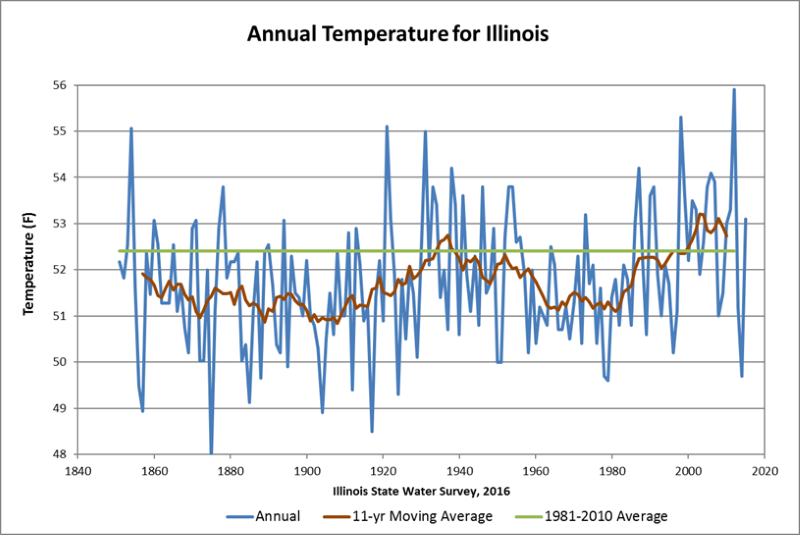
…and the predicted size variations in birds will be so minuscule, and the random variations in individual bird sizes are so large, that I’m confident you cannot make a quantified prediction based on Bergmann’s rule which can be confirmed by a statistically significant measured change in bird size.
Insect holocaust is what is causing it:
Scientists have long been speculating about the potential reasons for the declining number of insects and the birds that depend on these critters for their survival, with new research potentially shedding some light on this problem.
An insect apocalypse with a massive decline in the number of arthropods is underway due to the prevalence of artificial light at night, also known as light pollution, a new study published in the journal Biological Conservation claims.
Scientists from Tufts University in Massachusetts reviewed the results of more than 200 independent studies to conclude that it is artificial light at night (ALAN) that could be a significant factor driving the so-called insect apocalypse due to its influence on reproductive success, hiding from predators, and the search for food by various insect species, potentially contributing to the loss of about 40% of all species in the next few decades.
“Artificial light at night impacts nocturnal and diurnal insects through effects on development, movement, foraging, reproduction, and predation risk”, the paper claims.
“We also emphasise that artificial light at night is not merely a subcategory of urbanisation. The ecological consequences of light pollution are not limited to urban and suburban centres, but widespread along roadways and around protected areas”, researchers added.
In an Oct. 7, 2015, photo, a bucket of crickets are seen in the Detroit Zoo’s cricket breeding area in Royal Oak, Mich.
© AP PHOTO / CARLOS OSORIO
Insects Are Dying Off in Europe in Apocalyptic Wildlife Omen, New Study Suggests
The declining number of insects, in turn, leads to disruptions in the food chain and global ecosystem by causing a significant reduction in the number of birds. So, researchers believe that the loss of around 3 billion birds in the US and Canada in the last 50 years is likely to be directly related to the declining number of insects.
The study concludes by saying that this problem is still relatively easy to address in comparison to other anthropogenic problems, by, for example, reducing our reliance on artificial light or shielding outdoor illumination.
So there’s a large increase in insect death during a full moon? I’m calling B.S. The vast majority of the Earth’s surface isn’t artificially lighted at night.
Come to Alabama and go camping with me. Then come home with me. If you don’t wear insect repellent you will get eaten up in both locations.
Less payload and bigger wings ? What it takes to keep altitude and maneuver out of harm from wind turbines.
I guess it’ll take two African Swallows to carry the coconuts to Mercea now instead of one.
depends on their air-speed
African swallows are non- migratory.
While they seem to imply that climate change was a modern phenomenon (at least the phrase), they stopped short of invoking CAGW!
I wonder what the trend was for the hundred years prior to 1978?
If you already know the problem is climate change, it is easy to find evidence of such. But, these birds are MIGRATORY, which means they live through MANY climates. They move to where the climate is more suitable, since they don’t build houses and streets.
Attempting to pin bird size changes on climate change is ridiculous, in the extreme. How about the invasive species, like the starlings, which travel in massive flocks and eat all manner of food – insects and seeds and fruit – that native species thrive on. Their FOOD supply is under attack, yet these idiots claim that the change from 1970’s (a cool period) to now, (a warmer period) is the CAUSE of the bird size changes. Isn’t bird size related to food availability? What kind of researchers would leave that very obvious problem out of their prognostications about climate change and bird size.
And the birds in the photo may have smaller bodies and longer wings but they are all dead! Why is he smiling?
Good question. Drawers of dead birds is a rather disturbing site. Did they die of natural causes? If not, what killed them? Inquiring minds want to know.
Perhaps the body size is smaller in order to fit into the drawers.
Bigger drawers, bigger birds.
Send funding for further study.
My bullshit detector just went haywire.
The tiny variations (a couple of grams) over 40 years?
And the natural variation of temperature over a day, over a month, over a year is how much?
Do they predict how long it will take for these little birds to be weightless?
Or like the legendary Oozlum bird, will they fly round in ever decreasing circles until they disappear up their own arses in a puff of smoke?
Enquiring minds want to know.
Send more Grant Money.
These birds all were collected after smacking into a building. That suggests that the evolutionary transformation also affected decision making skills along with increased wingspan and others.
Evolution simply means change and takes many different paths to find one that works. The ones that don’t work, don’t survive.
Mark Twain had something to say about extrapolation.
Hey thanks, CB. I live not far from Hannibal, MO, yet that quote is fresh to me.
There is something similar with bat populations which underwent similar morphological changes (wing size) in response to increased living in urban environments. Urban zones have increased substantially and birds are likely to go there (better shelter, more food) and adapt accordingly. https://royalsocietypublishing.org/doi/10.1098/rspb.2018.1222
“The authors of the Ecology Letters paper suggest that the body-size reductions are a response to climate warming and that increased wing length may help offset the body-mass losses.”
—
Increased wing length to offset reduced body mass? Oh, really?
In other news, this study undermines the trope that climate change portends mass extinctions.
Instead, if their attributions for body changes are correct, the study shows (again,) that species adapt very quickly to incremental environmental changes and therefore, those changes pose less of an existential threat.
New species aren’t being formed here…just (very minor) species variations are being selectively expressed for reasons hypothesized but still unknown. It will take a lot more funding $$ than it’s worth to titrate the MAIN factor out of possibly many SIMULTANEOUS factors in the selection of species attributes that are favored in changing circumstances…when more than 1 environmental factor and probably more than 10 environmental factors are changing (amount of food available, types of food available, quality of the food available, numbers of species competing for the food, new species entering regions that compete for food, the amount of “flock mixing” that “mixes” genes within different migratory groups during mating, local rainfall affecting food and growth and food rotting rates, amounts of molds and fungi affecting foods, wind speed averages during migration that greatly affect energy requirements, just how random the “sample bird” selection is – smaller birds might get caught more often) in other words JUST LIKE THE CLIMATE, IT’S TOO COMPLICATED to make simple claims and get confident answers WITHOUT A WHOLE LOT OF EFFORT that requires time and money. Obviously more $$ than it could ever be worth to find out why an average bird weighs 1.3 g more and has a wingspan 6mm wider than it used to.
I’d need to study the statistics involved in this study to put a grade on their claims. Lots of interlocking variables are obviously involved here…the main one OBVIOUSLY being the need to find anything that could possibly be caused by 1/3 of a degree warming over several decades for species that migrate through regions that typically differ by 10’s of degrees.
In other words…this is mostly wasting my $$ to provide another climare propaganda story.
“Increased wing length to offset reduced body mass? Oh, really?”
Indeed! I suspect that the researchers don’t know much about aerodynamics.
“liked” cos it made me laugh
lighter weight due to less bugs and how many that hit windows would be juvelines over wiser adults I wonder?
understand limited area confined changes happening soonish die to environment
but not in a spot where their options for breeding and habitat are fairly wide
bloody sparrows getting smaller? aerial vermin like them never go without a feed!
and the ones the feral cats never catch are them and starlings!
near impossible to skittle em while driving as well.
https://www.discovermagazine.com/planet-earth/climate-change-could-be-making-birds-smaller
From a volunteer collector–
“I’m a better data generator than I am a data analyzer,” adds Willard. “And the changes were small enough that it’s not like we could see them……The scientists found that the species with the fastest decline in body size also had the speediest gains in wingspan over the 40-year timeframe.” Percentage, variation, changes by date, etc.?
https://onlinelibrary.wiley.com/doi/abs/10.1111/ele.13434
Accord to the Ecology Letters website it took only two days to accept the paper. Paywall, abstract not clear, but if all birds were collected from buildings, maybe other possibilities exist. “It’ll be up to people’s imaginations to use this dataset in ways that we haven’t even thought of yet.” What where the results from body mass? They have a reasonable hypothesis, what are others? Their percentages of changes are very small, therefore easily suspect.
Did not know that you could measure to that precision, but then I just saw a weather forecast with wind speeds to two decimal places. Be careful what you advertise. Mortality numbers of migratory birds crossing the Gulf of Mexico is probably unknown, but significant. They land on oil platforms, boats, even show up in shark stomachs.
I was wrong, it was fog visibility, maybe a clerical error, makes sense less than mile, but not more. I got to thinking that while favoring hypotheses is nothing new, I ran across this paper not long ago about HARKING, Hypothesis after results known. In this case, it was perhaps before. Authors maybe never had their term paper title crossed out. Common, long ago warned error about confusing statistical with biological significance. Never measured birds, but lots of marine animals, even had the device they showed to measure small bones, not for the decimals, but more accurate. Such apparently claimed precision detracts from what might be a good study.
Notice he used percentages instead of measurements.
Those birds with 10 cm wing spans increasing 1.3\% etc.
1.3 millimeters, but he found it, what utter bollocks.
Very far afield for me, but bird wings have flexible joints and the feathers ‘feather out’. I wonder how the measuring protocol can be standardized to less than mm?
More junk science: the findings come from a dataset of some 70,000 birds that died when they collided with buildings, to be truly representative they also need to have 70,000 birds that didn’t collide with buildings.
Q:
Are the dead ones a mutation & hitting buildings because the wings are too long ?
Or are they malnourished leading to poor eyesight ?
or, Is it survival of the fittest ? read Darwin.
Which direction were they flying when they died – from hot to cold or vice-versa ?**
“Both changes appear to be responses to a warming climate.”
**In 1847 Carl Bergmann, a German biologist knew that Birds and mammals in cold regions were observed to be bulkier than individuals of the same species in warm regions.
I’m an engineer not a biologist & I knew that !!!
You hit on their underlying assumption. Why did they assume that the collection of dead birds which collided with buildings in Chicago is a representative sample of a species? They never considered the hypothesis that lighter birds with larger wings could be more likely to collide with buildings. They claim statistical significance but what is the standard deviation of their data? What is their measurement error?
our canadian geese have just gotten lazy, fat, and huge
Christmas is coming, the geese are getting fat,
Please to put a penny in an old man’s hat;
If you haven’t got a penny a ha’penny* will do,
If you haven’t got a ha’penny, God bless you.
My friends got big, fat Christmas bonuses, but all I got was a goose.
Many things have changed around Chicago in the last 40 years. To reach the conclusions that global warming shrinks bird weights, increases bird wing lengths, and decreases bird leg lengths, requires some assumptions:
● that the downtown Chicago location is a typical bird habitat
● that the Chicago area hasn’t changed in 40 years in any way which could affect birds
● that 40 years of having bird populations culled by flying into windows hasn’t exerted any evolutionary pressure on them
There’s no clear causal mechanism which would lead us to predict that global warming would shrink bird weights, increases bird wing lengths, and decreases bird leg lengths. So to credibly attribute those changes in birds which flew into a particular building in a particular city, to global warming, requires ruling out other factors which could, just as credibly, affect birds. Obviously that wasn’t done.
The amount of global warming which has occurred is minute: 1 °C is equivalent to a change in latitude of perhaps 60 miles. Are the birds 60 miles south of where you live smaller than the birds in your yard? Do they have longer wings, and shorter legs?
Many, many things have changed in 40 years. Nearby trees have grown, or died. The Field Museum has probably switched to LED lighting, as have other surrounding (“competing”) buildings, and streetlights. The mix of crops grown in surrounding rural Illinois has probably changed, as have the pesticides used on them, and the tilling practices. Air pollution has been abated. Airplane traffic has changed.
Any of those things are at least as plausible as “global warming,” as candidates for attribution of the minuscule changes observed.
The attribution of any and every observed change, in just about anything you can imagine, to manmade climate change, is one of the most strikingly unscientific aspects of climate hysteria.
Dave, you hit the nail on the head. Keep pounding away.
Good comments … these authors obviously set out to blame global warming for whatever change they discovered over what is a very short period of time (40 years) in evolutionary timeframes. They ignored dozens if not hundreds of other potential “causes” of changes in avian physiology over time.
Besides, are birds happier with smaller bodies and longer wings, or vice versa? Sounds like we should empanel a group of expert avian psychologists and avian sociologists.
Dave, what has changed is more CO2…..greening….more food
Migratory birds can be smaller, find more food along the way and when they get there, don’t need to store as much energy, and can have longer wings to glide better
Perhaps the average size of birds killing themselves by collision with museum windows is smaller now because bigger birds fly higher, and some of the larger birds are being killed by wind turbines.
Perhaps the adoption of low-till & no-till agricultural practices has made it harder for bird species that eat bugs turned up in fields to get enough to eat.
Perhaps the use of Roundup-Ready crops and glyphosate, or of increasing acreage devoted to corn ethanol production (to “fight climate change”), has reduced the availability of weed seeds eaten by some bird species, resulting in leaner birds.
Perhaps the population of “outdoor cats” (feral and non-feral) has changed, with resulting changes in bird populations.
Perhaps the spread of invasive mussels in Lake Michigan has changed the food chain in that region in ways that have affected bird diets.
Perhaps the pressure on bat populations, due to the spread of “white-nose syndrome” disease, has had secondary effects on insect and bird populations.
https://www.youtube.com/watch?v=iSd6-EvBgN4
We could come up with such “perhapses” all day.
Too true Dave.
One wonders whether these geniuses checked with dead birds hitting buildings in New York, perhaps.
Or maybe cast the net a little wider.
Spanish and Italian hunters love to shoot migrating song birds. And eat them. Tasty morsels.
Have they been grousing that their favourite snacks seem a little, err, diminished?
And that’s yet another ‘perhaps’.
(I guess every regular on here could dream up a dozen ‘perhapses’ in five minutes – despite these geniuses only thinking of the one in their heads when they started.)
Perhaps the ‘volunteer corpse collectors’ just trousered the plumper specimens…
This just such BS.
The idea that a 1 degree rise in globally averaged temperatures precipitates a noticeable evolutionary change in just 4 decades is ridiculous.
Indeed. What were the various climate changes for all the habitats through which they migrated and lived? some places could have been cooler. But, of course, they said “climate change”, which could be literally anything.
Indeed. These bird species all survived multiple glaciation and deglaciation cycles, which saw the site of the Field Museum (and the rest of Chicago) alternately buried beneath a mile or so of ice, and then uncovered again, repeatedly.
We also know from ice core isotope analyses that over the last 100,000 years the Earth has experienced dozens of natural “Dansgaard-Oeschger events” in which temperatures changed at rates as rapid as several degrees per decade.
EXCERPTS FROM THE LATTER SOURCE:
Those temperature changes were much, much larger and more rapid than anything caused by mankind, and they often persisted for thousands of years — and nobody knows with certainty why they occurred. (Fortunately, mankind, corals, polar bears, and nearly every other existing species of animal and plant, including all those bird species, survived all those large, abrupt temperature changes, so there’s no reason to fear that the current slight warming trend will be catastrophic for them.)
I’m not surprised that migratory birds are shrinking if you keep them in drawers.
How does anyone know that the specimens which were used as “controls” were normal-sized in their day? Seems likely to me that the museum would collect the “best” specimens, and those frequently are perceived to be the largest ones.
I observe that in temperate zones migratory individuals are smaller than resident individuals of the same species.
Can I get a grant?
Well, it’s a good thing they weren’t after the goldfinches in my sunflowers last summer. Making pigs of themselves, they were, while they were changing from the yellow (male) feathers to the green seasonal travel pattern.
If the measurements are as small as the article indicates, did it NOT occur to these people that maybe the birds that slammed into Chicago’s skyscrapers were not fully-grown adult birds? No, I guess not. Smaller body size may only mean less stored fat for migration, and there is no indication in that article that the time of body-slamming a building was noted. That does make a difference.
Since the sparrows stick around all winter (I feed them, so I have my own bird count), I see fat little birds that may or may not be fully mature adults, ready for a few more seasons. I see the newly-fledged youngsters show up with a parent bird at my feeding station and their wings are longer than their bodies because they are now flying, even if they are not fully mature. The birds’ age has something to do with that, which it seems those people at the Field Museum failed to take into account.
Flawed study, and the guy in the photo looks a bit too smug to me. Also, since there’s no recorded age on these critters (yeah, how would they do that, anyway, when they don’t observe fledglings and parents?), the real data that they came up with is flawed, in my view, because they are sitting at desks, measuring dead birds instead of observing the live critters the way the rest of us birders do.
I see these are dead birds due to collisions with buildings. I missed that in my earlier comment as to why are they dead. So, these are the stupid birds…..
This study started BEFORE climate change was a cash cow. I would imagine the early reason for the study was simply study of migratory birds and their changes. Decades ago, I watched a special on birds in the Galapagos and how their beak size changed as seed size changed. It was a special supporting Darwin. Now, all specials and study do NOT support Darwin but instead claim something unnatural is occurring and we, either made by God or aliens from another planet, are causing it. We CANNOT be part of evolution under that scenario or we would not be unnatural. It is interesting what climate science necessitated as reality and how they killed Darwin so effectively.
Several points here:
1) Correlation is not causation.
2) The data set is of birds killed by flying into buildings … not all birds .. the authors did nothing to discuss how the birds that are more likely to be killed by flying into buildings might have different characteristics that actually amount to causation.
3) The authors are merely ASSERTING a climate causation.
4) The authors did not postulate how a warming climate might result in changes in avian body sizes .. i.e., what actual physical manipulation of the body results from warmer temperatures.
5) The authors fail to mention that when the climate was much warmer than it is today, birds were also much bigger. They were called “dinosaurs” – today’s birds are successors to dinosaurs, the only major difference, aside from smaller size (???????) being that today’s birds are warm blooded, and therefore natural selection favored them over cold blooded creatures in a cooling climate.
Etc. etc. etc.
Very poor study – typical climate alarmist BS, by the way. A bit of data, and a huge amount of assertion and false claims of causality.
Indeed. If you want to know how 1°C of warming affects birds of a particular species, then you could simply compare the birds at two locations which have a 1°C difference between their average temperatures (typically about 60 miles apart).
Of course that would be silly because everybody knows there’s no measurable difference between bird populations of a single species that near to each other. But it is no more silly than this “study.”
The Audubon Society has a page about Cardinals, here:
https://www.audubon.org/field-guide/bird/northern-cardinal
Note the map, showing their range: from southern Canada to the middle of Mexico.
Here’s a gardeners’ growing zone chart, where you can see that that corresponds to a climate difference of at least 50°F = 28°C:
Now, seriously, given that kind of range, how can anyone think that 1°C of warming could be a problem for those birds?
Smaller body, larger wingspan – looks like adaptations to fly fast, change direction quickly, hunt insects in flight. Cf. swifts and swallows. Might be an adaptation to the urban habitat.