By Rong-Gong Lin II Staff Writer
Oct. 17, 2019 1:45 PM
A major California fault capable of producing a magnitude 8 earthquake has begun moving for the first time on record, a result of this year’s Ridgecrest earthquake sequence destabilizing nearby faults, Caltech scientists say in a new study released in the journal Science on Thursday.
In the modern historical record, the 160-mile-long Garlock fault on the northern edge of the Mojave Desert has never been observed to produce either a strong earthquake or even to creep.
But new satellite radar images now show that the fault has started to move, causing a bulging of land that can be viewed from space.
“This is surprising, because we’ve never seen the Garlock fault do anything. Here, all of a sudden, it changed its behavior,” said the lead author of the study, Zachary Ross, assistant professor of geophysics at Caltech. “We don’t know what it means.”
The creeping illustrates how the Ridgecrest quakes — the largest in Southern California in two decades — have destabilized this remote desert region of California between the state’s greatest mountain range, the Sierra Nevada, and its lowest point, Death Valley.
It also punctures a persistent myth that circulates in California and beyond — that quakes like the Ridgecrest temblors are somehow a good thing that makes future quakes less likely. In fact, earthquakes make future earthquakes more likely. Most of the time, the follow-up quakes are smaller. But occasionally, they’re bigger.
Not only has the Garlock fault begun to creep in one section, but there’s also been a substantial swarm of small earthquakes in another section of the fault, and two additional clusters of earthquakes elsewhere — one south of Owens Lake and the other in the Panamint Valley just west of Death Valley.
Whether the destabilization will result in a major quake soon cannot be predicted. In September, the U.S. Geological Survey said the most likely scenario is that the Ridgecrest quakes probably won’t trigger a larger earthquake. Nevertheless, the USGS said that the July quakes have raised the chances of an earthquake of magnitude 7.5 or more on the nearby Garlock, Owens Valley, Blackwater and Panamint Valley faults over the next year.
A large quake on the Garlock fault has the potential to send strong shaking to the San Fernando Valley, Santa Clarita, Lancaster, Palmdale, Ventura, Oxnard, Bakersfield and Kern County, one of the nation’s most productive regions for agriculture and oil.
Important military installations could also get strong shaking, such as Edwards Air Force Base, Naval Air Weapons Station China Lake and Fort Irwin National Training Center. The fault is crossed by two of Southern California’s most important supplies of imported water — the California and Los Angeles aqueducts — and critical roads like Interstate 5, state routes 14 and 58 and U.S. 395.
A major quake on the Garlock fault could then, in turn, destabilize the San Andreas. A powerful earthquake on a stretch of the roughly 300-mile-long southern San Andreas fault could cause the worst shaking the Southern California region has felt since 1857, and send destructive tremors through Los Angeles and beyond.
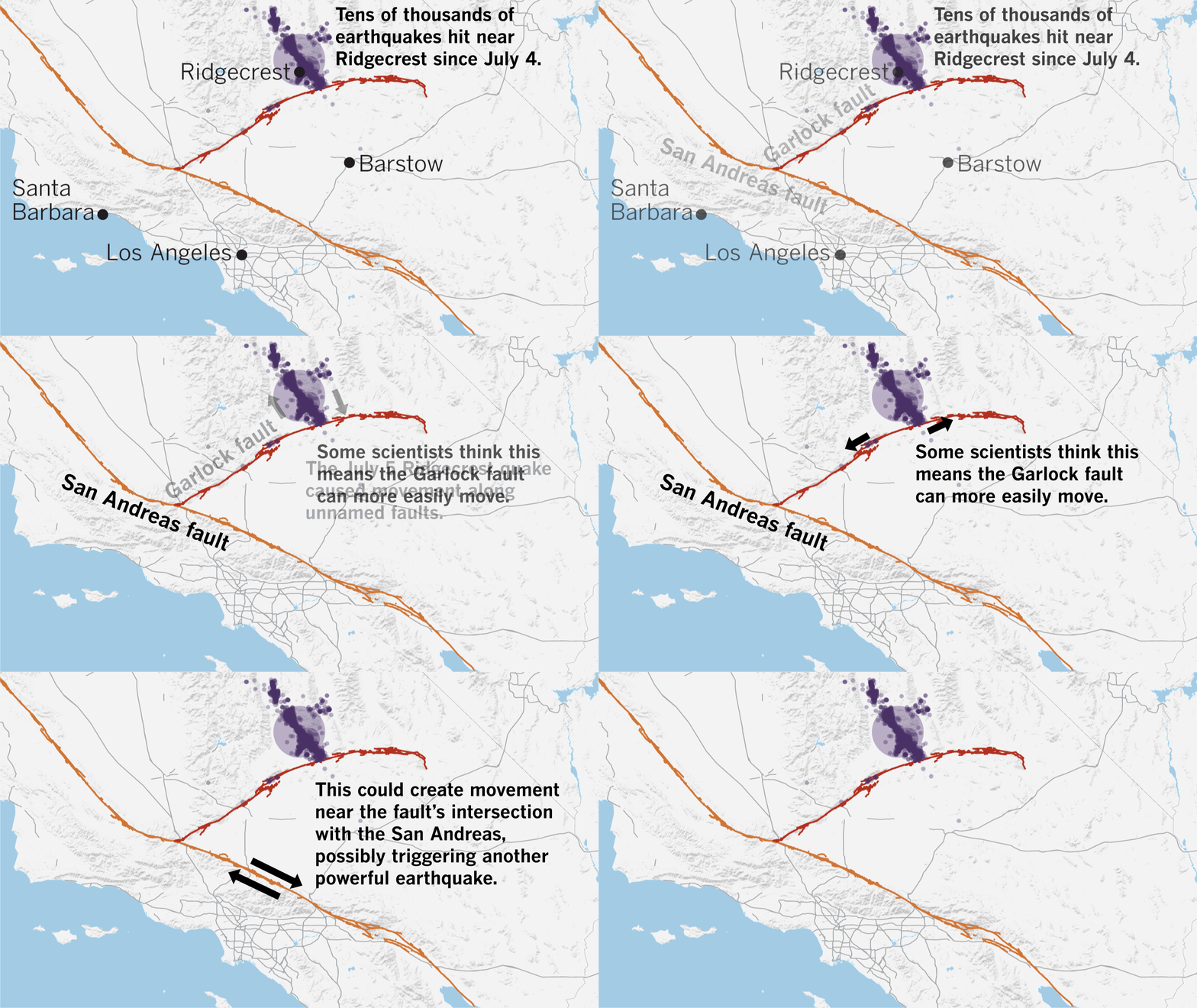
One plausible scenario involves the Ridgecrest quakes triggering a large temblor on the Garlock fault, which then triggers a seismic event on the San Andreas. The chances of such an event happening are small. Another plausible scenario, not mapped, involves a rupture of faults southeast of the Ridgecrest quakes.
(Jon Schleuss / Los Angeles Times)
HT/ozspeaksup
More cosmic rays means more earthquakes and volcanic eruptions?
can’t vouch for the site but:
https://watchers.news/2015/06/09/cosmic-solar-radiation-as-the-cause-of-earthquakes-and-volcanic-eruptions/
Ive read something along those lines on another site, some say its the north south flip?
I’d read this a while back.
https://www.researchgate.net/publication/288835606_Significant_statistically_relationship_between_the_great_volcanic_eruptions_and_the_count_of_sunspots_from_1610_to_the_present
If fracking is such an evil act against Nature, then why does Ma’ Gaia do it?
D**m, the downside of Marcellus fracking is worse then we imagined!
\sarc=off
If the Ridgecrest quakes and triggers a large temblor on the Garlock fault, it could help concentrate Californian minds back on real problems other than CO2 and Global Warming.
Oh no, recorded moving for the first time evah! That’s unequivocally caused by fracking, because circumstantial evidence is all we need to base a politically correct paper on these days. But seriously, some researcher from Berkeley or Cornell will literally blame this on some anthropogenic activity in 3,2,1…
Project Plowshares.
(It just took a few decades to effect California.)
God forbid it ever happens, but I wonder how well the area would deal with the aftermath of a major earthquake were they relying on windmills and solar panels as their principle source of energy?
We should recognize merit where it exists, there would be less risk if the Green blight transformed to the Green mush. However, the risk of other technologies can be managed and the effects mitigated when we follow best practices.
Are windmills rated for earthquake survival?. How about solar panels – will they stress fracture in a quake?
Doom porn post of the day!
There does seem to be a correlation between a quite sun volcanoes and earth quakes.
The loss of the strength in the suns magnetic field makes the earths magnetic field loose strength and we get hit with more cosmic rays.
Possibly other things we do not know about,but something seems to shake the world up.
Thanks Wayne Job,
I’d seen that too and wanted confirmation from scientists here.
https://www.researchgate.net/publication/288835606_Significant_statistically_relationship_between_the_great_volcanic_eruptions_and_the_count_of_sunspots_from_1610_to_the_present
https://www.nytimes.com/2019/09/25/world/asia/indonesia-earthquake-ambon.html
This is an activity popularly known as p-chasing.
There is also a highly significant correlation between Bangladesh butter production and the S&P 500.
ah, ‘p-chasing’, ok, interesting, was unfamiliar with the term.
thanks for weighing in tty.
so if I understand correctly, for you, any even mildly significant correlation that might exist between the number of cosmic rays entering the earth’s atmosphere and sub-terranean activity in terms of volcanic activity and/or earthquakes is then most likely fortuitous and meaningless? (this is a serious and sincere question; not a rhetorical one.)
So basically, tty, the link and content below is horse pucky? :
“…These muons can contribute to nucleation in supersaturated magma, as documented by many authors studying a bubble chamber, via ionization loss.
This radiation-induced nucleation can lead to the pre-eruptive exsolution of H2O in the silica-rich magma. We note the possibility that the 1991 Mt. Pinatubo eruption was triggered by the same mechanism: an increase in cosmic-ray flux triggered by Typhoon Yunya, as a decrease in atmospheric pressure results in an increase in cosmic-ray flux…”
https://www.sciencedirect.com/science/article/abs/pii/S1342937X10001966
sincere thanks in advance for any informative remarks.
Only accessed abstract and a few pages:
Title: Strong earthquakes, novae and cosmic ray environment
Authors: Yu, Z. D.
Journal: In NASA. Goddard Space Flight Center 19th Intern. Cosmic Ray Conf., Vol. 5 p 529-532 (SEE N85-34991 23-93)
http://articles.adsabs.harvard.edu//full/1985ICRC….5..529Y/E000529.000.html
So where is Otisburg? I might want to invest early in new beachfront land. sarc/
After that quake I looked at the area. Southern California has many faults. Unless they all go at once a quake on one is always going to move more stress to another. As long as the plates keep moving there will be quakes. I have always wondered why all the faults don’t go at the same time. You would think the movement of a major quake would set them all off at once.
“It also punctures a persistent myth that circulates in California and beyond — that quakes like the Ridgecrest temblors are somehow a good thing that makes future quakes less likely. ”
It’s not a myth, at least not completely. An earthquake makes a new (large) quake on the same fault less likely in the near future, but it could at the same time increase the strain on other faults, as in this case.
The left-lateral slip of the Garlock fault depicted in the animation doesn’t readily jibe with the right-lateral slip of the San Andreas.