
Guest essay by Eric Worrall
h/t Dr. Willie Soon; Apparently we face an urgent need to reform land use and human diets, even though satellite measurements prove the world is greening.
IPCC climate change report calls for urgent overhaul of food production, land management
By environment reporter Nick Kilvert
…
And changing the way we farm could improve things for ourselves, as well as for the planet: “Balanced diets featuring plant-based foods such as those based on coarse grains, legumes, fruits and vegetable, nuts and seeds and animal-sourced food produced in resilient, sustainable and low-greenhouse-gas-emission systems present major opportunities for adaptation and mitigation while generating significant co-benefits in terms of human health.“
In Australia, where our meat consumption is particularly high on a global average, that means things like switching to low-emissions meat sources, ditching non-essential foods, and sourcing locally grown produce.
Reducing food waste is also identified as a key area to gain efficiency and reduce the environmental impact of agriculture.
Between 25 and 30 per cent of food is wasted worldwide, including crop waste, transport and store loss and personal waste.
“By 2050, reduced food loss and waste can free several million square kilometres of land,” the authors write.
The report confirms the world has a double-edged sword hanging over its head, according to IPCC vice-chair Mark Howden.
“We ignore the interactions between climate change and the land at our peril.”
Read more: https://www.abc.net.au/news/science/2019-08-08/ipcc-report-climate-change-land-use/11391180
…
George Monbiot’s response is even more entertaining, he gave one of his signature wide eyed video interviews: “Beef is like a loaded gun pointed at the living world“.
What the IPCC said of course is a little less apocalyptic, in fact in his video interview Monbiot describes the report as “pathetic and mealy mouthed”, because the scientists didn’t say what he wanted them to say.
Some interesting highlights from the Summary for Policymakers;
Climate Change and Land
An IPCC Special Report on climate change, desertification, land degradation, sustainable land management, food security, and greenhouse gas fluxes in terrestrial ecosystems
Summary for Policymakers
…
A2.3. Satellite observations15 have shown vegetation greening16 over the last three decades in parts of Asia, Europe, South America, central North America, and southeast Australia. Causes of greening include combinations of an extended growing season, nitrogen deposition, CO2fertilisation17, and land management (high confidence). Vegetation browning18 has been observed in some regions including northern Eurasia, parts of North America, Central Asia and the Congo Basin, largely as a result of water stress (medium confidence). Globally, vegetation greening has occurred over a larger area than vegetation browning (high confidence). {2.2.3, Box 2.3, 2.2.4, 3.2.1, 3.2.2, 4.3.1, 4.3.2, 4.6.2, 5.2.2}
…
B6.2. Diversification in the food system (e.g., implementation of integrated production systems, broad-based genetic resources, and diets) can reduce risks from climate change (medium confidence). Balanced diets, featuring plant-based foods, such as those based on coarse grains, legumes, fruits and vegetables, nuts and seeds, and animal-sourced food produced in resilient, sustainable and low-GHG emission systems, present major opportunities for adaptation and mitigation while generating significant co-benefits in terms of human health (high confidence). By 2050, dietary changes could free several Mkm2 (medium confidence) of land and provide a technical mitigation potential of 0.7 to 8.0 GtCO2e yr-1, relative to business as usual projections (high confidence). Transitions towards low-GHG emission diets may be influenced by local production practices, technical and financial barriers and associated livelihoods and cultural habits (high confidence). {5.3, 5.5.2, 5.5, 5.6}
…
C1.2. Insecure land tenure affects the ability of people, communities and organisations to make changes to land that can advance adaptation and mitigation (medium confidence). Limited recognition of customary access to land and ownership of land can result in increased vulnerability and decreased adaptive capacity (medium confidence). Land policies (including recognition of customary tenure, community mapping, redistribution, decentralisation, co-management, regulation of rental markets) can provide both security and flexibility response to climate change (medium confidence). {3.6.1, 3.6.2, 5.3, 7.2.4, 7.6.4, Cross-Chapter Box 6 in Chapter 5}
…
D 3. Rapid reductions in anthropogenic GHG emissions across all sectors following ambitious mitigation pathways reduce negative impacts of climate change on land ecosystems and food systems (medium confidence). Delaying climate mitigation and adaptation responses across sectors would lead to increasingly negative impacts on land and reduce the prospect of sustainable development (medium confidence). {Box SPM.1, Figure SPM.2, 2.5, 2.7, 5.2, 6.2, 6.4, 7.2, 7.3.1, 7.4.7, 7.4.8, 7.5.6; Cross-Chapter Box 9 in Chapter 6, Cross-Chapter Box 10 in Chapter 7}
…
Read more: https://www.ipcc.ch/site/assets/uploads/2019/08/4.-SPM_Approved_Microsite_FINAL.pdf
It seems a little premature to declare a global land use and climate emergency, when satellite measurements suggest the world is greening.
What I find more interesting though , the IPCC admits they only have “medium confidence” that reducing greenhouse gas emissions would mitigate the problems they identified as affecting food supply.
The vague and in my opinion misleading term “medium confidence” may be a gift from the late Stephen Schneider. There is a hilarious climate gate email which suggests the term “medium confidence” arose because climate scientists didn’t want to say “inconclusive” in their reports;
Hello all. I appreciate the improvement in the table from WG 1, particularly the inclusion of symmetrical confidence levels–but please get rid of the ridiculous “inconclusive” for the .34 to .66 subjective probability range. It will convey a completely differnt meaning to lay persons–read decisionmakers–since that probability range represents medium levels of confidence, not rare events. A phrase like “quite possible” is closer to popular lexicon, but inconclusive applies as well to very likely or very unlikely events and is undoubtedly going to be misinterpreted on the outside. I also appreciate the addition of increasing huricane intensities with warming moving out of the catch all less than .66 category it was in the SOD.
…
Great Tom, I think we are converging to much clearer meanings across various cultures here. Please get the inconclusive out! By the way, “possible” still has some logical issues as it is true for very large or very small probabilities in principle, but if you define it clearly it is probably OK–but “quite possible” conveys medium confidence better–but then why not use medium confidence, as the 3 rounds of review over the guidance paper concluded after going through exactly the kinds of disucssions were having now. Thanks, Steve
…
Climategate email 0967041809.txt (the paragraphs are reversed from the original reference to show correct chronological order)
Obviously some regions like Australia and Africa could do with a little more water infrastructure, and deforestation can have a substantial impact on rainfall, so planting a few trees, especially in marginal areas, is not always a bad idea.
The “balanced diet” demand stinks of one size fits all-ism. There are substantial regions of the world where herding cattle over low grade pastures is a tradition, because the land quality simply isn’t good enough for a more settled way of life. The land might be improved with a vast investment in infrastructure, but who is going to supply the cash?
Frankly I don’t see a case for radical global land use change and massive government intervention, as the IPCC seems to be advocating. Some of their ideas like security of tenure, better property rights are sensible, but investments in water infrastructure and tree planting are local issues. Determination to address these issues has and will emerge where necessary through normal local and national political processes; no great global political intervention required.
While the world continues to green, suggestions that the world faces a serious ecosystem degradation problem seem a bit of a stretch.
All these diet changes are just for the peasants, of course. The elites still get to eat what they want, travel wherever they want, live in big houses, etc., as long as they think pure thoughts…bonus points if they buy a hybrid or EV.
George Monbiot is an odious little worm.
https://www.bbc.co.uk/news/science-environment-49255642
Cognitive dissonance at its best.
Regards
Climate Heretic
The IPCC hardly have any expertise in the climate (having demonstrated they are incapable of predicting what the climate does … and have to resort to fiddling the data).
For them to now get involved in areas where they are just lay people with ZERO credibility is bizarre and just shows the IPCC is just a political campaigning body with a nano-scopically thin veneer of “science”.
In Summary for Policy Makers ( A2.3) they give four reasons for global ‘greening’. One of them is CO2 fertilisation. That is obviously at too good message for the polititians. That is why they also mention global ‘browning’. But the reason for the browning is not one of the previous four reasons but a fifth. Two different messages put together and compared, just to keep up alarmism.
The USSR and communist China have both tried telling farmers what to grow and how to grow it. It didn’t work out well.
Another holy text from the church of unicorns that will be used by wide-eyed preachers to tell people how to live their lives.
Yet another in the 40 year parade of lies from the UN. Their initial report stated that they
were certain that the Earth was warming due to the “Greenhouse Effect”.
The model used to determine the Greenhouse Effect took the incoming Solar constant
of 1370 Watts per square metre and spread that across the whole spherical surface of the
Earth giving 342.5 W/m^2 as the average irradiance. That is, the model had no night or day
and no polar ice caps or Equatorial tropical zone, simply the same irradiance causing the same
constant temperature everywhere. This means a non-rotating, non-orbiting Earth receiving
equal radiation from all directions of the three dimensional Universe.
This is manifestly different to reality, whereby, at any instant in time there is only one
spot on the surface potentially receiving the full irradiance of 1370 W/m^2. That spot
circumnavigates the globe every 24 hours along a different path each time but always lies
within the Equatorial zone. The remainder of that part of the globe facing the Sun receives the
Solar constant reduced by the sine of the angle of inclination of the surface with respect to the
incoming radiation. This diminishes to zero along the circumference of the plane facing the
Sun and over all of the surface facing away from the Sun. That is, the temperature is always
fluctuating back and forth between daily maxima and minima and these constantly change as
the Earth orbits the Sun.
Astrophysicist Joseph Postma has devised a rational model for the Sun warming the Earth which
gave a result of +15.5 degrees Celsius for the average surface temperature of the Sun-lit side, an
acceptable estimate without invoking a Greenhouse Effect.
In summary, the UN IPCC model defines an isolated sphere in space exhibiting no change in surface temperature whatsoever in marked contrast to the ever-changing temperature both with time and
location across the Earth’s surface.
The contrived 33 degree Kelvin Greenhouse Effect is not a property of the atmosphere but a measure of the bias inherent in the artificial model used to estimate the average temperature of the surface of an
imaginary Earth. There is no “Greenhouse Effect” other than inside a greenhouse and that has nothing to
do with CO2.
1981, and S Schnieder explains how a computer models CO2 induced global warming and the consequential result of 2 degrees.
It would appear that no matter how sophisticated computers have evolved over the years, they have all arrived at the same conclusion as 1981.
– 3.00, S Schnieder: “ Then, you literally pollute the model.
You of course just go to a type writer, you type in a couple of cards which end up saying, model, here is a different CO2 concentration.
Then, part of the model which computes the greenhouse effect computes a different kind of greenhouse effect.
You run the model so many years forward in simulated time, ‘computer, new climate’, and that’s where these predictions of 2 to 3 degrees warming in 100 years come from.”
Bevan,
You are fundamentally incorrect.
The amount of heat being radiated from one surface to another is
q/a= [k/(1/ehot+1/ecold-1] x (Thot^4-Tcold^4).
The ground is at Thot due to being warmed by sunshine,
If the atmosphere was only N2 and O2, it would be completelely transparent to Infrared. The “surface” the ground would radiate to is outer space at -270 C. But CO2 and H2O readily absorb and reradiate IR. Because the H2O and CO2 are the same temperature in the atmosphere as the N2 and CO2, the “surface” the ground radiates to is “the sky”, and the “sky” is much warmer than outer space. You can take an IR thermometer and typically read the temperature of clouds at about freezing and blue sky down to -80, but $40 IR guns do not have proper emissivity settings for this job. Anyway my point is that the ground temp has to get warmer as it heats in the sunshine in order to radiate the same amount of heat it receives from the sun, when there are radiating gases between the ground and outer space.
The Earth’s Albedo of .3 is used to come up with the often stated 33 C number, however Albedo is so dependent on clouds and clouds are made of water, but people who make this generalization are only trying to show how the radiative gas effect works.
So the GHE effect exists, caused by “back radiation” from the radiative gases in the sky.
DMacKenzie,
Using the facility on the HITRAN website, a listing of the emission spectra for
isotopologue 16O12C16O was calculated for a temperature of 280 degrees Kelvin (7 deg. C) and
pressure of 0.9 atmospheres, roughly the conditions at an altitude of 1000 metres above sea
level. This isotopologue has a natural abundance of 0.984 so is a reasonable representation of
the atmospheric CO2 absorption.
Taking a cutoff level of one thousandth of the maximum line strength gave three absorption
peaks. These were :
(a) the maximum of 3.687E-18 cm/molecule at wavelength 4.23 microns within the band 4.19
microns to 4.37 microns,
(b) a lessor maximum of 3.106E-19 cm/molecule at wavelength 14.98 microns within the band
14.09 microns to 16.19 microns, and
(c) the third maximum of 6.169E-20 cm/molecule at wavelength 2.68 microns within the band
2.67 microns to 2.8 microns.
Applying Wein’s law determines that
(a) is indicative of a source temperature of 685 degrees Kelvin (412 degrees Celsius)
(b) is indicative of a source temperature of 194 degrees Kelvin (-79 degrees Celsius), and
(c) is indicative of a source temperature 1081 degrees Kelvin (808 degrees Celsius).
As (b) is less than the assumed average temperature of the Earth it cannot cause the Earth’s
temperature to increase. Only radiation in (a) the 4.23 micron band and (c) the 2.68 micron
band can increase the Earth’s temperature.
For a source at 288 degrees Kelvin, Planck’s law determines that the 2.68 micron band has an
energy density of 5.016 x 10^-11 Joules per cubic metre and the 4.23 micron band has an
energy density of 5.344 x 10^-9 J/m^3, making a total of 5.39416 x 10^-9 J/m^3 radiated from
the Earth’s surface. Of this, one quarter may be back-radiated towards the Earth where the
surface, due to the albedo, may absorb seven tenths as heating, which is 0.944 x 10^-9 J/m^3
or one part in 21.25 of the supposed Greenhouse Effect. If there is to be a Greenhouse Effect
then the UN IPCC needs to explain from where do they source the other 95% of the backradiation
energy.
Thank You Geoff.
The fact is that analysis of climate data shows that satellite lower troposphere temperature is independent of atmospheric CO2 concentration and temperature drives the rate of generation of CO2 so there is no Greenhouse Effect. Further, if there was, then there would be far more of the Sun’s incoming radiation back-radiated into space than the possible Earth’s heat back-radiated to the surface and the Earth would cool with increasing CO2 concentration.
I will have to find a better way of expressing the problem.
DMacKenzie,
The sky is not a surface so your formula fails.
Also the ground does not radiate the same amount of heat as it receives from the Sun – it is not a mirror. In-coming radiation evaporates water, melts ice, makes vegetation grow via photosynthesis and more.
Apart from the fact that much livestock grazing takes place in areas where topography and rainfall make arable farming unsuitable, when grassland is cultivated there is a large breakdown in soil organic matter releasing CO2. This happened in the US prairies where thousands of years accumulation of carbon was lost in under 100 years. Result, the Dust Bowl years.
Organic farming methods are often suggested as an alternative, but rely on cultivations for weed control which results in soil organic matter loss unless fertility building crops are grown. The resulting yields of edible produce per acre per year are considerably lower.
Minimal tillage techniques can reduce organic matter losses, but usually rely on Glyphosate (shock, horror) for weed control. Flame weeding would release significant amounts of CO2, even if we are still allowed to use gas.
I suppose we could use infra red lamps powered by the batteries that power the tractors.
The other problem is the steady drain of nutrients in the harvested crops. The Chinese got round the problem by fertilising their crops with ‘night soil’. Who would be volunteered for that job, and would the neighbours complain about the smell?
The whole fuss in the MSM seems to be caused by a degree of ignorance concerning the complexity of the whole food production system, possibly with some egging on by closet vegans.
Zimbabwe, and now possibly South Africa are shining examples of what happens when politicians get involved in farming and land ownership policy.
“StephenP August 10, 2019 at 1:58 am
…now possibly South Africa are shining examples of what happens when politicians get involved in farming and land ownership policy.”
SA is on the brink of all out civil war. Crime, poverty, water shortages etc etc…
Stephen,
Sounds like you would find this video interesting at the least:
https://m.youtube.com/watch?v=YuvSbmumgcI
They are doing weed control a totally different way.
Immediately after harvest, seed the land with winter wheat or similar (a cover crop).
The cover crop out competes the fall/winter weeds and keeps them from establishing.
Then, when you’re ready to terminate the cover crop to free the soil for your cash crop use a roller-crimper to level it. But leave the plant litter in place to prevent spring/summer weeds from getting established.
The plant litter will degrade over time, but much of the organic material will end up integrated into the soil.
Prof debunks flatulence as major cause of global warming
“In 2006, the United Nations concluded that the livestock industry was a big contributor to [global warming].
In its report “Livestock’s Long Shadow,” the U.N. concluded that livestock were contributing 18 percent of the world’s greenhouse gases — allegedly more than the entire world’s transpiration.
The U.N.’s Intergovernmental Panel on Climate Change used the report to forecast that Himalayan glaciers might vanish within 25 years.
Outside groups reacted to the U.N.’s claims by launching efforts to slow global warming by getting the public to go meatless one day a week, as way of lowering demand for livestock products.
Mitloehner convinced the U.N. to recant its claim in 2010.
The U.N. report estimated the amount of greenhouse gases emitted from every aspect of raising meat.
The U.N. did not do the same when estimating the greenhouse gases from cars.”
https://helenair.com/news/state-and-regional/prof-debunks-flatulence-as-major-cause-of-global-warming/article_1c6c9c5e-2dbb-11e2-9e51-0019bb2963f4.html
The more the UN pushes this climate nonsense, the more words like oppression and tyranny come to mind.
Regards,
Bob
The IPCC has become the world’s Super Duper Uber Nanny. If we don’t change our ways, we might have to sit in the naughty spot for a while. Honestly, they do raise some important issues, but they are localized concerns, and the attempt to conflate some real concerns with the fake one, CAGW is just pathetic.
..How did that “Let them eat cake !” thingy work out last time ?
“Frankly I don’t see a case for radical global land use change and massive government intervention” massive government intervention is the IPCC’s middle name
We already have technologies to remediate all aspects of food science worries mentioned in the article. First, if CO2 doubles (it won’t, but it would be great), this would be a good thing, allowing crops to be more adaptable to drought, as well as growing faster.
The technology we have already in hand, in genetically modifying crops and meat producing animals (OH NO! He said GMO!!!). It is ludicrous that the cognitively impaired have stigmatized this amazing blessing of technology. Just Golden Rice alone would be a nutritional boon to billions. Please let not the Luddites determine our futures!
“We have met the enemy, and he is us!” — Pogo
22 minute talk summarizing my views on global warming
By Nir Shaviv, Science Bits, Aug 4, 2019
http://www.sciencebits.com/22-minute-talk-summarizing-my-views-global-warming
At 2:48 in the presentation, Shaviv says:
“In all cores where you have a high-enough resolution, you see that the CO2 follows the temperature and not vice-versa. Namely, we know that the CO2 is affected by the temperature, but it doesn’t tell you anything about the opposite relation. In fact, there is no time scale whatsoever where you see CO2 variations cause a large temperature variation.”
At 5:30 Shaviv shows a diagram that shows the close correlation of a proxy of solar activity with a proxy for Earth’s climate. More similar close solar-climate relationships follow.
Shaviv concludes that the sensitivity of climate to increasing atmospheric CO2 is 1.0C to 1.5C/(doubling of CO2), much lower than the assumptions used in the computer climate models cited by the IPCC, which greatly exaggerate future global warming.
At this low level of climate sensitivity, there is NO dangerous human-made global warming or climate change crisis.
“At this low level of climate sensitivity, there is NO dangerous human-made global warming or climate change crisis.”
Told you so – 17 YEARS AGO!
The four most beautiful words in our common language: “I told you so.”
– Gore Vidal, October 3, 1925 – July 31, 2012
“Climate science does not support the theory of catastrophic human-made global warming – the alleged warming crisis does not exist.”
Source:
DEBATE ON THE KYOTO ACCORD
PEGG, reprinted in edited form at their request by several other professional journals, the Globe and Mail and La Presse in translation, by Sallie Baliunas, Tim Patterson and Allan MacRae.
http://www.friendsofscience.org/assets/documents/KyotoAPEGA2002REV1.pdf
DEBATE ON THE KYOTO ACCORD
The PEGG, November 2002, reprinted in edited form at their request by several other professional journals, the Globe and Mail and La Presse in translation, by Sallie Baliunas, Tim Patterson and Allan MacRae.
http://www.friendsofscience.org/assets/documents/KyotoAPEGA2002REV1.pdf
Note the “cold tongue” extending west into the equatorial Pacific through July and August 2019.
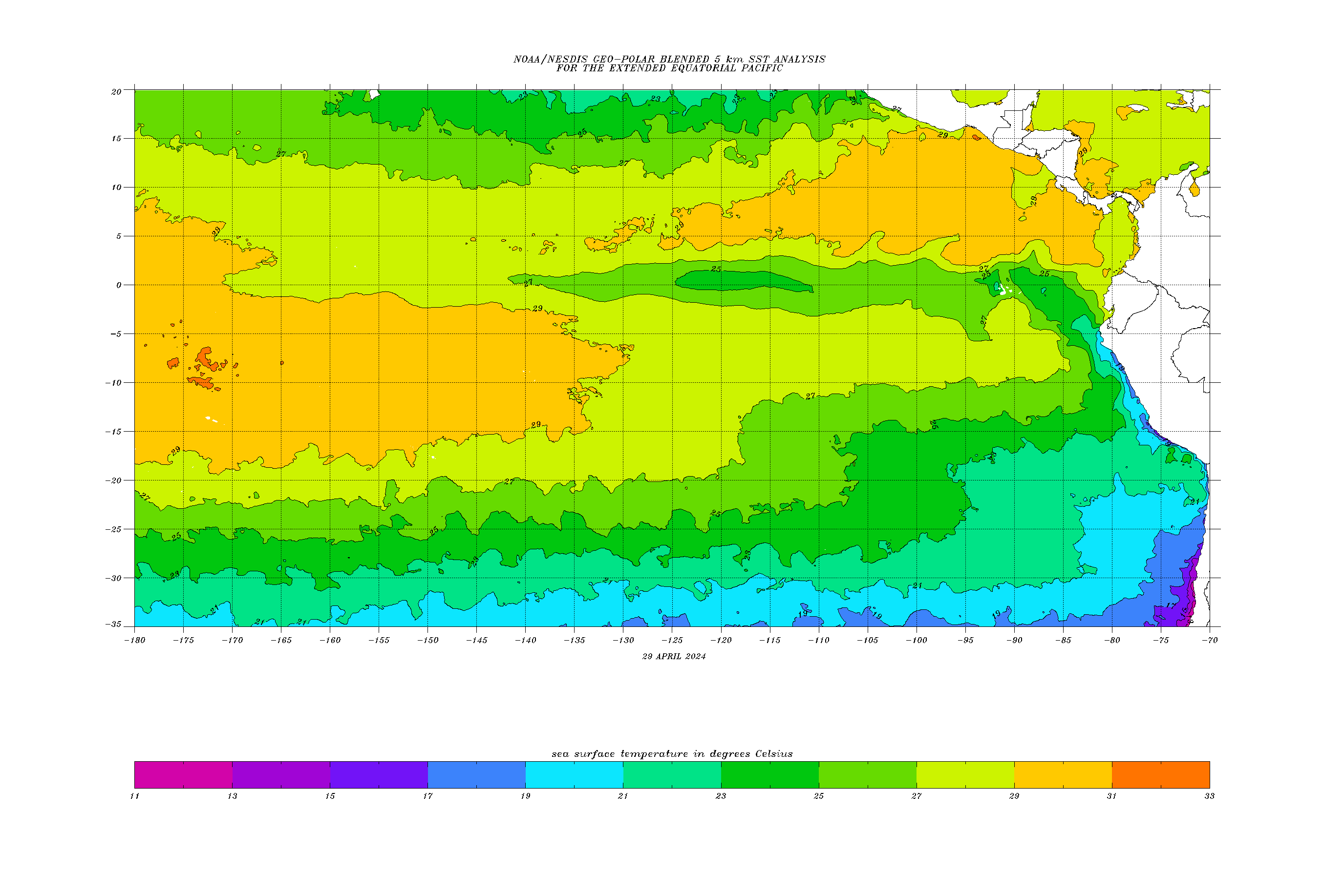
The equatorial Pacific Nino34 area SST is a good 4-month predictor of future global atmospheric average temperature.
https://wattsupwiththat.com/2019/06/15/co2-global-warming-climate-and-energy-2/
[excerpt]
5. UAH LT Global Temperatures can be predicted ~4 months in the future with just two parameters:
UAHLT Anomaly (+4 months) = 0.2*Nino34Anomaly + 0.15 – 5*SatoGlobalAerosolOpticalDepth
In the absence of major (century-scale) volcanoes this can be simplified to
UAHLT Anomaly (+4 months) = 0.2*Nino34SSTAnomaly + 0.15
Let’s see how the duration and the magnitude of this Nino34 predictor unfolds, and how much global cooling results.
The IPCC is not an objective scientific body. It is an agency of the UN and the UN has a climate agenda in the heels of its ozone success.
https://tambonthongchai.com/2019/08/11/ipccisun/