Guest Commentary by David Archibald
The area planted for corn and soybeans this season is well below historic averages. This was mostly due to waterlogged fields and flooding which precluded planting. The planting windows for corn and soybeans are now closed. The USDA crop progress reports provide weekly updates by state. For example this is the state of the corn crop in Indiana to Monday June 17:

Figure 1: Indiana corn crop progress to Monday June 17.
The emerged crop is one month behind where it was in 2018. Which means that maturity will be one month later at best, assuming that the rest of the summer isn’t abnormally cold.
Figure 2 shows that the same situation in soybeans in Indiana:

Figure 2: Indiana soybean crop progress to Monday June 17.
The current expectation is that the US corn crop will be down 30% on 2018 which will push the price to about $9.00 per bushel at harvest. What could make the situation a lot worse is an early frost. The Corn Belt did warm slightly over the last 100 years due to the high solar activity of the second half of the 20th century. This is shown by the cumulative growing degree days (GDD) of the first decade of the 20th century (blue lines) compared to the first decade of the 21st century (red lines) in Figure 3 for Whitestown, Indiana:

Figure 3: Cumulative GDD for Whitestown, Indiana
Normally, for the 21st century, the corn crop is in the ground by April 27 and the crop has reached maturity with 2,500 GDD well before the normal first frost date for Whitestown of October 10. The earliest recorded date for Whitestown is September 3. That was in 1908. If that is repeated in 2019 the crop will be only 80% through its growth cycle. Yield and quality will be well down and the total crop may be 50% or less of the 2018 level.
The US will be able to feed itself but at much higher prices. Currently some 40% of the corn crop goes to ethanol production and this could be redirected to animal feed without too much trouble. But protein production would still be well down. Each 56 lb bushel of corn used in ethanol production results in 18 lbs of dried distillers grains (DDG) containing the protein. This is used as a feed supplement to pigs, chickens and cattle. Both pigs and chickens have a 25% conversion efficiency of vegetable protein to animal protein. The global warmers want us to adopt vegetarianism in order to save the planet. The public is going to get a taste of that future coming up soon. However animal fat is essential for infant neurological development and brain function so we can’t go completely vegetarian.
What is happening in the Corn Belt is a mini version of the transition from the Medieval Warm Period to the Little Ice Age. The population of Europe exploded in benign conditions of the Medieval Warm Period from 1000 AD to 1300 AD, reaching population levels that weren’t matched again until the 19th century. In fact parts of rural France have less population today than at the beginning of the 14th century.
The breakover from the Medieval Warm Period to the Little Ice Age in Europe had sustained periods of bad weather characterised by severe winters and rainy and cold summers. The Great Famine of 1315 – 1317 started with bad weather in the spring of 1315. Crop failures lasted through 1316 until the summer of 1317. The population decline over the two years is thought to be about 10%, associated with “extreme levels of crime, disease, mass death, cannibalism and infanticide.” These conditions may be less in the Mormons amongst us who are instructed to keep one year’s worth of food in stock.
The Modern Warm Period ended in 2006. Current solar activity is back to levels of the Little Ice Age. To paraphrase Santayana, those who don’t remember history are condemned to being surprised and unprepared when it repeats itself.
A large and increasing number of nations are feeding their population growth with imported grain. That is going to be become more expensive to continue, with or without an early frost in the Corn Belt. Global warming hysteria has been a consequence of very benign conditions for the OECD countries where it is concentrated. That angst will be supplanted by more basic concerns.
David Archibald is the author of American Gripen: The Solution to the F-35 Nightmare
Discover more from Watts Up With That?
Subscribe to get the latest posts sent to your email.
The mandated use of biofuels such as the Ethanol Mandate have the economic effect of tying the price of the field crops used to the market price of the hydrocarbon fuels they must be blended with. In essence, if a gasoline retailer wants to sell a gallon of gasoline, they must acquire a certain amount of ethanol. The market price of the final fuel product sets the ceiling for how much can be paid for the ethanol, irrespective of its value as human or animal food. This linkage sets up market forces whereby vehicle use competes for corn against food use of corn. And as we know from the housing debacle and financial collapse of 2007-2008, government takes years to repeal or suspend the rules that caused the crisis.
Currently we consume around 36% of our entire corn crop for fuel blending and biofuels. What happens when poor growing conditions reduce the corn harvest by 40%? We may soon find out.
The EPA has the authority under the law to lower the obligation without legislative action.
The obligation is set each fall for the next year. If the corn harvest is small this summer, the EPA will have time to reduce the obligation for 2020.
Maybe they ought to start now, not wait till Fall…
https://www.zerohedge.com/news/2019-06-24/shocking-after-photos-reveal-awful-truth-about-widespread-us-crop-failures-2019
Maybe the EPA to start now, not wait till Fall…
https://www.zerohedge.com/news/2019-06-24/shocking-after-photos-reveal-awful-truth-about-widespread-us-crop-failures-2019
Regarding “animal fat is essential for infant neurological development and brain function”: Isn’t that a reason for infants to drink mothers’ milk?
Donald, that and colostrom that is in the early milk to transfer antibodies for protection against disease on newborns. This is a function that mod folk seem unaware of.
Valentina Zharkova Magnetic Fields & Wavelengths SGSM Grand Solar Minimum
Ilya Usoskin proved her wrong:
Usoskin, I.G., 2018. Comment on the paper by Popova et al.“On a role of quadruple component of magnetic field in defining solar activity in grand cycles”. Journal of Atmospheric and Solar-Terrestrial Physics, 176, pp.69-71.
https://arxiv.org/pdf/1710.05203
Ilya Usoskin has already proven her model wrong:
Usoskin, I.G., 2018. Comment on the paper by Popova et al.“On a role of quadruple component of magnetic field in defining solar activity in grand cycles”. Journal of Atmospheric and Solar-Terrestrial Physics, 176, pp.69-71.
https://arxiv.org/pdf/1710.05203
These people of the Super Grand Solar Minimum (SGSM) don’t know what they talk about. Behind all these doom cults there is always a scam operating.
Anyone can prove her wrong. Her model has peak low amplitude in the 1700’s rather than the 1600’s, and places the Dalton minimum entirely within the 1700’s. Then it has a totally fake Medieval Warm Period in the 1400’s, with peak model power during probably the most severe centennial minimum of the LIA series from around 1425. In reality the model disproves a 400 year cycle. She must be hypnotizing people with her accent and hand-waves for them not to notice such stark incongruities.
The changing climate at the end of the Medieval Warm period at Torre Abbey Torquay Devon, as set out in the recently researched general information boards set in the Abbey Buildings
The Abbey -established in 1196- is set back around 200 yards from the shores of Torbay in South Devon. now known as the English Riviera.
“Canons lived austere lives with only one heated room known as the calefactory (Latin Calefactus-made warm.) The additional fireplaces added during the 1300’s reflect the extreme weather conditions of this period.
As the climate deteriorated during the 1300’s the original thatched roof of the Barn was replaced with a slate roof that was better able to to deal with stormy weather coming in from the sea (note; this signifies a change from warmer Westerlies to colder Easterlies)
The most dramatic change in response to climate were the alterations to the cloister. The original cloister had wide walkways with gently sloping roofs where canons could sit and study or pray . As the climate became colder and wetter, this was no longer possible. The cloister was rebuilt with narrower walks and less shelter. The pitch of the roof was increased to shed heavy rains and even snow.
“Climate change summary board; From 1370 the Abbey was altered to cope with a colder wetter climate. The thatched barn was re-roofed with skate . The cloister was rebuilt with steep roofs to take away the rain and narrow walks as it was now too cold to work in them . New fireplaces were added.”
So we have physical proof that weather changes. Ironically the decades following this rebuilding of the abbey were quite settled and warm.
tonyb
Cooling, to whatever degree is more likely than any further warming. If we’re lucky, maybe we’ll only slip back to the period of the 40s thru 70s, or perhaps the Dalton era. The point is, humanity, and nature in general are far more threatened by cooling than warming. That is both historical fact, and common sense. What we are doing in “preparing” for a mythical beast – manmade global warming, punishing “carbon”, and hurting ourselves both economically as well as in our all-important energy sectors would be stupid enough in good times, but if you add significant cooling to it, that could have disasterous consequences.
This article is undoubtedly too alarmist, but one truth Archibald speaks is that food stocks are smaller than most people think. It is good to keep in mind.
It would be nice to have a climate model that included relevent physics instead of the alarmist exercise we have now. This wet spell will happen again and we’ll be just as unprepared next time.
There’s a lot of wet ground sitting out in farm fields. If the rains continue the crops in these areas will be stunted. This will add to the reduction in yields. If the wet weather across the central US seen in June continues into July it might not take an early frost to reduce yields by 30%.
The big factor that David is missing is the oceans. They are warmer now than they were during the LIA. I can’t see any big drop in global temperatures until the oceans cool and there is no signs of any major ocean cooling.
One year’s weather does not signify an ice age.
The key part of David Archibald’s article to worry about is that populations boom during beneficial periods.
The worrisome part is that populations bust during any declines from optimal conditions.
All of those wonderful climbing yields graphics do not look so pleasant when yields decline, or heaven forfend, plummet.
When crops that require longer growing periods are not suitable, it is possible to plant crops that reach maturity quicker; pinto beans as mentioned above by Kevin kilty.
Canada, Northern Europe, Russia, Koreas, Gobi and let’s not forget the Southern Hemisphere’s higher latitudes, may have disappointing crop yields in the future.
Fortunately, that is not the case. North America’s wet planting season and cool growing conditions do not appear to be world wide.
“World Agricultural Production (WAP) Circular
WAP Current Update (Jun 11, 2019)
• Ukraine Wheat: Record Yield Expected
Ukraine wheat production for 2019/20 is forecast at 30.0 million metric tons, up 3 percent from last month and up 20 percent from last year. Harvested area is forecast at 7.0 million hectares, unchanged from last month and up 4 percent from last year. Yield is forecast at a record 4.29 tons per hectare, up 3 percent from last month and up 15 percent from last year. The month-to-month increase in yield is attributed to favorable weather in the Steppe Zone, which accounts for about half of Ukraine’s production. Landsat imagery shows favorable conditions compared to last year. Additionally, MODIS Normalized Difference Vegetation Index (NDVI) in the Steppe Zone depicts an above-average crop. All USDA crop production estimates for Ukraine include estimated output from Crimea. (For more information, please contact Katie.McGaughey@fas.usda.gov.)
• Russia Wheat: Spring Wheat Planting Nearly Complete; Good Conditions for Winter Wheat
• India Wheat: Wheat Estimated at Record Production
• European Union Wheat: Mixed Weather Conditions with Drought in Spain; Favorable Rains in East
• European Union Rapeseed: Unchanged Production Despite Mixed Conditions
• Canada Corn: Delayed Planting Due to Unfavorable Wetness
• Brazil Corn: Continued Rains Boost Second-Crop Corn Yields for 2018/19
• Argentina Corn: Record Corn Area Expected
• Spain Barley: Dryness Lowers Crop Prospects
• Madagascar Rice: Favorable Production for Two Consecutive Years
• Thailand Rice: Forecast Production Expected to Increase Due to Expansion in Planted Area”
The warning about bust cycles should be considered carefully, but it is not time to “Run in circles, scream and shout”, yet.
Scale, scale is important. US corn production is normally 400 million tonnes per annum. That is 13 times the size of your Ukrainian wheat crop. The proportion that is used to make ethanol could feed 400 million Mexicans.
🙂 Clouds, silver lining. The Russians do not truck with GM crops. What has happened is that unnatural crops have suffered a setback. Tsk.
I’d prefer they get rid of it entirely, but congress could do a one year relaxation of the ethanol requirements for gasoline.
Go to
http://www.cmegroup.com
and look corn futures prices for this year’s harvest. If you are right about nine dollar corn, you could make a lot of money. Or maybe the market is closer to right and you are wrong. We shall see in a few months.
My wife and I, and our close-knit circle of friends decorate our yards and gardens with hundreds of chrysanthemum plants. Started with my father, finding unusual varieties, and ‘gifting’ pots of them every year to everyone. I do the same. So… lots of ‘mums.
Strikingly this year, and in only one year in memory before this, almost all the ‘mums are already blooming. Its blôody June! Collectively, they usually wait to September thru November depending on weather and the caprice of nature.
My cousins three came over last evening, and without prompting started talking about how their ‘mums are budding and popping already. Quite something.
The armchair gardener-weather-observer in me is troubled. Does this portend a very early upcoming Winter, and a defeat of our families’ retirement income bolstering food crops? Dunno. I hope not. But “the plants, they know things” has always been a high-correlation observation. And the mums are popping.
Also, this is the absolute latest year anyone can recall for the ripening of the lovely Blenheim apricots that we all grow. They’re such lovely fruit just off the tree. By June 24th, most every year, I’ve already harvested all the extras from all our trees, and have put up jar after jar of jams, pie fillings, freezer bags, and syrups. Haven’t picked a single ‘cot this year so far. They’re trying… you can tell. But still hard, yellow-green and sour.
Anyway.
From HAYWARD California, where our roads and lanes are named “Berry Ln”, and “Cherryland Court” and “Apricot St.” and “Peach Road”. Before wall-to-wall housing, it once was quite the open orchard land. Just a few sturdy old home-garden trees survive. And mostly they’re very happy and productive. This year is different.
Just saying,
GoatGuy ✓
In the event of another Little Ice Age, I will predict that there will be not so much an effort to burn more coal by crusaders. Something about Malthus attitude more than any scientific argument.
We were asked by a major agricultural advisory service to look at cooling versus warming impacts on agriculture in 2014. We found cooling is far more harmful to food security than a moderate warming. https://alarmistclaimresearch.files.wordpress.com/2019/05/white-paper-ag-and-cooling-versus-warming.docx
So the least healthy crops most responsible for the unhealthy American diet and obesity epidemic are well below historic averages… I’m really struggling to see this as a bad thing.
“The Chronicle of Guillaume de Nangis, written by a monk at the Abbey of Saint-Denis, records records their [rains] start in the middle of April. Other accounts have the storms arriving in Flanders around Pentecost, May 11. The abbot of Saint-Vincent, near Leon, noted that ‘it rained most marvelously and for so long.’ So long, in fact, that it didn’t stop, excepts for a day or two, until August. By one count, it rained for 155 days in a row, virtually everywhere in Europe north of the Pyrenees and Apls, west of the Urals: throughout France, Britain. the Baltic, and German principalities, Poland, and Lithuania. A weather index prepared in the twentieth century calculated the severity of winter frosts and summer rains throughout the Middle Ages, and not only found that the two decades 1310-1330 contained the worst winters on record but that the rainy years between 1310 and 1330 included the four worst winters in four centuries.”
–“The Third Horseman”
William Rosen
Penguin Books
2014
Bob
Thanks for reminding me of that book which has been placed on my birthday present list. The following come from a number of my sources and refer primarily to Central England and London. It illustrates the ups and downs of our climate. The winter of 1309/10 appears to have been the worst for many decades.
1309/10
Around Christmas great frost and ice on the thames which was used as a passageway
‘such masses of encrusted ice were on the thames that men took their way thereon from queenhithe in southwark and from westminster into London and it lasted so long that the people indulged in dancing in the midst of it near a certain fire made on the same and hunted a hare with dogs in the midst of the Thames; London bridge was in great peril and permanently damaged. And the bridge at Rochester and the other bridges standing in the current were wholly broken down,.’
Said to be a north wind blowing then a great thaw and flooding that rose so fast the king had to hastily leave Salisbury cathedral lest he drowned. . this rage endured for two days.
1313 the past year was neither cloudy nor serene neither disturbed nor calm-an ordinary year
1314 great wind and rain through much of the year ‘so not seven serene days together could be found’
Generally there seemed to be great famines 1314-1316 caused by wet weather
the rain lasted from Whitsun of 1314 to Easter of 1315.
1315 great inundations of rain for nearly the whole year
1316 great inundation of rain in the summer and autumn
Said to be the last serious famine in England.
1317 very good summer and an early and plentiful harvest.
1318 in Ireland snow the like of which had not been seen for a long time fell.
1321 very hot dry summer according to Short.
1321 aurora display in London on nov 4th
1324 great drought but might refer to 1325
1325 great drought- such a shortage of water in the Thames that the water of the Thames was salt –probably related to London.
1326 great drought in summer and in other times of the year. Brooks and streams dried up that had never previously done so. Again a remark that the river Thames for nearly a whole year was salt certainly seems to have been 2 consecutive dry years probably 1325 and 1326
tonyb
Decades ago I ran into the annals from Cambridge or Oxford.
Kept track of wheat prices, weather, and crop conditions during each year.
Through the 1300s.
Rosen writes that ploughed fields had topsoil washed away.
The grass was poor so animals were malnourished and subject to diseases.
Salt could not be evaporated so preserving of fish and meat was restricted.
Javier:
You omitted a reference to Professor Zharkova’s reply to Usoskin’s criticisms of her paper.
https://www.sciencedirect.com/science/article/pii/S1364682617304728?via%3Dihub
If her predictions for sunspot cycles 25 and 26 are as good as her prediction for cycle 24 then her dynamo theory of the sun’s inner workings may yet be vindicated. It is too early to dismiss her work out of hand.
You’ve got to be kidding me. The prediction was published in 2017:
Popova, E., Zharkova, V.V., Shepherd, S.J., Zharkov, S.I., 2017a. On a role of quadruple
component of magnetic field in defining solar activity in grand cycles. J. Atmos. solar-
Terres. Phys. https://doi.org/10.1016/j.jastp.2017.05.006.
While solar cycle 24 started in 2009 and had peaked by 2014. Changing the quote attributed to Yogi Berra, “It is easy to make predictions, especially about the past.”
Zharkova made a principal component analysis for solar data for just three solar cycles (21-23):
Zharkova, V.V., Shepherd, S.J. and Zharkov, S.I., 2012. Principal component analysis of background and sunspot magnetic field variations during solar cycles 21–23. Monthly Notices of the Royal Astronomical Society, 424(4), pp.2943-2953.
What’s wrong with that? It is too short a period (~30 years) and it is a period of declining solar activity only. So her result is unreliable as Usoskin says.
She writes:
“We believe that the Sun is on our side, because in a few years time our star will start the next grand minimum (2020–2053), as we predicted and everyone on the Earth will witness it, including U17 [Usoskin].”
Seriously? The Sun on their side? The polar fields method should have to be seriously wrong for SC25 to be as small as she has predicted, and unlike her limited analysis, the polar fields method does reproduce the past and properly predicted SC24 before it happened.
https://www.leif.org/research/Prediction-of-SC25.pdf
Not to mention that my own analysis of cosmogenic records for the past 11,000 years and sunspots for the past 300 indicates that Zharkova hasn’t properly identified the relevant periodicities and that solar activity is likely to have been at it lowest for at least 80 years during SC24-SC25, around 2009.
The WSO data indicates that the strength of the solar polar field is starting to weaken again.
http://www.solen.info/solar/polarfields/polarfields.png
From that the amplitude of 25 will be close to that of 24.
Predictions for later this year based on the events that have already occurred are perfectly reasonable. To a point. Adding a cautionary amendment on the effect of an early frost, IF IT OCCURS, is also ok. The comparisons to the early ice age with broad generalizations about population is absurd. As others have stated, there were many options for dying in the 1300’s. Waves of plagues (there wasn’t one outbreak of Bubonic plague, there were several), war, starvation due to cooling, breakdown in social structures, continued Muslim depredation on the Mediterranean coasts, etc. Living conditions then are not analogous to conditions today. Technology, energy, communications, travel, etc. have some negative effects when nature gets nasty, but the positives are so overwhelming in comparison, you can’t extrapolate all the causes of 14th Century European population decline to the 21st Century.
The little ice age was observed and those observations were written down
Detailed chronology (list of historical facts) of little ice age by James S. Aber
http://academic.emporia.edu/aberjame/ice/lec19/holocene.htm
The waving jet will not help farmers in the central US.

Ren thankyou for your input.
Bad forecast for central US. Jet 500 hPa will fall again over California.
http://www.lightningwizard.com/maps/North_America/gfs_cape_usa72.png
http://www.lightningwizard.com/maps/usa.html
Greetings.
I think what’s in store is a split between both warming and cooling alarmist positions. I recall an unusual frost in ~1967 in June in southern Ontario. An NHL hockey star had famously retired and put all his savings into a huge crop (corn?) only to lose everything.
The intelligent and knowledgeable among the crisis warming folk have to be much less certain of their position these days. Changing over from Catastrophic Anthropo Global Warming to
very ho-hum “Climate Change” after the nerve battering “hiatus” is proof of that. Then drastically shifting the goal posts from +2C above 1950 to a paltry 1.5C above 1850, which is really 0.7C above 1950 and selling the alarmist synod on the notion that this is a dangerous threshold is the biggest “tell”: The consensus scientists reveal that they don’t believe it will warm anymore this century than the 0.8 of the last century. This is clear to those who don’t even play poker. But alarmist cooling, too, is jumping to conclusions from a few data points in the climate noise. I do believe honorable scientists are going to learn something significant about climate in the coming decade.
It makes me think that author of the article, however knowledgeable is not old enough to remember early 1970’s climate change scary stories as this one from the NY Times
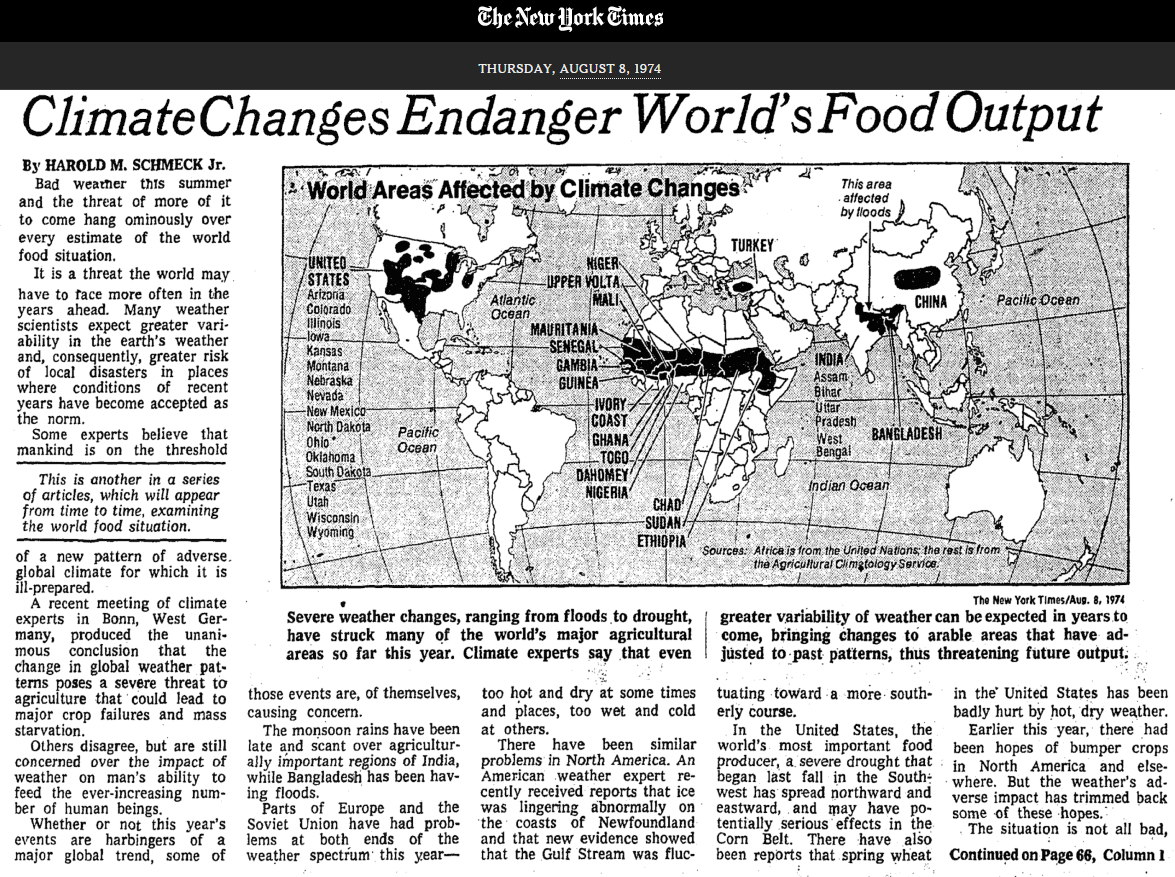
https://www.denverpost.com/2019/06/22/colorado-weather-rain-snow-summer/
and snow in late June
The weather will not help farmers.
https://earth.nullschool.net/#2019/06/27/0000Z/wind/isobaric/850hPa/overlay=cape/orthographic=-95.52,37.87,2059/loc=-94.725,39.722
David,
RE: “The emerged crop is one month behind where it was in 2018. Which means that maturity will be one month later at best, assuming that the rest of the summer isn’t abnormally cold.”
Not quite right. When cold and rain prevents farmers from planting the ‘normal’ 110 – 120 day maturity corn varieties, they usually buy shorter maturity varieties (90 day) to accommodate the shortened growing season.
Hay production is also imperiled. The continued rains across Minnesota, Iowa, Wisconsin, Illinois, Michigan, Indiana, and Ohio has seriously delayed the 1st cutting of both alfalfa and grass hay. In some areas, it is so wet and the hay crop is so far past prime and spoiled that it will likely be cut, removed from the fields, and thrown away to allow the 2nd cutting regrowth to progress! Cut hay needs 3 to 5 days of sunny drying weather before it can be safely baled and stored without molding or spontaneously combusting. When the underlying soils are water saturated, the cut/crimped hay takes longer (5 sunny days) to dry sufficiently… and may still require heavy additions of ‘preservatives’ to prevent molding and/or heating.
So should President Trump issue an executive order canceling the ethanol quota for gasoline?
Or just let people starve?
I do not believe that the interesting analysis supports the far reaching conclusion. There is no point in replacing premature fear mongering conclusions from the warmists with premature fear mongering “coldists” conclusions.