by Dr. Roger Roots, Lysander Spooner University
A decade ago, folks in northern states such as Minnesota, South and North Dakota, Montana, Wyoming and Idaho were watching large swaths of their pine forests die off due to invasive pine beetles. The pine beetles bored beneath the bark of pine trees and introduced a fungus and larvae which weakened and then killed the trees.
Millions of pine trees were killed, prompting environmentalists and state and federal government agencies to link the invasive beetles to catastrophic-manmade-global-warming-by-carbon dioxide. Science Magazine warned that “Climate Change Sends Beetles Into Overdrive” (Mar. 16, 2012). The U.S. Forest Service launched numerous web pages under a “Bark Beetles and Climate Change in the United States” designation.
State and federal agencies collected and spent millions of dollars to mitigate the effects of the beetles. Several states amassed funds in designated ‘beetle epidemic’ accounts.
But colder weather accomplished what the agencies could not. Five years of harsh winters have mostly killed off the beetles in the north woods. Most foresters declared the end of the beetle epidemic around 2017. Almost no one seemed to link the END of the epidemic to earlier claims regarding a link to the CO2 apocalypse.
Now the State of South Dakota has $700,000 remaining in a ‘pine beetle fund’ which was never used. Last week the South Dakota legislature debated about what to do with the excess money. The debate was the topic of Tuesday’s top front page in the Rapid City Journal.
The end of so-called “global warming”.
I have a suggestion for that excess money. Spend it on a study debunking global warming catastrophy predictions.
Nah buy tbe forestery service Teslas.
That would take up $10.95. What can we do with the rest? I suggest a pig roast kegger and used tire bonfire! That would go through at least $500. A good start.
https://www.breitbart.com/politics/2019/02/26/watch-louie-gohmert-ends-climate-change-hearing-due-to-lack-of-democrat-attendance/
Even Democrats have lost interest in climate change.
Uh… what? Was I having a strange dream? They’re losing interest in this new religion?? Holy cow!
What’s happening?????
Worshipping a false god is a waste of time and money!
Was any god even proven true?
You wouldn’t know it watching the leftist greenies on daily display.
Never confuse political interest for personal action.
See: list too long to post, but would include Leonardo di Caprio (and most of Hollywood and the entertainment business in general), Bernie Sanders (and most other leftists, and way, way too many of the right), etc.
“You wouldn’t know it watching the leftist greenies on daily display.”
That bunch is always a day late and a lot of YOUR money short!
Where is oscio kotex when we need her?
Well, colder winters are due to AGW, don’t you know? /sarc
And give it a few dataset revisions – they’ll make sure those colder winters never happened.
no no no…Warmer Summers are AGW (W), Colder Winters are ACC
Yep …. and we will hear a prediction soon that Climate Change will result in the extinction of the benovolent pine Beetle. /sarc
ROTFLMAO! I didn’t even think of the ‘extinction of another animal’ angle.
Earlier WUWT threads on this topic contained quotes from warmist scientists or “communicators” that AGW implied that really cold winters were a thing of the past.
The trick is to have so many people predicting so many things that some of those predictions will come true no matter what happens.
No matter what happens, the warmists can tell us that it is exactly what was predicted.
The problem is to hold the warmists accountable for all the failed predictions. I have no idea how to do that.
But they are just “projections”, so it’s OK.
That’s why they get so beside themselves when you point out that a theory which predicts everything really predicts nothing.
It’s difficult to say their predictions failed when they use global warming for every type of rough weather and disease known and unknown to man. Global warming causes no snow, global warming causes more snow. Global warming causes drought, global causes floods, global warming causes cancer, global warming causes small testicles etc.
Horse hockey, (not to be confused with hockey stick) global warming has created piles and piles of that.
Considering that absolutely none of even the scariest warming scenarios dreampt up by the apocobots says that there will be NO cold winters (yes, despite the “children won’t know what snow is headlines)…even the Chickenest of Chicken Littles shouldn’t be suprised by this.
Or, as we all know, the dangers of averages strikes again…
Or the “new normal” of permanent drought in California? The past two years have been on the high side of the normal distribution for rain.
Last year here in Toronto, we had some bad localized flooding due to high spring run-off.
The usual suspects trotted out the usual models and, sure enough, in perfect sciency hindsight, this was the very “new normal” we could expect. The science was settled, we would get more spring run-off due to sciency stuff the layperson couldn’t possibly understand. Just believe the High Priests, provide them with the usual tribute, and start the process of learning to live like cave men again.
Of course, just two years before that, we had a spring with lower-than average spring run-off. The water level of the Great Lakes was low. We’d have to spend billions of dollars to dredge channels and the pleasure boat industry was worried as docks were too far from the water.
The usual suspects trotted out the usual models and, sure enough, in perfect sciency hindsight, this was the very “new normal” we could expect. The science was settled, we would get less spring run-off due to sciency stuff the layperson couldn’t possibly understand. Just believe the High Priests, provide them with the usual tribute, and start the process of learning to live like cave men again.
Of course, the intervening two years had completely average spring run-off, and when you average the very low year, the average years, and the very high year…you get something…very average indeed.
And certainly not headline-worthy. It ain’t bleeding, so it ain’t leading. Quick, find a threatened bee somewhere (and hope people forgot that this week they “found” a long extinct bee).
Repeat as needed (needed defined as “increase the number of clicks we can show our advertisers so our bonus and stock options won’t be threatened).
We have had a very minor earthquake of Richter 3.70 earlier this week, and a couple more of a smaller intensity, in Surrey, England! No damage and no injuries has been reported! Regardless of this, the Green blob immediately screeched on the net, ” it’s all due to fracking!” Someone had to politely explain to them that there were no fracking activities in this part of the UK!
We have also had, this week, a significant moorland fire in Yorkshire. A relatively dry winter with an unseasonal much warmer February which led to hundreds of acres of dry peatland – a fire just waiting to happen!. However, no one yet knows what started the fire, and it was soon brought under control! Regardless of that, the same Green blob shrilled out: “Climate Change” blithely disregarding the fact that last year at the same time we had what was known as “the Beast from the East” – an uncharacteristic swathe of extreme colder weather from mainland Europe.
Too many of the Greens have no integrity, common sense or shame! They scream out CAGW/Climate Change whatever happens and regardless of how ridiculous they make themselves look and even further discrediting whatever arguments and evidence they provide. Their intellectual contortions and acrobatics in an attempt to publicise and substantiate their theories is similar to that practised by the extreme left throughout the 20th century and even now. – a desperate attempt to justify and substantiate their dogma!
Well, as I’ve pointed out before, fewer people would be frightened these days if their math skills were better.
I try to counter science with science, and anectdotes with anectdotes.
I find stuff like this good for the later:
http://www.gutenberg.org/files/34439/34439-h/34439-h.htm
1838.
JANUARY.
1.—The weather on this day was of a beautiful and spring-like character. During the remainder of the week “the moon in her first quarter and the planet Venus made the evenings most brilliant. Never in the memory of man did the old year go out or the new one come in with such splendour as the last and the present. Both days in all respects resembled April or even May much more than December or January.”
DECEMBER.
24.—The weather on this day was only ten degrees colder than on June 24th. “The thermometer out of doors remained at 50.”
1840.
December
31.—The weather “was warmer and more brilliant than the last days of May are sometimes found to be.” In the previous week the thermometer stood at eleven degrees below freezing point.
1841.
JANUARY.
16.—All the marshes and low-lying lands in the vicinity of Norwich were flooded upon the breaking up of the frost. Owing to the heavy state of the roads, the mail and stage coaches were delayed several hours beyond their usual time. The weather was remarkably warm and brilliant in the last week of the month.
1856.
November
29.—Snow began to fall, and soon reached a greater depth than had been recorded in Norfolk for many years previously. At nine o’clock on the morning of December 4th the thermometer stood at 16 deg.; the reading of the same instrument, in the same place, at eleven a.m. on December 6th was 60 deg. In thirty-six hours from ten to twelve inches of snow had disappeared, and the weather thenceforth was very mild.
1859.
FEBRUARY.
5.*—“Several primroses were gathered in the hedges near Ormesby a few days ago. The weather is exceedingly mild in this locality, which is not a little remarkable for this, almost the easternmost, part of England.”
Its almost as if they don’t think we’d check…
So glad to hear you survived your first devastating earthquakes in Surrey! I was raised in Cobham Surrey and have lived in the suburbs of Los Angeles for the last 54 years. A 3.5 EQ here in L.A. would be registered about 10 times a week and would be hardly noticed. I have lived through 3 that registered above 6 on the scale,
including the Northridge quake at 6.9 that killed 17 people. We dont have fracking in California either!! We do have cheaper gasoline by $1 a gallon because of President Trump allowing fracking in other States though and the US is now exporting more oil than the Saudis!! (and sells rice to China that is grown in California) U.S. WINNING AGAIN!!😄😄
There is an article in the National Geographic quite a few years ago, that linked lake level (low at that time) to the dreaded climate change-then still called Global Warming. Amazing enough, they provided graphs that unequivocal pointed to frequent swings in lake level-up and down, miraculously to about the same level.
Low as well as high. It was obvious a thing that repeats itself. Only years later I learned that the levels are influenced to a large decree by outflow on the US side (indeed man-made).
Since then we have seen at least one, if not more cycles if “oi, it is low these years” and “oi, it is high these years”
There is an article in this months National Geographic delivered today in Australia blaming climate change on a massive increase of these beetles as well as Invading grasses, Wilder wildfires, bark beetles, mountain pine beetles and spruce beetles in the Rocky Mountain National Park .
Here in PA we have seen a decline in gypsy moth caterpillar infestations. And here I thought is was because people started using pump up sprayers filled with warm water and Dawn dish soap on their nests. Climate Change, is there nothing it can not do!?!?!?
Control hemorrhoids???
Not likely. Warmests are already a pain in the A$$!
Nests?
Gypsy moth nests?
I believe you have misidentified your caterpillars.
Gypsy Moths do not form nests, per se. They do lay egg masses or clutches on the bark of a tree. Gypsy moths also form cocoons, which can be found anywhere the caterpillar can crawl, including vehicles,doorways and windowsills.
In between, they live on the branches where they eat leaves.
Tent caterpillars form the nests one commonly sees in trees.
Tent caterpillars lay their egg masses around a twig, not in a nest. The caterpillars make the silken nest and expand it as the caterpillars grow.
It is possible for soap to minimize surface tension and allow water to fill insect breathing tubes, thus drowning them. Otherwise, soap simply cleans the caterpillar.
Soap is used in herbicidal and insecticidal solutions, allowing the spray to ‘wet’ the surface of the target.
One of the reasons poison ivy is so hard to kill is because the oily surface prevents herbicides from wetting the leaf.
Tent (and forest) caterpillar webbing similarly protects the tent caterpillars. One must breach the exterior and spray inside of the nest.
Tent caterpillars return to their nest each night,but range all over the tree during daytime hours. Making the best time to treat their nests, just after dawn.
Frankly, I usually just break off the branch where the nest is forming and squash the bugs.
“Frankly, I usually just break off the branch where the nest is forming and squash the bugs.”
That’s the techique I use. It works pretty good.
Another species at risk of extinction due to extreme cold caused by global warming.
/sarc
What PaulH said!
Just to clarify – this is a native species, not an invasive. Pine beetle populations track cycles of temperature and moisture and are a totally ‘normal’ part of Pinus evolution.
Matt in Wyoming
Normal yes, but the size and extent of this ongoing outbreak was facilitated by poor forestry practices, or at least that is how the forest entomologists explained it before being bullied into silence or recanting (or jumping on the funding bandwagon) by the AGW crowd.
Some of the unspent money needs to go toward signage changes at state and national parks that spread the propaganda message for park visitors on propaganda placards (e.g. Rocky Mtn National Park, Grand Canyon National park, and Sunset Crater AZ). Do this before the lawsuits ensue over the damage done from spoiled visits to parks.
I’m skeptical.
Pine beetles are ubiquitous.
Healthy pines are resistant to pine beetles.
The pine forests die off is due to weak trees; the beetles are secondary.
Don’t know why the trees were weak. Could have been weather. Could not have been CLIMATE.
‘Climate Change Sends Beetles Into Overdrive’
Science Mag should be embarrassed; they won’t be.
Pine beetles can turn healthy pines into unhealthy pines and they will ultimately die. The size of the infestation depends on a lot of things, but when things are right a lot of trees (healthy or unhealthy) will succumb.
Forest fires promote bark beetle outbreaks by weakening trees.
I have heard the hum of bark beetles in recently scorched pine stands. The needles are gone but the trunks are still green. Beetles love it and breed like mad, with so many (male) beetles stridulating that it sounds like a 60 cycle hum in the burnt forest.
The next spring the newly hatched beetles swarm into adjacent unburned stands and overwhelm even healthy trees. In fact, every major bark beetle infestation in recent decades has been the predictable result of preceding fires.
Enter the lowly woodpecker.
Woodpeckers drill holes that allow vermin to further infest trees.
Providing a bounty for woodpeckers later when they return to consume any bugs.
John Gierach,an author, has written about his short career cutting down beetle killed trees in Colorado’s forests during the 1960s.
Beetle infestations are cyclical.
What is the property of the pine tree specifically that weakens that the pine beetles use to infest the bark? Has any arborist done a gene expression analysis pre and post infestation to see which genes are turned off or over expressed in the infested trees compared to the non infested ones? There may be clues in the epigenetics as well.
The current temperature in South Dakota.

In fahrenheit
Living in southeastern Idaho in the 80s, I saw the forests in Idaho and Yellowstone that had been devastated by the pine bark beetle. Clearly, those epidemics were NOT caused by global warming, but these new outbreaks are…
Oh, and the late 80s Yellowstone fires were huge because of accumulated fuel loads, but fires in the 2010s are because of global warming.
1980s had weather
2010s have climate change
1988 Yellowstone fires. A relative did contract work for the U.S. Forest-Yellowstone National Park prior to this the big year 88′. Arial mapping, digital. Flying taking these Arial photos that could be, latter enhanced digitally to show earth, landscape, vegetation, man made features etc.
Post 88′ fires, new mapping was done. The earlier mapping showed the beetle kill. The post 88′ fire mapping showed that the fires more or less followed the bug kill stands, with some healthy forest burn kill. Excessive fuel – bug kill on the ground in some places inside of Yellowstone made fire control-herding nearly impossible.
“Collaborative efforts have begun to make the Black Hills more resilient during the next epidemic. Research has led some observers to believe that a thinner forest is more resilient to the bugs. A thinner forest also contains less fuel for wildfires.”
Someone did actual research to figure this out? It will be interesting to see what they do with the leftover money.
Rule 17 for research: Research will expand to absorb all monies allocated to the subject.
I remember reading years ago that the pine beetle is a weak flier, if I recall right it’s was something like they can fly 6 feet. If the trees are dense (like they are when planted by man post logging) the infestation easily spreads. Density is so high that it’s hard to impossible to walk through a stand between how close the trunks are spaced and limbs intertwining. More natural growth ends up with trees spaced 20ish feet apart so it is harder for the infestation to travel between trees, slowing down the spread.
No, they’re not weak fliers, they breed while flying. Once bred, the female will only fly until she finds the closest suitable tree to infest.
Trees planted post logging are usually less dense than natural. Lodgepole pine cones will not open unless exposed to high temperature that only comes from direct summer sunlight or fire. Shaded cones can remain closed and viable on the tree for decades and then when opened by the heat of a fire, spread decades worth of accumulated like grass. I’ve seen such pine stands so thick a rabbit would have a hard time getting through, 30 years old and only 3 ft. tall because they suppress and stunt each other.
Flying pine beetles have been known to be caught in strong thermal updrafts and transported across the Rockies.
Salute Art!
Darrin is correct. They only fly a hundred yards or less, then burrow in.
Secondly, that is where they mate, and the female emits a pheromone , maybe some from the males there, and soon you have a mass attack. They do not mate in the air.
The cold really does kill them, and so you find most beetle kill are older trees with thick bark so those buggers can survive a cold winter. They cannot survive on dead trees resulting from a fire due to lack of sap, and a fire in early spring will likely kill the adults before they fly to the next tree. The tree may survive, but do not count on that.
Gums sends…
Beetle watcher and killer since 1998 on my property
I stand corrected, when they “fly” is when they mate. Other than that their lives are spent in the bark.
A hundred yards is considerably more than would be affected by sparse planting. Wind also moves them along. I’ve seen a small group of infested pines within a spruce/balsam stand, miles from any other pine. They do travel far at times.
Old yellow (ponderosa) pine and old white pine have thick bark. Old lodgepole pine does not, it’s the same as the younger trees.
Simple example of population dynamics. Every species has natural predators. When one population expands, the predator population will follow with an increase in population that will bring the first population under control. This oscillation will continue into the future with the same or new and different species. It has virtually nothing to do with climate change.
Just wait for it, climate change will be blamed for the decreased pine beetle population, just like the claims that climate change has already reduced flying insect populations by up to 80%! How exactly has climate change accomplished this? ??? We just know that climate change is bad, and man is what done it.
Bark Beetle a consistent negative in a coniferous forest in North America. https://en.wikipedia.org/wiki/Bark_beetle. The 1940-1950’s foresters considered the Western United States conifer forests had a 350 year window of healthy to sick-dying cycle. Not all at once but piecemeal thrive and die-burn. Bark Beetle played a role. Sir Frances Drake on a seaborne exploration voyage noted large standing smoke columns in the interior of California. Speculation is plenty, man made fire or nature fire?? Both?
Bark Beetle bores egg holes. Tree if healthy plenty of nutrients, water is a major one that may/can change seasonally, along with chemical nutrients produce sap. This sap in a good year will plug the egg bore hole and kill the eggs-hatch. Bark beetles are always present. Good tree growth years the sap keeps the beetle damage in a state of neutral, low spread damage. Significant Cold helps this natural defense.
Dry years-droughts will allow wide spread bark beetle damage. During the 50’s-60’s (PNF-Plumas National Forest, I am most familiar with, but the Lassen to the North and the Tahoe south) a 55% sustained yield on the PNF harvest created a checker board appearance. Readily visible from the air. Blocks harvested-contracted by private loggers would many times have an add on adjacent to or near by the harvest block to remove bug kill stands. Some smaller ‘clear cut’ did occur, primary purpose was to remove poor stands and or invasive specie trees. Replant of a clear cut was soon after. Some ‘harvest block’ manual replant occurred, other times a natural seeding (Mother Trees – seed) . Prior to the false narrative of spotted owl and 2nd growth the PNF was producing 180 million board feet of lumber per year. Sustainable at the 55% average yield.
Two additional qualities of this ‘checker board’ harvest plan allowed competent fire control management using this checker board landscape a man created fuel reduction place to control an unwanted fire. Unwanted Fire may not have been fully developed as a ‘criteria’. For sure one of these ‘unwanted’ fires during a drought-Red Flag fire weather time frames the Fire could be attacked with experienced logging equipment operators in 7-10 ‘Sides’ – meaning individual logging operations spread out on the forest (PNF) during the normal logging season. Equipment plenty, Cat’s (bulldozers) and water trucks. Fire Cache requirements at each site. Also the assigned U.S. Forest Wildland fire fighters. The then Forest assigned forest managers knew their watersheds like the back of their hand. Ingress-Egress, with the ideal checker board. Not so today – Computers have replaced boots on the ground for forest management which is to let nature do the work.
WUWT several years ago posted a picture of a large cross section round piece of Redwood-Sequoia dead tree. This showed some interesting burn/char cycles. Man created or natural? Definitely not modern industrialize man. Fire fuel accumulation to create 1 or 2 of the larger char would be necessary. Would be necessary to visit the ‘site’ where this tree round was taken, slope-topography and fuel. There are accounts – California Indian verbal history where large tree (like this Sequoia) would be intentionally prepared fire charred creating receptive fire start material (charcoal). These Indians would hike to the high forest in the Sierra time to time, like teaching a youth boy transitioning to man, and if caught in a summer snow/cold rain could take shelter in these Cat Faced charred trees. Boys are always Boys no matter the culture.
1°C of warming is roughly equivalent to an average latitude shift of about sixty miles.
For the beetles, it’s apparently winter nighttime lows that matter most, and those are what are disproportionately affected by “global”[sic] warming. So, plausibly, it could cause a bit more beetle range expansion than that. Maybe a hundred miles?
Now, compare that small distance to the beetle’s >2000 mile range:
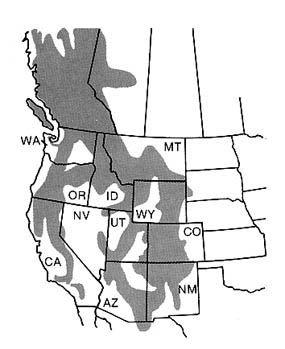
Yet they want to blame pine bark beetle damage to climate change!?! That’s crazy.
They didn’t “debate about.” They just debated.
Oh noes! Another species goes extinct due to caaaahbon! #@ur momisugly$! that Global Warming.
Insect armageddon!
Another round of bug-killing extreme cold coming to the Dakotas-Great Lakes-Iowa region this weekend into Monday.
When it is excessive cold, it’s weather.
When it is excessive heat, it’s climate change.
Climate Change alarmism – The Big Lie.
Here in Southeast Michigan back may 12-15 years ago we were overrun with Asian Ladybeetles. Shaped like the classic Ladybug, but with more spots and often colored light yellow or light orange. Also had a nasty bite and let off a stink if you squashed them. They’d over-winter in any crevice they could find. I’d vacuum up dozens if not hundreds from our 3-season porch (unheated, glass doorwalls all around).
I have not seen one in at least 5 years. A few years ago we had a couple of really hard winters – days long periods of lows near to well below zero F and sometime highs below zero. No more Asian Ladybeetles. The population of Japanese Beetles, which became a problem, is way down also.
Too bad the cold can’t kill Emerald Ash Borer or some of the other invasive nasties we have showing up.
The climate alarmists’ parade of horribles continues on, with most of them pointing to the mid-1800s as the end of a postulated planetary golden age when humans began killing off every precious thing with our gluttony and acquisitiveness and the beginning of the “Anthropocene Era” of global warning.
Raining on their little parade, are the following facts from the North American Forest Commission:
“After two centuries of decline, the area of US forestland stabilized in about 1920 and has since increased slightly. The forest area of the US is about two-thirds what it was in 1600.
The area consumed by wildfire each year has fallen 90 percent; it was between eight and twenty million hectares (20-50 million acres) in the early 1900s and is between one and two million hectares (2-5 million acres) today.
Forest growth nationally has exceeded harvest since the 1940s. By 1997 forest growth exceeded harvest by 42 percent and the volume of forest growth was 380 percent greater than it had been in 1920.
Nationally, the average standing wood volume per acre in US forests is about one-third greater today than in 1952; in the East, average volume per acre has almost doubled. About three-quarters of the volume increase is in broad leaved or deciduous trees.
Populations of many wildlife species have increased dramatically since 1900. But some species, especially some having specialized habitat conditions, remain the cause for concern.
Tree planting on all forestland rose dramatically after World War II, reaching record levels in the 1980s. Many private forestlands are now actively managed for tree growing and other values and uses.
Recreational use on national forests and other public and private forest lands has increased manyfold .
American society in the 20th century has changed from rural and agrarian to urban and industrialized. This has caused a shift in the mix of uses and values the public seeks from its forests (particularly its pubic forests). Increased demands for recreation and protection of biodiversity are driving forest management. This has caused timber harvest from federal lands to decline by more than 60 percent since 1990. In spite of this shift, today’s urbanized nation is also placing record demands on its forests for timber production.
“The area consumed by wildfire each year has fallen 90 percent”
This is true.
The big difference? ICE. It was the internal combustion engine that gave us the mobility to manage the wilds so effectively.
Matt Dzialak is correct, the pine beetle is NOT an invasive specie.
Furthermore, if warm weather is responsible for the “unusual” spread of the beetles, why do pine trees even exist in the warmer south?
Way back about 1970, I was an assistant ranger in the BC Forest Service in the southern part of the province. At that time we were given a seminar on what to watch for vis-à-vis symptoms of pine beetle infestation. Our superiors were concerned that we could experience a similar outbreak to the vast infestations that were a regular occurrence in the NORTH central part of the province. That’s right, the infestation here in BC started in the western north central region and spread eastward and south. They ripped through the hot Kamloops region but somehow the infestation stopped before reaching the hot Okanagan where it NEVER gets cold enough to kill them.
Healthy vigorous trees push out the beetles with sap flow. Old, over-mature trees are like old people, their metabolisms slow right down, and they can’t push the beetles out. At the time of the pine beetle outbreak here in BC, we had 4 times as much old pine forest as 100 years before, likely due to our ending the native practice of burning off forest (in order to generate new growth which has much more resources for a hunter gatherer society) and fighting fire.
In the late 1990’s we had a quite a nice collection of exotic plant species in the garden. Things like broad-leafed banana plants that would not normally exist in Scotland. It was quite fashionable and these things were in garden centres. So why not, and we got away with it for a good few years. And then we had a bad winter with freezing conditions, and the penny dropped. It only takes one bad winter to show why these things don’t live here. Lesson learned.
I have discussed this before (on related posts regarding bark beetle epidemic), the most recent and wide ranging and destructive epidemic can trace its beginnings to a blow down event on the Routt NF in 1997. I link to an article below from the time, unfortunately the USFS did not have the budget to re-mediate the downed trees and the commercial option that would have mitigated the situation was stalled by legal action; stalled long enough for the commercial viability for salvage to expire. The resulting spread/damage was a textbook case of “road to ruin is paved with good intentions” with a healthy dose of NIMBYism. Link to article: https://www.hcn.org/issues/119/3803