IT WORSE THAN WE THOUGHT! ~ctm
Climate change tipping point could be coming sooner than we think
New study shows that vegetation may not be able to continue abating the effects of emissions from human activities
Columbia University School of Engineering and Applied Science

New York, NY–January 23, 2019–Global carbon emissions reached a record high in 2018, rising by an estimated 3.4 percent in the U.S. alone. This trend is making scientists, government officials, and industry leaders more anxious than ever about the future of our planet. As United Nations Secretary General António Guterres said at the opening of the 24th annual U.N. climate conference on December 3, “We are in deep trouble with climate change.”
A Columbia Engineering study, published today in Nature, confirms the urgency to tackle climate change. While it’s known that extreme weather events can affect the year-to-year variability in carbon uptake, and some researchers have suggested that there may be longer-term effects, this new study is the first to actually quantify the effects through the 21st century and demonstrates that wetter-than-normal years do not compensate for losses in carbon uptake during dryer-than-normal years, caused by events such as droughts or heatwaves.
Anthropogenic emissions of CO2–emissions caused by human activities–are increasing the concentration of CO2 in the Earth’s atmosphere and producing unnatural changes to the planet’s climate system. The effects of these emissions on global warming are only being partially abated by the land and ocean. Currently, the ocean and terrestrial biosphere (forests, savannas, etc.) are absorbing about 50% of these releases–explaining the bleaching of coral reefs and acidification of the ocean, as well as the increase of carbon storage in our forests.
“It is unclear, however, whether the land can continue to uptake anthropogenic emissions at the current rates,” says Pierre Gentine, associate professor of earth and environmental engineering and affiliated with the Earth Institute, who led the study. “Should the land reach a maximum carbon uptake rate, global warming could accelerate, with important consequences for people and the environment. This means that we all really need to act now to avoid greater consequences of climate change.”
Working with his PhD student Julia Green, Gentine wanted to understand how variability in the hydrological cycle (droughts and floods, and long-term drying trends) was affecting the capacity of the continents to trap some of the emissions of CO2. The research is particularly timely as climate scientists have predicted that extreme events will likely increase in frequency and intensity in the future, some of which we are already witnessing today, and that there will also be a change in rainfall patterns that will likely affect the ability of the Earth’s vegetation to uptake carbon.
To define the amount of carbon stored in vegetation and soil, Gentine and Green analyzed net biome productivity (NBP), defined by the Intergovernmental Panel on Climate Change as the net gain or loss of carbon from a region, equal to the net ecosystem production minus the carbon lost from disturbance like a forest fire or a forest harvest.
The researchers used data from four Earth System Models from the GLACE-CMIP5 (Global Land Atmosphere Coupling Experiment–Coupled Model Intercomparison Project) experiments, to run a series of experiments to isolate reductions in NBP that are due strictly to changes in soil moisture. They were able to isolate the effects of changes in long-term soil moisture trends (i.e. drying) as well as short-term variability (i.e., the effects of extreme events such as floods and droughts) on the ability of the land to uptake carbon.
“We saw that the value of NBP, in this instance a net gain of carbon on the land surface, would actually be almost twice as high if it weren’t for these changes (variability and trend) in soil moisture,” says Green, the paper’s lead author. “This is a big deal! If soil moisture continues to reduce NBP at the current rate, and the rate of carbon uptake by the land starts to decrease by the middle of this century–as we found in the models–we could potentially see a large increase in the concentration of atmospheric CO2 and a corresponding rise in the effects of global warming and climate change.”
Gentine and Green note that soil-moisture variability notably reduces the present land carbon sink, and their results show that both variability and drying trends reduce it in the future. By quantifying the critical importance of soil-water variability for the terrestrial carbon cycle, and the reduction in carbon uptake due to the effects of these changes in soil moisture, the study findings highlight the necessity of implementing improved modeling of vegetation response to water stress and land-atmosphere coupling in Earth system models to constrain the future terrestrial carbon flux and to better predict future climate.
“Essentially, if there were no droughts and heat waves, if there were not going to be any long-term drying over the next century, then the continents would be able to store almost twice as much carbon as they do now,” says Gentine. “Because soil moisture plays such a large role in the carbon cycle, in the ability of the land to uptake carbon, it’s essential that processes related to its representation in models become a top research priority.”
There is still a great deal of uncertainty on how plants respond to water stress, and so Green and Gentine will continue their work on improving representations of vegetation response to soil moisture changes. They are now focusing on the tropics, a region with lots of unknowns, and the largest terrestrial carbon sink, to determine how vegetation activity is being controlled by both changes in soil moisture as well as atmospheric dryness. These findings will provide guidance on improving the representation of plant water stress in the tropics.
“This study is highly valuable as it shines a bright spotlight on just how important water is for the uptake of carbon by the biosphere,” says Chris Schwalm, an associate scientist at Woods Hole Research Center and an expert in global environmental change, carbon cycle sensitivity and modeling frameworks who was not involved in the study. “It also exposes underdeveloped aspects of Earth system modeling such as processes related to vegetation water-stress and soil moisture, which can be targeted during model development for better predictive capacity in the context of global environmental change.”
###
From EurekAlert! Public Release: 23-Jan-2019
About the Study
The study is titled “Large influence of soil moisture on long-term terrestrial carbon uptake.”
Authors are: Julia K. Green1, Sonia I. Seneviratne2, Alexis M. Berg3, Kirsten L. Findell4, Stefan Hagemann5, David M. Lawrence6 & Pierre Gentine1,7 (1Department of Earth and Environmental Engineering, Columbia Engineering; 2Department of Environmental Systems Science, ETH Zurich, Switzerland; 3Department of Civil and Environmental Engineering, Princeton University; 4Geophysical Fluid Dynamics Laboratory, Princeton, NJ; 5Institute of Coastal Research, Helmholtz-Zentrum Geesthacht, Germany; 6Climate and Global Dynamics Laboratory, Terrestrial Sciences, National Center for Atmospheric Research, Boulder, CO; 7The Earth Institute, Columbia University.)
The study was supported by NASA Earth and Space Science Fellowship (NNX16AO16H).
The authors declare no competing interests.
LINKS:
Paper: https://www.nature.com/articles/s41586-018-0848-x
DOI: 10.1038/s41586-018-0848-x
Discover more from Watts Up With That?
Subscribe to get the latest posts sent to your email.
I thought we already past the tipping point… several times!
Who would have thought that moving goalposts would become such a high paying occupation.
Yes, it is happening so fast we just keep tipping over and over and over….just Guam…. ; )
Just LIKE Guam…..D’OH !
Didn’t we just miss a tipping point with the carbon dioxide starvation of the earth’s vegetation?
More history denial from the alarmists. Or is it wilful ignorance of history as opening their eyes and thoughts could remove the confirmation bias they all seem to suffer from?
Apparently we’ll reach a tipping point when the oceans dry out. In 50-80 years.
Junk science if there ever were.
“The authors declare no competing interests.” nope, just paid to produce a result…
Gentine and Green note that soil-moisture variability notably reduces the present land carbon sink
which is why some of the wettest places are also some of the greenest places such has the tropical jungles that would be green as in ‘good carbon sinks ‘
The tipping point problem goes away if there is no AGW.
1) There are a dozen different papers that show CO2 does not even correlate with temperature change in the ancient climate.
2) There are also a dozen papers that show the majority of the increase in atmospheric CO2 was due to the increase in temperature not human emissions. (William: This second issue is interesting as there is geological evidence that explains what is happening.)
3) The temperature rise in the atmosphere that did happen in the last 390 years does not match the signature of AGW.
Example of 1 in a 2017 peer reviewed paper.
…This study demonstrates that changes in atmospheric CO2 concentration did not cause temperature change in the ancient climate.
http://www.mdpi.com/2225-1154/5/4/76/pdf
The Relationship between Atmospheric Carbon Dioxide Concentration and Global Temperature for the Last 425 Million Years
Atmospheric CO2 concentration is correlated weakly but negatively with linearly-detrended T proxies over the last 425 million years.
Of 68 correlation coefficients (half non-parametric) between CO2 and T proxies encompassing all known major Phanerozoic climate transitions, 77.9% are non-discernible (p > 0.05) and 60.0% of discernible correlations are negative.
Marginal radiative forcing (DRFCO2), the change in forcing at the top of the troposphere associated with a unit increase in atmospheric CO2 concentration, was computed using MODTRAN.
The correlation between DRFCO2 and linearly-detrended T across the Phanerozoic Eon is positive and discernible, but only 2.6% of variance in T is attributable to variance in DRFCO2….
…This study demonstrates that changes in atmospheric CO2 concentration did not cause temperature change in the ancient climate.
“There is still a great deal of uncertainty on how plants respond to water stress, and so Green and Gentine will continue their work on improving representations of vegetation response to soil moisture changes. They are now focusing on the tropics, a region with lots of unknowns, and the largest terrestrial carbon sink”
….so please send money so we can go all expenses paid to the Amazon to try to measure something we could more easily quantify by making a terrarium.
Climate change ‘tipping points’ only exist in climate models. They bear no relation to the real world.
New study shows that vegetation may not be able to continue keeping squadrons of pigs from taking to the air, or attacks by space aliens. Stupid vegetation.
Regarding sea level rise, the best “model” I know of are the sea level gauges at The Battery in NYC, or Baltimore or Philadelphia. All three are mounted on crystal rock. All three show uniform rates of sea level rise for 168 years (The Battery) or 118 years (Baltimore and Philadelphia.) None show any inflection whatsoever up or down. All three have recently installed GPS elevation measuring devices which show slow subsidence over the past decade or so, suggesting that about half the measured rise is due to subsidence. When these devices start to show rapidly increasing sea level rise rates, I will believe the warmists. Folks have been watching now for up to 168 years with nothing revealed except slow and very steady sea level rise which some sources suggest has been going on for the past 6,000 years.
Check out PSMSL.org and see for yourself. NOAA has the same sea level charts available but unfortunately (or perhaps intentionally) does not show the elevation changes .
Water is important to plants: NO!!!!!!
You do not say:
6H2O + 6 CO2 plus light gives you C6H12O6 + 6O2 anyone?
Photosynthesis requires water!
Give me a Nobel Prize immediately!
How many tipping points are you allowed before your called out?
Apparently some politicians are allowed more than others
I knew a guy who got a master’s degree from Columbia. He was a complete idiot. I’m sure that this is not the case with all that attend that prestigious school but it proves that it is possible to attend, receive an advanced degree and still be an imbecile.
Probably does a lot of talking, too.
Nailed it!
I have a Master from the EPFL which is considered a prestigious school in Europe, some of my colleagues have said that me arguing against CAGW was a crime against humanity. I counter argued along the lines of Alex Epstein’s moral case for fossil fuels, it shut them up but I am not sure I convinced them. Some of these colleagues are very smart, but when it comes to climate they seem to lose their minds and forget the principles of the scientific method…
I know a literal rocket scientist.
He once crashed our entire computer network when he loaded up Napster…
As they say: knowledge is knowing that a tomato is a fruit. Wisdom is not putting a tomato in a fruit salad.
And according to the same climastrology models, as tundra thaws into marsh, bogs, and lakes, there will be net carbon output and less carbon sequestration. So now dryer soils = loss of soil carbon and wetter soil = loss of soil carbon. It definitely sounds worse than we thought, the state of the “science” that is.
It’s worse than we thought!!!
Again.
And again, and again, and….
Despite passing all the deadlines of all the predictions of having no more than 10 years to act with no catastrophe.
Seems to me the actual observable evidence contradicts all the doomsday predictions. They should be saying it’s nowhere near as bad as we thought.
In the beginning there was headline journalism and then it spread to headline science positioning.
Yes, as I posted yesterday about something on CNN.com:
1) headline said climate change “will” affect gender
2) the VERY FIRST PARAGRAPH said climate change “might” affect gender based on a new report
3) the new report “verified” a previous report that said the same thing
4) the new report said it wasn’t sure why climate change might affec gender
Science reporting: clickbait about murky research getting torqued to maintain the Narrative…
“The researchers used data from four Earth System Models from the GLACE-CMIP5 (Global Land Atmosphere Coupling Experiment–Coupled Model Intercomparison Project) experiments, to run a series of experiments to isolate reductions in NBP that are due strictly to changes in soil moisture.”
Reasrchers? Experiments?
Garbage, Garbage In Garbage out. They researched nothing. They ran no experiments. They didn’t know how the real world worked when they started, and they still don’t. They never left the campus of Columbia University in the middle of one of the most densely urbanized places on the planet. They neither touched nor saw a plant, a forest, the ocean or anything other than their keyboards and monitors.
This is not science. It is mathematical onanism. And, they need to stop before they go blind.
Graph of UAH v6.0 temperatures shows that the temperature uptrend ended in about 2002-2005. Comparison with TPW (water vapor) and CO2 demonstrates what has been driving average global temperature. Apparently, in spite of it being a ghg, CO2 has little if any effect on average global temperature and therefore no significant effect on climate.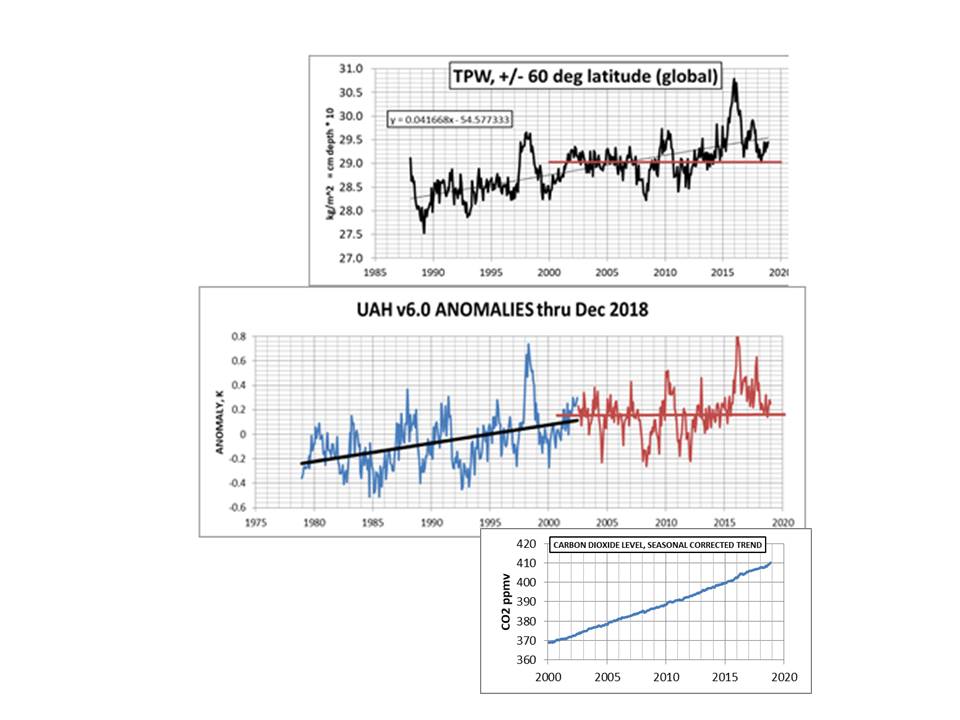
Water vapor has increased about twice as much as calculated from temperature increase of liquid surface water. Both changed slope trend from up to flat about 2002-2005 interrupted by el Nino which peaked in Jan 2016. Both are still in downtrend. Global Warming appears to be over. Is all that snow/rain just bad weather or has increased water vapor contributed?
As Mike and Dale and Dale said up-thread – this doomster news is brought to us by RCP8.5.
This is a two-fer. It not only uses RCP8.5 and only RCP8.5, but describes it as a “business-as-usual” scenario. Which is a lie at this point in time, as that claim has been repeatedly debunked. There is no valid excuse for it. It is also a failure in peer review.
RCP8.5 is the worst-case analysis used in AR5. To get that level of forcing requires large changes in long-standing trends – such as fertility and technological progress.
“It is unclear…”
I suggest making it clear before sounding the alarm.
How many is this? Aren’t there supposed to be only one tipping point?
“Climate change tipping point could be coming sooner than we think”
================
I hate these vague statements.
Does it mean I should just cancel my weekend plans, or start preparing for anarchy ??
The ‘tipping point’ will be the day before the second coming.
“Climate change” tipping point will come sooner than alarmists think as this exposed scam will soon be over.
Since NOW is an infinitely brief moment between past and future, the speed with which it proceeds along the timeline is infinite, every moment is a tipping point. If it were not for gravity we’d all be somewhere else, and if it were not for celestial movement our future selves will have already smacked into our past arses and will again, eventually.