WUWT regular David Burton writes:
One of the most pernicious examples of disinformation promoted by the Climate Industry is the claim that manmade climate change from CO2 emissions threatens agriculture and “food security.” That’s the exact opposite of the truth. CO2 is “plant fertilizer,” and hundreds of agricultural studies have shown that higher CO2 levels are dramatically beneficial for agriculture, to levels far above what we can ever hope for outdoors.
Most plants grow best with daytime atmospheric CO2 of at least about 1500 ppmv. That’s about what CO2 levels are thought to have averaged during the Cretaceous. It’s 1090 ppmv higher than the current average outdoor level of about 410 ppmv.
In other words, most plants would grow best if CO2 levels were increased by more than eight times the measly 130 ppmv by which mankind has managed to increase CO2 levels since the “pre-industrial” Little Ice Age. (Levels even higher than that wouldn’t hurt plants, but they wouldn’t help much, either.)
https://sealevel.info/co2.html?co2scale=2

(click to enlarge)
That’s why most commercial greenhouses use “CO2 generators” to raise daytime CO2 to about that level. It makes the plants healthier, faster-growing, and more productive.
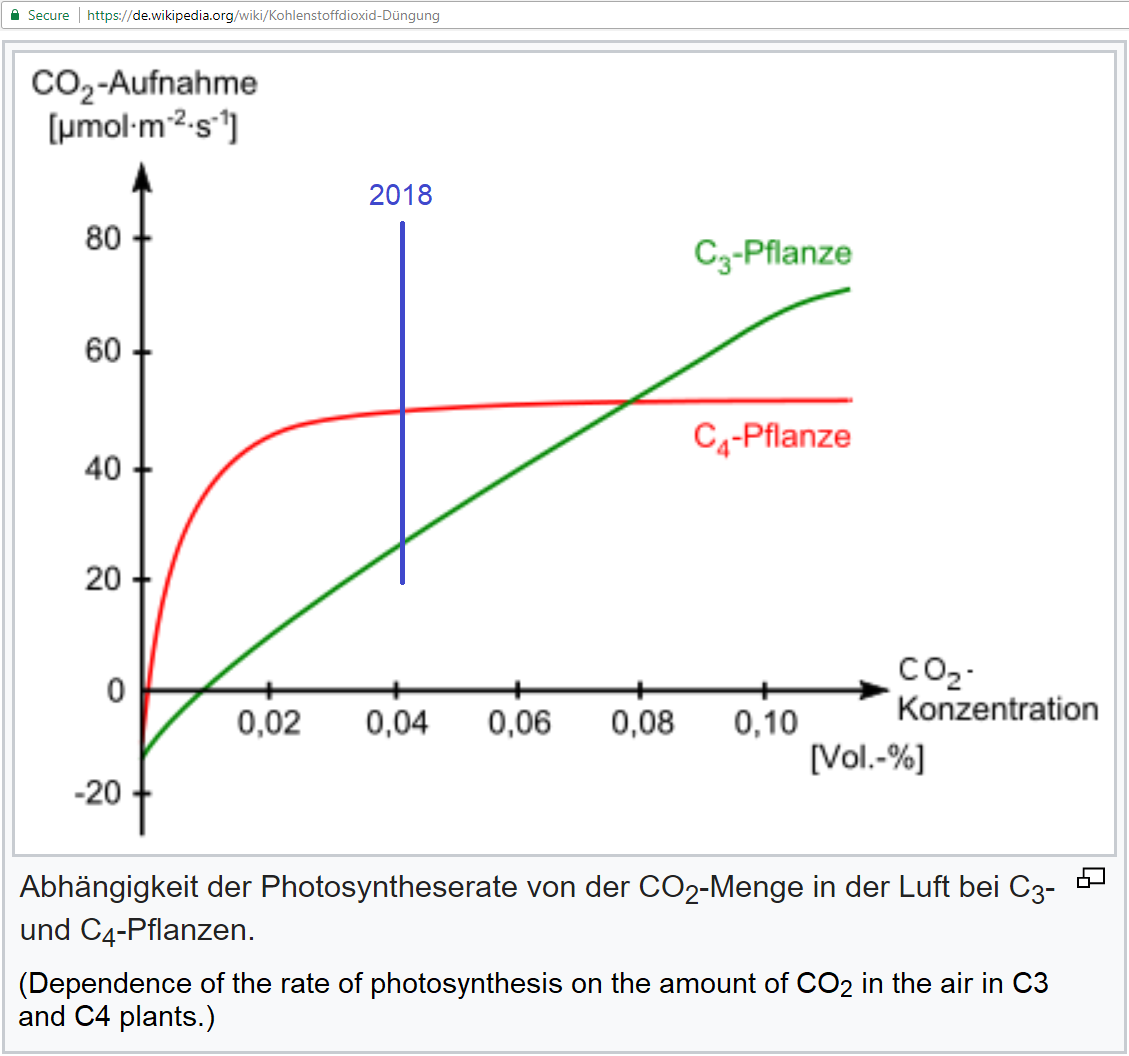
Note: There are several different kinds of photosynthesis. Plants that use “C3” or “CAM” photosynthesis benefit the most from higher CO2 levels. “C4” crops benefit the least, but even C4 crops benefit when under drought stress. Most crops use C3 photosynthesis. There are only four important C4 crops, all of them grasses: corn [maize], sugarcane, sorghum, and millet.)
https://www.sealevel.info/C3_and_C4_Pflanze_vs_CO2_Konzentration_2018.png

(dependence of the rate of photosynthesis on the amount of CO2 in the air in C3 and C4 plants, from https://de.wikipedia.org/wiki/Photosynthese; click to enlarge)
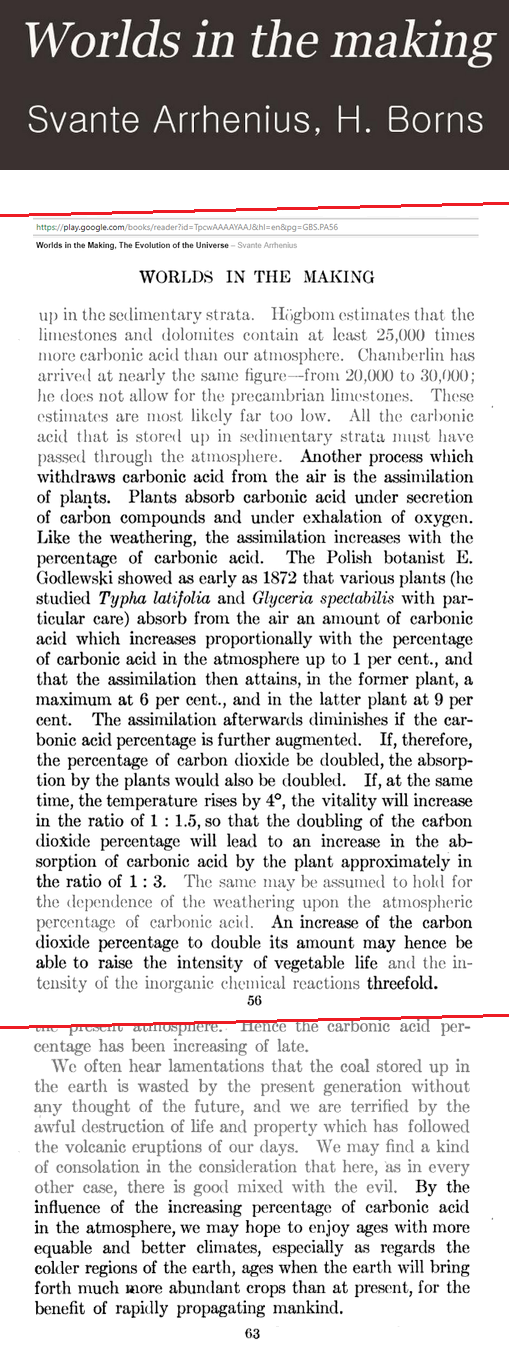
The value of higher CO2 levels for agriculture is not a new discovery. Svante Arrhenius wrote about it in 1908, and cited a source from as early as 1872. Arrhenius predicted that:
“By the influence of the increasing percentage of carbonic acid [CO2] in the atmosphere, we may hope to enjoy ages with more equable and better climates, especially as regards the colder regions of the earth, ages when the earth will bring forth much more abundant crops than at present, for the benefit of rapidly propagating mankind.”
In 1920, Scientific American reported the results of German greenhouse and F.A.C.E. experiments with CO2 supplementation. The experiments were so spectacularly successful that SciAm called anthropogenic CO2 “the precious air fertilizer.” From this photo, which accompanied the article, you can certainly see why:
SciAm 1920: Carbonic Acid Gas to Fertilize the Air

(click to view article)
Over the last century, many hundreds of studies have measured the large benefits of higher CO2 levels for most crops:
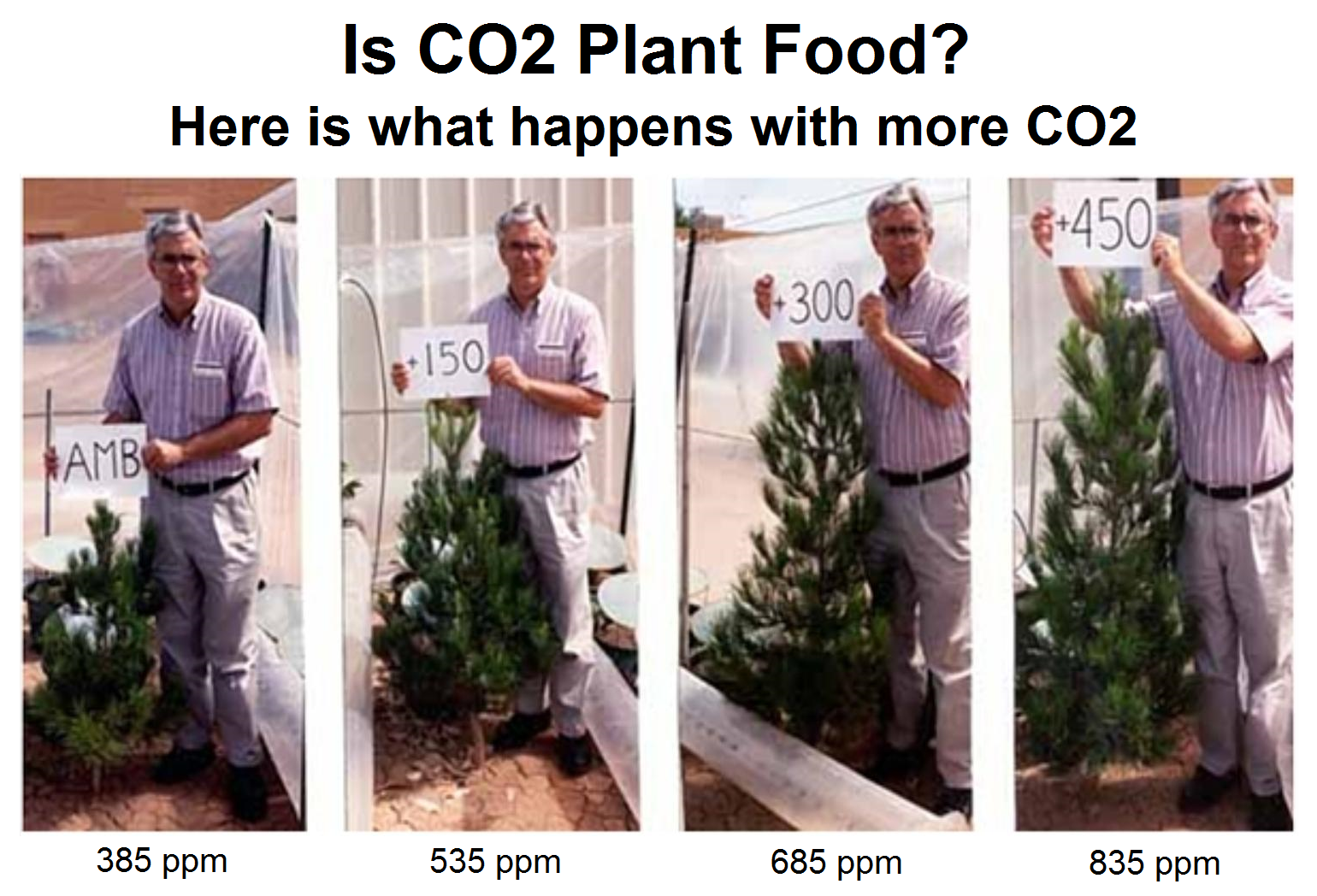
https://sealevel.info/CO2-pineGrowth100120_white_bg.png

(Dr. Sherwood Idso showing the effect of CO2 level on pine trees; click to enlarge)
But the National Academy of Sciences would have you believe that global warming threatens agricultural productivity. So let’s examine that claim.
Here’s a recent article from the Farm Bureau, reporting preliminary U.S. state-by-state corn and soybean yield numbers for 2018:
Farm Bureau 2018: Corn and Soybean Yields are YUUUGE

(click to view article)
Of course the headline obviously suggests that climate change hasn’t hurt corn and soybean production, so far. But that’s not the most interesting part of it.
Look at the wide distribution of states, which grow corn. In this map, from the article, you can see that Minnesota’s 2018 corn yields averaged 191 Bushels Per Acre (BPA), and Mississippi’s corn yields averaged 185 BPA. The “breadbasket” states of Illinois and Iowa both had even bigger bumper crops, with yields above 200 BPA:
https://www.fb.org/images/uploads/_900w/Yuge_fig_1.jpg

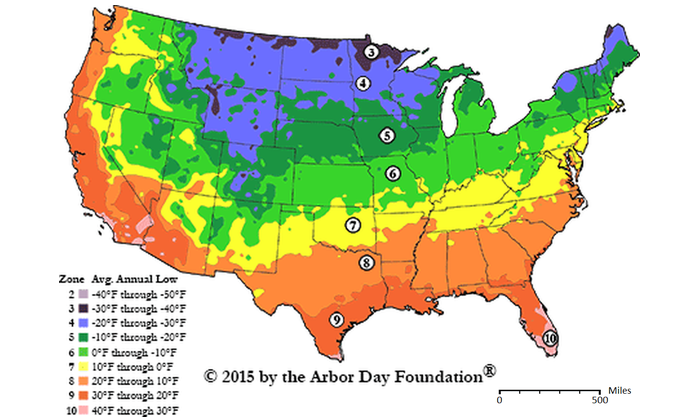
Now, compare that map with this growing-zone map (courtesy of arborday.org). In it you can see that Minnesota and Mississippi are about four climate/growing zones apart. Minnesota is mostly zone 4, and Mississippi is almost entirely zone 8. Illinois and Iowa are a mix of zones 5 & 6:
https://sealevel.info/zones-2015_700x420.png

U.S. climate zones span 10°F, so the center-to-center difference between four zone numbers is 40°F = 22.2 °C.
However, in this map you can see that Minnesota’s corn is mostly from the southern half of the state, which is a mix of zone 4 and zone 5, and Mississippi’s corn is mostly from the northwest half of the state, which is upper zone 8.
http://ctgpublishing.com/united-states-corn-production/

So the average temperature difference between the middle of the prime corn-growing regions of the two states is a bit less than 40°F, I’d call it about 33 ±2°F.
In Celsius, that’s a temperature difference of 17.2 to 19.4 °C (midpoint 18.3°C), between Mississippi (185 BPA) and Minnesota (191 BPA).
In other words, it is plain that an average temperature difference of about 18°C has little effect on corn yields.
Many other major crops are even less climate-sensitive:
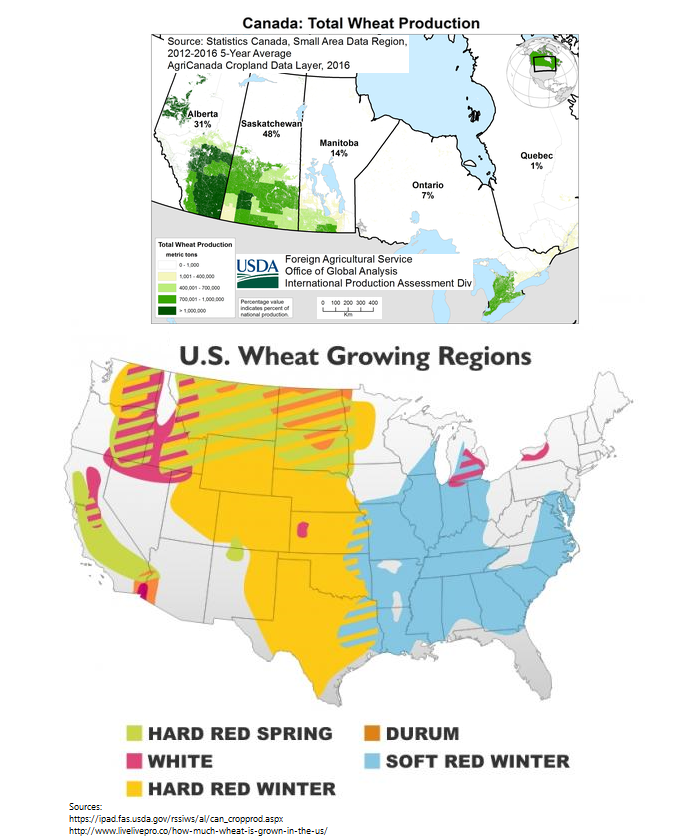
● Wheat is profitably grown in zones 3 through 9, from Saskatchewan to south Texas, a temperature range of over 35°C:
https://sealevel.info/wheat_growing_regions_usa_and_canada_700x840.png

● Maine & Florida are both major producers of Potatoes:
http://potatoesusa.com/us-potato-industry/us-growing-regions

● Soybeans are grown from Louisiana & Mississippi to Minnesota & Canada:
https://www.fb.org/images/uploads/_900w/Yuge_fig_4.jpg

What, then, are we to make of this PNAS paper?
Zhao C, et al. (2017) Temperature increase reduces global yields of major crops in four independent estimates. Proc Natl Acad Sci USA 114:9326–9331. doi:10.1073/pnas.1701762114
From the title you would probably assume that they found anthropogenic climate change causes crop yields to decline, because negative impacts of temperature increases exceed the positive impacts of CO2 fertilization and improved drought resistance from higher CO2 levels. That’s what you’re supposed to think, and that’s how the press release reported it:
“Climate change will cut crop yields,” said the caption on Phys.org, and called the little five-page paper “a major scientific report.”
“Global Warming Will Sear Three of Four Major Grain Crops,” said the caption on Haaratz.
But if you read the paper, or if you read Eric Worrall’s excellent 2017 analysis of it on WUWT, you’ll discover that the authors did not actually say that. Instead, they wrote that they were discussing what they think would happen to yields in an imaginary world “without CO2 fertilization, effective adaptation, and genetic improvement.”
Of course “without CO2 fertilization” means they’re ignoring the beneficial effects of higher CO2 levels, which obviously divorces the paper from any pretense of presenting predictions of future reality.
But it’s even worse than that. Can you guess what their assumption of no “effective adaptation” to a warming climate actually means?
For annual crops, “effective adaptation” means adjusting spring planting dates, and perhaps adjusting cultivar selection. That’s all.
It’s not rocket science. In America’s heartland, moving the planting date up by about six days compensates for 1°C of warming:
https://www.currentresults.com/Weather/Kansas/Places/wichita-temperatures-by-month-average.php

So +4°C of warming is equivalent to planting about 24 days late.
The assumption of no “effective adaptation” to warming means these 29(!) authors assumed farmers are all idiots, who can’t figure out when they should plant their crops. (Projection, maybe?)
It’s utterly preposterous. The reality is that most farmers are not idiots, anthropogenic CO2 is highly beneficial “air fertilizer,” and the further that CO2 levels rise, the more productive farms will become.
That fact is true for the great majority of crops, nearly everywhere in the world. Yet the NAS has been promoting the anti-scientific claim that rising CO2 levels are bad for agriculture, for years. This 2011 NAS / NRC propaganda graph is a particularly outrageous example:



Notice the red “US Maize” and purple “India Wheat” traces, and where they intersect the 4°C line. You can see that they’re predicting that in the event of a 4°C temperature increase, U.S. maize (corn) yields would decline by a devastating 60%, and wheat yields in India would fall 68%.
(Of course such a large temperature increase is thoroughly implausible, but never mind that. That’s a different rant, for a different day.)
Today’s rant is this: That NAS / NRC graph is a lie.
If a mere 4°C of warming were actually that destructive to corn yields, it would obviously be impossible to profitably grow corn even in Tennessee & Kentucky (zone 7, 174-175 BPA in 2018), let alone Mississippi (zone 8, 185 BPA).
Likewise, if a mere 4°C temperature increase were actually that destructive to wheat yields, then it would obviously be impossible for North Americans to cultivate wheat across seven climate zones, from Saskatchewan to south Texas, spanning an average temperature range of about 35°C.
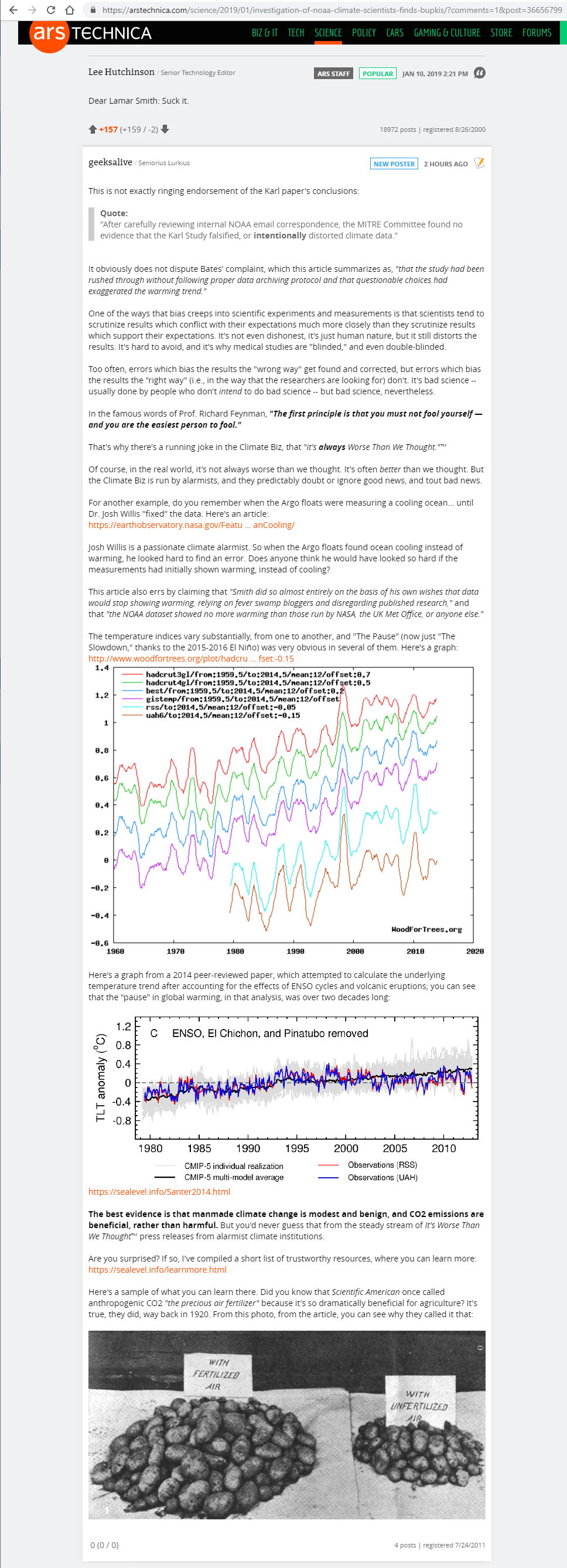
That NAS / NRC graph is utter nonsense. But even though it is old, it’s still being used by climate change zealots to mislead people. I stumbled across it because someone posted it in the comments on an article at ArsTechnica. (I’m currently banned for a week there, for “ignoring moderation,” because I disagreed with their leftist moderator. My first comment there [screenshot] has been deleted, too, but some of the others are still there. They look “faded” because the ArsTechnica comment system fades-out comments with lots of downvotes.)
On March 22, 2012, Rud Istvan did a wonderful, in-depth demolition of that graph, on WUWT & ClimateEtc:
● https://judithcurry.com/2012/03/22/nrcs-artless-untruths-on-climate-change-and-food-security/
● https://wattsupwiththat.wordpress.com/2012/03/22/nrcs-2011-climategate/
Yet, despite their propaganda graph having been completely debunked, the NAS is still disseminating it, to promote the climate scare.
Here it is on their web site, on p.28 of a little 40 page propaganda booklet, which appears to be designed to be used as a resource by schoolteachers:
Here it is, in convenient PowerPoint format, for incorporation into your talk at the local garden club (slide 21):
http://dels.nas.edu/resources/static-assets/exec-office-other/climate-change-figures.ppt
(The file metadata indicates that the slides were created by “Rebecca” in June, 2013 — more than a year after Rud had discredited the graph.)
It’s also on p.161 of this free 299-page ebook:
If Zhao and his 28 co-authors really believe, as they claimed in their PNAS paper, that correctly assessing the impact of climate change on agriculture is “critical to maintaining global food supply,” then it is incredibly cynical of them and the NAS to publish misleading papers and graphs which encourage policymakers to take steps that will actually reduce that the global food supply.
I’m beginning to wonder: Does the “A” in “NAS” is still stand for “Academy of,” or does it now stand for “Anti-,”?
Why doesn’t the massive increase in plant growth (natural and crops) show up as a dropping or stabilizing of the CO2 levels. Is there any science about how much CO2 all the extra growth is soaking up? Is it less than we are putting out ? If plants evolved to grown in high CO2 levels, then they should be soaking up all of the CO2 we are emitting.
Great question, but a very difficult answer. You also have to factor in major city growth and urban sprawl, which require cutting lots of trees, plants, grass, etc. Her is a paper:
https://www.pnas.org/content/112/2/436.short
Papers like this might be worth a post on WUWT
It does, if you measure CO2 in a cornfield during active growth when there is no wind. The levels drop very low. The wind is needed to distribute the CO2 generated elsewhere to the field.
The same effect is present in a greenhouse. CO2 levels drop precipitously at the beginning of the day’s growth, to levels that will not support photosynthesis. The growers add CO2 to maintain their desired level.
Yes, but that wasnt his question. The question isnt whether plants use CO2 to grow, they do. His question was about the carbon cycle, which is much more complex. It seems our cutting down tropical forests is offsetting the greater CO2 growth of other forests.
According to NASA, the planet as a whole is getting greener.
The cutting down of the tropical forests for the most part is at a constant rate. One part being cut down, another part growing back. It’s not as dire as some want us to believe.
I dont disagree, but I am not sure you are talking about the question asked. Try reading the reference and get back to me.
I addressed the claim that cutting down tropical forests was offsetting greater CO2 growth of other forests.
If you meant something else, you should have written something else.
ArsTechnica is a cesspool of antiscience. Should never be linked to or posted at.
BTW, in addition to the hilarity of any historical graph of crop yields vs temps, note that while about 1/3 of the Earth is too cold for serious biomass generation at any given time, there is no place on Earth too hot for agriculture given sufficient irrigation.
+1
I have a theory that Gaia was concerned about falling carbon dioxide levels, as they were getting near to the level where plants can no longer survive. So, she evolved humans, because that species is exceptionally good at drilling holes in the ground to release the sequestered CO2 from bygone ages.
However, if we stopped releasing CO2 before optimum levels are reached, and started covering the planet with spinning thingys instead, she might just decide we were a mistake and try another species.
That’s very scientific Ian. You should see about having EurekAlert! publish your theory.
I am a qualified and experienced science with a background in environmental research, agriculture, and geology (yes, geologist must also look at facts). The article is correct. Wrongly thought most people understood the facts and easily observed relationship of ag production .
The indoctrination of millennials. See page two
https://science.howstuffworks.com/environmental/green-science/sahel-shifting.htm
It’s political science as we know. Doesn’t stop farm state politicians in the US from driving this narrative to get increased funding. Climate Change crop insurance, Climate Change mitigation money, A John Deere tractor that runs on ethanol, whatever. For some it’s the money for others its the control. The green thing is useful for many reasons. Foe the NAS it’s “science funding” from the plebs pockets.
This feature makes the green hydra hard to stop.
Thanks for the link.
Note: There are several different kinds of photosynthesis. Plants that use “C3” or “CAM” photosynthesis benefit the most from higher CO2 levels. “C4” crops benefit the least, but even C4 crops benefit when under drought stress. Most crops use C3 photosynthesis. There are only four important C4 crops, all of them grasses: corn [maize], sugarcane, sorghum, and millet.)
You have this backwards, C4 and CAM plants benefit the most, they are evolutionary changes which allow these plants to grow better in hot, dry conditions than do C3 plants. Photosynthetic rate for C3 plants is better than C4 at temperatures below 20ºC whereas C4 does better above 20ºC.
Most crops are C3, focussing on a C4 (maize) is misleading.
Well, kinda sorta. C4 plants evolved in low CO2 conditions to make their photosynthesis more efficient under these conditions. They also are better at tolerating heat. SO – it depends – for heat C4 are better, for high CO2, C3 are better. This stuff is complex….in fact many specualte that we are at a CO2 level now where C4 plants do not have a growth advantage as they cannot take advantage of the higher CO2 present today.
Also, he is correct to focus on maize, it is the biggest crop grown on the planet and accounts for a large part of the calories available to humanity.
It is a very Good Thing that the C4 plants are mostly grasses, and there are no C4 trees. Trees have the potential to sequester carbon for a long time. Grasses mostly rot and release their CO2 within a year or two.
Widespread C4 trees could potentially suck so much of the remaining CO2 from the air, and drive the CO2 level so low, that it would kill off the CO2-starved C3 plants.
So, are the findings in this write-up able to be published to the Proceedings of the NAS for scientific method review and scrutiny?
David,
Thanks for the well written and well documented article refuting recent fabrications concerning the evils of CO2 and food growth..
It is nice to know that everything we were taught in grade school about CO2 and photosynthesis was spot on.
Tree picture use is misleading. It is an age phase without reference to mature trees & there are lots of differences among kinds of trees.
Elevated eCO2 induces more roots, especially fine roots (usually). Trees with deeper fine roots access more nitrogen from fallen leaf litter (identified as isotope 15N) that was/is 30-60cm down.
Analysis of a variety (C3& C4 included) 28 plants reveal that in 6 species eCO2 was associated with no change in their leaf 15N, in 3 species eCO2 was associated with an increase in their leaf 15N & in the majority (19 species) eCO2 was associated with a decrease in their leaf 15N.
Trees unlike row & geenhouse crops) are needing leaf nitrogen (quantifiable as 15N) cycling for uptake. A long term eCO2 (USA gum tree) analysis showed that over time the pool of 15N goes down.
My point here is that this decreasing change in nitrogen available for trees makes the above tree picture of eCO2 impact on young growth a snap-shot in time that is not indicative of future productivity. To be precise, I will add that the decreased pool of nitrogen for a tree takes years to
develop into a significant limiting factor.
Plants have different reactions to eCO2. For example, if there is an association with the type of fungi myco-rrhizal then more roots (from eCO2) foster more of this fungi & then those fungi (avg. 6% nitrogen) themselves are using more of the soil nitrogen.
The exceptional impact of eCO2 on many kinds of adult trees is less than what might be extrapolated from the above photo (water will become more relevant to mature trees). The eCO2 will be putting more nitrogen in woody mass & more nitrogen assimilated will go into the roots under eCO2 than otherwise.
All trees are C3, so I expect that they all benefit from eCO2, though to varying degrees. This F.A.C.E. study examined birch, aspen & maple:
https://news.umich.edu/future-forests-may-soak-up-more-carbon-dioxide-than-previously-believed-helping-to-buffer-climate-change/
But, like everyone’s favorite Facebook relationship status, “it’s complicated.” For instance, I’ve recently learned, to my surprise, that alder trees fix their own nitrogen, via symbiotic bacteria, like legumes do.
Original Post asserts eCO2 results in the “… plants healthier.” That may be an over-statement.
C3 plants respond to ratio of CO2 to O2 (RuBP, ribulose bi-phosphate “acceptor” molecule takes these catalyzed by enzyme Rubisco). And at the same temperature different plants will bind different ratios of CO2 to O2; this dynamic applies to both C3 & C4 plants & can partly contribute to variable results reported in eCO2 experiments.
When C3 plants (named because CO2 + Rubisco acting –> two molecules having 3 carbon atoms in them) take up O2 (instead of CO2) the C3 plant’s Rubisco catalyzes instead only one molecule having 1 carbon in it plus phospho-glycolate (ie: O2 + Rubisco acting –> phospho-glycolate + a single carbon molecule).
Now, eCO2 for C3 plants causes (the pressure of CO2 relatively reduces O2 processing) less of phospho-glycolate being made & more of air’s carbon (from CO2) taken into the leaf in a form readily assimilated. Which we observe as more (usually) plant matter under eCO2.
My issue with eCO2 and plant “health” claim is that oxygen O2 processing is not a waste of time. The single carbon molecule is used for synthesis of the amino acid methionine, purine & pyimid-ines. The phospho-glycolate made in chloroplasts gets sent out for plant purposes.
In light the O2 + Rubisco generated phospho-glycolate pathway (glycolate pathway) involving the leaf mitochondria. Simply stated there is a release of CO2 from the mitochindria plus release of nitrogen NH3 nitrate.
This mitochondrial CO2 release is called “photo-respiration” . Along the way, during photo-respiration, assimilated carbon (CO2 taken in & “fixed” w/Rubisco) is getting used for other things than making “sugar”.
Because eCO2 reduces O2 processing eCO2 reduces”photo-respiration” & we see the growth boost of eCO2. On average the way plants handle carbon & nitrogen as a result of “photo-respiration” uses up over 30% of available energy.
And also due to “photo-respiration” about 25% of the newly assimilated carbon (from CO2) is gone (when glycolate pathway uses 2 glycine molecules comprising 4 carbon atoms to make a serine). There is fortunately 75% of carbon involved in “photo-respiration” that eventually gets shunted back to chloroplasts as 3-carbon molecules (just like the 3-carbon molecules made by “fixing” CO2).
I’ll continue …
“Photo-respiration” orientation now put forth I”ll try to describe plant health. Plant mitochondria will take glycine derived from phospho-glycolate (photo-respiration product) via a pathway (glycolate pathway) & the mitochondria will “oxidize”/”burn” glycine. Thus leaves are relatively low in glycine under ambient CO2 since glycine & serine are precursor molecules of chlorophyll – so eCO2 plants can be seen by our eyes as “greener” (to be precise there are 3 ways leaves can make glycine)
Leaves that get nitrogen taken in as nitrate NO3 (plus 2 H+ via enzyme nitrate reductase to –> H20 plus nitrite NO2, which with 6 electrons plus 7 H+ via enzyme nitrite reductase to –> NH3 ammonia nitrogen) will change that into nitrogen NH3 ammonia,; because leaves can only make amino acids from NH3 ammonia (& NH4 ammonium). Thus “photo-repiration” release of NH3 ammonia by mitochondria benefits the leaves by, not only providing more amino acid ready synthesizable nitrogen as NH3 & by obtaining that NH3 nitogen without requiring many H+ ions &/or electrons there are more of those free to process NO3 nitrogen taken in.
One way the “health” of eCO2 plants has been reported as being vulnerable beause their leaves have altered carbon (more) ratio to nitrogen (less under eCO2). This is a trade off that has been the subject of prior WUWT posts so I’ll forgo revisiting the dynamics.
eCO2 assimilation when (light adequate) produces more “sugar”; thus, the leaves are a “source” of carbon for use. The leaf (mesophyll) loads up with “sugar” (sucrose & fructan/”fructose”) so “sugar” is shifted toward the leaf bundle sheath (cell layer around leaf’s veins).
C3 bundle sheath holds CO2 assimilated “sugar” until it can divest it (“sugar”) into the vascular phloem for the assimilates to be delivered to a plant “sink”. We see eCO2 growth resulting in more roots (“sink”), more stem/trunk (“sink”) & more dry matter (& lignin).
The “sugar” enriched C3 plant’s bundle sheath (technically a layer of parenchyma cells) from eCO2 makes it vulnerable (less “healthy”) to certain kinds of insect feeding. Then too when the roots &/or lower stem of a plant (“sink”) is cooled the bundle sheath retains more “sugar”.
To load “sugar” into the phloem for circulation O2 is required (even though bundle cells have more CO2 than O2) by both C3 & C4 plants; the difference is that C4 plants must use O2 “evolved” as part of photo-synthesis (“fixing” CO2). Thus when it is dark/cloudy/night the C4 plants’ rate of phloem loading (“sugar”) is reduced heading for a “sink” & their C4 leaves are more attractive to insects.
To be precise for C4 plants: low ambient CO2, due to less photsynthesis generated O2 (more photo-respiration), can also be said to result in less “sugar” loading into the phloem for distribution. Thus (C4’s want of properly provided O2) assures insects can also find attractive “sugar” in leaves – just at a lower amount of “sugar”.
I have tried to write for laymen & end with pointing out that C4 plant’s concentrate CO2 in bundle sheaths for better photosynthesis efficiency under low CO2 (it decreases CO2 exported from mitochondria as “photo-respiration” in the light). There is a theory that when Earth’s air had low CO2 (high O2) plants evolved moving their enzyme (glycine de-carboxyl-ate) that is integral to getting glycine usable into the bundle sheath (C3 plants did/does this in their mesophyll).
gringojay wrote, “I have tried to write for laymen…”
Ah, well, thank you for that. 😮
Sadly, your layman-level is still way beyond my computer geek-level.
Do you not think that we can use tests like these to reach conclusions about which plants are thriving (healthiest), and which are failing to thrive?
Hi Dave Burton, – I took the time to get some things in print for people like you who are dealing with aspects of CO2 to mull over at leisure. When reading it skip over what is in parenthesis (that’s for those who want to look up things by name) to weed out distractions. Laymen hear some commentators/sources using words like photo-respiration & I wanted to try to describe what that is about.
You link a picture of rice at variable levels of CO2 & ask which is thriving. I mentioned that “health” is relative to insect predation: at eCO2 the ratio of carbon goes up relative to nitrogen & commonly (not always) chewing insects with eat more of the plant to get more nitrogen –> that plant can get a lot of damage.
Rice has a juice sucking leaf hopper that likes to feed on it. At eCO2 & common ambient temperature the leaf hopper will eat & put out more of a substance called “honeydew” (than at ambient CO2).
“Honeydew” is sticky sweet & very prone to be colonized by mold. So the young pictured rice plant at eCO2 can end up with it’s leaves massively covered in black mold (see pictures of “sooty mold” on-line) which cut down photosynthesis.
Now ambient CO2 & ambient temperature growing rice still can get some leaf hoppers’ honeydew,but it will be less than eCO2 & ambient temperature. In fact eCO2 & elevated temperature growing rice will also get less honeydew than eCO2 & ambient temperature, but: the female rice leaf hopper will lay more eggs.
We humans can be robust looking & yet suffer more pathology than others that do not seem to be “thriving”. And then too, one may have a problem that confers better outcome than otherwise; the aphorism is “looks can be decieving.”
By the way, I have no qualms about eCO2; greenhouses can certainly do nicely with adding CO2. Pictures are informative & I just think additional context is relevant.
If the issue is attractiveness to insects, GM rice might help.
https://www.ncbi.nlm.nih.gov/pmc/articles/PMC6131420/
I am pro-GM. And I’ve certainly inadvertently taken in lots of agricultural chemicals over the years too. I’m pro-fungicide/herbicide – ideally properly administered.
I suppose that could be a difference between greenhouses and outdoors: Insects are presumably easier to control in greenhouses.
Mosh is trying to be cute.
He doesn’t do it well.
If we relied on these academics to grow the crops we depend on, I’m sure their output would be in line with their gloomy predictions. Fortunately the average farmer doesn’t have their educational background, so yields have been increasing.
Well done Dave!
Agree wholeheartedly.
Corn is a high altitude, tropical plant. Ancient Mexican farmers developed it from its genetically identical (same protein coding sequences, ie genes) wild ancestor, teosinte. The key mutations exploited by breeders are in control sequences.
Some “experts” said that with higher levels of CO2 plants grow more rapidly and have less protein.
My response was not all and you can add nutrients as required,
You solve this by using the increased fertility to grow more fodder and eat more beef and pork.
Which is exactly what the chinese have been doing this last generation. The first time I visited Beijing back in the early eighties there was only about a dozen restaurants serving Beijing duck, now there are many hundreds, if not thousands.
The first map [Figure 1. 2018 Corn yield . . . ] should be looked at along with the 2nd one down from it – where Iowa (18) is shown in green.
On the two maps, note {map #1} the fully colored Great State of Washington, now the number one producer of Blueberries.
The first map shows WA with 210 bu/acre, but there is a central-regional area shown on the 2nd map. The area where corn is grown is also irrigated. This is a naturally hot and dry area in the summer. Note comment by TallDave @8:31, a few above this one.
Note also that the 210 bushels is the highest state average!
Each year there is a contest:
National Corn Growers Association 2018 National Corn Yield Contest. 477.68 bushels per acre
The 477 bu/acre was grown in south central Michigan with irrigation. A North Dakota grower managed to get 299.78 bu/acre with non-irrigation.
There are 18 winners (3 each in 6 categories).
David Burton writes:
“YUP”, and plants were growing their best during the (Mesozoic) Triassic, Jurassic and Cretaceous Periods because of the high atmospheric CO2 ppm and warm global average temperatures as defined on this graph of geologic periods, to wit: http://worldview3.50webs.com/6temp.chart.n.co2.jpg
And according to the above cited graph, atmospheric CO2 abruptly increased to about 1,900 ppm at 259 mya (Triassic Period), …… and then increased to 2,800 ppm at 150 mya (Jurassic Period), and then began a gradual decline to 700 ppm at 66 mya (Cretaceous Period).
And the reason we know that plants were growing their best during the Mesozoic Period is because of the interesting scientific fact associated with the above “rise n’ fall” of atmospheric CO2 from 1,900 ppm @ur momisugly 259 mya to 700 ppm @ur momisugly 66 mya …… is that it correlates directly with The Age of the Dinosaurs, to wit:
“During the Mesozoic, or “Middle Life” Era, life diversified rapidly and giant reptiles, dinosaurs and other monstrous beasts roamed the Earth. The period, which spans from about 252 million years ago to about 66 million years ago, was also known as the age of reptiles or the age of dinosaurs.”
Tremendous amounts of rapidly growing “green” biomass was absolutely necessary for the evolution and survival of the dinosaurs and when atmospheric CO2 started its decline during the Cretaceous, so did the decline of the dinosaurs and their demise was complete when CO2 fell below 700 ppm @ur momisugly 66 mya.
Thus it was “atmospheric CO2 sequestration” by natural processes that SLOWLY “wiped out” the dinosaurs (their death was due to starvation), …. not a sudden event such as an asteroid strike or some other silly suggested cataclysmic event.
So you mean it was purely coincidental that all non-avian dinosaurs, most avian dinosaurs, most mammals, all ammonites, all mosasaurs, plesiosaurs and pterosaurs, and a lot of other all’s and most’s happened to go extinct 66 mya, at the exact time that the Chicxulub impact happened?
tty, given the accepted scientific fact that all the major animal phyla that exists today, ……. evolved during Cambrian Explosion (521 mya), ….. please tell me what you think was so “MAGICAL” about the, per se, Chicxulub impact event of 66 mya that primarily targeted the extinction of the extremely large herbivores dinosaurs and their meat-eating predator dinosaurs but spared the ancestors of all current day phyla and species?
Deny this, to wit:
And ps, tty, where it states in the above that “All these species dying out ”, ….. what it actually means is ….. “they disappeared from the fossil record” …… and not that they instantly died/disappeared.
The only place where NAS is fully stated is under the 4 photos of the pine tree. Even there the letters and name are not connected. This is a dis-service to readers.
In addition to fertilization, CO2 increases water efficiency of plants and makes water more available for other plants and increases soil moisture. Increases carb production also allows many plants to share more resources with symbiotic bacteria and fungi which increase bio available Phosphorus and Nitrogen and add carbon to soil, making it more structurally sound and capable of retaining water. Reality is that N & P are CO2 constrained and this will increases retention of water over land and accelerate CO2 uptake as CO2 rises. This is likely already mitigating sea level rise, as GRACE shows significantly more retention of water over than hydrological models estimate. https://www.politico.com/agenda/story/2017/09/13/food-nutrients-carbon-dioxide-000511
Crops, particularly C4, have been engineered to optimize for carb production and are generally not P & N constrained, so this happens to a lesser extent with industrialized agriculture.
Wrong link, here’s correct: https://wattsupwiththat.com/2018/01/26/what-to-believe-models-or-grace-data/
Further supported by increasing soil moisture.
http://archive.news.iupui.edu/releases/2016/02/drylands-global-greening.shtml
I’m with Scott Adams on this:
Facts don’t matter.
When an AGENDA is the driver, then science takes a back seat. Feelings are what counts and when you argue with someone with an agenda, be prepared never to win. Science be dammed, especially YOUR science as it is either lies to support your cause or made-up for the purpose of “confusing” me. This is what I have noticed and facts don’t really matter. Look at all the science that supports natural variability and how easily it is dismissed by those claiming to be scientists. Facts don’t matter.
When someone cites science and argues Global Warming is happening beyond what the current crop of legitimate scientists argue, be prepared to be attacked and called a “den1er”.
I have given up on the thought of ever winning an argument when faced with someone with an agenda.
What folks need to do I suppose is minimize the “facts” and concentrate on the basic issue of AGENDA.
Billy how do you win an argument with religious zealots?
My comment would be to not engage them as they are agenda driven.
It does no good. You will never win in a legitimate debate. It involves “feelings”. Religious zealots are about “feelings”. It makes them feel good to behave that way and they feel morally superior.
Work on other more salvageable people with little agenda to protect.
Derg, you’re dealing with people driven by emotion, so you probably need to appeal to their emotions. I suggest talking about the Third Horseman of the Apocalypse: famine.
If you’re talking to someone old enough to remember frequent major famines, in places like Bangladesh, then remind them of that, and ask them if they’ve noticed how infrequently we hear about famines, now? Inform them that Bangladesh and India now struggle with the problem of chronic food gluts!
If you’re talking to a youngster, then you must first teach him or her about famines. Throughout history, famine has always been one of the great scourges of humanity — until now.
Here’s a paper, about the great drought & famine of 1875-78, which shows how famines used to happen. I wouldn’t put too much stock in the attribution part, but the history is illuminating:
https://journals.ametsoc.org/doi/abs/10.1175/JCLI-D-18-0159.1
A reasonable estimate is that the rise in CO2 levels is responsible for a global increase in agricultural productivity of about 20%. That is a Very Big Deal. Ending famines is an advance comparable to ending war, and rising CO2 levels have contributed substantially.
If the person you’re talking to is the sort who gets all dewy-eyed about rain forests, you could also mention that if we didn’t have the extra agricultural productivity — i.e., if CO2 levels were still at 280 ppmv — then we could approximately make up for the loss of productivity by converting all of the world’s rainforests to agriculture.
Dave Burton – January 21, 2019 at 5:14 pm
Personally, me thinks if the “appeal to their emotions” ….. was a request, …. it would be denied.
And if the “appeal to their emotions” ….. was for a reversal of their belief, ….. they would just become more convinced they were correct.
One way to win an argument with a religious zealot is to use their own commentary or beliefs to embarrass them “in front of gawd and everyone”, ….. which is sure to cause them “severe emotional pain”, …….. which is not easily forgotten, if ever.
And that is because the stimuli that triggered the “pain”, be it mental or physical, is quickly nurtured (learned), easily recalled and excites an emotional reaction again. As per the saying “hell hath no fury like ……”
I will take the Mosher seriously when he learns to write in English.
You honestly can’t expect an English major to write in English. Fer reals, dude.
He blames the poor formatting and spelling on his “smart” phone.
If the genes in wild corn in Mexico are identical, how is it that the modern variety is so much better ?
9,000 years of artificial selection.
From the Johnson CO2 generator ad:
Nighttime levels in a greenhouse range from 400 to 500 ppm due to plant respiration. Shortly after sunrise this level will drop to normal atmosphere (300 ppm) due to the plant using the early light to start photosynthesis. After 3 to 4 hours of early morning sunlight the CO2 level can drop to around l00 to 150 ppm, then growth is practically stopped. Supplemental CO2 added during this period can substantially increase your plant and flower production.
I enjoyed this scholarly article, Dave Burton. The “Great Greening” of the planet is the only unequivocal anthropo-assisted Climate Change that has occurred thus far. Temperature rising from the LIA (thank goodness for that) was a natural effect, like the MWP before it when Greenlanders were growing grain and other crops for a period of about 400yrs.
Note that this big greening took the clime syndicate by surprise and it is their deepest anxiety because of what it does to the real cost- benefit equation for CO2 increase. They know if they don’t hold the line on this, the whole game is over. This is why they only talk about exaggerated temperature rise and what it will do to crops. Ive seen articles on forest development and crops that attribute changes only to temperature rise. Sometimes they grudgingly feel obliged to admit a small contribution of CO2, but they then beat it to death because “it’s only temporary” and it will result in even more CO2 loading the atmosphere when the brief honeymoon is over. “The Great Greening” is poised to strike the final blow to this terrible movement that has been basically on a life support coma since struck by the one-two punch of a 2-decade “Dreaded Pause”that caused the Climate Blues epidemic and Climategate that exposed the underbelly of the beast.
Quote Gary Pearse:
“….is the only unequivocal anthropo-assisted Climate Change that has occurred….”
Not even sure that is true. Neither the geochemical, geophysics or biological processes discriminate as to which CO2 to use. So, logically some of the human release CO2 has been returned to a sink. And if the Earth is naturally Warming, regardless of our actions, then there is just more CO2 in the atmosphere. I have seen some of the math and thoughts behind the math but coming from my chemistry background equilibrium is in play. Models are not reality, they are tools and perhaps poor tools.
But hey maybe Monsanto has taught the corn to sink only the human portion of CO2…perhaps my body is only using the natural sources of CO2. Or perhaps it using trans-dimensional CO2 to keep me Social Justicily honest ; -)