WUWT regular David Burton writes:
One of the most pernicious examples of disinformation promoted by the Climate Industry is the claim that manmade climate change from CO2 emissions threatens agriculture and “food security.” That’s the exact opposite of the truth. CO2 is “plant fertilizer,” and hundreds of agricultural studies have shown that higher CO2 levels are dramatically beneficial for agriculture, to levels far above what we can ever hope for outdoors.
Most plants grow best with daytime atmospheric CO2 of at least about 1500 ppmv. That’s about what CO2 levels are thought to have averaged during the Cretaceous. It’s 1090 ppmv higher than the current average outdoor level of about 410 ppmv.
In other words, most plants would grow best if CO2 levels were increased by more than eight times the measly 130 ppmv by which mankind has managed to increase CO2 levels since the “pre-industrial” Little Ice Age. (Levels even higher than that wouldn’t hurt plants, but they wouldn’t help much, either.)
https://sealevel.info/co2.html?co2scale=2

(click to enlarge)
That’s why most commercial greenhouses use “CO2 generators” to raise daytime CO2 to about that level. It makes the plants healthier, faster-growing, and more productive.
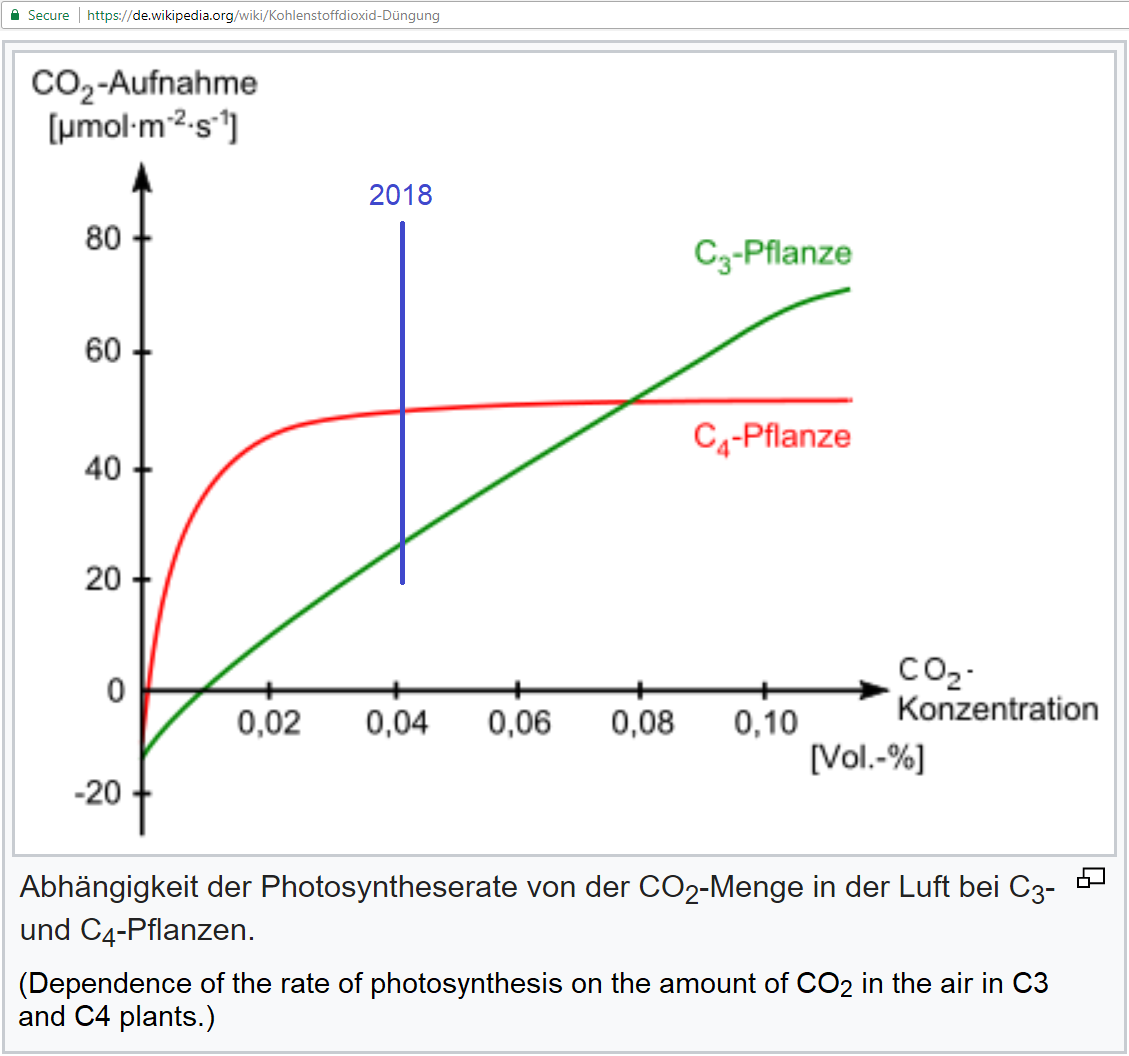
Note: There are several different kinds of photosynthesis. Plants that use “C3” or “CAM” photosynthesis benefit the most from higher CO2 levels. “C4” crops benefit the least, but even C4 crops benefit when under drought stress. Most crops use C3 photosynthesis. There are only four important C4 crops, all of them grasses: corn [maize], sugarcane, sorghum, and millet.)
https://www.sealevel.info/C3_and_C4_Pflanze_vs_CO2_Konzentration_2018.png

(dependence of the rate of photosynthesis on the amount of CO2 in the air in C3 and C4 plants, from https://de.wikipedia.org/wiki/Photosynthese; click to enlarge)
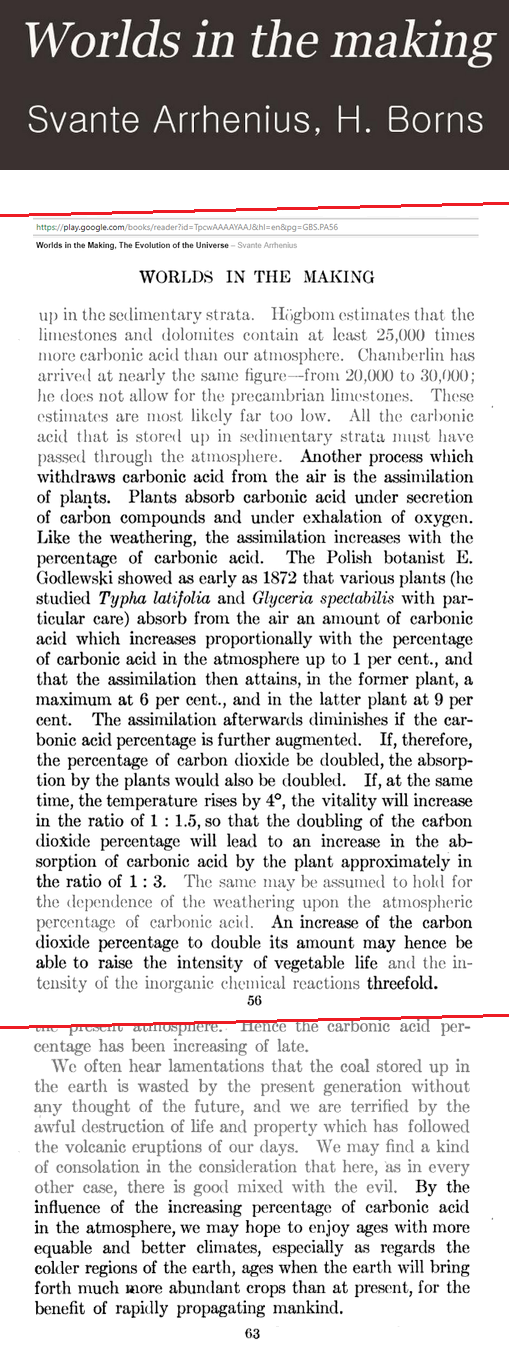
The value of higher CO2 levels for agriculture is not a new discovery. Svante Arrhenius wrote about it in 1908, and cited a source from as early as 1872. Arrhenius predicted that:
“By the influence of the increasing percentage of carbonic acid [CO2] in the atmosphere, we may hope to enjoy ages with more equable and better climates, especially as regards the colder regions of the earth, ages when the earth will bring forth much more abundant crops than at present, for the benefit of rapidly propagating mankind.”
In 1920, Scientific American reported the results of German greenhouse and F.A.C.E. experiments with CO2 supplementation. The experiments were so spectacularly successful that SciAm called anthropogenic CO2 “the precious air fertilizer.” From this photo, which accompanied the article, you can certainly see why:
SciAm 1920: Carbonic Acid Gas to Fertilize the Air

(click to view article)
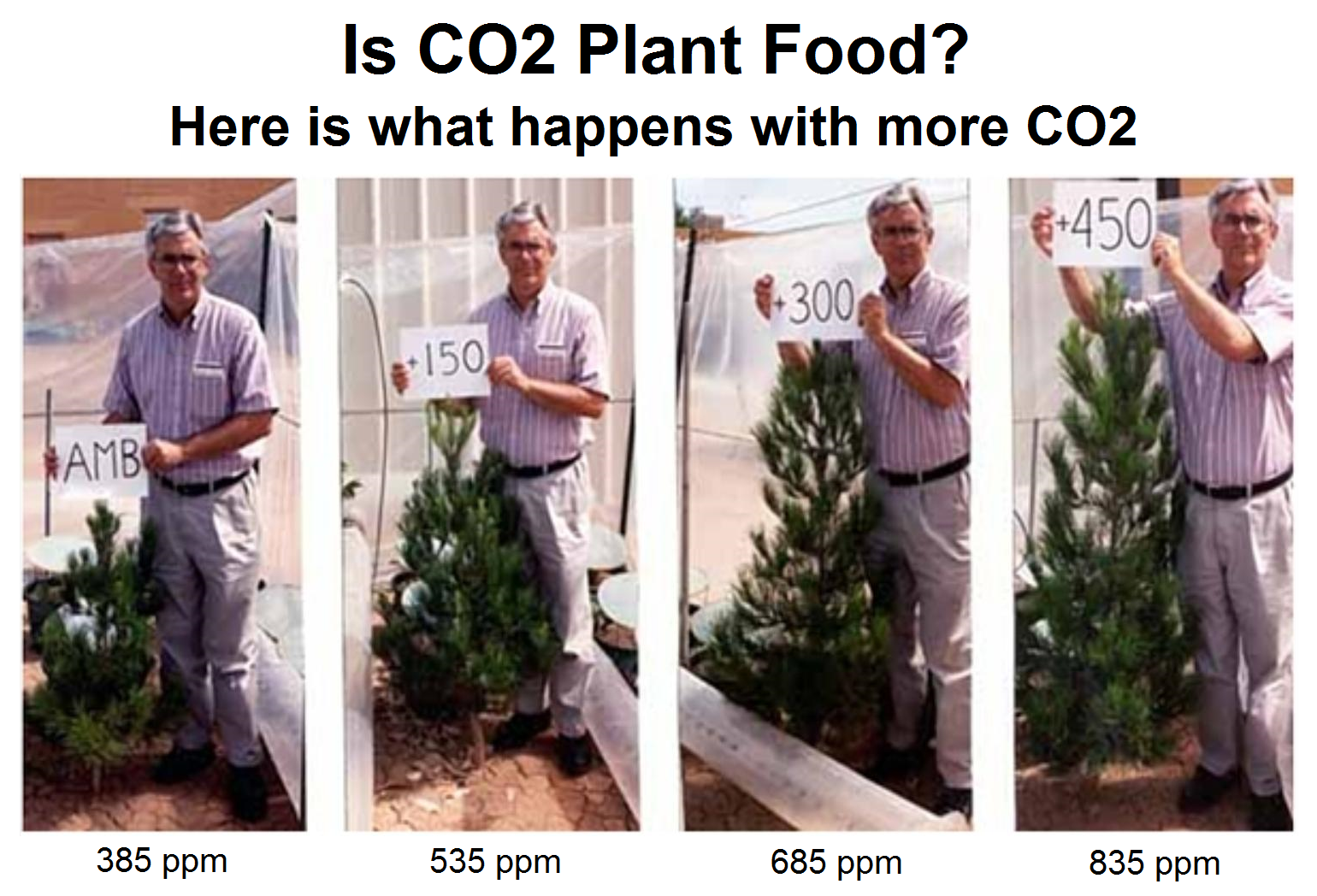
Over the last century, many hundreds of studies have measured the large benefits of higher CO2 levels for most crops:
https://sealevel.info/CO2-pineGrowth100120_white_bg.png

(Dr. Sherwood Idso showing the effect of CO2 level on pine trees; click to enlarge)
But the National Academy of Sciences would have you believe that global warming threatens agricultural productivity. So let’s examine that claim.
Here’s a recent article from the Farm Bureau, reporting preliminary U.S. state-by-state corn and soybean yield numbers for 2018:
Farm Bureau 2018: Corn and Soybean Yields are YUUUGE

(click to view article)
Of course the headline obviously suggests that climate change hasn’t hurt corn and soybean production, so far. But that’s not the most interesting part of it.
Look at the wide distribution of states, which grow corn. In this map, from the article, you can see that Minnesota’s 2018 corn yields averaged 191 Bushels Per Acre (BPA), and Mississippi’s corn yields averaged 185 BPA. The “breadbasket” states of Illinois and Iowa both had even bigger bumper crops, with yields above 200 BPA:
https://www.fb.org/images/uploads/_900w/Yuge_fig_1.jpg

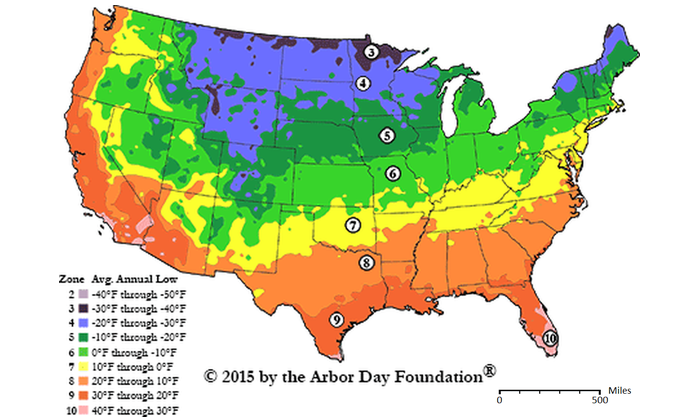
Now, compare that map with this growing-zone map (courtesy of arborday.org). In it you can see that Minnesota and Mississippi are about four climate/growing zones apart. Minnesota is mostly zone 4, and Mississippi is almost entirely zone 8. Illinois and Iowa are a mix of zones 5 & 6:
https://sealevel.info/zones-2015_700x420.png

U.S. climate zones span 10°F, so the center-to-center difference between four zone numbers is 40°F = 22.2 °C.
However, in this map you can see that Minnesota’s corn is mostly from the southern half of the state, which is a mix of zone 4 and zone 5, and Mississippi’s corn is mostly from the northwest half of the state, which is upper zone 8.
http://ctgpublishing.com/united-states-corn-production/

So the average temperature difference between the middle of the prime corn-growing regions of the two states is a bit less than 40°F, I’d call it about 33 ±2°F.
In Celsius, that’s a temperature difference of 17.2 to 19.4 °C (midpoint 18.3°C), between Mississippi (185 BPA) and Minnesota (191 BPA).
In other words, it is plain that an average temperature difference of about 18°C has little effect on corn yields.
Many other major crops are even less climate-sensitive:
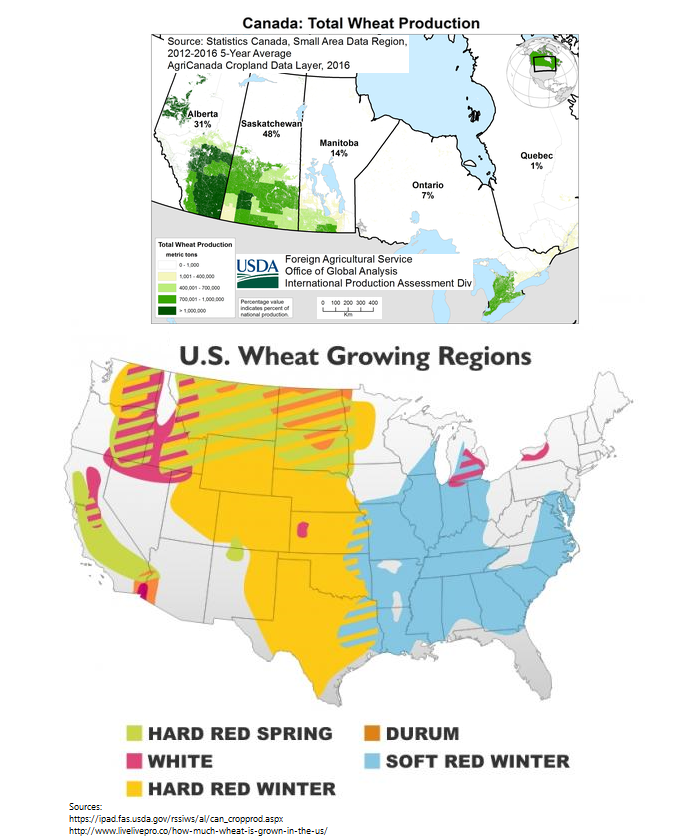
● Wheat is profitably grown in zones 3 through 9, from Saskatchewan to south Texas, a temperature range of over 35°C:
https://sealevel.info/wheat_growing_regions_usa_and_canada_700x840.png

● Maine & Florida are both major producers of Potatoes:
http://potatoesusa.com/us-potato-industry/us-growing-regions

● Soybeans are grown from Louisiana & Mississippi to Minnesota & Canada:
https://www.fb.org/images/uploads/_900w/Yuge_fig_4.jpg

What, then, are we to make of this PNAS paper?
Zhao C, et al. (2017) Temperature increase reduces global yields of major crops in four independent estimates. Proc Natl Acad Sci USA 114:9326–9331. doi:10.1073/pnas.1701762114
From the title you would probably assume that they found anthropogenic climate change causes crop yields to decline, because negative impacts of temperature increases exceed the positive impacts of CO2 fertilization and improved drought resistance from higher CO2 levels. That’s what you’re supposed to think, and that’s how the press release reported it:
“Climate change will cut crop yields,” said the caption on Phys.org, and called the little five-page paper “a major scientific report.”
“Global Warming Will Sear Three of Four Major Grain Crops,” said the caption on Haaratz.
But if you read the paper, or if you read Eric Worrall’s excellent 2017 analysis of it on WUWT, you’ll discover that the authors did not actually say that. Instead, they wrote that they were discussing what they think would happen to yields in an imaginary world “without CO2 fertilization, effective adaptation, and genetic improvement.”
Of course “without CO2 fertilization” means they’re ignoring the beneficial effects of higher CO2 levels, which obviously divorces the paper from any pretense of presenting predictions of future reality.
But it’s even worse than that. Can you guess what their assumption of no “effective adaptation” to a warming climate actually means?
For annual crops, “effective adaptation” means adjusting spring planting dates, and perhaps adjusting cultivar selection. That’s all.
It’s not rocket science. In America’s heartland, moving the planting date up by about six days compensates for 1°C of warming:
https://www.currentresults.com/Weather/Kansas/Places/wichita-temperatures-by-month-average.php

So +4°C of warming is equivalent to planting about 24 days late.
The assumption of no “effective adaptation” to warming means these 29(!) authors assumed farmers are all idiots, who can’t figure out when they should plant their crops. (Projection, maybe?)
It’s utterly preposterous. The reality is that most farmers are not idiots, anthropogenic CO2 is highly beneficial “air fertilizer,” and the further that CO2 levels rise, the more productive farms will become.
That fact is true for the great majority of crops, nearly everywhere in the world. Yet the NAS has been promoting the anti-scientific claim that rising CO2 levels are bad for agriculture, for years. This 2011 NAS / NRC propaganda graph is a particularly outrageous example:



Notice the red “US Maize” and purple “India Wheat” traces, and where they intersect the 4°C line. You can see that they’re predicting that in the event of a 4°C temperature increase, U.S. maize (corn) yields would decline by a devastating 60%, and wheat yields in India would fall 68%.
(Of course such a large temperature increase is thoroughly implausible, but never mind that. That’s a different rant, for a different day.)
Today’s rant is this: That NAS / NRC graph is a lie.
If a mere 4°C of warming were actually that destructive to corn yields, it would obviously be impossible to profitably grow corn even in Tennessee & Kentucky (zone 7, 174-175 BPA in 2018), let alone Mississippi (zone 8, 185 BPA).
Likewise, if a mere 4°C temperature increase were actually that destructive to wheat yields, then it would obviously be impossible for North Americans to cultivate wheat across seven climate zones, from Saskatchewan to south Texas, spanning an average temperature range of about 35°C.
That NAS / NRC graph is utter nonsense. But even though it is old, it’s still being used by climate change zealots to mislead people. I stumbled across it because someone posted it in the comments on an article at ArsTechnica. (I’m currently banned for a week there, for “ignoring moderation,” because I disagreed with their leftist moderator. My first comment there [screenshot] has been deleted, too, but some of the others are still there. They look “faded” because the ArsTechnica comment system fades-out comments with lots of downvotes.)
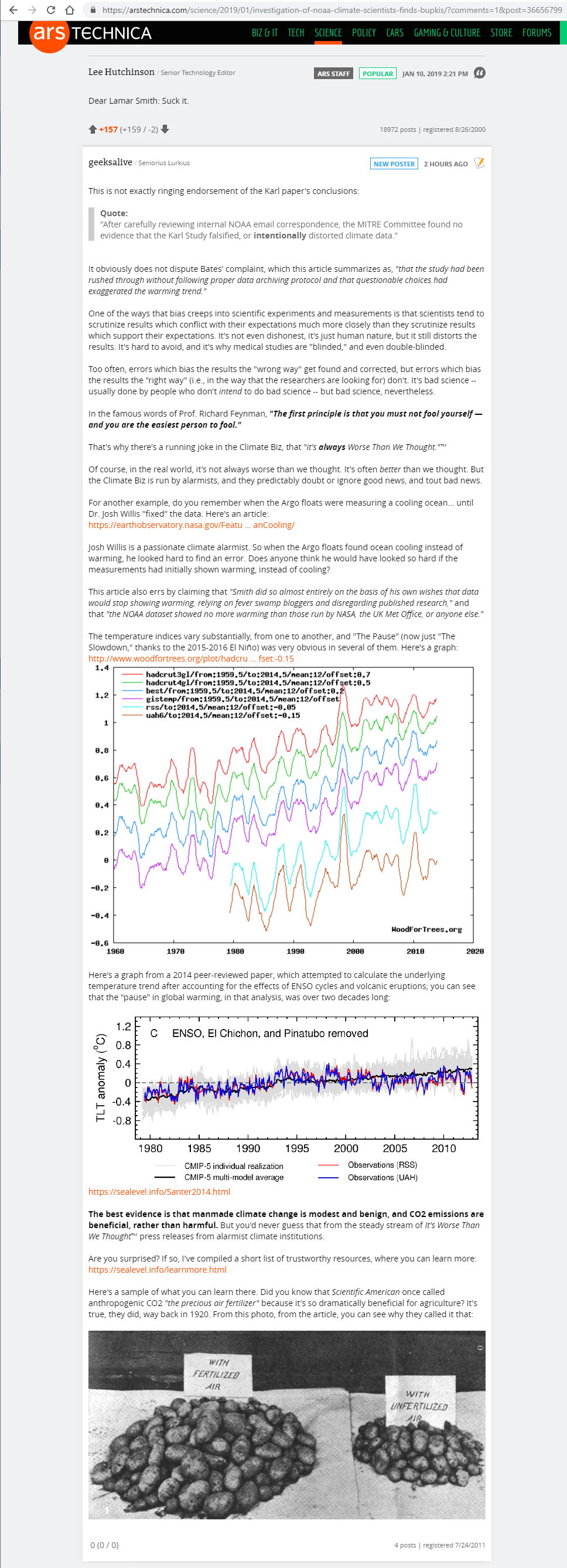
On March 22, 2012, Rud Istvan did a wonderful, in-depth demolition of that graph, on WUWT & ClimateEtc:
● https://judithcurry.com/2012/03/22/nrcs-artless-untruths-on-climate-change-and-food-security/
● https://wattsupwiththat.wordpress.com/2012/03/22/nrcs-2011-climategate/
Yet, despite their propaganda graph having been completely debunked, the NAS is still disseminating it, to promote the climate scare.
Here it is on their web site, on p.28 of a little 40 page propaganda booklet, which appears to be designed to be used as a resource by schoolteachers:
Here it is, in convenient PowerPoint format, for incorporation into your talk at the local garden club (slide 21):
http://dels.nas.edu/resources/static-assets/exec-office-other/climate-change-figures.ppt
(The file metadata indicates that the slides were created by “Rebecca” in June, 2013 — more than a year after Rud had discredited the graph.)
It’s also on p.161 of this free 299-page ebook:
If Zhao and his 28 co-authors really believe, as they claimed in their PNAS paper, that correctly assessing the impact of climate change on agriculture is “critical to maintaining global food supply,” then it is incredibly cynical of them and the NAS to publish misleading papers and graphs which encourage policymakers to take steps that will actually reduce that the global food supply.
I’m beginning to wonder: Does the “A” in “NAS” is still stand for “Academy of,” or does it now stand for “Anti-,”?
I do suppose that if someone was foolish enough to plant a variety of maize or wheat adapted to Minnesota in Mississippi, one could get an inferior yield.
Probably exactly what they did.
…could bump Florida up on corn….over 30,000 acres…but they don’t even plant until Sept
“So +4°C of warming is equivalent to planting about 24 days late”
If it’s warmer, wouldn’t they be planting 24 days earlier ?
Re-read that. He is saying that planting 24 days later would be equivalent to planting at the regular time if temperatures were 4C higher.
Yes, but so what? The time required for a crop to mature is pretty much the same. Warming would increase the length of the growing season at both ends. Having more time to plant and harvest can only be a good thing.
Here in Sweden farmers have always started planting as soon as the snow has melted and the ground has dried out enough, so “adaptation” will occur automatically.
For them, a longer growing season could only be a good thing, and yet this area of the world is one of the most strident of warmists at all the conferences.
Not agreeing or disagreeing, just clarifying what was said.
Few occupations discuss weather as extensively as farmers. Degree-day calculations gives some predictability on plant growth stages – when to plant, fertilize, spray, and when to expect harvest. Check it out on the web.
Note: I wrote, ““C4” crops benefit the least, but even C4 crops benefit when under drought stress.”
But Craig Idso points out that a new paper reports that corn (maize), which is the most important C4 crop, benefits from eCO2 more than you would expect for a C4 plant:
http://www.co2science.org/articles/V21/oct/a17.php
https://www.tandfonline.com/doi/abs/10.1080/00103624.2018.1448413
See also, http://www.co2science.org/subject/a/agriculturemaize.php and http://www.co2science.org/data/plant_growth/dry/z/zeam.php
Thanks, Craig!
Yes, CO2 is more than fertilizer. It’s the fundamental building block of all life. Like water, it is essential. Plants can be overwatered, but they can’t really be over CO2’ed as the optimum level of CO2 is at much higher levels.
Even C4 plants need less water under elevated plant food levels in the air, as you suggest.
Under drought stress C4 grain plants will hold their longer under eCO2; early ageing of leaves otherwise (under drought) results in faster senescence (being old). C4’s later occuring senescence (in drought) results in more leaf biomass & C4 grain plants (some, can’t say if all) will take about an extra week to start filling their grain (in drought).
Drought after anthesis (flowering) can cut grain yields by up to 30%; while keeping green leaves during grain filling yields more grain. Late in life C4 grain plants’ leaves hold more amino acids under eCO2 than ambient CO2 leaves do late in life.
eCO2 partitioning more carbon for storing in the roots allows these to be re-mobilized under drought to send upwards for grain filling. Grains filling under eCO2 will have more cysteine (made from chloroplast’s sulphur); vital because cysteine (plus glutamine & ATP via an enzyme having glycine on it’s C-terminal) cobbles together the cellular protective molecule glutathione.
eCO2 in C4 drought grains will also have more of certain molecules (sorbitol & glycerol) that are useful for coping with drought stress; in part, because eCO2 drives increased CO2 assimilation. This allows more electrons to be used when plant getting lots of light (technically more photons “captured” regardless of photo-synthesis) when drought threatens to stress the leaves – in simple terms the eCO2 growing plant can use that energy chemically, bumping up the amount of electrons used by making compounds (& sugars) that are protective.
Many assume that eCO2’s reduction of stomatal conductance (leaf pores more closed) is how C4 plants get better yields in drought than the same C4 gets in ambient CO2 + drought. The dynamic is not really linear; yes, for most of it’s days the C4 grain plant under eCO2 + drought will exhibit less open stomata (than ambient CO2 + drought). However, late in it’s viable days this will change; the eCO2 + drought C4 grain plant will actually have more stomatal pore conductance than the other (ambient CO2 + drought C4 plant).
Edit: 1st sentence insert word …” leaves” … before word longer. Pardon any other errors.
Corn yield in the early 60s was around 80 bushel per acre (boa)in Iowa. It is now 200 bpa. A corn kernel is nearly 50% carbon. A bushel weighs 63 lbs per bushel. So, among friends let’s just say that is an increase of 120 x 30 = 3600 more pounds of carbon just with the kernel per acre.
I just spent a little time reading the Idsos’ wonderful CO2 Science site, and elsewhere, about the other three main C4 crops.
It seems that sugarcane (the 2nd-most-important C4 crop?) also benefits pretty dramatically from eCO2:
http://www.co2science.org/data/plant_growth/dry/s/saccharumo.php
I also read, to my surprise, that, like legumes and alder trees, sugarcane can fix its own nitrogen via symbiotic bacteria. That might have something to do with the surprisingly large benefit it enjoys from eCO2, which would be consistent with C3 legumes (which also fix their own nitrogen, and benefit very dramatically from eCO2). Perhaps the plants’ ability to fix nitrogen means that there’s less risk that faster-growing crops will need more nitrogen fertilization than they get.
The benefits of eCO2 for sorghum (the 3rd-most-important C4 crop?) are unclear. Results vary. Some studies show benefits, but two studies show benefits only under dry conditions:
http://www.co2science.org/data/plant_growth/dry/s/sorghumb.php
Millet (the 4th-most-important C4 crop) is similarly unclear. One study says it benefits from eCO2, another says it doesn’t:
http://www.co2science.org/data/plant_growth/dry/p/panicumm.php
However, I should add that sorghum is known as a particularly drought-hardy crop. So, I presume that it is especially likely to be planted in places with high risk of drought. So even if eCO2 benefits “only under dry conditions” that is still a very Good Thing, for sorghum.
There is one other rather obscure C4 grain, which is also known as a particularly drought-hardy crop: Amaranth. There are many species of amaranth, several of which are cultivated, mostly for grain. There aren’t many studies of most amaranth species under eCO2, but the few that have been done have tended to show small benefits:
Amaranthus cruentus:
http://www.co2science.org/data/plant_growth/dry/a/amaranthusc.php
Amaranthus hypocondriacus:
http://www.co2science.org/data/plant_growth/dry/a/amaranthush.php
Amaranthus caudatus (also grown as ornamental):
apparently no studies
Amaranthus retroflexus (also grown as a vegetable):
http://www.co2science.org/data/plant_growth/dry/a/amaranthusr.php
Others:
http://www.co2science.org/data/plant_growth/dry/a/amaranthust.php
http://www.co2science.org/data/plant_growth/dry/a/amaranthusv.php
http://www.co2science.org/data/plant_growth/dry/a/amaranthushyb.php
Cassava (tapioca) is another little-studied crop, which is known to be especially drought-hardy. It is unusual in that it is considered to be “C3-C4 intermediate.” The CO2 Science plant database lists only two eCO2 studies of cassava, with inconsistent results:
http://www.co2science.org/data/plant_growth/dry/m/manihote.php
However, Craig has recently reviewed two newer papers, which haven’t been added to the database yet; they both report a strong benefit from eCO2, especially under dry conditions:
1. http://www.co2science.org/articles/V21/dec/a1.php
https://www.researchgate.net/publication/305845066_Elevated_CO2_concentrations_alleviate_the_inhibitory_effect_of_drought_on_physiology_and_growth_of_cassava_plants
2. http://www.co2science.org/articles/V21/dec/a15.php
https://www.tandfonline.com/doi/abs/10.1080/03650340.2018.1446523
The reason for the insensitivity to climate zone is largely the result of having short season versus long season varieties to plant. One can match variety to the reliable growing season. This is also a major factor in the yield. I grew corn in eastern Wyoming, which barely shows a corn growing region on the maps. We planted a lot of corn in the 87 to 95 day varieties, and considered it a bumper season if we got 144 BPA.
Now, a longer growing season, if reliable, would allow one to plant longer season varieties, and with appropriate inputs (water, fertilizer) yields would rise. Agriculture is always an optimization problem of balancing various trade-offs.
Or you could continue to plant the sort season varieties, and get two crops per year.
short season, not sort season
You certainly could if you sow the first crop in the autumn to over winter, alot of winter barley sown here, gives them 2 harvests, winter then spring sown, winter sown provides best tonnage pa.
winter sown looks like long grass when the spring barley is being drilled.
This is happening already, and not due to global warming. I have a friend who is a farmer in New Jersey who has abandoned growing corn varieties for sales as fresh ear corn. He can’t sell profitably when the price offered at market has to compete with Georgia growers who are getting two crops of ear corn per season. Higher temperatures in the South, combined with matched cultivars are totally changing the market for this crop.
There you go talking common sense and using practical examples. No wonder no alarmists come calling to engage you as a speaker.
What do farmers know about farming? It’s a good job we don’t depend on them for our food supply. Thank goodness we have Loblaws and the Walton family to thank for that service.
Sometimes I wonder if farmers understand anything at all about the weather and climate.
Obligatory /sarc
Why do these “studies” need 29 authors ?
One person to make stuff up, one to write it down, and 27 to nod their heads.
How else to achieve a 97% consensus?
Spread the blame?
Sorry about being so flip; couldn’t pass it up. It’s to generate citations for their CVs.
Spread the grant funding.
Spread the prestige of being associated with the grant-funded study.
Why make the funding to one author, when you can make it to 29? –28 more potential famous people bought with that funding? There’s grant-receiving strength in numbers.
…exactly right…that’s how it works
Simple, gets their names in print. Part of the “Publish or perish” culture, that infests universities these days.
In Neil deGrasse Tyson’s CV is a paper where he is one of 41 “authors.” He actually only has 14 papers total in his CV, IIRC.
If you add my name to your paper, I’ll add your name to my paper.
Wrong. It means that 29 CV:s will have another paper on it. “If you scratch my back, I will scratch your”.
Also known as MPU/MNA “Minimum publishable unit, Maximum number of authors”.
It has been said that the quality of any study is inversely proportional to the number of authors. This paper could be used as a case study. Does author #29 actually understand what the lead author actually said? Did he/she even read the paper? In some cases of academic fraud, people have added fake co-authors without even telling them, although I don’t say that this has happened with this paper.
I recently discovered that I was listed as the lead author on a paper based upon analysis I performed with an instrument which was so crapped up with junk from previous run that I abandoned the research after my advisor refused to allow me to clean it. I left industry and entered graduate school because of all of the lying and BS I encountered a discovered the same thing happening. The Department head who recruited me eventually left for another university. I guess that I should have followed him.
Carbon Based Life Forms participate in the Carbon Cycle.
Atmospheric Carbon Dioxide is necessary to complete the Carbon Cycle.
“Today’s rant is this: That NAS / NRC graph is a lie.”
Maybe one of them “accidentally” put the graph upside down…..again. LOL
No. I traced the graph origins in my 2012 post here and at Judiths. It was a deliberate misrepresentation made for a congressional briefing. The provable criminal felony is 18USC1001.
And the underlying maize yield paper comprises scientific misconduct for deliberately leaving a crucial, experimentally known covariance term out of the multiple regression.
Dave Burton was perhaps too polite in his condemnation.
Of course, it wouldn’t be as scary if the warmists didn’t press the narrative that no matter what the future holds as far as climate, it’s going to be bad. More scary means more funding.
“Food security” is cultural marxist sloganeering, to justify global government control of agriculture.
Billions will die.
Should the alarmists succeed in reducing global CO2 levels below 180ppm, which many if the severely mislead seem to desire, then billions of people (and most carbon based life) would die
That experiment could be done, and maybe has been. In a group of small greenhouses with lowered CO2, say, by 10 ppm increments from 200 to 50. Plant corn, water, maintain temperature, measure growth and yield.
Perform the experiment in each of the growth zones.
The result would be data, not speculation or models.
Although the press is always fast to link just about anything to Manmade Climate Change, I read a story two weeks ago about the fact that “the Sahel is becoming greener thanks to the efforts of the local farmers”.
Right… I guess local farmers just weren’t trying hard enough during the 20th century…
(CO2 has nothing to do with. CO2 bàààààd.)
The BBC has just had a feature blaming the problems in Mali on climate change.
This despite the population doubling every 20 years, and serious problems with terrorist groups.
Great thing about having the CO2 monitoring station in Hawaii is that it is in the middle of the ocean and not close to any continuous erupting volcanos…..During the flower phase of certain plants, a bigger yield can be obtain by producing CO2. Many greenhouse , while heating in winter, will let a gas heaters produces of combustion vent directly into greenhouse…Extra CO alarms just incase combustion goes haywire
I visited an Ontario greenhouse, and while there, the CO2 truck arrived with a delivery. They used the gas as part of their greenhouse procedures, even in summer.
One of the five volcanoes on the Big Island has been continuously erupting for 35 years.
https://en.wikipedia.org/wiki/K%C4%ABlauea
The CO2 observatory lies on another active volcano.
https://en.wikipedia.org/wiki/Mauna_Loa
My reply is yet again lost in cyberspace.
The Mauna Loa (an active volcano) CO2 observatory lies on the same island with the continuously erupting Kilauea volcano, and three other volcanoes.
Even scientists are smart enough to figure out which way the wind is blowing, and not take readings when they are down wind of the volcanoes.
Keeling tried to homogenize out local sources of CO2. One might wonder how effectively.
Mauna Loa is an active volcano, to include essentially continuous venting. No matter which direction the wind blows, it comes from an eruptive direction. If not from Mauna Loa itself, then from Kilauea, Hualalai, Mauna Kea or Kohala. Haleakala on nearby Maui is also probably not extinct, but dormant.
http://www.soest.hawaii.edu/gg/HCV/mloa-eruptions.html
Recent exceptional activity from Kilauea must have the data homogenizers whirring night and day.
To which I could add Lo’ihi Seamount, the new, still submarine volcano forming off the Big Island, as the Pacific Plate moves over the Hawaiian Hotspot.
Mauna Loa itself also has submarine vents.
Yet again my comment fails to post. It contained only a single link, since I didn’t include a source on how the Keeling Curve tries to handle local CO2 sources.
Is the output of CO2 from Mauna Loa volcano consistent over time?
Why was it chosen as the measuring point for CO2?
It varies, but, at least from submarine vents, it’s almost always outgassing.
The idea was that it would be a good locale for measurement, assuming that local sources could be controlled for. Better a tropical (barely) island mountaintop, even if volcanic, than close to a temperate zone continental city with high and greatly varying emissions.
Dave great post (-:
CO2 is more than fertilizer. The Nitrogen, phosphorus, and potassium in commercial fertilizers are needed in relatively small amounts, but CO2 is an essential ingredient. It is the feed stock of photosynthesis. It is as essential to the chloroplasts in the green leaves that produce the simple sugar as iron ore is essential to the smelter producing steel.
Disgraceful Science.
I spent a career in the seed industry in those bread basket states:
1) Corn is currently grown from the equator to Canada, and breeders are now developing corn to plant in Alberta. We have the genetics to “adapt” to almost any climate, as long as it rains.
2) Soybeans and all other beans have increased yields in higher CO2 environments, go to Google scholar and do a search. The CO2 window downwind from cities even increases yields slightly.
3) The application of genomics means we have the best breeders with the best ever in the planets history right now.
Namely, don’t worry about agriculture productivity in a warming world, we got this. There might be a problem if a truly cold period sets in though….just sayin’
Scary headlines have always had more value in climate ‘science ‘ than facts.
Partly because you can bet most people will never bother to check the facts and partly because you need these to keep the grant money flowing in and to let others know you are ‘one of them and not an evil denier ‘
The authorises merely acted the normal way for the rea they work-in, which in turn tells us much about the nature of the area.
Bear in mind that in a lot of these areas prairie grass used to grow until Mr John Deere Steel plough was able to tear through the grass and leave behind soil ready for planting.
Prairie grass is drought resistant illustrating the climate of vast areas. It’s a miracle that year on year there are bumper crops illustrating benign weather.
Interesting to note that during the 30s Great Drought, the shortgrass of Nebraska and Kansas spread hundreds of miles to the east into the mixed grass region, while the mixed grass spread hundreds of miles into the tallgrass.
Prairie grass being drought resistant has little to do with why it dominated this region, where drought happens but not regularly. Go look at all the natural forest still left in IL, WI, IA, and MI. Prairie grass dominated as it is a perrennial that can survive the cold winters, and can outcompete trees on many types of soil. Areas that are not great for farming because of drought were poor places for pretty prairie grass too (but they were all that would grow), like NE and CO.
And didn’t grazing by 60 million bison/buffalo and other herbivores have something to do with trees not getting established?
Hey that’s not fair…
Using logic and history…
co2 is a trace gas.
there is so much about agriculture and plants we dont understand.
What? CO2 levels dropped and caused C4 plants to develop as they can limit the CO2 reaching the photosynthetic enzymes. We are already at the point where C3 and C4 yields are competitive, and as CO2 goes up the beans will do better while the corn and wheat will stay the same. BTW, we know almost everything about plants physiologically and developmentally and we know their genomes, for almost all land plants, to the letter. What do you mean?
Mosh is having another tantrum.
He’s trying to parallel the claims of some that since CO2 is a trace gas it can’t have any impact on the climate.
He’s also trying to parallel those that point out that since there is so much we don’t know about the climate it’s too early to proclaim panic.
No you’d expect the C4 plants to do better that is maize.
No, C4 plants are losing any advantage they did have because of CO2, they still do better in drought, and corn has had a few hundred years of unprofessional and plant breeding so it is pretty hard to replace. Field corn is far from the average plant, C4 or not.
Bingo!
Excellent comment, Wex!
More like thousands of years of breeding. The natives were cultivating maize long before the Europeans figured out how to make boats that could sail the open ocean.
And about climate.
Another drive by Moshing.
The fact that plants thrive with more CO2 is known, and has been well known for over 100 years.
What’s more, it can be replicated with proper scientific experiments under controlled conditions, in a relatively short space of time.
The global warmulans, by contrast, assert something that cannot be tested with any kind of controls, and which cannot be falsified until after the protagonists are dead or unaccountable for any lies told
Now which one comes closest to the ideals of science?
So much that YOU don’t understand Mosher. Farmers are different. They understand about agriculture and plants.
B
But not “Global warming”! That’s settled science!
co2 is a deadly gas, because if you breathe car exhaust for very long you’ll die
we can pinpoint exactly what the climate is doing and will do, because of what our models driven by ginormous computers tell us, and unless we go back to living in dark mud huts and caves and eating twigs, we will kill the planet
Carbon monoxide (CO) is a deadly gas whereas carbon dioxide (CO2) is plant food.
Yeah I don’t understand why Mosh isn’t pointing this out? Doesn’t he know that CO2 is deadly to humans? I mean with these decreasing agriculture yields, the plants will use even less CO2 and the concentration is going to go up even more. People will be more drowsy, will lose concentration and with it their ability to work, with serious economic consequences. IT”S WORSE THAN WE THOUGHT! The air we breathe will become toxic. I’ll bet this will seriously impact the ability of blood cells to swap out CO2 for O2, a major health challenge that will be a serious disaster. How many people are going to die? WHY DOESN’T ANYONE ON THIS BLOG CARE ABOUT THIS? DENIERS!
/sarc
https://www.kane.co.uk/knowledge-centre/what-are-safe-levels-of-co-and-co2-in-rooms
Isn’t ignorance, gross assumptions and ‘argumentum ad ignorantiam’ great!
If one is ignorant enough, specious claims are easy to spout.
A) What is in car exhaust that kills you is carbon monoxide.
Carbon monoxide monopolizes the oxygen receptors on blood cell hemoglobin, preventing oxygen from attaching.
Which is why people die from carbon monoxide poisoning when CO reaches 50 parts per million. 0.005%. Higher levels of CO speeds up the CO poisoning rate.
OSHA considers CO₂ safe at levels from 10,000 ppm to 30,000 ppm; i.e. 0.1% to 0.3%. Though higher levels have shown few ill effects.
Imagine that!? Models are omniscient!
It does not matter to bruce that none of the models have produced anything near accurate results.
Another soft malthusian urbanite drinking kool-aid and forgetting to observe and think.
Huh!? Aren’t you the guy that is always telling us that climate science is settled? And now you are telling us that we do not know anything about agriculture? Isn’t agriculture a part of climate, I mean it largely happens outside. If we are are confused by agriculture and if agriculture is part of the climate then we are confused about climate.
Overall I think the skeptically inclined are generally less confused as we are generally aware and admit to the things we do not know.
Next you will be telling me that Corn or Potatoes are non-gmo. Hint these plants were only indigenous to the New World and the Natives Americans here spent thousands of year modifying them.
Steven,
Both of your statements are true.
One must acknowledge that our agricultural knowledge base is increasing at the most rapid rate in history. I believe that it is safe to say that we have learned more about plants in the past 100 years than we learned in the previous 10,000 years. We will always have much more to learn.
The point of this article was that the NAS used only a portion of what we do know to be true about plants to paint a dismal picture which aligns with the authors’ odd agenda rather than the reality supported by empirical data.
Mosh,
There is surely much that you don’t understand.
However science does know that CO2 is essential for photosynthesis, the process by which plants make sugar, vital to their existence and the source of human food.
More CO2 is better, up to 1300 ppm, after which not much gain in productivity occurs. Dave’s figure is a little high. The small bit of CO2 added by humanity has greened the planet. Tripling present plant food levels in the air would have an even greater beneficial effect.
More CO2 for instance has greened the Sahel, because plants there need to keep their stomata open for less time to get the food they require from the air. This means less water loss, so they can expand their range into drier areas.
So far, more CO2 has been wholly beneficial. As early proponents of AGW like Arrhenius understood.
CO2 is a small percentage of the total atmosphere, but,
CO2 is the major plant food, and
whatever is in 2nd place is a trace fertilizer.
Trace but essential. Without CO2 in the air, then no land plants. Without land plants, no land animals or fungi. Nor many microbes.
The effect of trace gas increase on plants is KNOWN.
The effect of trace gas increase on temperature is UNKNOWN.
Moshe tries, but, as often, fails. Heh, we could say his pen, this time, is phony.
=============
More heh, ditto on phony pens for Zeke, Kevin, and cetera(see Nic @ur momisugly Judy’s). Really, moshe, you oughta be ashamed of yourself, joining the propagandists. Once upon a time, moshe, once upon a long gone passing.
================
Are we really so certain that it is mankind’s efforts that have increased CO2 levels by 100 plus ppm as assumed in the excellent posting?
I don’t have any great problem attributing a good part of the increase or even most of it to us but equally other natural factors could be at play and cannot be wholly discounted.
As sure as we can measure 282.9 ppm CO2 in ice from the year 1800 (that’s sarcasm BTW).
As one that has measured CO2 analytically thousands of times, my opinion is that the accuracy of ice core measurements are biased and overstated. There has been no third party review of the methods even though the results are being relied upon to make multi-billion dollar decisions. Prior to the 1980’s, ice core measurements routinely showed 1000 ppm CO2 or more. What changed? Measurement methods were altered to give “more reasonable” results (just more fudge actually).
Good point. I’ve put it on my to-do list to see if I can make my CO2 graph page round the ice core numbers to whole integers (which is still unrealistically optimistic, but not as ridiculous as tenths of a degree).
https://sealevel.info/co2.html
Thank you for the suggestion, R Shearer. I’ve changed https://sealevel.info/co2.html to round to the nearest integer for tooltips displaying ice core CO2 levels (vs. 2 decimal digits for Mauna Loa CO2 levels). That still might be too optimistic, but it’s at least less obviously silly.
It’s hard to get around increased productivity with increased CO2. So, what to do? I know. Let’s say that more CO2 makes crops less nutritious. link
The thing is that greenhouse growers increase CO2 a lot and the nutrition value of their crops doesn’t suffer. Once again, academics demonstrate that they have no knowledge of the real world. They do, however, demonstrate a willingness to bend science to fit the CAGW narrative.
More H2O also makes crops less nutritious. For the same mass, more water content, so go figure. But no sane individual would claim that is better to grow crops in desserts, with no irrigations whatsoever, to avoid the ‘less nutritious’ crops.
Bingo. Exactly right, Bob.
The alarmists’s fallback position, when shown proof of the benefits of CO2 fertilization, is typically, “but it makes food less nutritious.” But that claim is pretty obviously refuted by the example of food grown in greenhouses.
Human activities (mostly fossil fuel use) have raised outdoor CO2 levels by about 130 ppmv, from about 280 ppmv to nearly 410 ppmv. By comparison, commercial greenhouses typically use CO2 generators to keep CO2 levels at 1200 to 1500 ppmv, which is an increase 6 to 9 times as great.
If the modest increase in outdoor CO2 levels were making crops significantly less nutritious, then crops grown in greenhouses at dramatically higher CO2 levels would presumably be dramatically less nutritious than crops grown outdoors. But they aren’t, of course. Food grown in greenhouses at elevated CO2 levels has about the same nutritional value as food grown in open fields at ambient CO2 levels.
I think the most prominent promoter of that claim is Dr. Irakli Loladze, a mathematician. He and I had an online debate of sorts, in the comments on Quora. If you’re not a Quora member I don’t think you ca read those comments, but I saved a copy here:
https://sealevel.info/Is_Irakli_Loladze_right_that_rising_CO2_levels_are_affecting_the_nutritional_value_of_plants.html
Faster-growing, more productive crops do require more nutrients per acre (though not more nutrients per unit of production). That is true both for macro-nutrients like nitrogen, and micro-nutrients like iron. Agricultural best practices include fertilizing according to the needs of the crops.
The studies of nutritional content of crops grown with eCO2 (elevated CO2 level) have not found evidence that the overall nutritional value of crops is reduced by the improved plant productivity resulting from CO2 fertilization. Rather, they’ve found that when crops are grown in iron-poor or zinc-poor soil, the larger yields may contain lower levels (though not lower overall quantities!) of those micro-nutrients.
Most studies do not find a net protein or micronutrient reduction due to CO2 fertilization, because the increase in growth rates is greater than the protein or micronutrient level reductions.
The faster crops grow, the more nutrients they need. Competent farmers know that, and fertilize accordingly (or, for nitrogen, they may plant legumes — which, fortunately, benefit greatly from extra CO2). But if you fail to follow best agricultural practices, and don’t fertilize according to the needs of your crops, then the result may be substantial reductions in protein and/or micronutrient levels in the resulting crops.
The cause of those reductions is not higher CO2 levels, the cause is poor agricultural practices. Adequate fertilization alleviates most or all of the reduction.
Nitrogen is a special case. Inadequate nitrogen fertilization reduces protein production relative to carbohydrate production, because proteins contain nitrogen and carbohydrates don’t. Legumes, like clover, beans, and alfalfa, fix their own nitrogen, and with eCO2 they do so more rapidly, so adding extra nitrogen via fertilization is not typically required. (Fortuitously, those are precisely the crops which are most grown for protein!) Here’s a relevant paper:
https://www.ncbi.nlm.nih.gov/pmc/articles/PMC2773101/
But for other crops additional nitrogen fertilization is often needed with eCO2.
Here’s an excellent literature review on the topic, from the Idsos (as usual):
http://www.co2science.org/subject/p/summaries/protein.php
Excerpt:
Here are some additional references:
1. doi:10.1071/PP9960253
2. doi:10.1016/s0167-8809(98)00185-6
3. doi:10.1046/j.1469-8137.2001.00107.x
Once before on a WUWT thread I asked if anyone had data to detail the break down of different nutritional compounds for a human dietary plant grown which compared ambient CO2 & eCO2. I am asking for that again, please.
On WUWT I once post data showing trace mineral content changes, amino aid proportional content & carbohydrate variability for a plant grown at eCO2. I can accept one’s perspective of what constitutes “nutritional” is open to interpretation & the phrasing as “overall nutritional value” gives the dismissal of eCO2 changes some cover. Before butressing one’s declarations by touting how greenhouses grow food humans can live on can we actually see the data on what “all” is in that food compared to field grown version?
Repeated WUWT commentators over the years have stated if there is any reduction in nutrient in eCO2 grown food then we can just eat more of the more abundant eCO2 harvest – which I’ll accept is possible, for some, in some context. Whereas the suggestion farmers can simply fertilize crops better to counteract eCO2 induced nutritional changes I’ll concur is also possible, for some, in some context. However, most of my semi-arid farming neighbors are already cash strapped for buying fertilizer & local market forces are known to (sometimes) make your crop price at sale lower than the money invested.
I just do not see how the plant “knows” a CO2 molecule from an eCO2 molecule. It is like giving a human an oxygen mask sure there is increased uptake but the biological processes do not discriminate they just follow their chemical and biological kinetics.
It becomes the plant’s new “is” paradigm. Obviously the genetic information already exists in the plant and those genes get switched on.
The question is difficult to answer. There is the soil depletion problem that makes field crops less nutritious than they used to be. link It could well be that properly grown greenhouse crops are more nutritious than field crops.
There is a growing trend of indoor farming. All the light is artificial so it’s not the same as greenhouse growing. It could well be that standards will develop specifying the micronutrient content of indoor farmed crops.
Try this
http://www.co2science.org/articles/V21/nov/a6.php
They did a review of available studies and found that the positive effects outweigh any negative effects.
The chart shows avg. increases of 4% sucrose, 13% glucose & 14% fructose, but decreases in protein & most minerals under eCO2. I don’t automatically equate this as positive nutritionally.
Let’s, for sake of simplicity gaugeing the chart, that protein is 5% less under eCO2. If we follow someone’s advice to simply eat more (of the more abundant eCO2 harvest) then we are coincidentally going to be increasing already higher carbohydrate consumption.
While I am not doing the math, that adaptation (eat more for protein) is going to alter the calorie intake. Since WUWT is not a nutritional blog & there are readers here with personal dietary orientation I am mentioning this without analysis.
The chart shows “anti-oxidant”, etc. as much higher under eCO2. Again, to keep my comment from veering off topic, I will state (without analysis) that more of something (“anti-oxidants” as well) is not always better.
Did you bother to read the whole thing or just pick out what you wanted to and ignored the rest? It is called adaptation.
.” And for those concerned about the decreases in protein, nitrate, magnesium, iron, and zinc that were also observed in the meta-analysis, these slight declines can be reduced, if not reversed, through the application of several management approaches that were investigated and discussed by the authors, including “(1) selecting vegetable species or cultivars that possess greater ability in carbon fixation and synthesis of required quality-related compounds; (2) optimizing other environmental factors (e.g., moderate CO2 concentrations, moderate light intensity, increased N availability, or increased fertilization of Fe or Zn) to promote carbon fixation and nutrient uptake interactively when growing plants under elevated CO2; (3) harvesting vegetable products earlier in cases of over maturity and reduced benefit of elevated CO2 to vegetative growth; and (4) combining elevated CO2 with mild environmental stress (e.g., ultraviolet-B radiation or salinity) in instances when this enhances vegetable quality and might counteract the dilution effect or direct metabolic pathways toward the synthesis of health-beneficial compounds.”
All in all, it would therefore appear that CO2-induced plant nutritional enhancements far outweigh any CO2-induced plant nutritional declines. Thus, it can reasonably be concluded that rising atmospheric CO2 concentrations will yield future health benefits to both human and animal plant consumers.
Hi Robert, – I appreciate your highlighting what intrigued you. I simply used your link’s chart for average changes in nutritional components to avoid confusion.
As for your point “1)”: hey, that’s great – select the best plant. According to existing trends (linked chart) the “best” plant probably is still going to be carbohydrate increased, protein decreased & lower in many minerals. Without the specific cultivar of a specific plant’s nutritional data I won’t try to guess how much less carbohydrate, more protein & greater minerals can be gotten growing at eCO2.
By the way, it has been the cultivar selection, which , among other things (agronomic science) that has driven some of the yield increases the O.P. discussed & did not parse from yield increase that was CO2 related. Meaning rising CO2, currently, is only a contributing factor.
As for your point “2)”: nice tactics – most of my farming (small landholders) neighbors don’t have ready available funds for agricultural inputs (ex: lots of nitrogen) & they field crop (no light or CO2 greenhouse environmental control). My region is semi-arid & the topic of the day is always about rain; so I personally am 100% willing to see eCO2 (for plant water use efficiency, if nothing else).
As for your point “3)”: harvesting earlier sounds like something suitable for greenhouse vegetables that can be quickly picked, hydro-cooled, shipped to a refrigerated packing house, treated to conserve (ex: cut down ethylene & pectinase activity) for trans-shipment & await customers in an air conditioned supermarket.
My “developing country” farm neighbors choose to pick their cash crops when the season’s conditions are suitable (we get 1 rainy season & usually a very “short” rainy month plus unscheduled rain year round) & the produce item has market appeal (ex: no customers for dinky little okra, nor for jumbo okra). Family farms in “developing” countries don’t have crop insurance; sometimes here in Gringolandia a crop will be pre-sold (milk, incidentally, is very frequently pre-sold against money borrowed from a cheese producer) but this (pre-selling) is usually for things like coffee & cacao (not perishable vegetables). I’ve seen cases when mature crops were left in the field because following up paying the harvest labor & transport to market would have made grower lose money.
As for your point “4)”: manipulating UV-B is a again, a greenhouse option only. Manipulating “stress” is a more complex issue (I’ll skip agronomy explanation) & although some tactic(s) for this may (as in theoretically being possible) be a put into practise for field crops the practical execution (of any specific stress & subsequent seasons’ consequences) is somewhat of a challenge.
I can see eCO2 greenhouses being able to manipulate “stress”, although I am not sure if this will actually increase protein yield, or alter the amino acid profile in proportions we humans might “nutritionally” prefer. Possibly the eCO2 carbohydrate increase may decrease as carbon used to produce stress response molecules; although then too, it (carbohydrate composition change) may depend on which stress exposure employed.
Personally, I am of the opinion that experimental eCO2 is good science & I make a big deal only about how we need to understand that not all results are lineal. Based on how long it will take for field crop CO2 levels to reach experimental eCO2 levels my thinking is that plant science will develop faster in terms of boosting yields for C3 crops of commercial value (which does not mean automatically more “nutritious” either).
Getting the necessary information to farmers is the responsible of the government and it is in the industry’ Interest to also see that farmers have the most uptodate information. I have farmers in my family and have worked on a couple of farms in my younger days. I always found that farmers will not wait for the government to supply them with the necessary information to improve their farms. Several of my relatives made sure that their offspring went to college first then came back to the farm.
Again Robert, – I have no doubt your developed countries have farming depth such as you elucidated. My work has been in “developing/under developed” countries over the decades which on several continents & assorted agricultural focus – I’ll lump it together as agro-industrial.
20 years ago I had a tropical based import- export business. I mostly (among other food related items) imported pallets of agricultural seeds from the USA & mostly exported shipping containers of bananas (among other unprocessed foods) to Europe.
Which is to say the circumstances of our tropical market, farmer finances, crop issues, cultural proclivities & post-harvest peculiarities are clearly known to me. I’ll try to give an example that makes me assert our discussed points “2), 3)& 4) are irrelevant in my adopted “developing country” unless the small farmers can have greenhouses essentially given to them (hey, I’ve seen this happen to a few).
Scenario:
eCO2 has produced crops with more carbohydrates, less protein & less of many minerals. I have a license to import specially bred seeds from USA that reverse that pattern.
I initiate an educational out-reach to spread the science supporting the special seeds & try to get adoptees.
Being special seeds they cost more than other seeds & growers do their own price comparison.
Then most of the small farmers look at their finances & buy the old kind of seeds that yield produce with more carbohydrates & lower protein.
I remonstrate trying to convey the difference these small farmers are giving up & they negate this by declaring their volume of sales are to customers whose factor for produce selection is price & cultural preferences (type of bean/cucumber/greens/grain/etc.).
Some do take my advice on special seeds, but sales are anemic. With a stockpile of special seeds the import venture isn’t lucrative.
The following year instead of pallets imported few special seeds are brought in to service any farmers who trialed the 1st batch. This makes the
price higher by not being a bulk importation.
Appraised of a higher price & with financial details on their rate of return the early adopters consult their peers still growing non-special seeds. Imported seed sale volume goes down.
Losing money (& customers) is what I can envision likely happening on this import scenario, more so than widespread adoption supporting my business
model.
So I go to the government agricultural agencies & explain the scientific parameters. My contacts tell me they’ll see what they can do. When we get together again I’m told budgets are tight with other agricultural priorities than special seeds from abroad.
I give up the import license the following year by not paying relevant fees after my contacts submit my grant proposals to assorted NGOs, which pass on funding.
One NGO offers up instead a grant for a packing house in Afghanistan. I say “no thanks, like I told you with that offer for an agricultural project there back in 2005 – Afghanistan isn’t for me.”
Correct me if I’m wrong, but I think that most crops which are eaten for protein are legumes, which fix their own nitrogen, and don’t suffer substantially reduced protein content from eCO2.
Wheat is a bit of an exception, because high gluten content (a protein) is prized, for bread-making.
Fig 2 has variable chart of soybeans’ (have nitrogen fixers at roots) decrease in protein under eCO2.See free full text available on-line : “Effects of elevared CO2 on the protein content of food crops a neta-analysis.”
It shows again, how depending on the experimental parameters eCO2 is hard to make definative declarations about. Optimally retractors & advocates should qualify their writing when it is actually a generalization, but that makes for dense reading.
SAVE THE PLANET!
EMIT CO2
(I have never done bumper stickers on my car, but I am ordering this one.)
There’s another beneficial factor. If you to plant earlier, then your growing season will be closer to the summer solstice and you’ll gain some from higher sun and longer days. At high latitudes, this can get significant.
In some cases, global warming can extend the growing season enough to allow growing crops that weren’t even possible before.
True, but it is true for any growing season, up to the point that the plant (which is generally an annual) gains nothing from longer growth and more sunlight.
“So +4°C of warming is equivalent to planting about 24 days late.”
Wouldn’t that be 24 days earlier?
Not based on their theory, planting earlier gives you better yields as you plant cultivars that have a longer growth period prior to harvest (up to a point). Of course, they are still wrong because farmers will plant the right cultivar. This article makes unrealistic assumptions that would require farmers to use seeds not acclimated to the new climate
In other words, to compensate for +4°C of warming you would need to plant 24 days earlier.
Climate-killing CO2 supports the “white man bad” narrative, so it’s not going to go away easily.
It really is utterly appalling that the Climate McScientists and their tame hacks in the MSM get away with this time after time. They ought to be held to account for propagating disinformation and trying to frighten people with nonsense.