Note: I normally don’t publish anything related to the ideas of Nikolov and Zeller, for three reasons: 1) It’s just wrong, 2) It invariably descends into a shouting match. 3) These two guys published a paper under fake names to fool the peer-review process, which is a professional no-no.
But, here we are. I thought this was important to share. – Anthony
Giving Credit to Willis Eschenbach (originally published at drroyspencer.com)
by Roy W. Spencer, Ph. D.
The non-greenhouse theory of Nikolov (and now Zeller-Nikolov) continues to live on, most recently in this article I’ve been asked about on social media.
In short, it is the theory that there really isn’t a so-called “greenhouse effect”, and that the excess planetary surface temperatures on Earth, Venus, and other planets above the Stefan-Boltzmann (SB) temperature calculated from the rate of absorbed solar radiation is due to compressional heating by the atmosphere.
This is a popular alternative explanation that I am often asked about. Of course, if there is no “greenhouse effect”, we don’t have to worry about increasing CO2 in the atmosphere and all of the global warmmongers can go home.
I have posted on this blog many times over the years all of the evidences I can think of to show there really is a greenhouse effect, but it is never enough to change the minds of those who have already convinced themselves that planetary surface temperatures are only a function of (1) absorbed sunlight and (2) atmospheric pressure, as Zeller and Nikolov claim.
I’ve always had the nagging suspicion there was a simpler proof that the Zeller-Nikolov theory was wrong, but I could never put my finger on it. My co-worker, Danny Braswell (a PhD computational physicist) and I have joked over the years that we tend to make problems too difficult… we’ve spent days working a problem when the simple solution was staring us in the face all along.
Enter citizen scientist Willis Eschenbach, a frequent contributor at Wattsupwiththat.com, who back in 2012 posted there a “proof” that Nikolov was wrong. The simplicity of the proof makes it powerful, indeed. I don’t know why I did not notice it at the time. My apologies to Willis.
Basically, the proof starts with the simplified case of the average planetary temperature without an atmosphere, which can be calculated using a single equation (the Stefan-Boltzmann equation). Conceptually, in the absence of an atmosphere, sunlight will heat the surface and the temperature will rise until the rate of emitted infrared radiation from the surface to outer space equals the rate of absorbed solar energy. (To be accurate, one needs to take into account the fact the planet is rotating and spherical, the rate of heat conduction into the sub-surface, and you also need to know the planet’s albedo (solar reflectivity) and infrared emissivity).
The SB equation always results in a surface temperature that is too cold compared to surface temperatures when an atmosphere is present, and greenhouse theory is traditionally invoked to explain the difference.
Significantly, Willis pointed out that if atmospheric pressure is instead what raises the temperature above the S-B value, as the Zeller-Nikolov theory claims, the rate of energy loss by infrared radiation will then go up (for the same reason a hotter fire feels hotter on your skin at a distance). But now the energy loss by the surface is greater than the energy gained, and energy is no longer conserved. Thus, warming cannot occur from increasing pressure alone.
In other words, without the inclusion of the greenhouse effect (which has downward IR emission by the atmosphere reducing the net loss of IR by the surface), the atmospheric pressure hypothesis of Zeller-Nikolov cannot explain surface temperatures above the Stefan-Boltzmann value without violation of the fundamental 1st Law of Thermodynamics: Conservation of Energy.
This is a simple and elegant proof that radiation from the atmosphere does indeed warm the surface above the S-B value. This will be my first go-to argument from now on when asked about the no-greenhouse theory.
I like to give credit where credit is due, and Willis provided a valuable contribution here.
(For those who are not so scientifically inclined, I still like the use of a simple hand-held IR thermometer to demonstrate that the cold atmosphere can actually cause a warmer surface to become warmer still [and, no, the 2nd Law of Thermodynamics is not violated]).
Disappointing that after so many years here at WUWT, something as simple and basic as radiative GHE is not well understood or accepted by all, and that ‘embarassing’ alternative theories still abound to be espoused here.
The GHE is NOT warming; all warming comes from inbound solar radiation (lets skip the de minimus volcanic argument powered by radioactive decay in Earths core).
The GHE is a transient absence of eqivalent offsetting IR cooling to space. Convection and
conduction can move solar generated heat around, but by definition cannot shed it back to space. The most that convection can do is transport some heat above the effective radiating level (ERL) where the GHG IR scattering ‘fog’ clears sufficiently for IR to reach space. (Think towering thunderstorms).We know that ERL ‘height’ from the temperature/altitude lapse rate measured by radiosondes, and the ‘temperature’ of the escaping IR frequency as measured by satellites.
That transient absence of radiative cooling is caused by GHG, the existence of which was experimentally shown in 1859 by John Tyndall. Transient, because in the presence of any added amount of GHG, temperature will rise until sufficient additional offsetting IR materializes.
Dr Spencers backradiation sensor does not show that backradiation ‘warms’. It evidences the IR scattering by GHG that proves the loss of IR cooling that comprises the GHE. Hence his comment about not violating the second thermo law.
Greenhouse gases radiate. The question is, is their activity enough to raise the temperature of the earth’s surface above the blackbody calculation?
No one denies radiative effects. But to me and many others, it is the atmospheric greenhouse effect proposed by NZ and Stephen Wilde and others that makes possible, or that allows for, the radiative effects to occur. But those radiative effects are not powerful enough to warm the planet sufficiently; for that to happen an atmosphere dense enough to retain heat from land and oceans warmed by the sun is required. Atmospheric density is the big player, not greenhouse gases. That is the essential paradigm proposed by NZ but bastardized by those who suppose that they’re talking about compressive heating.
Don132
Hey Don, if/when you work through the actual physics of Wilde and his ilk, you will realize their errors.
BTW, NZ actually does suppose compressive heating.
“Pressure by itself is not a source of energy! Instead, it enhances (amplifies) the energy supplied by an external source such as the Sun through density-dependent rates of molecular collision. This relative enhancement only manifests as an actual energy in the presence of external heating.”
–Nikolov and Zeller
https://www.researchgate.net/publication/309651389_Unified_Theory_of_Climate_-_Expanding_the_Concept_of_Atmospheric_Greenhouse_Effect_Using_Thermodynamic_Principles_Implications_for_Predicting_Future_Climate_Change
Summary: the atmosphere is most dense at the surface, and thus most of the atmospheric heat is necessarily concentrated at the surface. It is so with or without GHGs. How many times are we going to accuse NZ of saying things they don’t, just so we can “prove” them wrong?
Rud Istvan, I may be wrong. Please show me where NZ support compressive heating, such as happens when a bicycle tire is blown up. My understanding is that it’s all about atmospheric density, and a lot of people don’t seem to get it.
Don132
It is amazing how many extra “harmless” assumptions are attributed and then attacked. Looks like standard practice – it is Kant in action (even if not realized).
Kant attacked “pure reason” which does not in fact exist, then practical reason, consensus, which does.
Any physical conjecture must conform to sufficient creative reason first. Those that Kan’t follow the Critique (colloquially straw-dog).
“Greenhouse gases radiate.”
Don’t all atmospheric gases radiate?
Feynman had these ideas, sound familiar?
https://principia-scientific.org/physicist-richard-feynman-discredits-greenhouse-gas-theory/
Oh great, I was just on the verge of declaring Willis the winner of this unsettled science debate and you had to ahead and throw Feynman into the equation……..
You do know that references to Principia-scientific are banned here?
https://wattsupwiththat.com/policy/
“For the same reasons as the absurd topics listed above, references to the “Slaying the Sky Dragon” Book and subsequent group “Principia Scientific” which have the misguided idea that the greenhouse effect doesn’t exist, and have elevated that idea into active zealotry, WUWT is a “Slayer Free Zone”. There are other blogs which will discuss this topic, take that commentary there.”
if you put in a sprinkler system , open the doors and windows mirroring the real world – what green house effect!
Yes PSI are supposed to be these really bad people. But oddly what they say on that page seems to make sense. Feynman seems to be talking sense.
Slightly skeptical December 31, 2018 at 2:22 pm
No, Feynman did NOT have these ideas. However, the idiots at Principia Scientific THINK he did. They say:
All that that shows is that the clowns over at P-S don’t understand the difference between work and energy.
w.
Feynman was notorious for deriving in his own way the same physics observations/predictions as the main stream theories he was late in accepting, as the quark model or QCD . I have sat through lectures in international settings where he did exactly that, and one had to tie ones brain in knots to follow, and really not see the reason of not sticking with the earlier mainstream version. He was correct in his mathematics, being Feynman of course. I know it is not worth my effort to check carefully the overlaps between the green house model and Feynman’s version.
.
Simply dismissing it [the NZ argument] in a judgemental one liner is even “wronger”.
.
I wonder why? Could it be that everyone is not convinced that “it’s just wrong”?
.
Fooled the peer-review process how? Exactly how was the process fooled? How did simply using different names fool the process of receiving a paper and evaluating it fairly? Did a change of names somehow disable the reviewer’s mental capacity to understand what they were reading? Did it render them blind? Did it give them intestinal issues to the point that they could not sit long enough to ingest and evaluate the paper?
Sorry, but this just seems way too unforgiving. Let’s not forget that non-popular ideas in this arena are seldom met with receptive arms, especially when those arms know the names of people putting forth the ideas, and, by knowing names, those arms can blacklist and reject the ideas and keep the ideas out of view, for no other reason than the ideas differ radically from the norm.
“Professional no-no”? … “peer review process”? … Please. What’s professional about the atmosphere in which such a paper was presented? You call the attitude of blacklisting known divergent thinkers, “professional”? Isn’t this something that WUWT frowns upon? I would think that we would have more understanding for resorting to unprofessional tactics in this … [clear throat] … “professional” publishing arena. Such gorilla tactics are not unwarranted.
And as much as WUWT has dissed the “peer review” process, when it comes to climate science, I would think that we would be even more understanding of this supposed “fake name” stunt.
If lots of people know who you are, and, knowing this, they automatically reject anything you might submit, then is using a “fake name” really so unforgivable, in order to get your work seen? I think not. In any other arena, this might be a “professional no-no”. But, in this one (the climate science arena) … I dunno.
I’m delighted to see physicists use humor – they simply do not care about the raging climate brawl and got off-planet for further research. They have no problem with GCR’s either. And they used NASA data, imagine that!
Now I wonder about the ~1300 exoplanets – is there enough data to check N-Z ? It looks like we only need exo-solar distance, mass and atmospheric spectra.
Seems like folks still aren’t getting it. Let me see if I can simplify it even more.
A blackbody planet with no greenhouse gases in the atmosphere has only one thing in the entire system that can absorb energy from outside the system—the surface.
It also has only one thing in the whole system that can lose energy back to space—the surface.
THEREFORE: the surface MUST radiate the amount that it receives, and therefore it cannot be warmed by ANY such proposed atmosphere-based process—whether said process is based on pressure or lapse rate or gravity or whatever. Over time, the surface CANNOT radiate more than it is receiving, period.
So please, all of the explanations about lapse rates and compression of gases and conduction and convection are missing the point—the surface can only radiate the amount that it receives, not more and not less. Thus in the system I described, none of those processes can raise the average temperature of the surface.
w.
“A blackbody planet with no greenhouse gases in the atmosphere has only one thing in the entire system that can absorb energy from outside the system—the surface.
It also has only one thing in the whole system that can lose energy back to space—the surface.”
Yep, exactly so.
All gases radiate at some level, just tiny compared to what CO2 can do. Otherwise, how does spectrography work?
Not all gases radiate in the thermal longwave (IR) range.
w.
It doesn’t matter what all gases do. Nitrogen and oxygen (99% of the atmosphere) do radiate infrared.
icisil January 1, 2019 at 6:56 am
No, basically they N2 and O2 do NOT radiate IR. That’s why they are not called “greenhouse gases”. Symmetrical diatomic molecules can only absorb or radiate infrared in very special circumstances. The overwhelming majority of the time they don’t do either.
Best regards,
w.
At standard temperature and pressure, most atmospheric gases neither absorb nor radiate at visible wavelengths. It is a property that permits transparency. Anything that can emit can also absorb and the atmosphere would not be transparent.
“Not all gases radiate in the thermal longwave (IR) range.
w.”
Here’s a calculation of the infrared cooling rate of a hypothetical 1 meter sphere of nitrogen at 300K:
https://physics.stackexchange.com/questions/163876/thermal-radiation-of-a-nitrogen-sphere
This study finds that due to the absorption bands of O2 and N2:
‘for dry atmospheric situations like over the Antarctic continent the effect of O2 and N2 even reach up to 80% of the influence of CH4’
https://agupubs.onlinelibrary.wiley.com/doi/pdf/10.1029/2012GL051409
Thanks, Ulric. I’ve said before that O2 and N2 are very weak absorbers/radiators of thermal infrared. They can only do that if the photo hits while they are colliding with another molecule.
You first link merely ASSUMES that N2 is a perfect blackbody. Fail.
The second one is accurate. It says:
So globally, O2 absorbs/radiates A TENTH OF A WATT/M2 and N2 absorbs TWO TENTHS OF A WATT/M2.
This is despite the fact that O2 and N2 together make up 99% of the atmosphere … like I said, they are very, very weak absorbers. As a result, they are generally ignored in greenhouse calculations.
w.
A blackbody planet with no greenhouse gases in the atmosphere has only one thing in the entire system that can absorb energy from outside the system—the surface.
All gassed absorb and radiate heat energy.
All gasses are greenhouse gasses.
How can any gas not interact with solar radiation?
http://notrickszone.com/2018/11/12/real-world-spectral-measurements-show-the-greenhouse-theory-is-wrong-all-gases-are-ghgs/
Tasfay Martinov December 31, 2018 at 3:57 pm
Not true. Monatomic gases (argon, neon, etc) neither absorb nor radiate thermal (longwave) radiation. And symmetrical diatomic gases (O2, N2) can only do so if the radiation strikes them just when they have been hit by another molecule.
Oh, please. Why do you think that scientists divide gases into GHGs and non-GHGs?
By being a monatomic gas …
Do some homework, please, you are embarrassing yourself.
w.
Willis
Are you telling us that the noble gases have an emissivity of zero? It is going to take a while to get my head wrapped around that. I thought that all material things above absolute zero radiated according to the 4th power of the temperature.
Yep, the noble gases have zero emissivity. And N2 and O2 have almost zero emissivity.
All SOLID things above absolute zero radiate according to the 4th power law. But not monatomic gases.
w.
Willis
OK I get it.
So the 399/400 ths of the atmosphere that are not CO2 are essentially dark matter.
And when astronomers do absorption spectroscopy of distant stars and gas clouds, the only thing they ever detect is CO2.
Right?
Let say that except for Raman effect (very small), non net electrical dipole molecules are not radiatives in vibrational and rotational modes (long wave IR).
“The simplest method is to heat the sample to a high temperature, after which the excitations are produced by collisions between the sample atoms.”
The key word is “hot”
https://en.wikipedia.org/wiki/Emission_spectrum
Willis … I won’t dispute that you are correct about NZ and pressure and all that, but … a black body ain’t earth. Specifically, the earth Is uniquely situated at a point, with an atmosphere that filters the energy, such that water exist in all three forms. Water acts as a heat capacitor. So do GHGs, but the joules of heat that can be stored in CO2 simply is minuscule because it’s absorption is limited by wavelength.
As such, I reject the NZ model, but I also reject that the GHG theory is capable of much either if you take water out of the equation. Water is the key. Water has the capacity to store heat for longer periods of time, clouds have the ability to limit or increase solar input to any given point, water is a greenhouse gas, but because it exist in all three states here on earth, it functions very differently from a gas like CO2.
I remember the early sun model published by the Stanford guys ….. GHGs other than water were not relevant. It’s simple as that.
What the oversimplified explanation fails to account for is the presence of an atmosphere that is warmed primarily by moist convection, not by LWIR radiation. Thus the surface loses heat not by radiation alone and GHGs provide only an ANCILLARY means of STORING thermal energy in the atmosphere.
That stored energy (which is NOT confined to the “radiationally active” constituents) is what raises the temperature, just as stored water behind a dam increases the pressure driving the flow-though plume of water. As long as outflow of energy balances the system inflow on a planetary basis, no violation of conservation of energy is necessary to explain the higher surface temperatures. On the contrary, positing the levels of LWIR exchange at the surface seen in popular climate cartoons requires wholly impossible power-production by the atmosphere. It’s simply not a radiation-only problem!
BTW, surfaces being mass-less, two-dimensional entities can only pass through, but not absorb or store, energy. Let’s not carry such aphysical nonsense into the New Year.
1sky1 December 31, 2018 at 4:22 pm
1sky1, it is a thought experiment. I specified no greenhouse gases … so there is no “moist convection”. It is not designed to replicate the earth. It is designed to show, and it does indeed show, that N&Z’s claim that some pressure related phenomenon or other can heat the surface in the absence of greenhouse gases is a violation of the Laws of Thermodynamics.
Period.
w.
Willis,
Even with a radiatively inert atmosphere there will still be a lapse rate slope due to decreasing density with height.
Convective overturning cannot be prevented due to uneven surface heating.
Something has to fuel such continuing convective overturning and if all surface heat were radiated to space the atmosphere would fall to the ground.
It is true that once an atmosphere is in place there is no further net energy exchange from surface to atmosphere but heat energy is still required at the surface to hold it suspended off the surface and that is the mass induced greenhouse effect.
Your ‘proof’ is fatally flawed.
atmosphere but heat energy is still required at the surface to hold it suspended off the surface and that is the mass induced greenhouse effect
No, that energy comes from the sun. Turn off the sun and the atmosphere falls to the ground as it radiates away its heat.
So we have the best energy from the sun holding the atmosphere up and the gravity vector holding it down. There’s your squeeze play heating the atmosphere on venus, compressing it every delta t.
Leif
Of course it would and the initial energy required to suspend the atmosphere off the originally came from the sun via conduction from surface to air during the formation process.
initial energy required to suspend the atmosphere off the originally came from the sun
It comes from the sun at all times as we speak, no ‘initial’ or ‘original’ nonsense involved.
Leif,
I do not see your point.
Hi Willis, it’s amazing that we get all this nonsense rearing its ugly head again, I thought we’d put it to bed last time! As I recall both Robert Brown and I got banned on another site for having the temerity to prove it wrong!
As regarding a planet without an atmosphere illuminated by a constant sun and with a constant albedo will achieve a constant surface temperature distribution and will reflect/emit the same energy flux as it receives. Add an non-absorbing atmosphere and some heat will be transferred to the atmosphere, this of course means that the surface temperature will decrease and the emission by the surface will decrease by a corresponding amount. This will continue until the energy held in the atmosphere stabilizes (it can’t be lost to space). The surface will then have to heat up because no more heat will be lost to the atmosphere. The system will eventually stabilize at the same surface temperature as before the atmosphere was added. Over time the difference will be that the planet will have emitted less energy to space than it has received by the amount held in the atmosphere. The only effect pressure would have would be to change the amount a energy stored in the atmosphere
Phil
Pressure is related to atmospheric mass plus gravitational force and you concede that pressure changes the amount of energy stored.
My point is that the stored energy is not heat. It is potential energy which is not heat and does not radiate.
Furthermore that potential energy is constantly being created from kinetic energy (heat) in ascending air and converted back to kinetic energy (heat) in descending air in a never ending recycling process which is independent of the throughput of solar energy in and out.
That independent process requires its own discrete energy source at the surface so the system can never stabilise at the same surface temperature as before the atmosphere was added.
So according to you the planet surface in the presence of a non-radiative atmosphere will be colder than in the absence of an atmosphere.
Phil
That is not said or implied in any of my words as far as I know.
Total absence of GHGs does not negate conduction into the surface boundary layer and subsequent dry convection. In fact, it curtails the ability of the atmosphere to radiate LWIR to space. Nor is the well-known phenomenon of adiabatic heating (q.v.) any “violation of the Laws of Thermodynamics.” What indeed has been shown is that failure to understand all of the mechanisms of heat transfer (see, e.g. Hofmeister’s recent monograph) leads to gross physical misconceptions emblematic of the self-promoting enterprise of “climate science.”
You’re getting warmer;-))
The surface cannot radiate more to space than it is receiving but it can store additional energy that is then used to fuel ongoing convective overturning.
Viewed from space the whole system will still comply with S-B but the surface will be warmer than S-B.
A single unit of surface heat cannot be in two places at once. It will either be radiated to space or be involved in a continuing net zero exchange with the atmosphere.
Willis
You said, “…the surface can only radiate the amount that it receives, not more and NOT LESS.” Is that what you really intended to say? Consider that most of the energy the Earth receives in in the visible region, with the peak at green light. That light passes through the atmosphere largely unobstructed by the gases, albeit nominally 30% gets reflected before reaching the surface. The light that reaches the surface is either reflected or absorbed. That which is absorbed increases the temperature. However, since the surface of the Earth is MUCH cooler than the sun, it radiates principally in the IR region. If the temperature of Earth was stable, it would imply that the incoming radiation absorbed was equal to the outgoing. However, if and when there is an imbalance, the Earth will cool or heat accordingly. That is, your statement is only true for an Earth that is in energy equilibrium. But, it is capable of being out of equilibrium.
I do not see disagreement over this statement:
We are not talking about radiating more than received. We are talking about the MAINTAINED temperature? — what establishes this? Isn’t the greenhouse effect just such a proposed mechanism of maintaining this temperature? Isn’t N&Z’s effect also a proposed mechanism of maintaining this temperature? Isn’t the greenhouse effect just such a proposed atmosphere-based process? — if not, then what is it? — how is it NOT an atmosphere-based process proposed to heat Earth’s surface?
“THEREFORE: the surface MUST radiate the amount that it receives…”
I think this is a misconception. If there is an atmosphere, a surface can conduct energy as well.
Bingo!
“…the surface can only radiate the amount that it receives, not more and not less.”
But that doesn’t mean that it has to radiate all of the energy it receives. If some is diminished via conduction, then it has less to radiate than it received.
“But that doesn’t mean that it has to radiate all of the energy it receives. If some is diminished via conduction, then it has less to radiate than it received.”
Exactly.
In fact the surface (the real one) cant radiate as much as it receives as it already uses part of the energy for convection, evaporation, etc.
But in one way or the other the same amount of energy will travel upwards. The energy is still transported to higher layers of the atmosphere. Once you get high enough that its cold enough will you get to a layer where CO2 is capable of starting to emit excess energy via radiation. H20 can do this as well & better (across wider range of spectra, temperatures, pressure etc). The higher layers will get a lot of the energy, that they receive from the surface, via collisions instead of only via rsdiation.
Simarly most energy incoming from the sun is absorbed by the atmosphere, long before the remainder (mostly in visible & infrared spectrum) arrives at the surface. Most of the absorption is not immediately emitted back to space, it triggers various processes, which trigger others (gamma ray +O2 to O3, later O3 is disassociated again and we get O2 plus free O etc). Different rays are involved with different gases at various altitudes.
The equilibrium result is that density and temperature is higher at lower altitudes closer to the surface. But that that seems unescapable, regardless of the exact composition of the atmosphere.
The total tally must eventually be a zero sum at equilibrium, when seen at the outer atmosphere.But I do not quite see why a trace gas, which can only radiate a small amount at certain higher altitudes, would neccessarily play some unique role.
If a non-GHG atmosphere of a planet is in contact with a warmed surface, then the atmosphere MUST be warmed by the surface. That atmosphere can cool by conduction with polar regions and by conduction with a nighttime surface, as well as by conduction with molecules higher up that have been cooled by conduction with polar regions and conduction with nighttime surfaces. If we say that the atmosphere can’t be warmed by the surface then we deny physics.
There is no violation of any laws. In this thought-experiment, what physical laws are violated, except for the assumption that the surface must now be radiating more than it receives? Is the near-surface atmosphere not now part of “the surface,” and has that near-surface atmosphere not absorbed a significant amount of energy incoming from the sun through conduction/convection with the surface?
I knew this would be fun! No offense to anyone intended.
Don132
But what holds the sky up above such a planet? The SB blackbody radiation from the surface can’t be the total energy in the planet/atmosphere system. Surely we have to add on the energy required to get all the tons of atmospheric gasses off the ground in the first place? So the system as a whole will require energy in excess of the blackbody equilibrium with incoming solar in order to have an atmosphere at all. This additional energy is locked into the system because it exists as potential energy. Thus the system isn’t fully wound up until the gasses have expanded against the forces of gravity to a point of equilibrium with the solar energy expanding them and the gravity holding them back.
I really hope this isn’t a repeat but if BRIR is true why
Can I calculate the temperature of a surface point without any reference to it.
Can I calculate the temperature distribution in the atmosphere without any reference to it
Is temperature directly related to elevation (atmospheric pressure).
Color me skeptical. The work being done on the atmosphere based on Venus is being done by gravity. Unless you can turn off the gravity, or reduce the mass of the atmosphere, it is like a continuous bicycle tire pump, continuously heating the atmosphere. Ceteris paribus. Other factors may have effects as well but gravitational compression just keeps on working.
LOL, and where does gravity get replenished energy from?
The curvature of space/time in the theory of relativity gives it force in the Newtonian sense. Turn it off and watch the atmosphere decompress and fly away. The pump does not stop as in the other analogies. Just keeps on going.
Force is not energy, nor is it work which is energy per unit time. Gravity can exert a constant force, but it can’t “continuously heat” a system.
LOL that is even funnier … ready so lets sinking your little boat with GR.
Energy has mass (E=MC2) so if you are creating energy to do this work then Venus is going into runaway becoming heavier and heavier (eventually to become a black hole). Long before that Venus will have destabilized the entire solar system and it will be changing it’s orbit and every planets.
Hmmm want to try that again?
+++
Personally I think you might want to restore the Energy Conservation or you are sinking faster than Venus is gaining mass 🙂
Oh and I forgot Jim if you really want to go down this classic physics crazy try working out where a fridge magnet gets it’s endless supply of energy to resist gravity and stay on that door 🙂
“Color me skeptical. The work being done on the atmosphere based on Venus is being done by gravity. ”
“it is like a continuous bicycle tire pump, continuously heating the atmosphere”
So in that case why don’t we utilise that to create perpetual energy for mankind?
Something for nothing merely by being within the Earth’s gravitational field?
Your logical fail comes from not realising that a “continuous bicycle tyre pump” tends to have the effect of causing a change in pressure. Upwards. Err continuously.
Gravity does not do that.
It stopped at 1013mb.
It has the atmosphere under pressure and it is no longer exerting work on it (in the sense of INCREASING the pressure and hence intensifying molecular collisions within it).
It’s over, fini, deceased, and pushing up the daisies.
Have you not been reading this thread?
So your bike tyre stays hot for ever?
Or if you’re a diver, your air tank?
Ever heard of hydroelectric power?
The logical fail in that is that the water needs to be replaced, it can’t flow forever unless that is so.
The sky-dragon N & Z “theory” says it’s perpetual with nothing needed to be replaced.
Gravity producing energy forever.
Force is an energy vector i.e. with a direction. You are using conservation of energy inappropriately. Take the steel tank away or the rubber tire and your compressed gas dissipates. Gravity can produce energy as long as it has something to work upon, water in the dam or hydrogen in a star. No gravity, no electricity or sunshine. Other than being 27% closer to the sun, what causes Venus’ high temperature. Pv=nrt. Certainly not co2 in any major way. At 90+ bars continuously being applied (to replace the steel tank or rubber tire) it is heating the atmosphere.
“Gravity can produce energy as long as it has something to work upon”
Work is force times distance. Gravity can provide the force to compress a gas from a large volume to a small volume, but once the gas has compressed, there’s no more work being done.
“At 90+ bars continuously being applied (to replace the steel tank or rubber tire) it is heating the atmosphere.”
No it’s not.
If logic as elucidated by myself and others on this thread cannot get through….
Again … keeping something pressurised is NOT applying work (and therefore heating).
It is the ACT of pressurisation that is the work.
Once it stops the gas will cool.
When a gas is compressed the molecules are pushed together causing collisions between and raising internal energy.
Stop the compression and further collisions stop (conceptually)
Otherwise you get something for nothing.
Unless, that is, the mass of the Earth slowly diminishes (of course it doesn’t).
Try going around and checking all the worlds pneumatic tyres to see if the are hot eh?
No, the heat of the atmosphere is provided by the sun. Gravity works to maintain the lapse rate, ie, pressure drop with altitude.
Mr. Layman here.
What temperature changes does the Moon, Mars, Mercury experience when they don’t face the Sun?
Pretty extreme.
What keeps the Earth from experiencing the same? Our oceans and our atmosphere. Water heats and cools slower than “air”. “Air” heats and cools faster than water.
There are two big factors that the effect temperature of the Earth.
But those two are just the gas and liquid elements involved the Earth’s supposed fever.
What about the “solid” part of the equation?
(According to Al, the Earth’s core is millions of degrees so everything is vaporized and I wouldn’t be here to make this comment and you wouldn’t be here to read it.)
The same volume of rock takes more time to heat up and cool down than a liquid.
The previous objects I mentioned all have lots of rock so there must be something(s) else going on.
The CAGWers want to claim that the only variable involved in any change in the weather is only Man’s Fossil Fuel CO2 emissions. (I think that Nut from New York has included CO2 from farming.)
Back on point as this Layman sees it, No greenhouse gas effect from our atmosphere, no oceans to retain and release heat, no Sun to supply the heat, no Rare Earth.
Focusing on ONLY Man’s CO2 as the cause of all of the weather patterns is politics, not science.
Increasing pressure generates heat so long as the pressure continues to increase. When the pressure becomes stable, there is no more added heat. If the container or system is perfectly insulated, there is no heat loss and it maintains its temperature. Reducing pressure causes it to cool. Imperfect or non-existent insulation allows heat to radiate away until the compressed gas reaches ambient temperature.
That part I understand. Someone please educate me further on the greenhouse effect itself. As I understand it, solar energy strikes the surface and is absorbed. Energy then radiates from the surface as long wavelength IR. Certain gases absorb certain wavelengths of IR and then re-emit it. So am I right that greenhouse gases don’t increase temperature, they just delay the radiation into space of a certain amount of energy.
You now need to get out of stupid classical physics and you need to learn a tiny bit of Quantum Mechanics.
Just do a search on “optical pumping” or specifically “optical pumping of CO2”.
I should say the energy will be offloaded from the CO2 to Nitrogen and other gases the pump is just the first phase it is what happens with the excited states that is where all the action is.
That is how we produce the population inversion in CO2 laser, collisional energy transfert between N2 and CO2.
First, download the Raytheon Infra Red Wall Chart from http://www.pblprojects.org/EOC/docs/Raytheon_IR_rvs_wallchart.pdf and peruse it.
First, look at the Spectral Radiant Emittance graph in the upper middle. This is the Stephan-Boltzmann curve and describes how an ideal blackbody emits electromagnetic (EM) radiation at a particular surface temperature. Note that two things happen as a blackbody gets hotter: the curve gets higher, and the peak of the curve moves towards shorter wavelengths. As an example, the Sun approximates an ideal blackbody at a temperature of 6000K. Notice particularly the differences between the curve for the Sun, at 6000K, and the “ambient temperature” (in your typical lab) of 300K (27C or 80 F).
In the real world, objects cannot be perfectly black and every physical object has an “emissivity” between 0 (perfect reflector and emits no energy) and 1 (a perfect blackbody radiator). The lower the emissivity, the higher its temperature must be to get the same emitted radiation as a blackbody. A good ultra-black flat paint has an emissivity of about .98 or so. The emissivity of the Earth’s surface is somewhere around .6, on the average. (NASA)
Next, look along the bottom of the chart at the Transmittance curve, which gives the atmospheric transmittance for wavelengths from UV to ultra-long-band IR. Note that there are a number of transmission windows where nearly all EM energy passes through and a number of absorption bands where nearly all energy is absorbed by (and re-emitted by) the atmosphere. (Trying to look through the air with an IR camera in an absorption band is like trying to look through glowing fog).
In particular, there are very heavy absorption bands at 1.5, 1.9, 2.6, 4.3, and 5.5-7.5 microns (um). Compare the two charts and notice very particularly that the atmosphere passes energy very well at the peak of the Sun’s emission spectrum. It also blocks, by absorption, much of the energy at the Earth’s emission peak! These absorption bands are due to the “greenhouse gasses”: water vapor, CO2, and , to a lesser extent, methane and other gasses. (See also https://wattsupwiththat.com/2014/04/11/methane-the-irrelevant-greenhouse-gas/).
This is a simplification, but energy from the Sun hits the top of the atmosphere. Some of it is absorbed by and heats the air on the way down, in the absorption bands. Much of it, though, especially in the visible part of the spectrum hits and warms the ground. About half of the energy absorbed by the atmosphere is re-emitted back into space, the other half is emitted towards the ground and heats it and the lower part of the atmosphere.
The earth, however, is at a cooler temperature than the Sun and it’s peak emission is right in the middle of those absorption bands. So it re-radiates the energy that it has absorbed from the Sun back out. Most of that escapes back into space (which has an effective temperature of 4K, so is an almost ideal heat sink) through the transmission windows, but much is absorbed by and heats the air – and the “climate”, to be eventually re-radiated by the upper atmosphere.
The stable temperature of the Earth’s surface, and of the air immediately above it, then is the temperature at which the energy received from the Sun is radiated into space, according to the Stephan-Boltzmann curve, allowing for the actual surface emissivity. However, you also have to take into account a tremendous number of other factors, including the absorption and emission characteristics of the atmosphere itself; that water can be vapor, droplet (cloud), ice, or surface liquid and change form quite quickly; and the convective dynamics of the atmosphere, which – as Willis has pointed out – can make life quite interesting.
(I’m setting aside for the moment the energy reflected from the ground, effects of clouds, and the fact that where energy is most absorbed – near the equator, during daytime – isn’t where it’s primarily radiated out again – at the poles, at night, where there’s little water in the atmosphere.)
The key, than, is how much escapes through the transmission windows and how much is absorbed to heat the atmosphere. Adding more “greenhouse” gasses increases the amount of Earth’s radiated energy that is absorbed again before it reaches space. (This is, of course, not the cause of the argument. Without some “greenhouse effect” we’d be like Mars. The debate is over how much overall effect each gas has and whether the bit of CO2 that we add is significant.)
Paul
The GHE is sometimes exaggerated by implying that only CO2 in the atmosphere interacts with radiation, the rest of the atmosphere is inert to radiation almost as if it were dark matter. Water vapour and clouds are also often ignored in such discussions.
Another problem is that these discussions seem to assume that a photon emitted from earth’s surface gets only one or if lucky, 2 or 3 interactions before leaving to space or being reabsorbed at the surface. The real number is much higher of course.
By analogy, a photon emitted near the sun’s core takes something like 100,000 years of bouncing around before it escapes the sun’s surface. It would be interesting to find out the corresponding “escape time” for an IR photon emitted at earth’s surface. Minutes? Hours? Days?
The answer from earth is dead simple it is almost instant .. we know it for certain because we fire normal data laser beams and entangled particles in the emission window for space communication.
The ISS for example has a 1550nm link
https://www.extremetech.com/extreme/183876-nasa-installs-space-laser-on-the-iss-uses-it-to-transmit-high-speed-data-back-to-earth
If you look at the Chinese with entagled photons from QUESS they tag/mark and receive individual photons … this is all know with hard experiments and outside the stupidity of climate science.
https://directory.eoportal.org/web/eoportal/satellite-missions/content/-/article/que-1
Just do a search on “Evaluation of Optimum Wavelengths for space communication” it will give you all the basic background.
Willis would you agree with Dr Nic Lewis that the cumulative effect of co2 emissions ( sensitivity) would be about about half of the projection of IPCC AR5?
IOW if all human co2 emissions ceased today what would be the impact after 1,000 years? Do you broadly agree with Dr Lewis? I think a lot of people would like to know who agrees or disagrees with AR5 cumulative sensitivity . Thanks.
https://judithcurry.com/2018/12/11/climate-sensitivity-to-cumulative-carbon-emissions/
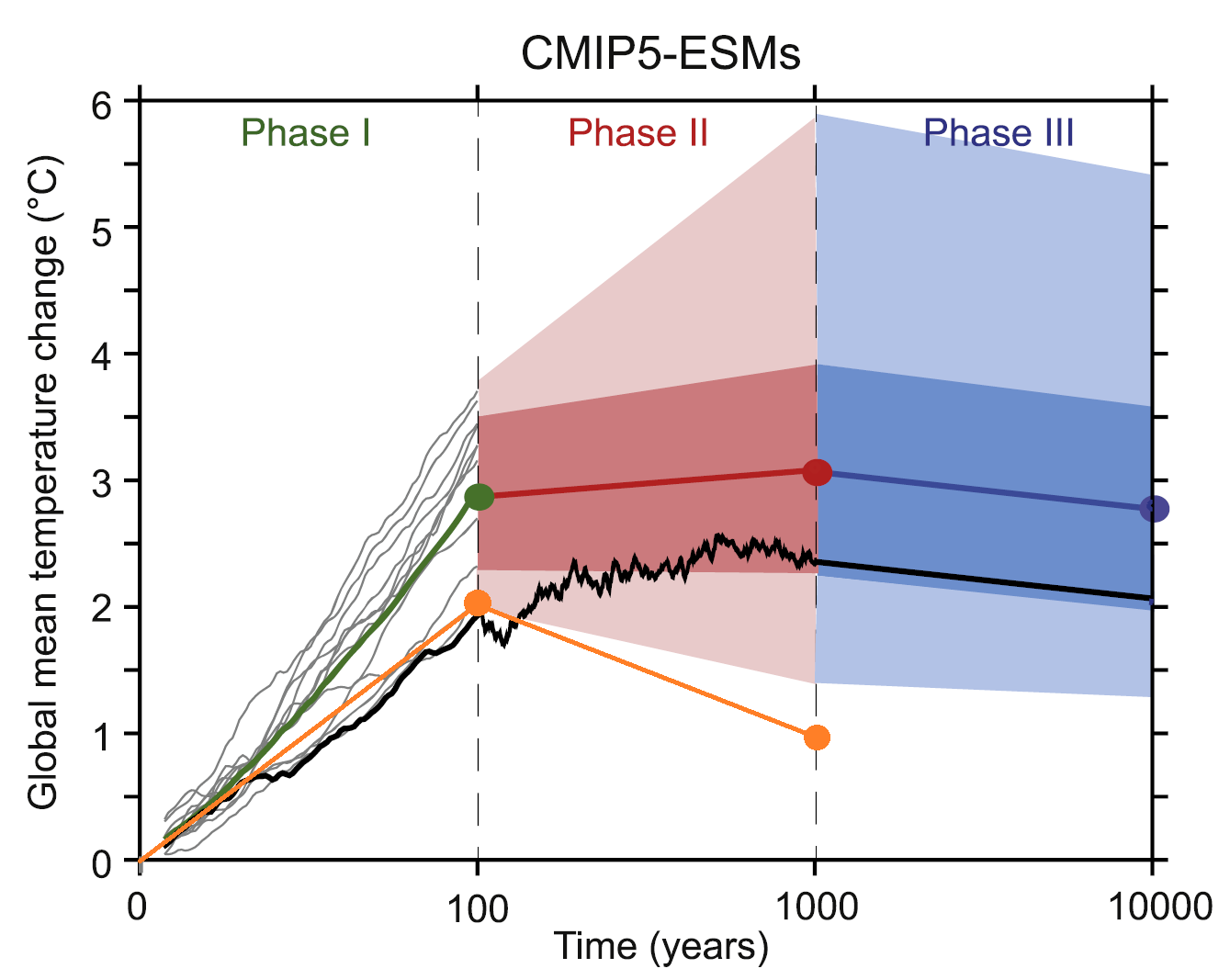
Here’s his update to their Fig 2
Very interesting discussion of the behavior of gasses, even on New Year’s Eve. 😉
Happy New Year!
Some folks are noticing the problem that in order for pressure to “maintain” a temperature, and if that pressure involves gravity, then gravity appears to be doing work without consuming any energy.
Let’s not forget relativity. Gravity is a shorthand for curvature of spacetime.
I have a feeling that Einstein anticipated string theory in the sense that reality involves architecture and morphology, not just points and numbers. And lots of dimensions.
I work with blackbodies all the time, in my work with infrared cameras. The Stefan-Boltzmann curve only applies when the emmisivity of the surface is 1, which the Earth’s surface most certainly is not. In addition, it specifies the surface temperature – that is, the surface that is visible to space, not the insulated interior, which – in effect – is what the surface is.
The other classical error that Nikolov and Zeller seem to be making is in mistaking temperature for heat. The law of thermodynamics only gives that the energy leaving the Earth must, over the long term, equal that received from the Sun plus any leaking from the core. It says nothing about the temperatures at the Earth’s (solid/liquid) surface.
Paul Blase December 31, 2018 at 5:02 pm
Sorry, Paul, but that is not true. The Stefan-Boltzmann equation is
where W is radiation, sigma is the Stefan-Boltzmann constant (5.67E-8), T is temperature …
… and epsilon is emissivity …
Since we can put the emissivity into the equation, it applies at ANY emissivity.
w.
I think that the increasing pressure analogies are not applicable. Both the pure black body and a planet with an atmosphere are about systems at equilibrium. You can look at the whole atmosphere as a system that is black body-like, and average it out. Look at the atmosphere’s typical average temperature profile vs. altitude and pressure, and at the point of half the surface pressure, where you have the centre of mass, the temperature is what you would get from a blackbody equation. I’ve only looked at the results myself for Earth and Venus, but it pans out. Surprising considering the huge differences in composition and pressures between the two, that the temperatures behaved the same way.
JimG
That is correct.
At hydrostatic equilibrium no additional compression is required. It is sufficient to have an ongoing cycle of decompression and compression which is supplied by convective overturning.
A layman’s plain English description of Zeller & Nikolov’s “discovery” is at http://www.opednews.com/articles/The-Zeller-Nikolov-climate-by-Christopher-Calder-Al-Gore_Al-Gore_Biofuels_Climate-Change-181228-572.html
A significant point seems to me is their comparison of Earth and Venus.
Alan, the N&Z results are a meretricious example of overfitting. Read The Mystery of Equation 8 for a discussion of why this is true.
w.
Eventually this ”net” b0ll0cks” will disappear up Dr Roys sphlincter.
Back radiation emission from a sub-zero temperature atmosphere is only potential heat, there is not one empirical measurement to show it thermalises in surface and isn’t just deflected by the earths as per the 2nd law.
You have to proof the greenhouse hypothesis to raise to theory and Dr Roy can only do that with sophistry and mathemagics.
Joe Postma makes complete mugs out of willis Dr Roy. and their steel greenhouse junk maths
‘[In other words, without the inclusion of the greenhouse effect (which has downward IR emission by the atmosphere reducing the net loss of IR by the surface), ”
I suppose it’s possible you could be more unpleasant, but you’d have to work at it.
In any case, such personal passionate attacks on folks who disagree with you are a clear sign that you are very unsure of your scientific position … when a man starts throwing mud, I know he’s out of real ammunition.
Best of the New Years to you,
w.
In complete agreement with you there, Willis.
Don132
Bit simplistic but simple is better. Heat flows from hot to cold. Avg temperature of the ocean surface which makes up 70% of the surface is 17 deg C. Avg temperature of ground at 200 ft is 1deg C higher than surface, and increases with depth.
Avg air temperature at surface is 15 deg C and decreases with altitude. It is being warmed by the earth (ex atmosphere) and not vice versa.
It appears to me that heat is being transferred from the earth (ex atmosphere) to the atmosphere and space, in other words, global cooling. The GHG in atmosphere are our insulation, and reduces the rate at which we are cooling, but does not warm us.
Temperature changes in the atmosphere come from changes in ocean circulation which release more (eg el nino) or less heat to atmosphere (eg la nina) . Variations in earths (ex atmosphere) cooling rate , and variations in the suns and earths magnetic field strength -which reduce or increase GCR’s that affect cloud formation , affect the temperature of the atmosphere.
If no atmosphere or GHG at all we are at -18 deg C, and the cooling process becomes much much quicker.
The planets destiny before being consumed by an expanding and dying sun is as a giant iceball. GHG such as CO2 buy us more time.
Co2 has not got the heat capacity to absorb 15 micron photons in the first kilometre it needs to be at -80c to absorb 15 micron photons,..
See Alan Tomaltys regular posting very proffesional, and ive not seen one person challenge his heat capacity calculations.
Back radiation has nothing zilch to do with absortion spectra, and everything to do with emission spectre and emission temperature.
Hey..nice. minus 80C is where CO2 imparts heat. Thus thermalisation will never reach surface as gases emit as a sphere, hence ever more diluted from 10km up. No effect on surface temp. Convection eaten it up. No hotspot. Net zero game . Better off w walking towards equator to get warmer or downhill.
Absolute garbage! A CO2 molecule in its ground vibrational state which about 98% of the molecules at 25ºC are will readily absorb a photon of ~15 microns.
Agree.
Temperature (energy level) of a CO2 molecule is not relevant to whether it will absorb an IR photon. Temperature is very relevant to whether it will emit IR photons and at what rate.
No. More heat flows from hot than from cold.
See the difference?
‘to’ is wrong.
Doesn’t make sense. Thermal transfer is from high potential to low potential (like electrical current). What evidence exists that a colder object heats a warmer object? Non-sensical. More likely IMO: radiation from a hotter object prevents radiation from a colder object along that vector.
Interesting concept. How would a (very slightly) cooler object know that it should not radiate in the direction of a (very slightly) warmer object (through that mirror 10m = 33ns away) when there is the possibility that the warmer object releases the energy that makes it ‘warmer’ in that say, 200ns the transfer would take and it becomes in fact cooler than the source?
Even more terrifying: When the warmer object is able to ‘see’ only a cooler one and emits some energy in the direction of it and another object did the same and 10ns before the energy packet of one of them hits the receiving object it becomes warmer than the source.
There are only two possible cases an energy packet can experience when hitting an object. Exactly at the time of the hit
– the object is cooler than the sender was
— then the packet is caught and the object becomes warmer or
— the packet is reflected (we know that photons only are caught with a probability)
– the object is warmer than the sender was
— then the packet is reflected (more probably?) or
— the packet is caught anyway
Both of the cases yield the same result for an observer. The object that was hit ‘looks’ warmer either because it reflected the ‘unwanted’ energy and it seems to come from the object or the object a little bit later radiates the caught energy and it does it faster than in its former state.
Icicil, because EMF is a vector force by nature is Physics. Check it out and follow a new trail…. Brett
Heres more simple.
The atmosphere is a blanket, on the lit a blanket hanging from a tree shading you.
And on the dark side keeping us warm.
dammit.
The atmosphere is a blanket, on the lit side of earth a blanket hanging from a tree shading us.
And on the dark side keeping us warm.
Such experts, the adiative transfer believers, who do not know that EMF is always a VECTOR force, would not admit what that means. I really hope not, for their sakes. Happy New Year to all. Brett
I’d like to try and cut through the issue of a unit of matter radiating at a rate commensurate with its temperature as per the S-B equation.
A given temperature is represented by the vibrational activity of the unit of matter concerned.
If one measures that level of vibrational activity from a point in contact with the unit of matter then of course S-B will apply and the appropriate wavelength of IR will observed.
If one measures it at a point distant from the initial unit of matter with no matter between the initial unit and the sensor then again the appropriate wavelength will be observed.
However, if one then interposes matter at a different temperature between the initial unit of matter and the sensor them S-B will not apply if conduction and convection have occurred between the initial unit of matter and the sensor.
That is what happens between a radiating surface and space beyond the atmosphere.
The continuously convecting mass of the atmosphere prevents the full amount of surface radiation from reaching space.
An IR sensor will still give the correct measure of temperature for the initial unit of matter because it is designed to ignore the interference from interposing matter at a different temperature.
Therefore, there is no incompatibility between a surface temperature of say 288k beneath a convecting atmosphere and an S-B temperature observed from space of say 255K. An IR sensor placed in space might still be able to measure the surface at 288k but only if it is designed to ignore the interference of 33k from the interposing atmosphere.
The AGW proponents say that the ‘missing’ 33k when viewing Earth from space is due to GHGs radiating that 33k back downwards but if that were the case then Earth should be radiating to space at 288k but it is not.
Earth’s temperature could not be as stable as observed if it were either radiating to space at 288k (because that is more going out than it receives) or if the atmosphere were radiating downwards at 33k in addition to ongoing insolation at 255k ( because that is more being received than it sends out).
The only logical solution is a discrete non radiative energy transfer loop between surface and atmosphere which requires additional surface energy to sustain it.
“The AGW proponents say that the ‘missing’ 33k when viewing Earth from space is due to GHGs radiating that 33k back downwards”
No. That is not remotely what AGW proponents say.
Steven,
I’m trying to understand your theory about pressure. I’m not scientifically minded so I’m struggling. But is it basically that the fact that gas at altitude has a greater ratio of potential:kinetic energy, and that potential energy does not exist as heat but persists nonetheless as energy.
Thus while the energy radiated in and out of the total system remains the same the addition of potential energy acts as a store of energy that is not accounted for in the in/out measurements. Somewhat like a battery on charge, that is at the same time passing current to an energy sink. First the battery/atmosphere-earth system has to be charged up to its full capacity by the power source/sun, thereafter it will absorb and emit energy to the energy sink/space without gaining extra energy but the measurements of energy in/out will not register the battery’s overall stored energy since it is potential, and not kinetic energy. The capacity to store a charge of the baterry/earth-atmosphere system is the difference between a simple atmosphereless blackbody model and one with gasses held in place by gravity with the sun streaming energy into the system.
Martin,
Yes, that is similar to comments I have made elsewhere at other times when I referred to a reservoir of potential energy which is drawn initially from solar input by conduction when the atmosphere first forms. Thereafter it operates much as your helpful battery analogy.
Stephen,
Congratulations. That is the clearest explanation I have ever seen of the role that the thermally semi-opaque, but turbulently convecting atmosphere has in separating the thermal emission temperature of the ground surface from that of the top of the atmosphere.
So now it becomes clear why the S-B relationship, which can reasonably be applied to the isothermal stratosphere (or of course the Moon’s solid surface in a vacuum), however cannot be applied to explain the thermal structure of the troposphere. This is why a separate equation of state, based on the Ideal Gas Law, is required to explain the thermal properties of the weather layer, in particular the lapse rate and the role that gravity has in establishing this.
OK, now my head hurts…BUT..I think Willis wins…HAPPY NEW YEAR to all of you and your great inputs..
Come on Bret armchair it for me will you please.
ps happy new year.
Electromotive force
Electromotive force, abbreviated emf, is the electrical intensity or “pressure” developed by a source of electrical energy such as a battery or generator. A device that converts other forms of energy into electrical energy provides an emf at its output.
Or such as the earths surface right ?.
Here is another conceptual way to view why atmospheric pressure is not the cause of higher surface temperature compared to a black body.
Pressuring a gas will cause its temperature to rise. That occurs in air within an air compressor. But that increased heat is a one-time effect produced by the energy required to compress the air. When compression stops, the added heating stops. The warmer air inside the compressor begins to lose its extra heat by conduction. IF that compressed air is quickly de-compressed, it cools. But only until it equilibrates with ambient temperature.
IF one could suddenly increase the pressure on Earth’s atmosphere (compressing it further), it would warm. However, IR radiation, which would increase due to warmer air, would dissipate the added heat. That occurs in formation of new stars when they collapse from gravitation. They heat from increasing pressure until nuclear reactions begin and produce an outward counter pressure.
In order for Earth’s atmosphere to posses heat above black body temperature because of atmospheric pressure would require that the atmosphere experience a continual increase in compression in the form of increasing atmospheric pressure. That does not occur. On average, Earth’s atmospheric pressure is constant. Any heating from initial atmospheric compression when the Earth formed has long been radiated away.
donb
As fast as the surface tries to radiate the atmosphere’s potential energy content to space it is replaced by new energy conducted from the surface so it never gets lost to space otherwise the atmosphere would fall to the ground.
At hydrostatic equilibrium no further compression is required. It is sufficient to have an ongoing cycle of decompression and compression which is present in convective overturning.
I believe that the theory proposed by Nikolov and Zeller is wrong. Their claims are not supported by the physics.
Put simply:
A gaseous atmosphere in equilibrium in a spherical gravitational field does not draw its energy from the gravitational field.
A gaseous atmosphere is just an amalgam of atoms, ions, and molecules, each of which contains
3/2 k T of energy – where k is Boltzman’s constant and T is local average temperature.
If an atmosphere contained zero energy all the atoms would be frozen out on the surface of the planet. The atmosphere’s average temperature would be 0 K = -273 C.
If you add energy to the individual atoms and molecules in the atmosphere, some of that energy will manifest itself in the form of kinetic energy (KE) and some as gravitational potential energy (GPE). Indeed, the local temperature of the atmosphere at a given point above the ground will simply be determined by the average speed (or average KE) of the atoms and molecules at that location. Similarly, the GPE of the atoms and molecules will be determined by the height of the particles above the ground. [N.B. some fraction of the energy will be stored in the rotational and vibrational motion of the molecules of the atmosphere, as well.]
The total amount of energy in the atmosphere at any one time is distributed between the atoms and molecules by:
1) collisions between particles
2) the absorption and emission of electromagnetic (EM) radiation by the particles
If no energy is added to the atmosphere either from the planet below, or from space, then whatever energy is present in the atmosphere will be slowly lost to space by radiation, until the atmosphere returns to the zero energy state.
HENCE:
If the atoms and molecules of an atmosphere receive a constant flow of outside net energy from:
a) the planet, in the form of geothermal energy – a small contribution at best.
b) space, in the form of absorbed EM radiation (i.e less the albedo)
c) re-emission of (mostly infrared) radiation from the ground
d) mechanical sensible heating by convection (& conduction)
e) latent heat of condensation of water vapor etc.
they will redistribute this energy amongst all of the particles that make up the atmosphere in such a way that they establish a temperature and pressure profile (with height) that produces an energy loss from the atmosphere that balances the energy gains.
In other words, the height (i.e. GPE) and temperature (i.e. KE) of any given particle in the atmosphere [and hence the equilibrium temperature and density profiles with height] will simply be a result of the way in which the atmosphere responds to ensure that the total energy loss perfectly balances the total energy gain.
Ian,
A gaseous atmosphere in equilibrium in a spherical gravitational field draws its energy from insolation via conduction from the surface during the initial formation. Thereafter that stored (potential energy – not heat) energy is recycled constantly in a net zero energy exchange between surface and atmosphere within convective overturning.
Gravity provides no energy. Gravity only provides the decline in density with height which permits convective overturning.
As fast as the surface tries to radiate that energy store to space it is replaced by new energy conducted from the surface so it never gets lost to space otherwise the atmosphere would fall to the ground.
Roy and Willis.
OK, now let’s substitute a totally non-GHG atmosphere (maybe pure nitrogen?) to 1 bar surface pressure.
Where is the surface from which the SB calculation is to be performed?
Is there no thermal conduction or convection and zero lapse rate?
Regards, just asking.
On a water planet there would always be sublimation and vapour wouldn’t there, like you i’m asking.
This gasless atmosphere blackbody T is just more rancid sophistry.