From the AGU EOS publication (h/t to Dr. Judith Curry)
Better Data for Modeling the Sun’s Influence on Climate
Compared to other stars, our Sun is a remarkably steady source of light and heat, but its output does vary. Solar light, heat, and particle streams drive weather and atmospheric chemistry, but how (and how much) does the Sun’s variability affect the climate here on Earth? The role of solar variability in recent global warming is not just a bone of contention; it is also a question of overriding importance for the scientific understanding of our Sun and of climate change.
Scientists simulate historical and future climates by setting up a suite of initial conditions and seeing how these conditions change when various factors, called forcings, are applied. For example, how does Earth’s surface temperature change if it receives more or less heat from the Sun? How do the streams of ionized particles that make up the solar wind affect certain weather patterns on Earth? Data sets compiled from historical records provide the necessary information for model forcing, so ensuring that these data sets provide accurate, relevant information is key to producing realistic climate model scenarios.
Recently, a series of initiatives brought together scientists working on different aspects of this highly multidisciplinary issue. These efforts shared several common objectives, including better estimates of solar forcing and identifying and quantifying the uncertainties in these estimates.
Here we report on the outcome of three of these initiatives:
- “Towards a more complete assessment of the impact of solar variability on the Earth’s climate” (TOSCA), a project that uses a network of European scientists from 20 countries that met from 2011 to 2015 to assess contributions of solar variability to Earth’s climate
- Solar Irradiance Data Exploitation (SOLID), a European-funded project dedicated to merging all exploitable spectrally resolved solar irradiance records into one single composite data set
- An international team of scientists that met at the International Space Science Institute (ISSI) to produce a comprehensive data set that includes solar radiative forcing and contributions from energetic particles
These initiatives have culminated in the production of two public data sets to assist with the scientific analysis of solar forcing: a composite data set of all irradiance observations and a comprehensive data set containing different solar forcings (radiative and by particles) since 1850.

How Does Solar Variability Affect Climate?
Solar variability affects Earth’s climate in many intricate and nonlinear ways. Most effects are ultimately driven and modulated by the solar magnetic field and its conspicuous solar cycle, which repeats approximately every 11 years.
The effect of solar variability on climate is mostly hidden in the natural variability of the climate system; thus, careful statistical analysis is required to extract it from a noisy background. Such analyses require records that extend over a long period of time, but the paucity of observations in existing records poses a serious challenge. For example, scientists have been making direct measurements (from space) of the total solar radiative input into Earth’s atmosphere only since 1978, although there had been earlier attempts to measure it from the ground.
Full story at EOS here
When I read “Towards …” in an academic’s product I am instantly reminded of Alan Sokal’s Towards a Transformative Hermeneutics of Quantum Gravity, and all that ensued.
Wait a second! I thought all of the climate models said the Sun’s influence on climate was negligible. Could the models be wrong! Say it ain’t so!!!
Rest assured the models are correct. They can predict with great certainty the temperature in 2100 to a 1/100th of a degree with only one input, the amount of CO2 burned. Ain’t science great?
Better modeling for the solar influence on atmospheric weather patterns at monthly scales could reveal the drivers of the ocean phases which rule the climatic modes. Without that influence there would have been no 1934, 1976, 2003, 2006, heatwaves, and neither most extreme winters, or much ENSO and AMO variability. No explanation for the noise means no explanation for climate. Most people are talking around the problem to be solved by talking about climate instead of the solar driven weather patterns that drives climate. As if all that variability was unforced.
https://www.americanthinker.com/articles/2010/02/the_hidden_flaw_in_greenhouse.html
Sometimes it pays to reread old passages.
“Consider too that since most air molecules are infrared-transparent, they can’t be heated by the infrared that CO2 and water vapor emit. This means that downward radiation from “greenhouse gases” can only explain how the earth’s surface might get warmer, not the rest of the atmosphere. This underscores, of course, how much the surface is heating this 99% by conduction and convection alone, since radiative transfer can’t do the job.”
The GHG theory is that N2 and O2 do not absorb IR very well . This is true. However the GHG theory goes on to say that if the CO2 concentration goes above 350ppm the extra CO2 will case more downward backward radiation and the troposphere will heat up with a continuous cycle of IR trapping by CO2 and then reradiating the photons back to the earth surface(losing 1/2 them upwards) to be reradiated back to the CO2 molecules and having the cycle continue until there are no more photons left to reradiate.
By that time the atmosphere near the earth surface (according to the alarmists ), has gotten hotter with all this photon activity. Of course every 14 hours of every day the sun comes back to recharge the surface with more radiation and the cycle starts all over again everywhere on earth. Eventually the atmosphere gets so hot that more water vapor evaporates and causes the photon cycle to be greatly expanded because now you have an even greater and more powerful GHG water vapour which reinforces the cycle.
However the flaw in this ; is the quote above. N2 an O2 cant be heated with IR. Since they make up 99% of the atmosphere how would the atmosphere get hot enough by CO2 alone? No matter how many times the IR gets recycled between the CO2 and the surface,the N2 AND O2 will not heat up with the IR . Only the sun ( and clouds at night ) can warm up the atmosphere to any appreciable degree. The alarmist is going to say that because of collisions between the O2 and N2 and between CO2 the photons get passed on that way. However for that theory to work they would have to say that water vapour through collisions cannot pass on the photons to N2 and O2 or else the global warming cycle would start with extra water vapour in a local area. If the CO2 does this through collisions the IR must be carried aloft to outer space and not cause the atmosphere to heat because the N2 and O2 outnumber the CO2 by a factor of 2500 to 1. So because CO2 is always cycling in and out of the atmosphere 225 GT carbon every year, and because it is outnumbered by 2500 to one by the N2 and the O2, AND 50 TO 1 BY WATER VAPOUR, there is not enough CO2 left at any one location or time period to affect the temperature of the surface air.
Around about the year 2000, most of the world got dumber for believing in this cockneyed GHG theory.
I get the impression that there is lots of confusion over WHAT is being energized.
The insides of a molecule can be energized, right? But the whole molecule, as part of a collection of molecules, can be energized too, no?
There’s stuff going on at the intra-molecular scale of reality, and stuff going on at the inter-molecular scale of reality. Am I correct in thinking that radiation is more directly an intra-molecular phenomenon, whereas heating is more of an inter-molecular phenomenon? And does the confusion happen in trying to decide how the intra-molecular energizing translates into the inter-molecular energizing?
A photon encounters a molecule, okay. Does the energy of that photon correspond, in a one-to-one fashion, to the energy that it imparts to the whole molecule that it encounters? I think that this is where the confusion and incorrect assumptions come into play. How do we know how the energy of the photon energizes the larger unit of the molecule it encounters? Does all that energy translate to kinetic energy that influences the temperature of a collection of molecules?
Can the energy that a photon imparts to a CO2 molecule energize the molecule in such a way that this CO2 molecule, in a collection of multiple thousands of molecules, imparts enough energy to the surrounding molecules to increase the kinetic energy of the whole collection of molecules, thus increasing temperature?
Answer to your last question: no.
The weather pattern in the Atlantic is very unusual. The extremely warm surface of the sea at the east coast can cause extreme weather in the northwest of the US. These can be heavy rainstorms.
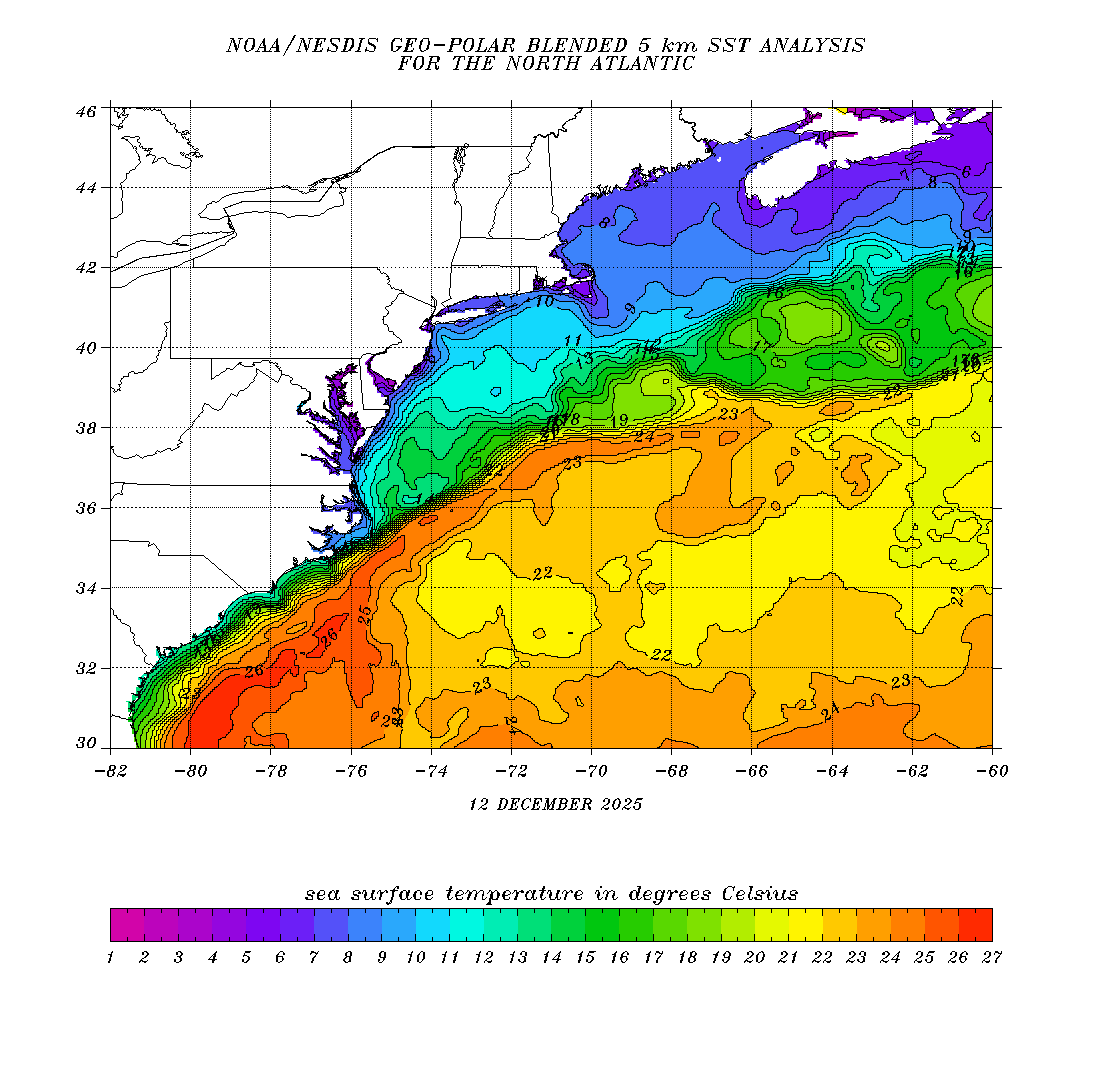
northwest – or – northeast U.S.?
They’ll have to straight up admit that a good percentage of the heat on Earth is from electromagnetic induction due to the plasma solar wind spraying past us at 300-700km/s. Add to that the heat generated by Lunar gravity within the Earth’s core and you will dumbfound these warmist fools.
At a speed of over 500 km / s, it gets warmer.