Too many small, lightweight cars cause too many deaths and injuries to justify tighter mpg rule
Guest opinion by Paul Driessen
A 2002 National Academy of Sciences study estimated that automotive mileage standards had helped cause as many as 2,600 extra fatalities in 1993 – at a relatively lenient standard of 27.5 miles per gallon. Other studies reached similar conclusions. And yet, in 2012, the Obama Administration began ratcheting the standards upward, with the goal of hitting 54.5 mpg by 2025.

Thankfully, EPA Administrator Scott Pruitt has proposed to re-examine the 54.5-mpg standard, possibly freeze it at the 2020 level of 39 mpg, and rein in other aspects of this harmful government program. His proposal drew howls of outrage from predictable factions. My article explains why Pruitt is right – and why his latest proposal for a thorough reform of agency cost-benefit analysis rules should be applied to vehicle mileage standards, especially on the vital issue of human injuries and deaths versus minimal and purely speculative climate change and extreme weather benefits.
Saying the air traffic controller work force was “too white,” the Obama Federal Aviation Administration allegedly replaced hiring standards based on science, math and ability to handle intense pressure with rules designed to increase racial diversity. It’s hard to find a more flagrant example of bureaucrats putting people’s safety and lives so low on their list of priorities. Difficult but not impossible.
Corporate Average Fuel Economy (CAFÉ) standards also play with people’s lives. Enacted in the 1970s amid fears of imminent oil depletion, the rules require that cars and light trucks on average across each manufacturer’s entire smorgasbord of vehicles must get better and better mileage over a period of years.
For the first few years, improving gasoline mileage was relatively easy. But as the standards tightened, car makers had to make vehicles smaller and use less steel and more aluminum and plastic to achieve the arbitrary mileage demands. That poses a serious problem that the Trump Administration wants to fix.
Bigger, heavier vehicles are safer, the Insurance Institute for Highway Safety has said for decades. Smaller, lighter vehicles are less crashworthy, less safe. Drivers and passengers in cars and light trucks are many times more likely to die in a crash – and far more likely to maimed, disfigured, disabled or paralyzed – beyond what would have occurred if the CAFÉ standards did not exist or had been relaxed.
Even with side air bags and other expensive vehicle modifications, smaller, lighter vehicles have less “armor” to protect occupants, and less space between them and any car, truck, bus, tree or other obstacle they might collide with. So they are less safe and more expensive – less affordable for poor families.
As Competitive Enterprise Institute general counsel Sam Kazman noted in a recent Wall Street Journal article, a 2002 National Academy of Sciences study estimated that CAFÉ rules had contributed to as many as 2,600 extra fatalities in 1993 – at a relatively lenient standard of 27.5 miles per gallon. Studies by the Brookings Institution, Harvard School of Public Health, National Academy of Sciences and USA Today all reached similar conclusions.
The National Highway Traffic Safety Administration (NHTSA) covered all this up. Grizzly facts would not be allowed to get in the way of a well-intentioned government program.
Thankfully, the mileage standards stayed around 27.5 mpg throughout the 1990s and beyond. But then, in 2012, the Obama Administration began ratcheting the standards upward, with the goal of hitting 54.5 mpg by 2025. The Environmental Protection Agency had begun helping to manage the NHTSA mileage program in 2009, and it became the driving force for doubling the mpg requirements. It became equally complicit in hiding the death and injury tolls associated with CAFÉ.
Horizontal drilling and hydraulic fracturing (fracking), other new technologies, and the discovery of new oil and gas deposits mean we will not run out of oil or natural gas for another century or more. So the Obama Administration asserted that mandating far tighter mileage rules would have the co-benefit of reducing tailpipe emissions of “greenhouse gases” associated with dangerous manmade climate change.
Scary headlines, data manipulation, computer models and well-orchestrated campaigns to link nearly every extreme weather event to rising atmospheric levels of (plant-fertilizing) carbon dioxide enabled the climate scare to get as far as it has. But the climate cataclysm movement is running out of gas.
People no longer accept claims that Earth’s climate was stable until the 1970s. They remember that it was a global cooling and global warming scare, before it became a climate change and extreme weather scare. They realize global temperatures have been stable for nearly 20 years, complying with Paris treaty and other climate edicts would cost trillions of dollars, and emerging economic powerhouses like China and India are not obligated or likely to reduce their use of fossil fuels or emission of greenhouse gases.
Despite $557 million in quiet funding by rich liberal foundations to wealthy alarmist groups, people are also figuring out that the Paris treaty actually has little or nothing to do with the climate or environment. “Climate change” is now used to justify replacing the capitalist economic model with a global governance system – and redistributing the world’s resources and wealth. The treaty itself says climate action must include an emphasis on “gender equality,” “empowerment of women,” “intergenerational equity” and “climate justice.” These are the “climate dangers” that supposedly justify lethal CAFÉ rules.
Thankfully, EPA Administrator Scott Pruitt recently proposed to re-examine the 54.5-mpg-by-2025 Obama EPA-NHTSA standards – and possibly freeze them at the pending 2020 level of 39 mpg. Mr. Pruitt noted that the standards had been implemented after years of lobbying by environmental pressure groups, and that assertions of climate and weather benefits do not reflect scientific or historical reality.
There has also been talk of revoking California’s unique right to set tougher standards than are applicable to the rest of the USA, and preventing the state from applying its more stringent mileage rules beyond its borders. EPA and Transportation Department officials say they have held “productive” discussions with California air quality regulators and others – but it’s hard to say where the talks might be headed.
The proposals drew predictable howls of outrage from environmentalists and California legislators and regulators, who are sticking to their claims that tougher mpg rules will somehow avoid climate chaos. An automobile manufacturers lobbying group insists that mileage standards should increase every year.
Auto makers would understandably prefer to have a single national mileage standard, rather than two: ultra tough rules for California and a less stringent mpg requirement for the rest of America. But the injury and death tolls dictate that any standard must be held well below 54.5 mpg or even 39 or 30 mpg.
Pruitt did not mention the injury and death tolls that result from these mileage standards. He should have, and his new plan to implement comprehensive cost-benefit reforms would compel his regulators to fairly, honestly and accurately assess the social and environmental costs and benefits of proposed mileage rules.
That would stand in stark contrast to the way EPA handled its arbitrary social cost of carbon analyses. The Obama agency looked only at alleged and exaggerated worldwide costs of United States carbon dioxide emissions – while totally ignoring the immense and obvious benefits of using fossil fuels. To compound the insanity, EPA claimed it could make reliable predictions three centuries into the future!
To support its various pollution control measures, the Obama EPA raised its “value of a statistical life” presumably saved by a proposed regulation from $7.9 million in 2011 to $9.7 million in 2013. The VSL estimates how much money people are willing to spend to reduce a risk enough to save one life. There is no evidence that EPA employed VSL to estimate the human cost of doubling the 1993 27.5 mpg standard.
The agency should certainly do so now. Using a $10-million VSL, $2 million per serious injury or paralysis – and 4,000 deaths and 50,000 serious injuries per year from a 54.5 mpg standard – would mean the average fuel efficiency demanded by California and radical greens would cost the United States $50 billion a year. In return, we would get small, purely speculative climate and weather benefits from burning less gasoline in the USA, assuming that tailpipe emissions play a major role in climate change.
(Applying similar cost-benefit analyses to electric cars would raise serious questions about the generous state and federal tax rebates, free access to toll and HOV lanes, free charging stations and other subsidies for pricey vehicles that only wealthy families can afford.)
Volkswagen’s deceit about diesel emissions defrauded consumers but didn’t kill anyone. And yet VW has generated far more regulatory, judicial, legislative and media outrage than lethal mileage standards.
As Ralph Nader might say, CAFÉ standards make cars unsafe at any speed – not by faulty car design, but by government decree. It’s time to reduce, eliminate or at least freeze these killer standards (and do the same thing with the ethanol mandates and gravy train).
Paul Driessen is senior policy analyst for the Committee For A Constructive Tomorrow (www.CFACT,org) and author of articles and books on energy, climate change, carbon dioxide and economic development.
How strange – my petrol car does real 50mpg (us gal) 60.5mpg uk
deaths in uk fell from peak in 60s to 22% in2016
deaths in us fell from peak in 70s to 70% in 2016
All this despite coke can thickness metal plastic parts. Maybe enforced government regs (seat belts) help – as do safety rating being required for all new cars.
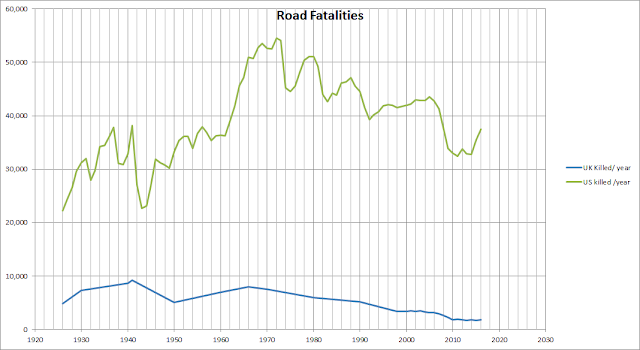
Most of the improvement in the US came from people buckling up, and improvements in road design.
In other words, the savings in lives would have been even greater, had not the cars themselves gotten more dangerous.
Everyone who have been around in both the US and in Europe knows that European cars are on average much smaller than their US counterparts.
How can it then be that the US have so many more road deaths per citizen than Europe?
Car deaths per citizen for some counties:
As you see, the US has two to four times more fatalities per citizen than these European countries where people, on average, drive much smaller cars.
Although it is marginally safer to be in a bigger car than a small one for each individual, it seems to have the opposite effect if all others also drive huge cars.
The huge powerful cars can inflict so much more damage on others, so it has negative effect if all people drive big cars.
/Jan
Hmmm… wonder what the average speed and distance is for each ?
indeed. The correct metrics would be fatalities per (person x distance).
I do not think all have reliable data for miles driven, but the speed limits on motorways are:
Us: 60 – 80 mph (97 – 129 kmh)
UK: 70 mph (113 kmh)
Germany: ulimited
Sweden: 110 -120 kmh (68 – 74 mph)
France: 130 kmh (81 mph)
This is one of the problems with climate science. They don’t have the data, but they decide to go ahead and use whatever they do have.
MarkW,
Not too fast, the km/person.year are known further down
Average distance in the US is about 13,000 km/person.year. Average in Europe 6,500 km/person.year. Even with the double distance in the US, fatalities are higher than in Europe. Speed on main roads about the same to higher in Europe. On speedways higher in Europe (120/130 km/h), in Germany even unlimited on several tracks. Despite that not more fatal accidents in Germany than in France, but driving style in Germany is more disciplined (for speed limits e.g.) than in France…
See: http://internationalcomparisons.org/environment/transportation.html
See also the difference in road fuel consumption per capita…
Highway speed in Europe matters much less than city speeds.
The US has a lot more miles of high speed road than does Europe, per mile driven. Our impact speeds average higher than those in European crashes.
It’s not a meaningful comparison.
Felix,
In the US, about 50% of all fatalities are in rural areas, thus mostly at Interstates and other high speed roads. That doesn’t explain the other 50% fatalities in urban areas, compared to most European countries which have half the fatalities of the US, even for the same miles driven in total.
There are lots of details about fatal accidents in the US here:
http://www.iihs.org/iihs/topics/t/roadway-and-environment/fatalityfacts/roadway-and-environment
and on several interesting other pages…
Convenient way of lying with statistics.
Number of deaths per capita is a meaningless number.
You have to know things like miles driven, average speed, compare road designs, you also have to compare driver training and other safety laws such as how drunk driving is handled.
You beliefs are refuted by every study ever done on the subject.
Even when big cars crash into each other, they are still safer.
MarkW,
Even when big cars crash into each other, they are still safer.
Sorry, but the laws of physics refute that. The clash between two lightweight cars or two heavy trucks is always as bad, as all what counts is the speed at the moment of impact and the length of the crumple zone during the impact. The latter may be longer for bigger cars, but that is not a given. Trucks in Europe have zero nose and in many cases the driver lost his/hers life even for a head tail collission with another truck.
Ferd, I’m guessing that it’s been a long time since you’ve studied physics, assuming you ever did. What matters is how fast the occupants come to a stop. The worst type of accident is colliding with an object with more kinetic energy than your car, because in that case, your car will not only be stopped, but pushed backwards. The next type is a collision with a fixed object, or a car with the same mass and momentum.
In both those scenarios, basic physics will tell you that the car with the larger crumple zone will be the safest, and that is always the larger car.
As to trucks with no noses, once again, the stupidity of not building in a crumple zone.
Those crumple zones are only helpful for occupants of the car, and only if they wear seatbelts.
16% of the US fatalities are pedestrians and another 2% are bicyclist. For pedestrians and bicyclists it is more deadly to be hit by a huge car, especially if they end up under the car.
63% of the fatalities were passenger vehicle occupants, and of those 10,428 were unbelted and 11,282 belted.
The big cars may have a marginal effect, but only on the 11,282 belted occupants, who constitute only 30% of all US fatalities.
file:///C:/Users/131401jaan/Downloads/812456%20(1).pdf
Jan Kjetil,
I have found a lot of facts on road fatalities in the US at:
http://www.iihs.org/iihs/topics/t/roadway-and-environment/topicoverview
Some interesting point: 55% of the fatalities in large trucks are from rollover during the accident. For SUV’s and Pickups it still is high at 47% and 43%, while for passenger cars it is only 22%:
http://www.iihs.org/iihs/topics/t/large-trucks/fatalityfacts/large-trucks/2016
In such cases the length of the front crumple zone doesn’t matter, wearing a seat belt is the main point I suppose…
Ok, I have used the numbers Ferdinand linked to above and calculated car deaths per billion km
There are still more fatalities in the US than in these European countries which all have on average much smaller cars.
/Jan
Now factor in the 1001 other differences between Europe and the US.
Mark says:
The claim in the article is that big cars are so much safer, but this statistics points in the other direction in four different European countries.
I have shown that also the highway speed limits are higher in Europe. Those with the highest speed limit are closer to the US rate, but still lower. UK and Sweden, which have speed limits closer to, US have about half the fatality rate per driven kilometer.
Those who claim that big cars are safer should point to which specific factors that could have such a huge negative effect in the US.
/Jan
Jan Kjetil Andersen
Ah, but you are not comparing like roads. European “superhighway” roads that ALLOW those very high speeds are built comparable to the best and newest of the many times more US interstate highway system: Wide margins, acceleration zones, separated dual lane roads, well-shielded off-ramps and highway abutments, clear large overhead signs, etc. MOST of the US interstate system is not that well-built, and very little of the tier 2 and tier 3 and tier 4 roads – which are as fast as the IH system in most areas 55-65-70 mph are not to the Euro expressway/superway levels. So the Euro communities are regulated down to 90-95 kph on raods that US drivers travel much faster on, at many times higher traffic density.
The very small back-country Euro towns are very dense with many pedestrians (except in the new areas built after WWII around the town centers.) So Euro driving is either at very high speeds on a very number of limited access superhighways, or much slower than US roads on uncrowded roads typically much narrower, but with little interference.
A different experience. How many US city interstate-style highways have you driven in, and for how many years? How many US highway (2-lane and 4 lane) UNDIVIDED high speed highways and country roads have you driven at 120-130 kph on?
RACookPE1978,
European “superhighway” roads that ALLOW those very high speeds are built comparable to the best and newest of the many times more US interstate highway system
Doesn’t sound like many of the the “superhighways” in my country, which were built in the ’70’s with (too) many (too) short accesses and (too) fast winding exits…
But I agree, you can’t compare accidents in different countries without knowing all different details.
What surprised me was that the US has twice as much fatalities per mile, while in general all driving at the similar speed with very little differences, while here one can drive 70 km/h minimum, heavy trucks 80 km/h, other cars 120/130 km/h at maximum speed (and beyond, here frequent, never seen in the US) or unlimited in Germany (and they do it!), so the possibility of a crash due to speed differences is much higher here.
I’m looking for some enlightenment. Coming from Europe where a VW Golf (Rabbit?) is a big selling family car and similar sized offerings from Ford, PSA and Fiat, GM has pulled out of Europe, dominate and large 4×4 and US style Pickups are in a minority. I wondered what the casualty data was for like to like crashes, that is a Golf to Golf collision compared to an F150 to F150 collision, and any vehicle to 40 Tonne truck (Semi?) collisions? Is there any reason why deaths per km driven in the USA are greater than for most EU countries and almost twice UK levels?
Also does the US have similar crash ratings like the European NCAP system?
https://www.euroncap.com
Thank you.
Ben, indeed it doesn’t make any difference if you have a Golf to Golf or F150 to F150 collission (or a collission of one car with a rock solid object): all what counts is the sum of speeds of both at the moment of the impact and how much the crumple zones of both have crumpled (not much crumple zone from a concrete bridge): that is all what you have as braking distance from the speed at the moment of impact to zero speed. That gives how much G force comes on your body via the safety belt or airbag or the interior of the car if you don’t wear a safety belt and no airbag is available…
According to physics, crashing in a same car is just the same as crashing into a wall.
Likewise, according to physics, if a crash occurs between a vehicle and another twice the weight, then the first endures 2x the stress of the second. Meaning, passenger of the first may be injured while those of the second are not, even if both car have the same security level.
paqyfelyc,
Agreed. The problem is that (too) many therefore think that buying a heavier car is safer, which in first instance is somewhat right for yourself (but doesn’t help if you crash into a tree, bridge, truck,… and more fatal for other road users) until everybody drives a heavy car and you are back to square one… At last everybody drives a tank and when these crash in a frontal collission with each other at 70 km/h (50 mph), everybody is killed as good as if everybody drives a lightweight car with the same speed at impact…
That’s ~43.5 mph.
IMO two tanks of equal mass hitting each other head on at that speed probably wouldn’t kill anyone. The drivers might be in danger of serious injury, but the turret crews would probably be OK, if properly restrained.
The impact would pack a lot of KE, but it would be spread out, unlike a hit from a 27mm wide, 5 kg APFSDS long rod penetrator traveling at 1.7 km/s. The much heavier but much more slowly moving tanks would IMO be less deadly to each other than would the high velocity, DU armor-piercing round.
What kills people are G forces. Even if fully restrained, you can be killed if the G forces get too high.
The G forces in two tanks would be greatly reduced by the mass between you and the point of collision.
Also, the front ends of tanks don’t crumple. The thick steel or advanced, space age composite materials absorb the impact.
I’ve never been in a tank hit by another tank at 43 mph, but I’ve been in one hitting large, stationary motor vehicles, and the only effect I’ve noticed is the rising effect from driving over and crushing it.
Fekix, that is the crux of the discussion: the mass of the tank is of no use in a collission with a similar tank, The fact that the tank is armored and has near zero crumple zone means that the full distance the driver’s body has from 70 km/h to 0 km/h is only the lengthening of the safety belt or the length of the airbag. That means 10 G or more and a lot of damage to one’s body, if not fatal…
In the case of hitting smaller cars, of course the tank has no problems at all…
Being in a big car does help if you crash into a fixed object. Basic physics
nope. Not for a crash in a fixed object.
What’s help is being in a car with some energy absorbing device, to reduce the g-force you experience. I rather be in a small modern car than in a real tank (And I did both), since the car has structure designed for crash control, while the tank doesn’t, meaning YOU get the full acceleration of a brutal stop, and this will kill you (Just ask Diana)
Now, of course, for a crash into a non fixed object, the higher the mass, the safer you are.
paqyfelyc says:
According to physics, crashing in a same car is just the same as crashing into a wall.
No. A solid wall won’t absorb any significant energy of the collision (all will be absorbed by the single car). Another car will absorb some of the energy w/its crumple zone.
beng135,
That is only true if the second car is stopped (or at a lower speed), then the energy is divided by the two cars and that is the same as one car hitting a wall with half the speed.
If both cars have the same speed at impact, that has the same result for driver and passengers as a single car hitting a wall at the same speed.
So what you’re saying is that if you’re in a small vehicle hit by a heavier vehicle that you are more likely to be killed or suffer more serious injury. In order to survive a RTA it is best to buy the heaviest vehicle you can afford, even if that vehicle is least likely to protect you in a like for like collision. The proportion of heavy vehicles in USA is higher in the USA leading to more heavy/light collisions and more heavy/heavy collisions in USA leading to a higher death rate per vehicle-km.
This doesn’t totally explain the difference between the USA and Europe. France is reducing the speed limit on some non motorway roads from 90 to 80kph at the end of this month. It is on an effort to reduce road deaths to a similar level to those in the UK. Having driven in both countries retraining French drivers on drink driving, overtaking and tailgating might be more effective. But time will tell.
I would suspect that there are other reasons at play with regards to why there are more accidents/fatalities here in the US than in most European countries. Reasons that have absolutely nothing to do with the vehicles themselves, nor even the roads, speed limits, etc. IMO much of the excess here in the US is likely caused by driver behavior (you can’t really ignore the people who are operating the vehicles when factoring in possible reasons). Aggressive driving is rife in many places, especially crowded, urban areas, here in the US, and quite possibly the average European driver is less likely to suffer from road rage or other aggressive driving behaviors. That, and add in distracted driving…I don’t know, perhaps the average European takes the operation of a motor vehicle more seriously than many here in the US do. Maybe driver education is better in many other countries…..
When comparisons such as these are made, it is wise to consider ALL factors (not unlike what climate skeptics tend to do with data and statistics).
There is an essential flaw in this article… Survival from a car crash has little to do with the weight of a car and everything to do with the speed at which you drive at the moment of the impact and how much of the crumple zone is used.
I was driving one the smallest cars – by weight – of the world: the Citroën 2CV, 560 kg full “steel” (or more accurate: 0.4 mm “thick” tin plate), when I had the same discussion about safety with a few consumer’s organisations.
Things are somewhat different between Europe and the US, in that US cars are 98% automatic, in Europe 98% manual. Real speed by cars on highways in the US are within narrow range, near everybody drives at the maximum allowed speed, including trucks. In Europe one must drive 70 km/h minimum and 120/130 km/h maximum (In Germany even unlimited on several tracks). Heavy trucks have a speed limit of 80 km/h. Problem: full range is used (+ higher), making collissions due to speed differences more frequent in Europe.
One of the better points of light weight cars is that in general, the lighter cars had the shortest braking distance starting at the same speed. Another one was that my car had a maximum speed of 110 km/h, while all others were (much) faster. A simple calculation showed that when I was at full speed and needed a full stop, the braking distance was some 37 meters (If I remember well… the discussion was from the ’70s), at that distance, the next best car still was driving at 70 km/h, thus if I had no accident at all at that moment, the other car at 70 km/h had a high risk of a fatal crash: from 70 km/h to 0 km/h over 1 meter distance (= crumple zone) gives a force of over 1 ton on your body…
Of course, if I had a frontal collission with a much heavier car, I would loose the contest. But if you have a frontal collission with a heavy truck, it doesn’t matter how much your car weights: you loose. Thus reducing ALL car’s weight doesn’t influence fatalities, or do you think that a frontal collission (or crashing in a tree or bridge, or…) between two 5 ton SUV’s makes any difference for the passengers or driver than between two 0.6 ton 2CV’s?
As an extra, I sampled all stories of fatal accidents in my country by brand and circumstances over a full year. That showed that the faster (and heavier) cars had the highest rate of fatal accidents… General rule of insurance companies at that time: you pay insurance in ratio to the hp under the hood…
Another point: speed. Due to the economical crisis in the ’70s, lower speed limits were imposed on the speedways and later increased again . The effect: for each 10 km/h extra, numbers of heavily injured and fatalities by accidents doubled…
The bigger the car, the bigger the crumple zone. That means that given the same impact speed, the forces on the passenger are going to be less in a big car.
MarkW,
Bigger: in general yes. More weight: no.
40+ tons trucks in Europe have no nose (the motor is under the driver cabin), the crumble zone is smaller than even for a small European car. Lots of fatalities even in head tail collisions with other trucks…
Reason: there is a maximum length for tractor + trailer in Europe, so the manufacturers made the tractors shorter to have a longer trailer…
The US also has a lot of cab over engine big rig (tractor-trailer) trucks, but at least the engine doesn’t end up in the driver’s lap.
Ferd, all you have done is demonstrate that it’s stupid to build trucks with no crumple zone.
MarkW,
Hé, something we agree on…
Another example of our representatives abdicating the rule-making to un-elected officials. If Congress were to do its job, they would set the level for the CAFE standard, not a committee of people who cannot be recalled. Same applies to the EPA “finding” that CO2 is a pollutant, and therefore under their power to regulate. This is something that Congress should have decided. Then if we the people don’t like the decision, we can elect a representative who will represent us, instead of passing the buck to an arm of the executive branch.
How about “Don’t drive like idiots, look where you’re going & wear a seatbelt”? Works for the civilised world.
Thank you for a favorable peer review of my thesis that drivers in Dallas are the epitome of uncivilized morons…
Way to many drivers in the American southwest learned how to drive in Mexico.
I know a couple of people who drove small cars to get better gas mileage but they had car accidents and sustained head injuries. They ended up losing their jobs.
They now drive full sized pick up trucks.
There can be a potentially large price to pay for driving small vehicles.
Surely the problem in America is too many large vehicles. They may well protect the occupants, but when they hit the ever increasing numbers of small cars, they cause carnage. When put this way, America needs LESS large vehicles, not more.
As an aside, my large 5-door turbo-diesel saloon has been doing 45 mpg in mixed driving, since 2005. And its successor, which I should recieve soon, will do 50 mpg in mixed driving (measured tank to tank – or 56 mpg according to the cars computer, which is optomistic.). American cars are no where near as economic as their European equivalents.
R
Ralf:
The perversity of the CAFE standards in large part created the problem you cite. They fundamentally outlawed the large cars, like stationwagons, that families wanted. So people with families had to turn to driving trucks (SUVs and minivans are considered “light trucks”.
So when these light trucks collide with “econoboxes” that get great mileage, the consequences are not good. A lot of people who otherwise would be happy with a small car joined the arms race toward larger vehicles to feel safe.
The CAFE requirements had a second tier impact as well. With station wagons virtually outlawed by ever-higher CAFE law requirements, the SUV/Caravan/vans were (at the time) classified as “Light Trucks” and so, as light trucks, the Caravan (for example) did NOT count against the company’s ever-lower mandated “average per CAR fuel economy” numbers, but only affected the company’s “average per truck” CAFE numbers. So the company’s average car CAFE report number went up! Sell more lightweight Caravans and the same number of heavier pickup trucks, cargo vans, and large trucks = Better “truck” CAFE numbers as well!
So the solution to the government mandating too many small cars is for the government to outlaw all big cars.
Who cares about personal choice, the government knows what is best for everybody.
A clue to how and why people die in car accidents can be seen by looking at deaths by state in the USA. One of the biggest causes (in the high variation of death rate between states) is not wearing a seat belt. Another is drinking & driving. I doubt there are many states or provinces in Europe that have the same driving attitude as Montana (108 deaths per 100,000), or North Dakota. Probably closer to New York or California (2-3 deaths per 100,000).
The greatest safety device in a car is the driver.
One of the other reasons I suppose is the long distances driven: what stands out in the US, compared to Europe is the small difference in speed on the interstates out of the cities and the low traffic density, compared to many roads in Europe. I have seen several accidents there in the middle of nowhere, probably from falling asleep due to no traffic to deal with, many hours of driving on cruise control and a long, boring road…
“The greatest safety device in a car is the driver.”
The greatest safety device in a car should be the driver.
Better?
Well, outside Montana, [or North Dakota] I guess.
Auto
In western states a contributing factor is driver fatigue because of the great distances. In Wyoming, for example, the increase in speed limits decreased the number of crashes due to drivers falling asleep at that wheel.
I can think of one thing that would increase the fuel efficiency of all petrol vehicles, decrease pollution, increase engine longevity, and conserve water — remove the ethanol mandate. But no, once the government makes a mistake they will put on blinders and stick with it, or find a way to make it even worse.
‘”2002 National Academy of Sciences study … Studies by the Brookings Institution, Harvard School of Public Health, National Academy of Sciences and USA Today all reached similar conclusions.”
None of these studies includes a link or citation; apart from the NAS study, not even a year is given. The WSJ article is pay-walled. No easy way to confirm any of the conclusions claimed by Driessen, and given “skeptics”‘ track record of ignoring or twisting the truth of what others say, their claims can’t be taken at face value. Even if not all “skeptics” avoid honest assessment of evidence in favor of biased rhetoric, enough do that their credibility as a whole is damaged. I’m sure you can understand this based on the comparably questionable claims of many alarmists. The challenge is to remember that just because they are uncomfortable or made by those with whom one disagrees doesn’t make them untrue.
“The National Highway Traffic Safety Administration (NHTSA) covered all this up. ” And here’s a perfect example of why I don’t trust skeptics’ assertions! This is a cover-up?
https://www.nhtsa.gov/sites/nhtsa.dot.gov/files/162944_web.pdf
It supports Driessen! This suggests that Driessen has not researched the claims he makes.
There is more recent research suggesting that CAFE actually lowered traffic fatalities:
(http://environment.yale.edu/gillingham/Bentoetal_CAFEAttributesAccidents.pdf)
It is based on the idea that the dispersion of weights is a factor in traffic fatality. The probability of injury depends not only on the size of the car occupied, but also on the size of any other car in the crash. If weights only on the top end of the scale were decreased (decreasing the mean mass as well as dispersion), fatalities and injuries would also decrease.
Whatever the truth of the matter, if traffic safety is such a high priority to skeptics, why don’t they advocate lowering speed limits? This is something that would accomplish both decreased risk of traffic deaths and higher mpg. But that might hurt the oil industry, and this is what it’s all about.
No, it would hurt the economy. Western states lose precious time, which is money, by having to drive 55. Even the most liberal Western states have raised their speed limits due to the frustration and loss of productivity from the idiotic speed limits imposed under the brain dead Democrat congresses.
“if traffic safety is such a high priority to skeptics, why don’t they advocate lowering speed limits?”
Been there, done that. It did not work.
The people learn from these mistakes, not so the government.
The national 55 mph limit was the most *hated* thing ever to come out of Washington.
Even contentious Hot Button issues like gun control and increasing taxes never generated the push back that “Double Nickels” did.
Things started with a resigned attempt to do the right thing and make it work by the motoring public. That would turn into a slow-burn anger and build into a raging fury as the whole program was seen clearly as utterly useless.
The politicians saw the villagers getting out the torches and pitchforks and preparing to storm the castle. They finally repealed it in an act of desperate self-preservation.
But I guess you would not know any of this.
Anyway, the whole affair now is a Blast From The Past. Memories.
So, a .edu is funded by the same .gov pushing higher ever-higher CAFE standards and smaller, less convenient cars and trucks as mandated by their fearless leader in the White House, and comes up with a “study” proposing the idea that lower weight cars (higher CAFE mandated standards) are safer? Gee, and I thought the evviilll oil companies corrupted funding by their money!
The “study” (as you point out) pushes the idea that if “dispersion of weights” (between the two cars in the accident) is less, then the amount of injuries will be less. Read it again. Do the actual numbers actually show that? See, the number of heavier, older cars did NOT decrcease as intended by Obola’s cash for clunkers stimulus spending (trying to force extra employment into the union-built autoworkers plants by destroying good cars now on the roads that have already been paid for!), so the more modern, super-lighter weight cars WERE outweighed by the older cars, still-large trucks, even more busses, and immobile objects such as trees, bridge abutments, and crash guards. The theory ONLY works if two lighter-weight newer cars manage to hit each other directly in their designed crumple zones! Projected far enough into the future (when virtually no old cars are on the road, the theory is morelikley – but is NOT supported by today’s accident reports.
Yet the Obola administration won’t report that. It’s hidden somewhere amidst Obola’s academic records, test scores, admission records, and law school grades. National secrets ya know.
From the .gov-funded study justifying the expansion of the .gov-favored policies mandated by the .gov groups favoring expansion of the .gov CAFE requirements to even higher levels of lightweight, smaller cars ,
It really is fascinating how socialists actually believe that the solution to every problem is more government.
And of course the troll has to get in her dig at how the evil oil companies secretly run the country.
After all, nobody would ever disagree with a socialist if they weren’t either evil or being paid off.
[Kristi’s comment history demonstrates clearly that she is not a troll. Simple disagreement with your position does not a troll make. Please remain polite and counter the ideas rather than disparaging the individual. -mod]
I say get rid of CAFE standards. Completely. They served their purpose.
The public is tuned into gas mileage enough to make their own decisions.
Though that decision is often trucks or SUVs. But it’s their choice, not the government’s. They decide that there are other factors that are more important to them. Obama doesn’t get to choose; the people do.
BTW, Obama chose SUVs, too.
We didn’t need CAFE to get us tuned into economy, all we ever needed was high gasoline prices.
There’s a reason why car makers only highlight fuel economy in their commercials when gas prices are high.
So due to global warming, more than 60 years after Rosa Parks refused to give up her bus seat for someone more privileged, California is now at the forefront of the drive to create whole exclusionary lanes on the road. Lanes which are going to disproportionately exclude people with a darker skin color because they cannot afford the right kind of car. And all because of global warming.
The irony is strong with this State.
The conclusion is correct but in my opinion the logic aupporting it is weak. CAFE is rigged multiple ways. See the long discussion in The Arts of Truth. It is a harmonic platform average. Platform footprints are rigged. The EPA MPG reported on vehicle stickers is on average a third less than CAFE. And so on.
Back in the 1970s I owned a Honda Civic CVCC. It met all the pollution standards of the day without all the added pollution devices other manufacturers were using. It weighed 1,500 pounds and if I didn’t lead foot it got 50 mpg on the highway and over 35 in the city. While a solid little car it probably would had not survived a run in with a full size pickup or SUV. Today the Honda Fit weighs 2,390 pounds and gets 33 mpg on the highway. I will bet the extra 1000+pounds is safety equipment all government mandated. Meanwhile a Formula One car weighs 1,605 and a driver can survive crash at over 200 mph with little more than bruising. The problem with both CAFE standards and safety standards is the intrusive nature of government and government regulations.
As the theoretical limit for mileage is 61 mpg if a human is to ride in the car, the 54.4 mpg goal from the Obama admin was a pie in the sky goal, as it would mean cars would barely be able to haul one human and a bag of groceries and get anywhere in less than hours. To go 50 miles in such a car, could easily take 2–3 hours, as one would have to take advantage of hills and coasting as much as possible. Remember, the 54.5 was an average, which means that, with 61 as the limit, we could never achieve that average without eliminating humans and all extra mass from the equation. Furthermore, such cars would be exorbitantly expensive and high tech, using every trick in the bool to store energy from braking and re-use it for acceleration.
The goal os 38 mpg is still very difficult to attain. We shall see what comes from this. BTW, electric cars can never get this kind of milage if the thermodynamics are calculated honestly. Electric cars are simply nonstarter, unless you limit people’s driving to only local driving. Force people to use electric cars and you immediately abrogate the people’s freedom to travel.
I am certainly not defending the stricter mileage standards but
Traffic fatality rates have been dropping for decades.
https://www.businessinsider.com.au/traffic-fatalities-historical-trend-us-2016-4?r=US&IR=T
Although there was an increase in 2015 (10.5%) and 2016 (5.6%)
Maybe this could this be partly due to lighter vehicles.
https://en.wikipedia.org/wiki/Motor_vehicle_fatality_rate_in_U.S._by_year
Mostly due to better safety equipment both in the cars and for first responders, as well as better designed roads.
There’s also the aging population so there are fewer teenagers out there.
Standards, subsidies and taxes. The bane of the free market. Standards should only be used to prevent injuries or bad health effects. Subsidies should only be used to prop up a company that produces a domestic product that is key to national security. Taxes should only be used as a government income source. Too often however the government uses standards to interfere in the life of all its citizens. At the same time governments subsidize almost everything. Taxes are collected for all sorts of reasons. Ex: liquor and tobacco taxes, estate or inheritance taxes, gift taxes, company asset taxes, and carbon taxes.
It is this last one that irks me the most. Carbon taxes are ridiculous. One of 3 things can happen. 1) The company can refuse to pay them and move out of the country or threaten to move out before they are enacted. In this case everybody loses. 2) The company can pay them and then raise their prices so that with business as usual no emission reduction of CO2 occurs. In this case only the company loses if it also exports its product. The consumers don’t lose because the carbon taxes are supposed to be given back to the public at large. However the general price level of all carbon related goods goes up so that inflation goes up. However since no decrease in CO2 emissions occurs, there was no reason to have the tax in the 1st place. 3) The company can change its source of fuel to a lower carbon entity at a higher cost and pass on its necessary price increase to its customers. The customers have no choice because all the competitors have to do the same thing. In that case there is a reduction in CO2 emissions but since the atmosphere needs more CO2 NOT less, everybody loses.
The biggest safety group in the world, UL (United Laboratories) has no government connection at all. UL sets up their own standards and companies pay UL to certify that their products meet the UL standards.
I’m not claiming that all standards can be set up this way, but there is a belief out there by many that only government can create standards.
We have the same thing in Canada called the Canadian Standards Association (CSA). The Canadian government passes laws on the safety of many commodities and the safety has to conform to the CSA standard.
Come on, really? I want to see how the 2600 deaths calculation was done. I find it quite unbelievable, but even if it was true, why pick that year? What has happened since then? Why not tell us? Safety has improved a lot in any vehicle since 1993. It’s been 25 years, for god’s sake…
Reduced accident protection isn’t the only downside of the obsession with fuel economy. I’m a gear-head and I work on my own cars where possible. I can say emphatically that cars have gotten much more difficult to work on, much less reliable and much more expensive to fix over the years, to the point that once they get off warranty, many cars are simply not worth repairing.
The US has no standing as an example of road traffic deaths. It’s about four times as bad as, say, the UK by deaths/population. Most EU countries are right up with the UK. The US ranks above third worlders and Russia but not any other highly-motorized place. This pretty much shows that it isn’t about the size of the cars.
Look here: https://en.wikipedia.org/wiki/List_of_countries_by_traffic-related_death_rate
You can sort the table by whatever criterion you want, even by miles driven, the US still doesn’t show too well.
Texas alone kills twice as many people as the UK, which has nearly three times the population. If anybody cares about US highway deaths, don’t use them as a specious argument against CAFE or small cars, have a look for the real reasons (I don’t know what they are , but bad roads and bad drivers might be worth looking at).
Which one has more fatal accidents?
Per travelled mile before crashing?
CAFE is the Nanny State writ large. The government has no business telling car manufacturers what kind of cars they should build, and what their fuel economies should be. Nanny-statism is well on the way to Socialism. Let the market decide. The goal of the CAFE standards was to reduce dependence on foreign oil, as was the mandated inclusion of ethanol. Setting aside the Constitution, due to fracking, dependence on foreign oil is no longer an issue, though the stupid and traitorous Greenies would have it be so.
Remember the Cash for Clunkers boondoggle? Same idea. Government interference in the market, at a huge cost for taxpayers. Crushing perfectly good cars is stupid on steroids. But the Nanny State “knows what’s best” for the peons.
This has been a very interesting discussion: large-vehicle vs. small vehicle; motorcycle (“I, don’ wanna pickle; I just wanna ride on my motor-ciccle … ” [Arlo Guthrie, 1968]) vs. anything …
So here’s my half-pfennig:
My ’95 Geo Metro is showing signs that after 222,000 miles, it’s time for it to ‘retire’ (no, I do not mean getting new synthetic rubber on it … ); it’s been zippy, maneuverable, gets great gas mileage, and I just love my five-speed manual transmission. With that said, my next vehicle, Good Lord willin’ and the creek don’t rise, will be an Elio, mostly because it comes with a five-speed manual transmission. The fuel economy is just a bonus. I hate the fact that fat, lazy, Americanos are too stupid to figure out what that third pedal is for. It was pointed out upthread that most Euro cars use manual transmissions, while most gringo-lets only come with (less control) automatic transmissions.
If Detroit (or any body else) wants my business, a five – , six – , or seven – speed manual transmission will be front and center in the options.
Or even the standard, w/ automatic (for the mentally-impaired) as an option …
Regards,
Vlad
Advances in automatic transmissions, such as offering additional gears, have practically wiped out any advantage which manual might have had in the last century.
https://www.edmunds.com/fuel-economy/five-myths-about-stick-shifts.html
Hi Felix,
My issue is not (or was not) w/ any ‘advantage’ of manual vs automatic. When I drive an automatic, I do not feel the road, and I do not feel I have as much control as the manual.
It’s true that some want (or need) an automatic; just as with these arbitrary fuel-economy goals, the market should be the driving force (no pun intended). Some of us prefer the manual, for whatever reason, but that choice is slowly being removed from us.
I want the choice,
Vlad
Vlad, I’ve heard some people here in the US (they had perfect driving records) have trouble getting INSURANCE on manual transmission cars. I have no idea why that would be…..
That’s interesting; I’ve no idea why an insurer would have an issue w/ manual.
Just curious: did anyone read the comments on that article Felix shared? Quite interesting. A lot of these individuals sound like me. It would seem to be accepted amongst us manual aficionados that manual requires a higher level of skill. Perhaps we’re better drivers, because we’re more attuned to our vehicle, and more “in touch” with the road (which I’ve thought for a long time).
So, your question becomes even more curious, because I do believe (just a personal opinion!) that manual divers are better.
But I’m biased … … …