
Guest essay by Eric Worrall
Vast hairy beasts tramping the Arctic Tundra will help save the world.
Scientists Hope Mammoth ‘De-extinction’ Will Save Earth
Kashmira Gander
1 day ago
…
Scientists fear that the absence of large mammals pressing down and scraping back thick layers of winter snow in the region prevents the cold from penetrating the soil. Combined with warmer summers, the Arctic permafrost is melting. As a result, the frozen soil, packed with leaves and other organic materials that haven’t decayed, will become exposed, releasing carbon into the atmosphere in the form of the greenhouse gasses carbon dioxide and methane.
…
The scientists are keen not to impregnate an elephant in case something goes wrong. But one of the biggest stumbling blocks to the project has been creating sufficient blood vessels in artificial womb tissue to provide support for a growing embryo.
…
Prof Church helped develop the most widely used technique, known as Crispr that has transformed genetic engineering since it was first demonstrated in 2012.
Derived from a defence system bacteria use to fend off viruses, it allows scientists to snip away parts of the genetic code and replace it with new DNA.
Prof Church, who spoke about Crispr at the meeting, said the mammoth project had two goals – securing an alternative future for the endangered Asian elephant and helping to combat global warming.
…
The scientists plan to genetically edit out the tusks, to deter ivory poachers.
I can’t help thinking a walking mountain of fresh meat wandering the frozen Arctic might attract hunters for reasons other than their ivory.
IMO Church’s team just came up with this climate-related excuse to get funding. They’ve been pushing the idea of splicing key woolly mammoth adaptations for cold into Asian elephant genome since at least 2015.
https://www.livescience.com/51424-woolly-mammoth-genome-sequenced.html
But they’d also need to include mammoth teeth differences. Both ancestral and woolly mammoths had teeth adapted for grassland and other low vegetation environments.
Cuvier used the dentition differences between extinct mammoths and modern elephants to support the reality of the unwelcome fact of extinction in 1798. It was hard to argue that living mammoths might be hiding somewhere. Nevertheless, Jefferson told Lewis and Clark to be on the lookout for mammoths and mastodons in the American West.
PS: Late in life, Jefferson did come to accept the reality of extinction. In the 20 years after Cuvier’s paper, too much evidence had piled up that enormous animals which once existed don’t anymore.
Some of this evidence was discovered by self-educated, Dissenting fossil collector Mary “She sells sea shells by the sea shore” Anning of Lyme Regis. Dorset. As time passed without sightings of ichthyosaurs or plesiosaurs, it became widely recognized that Jurassic seas were way different from modern ones, although hope of encountering marine reptile sea monsters in the tropics died hard among biblical literalists.
https://en.wikipedia.org/wiki/Mary_Anning#Major_discoveries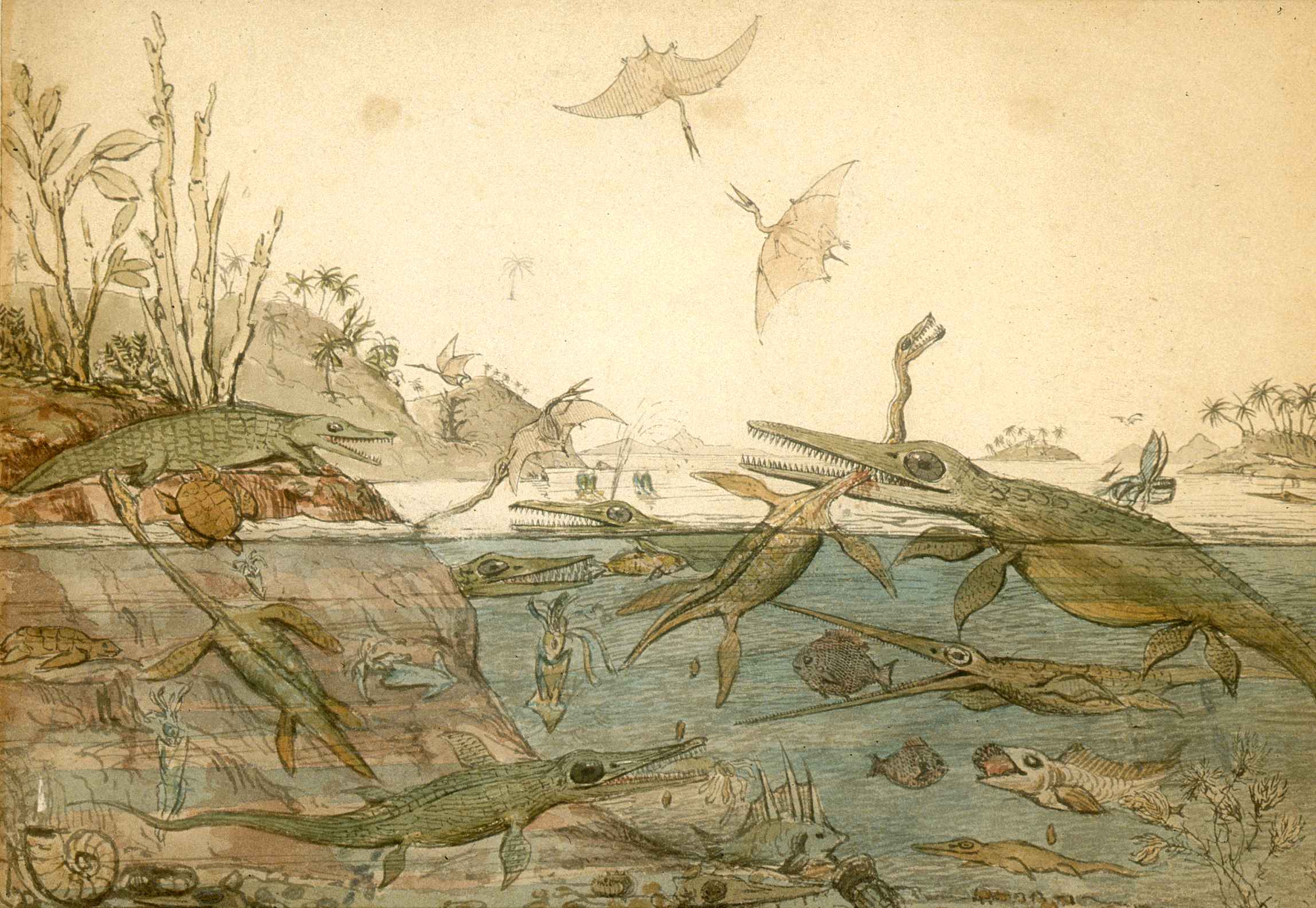
The first (1830, four years after TJ’s death) artistic recreation of the Mesozoic, by Mary’s friend and supporter geologist Henry de la Beche. Note the coprolites to be: