Foreword by Paul Driessen
A new study by climatologists Nicholas Lewis and Judith Curry concludes that Earth’s “equilibrium climate sensitivity” (ECS) to more atmospheric carbon dioxide is as much as 50% lower than climate alarmists have been claiming. That their paper was published in the Journal of Climate suggests that the asserted “97% consensus” of climate experts may be eroding.
Or as Cornwall Alliance founder Cal Beisner puts it (paraphrasing Winston Churchill) it may not be the beginning of the end of climate alarmism. But it could be the end of the beginning of alarmism as the dominant, ever-victorious tenet of our times.
Indeed, say other noted climatologists, there are good reasons to think ECS and alarmist errors are even greater than 50 percent. For one thing, there is no persuasive reason to assume our planet’s climate system and deep ocean temperatures were ever in “energy balance” back in the late 1800s – so we can’t know whether or how much they might be “out of balance” today. Moreover, solar, volcanic and ocean current variations could be sufficient to explain all the global warming over the period of allegedly anthropogenic warming – which means there is no global warming left to blame on carbon dioxide.
If this is indeed the case, there is no justification for the punitive, job-killing, poverty-prolonging energy policies that “climate consensus” and “renewable energy” proponents have been demanding.
Is climate alarmist consensus about to shatter?
Is this the Beginning of the End – or at least the End of the Beginning?
E. Calvin Beisner
On November 10, 1942, after British and Commonwealth forces defeated the Germans and Italians at the Second Battle of El Alamein, Winston Churchill told the British Parliament, “Now this is not the end. It is not even the beginning of the end. But it is, perhaps, the end of the beginning.”
In The Hinge of Fate, volume 3 of his marvelous 6-volume history of World War II, he reflected, “It may almost be said, ‘Before Alamein we never had a victory. After Alamein we never had a defeat’.”
The publication of Nicholas Lewis and Judith Curry’s newest paper in The Journal of Climate reminds me of that. The two authors for years have focused much of their work on figuring out how much warming should come from adding carbon dioxide to the atmosphere. In this paper they conclude that it’s at least 30% and probably 50% less than climate alarmists have claimed for the last forty years.
In fact, there are reasons to think the alarmists’ error is even greater than 50 percent. And if that is true, then all the reasons for drastic policies to cut carbon dioxide emissions – by replacing coal, oil and natural gas with wind and solar as dominant energy sources – simply disappear. Here’s another important point.
For the last 15 years or more, at least until a year or two ago, it would have been inconceivable that The Journal of Climate would publish their article. That this staunch defender of climate alarmist “consensus science” does so now could mean the alarmist dam has cracked, the water’s pouring through, and the crack will spread until the whole dam collapses.
Is this the beginning of the end of climate alarmists’ hold on climate science and policy, or the end of the beginning? Is it the Second Battle of El Alamein, or is it D-Day? I don’t know, but it is certainly significant. It may well be that henceforth the voices of reason and moderation will never suffer a defeat.
Shattered Consensus: The True State of Global Warming was edited 13 years ago by climatologist Patrick J. Michaels, then Research Professor of Environmental Sciences at the University of Virginia and the State Climatologist of Virginia; now Senior Fellow in Environmental Studies at the Cato Institute. Its title was at best premature.
The greatly exaggerated “consensus” – that unchecked human emissions of carbon dioxide and other “greenhouse” gases would cause potentially catastrophic global warming – wasn’t shattered then, and it hasn’t shattered since then. At least, that’s the case if the word “shattered” means what happens when you drop a piece of fine crystal on a granite counter top: instantaneous disintegration into tiny shards.
However, although premature and perhaps a bit hyperbolic, the title might have been prophetic.
From 1979 (when the National Academy of Sciences published “Carbon Dioxide and Climate: A Scientific Assessment”) until 2013 (when the Intergovernmental Panel on Climate Change published its “5th Assessment Report” or AR5), “establishment” climate-change scientists claimed that – if the concentration of carbon dioxide (or its equivalent in other “greenhouse” gases) doubled – global average surface temperature would rise by 1.5–4.5 degrees C, with a “best estimate” of about 3 degrees. (That’s 2.7–8.1 degrees F, with a “best” of 5.4 degrees F.)
But late in the first decade of this century, spurred partly by the atmosphere’s failure to warm as rapidly as the “consensus” predicted, various studies began challenging that conclusion, saying “equilibrium climate sensitivity” (ECS) was lower than claimed. As the Cornwall Alliance reported four years ago:
“The IPCC estimates climate sensitivity at 1.5˚C to 4.5˚C, but that estimate is based on computer climate models that failed to predict the absence of warming since 1995and predicted, on average, four times as much warming as actually occurred from 1979 to the present. It is therefore not credible. Newer, observationally based estimates have ranges like 0.3˚C to 1.0˚C (NIPCC 2013a, p. 7) or 1.25˚C to 3.0˚C – with a best estimate of 1.75˚C (Lewis and Crok 2013, p. 9). Further, “No empirical evidence exists to support the assertion that a planetary warming of 2°C would be net ecologically or economically damaging” (NIPCC 2013a, p. 10).” [Abbreviated references are identified here.]
However, most of the lower estimates of equilibrium climate sensitivity were published in places that are not controlled by “consensus” scientists and thus were written off or ignored.
Now, though, a journal dead center in the “consensus” – the American Meteorological Society’s Journal of Climate – has accepted a new paper, “The impact of recent forcing and ocean heat uptake data on estimates of climate sensitivity,” by Nicholas Lewis and Judith Curry. It concludes that ECS is very likely just 50–70% as high as the “consensus” range. (Lewis is an independent climate science researcher in the UK. Curry was Professor and Chair of the School of Earth and Atmospheric Sciences at the Georgia Institute of Technology and now is President of the Climate Forecast Applications Network.)
Here’s how Lewis and Curry summarize their findings in their abstract, with the takeaways emphasized:
“Energy budget estimates of equilibrium climate sensitivity (ECS) and transient climate response (TCR) [increase in global average surface temperature at time of doubling of atmospheric CO2 concentration, i.e., 70 years assuming 1% per annum increase in concentration] are derived based on the best estimates and uncertainty ranges for forcing provided in the IPCC Fifth Assessment Scientific Report (AR5).
“Recent revisions to greenhouse gas forcing and post-1990 ozone and aerosol forcing estimates are incorporated and the forcing data extended from 2011 to 2016. Reflecting recent evidence against strong aerosol forcing, its AR5 uncertainty lower bound is increased slightly. Using a 1869–1882 base period and a 2007−2016 final period, which are well-matched for volcanic activity and influence from internal variability, medians are derived for ECS of 1.50 K (5−95%: 1.05−2.45 K) and for TCR of 1.20 K (5−95%: 0.9−1.7 K). These estimates both have much lower upper bounds than those from a predecessor study using AR5 data ending in 2011.
“Using infilled, globally-complete temperature data gives slightly higher estimates; a median of 1.66 K for ECS (5−95%: 1.15−2.7 K) and 1.33 K for TCR (5−95%:1.0−1.90 K). These ECS estimates reflect climate feedbacks over the historical period, assumed time-invariant.
“Allowing for possible time-varying climate feedbacks increases the median ECS estimate to 1.76 K (5−95%: 1.2−3.1 K), using infilled temperature data. Possible biases from non-unit forcing efficacy, temperature estimation issues and variability in sea-surface temperature change patterns are examined and found to be minor when using globally-complete temperature data. These results imply that high ECS and TCR values derived from a majority of CMIP5 climate models are inconsistent with observed warming during the historical period.
A press release from the Global Warming Policy Forum quoted Lewis as saying, “Our results imply that, for any future emissions scenario, future warming is likely to be substantially lower than the central computer model-simulated level projected by the IPCC, and highly unlikely to exceed that level.”
Veteran environmental science writer Ronald Bailey commented on the new paper in Reason, saying: “How much lower? Their median ECS estimate of 1.66°C (5–95% uncertainty range: 1.15–2.7°C) is derived using globally complete temperature data. The comparable estimate for 31 current generation computer climate simulation models cited by the IPCC is 3.1°C. In other words, the models are running almost two times hotter than the analysis of historical data suggests that future temperatures will be.
“In addition, the high-end estimate of Lewis and Curry’s uncertainty range is 1.8°C below the IPCC’s high-end estimate.” [emphasis added]
Cornwall Alliance Senior Fellow Dr. Roy W. Spencer (Principal Research Scientist in Climatology at the University of Alabama-Huntsville and U.S. Science Team Leader for NASA’s satellite global temperature monitoring program) commented on the paper. Even Lewis and Curry’s figures make several assumptions that are at best unknown and quite likely false. He noted:
“I’d like to additionally emphasize overlooked (and possibly unquantifiable) uncertainties: (1) the assumption in studies like this that the climate system was in energy balance in the late 1800s in terms of deep ocean temperatures; and (2) that we know the change in radiative forcing that has occurred since the late 1800s, which would mean we would have to know the extent to which the system was in energy balance back then.
“We have no good reason to assume the climate system is ever in energy balance, although it is constantly readjusting to seek that balance. For example, the historical temperature (and proxy) record suggests the climate system was still emerging from the Little Ice Age in the late 1800s. The oceans are a nonlinear dynamical system, capable of their own unforced chaotic changes on century to millennial time scales, that can in turn alter atmospheric circulation patterns, thus clouds, thus the global energy balance. For some reason, modelers sweep this possibility under the rug (partly because they don’t know how to model unknowns).
“But just because we don’t know the extent to which this has occurred in the past doesn’t mean we can go ahead and assume it never occurs.
“Or at least if modelers assume it doesn’t occur, they should state that up front.
“If indeed some of the warming since the late 1800s was natural, the ECS would be even lower.”
With regard to that last sentence, Spencer’s University of Alabama research colleague Dr. John Christy and co-authors Dr. Joseph D’Aleo and Dr. James Wallace published a paper in the fall of 2016 (revised in the spring of 2017). It argued that solar, volcanic and ocean current variations are sufficient to explain all the global warming over the period of allegedly anthropogenic warming, leaving no global warming to blame on carbon dioxide.
At the very least, this suggests that indeed “some of the warming since the late 1800s was natural” – which means the ECS would be even lower than Lewis and Curry’s estimate.
All of this has important policy implications.
Wisely or not, the global community agreed in the 2015 Paris climate accords to try to limit global warming to at most 2 C degrees – preferably 1.5 degrees – above pre-Industrial (pre-1850) levels.
If Lewis and Curry are right, and the warming effect of CO2 is only 50–70% of what the “consensus” has said, cuts in CO2 emissions need not be as drastic as previously thought. That’s good news for the billions of people living in poverty and without affordable, reliable electricity. Their hope for electricity is seriously compromised by efforts to impose a rapid transition from abundant, affordable, reliable fossil fuels to diffuse, expensive, unreliable wind and solar (and other renewable) as chief electricity sources.
Moreover, if Spencer (like many others who agree with him) is right that the assumptions behind ECS calculations are themselves mistaken … and Christy (like many others who agree with him) is right that some or all of the modern warming has been naturally driven – then ECS is even lower than Lewis and Curry thought. That would mean there is even less justification for the punitive, job-killing, poverty-prolonging energy policies sought by the “climate consensus” community.
Regardless, we’re coming closer and closer to fulfilling the prophecy in Michaels’ 2005 book. The alarmist “consensus” on anthropogenic global warming is about to be shattered – or at least eroded and driven into a clear minority status.
E. Calvin Beisner, Ph.D., is Founder and National Spokesman of The Cornwall Alliance for the Stewardship of Creation.
Okay, well, what if the Little Ice Age didn’t really “end”, after all, and the “pause” we’ve been living in and expanding in all areas (population, agriculture, science, etc.) is slowly coming to a Kalte Ende?
If my grandfather recorded a blizzard in his journal in 1875 (I don’t have a later one, for 1878) and there were subsequent blizzards that followed and buried cities (NYC, e.g.), and we’re having the same things now – yes, it’s weather. But weather is the short term and “climate” is the long term (as so many note) and a short warm pause between colder weather periods COULD be more significant than you think.
I do have Grandpa’s Klondike journal, when he was up in the Great Frozen North digging for gold for four years. He paid close attention to things like blizzards and an avalanche at Chillicothe Pass, and how cold it was in the cabin he shared with three other gold rushers (-6F). (I guess I’ve inherited that watchful streak.)
However, if you will recall, Alaska and that area went through a warming period a few years ago in which highways were buried by avalanches from melting glaciers. Shocking! And Chillicothe Pass was completely bare of snow and ice.
So isn’t is possible that this “warm period” we’ve been in was just a pause in the Little Ice Age, instead of the end of it? In my view, anything is both possible and plausible.
I see all types of excuses, and explanations of where this paper ‘goes wrong’, including statements like, ‘we have models that prove..,’ and, ‘clearly there has been a downward (probably man-made) forcing of global temperatures, masking the true effect of carbon dioxide. When those forcings end, as they will, then we will suddely see catastrophic warming. With no time to adapt, the future will be worse than we thought.’
This charade will not end until we have experienced three decades of undeniably cold weather. I will not see that in my lifetime. The only other way this could end would be worse: the successful establishment of totalitarian world governments dismissing science altogether, doing as they wish, and destroying all who oppose. Hopefully I won’t live to see that,
I think it will end like so many other political stories, just kind of slowly loose steam as people get sick of hearing about it. Already, most people I talk to treat it like an old joke.
I think that faith in any belief system is a catastrophic system:
https://en.wikipedia.org/wiki/Catastrophe_theory
People will continue to have faith in something until, all of a sudden, they don’t. The transformation is rather sudden. I like to use the example of England’s Glorious Revolution of 1688. The English nobility were solidly behind James II until William of Orange landed his troops. Support for James evaporated like snow in a snow drift in a chinook.
We also have to distinguish between the ‘consensus’ among scientists and public opinion. The latter has been eroding as show by various opinion polls. People just aren’t seeing the catastrophe they had been promised. For many scientists, especially those who have not studied the evidence on climate, they’ve been sold on on the concept that skepticism is an “attack on science”. Their instinct is to rally ’round the flag and not look too closely at which side they are actually on. That is the consensus that is beginning to ‘crack’ as more scientists become aware of the arguments from other scientists that ‘global warming’ ain’t what it ever was.
Is there a climate sensitivity?
For sensitivity to exist it must be shown that temperature is responsive to changes in atmospheric CO2 concentration at an annual time scale. This responsiveness is not found in the data.
https://ssrn.com/abstract=3170971
Anyone who believes there ever was a 97% has never read the methodology on how that farcical number was manufactured. Lewis and Curry are just part of the 50% of scientists that never believed the made up hype.
Even warmist scientists quote the 97% papers. Metholodology matters not to any of them. Scientists protect their own standing—years and thousands of dollars for a PhD means you back all PhD’s, lest you get attacked. Lay people—too lazy to bother to check methods. If scientists voted that the theory is right, good enough for most. Good scientists will fight back, but the number willing to sacrifice to fight back is quite small. That’s why made up hype, enforced with humiliation, tormenting and ridicule of dissenters, sells so well and is so hard to overcome.
97% was also Joseph Stalin’s favourite percentage of votes in every election.
Given the politics of the Greens it is rather fitting.
well, since most greens are watermelons, its not only fitting but also not surprising.
If the comment sections on blogs is any indication, no, it’s not shattering. Not a bit. The Lewis and Curry paper is already being brought up and vilified. Yes, if pushed, the commenter usually resorts to nasty insults, but that’s what always happens. I see no difference at this point. The belief remains strong. (Trolls give up faster, but that’s in politics, global warming, all topics. Not sure why. I don’t know that it even means anything.)
Since most of the “consensus” backing blogs block/delete comments that go against the party line, I don’t think you can use that as a gage of any reliability
About consensus and percentage of certainty. Internet weather services list 100% chance of precipitation 3 days out and later change it to 0%. So, how does one arrive at 100% when it can not be 100%. Same goes for 97%.
Well, that’s the kicker right there: even the weather service can’t make accurate predictions ore than three to four days ahead, and they seldom take into account variables like a push of cold air coming down from the north, or a heat wave coming up from the south.
Not one weather forecaster in Chicago predicted the February 2, 2011, blizzard. Not one. Many people were stranded in their cars on the Outer Drive because of a bus breakdown and limited access and NO ONE predicted gale force winds off Lake Michigan during that storm.
Sara,
When you consider that the forecasting errors consist of false-positives and false-negatives, I am loath to even credit them for accurate predictions one day in advance. Recently here in central Ohio the forecast was for overcast skies and no precipitation. Yet, it snowed lightly all day. For places like California, with a Mediterranean Climate, forecasters do a pretty good job of picking between “Sunny with blue skies,” or “Overcast with light rain.” However, it is my impression that even with the GOES satellites, Doppler radar, and super computers, I can’t trust the weather forecasts any more than I could 50 years ago. I still look out the window to make my final decision on how to dress before leaving the house.
The consensus among climate scientists is the long-term prediction of future climate states is not possible. It still is. The consensus among alarmists is catastrophe in 2100 if we don’t reduce CO2 emission. No, it’s not about to shatter.
The consensus among alarmists is catastrophe in 2100 if we don’t reduce CO2 emission.
I think it’s useful to point out that “consensus” among alarmists in EVERY century, in EVERY civilization, has always been “REPENT YE, O REPENT YE, OR YE SHALL ALL PERISH IN FLAME, YE EVILDOERS!!!”
Nothing has changed. There’s always a group that gets off on the attention they get by proclaiming that.
In this study it maintains that even if the CO2 level rises by a factor of 8 the temperature rise with not exceed 2C.
https://www.atmos.washington.edu/2008Q2/591A/Articles/Rasool_Schneider_Science.pdf
The Lewis and Curry ECS estimates make minor adjustments to the IPCC forcings but use the same forecasting paradigm and thus fall outside the likely range of the real world. Like them, to the detriment of the reputation of science in general, establishment climate scientists made two egregious errors of judgment in their method of approach to climate forecasting . First, they based their analyses on inherently untestable and specifically structurally flawed models which included many questionable assumptions. Second they totally ignored the natural, solar driven , millennial and multi-decadal quasi-cycles. Unless we know where we are with regard to, and then incorporate, the phase of the millennial cycle in particular, useful forecasting and ECS estimation is simply impossible.The climate models on which the entire Catastrophic Anthropogenic Global Warming delusion rests are structured without regard to the natural 60+/- and more importantly 1000 year periodicities ( observed emergent behaviors) so obvious in the temperature record. The modelers approach is simply a scientific disaster and lacks even average commonsense .It is exactly like taking the temperature trend from say Feb – July and projecting it ahead linearly for 20 years or so beyond the annual peak and inversion point.The models are back-tuned for less than 100 years when the relevant time scale is millennial. .
.
It is fashionable in establishment climate circles to present climate forecasting as a “wicked” problem. I would by contrast contend that by adopting the appropriate time scale and method for analysis it becomes entirely tractable so that commonsense working hypotheses with sufficient likely accuracy and chances of success to guide policy can be formulated. See http://journals.sagepub.com/doi/full/10.1177/0958305X16686488
Here are some excerpts from my blog http://climatesense-norpag.blogspot.com/2016/03/the-imminent-collapse-of-cagw-delusion.html
Friday, March 18, 2016
The Imminent Collapse of the CAGW Delusion
“The modelling approach is inherently of no value for predicting future temperature with any calculable certainty because of the difficulty of specifying the initial conditions of a sufficiently fine grained spatio-temporal grid of a large number of variables with sufficient precision prior to multiple iterations. For a complete discussion of this see Essex: https://www.youtube.com/watch?v=hvhipLNeda4
…….Section IPCC AR4 WG1 8.6 deals with forcings, feedbacks and climate sensitivity. It recognizes the short comings of the models. The conclusions are in section 8.6.4 which concludes:
“Moreover it is not yet clear which tests are critical for constraining the future projections, consequently a set of model metrics that might be used to narrow the range of plausible climate change feedbacks and climate sensitivity has yet to be developed”
What could be clearer. The IPCC in 2007 said itself that it doesn’t even know what metrics to put into the models to test their reliability (i.e., we don’t know what future temperatures will be and we can’t calculate the climate sensitivity to CO2). This also begs a further question of what erroneous assumptions (e.g., that CO2 is the main climate driver) went into the “plausible” models to be tested any way.
Even the IPCC itself has now given up on estimating CS – the AR5 SPM says ( hidden away in a footnote)
“No best estimate for equilibrium climate sensitivity can now be given because of a lack of agreement on values across assessed lines of evidence and studies”
Paradoxically they still claim that UNFCCC can dial up a desired temperature by controlling CO2 levels .This is cognitive dissonance so extreme as to be irrational. There is no empirical evidence which proves that CO2 has anything more than a negligible effect on temperatures.
Fig 12 Comparative Temperature Forecasts to 2100.
Fig. 12 compares the IPCC forecast with the Akasofu (31) forecast (redharmonic) and with the simple and most reasonable working hypothesis of this paper (green line) that the “Golden Spike” temperature peak at about 2003 is the most recent peak in the millennial cycle. Akasofu forecasts a further temperature increase to 2100 to be 0.5°C ± 0.2C, rather than 4.0 C +/- 2.0C predicted by the IPCC. but this interpretation ignores the Millennial inflexion point at 2003/4. Fig. 12 shows that the well documented 60-year temperature cycle coincidentally also peaks at about 2003.Looking at the shorter 60+/- year wavelength modulation of the millennial trend, the most straightforward hypothesis is that the cooling trends from 2003 forward will simply be a mirror image of the recent rising trends. This is illustrated by the green curve in Fig. 12, which shows cooling until 2038, slight warming to 2073 and then cooling to the end of the century, by which time almost all of the 20th century warming will have been reversed.If the real outcomes follow the near term forecasts shown above I suggest that the establishment and Lewis and Curry estimates will be untenable past 2020.This is imminent in climate terms.
The hadsst3 data shows global SST temperatures are now below the pre El Nino trend.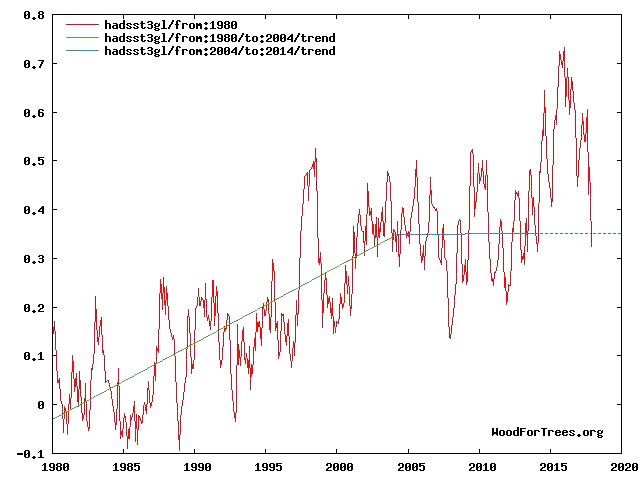
Page,
You touch on an important point that few seem to be aware of. That is the constructive and destructive interference of cycles that are out of phase. There are known lunar cycles of up to 20 years that those preparing tide tables take into account. However, those focused on sea level change apparently ignore those cycles or are unaware of them. So, similarly, cycles in solar insolation have to be examined in terms of amplitude, period, and phase, to properly assess their potential impact. Yet, it seems that little concern is expressed for other than the sunspot cycle, and some on both sides of the aisle question the importance of that.
The historical record from 1850 to today shows that global temperatures have risen 0.8 +/- 0.1 degrees. During this same time period, CO2 increased from 280 to 400 ppmv. Assuming a linear relation, then doubling CO2 from 280 to 560 ppmv should produce (0.8 +/- 0.1)(280/120) = 1.87 +/- 0.23 degrees warming. This is only 62% of the IPCC’s “best value” of 3 degrees! This simplest calculation automatically means that Lewis & Curry are right!
And it gets worse due to “saturation” effects on CO2 absorption of infrared (IR) radiation emitted from the surface of the Earth. Even the IPCC assumes that the relation is not linear, but logarithmic. If radiative forcing is given by “delta F” = 5.35 ln(C/Co), then doubling CO2 means C/Co = 2, and “delta F” = 5.35 ln2 = 3.7 W/m^2. If C/Co = 400/280, “delta F” = 5.35 ln(400/280) = 1.91 W/m^2 . Therefore if the IPCC value of 3K for equilibrium climate sensitivity (ECS) were true, this would correspond to 3K(1.91/3.7) = 1.55 +/- 0.19 K warming, which is 1.55/0.8 = 1.94 (almost 2) times the actual warming! Note that the predicted 1.55 K is way outside the error bars of the actual warming of 0.8 +/- 0.1 degrees. Any alert beginner to climate studies should have been able to make this calculation.
Alternatively, the ECS cannot be greater than
(0.8 +/- 0.1)[ln2/ln(400/280)] = 1.55 +/- 0.19 K (only 52% of the IPCC “best value” of 3K, which is not needed in this calculation), in agreement with Lewis & Curry.
The three El Nino spikes in the last 20 years and the recovery from the Mt. Pinatubo eruption show that the time constant for warming is of the order of a few years or less. There is no decades- or centuries-long time constant (if there were such a lag, then temperatures would have continued to increase, even if CO2 had remained constant instead of steadily increasing in the last 20 years when there was no major volcanic eruption).
The above calculations still assumed that ALL of the observed 0.8 +/- 0.1 K warming was due to CO2 and related feedbacks. The radiative forcing of 3.7 W/m^2 can be used to predict 1 degree warming on doubling CO2 (not including feedbacks). But the value of 3.7 W/m^2 comes from computed spectra necessarily assuming a cloudless troposphere.
Clouds are made of liquid water droplets or ice crystals which act as near-perfect (emissivity 0.98 or greater) Planck black bodies peaking at IR frequencies. This means they absorb nearly all IR emitted from the Earth’s surface and re-emit according to the Stefan-Boltzmann law, depending on the temperature of the cloud top which will be lower than the Earth’s surface. Doubling CO2 will have no effect on the absorption below the cloud top, because you cannot increase absorption which is already 100%. Therefore doubling CO2 will affect only the absorption in the shorter path length from cloud top to 10 km, the top of the troposphere, and there are fewer total CO2 molecules per unit area in the column. The marginal increase in absorption occurs from the v=1 first excited state of CO2 bond-bending vibration, and the population of these absorbing molecules decreases exponentially with decreasing temperature (increasing altitude). Therefore when the 62% of the Earth’s surface that is cloud-covered is considered, the amount of warming on doubling CO2 (not including feedbacks) is reduced to 0.6 to 0.7 degrees. Even if my calculated water vapor feedback in an infinite geometric series results in 50% net feedback, equilibrium climate sensitivity will be increased to only 0.9 to 1K. And if increased water vapor also leads to a slight increase in cloud cover, this will decrease the ECS back to below 0.7 degrees. The difference between this value and 1.55 +/- 0.19 K must be due to natural factors other than CO2 and related feedbacks.
When theory does not match experimental measurements, the theory is WRONG. It doesn’t matter how smart the theorist, or who the theorist is, or how many Nobel Prizes she has won. This simple scientific truth is stated in the first 60 seconds by Richard Feynman at https://www.youtube.com/watch?v=EYPapE-3FRw (if the link doesn’t work, Google “Feynman scientific method”).
For more details on the above calculations, email me at rtaguchi@rogers.com .
The fact is Sara we need to be using the term “GREENHOUSE EFFECT” and “Greenhouse Warming” once again to drive it home because that’s what this whole masquerade is about.
We have let them off the hook by moving away from “greenhouse effect”, and let them and the totally corrupt media to change the subject into the completely nebulous and faked term of “Climate Change”, so that they can claim that any detectable change will do as ‘evidence’ of such changery-ness.
Any old change won’t do. It has to be the predicted greenhouse effect or it’s totally false, and the public must understand that temperature rise above natural variability is the only measure of actual change.
And it has to be due to CO2 alone, not some other convenient gas substitute.
Plus a measured T rise ‘change’, has to be consistent with human CO2 emission—alone.
We can’t call it AGW, CAGW or “climate change”. We’ve got to stop playing along in their propaganda memes, and nebulous word games.
It is either human emitted CO2 inducing a physically predicted greenhouse-effect or there is nothing—The END.
Else, we’lll be talkng about AGW drivel until the end of this century and the public will still be reacting to their propaganda nonsense.
As I recall the claim that “the science is settled” became prominent during the same period when the lables if “green house effect” and AGW were the preferred meme. So your right. They were let off the hook.
We could start by ending the tax-free part for donations and grants. That might put a crimp in their style.
For a few decades, climatologists were in the grip of a political reign of terror.
But nothing lasts forever, and scientists generally loath being told how they must think and having their conclusions prescribed for them. As time goes on, more and more will dip their toes in the waters in climate apostasy.
I suspect that a few decades from now, the typical view will be that global warming is a problem, but that it is not the immediate catastrophe made out by some today — in other words, the Luke Warmers were right. The alarmists will be have decreasing credibility. That trend has been apparent for a while now.
Yes, but the politicians have brainwashed the children at the cost of the parents, to lever CO2 greenhouse warming effect, as long as possible.
The teaching profession as a whole has just as much to answer for as the corrupt media does, in enabling the politician’s perverse undermining of society in this way, for as long as possible to contrive.
The ‘teachers’ are mostly just dishonest cowards, and this must also be made plain to all before there is any recouperation from what they’ve done, with the money we’ve paid them, to get this perversion of education.
The whole misguided and misguiding system of govt and taxation has put us in this position. Where are all the mythical checks and balances?
AWOL, or else effectively non-existing in more than wishy shameless platitude.
Teachers are not all powerful. Youth have a natural skepticism of established beliefs. Often that skepticism is destructive, but in this case it is not.
@KillerMarmot
Yes, sort of, but many young are not like that at all, they are open, not skeptical (and may never become so), they are empty vessels with impressionable minds.
Why do you think the alarmists and politicians focus on them, with the CAGW climate-changery messaging drumbeats, and avoid CO2 greenhouse-effect warming, compared to natural variability?
They do it because what is taught IS formative. Children of catholics tend to becone Catholics, especially as they age. When quedtion it all, they revert to what they know, and become more ‘conservative’ We scientists tend to forget that us a common dynamic, and offering a counter argument to once Catholic children does not generally work. They stick with the initial Sunday School fables over facts, they don’t even want the complexity and exustential funk of questioning accepted mesages, and entertaining disenfranchising relations with others.
The children are all taught the ciriculum and get assessed on compliance with their understanding of that ciriculum. That’s what matters at school, they are kept in line by fear of the life implications of failing to consolidate the approved knowledge.
You would be surprised by what lefty economic ignoramous’s teachers generally are. I have known dozens of them, as an adult, girlfriends, many close friends, etc. I was shocked to discover they really had no clue how business, investment and employment occur, what the point is, how and why it functions. They think their salary comes from a taxation office’s State Treasury, and will forever. With no implications emerging from what they ‘teach’ children—or the standing ignorance they impart. My experience of teachers, and also Uni Professors, has had made it clear to me that this is a major source of education failures and resulting national and social trajectories.
Why do you think countries like Australia have become so self-impairing, and loonie-left, and not even realise it?
This is all a product, not just the cause.
This caught my attention,, “At the very least, this suggests that indeed “some of the warming since the late 1800s was natural . . .”
That suggests that most of GW – since the late 1800’s – is man-made? It seems that even the consensus among the alarmists only suggest that it’s only since mid-20th Century, or since the 1970’s, that most of GW is caused by AGHG increases. In fact, on NASA’s home Climate page – http://climate.nasa.gov/scientific-consensus/ – (though it says at the top, “over the past century are extremely likely due to human activities”), they list a slew of science orgs and academies, and their summary statements on AGW, all but two (ou8t of 18)referencing any period of time before 1950, and most limiting the wording to statements like these:
American Geophysical Union (ACS): Humanity is the major influence on the global climate change observed over the past 50 years.
American Meteorological Society: that the dominant cause of the rapid change in climate of the past half century is human-induced increases . .
The Geological Society of America : . .that human activities (mainly greenhouse‐gas emissions) account for most of the warming since the middle 1900s.”
International academies: Joint statement from 11 academies: It is likely that most of the warming in recent decades can be attributed to human activities (IPCC 2001).
U.S. Global Change Research Program: “The global warming of the past 50 years is due primarily to human-induced increases in heat-trapping gases.
Intergovernmental Panel on Climate Change : “Most of the observed increase in global average temperatures since the mid-20th century is very likely* due . .
CO2 was about 290ppm back in the late 1880’s, at 310ppm at mid-20th century and about 400pppm today. If CO2 is the driver (and don’t believe that it is) then warming should be much more dramatic since the amount of CO2 in the atmosphere really took off – not before.
There is too much inertia by vested interests for anything significant to happen in the near (think years) future. Check back in the next decade.
Is climate alarmist consensus about to shatter?
Sadly, no. The climate alarmism is like the fake Trump investigations — there’s a psychotic aspect to it that regardless of any facts, it will continue because the money/power gravy-train would otherwise be threatened.
There never was a consensus to shatter. If there had been, it would not have been necessary to misinterpret (possibly fake or fraudulent may be more appropriate here) the various surveys and papers that have made the 97% claim. As there is only a fake consensus it will remain until the money runs our or it becomes obviously unsustainable to the scientifically illiterate claimants.
Indeed. By defining an imaginary consensus, and moving the discussion only the complex plane, simple arithmetic can be used to create spin.
I have posted the following comment to Andy May’s essay nearby. I believe the following to be standard, even pretty dated, quantum mechanics relating to radiant solar energy. And I think it is a threshold question to be addressed to every study of climate sensitivity to CO2 forcing. Seems to me it is a question that has not been asked, not to say left unanswered, in popular forums.
What is lacking in most if not all analyses of climate sensitivity is “at what temperature exactly is CO2 interacting with solar radiant energy?” After all, photons are packets of energy, but their energy (temperature) ranges from ultraviolet, which for all I know might vaporize steel, down to radio waves measured in meters, which are probably scarcely above the universe’s background temperature.
So, HOW HOT is the infrared radiation that CO2 interacts with to warm the atmosphere?
My first thought about infrared light is the heat lamp at the feed store to warm the chicks. I don’t think that wraps it. As I understand, at about the time Max Planck discerned quantum mechanics in the classical-physics curve of radiated energy, which most of us are familiar with, Einstein and Planck derived a formula for measuring energy based on frequency times a proportionality constant, the Planck constant, h. That is,
E = vh, with v the frequency, h the Planck constant, and E the energy, that is, temperature.
Since frequency relates inversely to wavelength (λ), “v” may be written as the speed of light divided by peak wavelength, or c/λ, which is Wilhelm Wien’s peak displacement law. It was written before Planck’s general framework then modified for quantum mechanics. It is also called the Wien approximation. It states that wavelength (λ) for each black-body frequency peaks at a maxi¬mum, given by λ = b/T, with T in Kelvins and b the displacement constant (b ≈ 2900×K) applied to the wave¬length. Higher energy photons at higher frequency are at shorter wave¬lengths, so wave¬ length relates inversely to temperature. By that it is possible to calculate the peak energy or temperature for radiation with which CO2 is active.
If you divide 15μm into 2900°K you get 193°K or -80°C.
Also as I understand it, the Earth directly emits its highest energy IR photons, at 8-12μm wavelengths, through a window to space without interacting with any gases. Wien’s law shows that the 8μm photons exit the atmospheric window at 89°C and 12μm photons exit at -31.7°C, spanning a temperature drop of 120.7 Celsius degrees. By comparison, the peak wavelength at which “catastrophic” GHG, CO2, at a peak 15μm wavelength (in a spread from 13.5 to 17 μm), absorbs and emits photons at a -80°C temperature. That is, by established normal physical calculation, CO2 is interacting with radiant energy at minus 80 degrees Celsius. It raises the question how a gas interacting with radiation at 80 degrees cooler than ice threatens to warm the atmosphere at all.
I am nowhere near QM’s cutting edge, but I doubt the above relationship has been significantly altered from Einstein’s, Planck’s and Wien’s time. Even if it doesn’t exactly apply, it should be addressed and properly reckoned with. Better stick around to see how alarmism worms its way out of this. There should be a great deal of bootstrapping.
“at what temperature exactly is CO2 interacting with solar radiant energy?”
CO2 absorbs long-wave IR from the surface not from solar radiation.
“HOW HOT is the infrared radiation that CO2 interacts with to warm the atmosphere?”
Infrared is electromagnetic waves. It doesn’t have a temperature. Matter emitting EM waves has a temperature according to Stefan-Boltzmann law.
“If you divide 15μm into 2900°K you get 193°K or -80°C”
It makes no sense to divide temperature by wavelength. The shape of the black body curve depends on temperature. Total energy is the area under the curve or the integral of the entire range of wavelengths. You cannot cut temperature into pieces. You can cut energy per wavelength. Since the premise is wrong, the rest of the argument is wrong.
The reality for the “consensus” is the 4.5 K upper bound has become an untenable value for the alarmists.
Add in the fact that after 5 Assessment Reports in 23 years, the ECS range never decreased, never reducing uncertainty. Another untenable position.
Expect AR 6 to try to spin the fallback of the upper ECS bound into, “we are now more certain than ever…” blather.
“It’s wose than we thought…robust…yatta-yatta…”
This will just cause the alarmists to double down on alarmism. They will not be moved away from their true agenda- eliminating the use of fossil fuels.
Their true agenda is the establishment of a world-wide Socialist
paradisehell.Has the consensus been shattered? Or just plain shat?
To debate the magnitude of ECS is scientifically nonsensical as this magnifude is not observable.
So can I finally switch over the air in my tires from the winter blend to the summer blend? Because Michigan…
Unfortunately, there is only one way whereby the consensus will quickly shatter, and that is if Arctic Ice expands over the course of the next 10 years.
What is needed is something very stark and visual that runs contrary to the AGW mantra, and which cannot be subverted by data manipulation and homogenisation.
The climate change scare is political and the majority of the populations of most countries take little notice as they are to busy getting on with life .
Climate change is at the bottom of their worry list.
When left leaning governments start applying pressure with taxes and levies to alter peoples behavior to stop them driving their cars and forcing the price of every thing up from energy to food .that is when they wake up and start protesting and vote them out.
Politicians promise the world to get elected and spend our money to keep them selves in power .
The story has to be scary to frighten people into believing that they have to make sacrifices to secure a safe world for their grandchildren .
The modern world runs on fossil fuel and it is not about to change .
Populations are not about to return to serfdom .
The theory of dangerous global warming is but a theory and it is unproven and every paper that chips away at it helps bring some reality to the debate but a decade of icy weather would bust the scam wide open .
Good comments, thank you Gwan.
Re some of your words:
“The story has to be scary…”
Agreed – many great thinkers have observed that politicians too often scare the populace with false fears, in order to implement their desired policies.
Politicians love a big scam, because that is where they can siphon off the most graft. Global warming alarmism, and its objective to replace fossil fuels with so-called ‘green energy” is the most expensive scam in the history of humanity. Tens of trillions of dollars have been squandered on green energy schemes that are not green and produce little useful (dispatchable) energy.
“The modern world runs on fossil fuel and it is not about to change.”
Correct. Fully 85% of global primary energy is fossil fuels – oil, coal and natural gas. The rest is mostly nuclear and hydro, with about 2 percent being largely non-dispatchable wind and solar nonsense, supported by tens of trillions in subsidies.
“The theory of dangerous global warming is but a theory and it is unproven…”
Correct, and more: The theory of catastrophic man-made global warming was disproved by the global cooling period from ~1940 to ~1977, even as fossil fuel combustion and atmospheric CO2 concentration strongly accelerated, and by the ~20-year “Pause” in global temperatures, which has recently re-established itself after the last major El Nino. In the past 78 years since 1940, there have been about 57 years of cooling or no-net-warming, and only about 21 years of warming, all as CO2 increased.
“… a decade of icy weather would bust the scam wide open.”
Agreed, but the aforementioned almost-four decades of icy weather already did – we do not have to wait for the next natural cooling period to re-prove what we already know.
Furthermore, we need to ensure that populations have access to cheap, reliable, abundant energy before more cooling sets in, because humanity suffers and dies in greater numbers during global cooling periods.
Again, thank you for your good comments.
Regards, Allan
first. see i told you so many years ago.
just put all your energy behind nic.
did you listen..nope.
“or the last 15 years or more, at least until a year or two ago, it would have been inconceivable that The Journal of Climate would publish their article. That this staunch defender of climate alarmist “consensus science” does so now could mean the alarmist dam has cracked, the water’s pouring through, and the crack will spread until the whole dam collapses.”
this is hogwash. Nic got published because he does good science. no crazy sun nuttery.
Nic got published because he does good science. no crazy sun buttery.
Yes, of course.
Neither is it the ridiculous fake skeptic’s and physics illiterate bullshit such as “GHE violates second law of thermodynamics”, “CO2 increase in air is natural”, “GHE does not exist” or merely stubborn and laughable denying of a possible influence of mankind on climate.
How many idiotic “articles” relevant to this bullshit have been published on this and other similar sites ?
Maybe, what is about to shatter is rather the idiocy promoted in this way ?