By Christopher Monckton of Brenchley
Skeptics 1, Fanatics 0. That’s the final score.
The corrected mid-range estimate of Charney sensitivity, which is equilibrium sensitivity to doubled CO2 in the air, is less than half of the official mid-range estimates that have prevailed in the past four decades. Transient sensitivity of 1.25 K and Charney sensitivity of 1.45 K are nothing like enough to worry about.
This third article answers some objections raised as a result of the first two pieces. Before I give some definitions, equations and values to provide clarity, let me make it plain that my approach is to accept – for the sake of argument only – that everything in official climatology is true except where we have discovered errors. By this acceptance solum ad argumentum, we minimize the scope for futile objections that avoid the main point, and we focus the discussion on the grave errors we have found.
Definitions
All definitions except that of temperature feedback are mainstream. I am including them in the hope of forestalling comments to the effect that there is no such thing as the greenhouse effect, or that temperatures (whether entire or delta) cannot induce feedbacks. If you are already well versed in climatology, as most readers here are, skip this section except for the definition of feedback, where climatology is at odds with mainstream feedback theory.
Greenhouse gases possess at least three atoms in their molecules and are thus capable of possessing or, under appropriate conditions, acquiring a dipole moment that causes them to oscillate in one of their vibrational modes and thus to emit heat.
Carbon dioxide (CO2), being symmetrical, does not possess a dipole moment, but acquires one in its bending vibrational mode on interacting with a near-infrared photon. To use Professor Essex’s excellent analogy, when a greenhouse gas meets a photon of the right wavelength it is turned on like a radiator, whereupon some warming must by definition occur.
The non-condensing greenhouse gases exclude water vapor.
Water vapor, the most significant greenhouse gas by quantity, is a condensing gas. All relevant changes in its atmospheric burden are treated as temperature feedbacks. Its atmospheric burden is thought to increase by 7% per Kelvin of warming in accordance with the Clausius-Clapeyron relation (Wentz 2007).
Emission temperature would obtain at the Earth’s surface if there were no non-condensing greenhouse gases or feedbacks present. Emission temperature is a function of insolation, albedo and emissivity (assumed to be unity), and of nothing else. As non-condensing greenhouse gases and feedbacks warm the atmosphere, the altitude at which the emission temperature obtains rises.
Radiative forcing (in W m–2) is an exogenous perturbation in the net (down minus up) radiative flux density at the top of the atmosphere. Forcings become warmings via –
The Planck sensitivity parameter (in K W–1 m2: Roe 2009), the quantity by which a radiative forcing is multiplied to yield the reference sensitivity. To a first approximation, it is the first derivative of the fundamental equation of radiative transfer with respect to the Earth’s emission temperature and emission flux density. Its value is thus dependent on insolation and albedo. The first derivative is the change in temperature per unit change in flux density, i.e., at today’s values 255.4 / (4 x 241.2) = 0.27 K W–1 m2. However, owing to altitudinal variation, the modeled value today is 0.31 = 3.2–1 K W–1 m2 (IPCC 2007, p. 631 fn.).
Temperature feedback (in W m–2 K–1), an additional forcing proportional to the temperature that induces it, in turn drives a feedback response (in K) that modifies the originating temperature. This definition of a feedback as a modification of a signal (not merely of a change in the input signal but also of the input signal itself) is standard in all applications of control theory except climatology, where it has been near-universally but falsely imagined that an input signal (emission temperature in the climate) does not induce a feedback, even where feedback processes are present and will modify even the tiniest change in that signal. It is this error that has misled official climatology into overestimating climate sensitivities.
Models do not implement feedback math explicitly. However, their outputs are routinely calibrated against past climate. Paper after paper incorrectly states that the entire 33 K difference between today’s surface temperature of 288 K and the emission temperature of 255 K that would prevail today in the absence of greenhouse gases or of feedbacks is driven by the directly-forced warming from the non-condensing greenhouse gases and the feedbacks induced by that warming.
For instance, Lacis (2010) says that three-quarters of the difference between emission temperature and today’s temperature is the feedback response to the non-condensing greenhouse gases: i.e, that the feedback fraction is 0.75, which, given the CMIP5 reference sensitivity of 1.1 K (Andrews 2012) would yield Charney sensitivity of 4.4 K. Sure enough, the CMIP5 models’ feedback fraction, at 0.67, is close to Lacis’ value, implying Charney sensitivity of 3.3 K. It will be proven that there is no justification whatever for mid-range estimates anything like this high. They arise solely because the models have been tuned over the decades to yield Charney sensitivities high enough to account for the entire 33 K.
- Reference sensitivity is the temperature change in response to a radiative forcing before taking feedbacks into account.
- Equilibrium sensitivity, the warming expected to occur within a policy-relevant timeframe once the climate has resettled to equilibrium after perturbation by a radiative forcing (such as doubled CO2 concentration) and after all temperature feedbacks of sub-decadal duration have aced, may be somewhat larger than –
- Transient climate sensitivity, the warming expected to occur immediately in response to a forcing. The chief reason for the difference is the delay occasioned by the vast heat-sink that is the ocean.
- Charney sensitivity, named after Dr Jule Charney, is equilibrium sensitivity to doubled CO2.
Zero-dimensional-model equation relates reference and equilibrium sensitivities or temperatures via the feedback fraction, which accounts for the entire difference between them. Control theory in all applications except climatology uses both forms of (1) and of its rearrangement, (2), but climatology has not hitherto appreciated that the right-hand form of each equation is permissible. For this reason, it has failed to accord sufficient – or in most instances any – weight to the feedback response that arises from the presence of emission temperature. As a result of this grave error, official climatology has greatly overestimated the feedback fraction and hence all transient and equilibrium climate sensitivities.

Input variables
Input variables are from official sources. Net industrial-era anthropogenic radiative forcing to 2011 was 2.29 W m–2 (IPCC 2013, table SPM.5); the Planck sensitivity parameter is 3.2–2 K W–1 m2 (IPCC 2007, p. 631 fn.); the radiative energy imbalance to 2010 was 0.59 W m–2 (Smith 2015); industrial-era warming to 2011 was 0.75 K (least-squares trend on the HadCRUT4 monthly global mean surface temperature anomalies, 1850-2011: Morice 2012); and the radiative forcing at CO2 doubling is 3.5 W m–2 (Andrews 2012); the Stefan-Boltzmann constant is 5.6704 x 10⁻⁸ W m–2 K–4 (Rybicki 1979); albedo without non-condensing greenhouse gases or feedbacks would be 0.418 (Lacis 2010); global mean surface temperature without greenhouse gases would be 252 K (ibid.); and today’s global mean surface temperature is 288.4 K (ISCCP 2016).
Mid-range industrial-era Charney sensitivity
Now for the simplest proof of small Charney sensitivity. Net industrial-era manmade forcing to 2011 was 2.29 W m–2, implying industrial-era reference warming 2.29 / 3.2 = 0.72 K. The radiative imbalance to 2010 was 0.59 W m–2. Warming has thus radiated 2.29 – 0.59 = 1.70 W m–2 (74.2%) to space. Equilibrium warming to 2011 may thus prove to have been 34.7% greater than the observed 0.75 K industrial-era warming to 2011. The feedback fraction for transient sensitivity is then f = 1 – 0.716 / 0.751 = 0.047, so that transient climate sensitivity is 1.09 / (1 – 0.047) = 1.15 K. Industrial-era f for equilibrium sensitivity is 1 – 0.716 / (0.751 x 1.347) = 0.29, implying Charney sensitivity 1.09 / (1 – 0.29) = 1.55 K.
That’s it. Charney sensitivity is less than half of the 3.3 K mid-range estimate in the CMIP3 and CMIP5 general-circulation models, distorted as they are by the long-standing misallocation of all 33 K of the difference between today’s temperature and emission temperature to greenhouse-gas forcings and consequent feedbacks.
Mid-range pre-industrial Charney sensitivity
To show how official climatology’s grave error arose, we shall study how it has been apportioning that 33 K difference between today’s temperature and emission temperature.
Lacis (2010) estimated albedo without greenhouse gases as 0.418, implying emission temperature [1364.625(1 – 0.418) / (4σ)]0.25 = 243.26 K (Stefan-Boltzmann equation, with unit emissivity). However, Lacis estimated the global mean surface temperature without non-condensing greenhouse gases as 252 K, implying a small feedback response to emission temperature, arising from melting equatorial ice and about 10% of the current atmospheric burden of water vapor. That 10% value can be obtained from the 7% per Kelvin increase in water vapor found in Wentz (2007): thus, 100 / 1.0733 = 10.7.
Global temperature in 1850 was 287.6 K. The 35.6 K difference between 287.6 and 252 K was given as 25% [8.9 K] directly-forced warming from the naturally-occurring, non-condensing greenhouse gases and 75% [26.7 K] feedback response to that greenhouse warming. However, if the feedback fraction f over Lacis’ 50-year study period were constant, for transient sensitivity f would be 1 – (243.26 + 8.9) / 287.6 = 0.123, and transient sensitivity itself would be 1.09 / (1 – 0.123) = 1.25 K. If an energy imbalance in 1850 might eventually increase that year’s temperature by 10%, then f = 1 – (243.26 + 8.9) / (287.6 x 1.1) = 0.203. Charney sensitivity would then be 1.09 / (1 – 0.203) = 1.4 K.
In Lacis, the 44.2 K difference between emission and 1850 temperatures comprises 8.7 K (3.6%) feedback response to the 243.3 K emission temperature and, since Lacis takes transient-sensitivity f = 0.75, directly-forced greenhouse warming of 8.9 K inducing 26.6 K (300%) feedback response. Thus, Lacis imagines the feedback responses to emission temperature and to direct greenhouse warming are 3.6% and 300% respectively of the underlying quantities, which is absurd. What is more, Lacis says that the feedback fraction 0.75 applies also to “current climate”, an explicit demonstration that climatology’s error leading to overstatements of equilibrium sensitivity in the models arose from its neglect of the large feedback response to emission temperature.
Our corrected method finds transient-sensitivity f a lot less that Lacis’ 0.75. It is just 0.123. Then the 44.2 K difference between 1850 temperature and emission temperature comprises 243.3 f / (1 – f) = 34.1 K feedback response to emission temperature; 8.9 K directly-forced greenhouse warming; and 8.9 f / (1 – f) = 1.2 K feedback response to direct greenhouse warming. Thus, feedback responses to emission temperature and direct greenhouse warming are identical at f / (1 – f) = 14% of the underlying quantities.
In practice, ice-melt would steadily reduce the ice-covered surface area, reducing the surface-albedo feedback and hence the overall feedback fraction, though that effect might be largely canceled by increased water vapor and cloud feedback. The assumption of a uniform feedback fraction throughout the transition from emission temperature to 1850 temperature is, therefore, not unreasonable. Other apportionments might be made: but it would not be reasonable to make apportionments anywhere close to those of Lacis or of the CMIP models.
Note how well the industrial and pre-industrial sensitivities cohere, and how very much smaller they are than official climatology’s 0.67-075. The corrected industrial-era values, just 1.25 K transient sensitivity and 1.55 K equilibrium sensitivity, necessarily follow from the stated official definitions and values. In my submission, it is no longer legitimate for official climatology to maintain that the mid-range estimate of Charney sensitivity is anything like as high as the CMIP3/CMIP5 models’ 3.3 K.
Certainty about uncertainties
What of the uncertainties in our result? Some of the official input values on which we have relied are subject to quite wide error margins. However, because our mid-range estimate of Charney sensitivity is low, occurring at the left-hand end of the rectangular-hyperbolic curve of Charney sensitivities in response to various values of the feedback fraction, the interval of plausible sensitivities is nothing like as broad as the official interval, which I shall now demonstrate to be a hilarious fiction.

The Charney report of 1979, echoed by several IPCC Assessment Reports, gives a Charney-sensitivity interval 3.0 [1.5, 4.5] K. The 2013 Fifth Assessment Report retains the bounds but no longer dares to state the mid-range estimate, for a reason that I shall now reveal.
By now it will be apparent to all that the chief uncertainty in deriving transient or equilibrium sensitivities is the value of the feedback fraction. I found it curious, therefore, that IPCC did not derive its mid-range estimate of Charney sensitivity from the mean of the bounds of the feedback fraction’s interval. The mismatch is quite striking (see below)
IPCC’s mid-range Charney sensitivity 3.0 K implies a feedback fraction 0.61, which is three times closer to the upper bound 0.74 than to the lower bound 0.23. If IPCC had derived its mid-range Charney sensitivity from a value of the feedback fraction midway between the bounds, its 3 K mid-range estimate would have fallen by an impressive 0.75 K to just 2.25 K:

How, then, did IPCC come to imagine that mid-range Charney sensitivity could be as high as 3 K? The Charney Report of 1979, the first official attempt to derive Charney sensitivity, provides a clue. On p. 9, Charney found that the interval was 2.4 [1.6, 4.5] K, implying a feedback fraction close enough to the mean of its bounds. However, by p. 16 he had decided that his eponymous interval was “in the range 1.5-4.5 K, with the most probable value near 3 K”. Why did he go for 3 K? And why did IPCC and CMIP5 remain in that ballpark for four decades? Perhaps it was because, owing to their error, they could not otherwise account for the 33 K difference between emission temperature and present-day temperature.

Be that as it may, where (a) the feedback fraction is defined as 1 minus the ratio of reference to equilibrium temperature (Eq. (2)), where (b) the mid-range value of the feedback fraction is the mean of the bounds of its interval, and where (c) the mid-range estimate of equilibrium sensitivity is twice the lower-bound estimate, the upper bound of the feedback fraction must be unity. Then the upper bound of equilibrium sensitivity will fall precisely on the singularity in the rectangular-hyperbolic response curve, and will therefore be somewhere between plus and minus infinity (see above). This is definitive evidence that the supposed Charney-sensitivity interval 3.0 [1.5, 4.5] K is nonsense, and that all attempts to ascribe a statistical confidence interval to it are likewise nonsense.
Is our mid-range estimate of Charney sensitivity reasonable?
Rud Istvan, in one of many interesting comments on the earlier articles, says Lewis & Curry (2014) found transient and equilibrium sensitivities to be 1.3 K and 1.65 K respectively, implying that Charney sensitivity is 1.25 times transient sensitivity, not 1.37 times as I calculated earlier. In that event, the feedback fraction is 1 – 0.716 / (0.751 x 1.25) = 0.237, implying Charney sensitivity 1.09 / (1 – 0.237) = 1.45 K, similar to the 1.5 K in Lewis 2015.
Rud offers the following interesting confirmatory method. In IPCC (2013), the mid-range estimates of the sub-decadal temperature feedback sum is 1.6 W m–2 K–1, since the feedbacks other than the water-vapor feedback sum to zero. Multiplying the feedback sum by the Planck parameter gives a mid-range feedback fraction 0.5 (Table 1). Note in passing that, as discussed earlier, the upper-bound feedback fraction works out at the absurd value 1.0.

Rud goes on to point out that, as several papers show, the CMIP5 models produce about half the observed rainfall, implying that the modeled water-vapor feedback is double the true value. Therefore, he says, the true feedback fraction is half the CMIP5 models’ estimate. That means 0.25, giving a Charney sensitivity of 1.09 / (1 – 0.25) = 1.45 K.
I shall let Rud Istvan have the last word:
“This is not coincidental. The ‘best’ Charney sensitivity, whether calculated using the energy budget, or observed v. modeled via Bode’s feedback fraction f, is half of the ‘best estimate’ in IPCC (2007). I agree with Christopher Monckton of Brenchley. It’s game over.”
“They arise solely because the models have been tuned over the decades to yield Charney sensitivities high enough to account for the entire 33 K.”
No room for any poleward heat transport from the tropics?
There are many interesting aspects of climate, such as polar amplification, but the head posting concerns itself only with climate sensitivity.
Polar amplification is bunk. My point is that poleward heat transport raises the global mean surface temperature independently of the mean global atmospheric greenhouse effect. Particularly ocean transport.
Earth’s inner cire has been moving. Quite a lot. North east. Magnetic stirrer effect? Leaves is cooler here in South Africa. And warmer at the morth pole.
Yogi Bear is entitled to his opinion that “polar amplification is bunk”. However, official climatology, after measuring the relative rates of warming, confirms what theory would lead us to expect: that it is not bunk. It is so. Got over it. As I have repeated time and again, if people wish to disagree with official climatology, except where we have demonstrated it to be in error, this is not the appropriate thread.
Poleward heat transport exists regardless of arguments about polar amplification.
Yogi Bear continues to be confused as well as off topic. It is precisely because of poleward advection that polar amplification occurs.
You are the confused party, poleward heat transport does not directly imply polar amplification. UAH lower stratosphere shows the north pole region cooled Dec 1978 to Mar 1995. Why should something raises Earth’s mean surface temperature independently of an atmospheric greenhouse effect be off topic?
Christopher Monckton is right and should be congratulated for his excellent work. The idea that only carbon dioxide is the change that forces feedback is ludicrous.
Almost every location on the planet undergoes continuous changes in solar insolation due to seasonal, diurnal and cloud cover effects. At any point in time, the location will be affected by feedbacks which may involve water phase changes (freeze, thaw, evaporation, condensation) and their heating or cooling consequences. The microclimate will depend on the particular temperature driving the feedbacks at that time at that location.
Note that none of this requires any involvement of carbon dioxide, which is just another minor variable. I am conscious that the dynamic nature of the situation I describe can be interpreted as a series of changes in temperature, suggesting that I agree that feedbacks require change to initiate them.
It is the actual temperature that is important, not the change. A low temperature will cause less water evaporation than a high temperature. The concept of a global (average) temperature has been challenged by many people. To then believe that it has physical reality and treat it as somehow fixed or static is to take the concept to a ridiculous extent.
The work discussed above really should be a game changer, though I suspect the climate community will receive it with resounding silence. There is still a mountain to climb.
Yes indeed, scraping the ice off your car windscreen(shield) after a clear night above freezing is a good moment to contemplate the universe and the little we know of it.
Schrodinger’s Cat is one among many who have been kind enough to say they consider the argument summarized in the head posting to be correct. For it is a simple argument. There is a belief, fostered by totalitarians, that all arguments to do with the climate must be complex. However, as William of Ockham used to say, “Essentia non sunt multiplicanda praeter necessitatem.” It is the simplicity of our discovery – provided that we are correct – that will eventually convince all but an immovable totalitarian few.
fantasy, cm.
ask dan pearl how it works convincing a true believer.
you’re the bull who will tear up that red cape is all.
the game is about submission. debate is negotiation of terms.
when you realize it’s strictly a ruse and focus on defending your rights, you may have a chance- but dan didn’t figure it out quickly enough and i have no reason to expect the rest of the angels.of.sweet.reason will figure it out either.
the renaissance of your dreams happens rarely- and for a brief moment, the light of reason may illuminate the world.
then the kids grow up savage and stupid again from excess of leisure combined with lack of responsibility.
consequences are borne by the victims who endure, in vain hope that sweet reason may return as if by magic. because they also have grown to believe that it’s not up to them to do more than exhort the supernatural ‘others’ who will bring salvation to them.
as long as people continue to pay for it, it will go on. debate prolongs the predator’s foreplay and they like it.
they know you are already lost in the long game when you negotiate because if you were truly averse you would approach the topic of your submission rather differently.
Gnomish, like so many others here, despairs. However, I was brought up not to do that. If the truth is simple, as we say it is, then the totalitarians – like it or not – will have to come into line, and sooner rather than later.
had the citizens debated the price of tea with king george, they’d still be subjects.
In response to Gnomish, the tax on tea imposed by HM Government was at the bargain-basement rate of half a crown a pound. If the Colonies would like to rejoin the fold, we shall be happy to remit all other taxes, imposts and charges now inflicted by the grasping Infernal Revenue Service upon Her Majesty’s loyal and long-suffering colonial subjects, provided that in future those subjects remember to put the tea in the teapot rather than in the harbor. Tastes better that way.
gnomish April 1, 2018 at 6:19 am
Even the British are no longer technically subjects of the Crown. They’re now officially “citizens” of the UK, although lacking many of the inherent rights of citizens.
Gnomish says Britons are no longer subjects of the Crown but mere “citizens”. In fact, a year from now we shall cease to be “citizens of the European Union” and become British subjects once more. God save the Queen!
it’s a good thing you didn’t have to tell that joke in german
but if you fail to learn from history-
when the globalists won’t let britain secede from the EU, you can’t fight them off with a sporks.
https://twitter.com/OCowardsC/status/788283045094850562/photo/1
debate is how you got ate.
To avoid confusion, is this value of Charney sensitivity of 1.45K accepted as accurate, or is it another case of “bending the numbers”? If it is accepted, doesn’t that invalidate the original claim that the upper bound was 1.35K? Finally what is the confidence interval for the 1.45K figure?
Ah, perhaps a misstatement. Ever since Carney, yhe lower, not upper, bound was ~1.5. Thismis as a likely most probable at his,lower bound. Game over.
I was referring to Christopher Monckton’s upper bound of 1.35K, from 3 days ago.
Bellman should appreciate that there is a distinction – perhaps real, perhaps theoretical – between transient and equilibrium sensitivities.
Monckton of Brenchley,
Did I misunderstand? Your fisrt post said that Charney sensitivity was 1.2 ± 0.15 K, now you say Charney sensitivity 1.45K. Are you saying that in your first post you meant that it was transient sensitivity that was 1.2K?
Monckton of Brenchley,
I was asking about your original post saying the Charney sensitivity was 1.2 ± 0.15K. Are you saying that should have been transient sensitivity?
For reasons that I shall explain in a future posting, I shall hope to demonstrate that there may not be much difference between transient and equilibrium sensitivity.
“…I shall hope to demonstrate that there may not be much difference between transient and equilibrium sensitivity.”
So why ask if I understood the difference?
My original question still stands. Are you accepting that your figure for Charney sensitivity of 1.2 ± 0.15 K was wrong and a better value is 1.45K?
In reply to “Bellman”, it was made quite explicit in the discussion of transient and equilibrium sensitivity in the second piece in this series that I was bending over backwards to push the argument as far in the direction of the totalitarians as I could. This should not be taken as acceptance on my part that equilibrium sensitivity much exceeds 1.2 K.
Monckton of Brenchley
“In reply to “Bellman”, it was made quite explicit in the discussion of transient and equilibrium sensitivity in the second piece in this series that I was bending over backwards to push the argument as far in the direction of the totalitarians as I could. This should not be taken as acceptance on my part that equilibrium sensitivity much exceeds 1.2 K.”
Thanks for the eventual clarification. It wasn’t clear to me that these latest figures were part of the same “bending over backwards” process given that you started of by calling them the “corrected” figures, and ristvan seemed to think you were agreeing with his figures.
Perhaps it would help in future, if you explicitly listed which arguments you are using that you think sets the value unrealistically high.
Bellman should read the head postings more carefully. I had stated in the second article that the climate sensitivities were being adjusted to push them as far towards the totalitarian position as possible. Even then, equilibrium sensitivity is less than half of the currently-advertised mid-range estimates.
Monckton of Brenchley,
We were talking about this article. But even in your second post I don’t see where you made such a claim. All I see is you saying have made “generous allowance for the point raised by commentators.”. You make similar claims in the first post, and in this post you say you are accepting for arguments sake “that everything in official climatology is true except where we have discovered errors.”
I don’t see anything in this post to suggest you think that the 1.55K sensitivity is less reliable than the 1.2 ±0.15K sensitivity. You don’t even mention the original figure or explain why the new figure is different or why it probably wrong. On the contrary, you seem to accept ristvan’s sensitivity of 1.45K as supporting your argument, and in the comments above, ristvan seems to think you had changed your mind:
Finally, when I asked for clarification as to which sensitivity you thought was correct, rather than simply saying the 1.45K figure was an exaggeration, you pointed out there was a distinction between equilibrium and transitive sensitivities.
So I’m sorry if I didn’t immediately realize which figure was the one you thought most likely, but I do think you might benefit from being just a little clearer in your writing.
The preachy Bellman asks me to be clearer in my writing. With respect, he should be more attentive to his reading skills. Several kindergartens offer remedial classes.
Here is a quotation from my second article: “However, commenters have asserted that the equilibrium warming will be perhaps 40% greater than the 0.76 shown in the temperature record, because some of the warming will have gone into the ocean, and may return to warm the atmosphere in a few decades.
In that event, our industrial-era feedback fraction becomes 1 – 0.72 / (0.76 x 1.4) = 0.32, or more than two and a half times the pre-industrial feedback fraction. That should handsomely allow for the nonlinearities in feedbacks whose omission from the original calculation several commenters complained of. In reality, the nonlinearity will be far less than this.”
In the very next sentence, I confirm the point by saying that the feedback fraction 0.32 is “probably much inflated”.
This seems clear enough to me. But Bellman is really only going on and on about this to try – vainly – to distract attention away from the fact that, once due allowance is made for the feedback response to emission temperature, and once that large response is no longer erroneously added to the feedback response to the presence of the naturally-occurring, non-condensing greenhouse gases, the feedback fraction – whichever way one slices it – is very substantially below the 0.67-0.75 currently imagined by official climatology on the basis of its error. Take away the error and the rate of global warming will be altogether insufficient to cause net harm worldwide.
“Here is a quotation from my second article”
As I’ve said before, my question was not about your second article but the third one. I accept you made it clear that you did not agree with the 1.6K sensitivity value stated in the second article (though I think it would have been clearer if you had explicitly stated this at the start), hence my initial confusion at this third article which seems to be accepting a value of 1.55K even if for the sake of argument.
I can find nothing in this article to indicate that you think the 1.55K value is too high, and lots to suggest you were accepting it. As previously mentioned, Rud Istvan, who you quote in support explicitly describes your 1.2K figure as probably being too low, and you said nothing to correct him.
Therefore I felt it worth asking for clarification. You could have ended this pointless discussion straight away by saying, “no we don’t accept the 1.45K figure”, instead you asked me to consider the distinction between transient and equilibrium sensitivities. Either a non sequitur or possibly implying that the 1.2K value was for transient sensitivity.
There is only one way that temperature can increase and that is for the translation velocity of the molecules to increase. It can not be shown that the IR absorbed by a CO2 molecule is sufficient to do that. The mass of CO2 molecule is too high.
Anthony already demonstrated if given the same Q that CO2 has a lower temperature. See his video on CO2 in a glass jar.
It takes 1.3 kJ to increase a cubic meter of air one degree C. There is not enough energy in the IR at 15 micro to do it. Dr. Christy pointed this out years ago.
MKelly, please stop tarnishing solid gold skeptic arguments with such rubbish. To issue a more specific challenge, you assert WUWT already published a CO2 in a glass jar AGW disproof.
What Anthony did was prove the Bill Nye ‘experiment’ was bogus. I think you miscomprehend AGW. Go look again, then get back.
ristvan: MKelly, please stop tarnishing solid gold skeptic arguments with such rubbish.
Good luck with that. I am afraid the rubbish is with us forever.
Ristvan, sorry you disagree but using standard Q = Cp* m * dT it is easily shown that the jar with CO2 could not attain the same temperature, given same Q, as the jar with air. The mass of CO2 is too high.
Anthony demonstrated just that.
According to theory the CO2 jar should have had an extra 75 W available and cooled slower. That did not happen.
Dr. Strangelove below shows that a photon of 15 micro can only impart 1.32 e-20 J to a CO2 molecule. Now that energy is supposed to increase the translation of the CO2 molecule which then causes other molecules via collision to increase translation there by raising temperature. That input is too small to make a measurable difference.
Dr. Christy years ago used the example of how much Q is necessary to raise 1 cubic meter air a degree and ask his students to try and show if that could be done using IPCC forcing. (If I remember correctly). It takes 1300 kJ to do that. I have never been able to get the math to work.
You may not like the conclusion I come to but it is all based on standard physics. I am certainly willing to be corrected but your “rubbish” comment shows me you may not not be as willing or as congenial.
If I am incorrect about the relationship between translation and temperature, or the specific heat formula, or which theory of AGW I used please let me know.
Anthony’s rebuttal was heroic and showed just what he said it did – the Bill Nye presentation was bogus.
Now – does anyone remember the physics paper that said that even if it had not been faked, whatever came out could not be the result of CO2? I think it blamed “enthalpy”. Sent me in search of my thermo text. Can’t relocate the paper. Thanks for any pointing.
“There is only one way that temperature can increase and that is for the translation velocity of the molecules to increase. It can not be shown that the IR absorbed by a CO2 molecule is sufficient to do that. The mass of CO2 molecule is too high.”
This is wrong. IR can easily increase gas temperature.
Energy of 15 um IR photon from Planck’s law:
E = h c/w = 1.32 e-20 J
where E is energy, h is Planck’s constant, c is speed of light, w is wavelength
Kinetic energy of CO2 molecule:
E = KE = 1/2 m v^2
m = M/N
where KE is kinetic energy, m is mass of molecule, v is velocity of molecule, M is molar mass of CO2 = 44 g/mol, N is Avogadro’s number
Solving for v^2
v^2 = 2 E/m = 3.6 e5
Mean kinetic temperature of gas from kinetic molecular theory:
T = v^2 M /(3 R)
where T is mean kinetic temperature, R is ideal gas constant
T = 635 K
You see there’s enough energy in IR to increase gas temperature. CO2 is only a trace gas in the air that’s why we don’t get this high temperature
Whilst I do not disagree with the entirety of your comment, I would point out that CO2 is not a trace gas on Mars, and Mars does not get that high temperature.
It is a question how everything plays out in the complex and dynamic atmosphere that our planet has where IR (other than at TOA) is only a bit player.
Thank you Dr. Strangelove I will have go back and redo my numbers. I may have made a mistake.
“CO2 is not a trace gas on Mars, and Mars does not get that high temperature”
Kinetic temperature is not equal to thermometer temperature. Thermometer approximates kinetic temperature when gas density is high. For example, kinetic temperature in the thermosphere is 1,000 C but it’s cold there due to low gas density. Mars atmosphere is 100 times thinner than Earth’s
Dr. Strangelove March 30, 2018 at 11:00 pm
“There is only one way that temperature can increase and that is for the translation velocity of the molecules to increase. It can not be shown that the IR absorbed by a CO2 molecule is sufficient to do that. The mass of CO2 molecule is too high.”
This is wrong. IR can easily increase gas temperature.
………
You see there’s enough energy in IR to increase gas temperature. CO2 is only a trace gas in the air that’s why we don’t get this high temperature
Yes as I recall when I last worked this calculation there’s about enough energy in a single 15 micron photon to raise the temperature of ~600 air molecules by 1ºC, when thermalized via a CO2 molecule.
Dr. Strangelove March 31, 2018 at 3:46 am
“CO2 is not a trace gas on Mars, and Mars does not get that high temperature”
Kinetic temperature is not equal to thermometer temperature. Thermometer approximates kinetic temperature when gas density is high. For example, kinetic temperature in the thermosphere is 1,000 C but it’s cold there due to low gas density. Mars atmosphere is 100 times thinner than Earth’s
Under Martian conditions the excited CO2 molecule is more likely to lose its energy by rereadiation rather than thermalizing with the surrounding atmosphere (unlike earth).
“T=635C”
What did you figure out there?
The internal energy of co2 converted to macroscopic energy?
15 micron peak radiation is equivalent to a ~200K blackbody. Gases absorb much weaker than a blackbody, so it’s way less than 200K.
That’s about -100°F
https://www.ajdesigner.com/phpwien/wien_equation_t.php
15 microns =
193K or -112F to be more exact.
>>
Dr. Strangelove
March 30, 2018 at 11:00 pm
Mean kinetic temperature of gas from kinetic molecular theory:
T = v^2 M /(3 R)
where T is mean kinetic temperature, R is ideal gas constant
T = 635 K
<<
Your calculation is slightly wrong. The kinetic molecular theory equation is using only three degrees of freedom. Three degrees of freedom would be for a monatomic gas such as helium or neon (the noble gases). Generally (for normal temperatures), diatomic gases use five degrees of freedom (they can go up to seven). CO2 is neither of these. CO2 has nine degrees of freedom (3 translational, 2 rotational, 4 vibrational). So your temperature should be something like 212K.
Jim
Jim Masterson April 3, 2018 at 6:41 am
>>
Dr. Strangelove
March 30, 2018 at 11:00 pm
Mean kinetic temperature of gas from kinetic molecular theory:
T = v^2 M /(3 R)
where T is mean kinetic temperature, R is ideal gas constant
T = 635 K
<<
Your calculation is slightly wrong. The kinetic molecular theory equation is using only three degrees of freedom.
Which is correct, the kinetic energy of translational motion only three dof.
Three degrees of freedom would be for a monatomic gas such as helium or neon (the noble gases). Generally (for normal temperatures), diatomic gases use five degrees of freedom (they can go up to seven). CO2 is neither of these. CO2 has nine degrees of freedom (3 translational, 2 rotational, 4 vibrational). So your temperature should be something like 212K.
The internal degrees of freedom come into play when determining heat capacity, around room temperature the vibrational modes are largely ‘frozen out’, in CO2 there is some contribution of vibration but not the full amount.
Rather than continue the nonsense of reducing CO2 can we use these models constructively. If mankind can push CO2 to 800ppm over the next 200 years, will temperatures and precipitation rise enough to help the ecosystem use the CO2 effectively to increase agricultural production and improve the lot of man.
Unfortunately, 800 ppm of plant food in the air is probably not possible. The most we can possibly boost this essential trace gas is likely about another 200 ppm.
More’s the pity. Let alone the 1200 ppm which would be ideal for life on our CO2-starved planet.
+100
Beng,
Thanks!
Various authors have attempted to calculate just how much plant food we might be able to add to the air over the next, say, 168 years. Allegedly we’ve enriched the atmosphere by some 120 ppm since AD 1850. Population growth will slow over the coming century, but standard of living will likely increase. So too however will the efficiency of fossil fuel use. Hence, IMO, even another 120 ppm might be pushing it, depending upon nuclear fraction. Forget about so-called renewables. They’ll never be significant.
But I’ve read credible suggestions of 600 ppm, perhaps over a slightly longer interval. But that assumes a maximal amount of fossil fuel use.
What is the likelihood to have the whole argument rejected just because of who you are?
LearDog well appreciates the totalitarian mindset when he says that our argument may be rejected because I do not possess any piece of paper to say that I have received appropriate Socialist training in climatology. However, our argument is sufficiently simple to be accessible to any open mind with high-school mathematics. In the end, just as the truth is rapidly gaining ground here, so it will come to be known more widely, until the present absurd overestimates of transient and equilibrium sensitivities are overthrown, and the climate scam with them.
Christopher Monckton of Brenchley,
Green, and Wolf, have the most significant critiques of your efforts. Verney supported me but not much else. Ristvan is wise, good elsewhere, but not much on this thread.
I have been composing this for three days. Mechanical Engineers go quite in depth with heat, radiation, energy, flux, heat capacity, Specific Heat which means Heat Capacity per unit mass, absorbance/emissivity, and the properties of ice/water/steam, as that is where money is spent. I did not go to the Number One ME school in the world, MIT, where my dad went, I went to the second one, University of Michigan, on an academic scholarship by the way.
241 W/M2 destroys their argument, and yours as well. Feedback based on CO2 Increase leading to a Temperature Increase leading to a Water Vapor Increase leading to more Temperature Increase, (note how I have highlighted the key words by Capitalization) is completely unproven, particularly by no records showing any increase in RH or AH.
The concept that 255 K is the max that the Sun could make the temperature of the Earth is absurd, implying that an atmosphere cannot insulate, which by the way means “Retard Heat Transfer Away From,” this surface. Of course it can, with or without molecules with three or more atoms. Wolf demonstrated this well. One thing that nobody on here seems to understand is that Every Molecule in the Atmosphere Radiates All The Time at its own Temperature.
So-called “Climate Scientists” ignore the Laws of Physics in an attempt to game the Press, leftists, who want to gain political power by claiming to be protecting the Natural Earth. The Universities have become cesspools of Mendacity, done, hard to undo.
Wolf mentioned not to engage them in their own “Sandbox,” correct, please do not.
241 W/M2 comes from an absurd and arithmetically invalid idea that the Flux, note not Flux Density just Flux, can be averaged over the surface of the Spherical Rotating Earth and then back-run through the S-B Law to find an average surface temp. Dividing two quantities, both of which are taken to the Fourth Power, and then dividing by Four, and taking the Fourth Root, ignores the simplest arithmetic. And, the idea that we know the actual Albedo of the Earth from satellites that cannot see the entire surface, and know what it is every year/month/day/hour, even more absurd.
And, notwithstanding the different properties of Albedo/Specific Heat of every square meter of the surface of Mother Earth, we also ignore the 23 degree inclination of Her orbit, leaving large surfaces completely without Insolation for months on end.
Do you know understand what I meant by Vast Over-Simplification???
To close, what is the exact Average Surface Temperature of the Moon, which of course experiences the same Solar Flux as the Earth? There are caverns adjacent to the craters where Solar Flux never reaches, which approach absolute Zero as their averaged temperature.
You have jumped into deep water with both feet. I will help you to correct all this, for free, could you trouble yourself to ask. Things are going well for me now…
Michael Moon: Wolf mentioned not to engage them in their own “Sandbox,” correct, please do not.
I think it is worthwhile to point out the inconsistencies in the. shall I say “standard” view. A complete and accurate alternative does not look to me to be achievable in under 3 more decades. It’s as if to say, I don’t know the right place to construct a bridge across the river, but in the meantime let’s not build it upon sand.
“what is the exact Average Surface Temperature of the Moon, which of course experiences the same Solar Flux as the Earth?”
Ok let’s use the moon as proxy for Earth without atmosphere
Minimum moon temperature T1 = 100 K
Maximum moon temperature T2 = 373 K
Moon’s albedo = 0.12
Emissivity e = 1 – 0.12 = 0.88
Stefan-Boltzmann law in differential form:
dJ = e o dT^4
Integrating the differential equation:
J = e o T^5 /5
Summation from T1 to T2:
sum J = e o/5 (T2^5 – T1^5)
Average flux:
Ja = sum J /(T2 – T1) = 264 W/m^2
Average temperature:
Ta = (Ja/(e o))^0.25 = 270 K
Now that’s warmer than 255 K of standard climatology
“Now that’s warmer than 255 K of standard climatology”
Yes, but standard climatology is about the Earth, where albedo=0.31
Albedo is misused here. It determines the amount of sunlight that is absorbed and has to be emitted as IR. It doesn’t determine the IR emissivity.
Emissivity and Stefan-Boltzmann constant cancel out in the calculation. They don’t affect the average temperature.
Dr. Strangelove March 31, 2018 at 2:02 am
Emissivity and Stefan-Boltzmann constant cancel out in the calculation. They don’t affect the average temperature.
They don’t cancel out because the value calculated from the albedo is due to the range of wavelengths emitted by the sun whereas the value used in the S-B equation will refer to the wavelengths over which the IR is emitted.
In the case of the Earth 0.61 and ~0.98.
In the moon calculation, e is IR emissivity and it cancels out. Disregard the albedo. Even if e is unknown, it still cancels out. Clouds are part of the atmosphere and they reflect sunlight. So disregard albedo in a model without atmosphere.
Strangelove,
What do you say of this?
“It is important to note that the average kinetic energy used here is limited to the translational kinetic energy of the molecules. That is, they are treated as point masses and no account is made of internal degrees of freedom such as molecular rotation and vibration. This distinction becomes quite important when you deal with subjects like the specific heats of gases. When you try to assess specific heat, you must account for all the energy possessed by the molecules, and the temperature as ordinarily measured does not account for molecular rotation and vibration.”
http://hyperphysics.phy-astr.gsu.edu/hbase/Kinetic/kintem.html Geoff
I say translational kinetic energy is useful for study of heat transfer in fluids. Molecular rotational and vibration must be considered for heat transfer in solids, latent heat and entropy.
Dr. Strangelove March 31, 2018 at 7:05 pm
In the moon calculation, e is IR emissivity and it cancels out. Disregard the albedo. Even if e is unknown, it still cancels out. Clouds are part of the atmosphere and they reflect sunlight. So disregard albedo in a model without atmosphere.
In your calculation for the moon you used the Bond albedo so the e used is for all wavelengths, not IR only. The e used in the S-B equation will be the IR value which is not the same.
2016 rankings have UofM at number six in 2016, perhaps it was different in your day. MIT still at number one which most probably agree.
https://www.topuniversities.com/university-rankings-articles/university-subject-rankings/top-mechanical-engineering-schools-2016
More commonly accepted US News and World Report has the Glorious U of M at Number 2
Mr Moon finds the premises of official climatology incorrect. Perhaps so, perhaps not: but the approach we have sternly adopted in the head posting is to accept all of official climatology except what we can demonstrate to be false. If Mr Moon wishes to write a paper finding other errors, the world of scientific publishing is open to him: but, if we are right, there will be no need for him to do so: for the scare is over.
CMofB,
We cannot eliminate a scare by contradicting false premises. Whether these false premises are well-accepted or not, the only True Path is to demonstrate the actual physical truths. Maybe this seems too much for you.
I am independently wealthy, about to increase my fortune substantially, and find myself with time on my hands.
Let’s go
Michael
What a wonderful offer you made to Christopher. You suggest he will lead us doing some actual research? I also have some time on my hands. But I have no money….
Michael Moon
your comment gave me an idea.
Must say that we have not moved much in the discussion on whether there really is a warming effect from the increase [of 0.01%] CO2 in the atmosphere that happened during the past 40 years, since the past 10 years that I started looking at the problem…
I have done my own empirical experiment, others have done some calculations, like LordM, that convinced them either way, and most, like Nick& his friends here still believe in the scare mongers like Gore, Hansen and Mann. I think it is because nobody really could or wanted to or have the means and money to check the truth by experiment.
It is not so difficult for me to think of a large scale closed box experiment to check the warming effect of an increase of 0.01, 0.02 or 0.03 % of CO2 in the atmosphere. Would not cost much either. We could use some of the big green houses in Holland where they already add CO2 to get bigger tomatoes. However, that would only settle the OGLWR.
The ICSWR is where the problem lies. Up until recently I had no idea how we could measure this. However, there are now satellites measuring T (e.g. UAH and RSS) and most recently there is now also a satellite measuring CO2. If somehow we could co-ordinate some of these satellites’ measurements we could possibly have a link that measures CO2 and T at the same time at the same place. Given enough measurements, we could then possibly get a correlation between decreasing T and increasing CO2 in the atmosphere. [e.g. above volcanos CO2 would be higher than anywhere else next to the volcano; the more such opposing measurements, the merrier]
Note that I am here just throwing some ideas up in the air and see what falls down.
I am not sure exactly what is or will be possible with regard to the ICSWR to quantify the cooling effect of the CO2.
And that brought me to my point: How about it if you offer a certain prize to anyone coming up with the experiments that would prove without any doubt what the net effect is of more CO2 in the atmosphere in the relevant amounts, i.e. + 0.01-0.02%?
ps. just put me on the judges’ panel!
Michael Moon March 30, 2018 at 10:43 pm
The concept that 255 K is the max that the Sun could make the temperature of the Earth is absurd, implying that an atmosphere cannot insulate, which by the way means “Retard Heat Transfer Away From,” this surface. Of course it can, with or without molecules with three or more atoms. Wolf demonstrated this well. One thing that nobody on here seems to understand is that Every Molecule in the Atmosphere Radiates All The Time at its own Temperature.
Which if you’d attended some Physical Chemistry classes at your esteemed university you would have found out isn’t true!
The ‘three atom’ concept mentioned by Monckton is an oversimplification, heteronuclear diatomic molecules can also emit/absorb radiation, however the vast majority of the atmosphere is comprised of homonuclear diatomics or monatomics so it’s OK (OH and NO notwithstanding).
What? Phil, you have contributed nothing except to embarrass yourself. All matter above Absolute Zero radiates all the time. If you do not understand this, avoid further shame by silence.
Michael Moon April 1, 2018 at 8:30 pm
What? Phil, you have contributed nothing except to embarrass yourself. All matter above Absolute Zero radiates all the time. If you do not understand this, avoid further shame by silence.
You’re the one who should be embarrassed, clearly you don’t understand the interaction of light with gases.
I asked Kristi
You need to give me a report that quantifies both the cooling and warming effect. [of the CO2]”
Kristi said
Have you ever looked? Who needs to give you a report? You are the one that doesn’t trust, and yet you don’t even know if your distrust is appropriate because you don’t have and won’t seek the knowledge. The theory is 150 years old. Why wouldn’t lab experiments pick up cooling? It doesn’t matter – there is NO cooling effect of CO2. The fact that this is a GHG is so well-established that you really should just accept it, and if not it’s on YOU to show why that’s wrong.
Henry says
eissh
I looked for that report for the past 9 or 10 years. Could not find it. The people you trust did experiments so many years ago, I am afraid that in those days they did not even know how the mechanism of the GH effect works. Come to think of: you don’t know understand it either. Pity. I try and explain it to you, OK? There is only one main absorption of the CO2 in the IR where the earth emits, namely between 14-15 um. So when emission of this wavelength from earth goes up, it bounces against the CO2 molecule and is returned, 62.5% in the direction where it came from. So that effect is sort of like making the OGLW radiation (heat) to dissipate slower away to space.
OTOH, we have 1 or 2 absorptions bands of the CO2 in the UV [which is how we identify it on other planets], there are about 3 or 4 absorptions between 1-2 um which btw has also been proposed as a way to determine if planets are habitable – you can follow the green line fig 6 bottom:
http://astro.berkeley.edu/~kalas/disksite/library/turnbull06a.pdf
it all comes back to earth in fig.7, if I remember correctly.
!Just imagine: we can see that radiation specific to the CO2 coming back to earth after it was bounced off from the moon…so it went from the sun=>earth (CO2 atmosphere) =>moon=>earth
Lastly, we have very large absorption of CO2 between 4 and 5 um, which is also still in the emission spectrum of the sun.
So we have the cooling effect of the CO2 by deflection of certain incoming radiation from the sun back to space, also 62,5% in the direction where it came from, i.e. the sun, 12 hours per day. And we have the entrapment of earthshine, as already explained, 24 hours per day.
[the 62,5 % comes from assuming that each molecule is like a perfect sphere ]
Now, what I need to see in the report that would prove to me that AGW due to more CO2 is correct, is
1) quantification of both the cooling and warming effect,
2) the change that 0.01% CO2 does have on both the cooling and warming effect
as that might give us an indication whether the net effect of more CO2 is that of warming rather than that of cooling.
My best guess is that the two effects cancel each other out, more or less. At any rate, from my results, i.e.
https://wattsupwiththat.com/2018/03/30/game-over/comment-page-1/#comment-2778501
as reported earlier, it does not look that there is a net cooling or warming effect from more CO2 in the air or it so small that I simply cannot measure it..
Hope that helps you to get some perspective!
HenryP March 31, 2018 at 3:38 am
I looked for that report for the past 9 or 10 years. Could not find it. The people you trust did experiments so many years ago, I am afraid that in those days they did not even know how the mechanism of the GH effect works. Come to think of: you don’t know understand it either. Pity. I try and explain it to you, OK? There is only one main absorption of the CO2 in the IR where the earth emits, namely between 14-15 um. So when emission of this wavelength from earth goes up, it bounces against the CO2 molecule and is returned, 62.5% in the direction where it came from. So that effect is sort of like making the OGLW radiation (heat) to dissipate slower away to space.
A completely erroneous explanation of the interaction of a CO2 molecule with an incident photon.
What happens is that the incident photon transfers its energy to the internal modes of the molecule and induces a vibration/rotation of the molecule. Eventually the molecule loses that energy and returns to its ground state. The time taken on average for an excited CO2 molecule to radiate that energy away is rather long (see A21 Einstein coefficient) so in the lower atmosphere it is more likely to give up that energy to surrounding molecules by collisions (about ten times per nano sec). In the event that the molecule does emit a photon, its direction will be random compared to the direction of the incoming photon (so ~50/50 up/down not 62.5% back scatter)
Whew! Thank you, Phil, for explaining that. I didn’t want to be the one. As I understand it, the transfer of kinetic energy to surrounding molecules is quite important in the scheme of things, and it’s not often mentioned.
It seems to me the heat relationships within the atmosphere must be pretty important – where the energy of different origins goes, and how the gradients affect the overall energy balance. BWDIK? Wish my physics were better.
I contribute this, some graphs and tables of absorption and transmission spectra.
http://irina.eas.gatech.edu/EAS8803_Fall2009/Lec6.pdf
PS, Henry- I suspect you are thinking of the reflection of CO2 in the atmosphere of other planets. This is why Venus looks blue.
At this point the evidence is there for the
Kristi
it appears to me that you still do not understand how the anti GH effect works.
The atmosphere largely consists of molecules that are permeable to all radiation from the sun. However, there are some gases, namely GH gases, that have absorptions in the 0-5 um where the sun emits. These gases will reradiate when it is bombarded with that certain radiation [of the absorption region] , as I said, IMO 62.5% in the direction where that radiation came from. This radiation is deflected off to space. Hence we are able to measure and identify CO2 on other planets – if it is there – as well as that which is coming off from our own planet…..[see paper quoted earlier]
This back radiation from the GH gases to space is part of earth’s albedo. Now, you don’t have to be a rocket scientist to understand that if there are natural or man made processes on the earth that increase certain GH gases that have strong absorption in the 0-5 um region, it would increase earth’s albedo turning away more radiation to space and allowing less inside. That means there is a cooling effect, especially of those gases that have strong absorptions in the 0-5 um. {Think of certain sulfurous gases that are very well known because of their threat of cooling the earth]
The educational paper you quoted clearly shows the absorptions of CO2 in the 0-5 um and the big one in earth’s spectrum at 14-15. Good for you. At this stage you must realize that the energy 0-5 um being deflected away from earth is many times larger then that which is trapped on earth, i.e. the 14-15 um.
So. Now I ask you again: where is the report that shows me the quantification of the cooling and warming properties of each GHG?
Do you understand now why the closed box experiment won’t work? Yes, we all feel the cold after stepping out the shower cubicle long after the water was switched off. But that only applies to the re-radiated heat 5-15 um from the water vapor. What about the 0-5 microns that is being deflected away from earth that forms part of earth’s albedo?
Perhaps some of you here will now understand how ridiculous it to discuss the issue here at hand in such great detail without first having that report showing both the warming and cooling effect of each GHG…..in the correct dimensions……
[you guessed it: I think the net effect of more CO2 could be cooling rather than warming]
ERR, sorry, poor editing.
These quantum realities make me wonder why we assume that measurable warming happens at all. The higher concentration of CO2 results in the thermalization of OGLW in say 5 meters on average as opposed to 10 meters. CO2 does not “add” heat, it distributes it, in all directions. Is it not reasonable that the surrounding water vapor merely ascends slightly more rapidly, or earlier in the day? If the hydrology cycle advances by 5 minutes each day, where is it measured? It is not. We measure min/max temperatures, not the time profile of the earths heat output.
Our data is simply not fit for purpose to separate out anthropogenic change from natural change. Meanwhile, lets go back to challenging feedback assumptions in our modelling of the climate….
sailboarder April 1, 2018 at 3:55 am
These quantum realities make me wonder why we assume that measurable warming happens at all. The higher concentration of CO2 results in the thermalization of OGLW in say 5 meters on average as opposed to 10 meters. CO2 does not “add” heat, it distributes it, in all directions.
If that CO2 was not in the atmosphere the radiation that it absorbs would have been radiated to space. So the CO2 has ‘added’ heat that otherwise not be there.
henryp April 1, 2018 at 11:22 am
Kristi
it appears to me that you still do not understand how the anti GH effect works.
The atmosphere largely consists of molecules that are permeable to all radiation from the sun. However, there are some gases, namely GH gases, that have absorptions in the 0-5 um where the sun emits. These gases will reradiate when it is bombarded with that certain radiation [of the absorption region] , as I said, IMO 62.5% in the direction where that radiation came from.
You can say it as often as you like, there is no merit in that 62.5% value
Phil.
I made it clear previously that the 62,5% comes from the assumption that the molecule looks like a sphere. Can you figure that one out? If it looks more like a flying saucer, which is possible, I have to admit that you might get a different value.
Overall, you know that my tests show there is no AGW, which is why you always want to argue with me?
Never mind all of that, I must tell you, that you, Phil. , have the habit of nit picking on one point in my comments, that somehow you could not find in your books (62.5%!!!) , and that would serve as some kind of devious motive:
“if you are wrong on this one point, we can throw away the rest of your argument”
which is why I do not like to argue with you anymore.
Sorry.
You could apologize for that and figure some way of working with me on this?
{see my most recent argument to Michael Moon}
henryp April 2, 2018 at 7:50 am
Phil.
I made it clear previously that the 62,5% comes from the assumption that the molecule looks like a sphere. Can you figure that one out? If it looks more like a flying saucer, which is possible, I have to admit that you might get a different value.
No I can’t ‘figure that out’,because it just doesn’t happen that way as I explained above, I have no idea where you dreamt it up from.
Never mind all of that, I must tell you, that you, Phil. , have the habit of nit picking on one point in my comments, that somehow you could not find in your books (62.5%!!!) , and that would serve as some kind of devious motive:
“if you are wrong on this one point, we can throw away the rest of your argument”
which is why I do not like to argue with you anymore.
You make a completely false statement that a spherical molecule will back-scatter 62.5% of the light incident on it and then complain that I object to it. Try reading on the subject, Rayleigh scattering would give 50% back scatter, but absorption of an IR photon by a molecule of CO2 is not elastic scattering!
You could apologize for that and figure some way of working with me on this?
{see my most recent argument to Michael Moon}
I’m not going to apologize for pointing out your erroneous statements.
>>
You can say it as often as you like, there is no merit in that 62.5% value
<<
It’s interesting that in Kiehl and Trenberth 1997 they show the atmosphere radiating 195 W/m^2 towards space and 324 W/m^2 towards the surface. That gives (324 W/m^2)/(195 W/m^2 + 324 W/m^2) = 62.4%.
The CO2 molecule radiates in a random direction (when it radiates), but the atmosphere as a whole radiates more towards the surface than towards space–roughly 60/40.
Jim
A spherical radiation pattern, at say 10k ft, over a spherical surface would have less than 50% of the lower half of the radiating sphere striking the spherical target.
Not sure of the required height, but it’d be still well inside the atm me thinks to get your 62% figure.
That’s why they pay me the big bucks boys. Lol
>>
That’s why they pay me the big bucks boys.
<<
If that’s the best you can do, Micro, they are paying you too much.
What, was spherical to big a word for you?
>>
What, was spherical to big a word for you?
<<
You’re right, Micro, sometimes “spherical” is too big a word for me.
Modeling the atmosphere as one spherical object probably won’t give you a very accurate result. I’ve done it with multiple layers, and the result is closer to 60/40–as I said previously. Unfortunately, they don’t pay me the big bucks.
Jim
Jim, if that was you who said it was 60/40-62/38 or which ever, I was trying to agree with you.
😉
Friends, just a few final comments,
namely on the three factors that I have identified as being the main sources for the warming of earth
1)
my results of the 54 weather stations on Tmax showed that the output from the sun, i.e. the energy that is allowed through the atmosphere, came to neutral point around 1995. In other words, the average of all stations showed that Tmax started declining from that point. Now, I did figure that there is still a lot of energy stored in the oceans that is coming out that gives a delay in a lower Tmean but there is little doubt that eventually a lower Tmean is inevitable. I am telling you: winter is coming. Remember that a cooling world is perhaps not such a pleasant world as it will stunt growth and crops.
2)
the most puzzling of my results were those found in my own backyard. It showed continuous cooling, but on a curve. So there was still the solar warming [of the previous two Hale cycles, 1951-1995] coming through in the curve. How was this possible? How could it be cooling in my own country? (South Africa) On a near perfect curve?
I remembered the sweat on my face and body going 1 km down in a gold mine here. There is the elephant? Again, I was not able to find any real research finding out how big that elephant really is. But I did find out that the magnetic north pole has been moving north east. Fast; its movement the last century has been much faster than the previous century. To me, the movement of earth’s inner core is the only one that explains why here it actually cooling whilst at the north pole it is getting warmer.
3)
My results also showed that in the places where a lot of greening took place minimum temperatures are rising. It clearly shows that more vegetation traps more warmth. More vegetation comes from more CO2. To starve ourselves from CO2 is really the dumbest thing we can do to combat ‘climate change’…..
You are certainly correct on your first point. From the UN Food and Agricultural Organization: between 1961 and 2014, arable land increased from 1.39 billion hectares to 1.59 billion hectares (numbers rounded) or an approximate 14.4% increase. From the UN Dept. of Economic and Social Affairs, Population Division: during the same time period, world population increased from 3.1 billion to 7.3 billion (numbers rounded) or an approximate 235% increase.
Any return to less arable land caused by a shorter growing season would have to be offset by improved plant varieties and farming technology to keep our ever-expanding population fed. Failure to do so could be catastrophic.
The Russians know winter. They say, “Winter is coming”, as well.
JRF
Thanks for your comment. You mentioned Russia and I thought of Alaska. One of the first stations of the 54 that I looked at was in Alaska and here I was lucky to find a station with good data going back to the 1940s. Note that this was quite some time ago, in 2013. Especially when you look at Tmax there is not much that can go wrong: the thermometer gets stuck at a place and is read once a day; supposedly there is always one person available at this military station to do a reading. True: it was not until the 1950s that the mercury thermometers were even re-calibrated (!!!!) every year as it was found that the oxidation does cause an appreciable deviation. That is why I always laugh at people who truly ‘believe’ in T data from more than 70 years ago…. comparing todays’ measurements with then is like comparing apples with pears.
I remembered thinking about this issue when I started with this station here in Alaska and the way I got around the problem was by always looking at the rate of change in K or C/annum, i.e, using derivative of the least square equations after the relevant linear regressions over a number of period of time.
Let me show you my results of my analysis of the data of this station:
http://oi60.tinypic.com/2d7ja79.jpg
True enough, I made a small mistake on the wavelength. After some more appreciable research I realized the wavelength should have been 86.5 years, not 88 years. That changes a few of the turning points on the sine wave. However, it did not really change much in the turning point for the decline in Tmax – 1995 – that I mentioned before.
This discussion did not touch upon the question of the physical justification of the theory of the greenhouse effect, although it seems to me that not everything is obvious here.
“Greenhouse gases possess at least three atoms in their molecules, and are thus capable of possessing or, under appropriate conditions, acquiring a dipole moment that causes them to oscillate in one of their vibrational modes and thus to emit heat”.
Actually, the molecules of some important greenhouse gases are nonpolar: besides CO2, also CH4, CCl4, and SF6 have dipole moment of 0, and dipole moments of N2O and CO are relatively small: 0.17 and 0.11 debyes. At the same time, gases containing polar molecules, for example, SO2 and NH3, are not included in the IPCC list.
Under «appropriate conditions”, in which the molecule acquires a dipole moment, it is assumed, perhaps, the absorption of infrared radiation. I have not found confirmation of this in the physical literature.
“When a greenhouse gas meets a photon of the right wavelength, it is turned on like a radiator, whereupon some warming must by definition occur”.
Absorption of IR-radiation by the molecule changes its rotational and vibrational energy. May the emission of this energy increase temperature (produce warming)?
It’s not so obviously, especially taking in account that the magnitude of this energy is unknown. At the same time, it is known that the temperature change is directly related to the kinetic energy of the gas molecules, and applies to all gases, regardless of their ability to absorb IR-radiation. Finally, this description as well as comparison of IR-spectra does not explain why various greenhouse gases are attributed to the “warming potentials” that vary hundreds or thousands times.
About “non-condensing greenhouse gases”. Even at a temperature of 288K and a relative humidity of 50%, the amount of water vapor significantly exceeds amount of CO2, however H2O is not included to IPCC list. Nevertheless, CCl4 (b.p. ~350K) and CCl3F (b.p.~ 297 K) are there. So, what does “non-condensing” mean?
aleks, CO2 has no dipole when stretching symmetrically (O-C-O)or asymmetrically because it is linear. The asymmetric stretching O-CO and OC-O cancel each other out. However the bending vibration does have a dipole because the linearity is lost when the oxygens move out of line with each other.
Ammonia is polar, has a dipole and is a GHG. I expect the IPCC is concerned with gases commonly found in the atmosphere.
I take it that condensing gases are ones that undergo phase changes within the climatic temperature range. Water, of course, is the best example. The phase changes involve energy being released or consumed.
Electromagnetic radiation in the form of IR is adsorbed at the appropriate, characteristic wavelength by these molecules and the the molecules vibrate more vigorously than before. The energy is now in the form of kinetic energy. That extra energy is then lost as a photon is emitted. Don’t forget that electromagnetic energy exists as a particle or a wave.
Schrodinger’s Cat, thanks for reply. I’ll try to clarify my view on the polarity of molecules and their ability to absorb IR-radiation in a different way. IR-spectra of CO2 were recorded many times in different laboratories, and these spectra were always identical. Origin of CO2 does not matter. Also the dipole moment of CO2 was measured many times, and in all cases it was found the same (zero). I hope you will not assert that when measuring the dipole moment another CO2 (“prior to absorption of IR-radiation”) was used. The molecules of CO2 oscillate, i.e. each molecule absorbs and emits radiation. So, it’s impossible to find the difference between molecules “before” and “after” absorption.
About NH3. Sorry, but if you or me suppose that NH3 is a greenhouse gas, it doesn’t matter. It’s important that official science (IPCC and so on) does not consider it as a greenhouse gas and, therefore, does not take it into account in determining radiative forcing and in math models for climate description and prediction.
Sincerely, aleks
Alex wonders whether there is really a greenhouse effect, and whether we can quantify it. We know from experiment, confirmed by quantum theory, that some warming will result from adding molecules such as CO2 to the atmosphere. The question is not whether there is a greenhouse effect. There is. The question is how much warming it will cause.
The approach we have taken in the head posting is to assume for the purpose of argument that everything in official climatology, including the greenhouse effect, is true except where we can prove that official climatology is in error.
Lord Moncton, thank you for reply.
This is not about my personal opinion about the greenhouse effect theory. The question is whether this theory is physically justified. The absence of relation between polarity of molecules and their ability to absorb IR-radiation is only one example of the fact that this theory can not be considered established and indisputable.
Sincerely, aleks
In reply to Aleks, it may or not be the case that CO2 causes warming. We think it does, for experiment has established that and theory, down even to the quantum level, has established the mechanism. In any event, this thread is not the place to argue otherwise, since we have made it plain we are accepting, for the sake of argument, everything in official climatology that we cannot prove to be erroneous.
Thank you Lord Monckton for all your good-humoured clarifications and explanations throughout this discussion and for staying with it to the end. We can only hope that, in time, it will bring to an end to this sad period of our history.
Dear Lord Monckton
I want to thank you again for this post. Of course you know that I don’t believe in any AGW = simply because I could not measure it = but I do always love to peep in and see what is shaking your mind and that of others on same subject. You wisely always ignore my comments, maybe you already know that it would be fruitless to argue with a scientist that does not believe in what the books are telling unless he can test it or experience it himself.
Looking at the number of visits and comments I can see that your posts are generally the most popular! You are the greatest sceptic. For sure: one day soon the headline will be: “We won’
I am so sorry to hear about your ill health. Note that I will remember you in my prayers and I wish you a speedily recovery. I feel that it is appropriate to say that whatever happens [to us], be assured that Jesus is the Truth [note his discussion about that with Pilate] and that in the end the Truth will win. The tomb is empty.
http://breadonthewater.co.za/2017/02/20/if-god-exists-why-cannot-we-see-him/
I wish you and all my friends here a blessed Easter and a blessed Passover.
“Equilibrium sensitivity, . . .and after all temperature feedbacks of sub-decadal duration have aced, may be somewhat larger than . . . .” “acted”, not “aced” ?
“Game Over,” but the melody lingers on.
Summary
I’ll try a summary of where we get to in these three posts. There is the refrain of feedback, and how climatologists are omitting the feedback to the “emission temperature”, which is simply the solution of the Stefan-Boltzmann equation for a black body receiving about 240 W/m2, which is TSI less albedo. That of course is an unchanging number. I contend that feedback only makes sense in the context of changes, and asked, many times, the question – for that black-body snowball Earth at 255 K, what is the feedback to that emission temperature? What could it even mean? No answer.
So then to the computations of Charney Sensitivity (CS) in each of the three posts. I showed that the computation of CS in each case did not actually use the feedback calculation. Instead it was just
CS = 3.5*ΔT*M/ΔF
where M is what I called Lord M’s fudge factor. ΔT is the warming over some period, and ΔF is the change in forcing. The fact that it reduces to this seems to be conceded.
In the first post, titled
“Global warming on trial and the elementary error of physics that caused the global warming scare”
we had M=1. That is just the most primitive calculation, warming/forcing, and it way underestimates CS because of time scale effects.
That was conceded, so the second post
“Judge in #ExxonKnew case accepts amicus brief exposing climatology’s grave error”
raised M to 1.4. The calculation was otherwise the same. The factor 1.4 came from published ratios of ECS to TCR. Rud preferred 1.25 on the same basis.
But despite what many think, TCR is not just a response ΔT at any time to any history of varying ΔF. It is specific: ΔF increases by a constant factor each year for 70 years, at which time it has doubled. ΔT is taken at the end of that 70 years. The actual record of ΔF used here is nothing like that, which makes nonsense of that basis for M. So some time in that thread, the basis of M was changed to M=ΔF/(ΔF-ΔQ), where Q is flux into the ocean. ΔQ was given various values, but in the third thread
“Game over”
it had the value 0.59 vs ΔF=2.29 (both W/m2). That makes M=1.347, and CS=1.55 K.
But as I noted, this then made CS = 3.5*ΔT*M/ΔF = 3.5*ΔT*ΔF/(ΔF-ΔQ)/ΔF = 3.5*ΔT/(ΔF-ΔQ)
and this is exactly the formula used by Lewis and Curry. It is just reproducing that calculation (with slightly different ΔF and ΔQ). And like L&C, it is then subject to the very great uncertainties that they found (Lord M gives no uncertainties).
So it isn’t game over. It isn’t even a new shot. They are conventional calculations, and more significantly in this context, are totally uninfluenced by any newly found “grave error”.
In short Nick ….
Here we have Lord Christopher Monckton (Wiki) …
Education MA in classics, 1974; diploma in journalism studies
Alma mater Churchill College, Cambridge
University College, Cardiff
Occupation Politician, journalist
Presenting an exercise in Climate mathematics that is “Game Over” in exposing the incompetence of the world’s climate experts (sarc).
On the other hand we have that obvious oxymoron and Nick Stokes who patiently exposes the logical errors in his world-beating climate maths and removes his screen of sciency credibility – so reducing it back to simplicity and thereby showing that his “constraints of climate feedback not done by L&C”, are nothing of the sort and merely a trick of the “snake-oil salesman” for the gullible. (By the way are we to believe that climate feedback can be constrained with current knowledge – is that not what this site is all about?).
“Our method is not a “rehash” of Lewis & Curry 2014: it identifies climatology’s failure to take due account of the feedback response to emission temperature in deriving its feedback fractions. ”
Pray tell how one gets a feedback when the system temp is unchanging.
The def of feedback is something that occurs in response to a change.
So well done CM, you have at least included some sort of allowance for the Q being absorbed by oceans ….. which is progress of sorts I suppose since a few “Game-overs” ago when I last commented, that you needed to do.
Oh and we had to have the classic Monckton arrogant sarcy slur didn’t we ….
“Mr Stokes’ increasingly bitter contributions do not do him credit.”
No, your intransigent arrogance from a position of inexpert articulation that exploits your prominence in the field of scepticism “does you no credit” and on the contrary Nick’s unfailingly polite and patient take-down of your (intended or not …. though you are obviously intelligent – so one does wonder) repeated “Game-over” attempts gains him massive credit.
Hey tone, I get that you might not have noticed, but the temp changes every 24 hours.
Toneb: Not everyone stops learning when they leave university. No mention of the qualifications of the co-authors, any reason for that?
“Nick’s unfailingly polite and patient take-down”
For many years we’ve read Mr. Stokes all around the blogosphere and one would never question his sincerity to the cause of CAGW but the polite part is a fairly new tactic on his part.
Ask Steve M. at Climate Audit about the unfailing politeness of Mr. Stokes.
“Hey tone, I get that you might not have noticed, but the temp changes every 24 hours.”
That, I take it, was a joke micro.
Because you realise that the world’s average temperature does not change “every 24 hours” as there is always one half sunlit and one not.
DeltaT is caused by DeltaF and FB comes from that.
255K is the unchanging response to 240W/m2 and cannot have feedback.
But congrats for being one of Moncktons “gullibles”.
That one my learn beyond university is obviously true, however only in the world of climate scepticism does one get revered for it and, what’s more, it count for more.
As I said, the man is a snake-oil salesman.
And it is “trivially true” (LOL) that those people prosper.
Now if the Lord were able to debate the “science” with any sort of honesty and good-will (as does Nick Stokes) then this sort of post would be redundent and indeed counter productive.
But he doesn’t …. not interested.
We get double-down.
Yet magically the next “game-over” turns up with “modifications”, that lend just a tad more credibility to it.
As has been done since I pointed out his omission of ocean Q storage.
But still we have peeps here buying the “oil”.
Which is wrong tone, they are not symmetrical in warming and cooling rates, the cooling is nonlinear, that’s a big reason the models are junk, if that’s the way they operate. You will never be able to get a valid CS in that manner. Never. No wonder it’s so absurdly high.
Toneb:
You never defined “average temperature”. Also: average atmospheric surface temperature varies over a year by about 4C. From a low in January to a high in July. Earth’s “average temperature”, therefore, varies daily.
Mr Stokes continues to ignore the elephant in the room, which is that emission temperature induces a feedback response. Even Lacis (2010) showed that, though their value for it was unduly minuscule. He then repeats what he has already repeated many times before, and rather pointlessly: that we have used a standard method of providing an empirical confirmation that our theoretically-obtained result is in the right ballpark. So what?
As for the deplorable Mr Banton (a.k.a. the furtively but uselessly pseudonymous “Toneb”), as usual he contributes nothing but personalities to the discussion and has nothing of any scientific significance or novelty to offer.
For Anthony Banton and all other totalitarians who consider that only those with a certificate of appropriate Socialist training are allowed to raise questions about the Party Line, and who are therefore impressed by such certificates, my co-authors include 5 PhDs, three of whom are Professors (one emeritus, one tenured, one about to be tenured), as well as a brace of engineers and an expert in the worldwide electrical power industry.
Offical climatology, in our opinion, has made a bad mistake. After correction of that mistake, global warming ceases to be a problem. Game over.
I needed a good laugh today after a tough day at work. Thanks for providing that, Mr Monckton. Hahaha, game over.
In response to Chris, I am delighted that he is happy that it is game over. Time for rejoicing indeed – once our result has been verified.
As a further reply to the always unpleasant “Toneb” (a.k.a. Anthony Banton and who knows how many further aliases), if he thinks Mr Stokes has been “polite” he may care to look at the following, taken just from Mr Stokes’ comments on the present thread:
“The effect of all this rigmarole about feedback is a fantasy.”
“Lord M’s final step is to multiply by a fudge factor”.
“The quantities juggled here”.
“It is a rehash.”
“an arbitrary fudge factor”.
“this silly business of building electronic circuits”.
This type of lofty, sneering approach is typical of Mr Stokes, who, like so many who share his beliefs, is insufficiently confident in them to express himself civilly. Now and again I take him task for his impoliteness, and – compared with some of his earlier vileness – he is improving. But it is very clear that he still has at least as much to learn about manners as he has to learn about climatology.
“I contend that feedback only makes sense in the context of changes”. The disappointment here is that from your FEA background you know that to be pure sophistry. Feedback by definition causes a change to the input forcing effect. A radiative input causes an initial temperature estimate and a feedback temperature change but since the initial forcing depended on temperature therefore the right hand side (answer) affects the left hand side (input) and in FEA it is an iterative procedure. What you should have written is that ‘assuming that feedback only applies to the change makes the arithmetic a lot easier’.
Well, I’ve asked over and over, with no answer. For snowball earth; a black body at 255K, with emission temperature 255K. What is the feedback to that emission temperature?
Mr Stokes is confused. A snowball Earth would have albedo 0.6 (Pierrehumbert 2011). A waterbelt Earth, according to Lacis (2010), would have albedo 0.418, implying emission temperature 243.3 K. Today’s Earth, with albedo 0.293, has emission temperature 255.4 K. All of these values are known in the climate-sensitivity trade as “reference” temperatures, before accounting for any feedback response. Feedback responses are as mentioned in the head posting,.
Ice-covered Jovian moon Europa’s albedo is about 0.64.
Saturnian moon “Enceladus has the highest albedo of any known object in the Solar System. It reflects almost 100% of the sunlight it receives. This high reflectivity is caused by a very smooth surface of fresh water ice. Since Enceladus reflects so much of the sunlight it receives, its surface temperature is a chilling -330° F (-201° C).”
http://www.seasky.org/solar-system/saturn-enceladus.html
There are three scenarios for “Snowball Earth”, ie Iceball Earth, standard Snowball Earth and Slushball Earth (eg, Walterbelt Earth). Happily, our planet has probably never formed an ice ball, a la these two gas giant moons.
“A snowball Earth would have albedo 0.6 (Pierrehumbert 2011). A waterbelt Earth, according to Lacis (2010), would have albedo 0.418, implying emission temperature 243.3 K. Today’s Earth, with albedo 0.293, has emission temperature 255.4 K.”
This is just dodging the question. Albedo just changes the solar input that is balanced. OK, if albedo is 0.6, the emission temperature would be 221 K. So what is the feedback to that, and how does it affect the actual temperature? What would it be?
Mr Stokes asks (a few entries above this one) what would be the feedback fraction in response to a snowball-earth blackbody with emission temperature 255 K. I might just as well ask him how many skerfuffles there are in a Dilbert, and go on and on and on asking him that same meaningless question, and waxing lyrical with feigned impatience when I didn’t get an answer.
If the Earth were a snowball Earth, it would not be a blackbody. If it were a snowball Earth it would not have emission temperature 255 K. If it were a blackbody it would not have emission temperature 255 K. Mr Stokes’ question is, therefore, meaningless. I had tried to point this out in the gentlest possible way by showing what the emission temperatures would be at snowball albedo 0.6 and waterbelt albedo 0.418 as well as today’s albedo 0.293, but it seems I had not been blunt enough.
In the original article, I showed that for an Earth with emission temperature 255 K, to which about another 9 K is added by way of directly-forced warming from the presence of the naturally-occurring, non-condensing greenhouse gases, will have a feedback fraction 1 – (255 + 9) / 287 = 0.08 or thereby.
Mr Stokes asks (shortly above this comment) what the feedback fraction would be for a snowball Earth with albedo 0.6. Once again we shall assume, with Lacis (2010), that 9 K of warming from the rpesence of the non-condensing greenhouse gases should be added to the emission temperature, here 221 K. In that event, the feedback fraction would be 1 – (221 + 9) / 287 = 0.20.
So, snowball Earth feedback fraction 0.20; waterbelt Earth feedback fraction 1 – (243 + 9) / 287 = 0.12; today’s Earth feedback fraction 0.08. Conclusion: as the vast ice-sheets have melted away, the feedback fraction has declined. Of course, it remains possible that from here on the feedback fraction may increase above 0.08 owing to the near-exponential increase in total column water vapor that models predict. I shall deal with that possibility in more detail in a future posting.
“I showed that for an Earth with emission temperature 255 K, to which about another 9 K is added by way of directly-forced warming from the presence of the naturally-occurring, non-condensing greenhouse gases”
I assume that you mean condensing. But that isn’t feedback to the emission temperature of 255 K. It is warming caused by the introduction (or presence) of water vapour. And there is no feedback loop. The emission temperature doesn’t respond to the introduction of water vapour. The temperature would, but that is just normal wv feedback, ordinarilyly calculated to the wv amount.
That loop is what makes feedback feedback. If you warm the air (in our world) it makes more wv, which causes more warming, which makes more wv, etc. So there is a loop, and wv is a feedback. But warming doesn’t make more emission temperature, which makes more warming, which makes more emission temperature etc. That is why it makes no sense to speak of something that is fixed as a feedback.
If radiation was the only heat transfer mechanism in the atmosphere and if heat was additive, these calculation might make sense.
Tropo means “turning” in Greek. The troposphere is dominated by convection mediated conduction. One must account for ALL heat transfer mechanisms. This is not done here. Arrhenius’ mistake is taken as gospel.
To find out co2’s addition to atmospheric temperature one can approximate by taking co2’s MASS and comparing to the rest of the atmosphere.
This works out to ~0.00063. You’re welcome.
It should be obvious that radiating co2 with infrared will transfer energy from co2 to its surrounding environment, while decreasing it in co2.
CO2 would need to be IR heated to ~1587K to transfer 1K to its proportional surroundings.
The problem with climate junk science is false assumptions and abuse of the mathematical mapping function.
Please, boys, correct your mistake!
The co2-fills-a-false-gap theory must go.
If Ms Phin would like to write a paper correcting what she conceives to be an error in official climatology, she is of course free to do so. However, as we have repeatedly stated, not least in the head posting, we are here accepting all of official climatology except what we can prove to be false. We have some reason to doubt whether the direct forcing from CO2 is as big as is currently imagined, but we cannot prove it (though Professors Harde and Happer perhaps can). So, for the sake of argument, we have accepted official climatology’s current estimate of 3.5 Watts per square meter per CO2 doubling.
Thank you for the compliment Lord Monckton, but it’s Mrs.
Let’s see co2 gain 3 W/m^2 in a lab. We can harness this extra energy from co2 IR absorption via thermocouplers. Why aren’t climate scientists happy about their energy discovery? Why aren’t they making money from their 3/240=1.25% energy boost?
I don’t need to write a paper. I have already presented canonized science. It’s not possible to refute other people’s wishful thinking – to THEM. They will not accept it.
I’m trying to do physics, while climate scientists are trying
1) affirming the consequent
2) improperly applying mapping function to assign blame
We know cookies absorb IR, as do cakes. We know temperature increased while sweets increased. We can figure out how much temperature increase can be attributed to cookies. Same garbage with co2. We can do this for anything, really. It’s junk science, and should not be taken seriously. You can find a mistake in the cookies/cakes model, but you’d be conceding too much to the cookies-temperature hoax.
My compliments to mrs Phin!
Thank you, Henry. I appreciate it. I also liked your argument about co2 being a 0-5 micron reflector.
Zoe, thanks.
I am happy to see some people are understanding what we are saying.
It is better to ignore phil. as he is only interested in his own agenda, i.e. AGW.
The atmosphere is really completely insignificant in terms of energy for earth, as there is no mass. The oceans are the carriers of the warmth and most of that heat is coming from the UV.Study what varies the UV and you will find the clues.
{hint: most anti GH gases that are formed by the most energetic particles coming from the sun [to protect us] have strong absorption 0- 0.5 um}
Zoe, thanks for your enlightened comment. It is convection that moves heat away from the surface, not radiation, which consists of a bunch of photons buzzing around aimlessly and getting nowhere.
Maybe during the day, but on clear calm nights it cools by radiation, not aimlessly, going to space.
Zoe Phin April 1, 2018 at 8:27 am
If radiation was the only heat transfer mechanism in the atmosphere and if heat was additive, these calculation might make sense.
Tropo means “turning” in Greek. The troposphere is dominated by convection mediated conduction. One must account for ALL heat transfer mechanisms. This is not done here. Arrhenius’ mistake is taken as gospel.
Radiation is the only mechanism by which the planet can lose heat.
To find out co2’s addition to atmospheric temperature one can approximate by taking co2’s MASS and comparing to the rest of the atmosphere.
This works out to ~0.00063. You’re welcome.
It should be obvious that radiating co2 with infrared will transfer energy from co2 to its surrounding environment, while decreasing it in co2.
CO2 would need to be IR heated to ~1587K to transfer 1K to its proportional surroundings.
So in order to do that it would need to absorb about 3 photons, what’s your problem with that?
“Radiation is the only mechanism by which the planet can lose heat.”
We’re interested in temperature in the troposphere. Not what the upper atnosphere emits to space. Gas matter in the troposphere “traps heat”.
“So in order to do that it would need to absorb about 3 photons”
That’s completely wrong.
Zoe Phin April 2, 2018 at 6:07 am
“Radiation is the only mechanism by which the planet can lose heat.”
We’re interested in temperature in the troposphere. Not what the upper atnosphere emits to space. Gas matter in the troposphere “traps heat”.
“So in order to do that it would need to absorb about 3 photons”
That’s completely wrong.
I suggest you do the math, just share out the energy from 3 15micron photons among the appropriate number of air molecules.
Zoe Phin April 1, 2018 at 8:27 am
CO2 would need to be IR heated to ~1587K to transfer 1K to its proportional surroundings.
Energy of 15 um IR photon from Planck’s law:
E = h c/w = 1.32 e-20 J
Kinetic energy of an air molecule at 300K = 0.621×10^-20J
Kinetic energy of an air molecule at 301K = 0.623×10^-20J
So a single 15 micron photon is able to heat 660 neighboring air molecules from 300 to 301K
Phil, your math is based on wrong physics for problem. You are determining internal energy, not macroscopic temperature. According to your math, 3*1587 photons would make o2 and n2 be 1587K. Also, since o2 and n2 have absorption bands around 2 microns, 3 photons of that, according to you, would make them hotter than co2, and therefore contradict your co2 warms its surroundings theory. Colder molecules do not transfer energy to warmer molecules. You end up debunking your own inapproriate physics.
“Energy of 15 um IR photon from Planck’s law:
E = h c/w = 1.32 e-20 J
Kinetic energy of an air molecule at 300K = 0.621×10^-20J
Kinetic energy of an air molecule at 301K = 0.623×10^-20J
So a single 15 micron photon is able to heat 660 neighboring air molecules from 300 to 301K”
Where’d you get 660?
co2 is surrounded by ~2499 molecules (400ppm)
You are comparing internal energy to kinetic energy. That’s inappropriate.
Using your false physics, we would conclude that the sun’s peak radiation of 500 nanometers produces:
http://www.calctool.org/CALC/other/converters/e_of_photon
3.97e-19J
which equals
https://www.translatorscafe.com/unit-converter/en/energy/1-65/joule-kelvin/
28755K !
Now we know co2 can’t heat beyond that ! And it’s absurd anyway.
Thanks for showing yourself to be some sort of crackpot.
True!
Like I said:
Phil. Is such a waste of time it is best to ignore him.
Zoe Phin April 2, 2018 at 12:02 pm
Phil, your math is based on wrong physics for problem. You are determining internal energy, not macroscopic temperature.
Exactly that’s what happens in the real physics, the CO2 molecule absorbs the photon and its rotational/vibrational energy increases by the appropriate amount. Because the Einstein coefficient A21 means that the mean time for emission is very large that energy is shared via collisional deactivation with the surrounding molecules (10 collisions/nsec) until the molecule returns to the ground vibrational state.
According to your math, 3*1587 photons would make o2 and n2 be 1587K. Also, since o2 and n2 have absorption bands around 2 microns, 3 photons of that, according to you, would make them hotter than co2, and therefore contradict your co2 warms its surroundings theory.
No because the absorption in those bands is many orders of magnitude less than the absorption of CO2, which in the Q-branch is saturated.
Zoe Phin April 2, 2018 at 12:15 pm
“Energy of 15 um IR photon from Planck’s law:
E = h c/w = 1.32 e-20 J
Kinetic energy of an air molecule at 300K = 0.621×10^-20J
Kinetic energy of an air molecule at 301K = 0.623×10^-20J
So a single 15 micron photon is able to heat 660 neighboring air molecules from 300 to 301K”
Where’d you get 660?
The energy of 1.32×10^-20 shared between 660 molecules would give an average of 1K (/0.002×10^-20)
co2 is surrounded by ~2499 molecules (400ppm)
You are comparing internal energy to kinetic energy. That’s inappropriate.
It’s absolutely appropriate because the vibrational energy is converted to kinetic energy via the process of thermalization.
Using your
falsephysics, we would conclude that the sun’s peak radiation of 500 nanometers produces:http://www.calctool.org/CALC/other/converters/e_of_photon
3.97e-19J
Correct.
Henry,
Well that was fun. He’s been reduced to repeating himself and talking nonsense.
Best regards,
Zoe
“No because the absorption in those bands is many orders of magnitude less than the absorption of CO2, which in the Q-branch is saturated.”
No, because you said 3 photons will do it for co2! And o2 and n2 can easily get 3 photons! Can’t change your argument now!
Are you now claiming billions of photons? Well then your calculation will probably get to trillions of degrees! hah hah
Lying Phil has cut off my calculation for the Sun and left it at Joules. That’s his admission that he’s full of …
Zoe Phin April 2, 2018 at 6:31 pm
“No because the absorption in those bands is many orders of magnitude less than the absorption of CO2, which in the Q-branch is saturated.”
No, because you said 3 photons will do it for co2! And o2 and n2 can easily get 3 photons! Can’t change your argument now!
I haven’t, as I said O2 and N2 absorb negligibly compared with CO2, even allowing for their relative abundance in the atmosphere the absorption is orders magnitude lower. Put dry air in an FTIR spectrometer and you’ll see CO2 absorption but no N2 or O2.
Are you now claiming billions of photons? Well then your calculation will probably get to trillions of degrees! hah hah
Where do you see that?
Lying Phil has cut off my calculation for the Sun and left it at Joules. That’s his admission that he’s full of …
Since you gave no explanation of what heat capacity you used to make that calculation it was meaningless. Feel free to explain it.
“I haven’t”
Lol, this is what you said to my comment:
“CO2 would need to be IR heated to ~1587K to transfer 1K to its proportional surroundings.”
So in order to do that it would need to absorb about 3 photons, what’s your problem with that? -Phil
“Where do you see that?”
The air at “300K” emits billions of billions of photons, and you initially said 3 photos will make co2 raise 300K air by 1K.
“Since you gave no explanation of what heat capacity …”
I used the same formula you used for co2, and applied it to o2,n2, and the sun, to show you how absurd your inappropriate physics is.
Phil, stop talking. We can all see what you are.
Zoe Phin April 3, 2018 at 8:37 am
“I haven’t”
Lol, this is what you said to my comment:
“CO2 would need to be IR heated to ~1587K to transfer 1K to its proportional surroundings.”No it was in reply to: “Can’t change your argument now!
So in order to do that it would need to absorb about 3 photons, what’s your problem with that? -Phil
“Where do you see that?”
Was in response to your statement: “Are you now claiming billions of photons? Well then your calculation will probably get to trillions of degrees! hah hah
I made no claim about ‘billions of photons”, that’s something you made up.
The air at “300K” emits billions of billions of photons, and you initially said 3 photos will make co2 raise 300K air by 1K.
What I said was that three 15micron photons (emitted by the surface) absorbed by a single CO2 molecule is sufficient to thermalize about 2000 surrounding air molecules by 1º.
“Since you gave no explanation of what heat capacity …”
I used the same formula you used for co2, and applied it to o2,n2, and the sun, to show you how absurd your inappropriate physics is.
You didn’t use the ‘same formula’, and whatever method you used you applied it to non absorbing molecules O2 and N2. The real physics is thermalization of the absorbed photons with the surrounding molecules, that you don’t understand that is unfortunate.
What do you think happens to the energy of the photon?
I fail to see how an average global temperature value can be regarded as evidence that there is no temperature change on our planet.
No one in their right mind analyzes a dynamic system by first averaging away their signal.
Unless they’re trying to hide the signal.
Even if it turns out to be correct that feedbacks only result from change, then it makes no difference to the substantive point which is that the start or input temperature influences the feedback.
The spinning of the planet ensures the diurnal effect with temperatures changing all the time. Humidity changes as a function of temperature. This is what happens in the real world.
The average temperature of 255 K has no physical reality.
To be clear I used delta insolation forcing / measured delta temp change over the biannual seasonal change in forcing.
The exploration of cooling and RH was explaining why co2 has minimal effect.
I always enjoy your wit and posts Lord Monckton. In my opinion, the largest (and fatal) error is in the calculation of the GHE itself. It assumes that albedo is stable, but in fact, albedo IS the feedback. It is not so much that GHGs are important (they do have a small impact) but, it is water itself, in the form of droplets, that makes the difference. Water vapor is not very important directly as a GHG either because of the huge headroom that the albedo cooling mechanism (condensation) has. It is far more important as a heat transport medium, than for its GHG impact.
Assume (ad argumentum, as you say), that clouds and ice do not exist. The earth’s albedo would be around 0.15. In that case (the correct one), the rest of the effect is the actual GHE of the non-condensing gases, which is 20.5°C, not 33°C (because equilibrium temp (Te) would be higher due to higher solar energy absorption). The clouds and ice (and many other factors, like haze, angle of incidence) are the difference, the other 13°C).
At the other extreme, assume that instead, the earth is covered in bright clouds. Now it has an albedo of, let’s say, 0.75. We can use this to calculate the headroom of the correction process. Now Earth’s Te is 197K, but the actual temperature is 288K, a difference of 91K. That is a whopping 152 W/m^2 difference from the current state, and 205W/m^2 from the default (no cloud) state. So if, for some reason, CO2 changed the temperature a bit, and then (an even worse assumption), more water was evaporated, changing it even more, the result would be a higher albedo to compensate. If CO2 zigs, H2O zags. The process has the power, ultimately, to cool the system by about 57°C if necessary (though admittedly albedo could never get this high due to descending dry air creating clear patches in the atmosphere). Higher evaporation only means that more material (water) is forced through the condensation process, which carries more energy aloft for more efficient radiation to space from our perfect little emitters, the water droplets.
So:
* The real GHE is only 20.5°C
* The rest of the difference is cloud albedo.
* Cloud albedo offers correction with up to 152W/m^2 compensation. And we worry about 4W/m^2? H2O will never even know it happened it is so buried in the noise.
* Albedo will change in response to any forcing, it is a property of water, essentially a brick wall.
Calculations:
Looks like the img tag is not working… Any tips?
One more time:
Well, just try this then…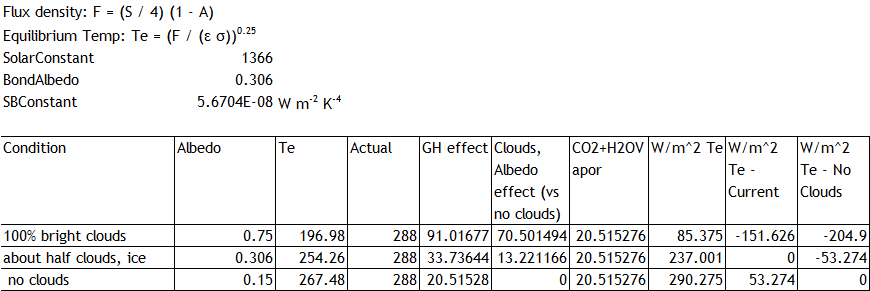
Mr Smith makes an interesting point. The albedo feedback is indeed a feedback, though IPCC and others, prompted by James Hansen, also use albedo effects as a way of artificially reducing the net anthropogenic forcing and accordingly artificially increasing climate sensitivity via an inflated feedback fraction.
Stokes,
240?
Do you not understand that 1368 W/M2 cannot have albedo subtracted and then be subject to division by four?
You would not have passed Transport of Heat and Mass at the U of M.
You keep doing this because it supports your meme, even though you know it to be false.
You need to find another way to make a living…
“240?”
The head post uses 241.2. I could change to that if you prefer.
Michael Moon April 1, 2018 at 8:46 pm
Stokes,
240?
Do you not understand that 1368 W/M2 cannot have albedo subtracted and then be subject to division by four?
You would not have passed Transport of Heat and Mass at the U of M.
Did you?
Do you understand that the albedo defines how much of that insolation is absorbed by the earth’s surface?
Do you understand that because that light is only incident vertically on the surface at one point on the surface at any given time and that you have to use trigonometry to determine the actual incident power at any point on the surface? Do you understand that the surface area of a sphere is 4 times the projected area?
Phil, do yo understand that it’s not radiation that transports the sun’s energy to the dark side of the earth? It’s convection and conduction. So you can’t divide insolation by 4. Radiation can only create twilight zones (dawn and dusk) via scattering.
Zoe Phin April 2, 2018 at 6:12 am
Phil, do yo understand that it’s not radiation that transports the sun’s energy to the dark side of the earth?
No I understand that the sun’s energy was transported to the dark side by radiation during the local day time!
Phil, exactly!
When night falls there is energy retained in solids, gases, and liquids, which slowly drain out. Thus you can’t dilute incoming solar energy by 4. The nightside is not 0, but you treat it as if it were, and dilute the day side by 2.
If no energy was retained, then the nightside would be 0K and you could pretend that the average daily temperature is a simple division by 4 of incoming radiation. But that’s not reality. You don’t get to divide new energy by 4, when old energy is still in the system.
Zoe Phin April 2, 2018 at 1:23 pm
Phil, exactly!
When night falls there is energy retained in solids, gases, and liquids, which slowly drain out. Thus you can’t dilute incoming solar energy by 4. The nightside is not 0, but you treat it as if it were, and dilute the day side by 2.
During the course of a day Global total Iin= Global total Iout
Iin*πr^2 = Iout*4πr^2
Iout=Iin/4
QED
Yet co2 emissions from the US continue to fall:
“Recent data clarify the trends causing emissions to shrink to their lowest level since 1995.
by Mike Orcutt May 6, 2014”
https://www.technologyreview.com/s/527106/how-and-why-us-greenhouse-gas-emissions-are-falling/
https://www.reuters.com/article/usa-natgas-eia-steo/update-1-u-s-carbon-emissions-seen-at-25-year-low-in-2017-idUSL1N1J311B
Whereas in China they are dramatically increasing
“Stronger Chinese economic growth will push global greenhouse gas emissions to a record high in 2017 after remaining flat for three years, dashing tentative hopes of a turning point in the world’s efforts to curb climate change.”
https://www.ft.com/content/ba4212b6-c63f-11e7-a1d2-6786f39ef675
And let’s not mention Germany…
“Higher energy demand triggered by economic growth and colder weather is likely to push up Germany’s greenhouse gas emissions again this year, energy market group AG Energiebilanzen forecast on Friday. A new rise would put Germany’s 2020 climate targets even further out of reach”
https://www.cleanenergywire.org/news/germanys-energy-use-and-emissions-likely-rise-yet-again-2017
I am trying to understand these arguments. As I see it:
1. Mid range industrial era Charney sensitivity. You mention “Net industrial-era manmade forcing to 2011 was 2.29 W m-2”. As I understand it, this is NET forcing. Which means if you change this forcing into temperature, and assume most of the temperature rise is manmade, you will get the ACTUAL temperature rise (your calculations = 0.72 K). Which is, as expected, close to the measured value of 0.75 K, if you assume, as orthodox climatology does, most of this warming is manmade. If you now calculate a feedback from this, you should obviously get a very small value because you are actually comparing almost the SAME quantity.
2. Mid range pre-industrial Charney sensitivity. You calculate the feedback fraction, f, WITHOUT any water vapor feedback. It is therefore not surprising that your temperature positive feedback estimates are very low, compared to the orthodox theory (which DO have water vapor feedback).
For starters you need to read the IPCC documents to obtain the orthodox position rather than just make it up. Both of your assumptions are untrue.
1. Yes, confirmed. In Fig. SMP.5 (not table SMP.5) from
IPCC, 2013: Summary for Policymakers. In: Climate Change 2013: The Physical Science Basis. Contribution of Working Group I to the Fifth Assessment Report of the Intergovernmental Panel on Climate Change [Stocker, T.F., D. Qin, G.-K. Plattner, M. Tignor, S.K. Allen, J. Boschung, A. Nauels, Y. Xia, V. Bex and P.M. Midgley (eds.)]. Cambridge University Press, Cambridge, United Kingdom and New York, NY, USA.
it states a Total (not Net) anthropogenic RF relative to 1750 is 2.29 W m-2. It is also stated that this is the biggest contribution to the total RF. So, within these assumptions, if you convert this RF into temperature rise you get something quite similar to measured temperature rise, which in turn implies the feedback you get from comparing these two temperatures is close to zero.
2. This is quite obvious by looking at the formulas from “Mid range pre-industrial Charney sensitivity”
Mr Calbet is broadly speaking correct. I use the term “net anthropogenic forcing” to show that the total is the sum of positivie and negative forcings.
Once again, it’s obvious
the science is not “settled”,
in fact, there is barely any
real science at all.
CO2 is a greenhouse gas that might
cause some warming, mainly at night,
in cooler drier latitudes.
Nothing unusual is visible in the
temperature record since 1940,
except that temperature history
keeps changing, thanks to smarmy
government bureaucrats !
But real science does not matter anymore,
because this subject has been taken over,
converted to a “crisis” (imaginary)
to help leftist politicians
grow government power.
If modern climate science
was real science, the skeptics
would have become the “consensus”
long ago.
1940
— Natural climate change dies
— Aerosols take over climate change
1975
— Aerosols fall out of the air
— CO2 takes over climate change
— Water vapor positive feedback is “born”
These claims are so silly
only a leftist could believe them.
My climate change blog
for people with common sense
http://www.elOnionBloggle.Blogspot.com
Mr Greene continues to use the carriage-return key with undue abandon. His comments would be more widely read, and taken more seriously, if he did not lay them out as though they were bad verses.
http://en.cnki.com.cn/Article_en/CJFDTotal-DQXK199204010.htm
https://www.nature.com/articles/35098000
http://www.pnas.org/content/114/39/10315
https://www.epa.gov/sites/production/files/2014-12/documents/incorporating_catastrophic_climate-change_into_policy_analysis.pdf