By Christopher Monckton of Brenchley
Skeptics 1, Fanatics 0. That’s the final score.
The corrected mid-range estimate of Charney sensitivity, which is equilibrium sensitivity to doubled CO2 in the air, is less than half of the official mid-range estimates that have prevailed in the past four decades. Transient sensitivity of 1.25 K and Charney sensitivity of 1.45 K are nothing like enough to worry about.
This third article answers some objections raised as a result of the first two pieces. Before I give some definitions, equations and values to provide clarity, let me make it plain that my approach is to accept – for the sake of argument only – that everything in official climatology is true except where we have discovered errors. By this acceptance solum ad argumentum, we minimize the scope for futile objections that avoid the main point, and we focus the discussion on the grave errors we have found.
Definitions
All definitions except that of temperature feedback are mainstream. I am including them in the hope of forestalling comments to the effect that there is no such thing as the greenhouse effect, or that temperatures (whether entire or delta) cannot induce feedbacks. If you are already well versed in climatology, as most readers here are, skip this section except for the definition of feedback, where climatology is at odds with mainstream feedback theory.
Greenhouse gases possess at least three atoms in their molecules and are thus capable of possessing or, under appropriate conditions, acquiring a dipole moment that causes them to oscillate in one of their vibrational modes and thus to emit heat.
Carbon dioxide (CO2), being symmetrical, does not possess a dipole moment, but acquires one in its bending vibrational mode on interacting with a near-infrared photon. To use Professor Essex’s excellent analogy, when a greenhouse gas meets a photon of the right wavelength it is turned on like a radiator, whereupon some warming must by definition occur.
The non-condensing greenhouse gases exclude water vapor.
Water vapor, the most significant greenhouse gas by quantity, is a condensing gas. All relevant changes in its atmospheric burden are treated as temperature feedbacks. Its atmospheric burden is thought to increase by 7% per Kelvin of warming in accordance with the Clausius-Clapeyron relation (Wentz 2007).
Emission temperature would obtain at the Earth’s surface if there were no non-condensing greenhouse gases or feedbacks present. Emission temperature is a function of insolation, albedo and emissivity (assumed to be unity), and of nothing else. As non-condensing greenhouse gases and feedbacks warm the atmosphere, the altitude at which the emission temperature obtains rises.
Radiative forcing (in W m–2) is an exogenous perturbation in the net (down minus up) radiative flux density at the top of the atmosphere. Forcings become warmings via –
The Planck sensitivity parameter (in K W–1 m2: Roe 2009), the quantity by which a radiative forcing is multiplied to yield the reference sensitivity. To a first approximation, it is the first derivative of the fundamental equation of radiative transfer with respect to the Earth’s emission temperature and emission flux density. Its value is thus dependent on insolation and albedo. The first derivative is the change in temperature per unit change in flux density, i.e., at today’s values 255.4 / (4 x 241.2) = 0.27 K W–1 m2. However, owing to altitudinal variation, the modeled value today is 0.31 = 3.2–1 K W–1 m2 (IPCC 2007, p. 631 fn.).
Temperature feedback (in W m–2 K–1), an additional forcing proportional to the temperature that induces it, in turn drives a feedback response (in K) that modifies the originating temperature. This definition of a feedback as a modification of a signal (not merely of a change in the input signal but also of the input signal itself) is standard in all applications of control theory except climatology, where it has been near-universally but falsely imagined that an input signal (emission temperature in the climate) does not induce a feedback, even where feedback processes are present and will modify even the tiniest change in that signal. It is this error that has misled official climatology into overestimating climate sensitivities.
Models do not implement feedback math explicitly. However, their outputs are routinely calibrated against past climate. Paper after paper incorrectly states that the entire 33 K difference between today’s surface temperature of 288 K and the emission temperature of 255 K that would prevail today in the absence of greenhouse gases or of feedbacks is driven by the directly-forced warming from the non-condensing greenhouse gases and the feedbacks induced by that warming.
For instance, Lacis (2010) says that three-quarters of the difference between emission temperature and today’s temperature is the feedback response to the non-condensing greenhouse gases: i.e, that the feedback fraction is 0.75, which, given the CMIP5 reference sensitivity of 1.1 K (Andrews 2012) would yield Charney sensitivity of 4.4 K. Sure enough, the CMIP5 models’ feedback fraction, at 0.67, is close to Lacis’ value, implying Charney sensitivity of 3.3 K. It will be proven that there is no justification whatever for mid-range estimates anything like this high. They arise solely because the models have been tuned over the decades to yield Charney sensitivities high enough to account for the entire 33 K.
- Reference sensitivity is the temperature change in response to a radiative forcing before taking feedbacks into account.
- Equilibrium sensitivity, the warming expected to occur within a policy-relevant timeframe once the climate has resettled to equilibrium after perturbation by a radiative forcing (such as doubled CO2 concentration) and after all temperature feedbacks of sub-decadal duration have aced, may be somewhat larger than –
- Transient climate sensitivity, the warming expected to occur immediately in response to a forcing. The chief reason for the difference is the delay occasioned by the vast heat-sink that is the ocean.
- Charney sensitivity, named after Dr Jule Charney, is equilibrium sensitivity to doubled CO2.
Zero-dimensional-model equation relates reference and equilibrium sensitivities or temperatures via the feedback fraction, which accounts for the entire difference between them. Control theory in all applications except climatology uses both forms of (1) and of its rearrangement, (2), but climatology has not hitherto appreciated that the right-hand form of each equation is permissible. For this reason, it has failed to accord sufficient – or in most instances any – weight to the feedback response that arises from the presence of emission temperature. As a result of this grave error, official climatology has greatly overestimated the feedback fraction and hence all transient and equilibrium climate sensitivities.

Input variables
Input variables are from official sources. Net industrial-era anthropogenic radiative forcing to 2011 was 2.29 W m–2 (IPCC 2013, table SPM.5); the Planck sensitivity parameter is 3.2–2 K W–1 m2 (IPCC 2007, p. 631 fn.); the radiative energy imbalance to 2010 was 0.59 W m–2 (Smith 2015); industrial-era warming to 2011 was 0.75 K (least-squares trend on the HadCRUT4 monthly global mean surface temperature anomalies, 1850-2011: Morice 2012); and the radiative forcing at CO2 doubling is 3.5 W m–2 (Andrews 2012); the Stefan-Boltzmann constant is 5.6704 x 10⁻⁸ W m–2 K–4 (Rybicki 1979); albedo without non-condensing greenhouse gases or feedbacks would be 0.418 (Lacis 2010); global mean surface temperature without greenhouse gases would be 252 K (ibid.); and today’s global mean surface temperature is 288.4 K (ISCCP 2016).
Mid-range industrial-era Charney sensitivity
Now for the simplest proof of small Charney sensitivity. Net industrial-era manmade forcing to 2011 was 2.29 W m–2, implying industrial-era reference warming 2.29 / 3.2 = 0.72 K. The radiative imbalance to 2010 was 0.59 W m–2. Warming has thus radiated 2.29 – 0.59 = 1.70 W m–2 (74.2%) to space. Equilibrium warming to 2011 may thus prove to have been 34.7% greater than the observed 0.75 K industrial-era warming to 2011. The feedback fraction for transient sensitivity is then f = 1 – 0.716 / 0.751 = 0.047, so that transient climate sensitivity is 1.09 / (1 – 0.047) = 1.15 K. Industrial-era f for equilibrium sensitivity is 1 – 0.716 / (0.751 x 1.347) = 0.29, implying Charney sensitivity 1.09 / (1 – 0.29) = 1.55 K.
That’s it. Charney sensitivity is less than half of the 3.3 K mid-range estimate in the CMIP3 and CMIP5 general-circulation models, distorted as they are by the long-standing misallocation of all 33 K of the difference between today’s temperature and emission temperature to greenhouse-gas forcings and consequent feedbacks.
Mid-range pre-industrial Charney sensitivity
To show how official climatology’s grave error arose, we shall study how it has been apportioning that 33 K difference between today’s temperature and emission temperature.
Lacis (2010) estimated albedo without greenhouse gases as 0.418, implying emission temperature [1364.625(1 – 0.418) / (4σ)]0.25 = 243.26 K (Stefan-Boltzmann equation, with unit emissivity). However, Lacis estimated the global mean surface temperature without non-condensing greenhouse gases as 252 K, implying a small feedback response to emission temperature, arising from melting equatorial ice and about 10% of the current atmospheric burden of water vapor. That 10% value can be obtained from the 7% per Kelvin increase in water vapor found in Wentz (2007): thus, 100 / 1.0733 = 10.7.
Global temperature in 1850 was 287.6 K. The 35.6 K difference between 287.6 and 252 K was given as 25% [8.9 K] directly-forced warming from the naturally-occurring, non-condensing greenhouse gases and 75% [26.7 K] feedback response to that greenhouse warming. However, if the feedback fraction f over Lacis’ 50-year study period were constant, for transient sensitivity f would be 1 – (243.26 + 8.9) / 287.6 = 0.123, and transient sensitivity itself would be 1.09 / (1 – 0.123) = 1.25 K. If an energy imbalance in 1850 might eventually increase that year’s temperature by 10%, then f = 1 – (243.26 + 8.9) / (287.6 x 1.1) = 0.203. Charney sensitivity would then be 1.09 / (1 – 0.203) = 1.4 K.
In Lacis, the 44.2 K difference between emission and 1850 temperatures comprises 8.7 K (3.6%) feedback response to the 243.3 K emission temperature and, since Lacis takes transient-sensitivity f = 0.75, directly-forced greenhouse warming of 8.9 K inducing 26.6 K (300%) feedback response. Thus, Lacis imagines the feedback responses to emission temperature and to direct greenhouse warming are 3.6% and 300% respectively of the underlying quantities, which is absurd. What is more, Lacis says that the feedback fraction 0.75 applies also to “current climate”, an explicit demonstration that climatology’s error leading to overstatements of equilibrium sensitivity in the models arose from its neglect of the large feedback response to emission temperature.
Our corrected method finds transient-sensitivity f a lot less that Lacis’ 0.75. It is just 0.123. Then the 44.2 K difference between 1850 temperature and emission temperature comprises 243.3 f / (1 – f) = 34.1 K feedback response to emission temperature; 8.9 K directly-forced greenhouse warming; and 8.9 f / (1 – f) = 1.2 K feedback response to direct greenhouse warming. Thus, feedback responses to emission temperature and direct greenhouse warming are identical at f / (1 – f) = 14% of the underlying quantities.
In practice, ice-melt would steadily reduce the ice-covered surface area, reducing the surface-albedo feedback and hence the overall feedback fraction, though that effect might be largely canceled by increased water vapor and cloud feedback. The assumption of a uniform feedback fraction throughout the transition from emission temperature to 1850 temperature is, therefore, not unreasonable. Other apportionments might be made: but it would not be reasonable to make apportionments anywhere close to those of Lacis or of the CMIP models.
Note how well the industrial and pre-industrial sensitivities cohere, and how very much smaller they are than official climatology’s 0.67-075. The corrected industrial-era values, just 1.25 K transient sensitivity and 1.55 K equilibrium sensitivity, necessarily follow from the stated official definitions and values. In my submission, it is no longer legitimate for official climatology to maintain that the mid-range estimate of Charney sensitivity is anything like as high as the CMIP3/CMIP5 models’ 3.3 K.
Certainty about uncertainties
What of the uncertainties in our result? Some of the official input values on which we have relied are subject to quite wide error margins. However, because our mid-range estimate of Charney sensitivity is low, occurring at the left-hand end of the rectangular-hyperbolic curve of Charney sensitivities in response to various values of the feedback fraction, the interval of plausible sensitivities is nothing like as broad as the official interval, which I shall now demonstrate to be a hilarious fiction.

The Charney report of 1979, echoed by several IPCC Assessment Reports, gives a Charney-sensitivity interval 3.0 [1.5, 4.5] K. The 2013 Fifth Assessment Report retains the bounds but no longer dares to state the mid-range estimate, for a reason that I shall now reveal.
By now it will be apparent to all that the chief uncertainty in deriving transient or equilibrium sensitivities is the value of the feedback fraction. I found it curious, therefore, that IPCC did not derive its mid-range estimate of Charney sensitivity from the mean of the bounds of the feedback fraction’s interval. The mismatch is quite striking (see below)
IPCC’s mid-range Charney sensitivity 3.0 K implies a feedback fraction 0.61, which is three times closer to the upper bound 0.74 than to the lower bound 0.23. If IPCC had derived its mid-range Charney sensitivity from a value of the feedback fraction midway between the bounds, its 3 K mid-range estimate would have fallen by an impressive 0.75 K to just 2.25 K:

How, then, did IPCC come to imagine that mid-range Charney sensitivity could be as high as 3 K? The Charney Report of 1979, the first official attempt to derive Charney sensitivity, provides a clue. On p. 9, Charney found that the interval was 2.4 [1.6, 4.5] K, implying a feedback fraction close enough to the mean of its bounds. However, by p. 16 he had decided that his eponymous interval was “in the range 1.5-4.5 K, with the most probable value near 3 K”. Why did he go for 3 K? And why did IPCC and CMIP5 remain in that ballpark for four decades? Perhaps it was because, owing to their error, they could not otherwise account for the 33 K difference between emission temperature and present-day temperature.

Be that as it may, where (a) the feedback fraction is defined as 1 minus the ratio of reference to equilibrium temperature (Eq. (2)), where (b) the mid-range value of the feedback fraction is the mean of the bounds of its interval, and where (c) the mid-range estimate of equilibrium sensitivity is twice the lower-bound estimate, the upper bound of the feedback fraction must be unity. Then the upper bound of equilibrium sensitivity will fall precisely on the singularity in the rectangular-hyperbolic response curve, and will therefore be somewhere between plus and minus infinity (see above). This is definitive evidence that the supposed Charney-sensitivity interval 3.0 [1.5, 4.5] K is nonsense, and that all attempts to ascribe a statistical confidence interval to it are likewise nonsense.
Is our mid-range estimate of Charney sensitivity reasonable?
Rud Istvan, in one of many interesting comments on the earlier articles, says Lewis & Curry (2014) found transient and equilibrium sensitivities to be 1.3 K and 1.65 K respectively, implying that Charney sensitivity is 1.25 times transient sensitivity, not 1.37 times as I calculated earlier. In that event, the feedback fraction is 1 – 0.716 / (0.751 x 1.25) = 0.237, implying Charney sensitivity 1.09 / (1 – 0.237) = 1.45 K, similar to the 1.5 K in Lewis 2015.
Rud offers the following interesting confirmatory method. In IPCC (2013), the mid-range estimates of the sub-decadal temperature feedback sum is 1.6 W m–2 K–1, since the feedbacks other than the water-vapor feedback sum to zero. Multiplying the feedback sum by the Planck parameter gives a mid-range feedback fraction 0.5 (Table 1). Note in passing that, as discussed earlier, the upper-bound feedback fraction works out at the absurd value 1.0.

Rud goes on to point out that, as several papers show, the CMIP5 models produce about half the observed rainfall, implying that the modeled water-vapor feedback is double the true value. Therefore, he says, the true feedback fraction is half the CMIP5 models’ estimate. That means 0.25, giving a Charney sensitivity of 1.09 / (1 – 0.25) = 1.45 K.
I shall let Rud Istvan have the last word:
“This is not coincidental. The ‘best’ Charney sensitivity, whether calculated using the energy budget, or observed v. modeled via Bode’s feedback fraction f, is half of the ‘best estimate’ in IPCC (2007). I agree with Christopher Monckton of Brenchley. It’s game over.”
Global warming is a multi trillion dollar carbon trading scam protected by a some very high status (climate science) liars. Arguing about the science is a complete waste of time.No one cares.
The IPCC AR1 diagram with the medieval warm period intact is all you need.
A discussion between Gavin Schmidt and Roger Pielke Senior was unable to find agreement on the most basic aspects of the so called science. No one knows.
“Christopher’s claim that the Earth’s effective radiating temperature (ERT) to outer space (around 255 K) itself causes a “feedback” makes no sense to me, because it isn’t (nor does it represent) a “forcing”. Feedbacks, by the climate definition, are only in response to forced departures from energy equilibrium.” – Dr. Roy Spencer
Got to believe in magic or game over said The Lord of the Rings
In reply to “Dr Strangelove”, the simple answer to Dr Spencer is that, with respect, a feedback is denominated in Watts per square meter per Kelvin. It is thus a forcing proportional to the temperature (or temperature change, which is also a temperature) that induced it. Dr Spencer is right that the definition of a “feedback” in climatology has been artfully drawn so as to exclude the possibility of a feedback response to a temperature that is not a temperature change, but the feedback mathematics, as well as our test rigs, demonstrate quite clearly that a feedback will respond not only to an amplification of a pre-existing temperature but also to that pre-existing temperature itself.
“Equilibrium sensitivity, the warming expected to occur within a policy-relevant timeframe once the climate has resettled to equilibrium after perturbation by a radiative forcing (such as doubled CO2 concentration) and after all temperature feedbacks of sub-decadal duration have aced, may be somewhat larger than”
Should be “acted” I believe.
WUWT at its finest. Glad to have made a small confirmatory contribution to such an important paper and finding. Hoghest regards to CMoB.
+10 in the Hoghest…er highest.
Three cheers for Lord Monckton. Hip hip….
. . . hurrah. . .
… and renewed thanks to Rud Istvan for his interesting and helpful comments, and to all others who have enjoyed our account of our work.
Clarification, from a previous thread, now closed.
ALLAN MACRAE March 22, 2018 at 1:26 pm
https://wattsupwiththat.com/2018/03/19/global-warming-on-trial-and-the-elementary-error-of-physics-that-caused-the-global-warming-scare/comment-page-1/#comment-2772149
Lord Monckton wrote below:
“The deliberately cautious approach we took ad argumentum in preparing our paper and our brief was that all warming after 1850 was anthropogenic.”
OK – I thought so,
Therefore the ANSWERS to my questions (I think) are:
Questions:
a. Is your estimate of ECS = ~+1.2C/(2xCO2) truly an average value, or is it an upper bound estimate (for example, assuming no natural variation)? UPPER BOUND
b. If in fact a significant part of the observed warming is later proven to be natural variation, does your ECS estimate decline below 1.2? YES, SIGNIFICANTLY.
c. If CO2 continues to increase, and significant global cooling commences, what impact does that have on your estimate of ECS? IT BECOMES MUCH LOWER, OR COULD EVEN BE NEGATIVE.
____________________________
Monckton of Brenchley March 24, 2018 at 1:11 pm
https://wattsupwiththat.com/2018/03/19/global-warming-on-trial-and-the-elementary-error-of-physics-that-caused-the-global-warming-scare/comment-page-1/#comment-2773812
I’m with Mr Macrae on a and b, but not on c. Whatever influence natural factors have on temperature, up or down, we find Charney sensitivity (i.e. equilibrium sensitivity to doubled CO2 in the air) to be positive. It is, of course, possible that, since we find Charney sensitivity to be only 1.2 K, and since solar activity is declining quite noticeably, after a sufficient period of lessened solar activity there might be net cooling. But, bearing in mind Leif Svalgaard’s estimates that the solar decline may not be as severe in the next cycle as in this one, I wouldn’t hold my breath. On balance, I expect around 1.2 K warming this century, on the assumption that there are no significant efforts to abate CO2 emissions.
Of course, if our result is correct, there will be no need to abate CO2 emissions. One less line-item of massive expenditure to unbalance the books of the nations of the West.
___________________________
Allan MacRae again:
Thank you Lord Monckton for your reply, which I just saw today. We are agreed on my points a and b, so let’s discuss point c:
My point c was a mathematical observation – that IF significant global cooling occurs and since your assumption (ad argumentum) was that all temperature change was driven by CO2 (which probably would continue to increase, albeit at a lower rate), then your calculation of Chaney sensitivity for this cooling period could indeed be negative. In fact, I made a rough calculation of this Charney sensitivity (using the same assumptions as Christy and McNider 2017) for the cooling period from ~1940 to ~1977 and it was MINUS 1C/(2xCO2).
Your further comment about point c is that you believe that “On balance, I expect around 1.2 K warming this century, on the assumption that there are no significant efforts to abate CO2 emissions.”
Although I have great respect for Dr. Svalgaard, my opinion is that naturally-caused global cooling will commence sometime within 2020-2030, as I (we) predicted in an article published in 2002. My cooling prediction is based on the probability of two consecutive weak solar cycles SC24 and SC25, and my opinion that the impact of the integral of solar activity on climate is greater than expected by many respected solar scientists.
I hope that you are correct about future warming and I am wrong about future cooling, because humanity and the environment both suffer during cooling periods.
Finally, I fully agree with your final statement:
“Of course, if our result is correct, there will be no need to abate CO2 emissions. One less line-item of massive expenditure to unbalance the books of the nations of the West.”
… and I am confident that Charney sensitivity does NOT exceed 1.2C/(2xCO2).
Best personal regards, Allan MacRae. P.Eng.
It’s probably wise for all of us to realize that the politicians will move on once AGW is revealed to be nonsense. Unfortunately, the actual people and forces that created the monster will always be with us.
Science may be safer for a time but civilization itself will always be at risk from those for whom truth is relative.
John Harmsworth wrote:
“It’s probably wise for all of us to realize that the politicians will move on once AGW is revealed to be nonsense.”
True John, and I suggest the politicians are already moving on. Global warming alarmism is a clear hypothesis that states “increased atmospheric CO2 will cause dangerous global warming”. As such, it can be disproved and it already has been disproved by credible evidence of very low TCS and ECS.
So they moved the goalposts to “climate change”, which is an unclear hypothesis that cannot be disproved – it is whatever the alarmists say it is – it is in fact unscientific nonsense, the prattling of imbeciles.
More goalpost moving, now the hypo is “sustainability”. Again, more unscientific nonsense, it is whatever the alarmists claim it is, to frighten the gullible and fearful, who live in a constant climate of fear.
In response to Mr MacRae, if internal variability or a decline in solar activity causes cooling when otherwise warming would be expected, that does not in any way alter the calculation of equilibrium sensitivity, which assumes that the climate would otherwise be in a steady state.
Agreed Sir, but if you ASSUME (ad argumentum) that ALL temperature change is due to increasing atm. CO2, and CO2 increases while temperature falls, you will calculate a negative value for climate sensitivity.
This does not mean that climate sensitivity is truly negative; rather it is an outcome of your input assumption.
Mr MacRae has not understood the matter. If there is a period of cooling, then our method of verifying our original result will show a somewhat lower climate sensitivity than formerly, but that is all.
@ur momisugly Dr. Strangelove
I think I already corrected the good doctor on this:
It does not matter how one calls it, it matters what the physical process is.
It is all a matter of energy. Energy that is an external input into the system and any internal feedback mechanisms.
Any process that does react to energy must react to both newly added extra energy as well as energy already in the system.
I do not care what you call forcing, be it the radiation input from the sun or as a result of the creation of CO2. Things like any internal feedback (using the official physics term) is also called a feedback by climate science. Anyways how you call it does not matter. What matters is physics, which means energy, radiation, pressure, evaporation etc etc.
Because it is about energy a starting point of 0 K makes sense. Any level above that means there is energy in the system and we do not discriminate between energy (already there) and energy (inputted from outside) and energy (lost to the outside),
If you believe that any process which reacts to energy (say evaporation) can or does discriminate between energy already there and energy recently added to the same system, then you believe in magic.
Quite so.
In reply to “Dr Strangelove”, Mr Titulaer is correct. Like it or not, climatology measures feedbacks in Watts per square meter per Kelvin (Kelvin being the measure of temperature). Therefore, temperatrue feedbacks in conventional climatology are feedbacks to temperature. If “Dr Strangelove” does not like that, he should take the matter up with the IPCC secretariat (secretariat@IPCC.ch), and not with me. I have stated explicitly, in the head posting, that for the sake of argument I am accepting all of official climatology except where I can prove that official climatology is in error.
“It does not matter how one calls it, it matters what the physical process is. It is all a matter of energy.”
Then you must agree with me and disagree with The Lord of the Rings. Temperature is not energy, it is matter’s response to heat energy. The feedback equation should use energy flux (W/m^2). There’s no temperature change in latent heat flow. You can double both the energy inflow and outflow without changing temperature because it’s in thermal equilibrium. Temperature and energy are not the same thing.
“Dr Strangelove” continues to argue not against me but against official climatology, which, whether he likes it or not, denominates feedbacks in Watts per square meter of the originating temperature (or temperature change). There is really no point in his trying to persuade me otherwise, because for the purposes of the present exercise I am accepting all of official climatology, right or wrong, for the sake of argument (but without warranty) except where I can demonstrate formally that official climatology is incorrect.
if “Dr Strangelove” wants to recalculate everything in Watts per square meter per Watt per square meter, or in skerfuffles per gloopazoid, that is a matter for him. But climatology uses Watts per square meter per Kelvin, so that is what we have used in the head posting. Get over it, and move on.
Yes indeed, the energies are in W m-2. And temperature and energy are of course not the same thing.
But they (IPCC et.al.) decided to formulate their feedback formulas in W m-2 K-1.
As in ΔTs=−R/λ where R is a ‘forcing’ in W m-2 and λ the ‘climate feedback’ parameter (in W m-2 K-1 obviously).
Strictly speaking it is just that parameter which is in W m-2 K-1, defined that way in order to get K in the answer. In the mean time any actual physical feedback must work in the real energy world (in W m-2).
At some point one has to convert back to be able to talk to the climate scientists in their world (and they like to hear things in temperatures).
LOL, they live in a different world! So that’s what you meant by magic? 🙂
Joking aside, I do not mind that they (try to) convert back into what it means in ΔT, i.e. in Kelvin.
That doesn’t mean that feedback in a system suddenly behaves differently. So there we do seem to agree.
[ And I agree that some of the IPCC (et.al.) choices may be a bit unfortunate, but I think the idea in this exercise is to simply keep everything as similar as to how IPCC (et.al.) defined it. ]
Temperature is a value placed on the level of molecular excitement of matter. Molecular excitement of matter is caused by …?
Personally, I think there is a huge problem relating W/M^2 to temperature. The Thermosphere is “hot” yet an astronaut would freeze to death and water would freeze in it. The lower atmosphere is saturated with H2O relative to CO2, so CO2’s impact is irrelevant. CO2 is the equivalent of taking an aspirin for pain after taking a huge shot of morphine. It is meaningless. Glaciers wouldn’t melt in the Thermosphere where CO2 is the dominant GHG.
Isolating the Contribution of CO2 on Atmospheric Temperature
In any serious scientific experiment, efforts are made to “control” for as many exogenous factors as possible. The whole purpose is to isolate the impact of the independent variable on the dependent variable. ΔWeightloss = ΔCaloric Intake + ΔExercise + ΔBase Metabolism + error. To minimize the error of the model (maximize explanatory power), variables outside … Continue reading
https://co2islife.wordpress.com/2018/02/14/isolating-the-contribution-of-co2-on-atmospheric-co2/
Like CO2islife, I too have many personal opinions about the climate. But, in the present research, we have taken the deliberate decision to accept, for the sake of argument, all of official climatology except what we can disprove. If CO2islife does not like the fact that official climatology expresses a feedback as a forcing proportional to the temperature that induces it, he should take the matter up not with me but with official climatology.
Lord Monckton, please don’t take my comments as critical. I greatly appreciate and admire your work. You are doing Yeoman’s work. My one concern is that Climate Alarmists can produce far far far more garbage than you and an entire team of researchers could debunk.Truth doesn’t matter to the Climate Alarmists, they are focused on Sophistry, not Science. Their objective is to produce plausible arguments that will win in the arena of public opinion and politics. Climate alarmists don’t rely on classical science and the scientific method, reproducibility, and experimentation, they rely on computer models, “theories” and “peer review.” How can you defeat arguments like “consensus” and “peer review” when the system is rigged? They just get Michael Mann to claim some nonsense, state that it is peer-reviewed, and therefore the “consensus.” That is science by authority, it is anti-science. If you look at the trial in San Francisco, pay attention to what the Judge Focused on. He didn’t focus on the minutia, he focused on the big pictures CO2 can’t explain. In my opinion, there is no way these highly scientific arguments would ever work in a court of law, they, in fact, work to confuse the issue and play into the climate alarmists strategy. By directing all the attention at the minutia, it opens the door for the Climate Alarmists to tie up the trial arguing over points that even if won, won’t change the outcome of the trial. Winning battles over minutia will end up losing the war. Remember in real science you only need to find one experiment to unseat the status quo, you only need one example to reject the null. The problem is, the judge and jury need to be able to understand that one experiment. That is why I focus on simple examples that the Climate Alarmists can’t explain. 1) Mt Kilimanjaro Glacier is disappearing, but there is no evidence of warming at that altitude and location. The Climategate emails expose the Climate Alarmists know it is due to sublimation, not CO2. Simply ask the Judge to have the CLimate Alarmist explain how a glacier can “MELT” is sub-zero temperatures. 2) The oceans are warming, CO2’s only mechanism by which to affect climate change is through thermalizing LWIR between 13 and 18 microns. Those wavelengths won’t warm H2O 3) MODTRAN demonstrates that CO2 doesn’t impact the energy balance until H2O starts to precipitate out at about 3 km altitude.
Once again, I greatly appreciate your efforts and admire your work. My only concern is that with limited time and resources, the climate alarmists can easily keep people distracted from the big picture by arguing over the minutia that even if they admit they are wrong on, they still win the trial.
Sea Level Sophistry In San Francisco; Climate Alarmists are Playing the Judge as a Fool
Reading the California vs. Exxon Lawsuit I had to laugh at all the stereotypical liberal dog whistles/Code Words. It reads more like campaign slogans than a court document. Global Warming, of course, is racist and will impact blacks, women and Hispanics worst. It is as if the 500 Women Scientists wrote it, complete with every virtue signaling non-relevant term … Continue reading
https://co2islife.wordpress.com/2018/03/29/sea-level-sophistry-in-san-francisco-climate-alarmists-are-playing-the-judge-as-a-fool/
Oil Companies Don’t Produce CO2, Car and Truck Drivers Do
Reminiscent of the “Guns Don’t Kill People, People Kill People” argument, the SF Judge Alsup presiding over CA vs. Big Oil Lawsuit asked a very interesting, and potentially, very damaging question for either the plaintiff or society at large. In the document titled: Case 3:17-cv-06012-WHA Document 161 Filed 03/27/18, the judge asks: If plaintiffs’ theory is correct, why wouldn’t … Continue reading
https://co2islife.wordpress.com/2018/03/28/oil-companies-dont-produce-co2-car-and-truck-drivers-do/
Climate Sophistry In San Francisco; Half-Truths are Twice the Lie
Thanks for Anthony Watts and Willie Soon over at WUWT, we now have the San Francisco Court Documents. My immediate thought was how short and concise the defense’s document was–Click Here and understand the issue–, compared to the prosecution’s–Click — and–Click Here and understand the issues. People that truly understand issues can better simplify the … Continue reading
https://co2islife.wordpress.com/2018/03/24/sophistry-in-san-francisco-half-truths-are-twice-the-lie/
Climate “Science” on Trial; The Criminal Case Against the Alarmists
I am not a climate “scientist.” I don’t have a degree in “climatology.” I’ve never stepped foot through the doors of NOAA, NASA GISS or HadCRUT. I am not an expert on the climate. Therefore I should not be able to write an article today that will prove 100% correct 10 years in the future, … Continue reading
https://co2islife.wordpress.com/2017/02/21/climate-science-on-trial-the-criminal-case-against-the-alarmists/
Lord Mockton, here is an example of the power of the KISS Concept:
San Francisco Judge Demonstrated a Real Understanding of Science; Vindicates KISS approach to Fighting Climate Alarmism
Unlike other skeptical climate change blogs that focus on the minutia of scientific publications, here at CO2isLife we focus on finding ways to communicate the issue in a down to earth understandable manner. To us, the best way to fight this issue isn’t with countless scientific publications, it is to simply find the best “smoking … Continue reading
https://co2islife.wordpress.com/2018/03/22/san-francisco-judge-demonstrated-a-real-understanding-of-science-vindicates-co2islife/
In response to CO2islife, I was brought up to understand that that which is objectively true must take precedence over that which is socially convenient, politically expedient or financially profitable. One cannot speak the truth unless one can first seek the truth. Difficult though it is to seek the truth about climate sensitivity – just look at the vicious manner in which those of us who have dared to do so have been publicly humiliated and vilified – we are not discouraged.
If our result is correct – and nothing in these three long threads has done anything other than nibble at the edges – then it has two merits. First, it is a proven result, verified by several methods. It is something that will eventually pass peer review and be published in a leading climate journal. We know that that will be a struggle. We know that we face bitterly hostile vested interests. Already, one of our co-authors has been suspended from his university on a trumped-up charge because the vice-chancellor got to hear of our paper. Secondly, ours is a simple result, which anyone with sufficient open-mindedness and diligence can understand. Therein lies not its weakness but its power. Though there is a feeling that climatology is too specialist to be left to anyone except those who have certificates to prove that they have received appropriate Socialist training in the subject, we can demonstrate that a simple argument refutes all the complexity. If we are right, then that is the end, scientifically speaking. There will not be all that much CO2-driven warming, and that will be that.
co2is life, you are correct in your analysis. MoB is a ‘saint’ hoping to die gloriously , cheered on by his supporters,
However in the real world of power, money and politics the ‘winners’ are those who produce the easy slogan to win over the masses. Unfortunately the warmists dominate all the mass media and no-one hears the objections.
The only way this will be resolved is the painful way of real energy shortages, electricity black-outs, or some very simple repudiation of warmism that the great unwashed take to their hearts.
Personally I think you can drive an omnibus through MoB’s logic, so this attempt isn’t the second of those. So we are still ‘hoping’ for real disruptions to electricity supply in one of the world’s biggest economies. Best bet is the UK at the moment.
In response to the sneering “jim”, my sole purpose in intervening in the climate debate is to seek the truth and then to speak it, as best I see it. I am not deterred by the malevolent attacks of the totalitarians. I am not put off by the notion that no one will listen. I am unmoved by the idea that governments, banks, oil companies, media, wind-farm boondogglers and all manner of other special vested interests are profiteering so mightily from this scam that they will not give in to the truth. The truth will prevail.
I’m reminded of my passionate, logical rebuttals to the crazy-making nonsense of my former husband, before I recognized his malignant narcissism. Sheer futility.
Sounds like my ex, too.
This could be an infinite thread and a textbook example of feedback!
In warfare we have a term called bouncing the rubble. It is kin to killing everything and sowing with salt. Nuking from orbit to make sure. Well, even though you have a lot of bombs and shells left and might as well
use them up sometimes it is okay to invoke the mercy rule. But in this case it seems to be a nightmare where a mythical beast will not die no matter how many mortal wounds it suffers. We have great heros
taking turns whacking away at the thing for decades. Lord Monckton, as an awestruck observer on the
sidelines, I note you have once again put in some mighty whacks. But, I fear the game is not over.
We are up against greed, evil, ignorance, and the quest of many to have power over others. They will continue
even from under the ice.
In reply to Snowsnake, one should never despair of seeking or seeking the truth on the ground that those in high office do not want to hear it. If our result is right, it is simple enough for anyone with high-school math to understand. So far, no one has landed a blow against our central point, which is that temperature feedbacks respond to emission temperature as well as to any greenhouse-gas enhancement of it and, therefore, the feedback fraction is a lot smaller than had been thought, and, therefore, climate sensitivity is less than half of the current official central estimate.
As we’re told the Sahara desert is greening, that would mean there is more water to support plant life.
If green decorative plants replaced living green plants that require water, the surface will become hotter. How can it be said water is a positive feedback? So called “runaway” greenhouse effect is not possible from my POV.
Negative feedback rules. Convection cools.
Actually, plants use less water with higher concentrations of atmospheric CO2. Their stomata can acquire the needed CO2 more rapidly, so the stomata need not open as wide or for as long as they do in lower CO2 concentrations, meaning that they lose less water. So plants in arid that receive higher doses of CO2 are better suited to efficiently use the limited water that is available to them.
My point was that dark “fake” vegetation will absorb more radiation causing the surface to warm whereas real live vegetation requiring water will cool the surface. There’s a reason why temperatures in the tropics at the same latitude as a desert location are cooler despite having a higher water vapor content. In the daytime convection removes the heat via water vapor much more effectively than radiation. Then at night the desert gets very cold in comparison to the tropics.
Water cools and warms, but cannot cause a runaway greenhouse effect.
Gator March 30, 2018 at 9:46 am
Actually, plants use less water with higher concentrations of atmospheric CO2. Their stomata can acquire the needed CO2 more rapidly, so the stomata need not open as wide or for as long as they do in lower CO2 concentrations, meaning that they lose less water. So plants in arid that receive higher doses of CO2 are better suited to efficiently use the limited water that is available to them.
If they’re C3 plants having their stomata closed will mean a higher O2 concentration inside the leaf so a higher level of photorespiration which will mean a less efficient production of carbohydrates
Monckton of Brenchley,
I do wish that you would pay more attention to the detail of the number of significant figures for your listed input variables, and the attendant error bars, and follow through with the justifiable number of significant figures in the consequent output.
As an example of my reason for making the request, your are inconsistent in reporting the Charney sensitivity, sometimes reporting two significant figures to the right of the decimal point, and at other times only showing one when two would be justified. If you do not have an eye for such detail, please find a reviewer who does.
Clyde – Some people might find your comment relevant. I suggest that it is not.
ALLAN MACRAE,
OK, so I know where you stand. How about sharing with me and others exactly why you do not find my comment relevant. If you have no reason, then I will consider your comment irrelevant.
Ever smaller numbers are only relevant to the extent that they are accurate in reality, not just as calculations. As they are applied subsequently in equations, their importance may increase or diminish. In this case they have a miniscule effect on real world temperatures. I estimate 0.0C.
Mr Spencer may, perhaps, be unfamiliar with the convention that smallish changes in temperature are denominated in units of one-twentieth of a Kelvin.
cAGW started at the beginning of the Cretinaceous Period or the Hubrisoscene 🙂
Earlier today, March 30, 2018 at 7:29 AM, Joe Born wrote a comment that began with: “I wouldn’t get too hung up in the feedback angle.”
I checked Roy Spencer’s blog ( http://www.drroyspencer.com/ )and read through those postings. Which by the way are very interesting. That brings me to the comment I want to make. Roy Spencer and Joe Born are both indicating that the feedback from the climate perspective does not work the way it is presented by Monckton.
Dr. Spencer wrote, “The amount of surface temperature change in response to that energy imbalance is, by definition, the climate sensitivity, which in turn depends upon feedback components. … Feedback is just a convenient term that quantifies the proportionality between an imposed energy imbalance and the resulting temperature change response, …
Feedbacks, by the climate definition, are only in response to forced departures from energy equilibrium.”
This raises a couple of questions. Is it true that the earth ever have a true energy equilibrium? How does the climate determine what is a forced departure from energy equilibrium such that the climate knows that at this point, we now apply FEEDBACK. In other words, the earth is sitting at some magical equilibrium point. CO2 increases and then and only then does feedback kick in to make a difference.
If hypothetically conditions stopped changing (CO2/Methane/no volcanoes/Solar stayed the same, ocean currents didn’t vary) and the earth reached an “equilibrium” temperature, then at whatever temperature that was, it would ALREADY incorporate all existing feedbacks due to the physics of the coupled atmosphere and ocean system.
Dr. Spencer writes, “Christopher’s claim that the Earth’s effective radiating temperature (ERT) to outer space (around 255 K) itself causes a “feedback” makes no sense to me, because it isn’t (nor does it represent) a “forcing”.
Feedback does not depend on a forcing. It does not start or stop arbitrarily at any particular temperature.
Dr. Spencer writes, “Feedbacks, by the climate definition, are only in response to forced departures from energy equilibrium.”
Monckton’s paper indirectly invalidates that definition. The definition is nonsensical from a physics point of view and should not be used (IMO of course).
A doubling of CO2 is typically calculated to have a radiative impact of ~ 3.7 W / m2 (each time CO2 is doubled). This radiative change will impact the temperatures including ocean and planet surface. If there were no feedback, this change is usually estimated to be around 1 to 1.2 K. But the physics of the coupled atmosphere and ocean system create a net feedback. The feedback (f) could then by used to multiply the temperature of 1 to 1.2 K. A negative feedback in this case would be an (f) less than 1. Once the feedback is added to the forcing from a doubling of CO2, it is the Charney sensitivity (or equilibrium sensitivity to doubled CO2).
The methods used in climate models to calculate past and future feedback and to derive the Charney sensitivity (see Monckton’s examples) assume feedback arbitrarily kicks in at 255 K.
But for calculating feedback, the climate modelers can’t assume that feedback arbitrarily kicks in at any particular temperatures. Feedback exists due to the physics of the existing coupled atmosphere and ocean system. It does not kick in or end at an arbitrary temperature.
Yep.
Let me make it simple. Radiation is always operating. And there are other factors.
CMoB’s analysis deals with the calculation of climate sensitivity from a starting point that that accepts the forcing premise of mainstream climate science. I believe the flaws in that viewpoint are far more fundamental and pervasive but Lord Monckton has chosen to engage the enemy on their own ground and believes he has delivered a fatal blow. Time will tell if the vampire hydra is actually finished. They might already be planning to change the name to climate sameness and start telling us how that will destroy us. I blame Marx.
As commented on the previous Monckton post. Roy is correct about the climate definition of feedback. It is used implicitly in the CMIP5 models, where for example delta CO2 forcing causes delta warming causes delta water vapor causes delta water vapor feedback, and so forth, producing eventually an emergent model ECS.These models provably run hot, see for example Christy’s 29 March 2017 congressional testimony. So their ECS is by definition suspect.
CMoB’s reply to Spencer can be summarized as just two points. First, the emergent model ECS must still correspond to the feedback circuit Bode equivalent result when using the data also inout to models. Second, when doing that circuit equivalent analysis, you must use the Bode circuit feedback definition. When one does, the result is ~1.45 not 3 or 3.3. Hence the fundamental error.
In a sense both Roy and CMoB were right at Roys blog. Difference of perspective. But when using Bode analysis, only one of those perspectives is correct—and it isn’t Roys.
The approach of this post importantly avoids having to diagnose how and why the models run hot. See my guest posts The Trouble with Climate Models and Why Models run Hot for plausible thoughts on that. In short computational intractability forces parameterization whose necessary tuning to best hindcast drags in the attribution problem. Put more specifically, cloud feedback ismobservationally zero (the actual resuotmof Dessler 2010b), not positive as in models, and the modeled water vapor feedback is high by a factor of about 2 because convection cells (WEs Tstorm effects) have to be parameterized. The indirect evidence for this is observed versus modeld precipitation. But the warmunists battle the dissecting models approach and control all the supercomputer ammo.pwesonally, almost no nonspecialist or nonmathematician could follow. Pretty smart people at Lucia’s got model partial differentials wrong a while ago, whichnis evidence that directly attacking model internals is not a winner.
directly attacking model internals is not a winner.
==========
the more complex a model, the more likely it is wrong.
Murphy’s Laws of Programming
Every non trivial program has at least one bug
The subtlest bugs cause the greatest damage and problems.
The chances of a program doing what it’s supposed to do is inversely proportional to the number of lines of code used to write it.
Most computer errors can be attributed to a similar problem – a screw loose behind the keyboard.
ristvan, I did go back and read your two posts (“The Trouble with Models” and “Why Models Run Hot”) and recommend those (don’t know how I missed them)! Also, do I recall that the models have a problem with high number of iterations and rounding that introduce more error?
I do have problems following the intricacies of the arguments in this thread (remember: just a biologist) but I do have respect for the stepwise logic of CMoB’s latest posts.
“Second, when doing that circuit equivalent analysis, you must use the Bode circuit feedback definition. When one does, the result is ~1.45 not 3 or 3.3. “
As I have shown here, the involvement of feedback in the ECS calculation is entirely illusory. It cancels out. The arithmetic has nothing to do with feedback, but is a far more primitive simple division of warming by forcing, with an arbitrary fudge factor. Here is the spreadsheet again:
JRF, many thanks. Any return on a relatively large investment is always appreciated.
Mr Stokes comes to the unremarkable conclusion that, when deriving either transient or equilibrium sensitivity from estimated net anthropogenic forcing and observed temperature change over a given period, one does not need to take feedback into account at all.
But the models, trained as they are to explain the 32 K difference between temperature in 1850 and emission temperature by attributing the entire 32 K to greenhouse forcings and feedbacks, are programmed in such a way as to predict far more warming than has occurred or will occur.
We began our research by deriving the feedback fraction theoretically by reference to the pre-anthropogenic period. We discovered that climatology had made the large error of assuming that feedback processes that respond even to the tiniest increase in emission temperature do not respond to emission temperature itself. Since feedback processes must and do respond to emission temperature, the feedback response to the presence of the naturally-occurring, non-condensing greenhouse gases is necessarily a great deal smaller than had previously been thought.
Our reason for doing the industrial-era calculation was to derive some estimate of equilibrium sensitivity empirically, to verify the result given by our theoretical calculation. Since neither individual temperature feedbacks nor their sum can be directly measured, or distinguished by measurement either from each other or from the temperatures or forced temperature changes that induced them, it ought to be blindingly obvious that there was no way of verifying our theoretical result empirically on the basis of knowing what the feedback sum was.
Instead, in our calculation in the head posting, we derived the industrialk-era feedback fraction from the observed temperature change and the latest value of the observed energy imbalance. That fraction is appreciably larger than the pre-industrial feedback fraction, suggesting the possibility either that there is considerable uncertainty in the ARGO bathythermograph measurements or that some element in industrial-era warming is natural, or both.
But it is good news that Mr Stokes’ confirmatory calculation demonstrates equilibrium sensitivity to be of order 1.6 K, and not the 3.3 K that is the models’ current mid-range estimate.
BobG is right. A feedback process, denominated in Watts per square meter per Kelvin of the temperature that induced it, does not discriminate between a pre-existing temperature and a subsequent increase in temperature. It acts in response first to one and then also to the other. The official climatological definition of feedback is, to this extent, false.
CMoB,
Many thanks for the additional illustrations and examples presented in the article above. Along with the ‘parry and riposte’ comments, greater clarity is provided for your mathematical arguments. Using the IPCC accepted ‘rules and regulations’ for the basis of your argument, you have truly shown the CAGW proponents ‘the fundamental error of their ways’!
Should your team’s arguments, embedded in your amicus brief to “People of California v. British Petroleum plc. et.al.”, be legally validated and precedent set, the Trillion dollar industry of Catastrophic Anthropogenic Global Warming is lawfully and scientifically demonstrated to be without merit.
Many thanks to JMac for his kind words. I’m not holding my breath for the California process to bounce in our favor: amici curiae are vulnerable in the U.S. system because they can be (and in the present case already have been) attacked by the parties without any formal opportunity to respond. However, our central finding that the emission temperature induces a temperature feedback, and that the temperature feedback to the presence of the naturally-occurring, noncondensing greenhouse gases is accordingly a lot smaller than previously imagined, greatly reducing climate sensitivity, is not easy to overthrow. The virtue of submitting our brief to the court is that experts from right at the heart of the climate community will have to look at our idea. They will scoff, but they will realize in the end that we are very much closer to the truth than they.
Christopher’s claim that the Earth’s effective radiating temperature (ERT) to outer space (around 255 K) itself causes a “feedback” makes no sense to me, because it isn’t (nor does it represent) a “forcing”. Feedbacks, by the climate definition, are only in response to forced departures from energy equilibrium.” – Dr. Roy Spencer
===============
The equilibrium temperature of the Earth is not 255 K. The Earth’s equilibrium temperature is slightly above 0 K, due to internal radioactive decay. It is ONLY after you add the Sun and CBR dues the Earth’s temperature rise to 255 K.
Thus, the Sun and CBR represent nearly 255 K of total forcing over what the Earth’s equilibrium temperature would be otherwise in space. The problem MB has pointed out is that Climatology does not consider this 255 K of forcing in its calculations for CO2 sensitivity.
A change in CO2 creates a change in temperature. It is this change in temperature, not the change in CO2, that changes the amount of water vapor in the atmosphere, which further affects the temperature.
However, in physics, a change in temperature is a change in temperature, regardless of source. Thus, the nearly 255K of temperature changed due to the Sun and CBR as compared to empty space also must have changed the amount of water vapor in the atmosphere, which also must further affect the temperature.
What MB has demonstrated is that this change in temperature due to the change in water vapor due to the warming of the Earth from 0 K to to 255 K has not been properly accounted for by Climatology.
“The problem MB has pointed out is that Climatology does not consider this 255 K of forcing in its calculations for CO2 sensitivity.”
The problem of MB that Climatology knows is 255 K is not a forcing nor an energy flow that should be considered in calculations for CO2 sensitivity.
“Consider the earth’s temperature. This can be converted to watts/meter squared. Since the earth is finite, the area is in meter squared, thus the total power represented by the earth’s temperature is given as watts.”
Why do you substitute temperature for power? Just use power because their relationship is non-linear. When you use temperature instead of power, the math and physics are wrong.
Climate sensitivity* is a general property of the climate system. A change in surface air temperature (ΔTs) correspondes to a change in radiative forcing (RF) and is therefore, expressed in units of °C/(W/m2).
For this to be useful, the measure must be independent of the nature of the forcing (e.g. from greenhouse gases or solar variation); to first order this is indeed found to be so.
*According to Wikipedia 😉
I explained this before if The Lord was paying attention. The formula for feedback factor in climatology uses CHANGE in temperature, not absolute temperature. Now if he wished to use the amplifier feedback equation, then use energy flux, not absolute temperature.
“Dr Strangelove” should do the math, as Mr Stokes has suggested. Take an input signal of 255 K. Set the gain block to unity, i.e. no amplification from the presence of any non-condensing greenhouse gases. Set the feedback block to, say, 0.08 for the feedback fraction. Then, using the version of the zero-dimensional-model equation that is customary in climatology, the output signal is 255 / (1 – 0.08). Now, is that still 255 K? No, of course not. it’s 277 K. So where did the extra 22 K of temperature come from? Answer: It came from the feedback response to that initial temperature. If you cannot see this at once, simply change the value of the input signal from 255 K to some other value, and notice how the output signal changes with it.
The head posting already specifically refers to the point that official climatology has mistakenly defined a temperature feedback as a feedback only to a change in temperature. That definition is incompatible with the truth, as one can see from working through the above simple equation. If “Dr Strangelove” wishes to add something to the discussion, let him provide some sort of rational, scientific or mathematical argument in support of official climatology’s definition, rather than merely restating it as though it were some sort of immovable totalitarian Party Line.
Sir, I found my error in regards to IR at 15 micro. Thanks again for your input.
I withdraw my comment about it not having sufficient engery.
Dr Strangelove continues to imagine that feedbacks should be denominated in units other than Watts per square meter per Kelvin of the temperature that induced them. If so, his complaint should be addressed not to me but to official climatology.
To complete the op amp analogy:
Consider the earth’s temperature. This can be converted to watts/meter squared. Since the earth is finite, the area is in meter squared, thus the total power represented by the earth’s temperature is given as watts.
Consider an amp with a rated capacity of 1000 watt for simplicity. The amplifier has DC and AC continuity. Nothing has been added to filter out either signal.
Adjust the gain on the amp to 1 and the feedback to 0. Now apply 255 watts at the input. This represents our 255 K temperature due the Sun, CBR and internal radioactive decay. We will see 255 watts at the output.
Now adjust the feedback so that we see 10% of the output power fed back into the input. This will increase the total power at the input to 255 + 25.5 = 280.5 watts. This will increase the output to 280.5 watts. However, 10% feedback will thus further increase our input to 255 + 25.5 + 2.55 = 282.5 watts. This process will repeat in an infinite sum until our total power at the output = 255 input + 28.3 feedback.
Now remove the signal at the input and the output and feedback will drop to 0 watts. Now re-apply the 255 watts to the input and the feedback will increase to 28.3 watts and the output to 283.3 watts.
As can be seen, when the input power is constant, the feedback power is constant. When the input power changes, the feedback power changes.
Ferd –
I would quibble that an op-amp rated at 1000 watts is hard to envision, and more to the point, it is voltage (not power) that is amplified in such an illustration, so allow me to suggest an input voltage of 255 millivolts (mV). You are quite correct that with 10% feedback the output ends up at 283.33333333….
In the analog case, the “convergence” is essentially instantaneous. What you suggest, an intermediate step of 255+23.5 = 280.5 is essentially the first iteration of a discrete-time view. The next iteration is 255+28.05 = 283.05, and the next ones 283.305 (math error in what you wrote?), 283.3305, . . . 283.3333333….
In fact, the analog case as the limit of a discrete-time case is basically the way I look at it:
http://electronotes.netfirms.com/EN219.pdf
– Bernie
In fact, the analog case as the limit of a discrete-time case is basically the way I look at it:
==========
agreed. As you noted, it makes no difference. The numbers work out the same. I was simply trying to make things simpler to understand.
Oh – I think it does more than make it easier to understand – now that I think about it. It shows that there is no such thing as a feedback without some delay – perhaps due to stray capacitance or to finite-slew-rates of op-amps. One of the problems with claiming “instantaneous” feedback is that it is possible to become alarmed that things blow up. The discrete time viewpoint (even very fast iterations) makes it Zeno’s Paradox which is easier to accept.
In response to Mr Hutchins, the delay in the operation of the principal temperature feedbacks relevant to the derivation of transient or equilibrium sensitivities is of years at most, accordinjg to IPCC (2013).
Monckton of Brenchley March 31, 2018 at 6:26 am said ” . . . . of years at most. . . . .”
I seldom if ever have referred to anything except electronics, so by instantaneous I am thinking of something like throwing a switch, and in such case the result seems instantaneous with respect to human perception. In reality, there is a small resistance R and stray capacitance C, so there is a “characteristic time” usually taken as 1/e=37% of the RC product (units are time) in addition to mechanical contact bounce. It is in the back of every engineer’s mind.
What Ferd and I were talking about is discrete-time (time-series) in which case all times are in units of the sampling interval. Any feedback is from the PREVIOUS time interval, so a notion of instantaneous (an unthinkable “delay-free loop”) never comes up.
Accordingly, in terms of the non-engineer, a notion such as “What if it comes around SO FAST that it is ALREADY Larger and then again !!!!! ” – an apparent catastrophe, can be dissuaded. Much easier.
In fact, DSP (Digital Signal Processing) is generally MUCH easier to understand than analog and some educators feel it should be taught (anti-historically) first.
In response to Mr Hutchins, one should not expect the climate to behave like an op-amp: but one can design an op-amp in such a way that it can illustrate the likely behavior of the climate in the presence of feedback processes. In the climate, the feedback processes are subject to a delay amounting to years at most (the water vapor feedback is of much shorter timescale).
How is this an analogue of, well, anything. It just says that if you set a device to multiply 255 by 1/(1-0.1) it will return the answer 283.333. Hopefully.
If you are asking where the term came from, my guess is that the profile of a track on a phonograph record was an analog (analogue!) of a sound pressure variation in time. Beyond that, we have analog computer possibilities for many things. I think today it means just “not digital”.
Not correct. Nothing to do with multiplication.
10% positive feedback is described by the infinite geometric series:
a/10^0 + a/10^1 + a/10^2 + a/10^3 …
which can be reduced to:
∑n=1∞ 255(1/10)^(n−1)
which can be reduced to the well known formula
S=a/(1−r)
where a=255 and r = 10%
https://www.varsitytutors.com/hotmath/hotmath_help/topics/infinite-geometric-series
ferd
“S=a/(1−r)”
Yes. Exactly what I said. But all you are doing is verifying the formula for sum of a geometric progression, and the ability of an op amp circuit to do multiplication. This doesn’t you anything about climate.
Careful Nick – op-amps can’t multiply, except any signal by a constant (the gain of an amplifier), or with the aid of a FET as a switch, they can multiply any signal by a square wave signal controlling the FET on/off. A proper analog multiplier will cost you probably $15.
” op-amps can’t multiply”
They do in ferd’s circuit – he has designed it that way. Here is the Wiki version:
V+out = V_in * (Rf + Rg)/Rg
ferd is setting up with V_in=255 and R_f = R_g *.1/(1 -.1) = R_g/9
So V_out = 283.3
Elementary circuit stuff, but tells nothing about climate.
Nick Stokes March 30, 2018 at 10:43 pm
” op-amps can’t multiply”
They do in ferd’s circuit – he has designed it that way. Here is the Wiki version:
V+out = V_in * (Rf + Rg)/Rg
Subject to the rarely mentioned limitation that Vout must be less than Vpower input (we have had some comments that too high a gain would cause the Op amps to be destroyed which doesn’t happen in the real circuit).
A similar analysis is applied in chemical reactor theory, where a proportion of the output of the reactor is returned (fed back) to the input stream.
Mr Stokes continues to complain that climatology ought not to use the methods of network analysis in deriving the effect of feedbacks on equilibrium sensitivity. But that is how climatology has long done it. Let him take his complaint to them, and not to me.
Climatology’s error lies not, as Mr Stokes thinks, in adopting feedback methodology as it had been originally derived for electronic network analysis, but in having misunderstood the zero-dimensional-model equation, expressing it in a form that improperly excludes the feedback response to emission temperature in the accounting.
“Mr Stokes continues to complain that climatology ought not to use the methods of network analysis”
No. I am saying that there is nothing special about the methods of network analysis. All they do is generate some linear equations using nodal analysis and Kirchhoff’s rules, and solve them. Climatology does the same. Sometimes they like to point out the analogy. That has no effect on the validity or applicability of the linear algebra, which both should and do use.
And neither does this silly business of building electronic circuits. It simply establishes that you can design and create one in which the Kirchhoff formulae satisfy the same arithmetic as the climatological model. If that works, you will get the same answer as you could have with the maths used to design the circuit.
To illustrate exactly how this works, consider the op amp circuit above, and the node connecting R_f and R_g. The op amp is assumed infinite gain, and so for finite output, its terminals must be at the same voltage, with no current flowing between them. So the same current I flows through R_g as through R_f, and can be written
I = V_in/R_g = V_out/(R_f+R_g)
The circuit is just a way of implementing this linear relation, and it will give you the desired value of V_out. But so would linear algebra.
That’s great, the question should be can you solve the nonlinear function though.
Nick Stokes said March 30, 2018 at 10:43 pm
” ‘ op-amps can’t multiply‘
They do in ferd’s circuit – he has designed it that way. . . .”
What I said was “op-amps can’t multiply, except any signal by a constant (the gain of an amplifier)….”
which is exactly what you came back with. Sorry if it was a trick question.
What I had in mind was a multiplier of two SIGNALS such as two sine waves (functions of time). For example, for a voltage-controlled amplifier or amplitude modulator. This requires a proper analog multiplier (transconductor) integrated circuit ($$$) or you can take logs (exploiting an inherent property of transistors, collector current being an exponential function of base-emitter voltage), adding, and taking the anti-log (VERY tedious).
One reason I wanted to see Monckton’s “test rig” (my equivalent for a similar function used $0.81 total parts) was to see if his government lab foolishly tried an analog divide [by (1-f)].
In reply to Mr Stokes, both the circuits and the algebra demonstrate that a feedback response must arise where a) there is an input signal (whether or not it be amplified) and b) feedback processes are present. Since climatology finds this fact hard to accept, we not only did the not particularly difficult algebra but also tested it. Since the algebra makes it plain that there must be a large feedback response to emission temperature, the feedback response to the presence of the non-condensing greenhouse gases must be small. If the feedback response is small, equilibrium sensitivity must be small also.
micro6500 quoting nick, March 31, 2018 at 9:47 am
“But so would linear algebra” and presented a supposed counter example.
First, the correct term is “algebra” or perhaps “high-school algebra” but “linear algebra” is formally a more specific discipline involving matrices. Even H-S Algebra, after all, involves such matters as polynomials, not just straight lines.
Secondly, the term “non-linear” as generally used in physics/engineering has the (inclusive) meaning of an ability (linear) or an inability (non-linear) to superimpose separate solutions. Too often it is just a “throw-away buzz-term” to suggest that thing are more complicated than is currently supposed. Perhaps so if one is specifically presenting a case.
Once again, for convenience, here is my Fig. 6 example. It has two inverting op-amps in series for a gain of (-1)(-1) = +1, with a feedback of +2/3 back to the input. Remove the red 3/2 resistor and you have just the original gain of +1. With the feedback of 2/3 in place, the output gain (Vout/Vin) is 1/(1-2/3) = 3. If I again take out the 3/2 resistor, and make the rightmost R resistor 3R instead, I have Vout/Vin =3 (by a different means).
http://electronotes.netfirms.com/EN219Fig6.bmp
Based only on the values of Vout and Vin being at a 3:1 ratio, you can’t tell me the feedback parameters (A and f), or even claim that A is not just 3 with f=0 (no feedback at all). We know there is feedback not at all because of a larger gain (exceeds 1), but because we PUT the feedback there.
Here is Bernie’s figure 6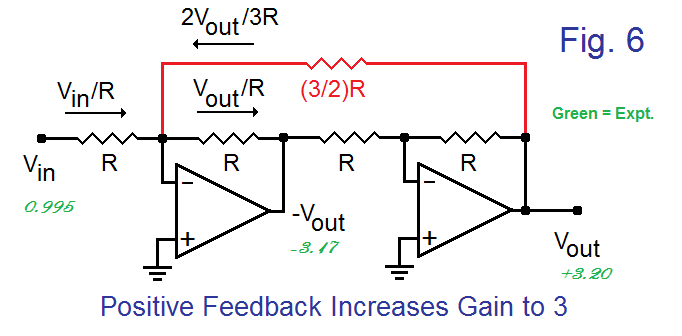
And here is a Bode-less analysis – just using linear relations from current balance:
let left output voltage be V. op amp inputs can’t have current flowing in (infinite gain), so current balance at the right input says
V_out/R + V/R = 0, so V = -V_out.
And at the left input, current balance
V_in/R + 2*V_out/3/R = V_out/R
So V_in = V_out/3; V_out = V_in * 3
Gain=3.
Just linear analysis. That is what Hansen did too with his linear equations. There is no Bode magic.
Three unknowns, V_in, V and V_out. Two node current balance equations. End result, one linear equation, after eliminating V, so relates V_in and V_out.
In essence, Mr Stokes is agreeing that emission temperature must induce a feedback, even in the absence of any amplification from the non-condensing greenhouse gases. And that is the main point we are making.
Monckton of Brenchley said April 1, 2018 at 4:10 am: “In essence, Mr Stokes is agreeing that emission temperature must induce a feedback….”
All that my presentations, and the one Nick gave just above at March 31, 2018 at 11:15 pm, show is that my circuit has a gain of 3, and that it yields to standard network equations (as already on my Fig. 6) OR that it CAN BE INTERPRETED as a Bode feedback ILLUSTRATION. Based on just the input/output results, it’s either/both. Without the internal details, it is foolish to talk about it being one OR the other. [Perhaps like solving a physics problem first with conservation of energy and then by conservation of momentum – giving the same answer.]
So, if with climate we observed a gain of 3, we could speculate on a pure gain of 3, or on feedback. If challenged to suggest an actual physical mechanism for the value 3, we might be unable to establish a gain ploy, but could suggest feedback (like ice melts from white to dark), and to suggest a “sensitivity” of +3 through a positive feedback of 2/3. In the circuit (where the details are revealed), there it is. For the Earth, nature is more subtle, perhaps.
Next suppose that the proponent of a sensitivity of +3 finds that the actual EVIDENCE suggests much less, perhaps +1.2. Bummer! But agenda still calls! Do you then claim that you have ALREADY ESTABLISHED feedback with the SUPPOSED (although failed) sensitivity of 3, so since the result is weaker, the positive feedback must have been weaker (+1/6 here)? Wrong tree – perhaps – I have no idea.
Much we do not know. The math/engineering is clear. Application to climate, broadly attempted – not so much!
Mr Hutchins seems confused. Mr Stokes has accepted that, where emission temperature is 255 K and the feedback fraction is, say, 0.1, then even in the absence of any amplification at all from non-condensing greenhouse gases the output temperature is 255 / (1 – 0.1), or 283.3 K. He is so sure of this that he says it was “silly” of us to build electronic circuits to verify that emission temperature induces a feedback response even in the absence of any amplification from the non-condensing greenhouse gases.
“Mr Hutchins seems confused. Mr Stokes has accepted that, where emission temperature is 255 K and the feedback fraction is, say, 0.1, then even in the absence of any amplification at all from non-condensing greenhouse gases the output temperature is 255 / (1 – 0.1), or 283.3 K.”
Absolutely not. I keep asking this question, with no answer:
For snowball earth, a black body at 255K, with that also as its emission temperature, what would be the feedback to that emission temperature? What would that even mean?
Lord M seems to provide an answer here. A black body emitting 241.2 W/m2 will have an emission temperature of 255 K, but after feedback to emission temperature, a temperature of 283.3 K. But really? That would violate Stefan-Boltzmann. And it just isn’t true.
To Monckton of Brenchley April 2, 2018 at 3:51 pm
As a favorite mentor of mine once was heard to say – “I’ve explained it in all the ways I know how – the rest is up to you.”
Mr Stokes asks a question he knows to be meaningless and then complains that it has not merited an answer. Here are his ipsissima verba: “For snowball Earth, a blackbody at 255 K, with that also as its emission temperature, what would be the feedback to that emission temperature?”
A snowball Earth would not be a blackbody. A snowball Earth would not have an emission temperature 255 K. A blackbody Earth would not have an emission temperature 255 K.
Mr Hutchins, therefore, will now ruefully realize that Mr Stokes has a lot more explaining to do before his question makes any kind of scientific sense.
What climatology calls “feedback” is actually the “change in feedback”. So for in our above example, with 10% feedback giving an output of 283.3 watts, consider what happens when we increase the CO2.
When we increase the CO2, this increases the amount of power fed back from the output to the input. An increase in the back radiation if you wish. So for example, let us increase the amount of CO2 such that 11% of the output feeds back into the input instead of 10%.
Now with 11% we are going to get a total feedback of (28 + 3.1 + .34 … ) = 286.5 watts. This represents a change of 286.5 – 283.3 = 3.2 K.
The problem comes in determining how much of the original 10% feedback is due to CO2 and how water is due to water vapor. If most of the 10% is due to water vapor, then you will need to add a lot of CO2 to get to 11% feedback. If most of the 10% is due to CO2, then you will only need to add a little CO2 to get to 11% feedback.
What MB has shown, is that the feedback is mostly due to water, because climatology did not properly account for the water vapor added to the atmosphere when the earth warmed to 255K.
ps: The Sun’s energy is mostly an AC signal as far as the Earth’s surface is concerned, with a period of 24 hours. At the poles the tilt of the Earth’s axis integrates this into a DC signal depending on the time of year.
Thus from the point of view of feedback it is incorrect to consider the Sun’s energy as constant (DC) power. It is AC power due to the rotation of the Earth and DC power due to the tilt of the axis. Thus any argument (misguided argument) that somehow feedback only exists for AC and not DC is irrelevant.
The actual range for ECS is probably 0.7 to 1.7 degrees C per doubling of CO2, centered on the laboratory value of 1.2 degrees C, without feedbacks in the real world’s complex climate system. In arriving at 0.7 degrees C from scientific observations, Lindzen finds net negative feedback effects. I agree that on our homeostatic water world, net negative feedbacks are more likely than positive. But I can’t rule out others’ findings of slightly positive net feedback effects.
So in the present state of our limited knowledge, 0.5 degree C from 1.2 degree C is a reasonable margin of error. IPCC’s unjustified, indeed unphysical, observation-free WAG of 1.5 degrees C either side of 3.0 degrees C would be ludicrous, had the scandalous sc@m not cost us so much in lives and treasure.
The idea that our planet would only be about 255K absence GHGs seems at odds with what we think we know about Mars.
We are now reasonable certain that Mars had running water (the photographic geographical evidence is strong) and this was at a time when the solar system had a faint sun, ie., at a time when the solar output was perhaps only about 70% of that observed today.
The faint sun causes problems for running water here on planet Earth. See (https://en.wikipedia.org/wiki/Faint_young_Sun_paradox), and one will note that in order for there to be running water on planet Earth it is argued that not only would there need to be more GHGs but also that the atmosphere must have been more massive with pressure perhaps up to 10 bar.
But the consequences of a faint sun are multiplied when one looks at Mars unless planetary temperature is a facet of atmospheric mass and pressure and not one of GHGs.
I meant photographic geological evidence.
There is also physical geological evidence on and from Mars of persistent liquid surface water in the past and ephemerally today.
The faint early sun paradox has effectively been solved, at least for Earth. Other explanations, except for extremely higher GHG concentrations, may have some validity, but this finding suffices:
https://www.nature.com/articles/nature08955
No climate paradox under the faint early Sun
Abstract
Environmental niches in which life first emerged and later evolved on the Earth have undergone dramatic changes in response to evolving tectonic/geochemical cycles and to biologic interventions1,2,3, as well as increases in the Sun’s luminosity of about 25 to 30 per cent over the Earth’s history4. It has been inferred that the greenhouse effect of atmospheric CO2 and/or CH4 compensated for the lower solar luminosity and dictated an Archaean climate in which liquid water was stable in the hydrosphere5,6,7,8. Here we demonstrate, however, that the mineralogy of Archaean sediments, particularly the ubiquitous presence of mixed-valence Fe(II–III) oxides (magnetite) in banded iron formations9 is inconsistent with such high concentrations of greenhouse gases and the metabolic constraints of extant methanogens. Prompted by this, and the absence of geologic evidence for very high greenhouse-gas concentrations10,11,12,13, we hypothesize that a lower albedo on the Earth, owing to considerably less continental area and to the lack of biologically induced cloud condensation nuclei14, made an important contribution to moderating surface temperature in the Archaean eon. Our model calculations suggest that the lower albedo of the early Earth provided environmental conditions above the freezing point of water, thus alleviating the need for extreme greenhouse-gas concentrations to satisfy the faint early Sun paradox.
But the consequences of a faint sun are multiplied when one looks at Mars unless planetary temperature is a facet of atmospheric mass and pressure and not one of GHGs.
========
One can consider that the GHG theory of atmospheric temperature is wrong. This would explain why no progress has been made in narrowing CO2 sensitivity in spite of 40 years of investigation and billions of dollars spent/wasted. It would also explain why many of the predictions of GHG theory have failed.
In my view, a more compelling theory is that the lapse rate warms the surface. This energy transfer to the surface results in a cooling of the upper atmosphere. And from the formula for lapse rate it is clear this is a function of the gravitational force and moisture content. Nowhere does GHG appear.
And what explains the lapse rate? Convection. The highly efficient conversion between Potential Energy (PE) and Kinetic Energy (KE) that results during convection. Since Temperature is a function of KE, but not PE, conduction is able to warm the surface and cool the upper atmosphere without requiring any net work.
“And what explains the lapse rate? Convection. The highly efficient conversion between Potential Energy (PE) and Kinetic Energy (KE) that results during convection. Since Temperature is a function of KE, but not PE, conduction is able to warm the surface and cool the upper atmosphere without requiring any net work.”
Yes, it is convection. But it does require work. What you describe is a heat pump. The energy comes from the wind – ie a heat engine driven by horizontal temperature differences.
The solar irradiance in Mars is 590 W/m^2 at noon. The equilibrium temperature is 46 C. It can have liquid water at day time. BTW the freezing point of 23% brine water is negative 21 C
Mars and Earth are two very similar planets.
Both planets have approximately the same tilt.
Both planets have approximately the same length of day, since they rotate at approximately the same rate.
Both planets, on a numerical basis of actual molecules physically present in their respective atmospheres, have broadly similar amounts of GHGs in their atmospheres. Whilst the Martian atmosphere is thin, if one were to count the molecules it has more than an order of magnitude more CO2 molecules, compared to that in Earth’s atmosphere, but it has less water vapour (although more water vapour at very high altitude). Overall, it has more molecules of GHGs.
Some people are of the view that its is GHGs in Earth’s atmosphere that keeps the planet warm. However, if one were to remove all the non GHGs from Earth’s atmosphere (ie., all the nitrogen, oxygen and argon) one would be left with the same thin atmosphere as has Mars, but with slightly less molecules of GHGs compared to that in the Martian atmosphere.
Now if it is the molecules of GHGs that keep a planet warm, and not the molecules of non GHGs such as nitrogen etc, why does Mars, which has more molecules of GHGs, have no (radiant) GHE? That is the question that needs to be answered.
Obviously, I am not suggesting that Mars because it has more molecules of GHGs should have about a 33K warming. After all, Mars is further away from the sun so one would not expect to see as much as an additional 33K. But if Mars receives some 590 W /m^2 at noon of solar irradiance and Earth receives some 1361 W /m^2 at noon, one might expect to see a (radiant) GHE in the order of 14K (lets say 8 to 16K). But there is none.
This is extremely surprising since not only are their more molecules of GHGs in the Martian atmosphere they are more closely spaced (Mars is a smaller sphere and the atmosphere, such that it has, takes up less volume). The fact is this, it is far more difficult for a photon radiated from the surface of Mars to make its way to TOA of the Martian atmosphere without interacting with molecules of GHGs than is the case on planet Earth. Any photon escaping the surface of mars will be absorbed and reradiated by molecules of CO2 on more occassions than a photon escaping the surface of Earth.
But despite all of these molecules of CO2, they appear top do nothing on Mars. On Mars your feet could be a comfortable 25 degC and your head would be freezing. They cannot even keep 2 metres of atmosphere near the surface warm.
“But there is none.”
You give no basis for saying that Mars has no GHE.
Nick.
It is well accepted that Mars has no significant measurable GHE. That is not a contentious statement (although hard data is limited as is all data in climate science). It may have a very slight one, I have seen papers putting it as high as about 1K, but the uncertainties are such that it is not readily patent.
The European Space Agency notes:
Solar irradiance of Earth vs. Mars: 1361/590 = 2.3
All things equal, Earth should be 2.3x warmer than Mars.
Equator temperature to the 4th power of Earth vs. Mars: (313/293)^4 = 1.3
But Earth is only 1.3x warmer. Mars is unusually warm. Maybe GHE of Martian atmosphere
richard verney March 31, 2018 at 2:26 am
Mars and Earth are two very similar planets.
Both planets have approximately the same tilt.
Both planets have approximately the same length of day, since they rotate at approximately the same rate.
Both planets, on a numerical basis of actual molecules physically present in their respective atmospheres, have broadly similar amounts of GHGs in their atmospheres. Whilst the Martian atmosphere is thin, if one were to count the molecules it has more than an order of magnitude more CO2 molecules, compared to that in Earth’s atmosphere, but it has less water vapour (although more water vapour at very high altitude). Overall, it has more molecules of GHGs.
Some people are of the view that its is GHGs in Earth’s atmosphere that keeps the planet warm. However, if one were to remove all the non GHGs from Earth’s atmosphere (ie., all the nitrogen, oxygen and argon) one would be left with the same thin atmosphere as has Mars, but with slightly less molecules of GHGs compared to that in the Martian atmosphere.
Except in that much thinner atmosphere the collisional broadening of the spectral lines is much less so the effective absorption of the outgoing IR by GHGs is much less.
The fact is this, it is far more difficult for a photon radiated from the surface of Mars to make its way to TOA of the Martian atmosphere without interacting with molecules of GHGs than is the case on planet Earth. Any photon escaping the surface of mars will be absorbed and reradiated by molecules of CO2 on more occassions than a photon escaping the surface of Earth.
Consequently this ‘fact’ is not true. Try running HITRAN with the appropriate parameters set for the two atmospheres.
Dr. Strangelove March 30, 2018 at 9:38 pm
The solar irradiance in Mars is 590 W/m^2 at noon. The equilibrium temperature is 46 C. It can have liquid water at day time. BTW the freezing point of 23% brine water is negative 21 C
No it cannot, the triple point of water is below the atmospheric pressure of Mars, you’d need a water vapor pressure exceeding the atmospheric pressure for liquid water to exist.
Phil
NASA found brine water today on Mars. Brine has different phase diagram than pure water
https://www.space.com/30673-water-flows-on-mars-discovery.html
Dr. Strangelove March 31, 2018 at 7:21 am
Phil
NASA found brine water today on Mars. Brine has different phase diagram than pure water
Indeed it does, but that’s not what you said that I responded to.
Check it out here.
https://www.lpi.usra.edu/meetings/lpsc2009/pdf/1380.pdf
“However, pure water is unstable in its liquid form due to the low pressures and temperatures associated with the Martian surface, so water is likely to be kept frozen and sublimating, or evaporating and boiling, if liquid [3]. Brines or salt-rich solutions composed of NaCl or CaCl2 have been suggested since they are known to lower the freezing point and evaporation rates”
Phil
I don’t want to split hairs but my “liquid water” is not pure liquid water. We call seawater “liquid water” but it’s brine or a salt solution.
But there is plenty of scientific rational to support the idea that the climate sensivity of CO2 is zero. Heat transfer away from the Earth’s surface in the troposphere is primarily by conduction, convection and phase change and not by LWIR absorption band radiation. H2O always provides a negative feedback to any possible CO2 based waming because the wet lapse rate is significantly less than the dry lapse rate. The temperature profile in the atmosphere has nothing to do with the LWIR absorption properties of so called greenhouse gases. Adding CO2 to the atmosphere has the effect of slightly lowering the dry lapse rate which is a cooling effect that almost eliminates any warming that could be caused by CO2’s LWIR absorption bands. After more than two decades of effort the IPCC has been umable to measure the climate sensivity of CO2 because there is nothing to measure. The AGW conjecture is based on a radiant greenhouse effect provided for by trace gases in the Earth’s atmosphere with LWIR absorption bands. Such a radiant greenhouse effect has not been observed in a real greenhouse, on Earth, or anywhere else in the solar system for that matter. The radiant greenhouse effect is science fiction as is the radiant greenhouse effect.
In response to Mr Haas, he is entitled to his opinion that CO2 exerts no forcing. However, for the sake of argument I have adopted all of official climatology as gospel except where we can prove official climatology to be incorrect. We did not consider it our place to advance theories that we could not prove. That meant accepting that CO2 does cause a forcing, and even accepting that the forcing (albeit that it has been much reduced since earlier official estimates) is not too high.
This points to a major problem with climatalogy in that there are just too many variables and one cannot run definitive experiments to prove anything. I myself believe that mankind’s burning up the Earth’s finite supply of fossil fuels is not such a good idea and I would like to use the AGW conjecture as another reason to conserve. At first the AGW conjecture seems quite plausable but upon closer inspection it is full of holes. CO2’s having LWIR absoption bands is fact but that adding more CO2 to th atmosphere will cause a decrease in the dry lapse rate in the troposphere is also fact but how these two properties of CO2 in the atmosphere combine to affect climate change is more of a matter of conjecture than it is fact. According to the AGW conjecture, adding more CO2 to the atmoshere will cause warming which will allow more H2O to enter the atmosphere. Because H2O is the primary greenhouse gas, more H2O will cause even more warming so H2O acts as a positive feedback to CO2. But this line of thought neglects the fact that besides being the primary greenhouse gas, H2O is a primary coolant in the Earth’s atmosphere, moving heat energy from the Earth’s surface to where clouds form via the heat of vaporization. The fact that the wet lapse rate is significantly less than the dry lapse rate is evidence of the over all cooling effect of H2O. The feedback is not positive but rather negative so that rather than amplify the effect of CO2, H2O should act to retard the effect of CO2. This is all assuming that there exists a radiant greenhouse effect at all yet there is no real evidence that it does. The AGW conjecture would have us believe that the non-greenhouse gases are somehow thermally inert, an idea that I canot accept. If anything it is the non-greenhouse gases that retain heat energy because they are such poor LWIR radaitors to space and the only way that heat energy can get off this planet is by radiation.
Mr Haas’ opinion that coal, oil and gas should be consumed more slowly is not uncommon. However, the present thread concerns itself with a scientific rather than a political question. Will there be anything like as much global warming as official climatology says? Answer: No.
“Official climateology” ? What is it and what makes it “official”? There is no “scientific consensus” regarding the AGW conjecture. Scientists have never registered and voted on the matter. Such a consensus would be nonsense because science is not a democracy. The laws of sceince are not some sort of legislation. Scientific theories are not validated by a voting process. I do however applaud your efforts that shows that, working in the confines of what the IPCC has published, the effects of the so called greenhouse gases are not nearly as bad as the IPCC makes out.
Mr. Monckton’s argument appears to be wrong for at least two reasons. The first is that no-one involved in modelling the climate uses his Eq. 1 and therefore it is irrelevant whether or not there is an error in how it is applied or even whether or not it is valid.
Secondly the claim that you can replace Delta T by T is wrong or at the very least misleading. Eq. 1 is concerned with a departure from an arbitrary equilibrium and if you change the equilibrium point from
one temperature to another all of the parameters will change. The most obvious one is the Planck sensitivity parameter which is defined (Roe 2009) as 1/(4 sigma T^3). Clearly this increases enormously if you work near 0K as compared to 300K. Similarly the forcing will also all be strong functions of temperature. So there is no way you can take the values estimated at one reference temperature and apply them to another. It is
like taking the coefficients of a Taylor series expansion about x=0 and using them to estimate the changes
about x=300. You will not get a sensible answer.
a. It is blindingly clear that the canonical 1.5K to 4.5K sensitivity range has guided the modelers to try to reproduce it from their models so they don’t have to use the actual equation to have it influence them. Basically when a run falls below what is expected then it is rejected as wrong and the parameters are changed to produce a more ‘correct’ result. The climate sensitivity is kept high to keep the parabolic temperature increase in the future while the aerosol parameter is fudged to keep the past and current climate matching the empirical data. All this is based on the circular reasoning that the sensitivity must be high because a low value would not show any problem with CO2 levels – and we can’t show that conclusion can we?
b. When you do radiative heat transfer with a model in nuclear physics then you have to include the convective feedbacks on old temps as well as new temps which requires iteration in order to get the final, correct answer. It’s true that the real situation for planet Earth would require iteration too so the circuit is not realistic. However I doubt Monckton believes in the simplistic electrical circuit analogy either but it is nevertheless used by the climate community. You seem to be arguing that we should ignore the equation and the electrical analogy because it is obviously based on a combination of wrong guesswork and a requirement for simplistic arithmetic. Fair enough but then also tell the alarmists to stop using such arrant nonsense for the purposes of egging the panic pudding.
Jasg,
In regards (b) it is more than simplistic arithmetic is is complete nonsense. Monckton’s climate equation
(1) refers to a change in temperature from an arbitrary ground state given a forcing F. Since he wants to
apply that to a ground state where the sun is off we can take the initial temperature of the earth to be
2.8K since it will be in thermal equilibrium with the cosmic microwave background. Then using the standard
equation for the Planck sensitivity of 1/(4 sigma T^3) you get a value of 200855 compared with 0.26 or so
at room temperature. Combine this with the forcing of 1000 W/m^2 you get when the sun turns on and the
reference temperature becomes 200 million K giving a value for f of -717339. Now I am willing to bet
that nobody would believe that number not even Monckton.
Which suggests to me at least that either Monckton is being deliberately fraudulent in trying to deceive people
or he has made an extremely simple mistake.
[??? .mod]
Germinios working reminds me of the physicists joke in TBBT that ‘I have a solution but it only works for a sphere in a vacuum’. Many physicists do calculations of the atmosphere by doing a calculation as if in space then applying a correction factor to account for the atmosphere. They do this because the sums are much easier and empirical data is not usually available to correct them. In reality the actual forcing due to radiation in an atmosphere is proportional to the difference term (T1^4 – T2^4) which makes the numbers far more reasonable to handle than if you leave the 2nd term out (as germinio did). Unfortunately you need a computer for correct calcs (either analogue or digital); the TBBT whiteboard is just not good enough. That exta term on the lhs of the equations is the unknown final temp which is also on the rhs. Hence the correct equation requires the feedback on the input that M describes (as indeed do all input values dependent on temperature) but some conventional physicists may not grasp this concept immediately because they have always done their calcs in the oversimplified way – by just ignoring that 2nd term and hence ignoring proper feedback – in order to obtain an easy ‘hand-written’ answer. This over-simplification can give them massive confusion about the relative size of numbers.
Germinio says the argument presented in the head posting is incorrect because “no one involved in modeling the climate uses his Eq. 1 and therefore it is irrelevant whether or not there is an error in how it is applied or even whether or not it is valid.” Germinio is simply wrong. Read e.g. Roe (2009); Bates (2007, 2016); several papers by Lindzen; Hansen (1984); Schlesinger (1985); etc.. etc., etc. The zero-dimensional model is used in climatology to discern diagnostically the equilibrium sensitivities that the models would be likely to predict given specified reference temperatures and feedback fractions.
Germinio is also incorrect to state that one may not use absolute or entire temperatures as inputs to and outputs from the feedback loop. We not only had the benefit of our own test rig and of a test rig constructed by a government laboratory but also the advice of two control engineers and a professor of applied control theory. The relevant feedback theory is well described in ch. 3 of the standard textboo, Bode (1945). The mathematics of feedback amplification is in essence the same for any dynamical system on which feedbacks bear.
Germinio is also incorrect to attempt to calculate the Planck parameter on the basis of only a few K of incoming radiation. Temperature feedbacks do not concern themselves with how the emission temperature of 255 K (not 0 or 2.73 K) came to be: they respond to the temperature as they find it. Such matters are very easily confirmed by using a test rig, which is precisely why we and the government lab built test rigs.
If you look at Eq. 5 of Roe 2009 it reads:
Delta T = lambda_0 Delta R/(1 – c_1 lambda_0)
where lambda_0 is defined in Eq. 3 as
lambda_0=1/(4 sigma T^3)
and c_1 is the feedback.
The question is then what is the Temperature T? Roe defines by:
Let R be the radiation imbalance at the top of the atmosphere between the net longwave radiation flux, F, and the net shortwave radiation flux, S. In equilibrium, R = S + F = 0.1 Let T be the global- and annual-mean temperature that characterizes this equilibrium state.
So before you can use Roe’s equation 5 “a reference system (i.e., a system without the feedback) must be defined. Defining this reference system is a central aspect of feedback analysis.” Again from Roe 2009.
If you want to replace as Monckton does the Delta T in Eq. T with T then that implies that your reference
state must be one with F=0 and hence the reference system is one in which the sun is not shining. This
gives a reference temperature of about 3 K and so lambda_0 which is the Planck sensitivity parameter is
about a million times larger than it is if you take the reference temperature to be the current average temperature. Which again gives a ridiculous value for the feedback parameter.
Now as Roe states you can take whatever reference system you like but then you need to remember that
Eq. 5 is only valid for small perturbations from that reference system. Again Roe 2009 has an entire
section entitled “Feedbacks Are Just Taylor Series in Disguise” which concludes with:
Gains and feedbacks calculated with respect to different reference systems cannot be directly compared.
Something that Monckton and his colleagues are trying to do and not surprisingly it leads to nonsense.
Germinio’s latest muddled contribution talks of different reference systems. But we are talking of only one reference system: the climate. In the climate, the reference temperature is the emission temperature, which may be amplified by adding non-condensing greenhouse gases to the mix. Bode makes the same mistake as all other climatologists in not understanding that the emission temperature is itself capable of inducing a feedback.
In my previous posting, for “Bode” read “Roe”.
Monckton – If you actually read Roe 2009 you would see that the reference system is a system
without feedbacks and therefore cannot be the climate. In Roe it is an idealized gray body that
emits according to the Stefan Bolztmann law. If you want to take the reference temperature as
255K (the emission temperature) then all temperatures in your Eq. 1 are measured relative to that
so that inputting a temperature of 255K would then imply that the actual temperature was 510K.
Again you need to read Roe’s paper rather than just selectively cite it.
Geronimo seems confused. By definition, in a dynamical system the reference value of a variable is the value of that variable before accounting for any feedback response that arises owing to the presence of a) the reference value and b) at least one feedback process. Roe is explicitly (though in one respect erroneously) applying the Bode equation to the climate.
I’ve always known you can win the science: it was always a scam. But can you win the politics? Can you change the hysteria that allows carpetbaggers to despoil our countries with wind/solar farms that add no value to a growing world – yet diminish the means whereby the first world can bring the third world into the present day? AGW was always a political entree to a UN-led order, where nobody, except the extremely wealthy Soroses and Gores (fill in the names as you will) of this world would benefit.
“Can you change the hysteria that allows carpetbaggers to despoil our countries with wind/solar farms that add no value to a growing world – yet diminish the means whereby the first world can bring the third world into the present day? AGW was always a political entree to a UN-led order, where nobody, except the extremely wealthy Soroses and Gores (fill in the names as you will) of this world would benefit.”
This is a lovely example of one’s views of AGW becoming dominated by the politics.
“despoil our countries with wind/solar farms” – How about the ugly power plants and refineries chugging out their putrid fumes, or the mines that blow the top of a mountain off?
“diminish the means whereby the first world can bring the third world into the present day”
What? It’s not the responsibility of the first world to determine their future. Many third world countries are electing to install renewables, as well as FF. Renewables are bringing electricity to villages off the grid. The price of PV panels has dropped so much that in some cases it’s less expensive than coal at auction, and it is generally catching up to coal. Renewable installation has been a major new employer, providing 100s of thousands of jobs in the U.S.
…And while China takes the clear global lead in renewable energy while we sit back and argue it’s a waste of money to cooperate with the rest of the world in reducing the threats of climate change that we, more than any other country, contributed to. Because half the nation rejects the science and turns it into a political debate. Meanwhile, the U.S. is cutting funding for R&D and making installation of PV more expensive for no good reason, unless it’s to help the FF industry.
“Skeptics” are constantly accusing AGW of being influenced by politics, yet seem completely blind to the fact that politics play an enormous role in their views. How is this possible? It baffles me.
The renewables industry has behaved badly:
1. They’ve stolen some of our money to fund their business.
2. They’re largely responsible for pushing-up the price of electricity in Australia to a level where our business can no longer compete with our Asian competitors (we’re highly automated so wages are not a factor).
You’ll have an answer for the above and every other possible objections to unfair energy prices because you’re a fundamentalist eco academic who doesn’t function in the real World.
Your life objective (like a hundred other Gov talking-heads and academics we know) is to live off other people in a socialist utopia. Half the World with extreme prejudice desires living off the other half .
Unfortunately for your kind, physics is against you so good luck with that because in the long game the real World will prevail.
Regarding China, we do business there and they don’t care about CO2 and it’s a standing joke to all except a small minority of EU schooled academics at Westernised universities there. China cares about:
1. Pollution.
2. Dominating the manufacture of solar and wind turbine components and systems.
3. Fostering anti CO2 fanaticism in the West to encourage the relocation of energy-intensive industries to China and in a hundred years to Africa where they’re currently (small step at a time) establish a formidable beach-head
Kristi has a lot of words paid for with others’ money. We, the real people here (many now retired) create employment and fill tax coffers (indicating we’re not a multi-national); well not yet.
well said warren. the internet abounds with shills ,i think you just highlighted another.
If China takes the lead in renewables, why do their CO2 emissions keep increasing, while America’s keep falling? I’m happy to let them take the lead in the dead end of renewables. It’s shocking that Trump hasn’t presented a budget ending subsidies for wind and solar.
Warren,
“You’ll have an answer for the above and every other possible objections to unfair energy prices because you’re a fundamentalist eco academic who doesn’t function in the real World.” Etc.
Is this how you perceive the world in general, Warren? Do you learn just enough about a person to put him in a box that lists his attributes, so you don’t have to know a person before characterizing him? We all do this to some extent, but some list fewer traits, and don’t keep the box locked.
No, I have no answers for you. I have no idea what’s going on between Asia and Australia.
So you’re an Aussie? I lived on the Atherton Tablelands for about 3 years. I loved living down there, thought the people delightful and the land amazingly beautiful. I miss it. I did notice there were a lot of people on the dole.
Socialism is impractical and wrong. It’s stuffing humanity into an unnatural mold. I’m a capitalist in favor of some regulation because I think free market capitalism is also idealistic. We can’t rely on humans to act in business in a way the promotes the good of society as a whole (e.g. put tax breaks back into the company rather than give bonuses to executives). ***Extreme*** wealth and income disparity is not good for society, and unrestrained free markets naturally lead to this disparity. Wealth is power and that means power is also uneven. Equal opportunity is a myth. I don’t know how to fix it, but socialism is not the answer.
China:
1) Agree
2) Agree
3) “Fostering anti CO2 fanaticism in the West to encourage the relocation of energy-intensive industries to China… ” Conspiracy theory? The “AGW is a Chinese hoax” hoax? What is this??
Warren, we’ve all been influenced by our surroundings. But whether liberal or conservative we all have the capacity to break our molds and think for ourselves. We are all human.
Chimp –
China’s CO2 emissions were rising extremely quickly because of their huge economic growth. Largely through transitioning to renewables, they actually turned that trend around so much that emissions dropped for a few years, although economic recession helped, and it increased again last year. Still, it’s pretty impressive; we’ll have to see what happens this year. Pollution is a motive, yes, but since China does a lot of climate research, I imagine that is also a factor. (I’m not saying China is innocent, and there are contradictions in words and action, but China is not alone there.)
That’s weird. The graph came without the text.
https://www.nytimes.com/2018/01/25/business/china-davos-climate-change.html
(NYT isn’t normally where I go for my data. I’ve seen the graph elsewhere.)
And that’s even weirder. The link came with the story attached. Sorry!!!
Kristi,
China’s emissions dropped because of their economic slowdown, not because of increased renewables use. China sells solar panels and windmills to the US because our environmental rules make it impossible to build them here, and thanks to China’s rare earth resources. But they make very little use of these technologies themselves.
They are however shutting down old coal plants in favor of newer, more efficient ones. The air in China’s cities is worse than Dickensian London, during the days of dark Satanic mills.
Mr Passfield raises a point that many others here have raised. Even if we are right and can prove it, how will we overcome the totalitarian party line? Simple: we seek the truth and then we speak the truth. Our argument is sufficiently simple that anyone with high-school math and an open mind will be able to understand it. It is, in our submission, self-evidently true. It leaves remarkably little room for argument. Once this fact becomes apparent to all, that will be the end of the scare.
As for Silber’s comment that skeptics have political views and can, therefore, be disregarded because they are not the totalitarian views that Silber espouses, the head posting does not constitute a political argument but a scientific one. It stands or falls on such intrinsic merits as it may possess, regardless of Silber’s politics or of anyone else’s.
Chimp –
“China’s emissions dropped because of their economic slowdown, not because of increased renewables use. China sells solar panels and windmills to the US because our environmental rules make it impossible to build them here, and thanks to China’s rare earth resources. But they make very little use of these technologies themselves.”
Have you ever Googled “china renewable energy”? There are umpteen reports about China’s use. Are they all propaganda?
http://ieefa.org/wp-content/uploads/2017/01/Chinas-Global-Renewable-Energy-Expansion_January-2017.pdf
They also invest in renewable projects here. Just think: the Chinese are putting up the money for our energy industry.
“The expanding rate of foreign investment by Chinese firms was examined in the 2013
report by the World Resources Institute, which tracked 124 investments over the decade
to 2012 (Figure 3). Investment has clearly accelerated since the global financial crisis,
taking advantage of the retreat from global markets of Western firms, particularly banks”
This is what happens when we shun globalization in a global economy: others capitalize on it.
“…because our environmental rules make it impossible to build them here” Yeah, great industry to put tariffs on. Makes a lot of sense. (It’s not impossible to build them here, or course; it’s just cheaper in China.)