Astronauts on the International Space Station may be at risk during long missions
THE WORSENING COSMIC RAY SITUATION: Cosmic rays are bad–and they’re getting worse. That’s the conclusion of a new paper just published in the research journal Space Weather. The authors, led by Prof. Nathan Schwadron of the University of New Hampshire, show that radiation from deep space is dangerous and intensifying faster than previously predicted.

The story begins four years ago when Schwadron and colleagues first sounded the alarm about cosmic rays. Analyzing data from the Cosmic Ray Telescope for the Effects of Radiation (CRaTER) instrument onboard NASA’s Lunar Reconnaissance Orbiter (LRO), they found that cosmic rays in the Earth-Moon system were peaking at levels never before seen in the Space Age. The worsening radiation environment, they pointed out, was a potential peril to astronauts, curtailing how long they could safely travel through space.
This figure from their original 2014 paper shows the number of days a 30-year old male astronaut flying in a spaceship with 10 g/cm2 of aluminum shielding could go before hitting NASA-mandated radiation limits:

Galactic cosmic rays come from outside the solar system. They are a mixture of high-energy photons and sub-atomic particles accelerated toward Earth by supernova explosions and other violent events in the cosmos. Our first line of defense is the sun: The sun’s magnetic field and solar wind combine to create a porous ‘shield’ that fends off cosmic rays attempting to enter the solar system. The shielding action of the sun is strongest during Solar Maximum and weakest during Solar Minimum–hence the 11-year rhythm of the mission duration plot above.
The problem is, as the authors note in their new paper, the shield is weakening: “Over the last decade, the solar wind has exhibited low densities and magnetic field strengths, representing anomalous states that have never been observed during the Space Age. As a result of this remarkably weak solar activity, we have also observed the highest fluxes of cosmic rays.”
Back in 2014, Schwadron et al used a leading model of solar activity to predict how bad cosmic rays would become during the next Solar Minimum, now expected in 2019-2020. “Our previous work suggested a ~ 20% increase of dose rates from one solar minimum to the next,” says Schwadron. “In fact, we now see that actual dose rates observed by CRaTER in the last 4 years exceed the predictions by ~ 10%, showing that the radiation environment is worsening even more rapidly than we expected.” In this plot bright green data points show the recent excess:

The data Schwadron et al have been analyzing come from CRaTER on the LRO spacecraft in orbit around the Moon, which is point-blank exposed to any cosmic radiation the sun allows to pass. Here on Earth, we have two additional lines of defense: the magnetic field and atmosphere of our planet. Both mitigate cosmic rays.
But even on Earth the increase is being felt. Spaceweather.com and the students of Earth to Sky Calculus have been launching space weather balloons to the stratosphere almost weekly since 2015. Sensors onboard those balloons show a 13% increase in radiation (X-rays and gamma-rays) penetrating our planet’s atmosphere:
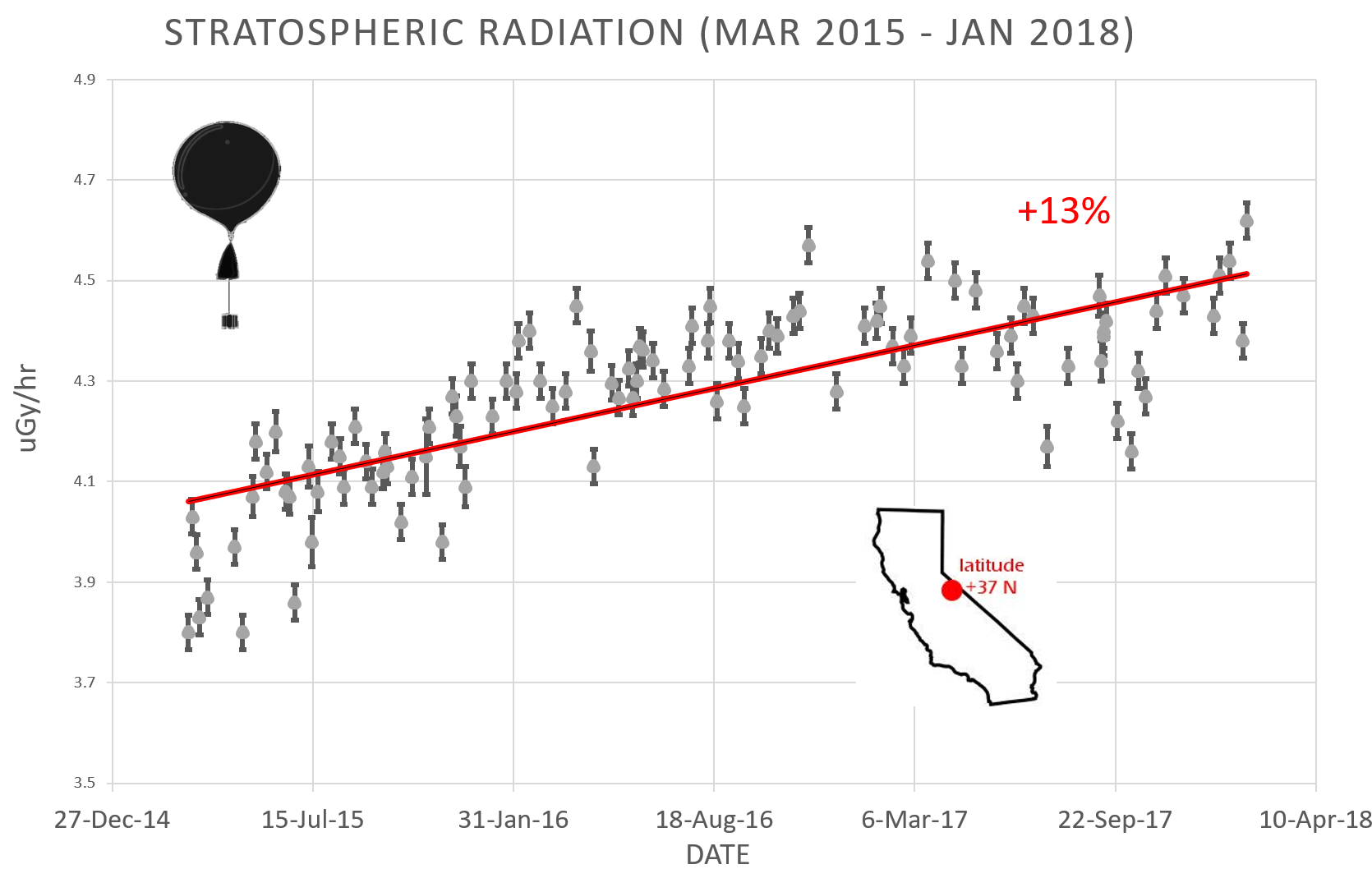
X-rays and gamma-rays detected by these balloons are “secondary cosmic rays,” produced by the crash of primary cosmic rays into Earth’s upper atmosphere. They trace radiation percolating down toward our planet’s surface. The energy range of the sensors, 10 keV to 20 MeV, is similar to that of medical X-ray machines and airport security scanners.
How does this affect us? Cosmic rays penetrate commercial airlines, dosing passengers and flight crews so much that pilots are classified by the International Commission on Radiological Protection as occupational radiation workers. Some research shows that cosmic rays can seed clouds and trigger lightning, potentially altering weather and climate. Furthermore, there are studies ( #1, #2, #3, #4) linking cosmic rays with cardiac arrhythmias in the general population.
Cosmic rays will intensify even more in the years ahead as the sun plunges toward what may be the deepest Solar Minimum in more than a century.
From NASA Spaceweather
Bad time to schedule a trip to Mars?
Nah.
Just put some tinfoil round the ship. And magnetise the hull.
Volunteers have been launching balloons for the past few years,
documenting the changes in GCMs in California. These records
don’t appear to be used by NASA, but they make a good supplement
to the NASA study.
http://www.spaceweather.com/images2018/02mar18/balloon_data_strip.png
Is the from the Earth to Sky Calculus group?
Or coat your spacecraft in water ice a meter thick.
Or just put the water tanks on the outer skin of your ship.
The price is going up due to the tariffs. I would suggest not waiting too long before stocking up.
Magnetize the hull?
Have you ever thought about angle of deflection from a relativistic proton when the hull is say only 2 cm thick Al and just a meter or so from human flesh?
Water freezes, then what? Use valuable electricity to keep it warm so that it is liquid and usable??
Gauss is your friend.
Actually water is an excellent insulator from harmful cosmic rays. Too bad it’s so heavy, but on the bright side they can produce it once they’re in space.
Did you read those levels of “tin foil”? Aluminum’s density is 2.7 g/cc. to get 10 g/cm2 the shielding would have to be 3.7 cm thick (almost 1.5″). Now that will account for multiple walls, however space craft walls are no where near that thick.
However, there are better lighter weight materials than aluminum, such as water and polyethylene. Yes, surround the cabin with your water supply and holding tanks.
External ice shells will offer another means of protection against micro-meteoroid orbital debris damage (MMOD). Maybe a good place to freeze the waste?
Until we invent deflector shields we’ll have to get by with what we know.
That doesn’t work
Cosmic rays will intensify even more in the years ahead as the sun plunges toward what may be the deepest Solar Minimum in more than a century
We just had that one. Cycle 25 looks to be a bit stronger than 24 so the hyped ‘warning’ may be a bit premature.
http://www.leif.org/research/Super-Synoptic-Maps-and-Polar-Fields.pdf
http://hmi.stanford.edu/hminuggets/?p=2084
One things for sure, winter severity correlates well with increased cosmic ray intensity:
The last time we had an extreme winter even close to this one, we had very high cosmic ray intensities.
https://www.accuweather.com/en/weather-news/how-extreme-was-the-winter-of/26257
It is probably not a coincidence that we have seen alarming low temperatures and snow events in areas that normally do experience events such as this winter without some reason behind it.
http://cosmicrays.oulu.fi/webform/monitor.gif
So, to cool the global climate, we build giant accelerators on the moon, and irradiate the atmosphere of earth?
There’s some carbon off-sets for you.
So cool.
To combat this and it”s deleterious affects, those who feel they are subject to the effects should make hats out of aluminum foil to ward off the cosmic rays and help others to be aware of this danger!
Question If the barometric pressure,humidity, location and time of year are exactly the same and there is a cloudless sky should the temperature also be very similar except of course for the level of solar iradiance which could be easy to calculate? Finally if this is the case shouldn’t a higher level of c02 also have a warming impact where these conditions are the same? Am I missing something with this question?
Is there nothing that man-made CO2 is not capable of!?!
No, nothing.
Including dental caries…just saying.
i am sure the problem with cosmic rays can be solved with more windmills and solar panels to reflect them back into space ,so just more of the same and we will be fine 😉
Don’t be giving any of the crazies any more crazy ideas.
I thought the point here is that this proves CO2 is not capable of anything.
I’d like to know why high CO2 in the interglacials does not seem to stymie a steepish plunge into the next glacial cycle.
Pretty sure an actual global greenhouse (a real one that is) wouldn’t tend not to do that.
So logically, the CO2 would have to drop rapidly FIRST, for the greenhouse to vanish.
Yeah-but, no-but, yeah-but … the TEMP drops FIRST, … and THEN the greenhouse glass breaks.
Now that’s just a little bit sus.
Falsified?
I thought your goal was to make sense?
CO2 does do a lot of good things.
Isn’t that pretty much what we would EXPECT, those of us who have suspected that we’re in for an extended “Dalton Minimum” type cooling? The Sun is entering a quiescent phase, and solar activity is decreasing, and the solar wind is less able to block galactic cosmic rays.
I can’t even pretend to be surprised by this finding; perhaps the Warmists will suddenly face the reality of a COOLING climate for a while.
how do cosmic rays cause cooling?
https://www.upi.com/Science_News/2017/12/19/Scientists-claim-cosmic-rays-influence-cloud-cover-climate-change/2251513690392/
“Finally, we have the last piece of the puzzle explaining how particles from space affect climate on Earth,” researcher Henrik Svensmark said.
“As cosmic rays rain down from space, they increase the number of ions in Earth’s atmosphere, which, according to scientists at the Technical University of Denmark, encourages the formation and growth of cloud condensation nuclei.“
“how do cosmic rays cause cooling?”
Oh my! A newbie!
Simple answer: More atmospheric ions, more clouds, higher albedo.
Hendrik Svenmark is a good place to start.
Just because both happen in sync doesn’t mean one must cause the other. There are other logical possibilities. Think about it.
And which ion species?
Presumably not free electrons?
That’s testable btw.
If you could make and inject the correct ions in the the right places, you’d have an effective global thermostatic knob.
Do they use knobs anymore?
Whatever, an app then, I’m flexible.
Fron what i have read, cosmic rays cause cooling by seeding clouds. Increased high altitude cloud cover increases albedo and reflects more sunlight back into space. While low-level cloud cover can insulate from heat loss during night time high level cloud cover is not as effective and results in a net heat loss.
Richard: Correct that correlation does not equal causation, however, CERN has done some experiments that seem to indicate that Hendrik Svenmark’s theories are correct.
David Paul Zimmerman, my understanding is that high, wispy. cirrus clouds are thought to have a warming effect because they are made of ice crystals, which makes them much more nearly opaque to outgoing longwave infrared than to incoming visible and near-IR solar radiation. Lower clouds, which are made of liquid water droplets, have a strong cooling effect in daytime, but a warming effect at night.
I have quite a few links to information about the work of Svensmark, Kirkby et al, here:
https://www.sealevel.info/resources.html#solar
(especially the last 4-5 paragraphs)
CO2 must be to blame… at least partly. Too good an opportunity to miss.
Is the prospect of a lunar colony now limited to robots? How far underground do cosmic rays penetrate?
Should we blame the same coal miners who killed all the penguins in Iceland?
You mean “the Great Auks”? Otherwise I will have to upgrade to a new fact: penguins in the northern hemisphere. That’s like polar bears in Antarctica. Plenty to eat, but how do we get them there?
Yes the original Penguins, Great Auk (Pinguinus impennis), after which the southern ones were named.
Name possibly derived from the welsh, Pen Gwyn (white head).
From Wikipedia:
The rocks were covered with blackbirds [referring to Guillemots] and there were the Geirfugles [Great Auk]… They walked slowly. Jón Brandsson crept up with his arms open. The bird that Jón got went into a corner but [mine] was going to the edge of the cliff. It walked like a man … but moved its feet quickly. caught it close to the edge – a precipice many fathoms deep. Its wings lay close to the sides – not hanging out. I took him by the neck and he flapped his wings. He made no cry. I strangled him.
https://en.wikipedia.org/wiki/Great_auk#Extinction
He is correct – there are no penguins in Iceland. It must have been the coal miners.
Personally, in Iowa, I put a banana in my ear to keep away the alligators. Works really well.
Here are a couple of encouraging approaches to help mankind do Moon and Mars colonies…
https://www.sciencealert.com/scientists-are-developing-a-magnetic-shield-to-protect-astronauts-from-cosmic-radiation
http://www.syfy.com/syfywire/we-might-have-figured-out-how-to-make-ourselves-resistant-to-space-radiation
Thanks for the link. Tardigrades are so impressive.
JF
Since any lunar colony is just a staging stop for a trip to Mars, and since Mars is a one-way ticket, I suppose the cosmic ray exposure will only perhaps shorten the colonists’ viability marginally. In the grand scheme, it matters little if they survive twenty years or two.
Until that certainly eventual solar CME blast sends a truly horrendous blast of high energy solar protons at them.
They get a blast of ~5-10 Grays of radiation in a few hours…. then it’s all over…. except for their last day or so of vomiting up blood in their pressurized space helmets and aspirating and choking on their own vomit, while gasping for air.. 100 million miles from Earth.
With nuclear powered rockets, Mars need not be a ‘one way trip’.
J Mac
March 5, 2018 at 9:27 pm
With nuclear powered rockets, Mars need not be a ‘one way trip’.
I like Polywell Fusion.
J Mac,
We can’t build nuclear powered anything here in the US anymore, unless it is a Top Secret nuclear submarine.
“With nuclear powered rockets, Mars need not be a ‘one way trip’.”
We need to get Clint Eastward to liberate one from the rooskies.
Why should a trip to Mars be a ‘one-way ticket’?
With Buzz Aldrin’s “Mars Cyclers”, Mars need not be a ‘one way trip.
https://buzzaldrin.com/space-vision/rocket_science/aldrin-mars-cycler/
Water ice one meter thick can be used to shield the habitat area from lethal radiation.
Michael,
An underground (sub-lunar) colony on the Moon? Really?
What would be the point then of such a massive expenditure of Earthly resources to establish such a thing?
The Moon’s crust is made of the same stuff as Earth’s crust. Why not just dig a mine here on Earth, stuff some naive people in it, seal it off except for radio comms, and just call it a lunar colony?
Because solar power collection on the moon is not subject to atmospheric losses or environmental concerns. Read Heinlein’s “The Moon is a harsh Mistress” for other ideas.
I am not saying the moon would be cost effective unless space elevator and or catapult launch systems were developed first.
Joel,
They have documented volcanic tubes on the Moon. Some of these tubes are huge. All one has to do is seal off the ends of the tube and you have an underground livable space requiring much less effort or materials than building structures on the surface. That’s the plan at least.
Unless you build your moon base at the poles the 14 day lunar night means you are not gathering solar energy for 14 days. Better to bring a small nuke plant to keep things running all 29.5 days of the lunar “month”
The main reason for establishing a base on the Moon is to mine the water ice that is there. The water ice can be used to make rocket fuel/oxidizer which will be used to develop the Earth-Moon-Mars system further. It’s a lot cheaper to supply this from the Moon than from the Earth.
An alternative for powering a Moonbase would be to use Solar Power Satellites (SPS) to collect the energy in orbit and beam it via microwaves to the Moon or to locations in the Earth/Moon system.
An SPS could also be used to accelerate small probes to great speeds and use the probes to make a relatively quick survey of many interesting objects in the solar system.
I think the 1 g gravity would give it away.
RS: We aren’t talking about the brightest of bulbs here.
As far as the volcanic tubes go… Yes, I’ve read about them. And how some folks have proposed using them as already made caves to build habitats in.
First, from a practical safety standpoint, how structurally sound are those lava tubes to vibrations that human construction and development would surely bring? Collapses, cave-ins? Safety would have to be the highest priority on any lunar mission, as there is no hope of timely rescues or an ability to bring in heavy equipment to dig people out as we do here on Earth after an Earthquake.
Even at 1/6 g, a thousand metric tonnes of rock is still gonna hurt bad when it falls on you. Remember, the moon has no tectonic activity to shake things up. Those lava tubes could be utterly fragile, with collapses waiting from even the slightest vibrations to bring ceiling debris crashing down. There has been the occasional meteor strike. But the period of heavy bombardment has long ago ceased, and it was that bombardment that help drive magmatic activity that created the lava plains on the surface and those tubes. Those all ended billions of years ago.
Finally, you have to have a justifiable reason to expend the vast amount of Earthly resources needed to even start such an endeavor. What would be the point? Yes, even assuming it could be done, the Why question has to be asked. It is not to return minerals to Earth, as everything in Lunar crust is also in our Terran crust. Operating a telescope or astronomical observatory complex, that can be robotics and AI remotely operated by humans safely in Earth’s cocoon.
Have you ever been in a lava tube? I ventured into a few in Iceland. (Dollan Lavacave)
My experience is that they are not stable. The discussion of ‘skylights’ on the Wikipedia article (https://en.wikipedia.org/wiki/Lunar_lava_tube) is due to cave-ins. Cave-ins seem to be the norm in Lava Tubes, I suspect that any industrial type development would require substantial structural enhancements.
Shackleton crater on the south pole of the moon has a peak on its rim we call the “Peak of Perpetual Sunshine” as the sun never sets on this peak. As the moon rotates through its day/night cycle (14 days on/14 off) this peak always sees the sun. It is a great spot for a solar base because there is no lunar atmosphere to cause obliquity issues.
” It is not to return minerals to Earth, as everything in Lunar crust is also in our Terran crust.”
There is a lot of Helium-3 on the Moon. The Chinese are thinking about mining it.
https://www.extremetech.com/extreme/197784-china-is-going-to-mine-the-moon-for-helium-3-fusion-fuel
Another problem with operating on the Moon is the Moon dust. It gets into everything and clings to everything.
Joel,
As mentioned by David Paul, Heinlein conceived of a penal colony on the moon. Australia was such but is no longer, so there is no way to keep the trouble makers in Australia anymore. The are constantly leaving and infesting the rest of the world, or just promulgating/colluding in stupid governance with the UN … a lunar penal colony could serve as a solution to the infestation by shipping the obnoxious portion (primarily the governing class) of the Australian citizenry to the moon.
From a cost/benefit analysis it definitely pencils out. And it would not have to be limited to only to Australians….
TA: “There is a lot of Helium-3 on the Moon.”
…
a lot??? concentrations between 1.4 and 15 ppb in sunlit areas…….. PPB ! The “trace gas” CO2 in Earth’s atmosphere is measured in ppm, but this He3 is PPB.
…
https://www.lpi.usra.edu/meetings/lpsc2007/pdf/2175.pdf
.
http://lunarnetworks.blogspot.cl/2010/12/change-1-maps-moons-helium-3-inventory.html
1) That’s a lot more than is on the Earth
2) You don’t need to collect a lot of it.
3) Over the entire surface of the moon, even parts per billion add up.
What is the point of anything in life? There are a great many people, including people with great wealth, who think that settling the moon, and later elsewhere, eg. Mars, should be part of the great human adventure. Since time immemorial, adventurers have chosen ventures that produce not wealth but greatness of experience. Perhaps having an Alexis in your home, or a turbo on your Porsche is what turns you on. For many, even a day on the surface of the Moon would be a day of greatness. As human wealth rises in general, the cost of space flight and colonies on Moon, Mars, etc will fall, relatively.
And there is the Stephen Hawking argument that the only protection of our species from a planet-killer asteroid is having a bolt hole elsewhere, the moon being most convenient.
About 18 to 24 inches of regolith heaped on top of structures will suffice, such as in sand bags. 2 ft of sand bags doesn’t weigh much on the moon. Tunneling will work well too.
The down side to metallic structures is that they tend to absorb the radiation and remain “hot”.
Solar radiation on moon is a bigger issue.
Don’t these cosmic rays trigger water droplets to form? Increasing cosmic rays -> more clouds -> cooling earth, yes?
No. see the latest CLOUD results.
no clouds.
Steven , your reply is so dogmatic that it must surely have a heavy weight of evidence behind it , which we would all appreciate , if only your reply was not also so enigmatic, providing no references (a hanging offence when I was a student).
By CLOUD do you mean the ISCCP ?
https://isccp.giss.nasa.gov/role.html
If so , the role of clouds is put , I think, quite well in this part of the introduction:
-“The net effect of clouds on the climate today is to cool the surface by about 5°C (9°F). One can calculate that a higher surface temperature would result from the buildup of greenhouse gases in the atmosphere and the consequent slowing of heat radiation from the surface, provided nothing else changes. But what happens to the radiation balance if, as part of the climatic response, the clouds themselves change?
If the radiative cooling effect of clouds increases more than the heating effect does, the clouds would reduce the magnitude of the eventual warming. The same result could come about if both effects decrease, but the cooling decreases less than the heating does. On the other hand, if the cooling increases less (or decreases more) than the heating, the cloud changes would boost the magnitude of eventual warming. It is also possible for the two effects to go in opposite directions, which would give rise to outcomes similar to the ones already mentioned, but much stronger. In any event, what matters is the difference between the cooling and the heating effects of clouds. For a more detailed and technical discussion, see
Rossow, W.B., and A.A. Lacis, 1990: Global, seasonal cloud variations from satellite radiance measurements. Part II: Cloud properties and radiative effects. J. Climate, 3, 1204-1253.
Rossow, W.B., and Y.-C. Zhang, 1995: Calculation of surface and top of atmosp here radiative fluxes from physical quantities based on ISCCP datasets, 2. Validation and first results. J. Geophys. Res., 100, 1167-1197.
and the references therein.”-
Admittedly those refs are old , so what new data are you referring to? There is a lot of information on that website , could you help steer our ways through it by pointing out the data that confirms your assertion?
Might be possible to protect astronauts with an artificial magnetic field – some research suggests a very compact magnet would make a lot of difference.
https://physicsworld.com/a/magnetic-shield-could-protect-spacecraft/
If we ever get high temperature super conductors, coating the craft with a layer of that would work as well.
Why high-temp super conductor? You could just use a low-temp super conductor and space-gap (as opposed to air gap) insulate it, from sunlight and internal heat.
Most current super conductors have operating temperatures just a few degrees above absolute zero.
That would require active cooling.
Magnetic fields protect against charged particles. Now what do you do about neutral particles, all the way from stray neutrons to heavy atoms/molecules?
There are not many [any?] of them and they don’t get accelerated to near light-speed.
10-20 g/cm^2 of Al. This is exactly what you don’t want. The high energy cosmic rays hit the Al and scatter into much more absorptive rays (same number of rads, much more rems). For high energy shield you either want a lot or none.
That and the essence of this study is things are much worse now because of a trivial amount of radiation might (as in really don’t know put it’s kind of possible) may cause cancer decades in the future. While the real risk of solar flares is significantly lower. Real being in the sense that if that radiation hits you, you’ll definitely be sick or dead in 30 days, no doubt about it.
Chicken little syndrome all they way.
Yes.
Cosmic rays produce damage by depositing energy as they pass through. An energetic cosmic ray will go through the human body and only deposit a minor portion of its energy. If a moderate amount of shielding is used, say a thickened metal skin, the cosmic ray will splinter and produce many different particles of lower energy. Those particles will deposit a much higher fraction of their total energy in the body, causing more damage.
An average cosmic ray proton can produce energetic particles a meter deep in rock (observed in returned lunar samples). So to really stop their effect would require considerable shielding — say an underground base on the Moon or Mars.
So … according to this data, and the cosmic-ray/climate connection theory of Svensmark, the world should have been cooling since the 1950s … riiiight …
w.
Well, the 40’s were hotter than the 50’s. And in fig. 3 I see a low in the 70’s (ice age scare) and a new low forming now (new mini ice age coming). Svensmark’s theory is still my favorite compared to ANYTHING else coming from climate science. Also like the related theory of Shaviv, of climate effects of passage through the galaxy’s spiral arms. A cosmic climate we have. No doubt in my mind.
My bet is that Svensmark will receive a Nobel Prize in climate science within ten years.
AndyE March 5, 2018 at 5:17 pm
I’m totally up for that bet. A thousand bucks. Even odds. Anthony can hold the stakes. Ten years from today.
You in, or is this just your mouth writing a check that you are unwilling to stand behind?
w.
It should be noted that the above post has zero to do with Earthly climate and/or Svensmarks hypothesis on cloud-albedo feedback effects.
It is simply about Space Weather and the enhanced hazardous environment for humans created during solar minimums.
So let’s stop the hyperventilating about a hypothesis that is likely wrong and not even the subject at hand.
Willis E……… – I’ve got the money – but, alas, I haven’t got the time!!
Yup.
Willis maybe you can answer my question. If the barometric pressure,humidity, location and time of year are exactly the same and there is a cloudless sky should the temperature also be very similar except of course for the level of solar iradiance which could be easy to calculate? Finally if this is the case shouldn’t a higher level of c02 also have a warming impact where these conditions are the same? Am I missing something with this question?
If that theory ignores reduced aerosols and dust and other pollution as input parameters, then yes … right.
Does that theory ignore all other potential parameters/inputs and treat GCRs as the sole contributor to CCN?
Willis
While I appreciate your hint, I don’t read anywhere how GCRs and ‘controlling the climate’ exclusively. That they have an influence on cloud formation is, I conclude, indisputable as replicable experiments have demonstrated, falsifying the notion that they don’t.
If cloud cover does exert an influence on the climate and temperature, then so does the GCR flux, via the proposed and observed mechanism.
When it comes to ‘global temperature’ of the atmosphere (the metric of choice of the spreaders of alarm) their theory is all wet. Using temperature instead of enthalpy is like calculating inertia by considering speed, but not mass as well.
Your comment accidently buys into their error. How do we know whether or not the GCR flux cools or warms the system? No one is reporting the changes in enthalpy, only the changes in temperature. Only when Trenberth was up against the wall on temperature did he seek to know the enthalpy of the oceans. Necessity is a mother.
You have pointed out the spatial hopelessness of the effort to calculate the heat content of the oceans. I have commented on the inaccuracy and imprecision of their results.
We can’t make sound claims about the GCR link using only temperature as the metric for the energy content of the system. That is like reporting the inertia of a variable mass by looking only at its variations in velocity. There’s a piece missing.
If GCR’s trigger lighting and lightning triggers rain drop formation and rain reduces cloudiness, we have yet another level of complexity to incorporate into our Earth System model.
Crispin in Waterloo but really in Naryn March 5, 2018 at 4:55 pm
Exclusivity is not the issue. The issue is real-world effects.
While replicable experiments have shown that CRs COULD have a significant effect on cloud formation, to date I know of no studies showing that they DO have such a significant effect. In fact, I can’t find even an insignificant effect from CRs on clouds.
If they did affect the clouds, then as the data above shows, we should see a strong 11-year cycle in total cloud amount … but we don’t see that.
w.
See my post “Splicing Clouds” for one such analysis …
Willis
“If they did affect the clouds, then as the data above shows, we should see a strong 11-year cycle in total cloud amount … but we don’t see that.”
I do not see why the effect has to be ‘strong’. The effect could be ‘just enough’. I appreciate your effort – I read the article and all the cloud ones.
There is one aspect you didn’t check, which is whether the scatter in your cloudiness analysis together with GCRs gives a tighter line than the one you produced ‘alone’. Where there is a clear effect from clouds and sea surface temperature, there may be a clearer effect, a sharper effect, when a mechanism that is known to affect clouds, is included.
You might find, for example, that cloudiness decreased when GCRs increased, which would disprove the claim that the increase cloudiness created by sea surface temperatures. To have a statistically significant effect, GCR’s cannot be examined on their own, they have to be examined in conjunction with sea surface temperature because we know that the sea surface temperature strongly affects cloudiness. If you subtracted the sea surface effect, is there then some clear relationship that evaded your first investigation? Rather like removing a trend.
It seems to me that before anyone claims not to have detected something, the known contributions to the same effect have to be mathematically accommodated.
Cheers
Willis Eschenbach you stated: “While replicable experiments have shown that CRs COULD have a significant effect on cloud formation, to date I know of no studies showing that they DO have such a significant effect.”
Have you studied the impact of Forbush events on clouds? See:
Svensmark, J., Enghoff, M. B., Shaviv, N. J. & Svensmark, H. The response of clouds and aerosols to cosmic ray decreases. J. Geophys. Res.: Space Phys. 121, 8152–8181 (2016). Posted at:
http://orbit.dtu.dk/ws/files/126609957/Svensmark_et_al_2016_Journal_of_Geophysical_Research_Space_Physics.pdf
This is summarized in:
Svensmark H, Enghoff MB, Shaviv NJ, Svensmark J. Increased ionization supports growth of aerosols into cloud condensation nuclei. Nature communications. 2017 Dec 19;8(1):2199. https://www.nature.com/articles/s41467-017-02082-2 They review citing ref 7 above:
“On rare occasions the Sun ejects solar plasma (coronal mass ejections) that may pass Earth, with the effect that the cosmic ray flux decreases suddenly and stays low for a week or two. Such events, with a significant reduction in the cosmic rays flux, are called Forbush decreases, and can be used to test the link between cosmic ray ionization and clouds. A recent comprehensive study identified the strongest Forbush decreases, ranked them according to strength, and disussed some of the controversies that have surrounded this subject7. Atmospheric data consisted of three independent cloud satellite data sets and one data set for aerosols. A clear response to the five strongest Forbush decreases was seen in both aerosols and all low cloud data7. The global average response time from the change in ionization to the change in clouds was ~7 days7, consistent with the above growth rate of ~0.4 nm h−1. The five strongest Forbush decreases (with ionization changes comparable to those observed over a solar cycle) exhibited inferred aerosol changes and cloud micro-physics changes of the order ~2%7. The range of ion production in the atmosphere varies between 2 and 35 ions pairs s−1 cm−337 and from Fig. 1b it can be inferred from that a 20% variation in the ion production can impact the growth rate in the range 1–4% (under the pristine conditions). It is suggested that such changes in the growth rate can explain the ~2% changes in clouds and aerosol change observed during Forbush decreases7. “
Crispin in Waterloo but really in Naryn March 5, 2018 at 4:55 pm:
Enthalpy: Hell yes. I agree with what you just explained. Looking at only temperature tells you nothing conclusive. The arguments are strawen in nature. I get into these debates with people presenting data without appreciation of the complexity you’ve just described. Thank you for your post.
That’s bullshit. Solar cycle 20, which was relatively weak, coincided with the impending ice age scare of the seventies, The following three solar cycles were stronger and coincided with a warming climate and the
global warming hoax. This current cycle 24 is much weaker and lo! The Earth is presently cooling.
You only have to look at the historical record to see it staring you in the face. See the past. See the future.
The earth is “presently cooling”??? Citation, please.
w.
Wilis, some things have more than one cause. Perhaps the anthropogenic warming caused by farming — increased dissolved silica run-off, albedo change, Haber process nitrogen fixation which may/have/will alter the planktonic makeup of the oceans — has been offsetting the cooling effect of the cosmic rays. Or… Or… etc.
Now, about that ‘oil sheen suppresses aerosol production’ theory….
JF
Thanks, Julian. My assertion is that IF the cosmic ray flux affects the temperature or the clouds, we’d see an ~ 11-year modulation in the temperature or the clouds. We don’t find that, which to me means that if the flux has an effect it is too small to be measured.
w.
Willis: “which to me means that if the flux has an effect it is too small to be measured.” No it does not mean that. It means you cannot find a correlation. The heat is not temperature. And there are complex latencies and thermal capacitance.
Mario Lento March 7, 2018 at 11:36 pm
Data?
Evidence?
I’m sorry, Mario, but unlike you and most talking heads here on WUWT, I’ve actually done the analysis and reported on it in detail. If you find errors in my work, let me know, and if you want to claim I missed something, then it is up to you to DEMONSTRATE, not just claim but DEMONSTRATE, that what I missed is there and is significant.
Handwaving about “complex latencies and thermal capacitance” is MEANINGLESS on Planet Science …
w.
Willis wrote:
“Evidence?
I’m sorry, Mario, but unlike you and most talking heads here on WUWT, I’ve actually done the analysis and reported on it in detail. If you find errors in my work, let me know, and if you want to claim I missed something, then it is up to you to DEMONSTRATE, not just claim but DEMONSTRATE, that what I missed is there and is significant.
Handwaving about “complex latencies and thermal capacitance” is MEANINGLESS on Planet Science …”
Please stay nice Willis, the ad hominems are not needed here.
If you believe as you say, “latency, and thermal capacitance are meaningless on Planet Science”, then I understand how you come to your conclusions. However, that you choose to ignor these fundamental principles, there is nothing more that needs to be said.
Mario Lento March 8, 2018 at 9:22 am Edit
Thanks, Mario, but I did NOT say that latency and thermal capacitance are meaningless. I said HANDWAVING ABOUT THEM is meaningless. You merely mention them as if they were a shibboleth to quell objections …
Nor do I “ignore these fundamental principles” as you claim, I’ve blogged about them at length … unlike you. See, e.g., here and here.
w.
Willis ==>
Just wondering aloud but maybe it does explains the Pan Evaporation Paradox though!
i.e. “If climate is warming, a more energetic hydrologic cycle is expected implying an increase in evaporation. However, observations of pan evaporation across the U.S. and the globe show a decreasing trend in pan evaporation. – J.A. Ramirez, Colorado State University”
For 50 years(1950-2000) the trend was sharply down!*
So, more cloud formation but not caused by the usual suspects but rather; by extra nucleation!
*Before a slight recovery 2000-2010 but sharply down again since then(Back to the near lowest levels of 1993).
Re: “cloud formation” above. Cloud as in light reducing atmospheric haze, where it might not be noticed or expected. i.e. Induced atmospheric dimming in smog or fogs etc.
There have been studies (At least one I read here on WUWT) that sighted the “qualities” of the initial nucleation had an important impact on the light reflecting characteristics of clouds.
So it may not be the amount of cloud cover per-se but its particular reflectivity (And emissivity?).
Here is the latest
http://onlinelibrary.wiley.com/doi/10.1002/2017JD027475/full
The Cosmics Leaving OUtdoor Droplets (CLOUD) experiment was created to systematically test the link between galactic cosmic rays (GCR) and climate, specifically, the connection of ions from GCR to aerosol nucleation and cloud condensation nuclei (CCN), the particles on which cloud droplets form. The CLOUD experiment subsequently unlocked many of the mysteries of nucleation and growth in our atmosphere, and it has improved our understanding of human influences on climate. Their most recent publication (Gordon et al. 2017, https://doi.org/10.1002/2017JD026844) provides their first estimate of the GCR-CCN connection, and they show that CCN respond too weakly to changes in GCR to yield a significant influence on clouds and climate.
Of course none of this will change people who already believe that GCR cause more clouds.
They dont.
There is no evidence that they do, but
A) Most readers ( unlike you and me willis) will never actually look at cloud data and GCR data and temperture.
B) Most readers will skip or dismiss the publications that also show no effect.
C) Most readers dont want to give up the hope that it “something else” will explain the warming
Consequently most readers won’t listen to you, or leif, or (god forbid ) me. They wont check for themselves. They wont read for themselves, they wont listen to voices they trust ( like you or leif), they will just stubbornlly and unskeptically cling to the belief that ‘it might be GCRs’. Anything BUT GHGs..
Closed minds are curious things
I don’t care what the so-called evidence says, I believe more and more cosmic rays are about to plunge us deeper into cooling which is much, much worse than warming. Look at Mars for example.
Mosh, you had me…they had me, until this line:
“..and it has improved our understanding of human influences on climate.”
How to destroy all allusions to impartiality in two words!
I’ll read it though, as I am diligent, if a little belligerent 😉
The link of cosmic rays to climate or even weather is hard to establish with so many other factors at play. But experiments by Svensmark and CERN showed that ions induces clustering of water vapor, biogenic, H2SO4 molecules. The first step to CCN production. Other things affect CCN but without the first step there won’t be any CCN and without CCN, no clouds. Ions and free electrons are produced by cosmic rays in the atmosphere.
I started reading and the first paragraph begins:
“The team made two computer simulations…”
And that is the beginning of the end for me!*
*So, they took CERN’s simulation and then simulated “atmospherics”, to come to a definitive conclusion; OMG. I’m completely convinced…NOT! 😉
Mosh, you have left out one very important consideration when it comes to CCN and GCRs which is where they have an effect because that affects how long it takes to work through the system.
Prof Lu from Waterloo has created the hypothesis, conducted the experiments to show it is correct, and shown from satellite measurements over Antarctica that there is a strong enough effect by all GCRs on ozone formation and destruction (which modulates heat loss from the Southern region) to, in his words, “explain all the global temperature changes in the past 50 years”.
This is a very different story from those coming from you and Willis. CO2 explains just about nothing useful concerning global temperatures. Clouds in the tropics explains a lot about the moderation and maintenance of the stable tropical temperature profile. Prof Lu’s proposed mechanism not only exists, it ‘works’. I hope you have time to read Prof Lu’s entertaining take-down of Eli Rabbet on the latter’s blog when he decided to attack Lu’s claims for satellite confirmation of his proposed mechanism. Perhaps Schmidt assigned him to tackle Lu to see what he was made of.
The GCR flux is inhomogeneously distributed so why should we expect to find effects outside its region of influence which might be swamped by, for example, oceanic flywheels. Having a weak influence in real time does not mean no influence, or no influence in the long run. A simplistic proposal cannot be used to refute (or confirm) a complex system.
I do not have a dog in this fight, I am just watching. The denial that solar variation could have an influence was addressed when the important influence of UV was discovered. With GCRs it looks like deja vu all over again. Svensmark makes a couple of good points, and so does Lu with his (largely natural) CFC, chlorine and bromine argument in favour of a significant role for GCRs.
Steven Mosher – March 6, 2018 3:03 am:
“Most readers…”
Just curious. How on earth do you know about “most readers” to make such categorical statements about them?
Most readers just keep their mouth shut. Maybe because they are in the process of trying to find out things for themselves, who knows…
You pretend to know something you cannot. That is not a healthy mental habit. It is also a very bad and impolite way of arguing towards others.
I guess you would appreciate it when “most readers” do take your words seriously. Well, one of them just did.
Crispin in Waterloo but really in Naryn March 6, 2018 at 5:07 am
Why is it so hard for people to CITE AND LINK TO THEIR EVIDENCE! I’m not going fishing for anyone. If you wish for me to comment on a piece of research CITE THE DAMN THING!
Sheesh …
w.
zazove March 6, 2018 at 3:44 am
And here is the problem with science education in our schools, displayed in full living color …
w.
That diatribe was well written. Nothing, will change your mind. However, when you read something that confirms your bias, that is what you choose to believe. If only you would consider taking your own advice.
Willis Eschenbach March 6, 2018 at 7:55 am: You posted:
“zazove March 6, 2018 at 3:44 am
I don’t care what the so-called evidence says, I believe more and more cosmic rays are about to plunge us deeper into cooling which is much, much worse than warming. Look at Mars for example.
And here is the problem with science education in our schools, displayed in full living color … w.”
I was thinking the exact same thing.
Mario
Didn’t Svensmark warn us this would happen? Or is it nothing to do with solar physics and is it all our fault?
But the predictions were based on a “leading model” of solar activity. So, the question is: is the unexpected increase in dose rates due to a change in the effectiveness of solar wind shielding, or is it merely a glitch (underpredicting) by the model?
But it was already well-known that solar cycle 24 was steadily weakening since 2015, which would cause a predictable reduction in the effectiveness of solar wind shielding. Again the question is: is the quoted “13% increase” greater than expected? Or merely the result of a well-known phenomenon?
The tone of the article suggests the authors may be engaging in “alarmist” fear-mongering.
They forget [or omit…] that at every other sunspot minimum [e.g. between cycles 22 and 23, and between cycles 24 and 25] the cosmic ray intensity is lower than during the previous minimum [e.g. between 23 and 24]. What is more important is that the Earth’s magnetic field is weakening [causing GCRs that arrive at the surface to increase], but this is not a problem for long-distance spaceflight.
NASA Goddard Space Flight Center is sitting on a ton of radiation data from the many Mars orbiter and lander transits of the last 20 years. They put radiation monitors on those spacecraft to assess the danger to manned-spaceflight.
Going to Mars is likely a suicide mission. Even if (Big IF) the astronauts make it back to Earth alive, their bodies (stem-cell compartments in the heart and brain leading to early death, and/or hematologic malignancies) will be so radiation damaged they will be walking dead.
joelobryan March 5, 2018 at 8:51 pm Edit
Joel,
The trip to mars will take about seven months one way. The longest time spent in space was by Gennady Padalka, who has spent 878 days in space. That’s about thirty months, or about two round trips to Mars.
So how come Gennady isn’t dead?
Google is your friend …
w.
Oh please Willis,
Low Earth orbit (LEO) is within the Earth’s magneto-sheath.
Soyuz, Space Station and ISS are all LEO.
Beyond 600 miles is the Van Allen Radiation Belts to about 1200 miles, then beyond that is …. well a long long way to Mars. And there it is GCR’s and solar protons which are a genuine hazard that Gennady never faced.
The Apollo astronauts reported seeing light flashes when their eyes were closed when they were on their lunar cruse phase, that is beyond LEO. And the early 70’s Apollo’s were during a strong solar magnetic maximum. What were those light flashes? They were GCR or solar protons energietic cascades of charged particles ripping through their retinas…. and every chromosome and cell in their body,
They were in a place that no Earthly life form had ever been, and had never evolved to adapt to.
And then there’s Apollo 13 astronaut Jack Swigert… well here’s Wikipedia…
The Apollo 13 astronauts were subjected to higher radiation levels because they had to spend 4 days in the thin-skinned (un-shielded) Lunar lander module, after the command module had an oxygen tank rupture. And that was during a solar max.
Beyond LEO, man-space flight needs significant radiation shielding. And light weight shielding is an oxymoron. It takes mass. Lots of mass (or lots of magnetic field strength) to shield from relativistic protons.
We are blessed on this blue ball with a magnetic shield and a thick atmosphere and gigantic water reservoir.
joelobryan March 5, 2018 at 10:45 pm:
“What were those light flashes? They were GCR or solar protons energietic cascades of charged particles ripping through their retinas….”
My graduate advisor did some of the early research on this.
https://books.google.com/books/about/Ionizing_radiation_neural_function_and_b.html?id=GdtqAAAAMAAJ
Retinal cells are nerve tissue, which repair slowly if at all. So all those high energy particles will leave skid marks on retinas. Over a long space voyage, retinas will gradually collect more skid marks than a bad intersection. NASA inquired about this situation. My graduate advisor said, “You can send your astronauts to the stars, but they will come back blind.” No NASA research grants for him.
The post states:
Galactic cosmic rays come from outside the solar system. They are a mixture of high-energy photons and sub-atomic particles
No, they are protons and other atomic particles [e.g. helium].
I always thought protons were sub-atomic particles. Electrons, neutrons, protons, and all those other little even tinier bits.
read it carefully: protons not photons…
High-energy photons? I’ll believe it when I can stick a fork in one.
I always thought protons were sub-atomic particles.
A proton is an ionized hydrogen atom.
Helium nuclei, not helium atoms. Two protons plus some neutrons depending on whichnhelium isotope, 3 or the dreaded 4 (Mouse that Roared quattrium joke there).
jeez, that was understood. Who would have thought anyone needed to nit-pick on that?
lawyers nit pic. Ruds a lawyer
A person with very low self esteem, trying to “prove” themselves intelligent would nit pick such mundane details.
Those who nit-pick over procedures are usually seeking leadership (positions). Offering nit-picking corrections of mistaken published content is helpful consultation. The article contains mistakes. So do some comments.
There may be readers who did not know what GCR’s are. Let the corrections come. A shared understanding is more important than who contributed to which portion of it.
It seems eminently possible to me that rivstan was simply explaining/elaborating . . but hey, don’t let that potential interfere with your high self esteem ; )
Classic Movie that was…”The Mouse that Roared”.
High energy photons, such as gamma rays perhaps?
No, no rays of any kind.
Correct
No, cosmic rays are not rays, but particles
Let’s get this straight. A proton is a sub-atomic particle, no? Makes up nuclei, along with neutrons, with electrons orbiting. So protons, neutrons, and electrons are sub-atomic particles. I know that photons are not protons. I thought that Lief was differentiating protons from sub-atomic particles, and just wanted to be clear.
I’ve found references to gamma rays as photons and particles
https://en.wikipedia.org/wiki/Gamma_ray
Leif,
“No rays at all”. After cosmic ray collision with atmospheric matter secondary xrays and sometimes gamma rays do result. A nit pick for you.
Regards,
JimG1
Those do not penetrate deeper into the atmosphere, and are not Cosmic Rays.
A result of cosmic rays though.
many things are results of cosmic rays, but are not relevant for the discussion.
Invest in California tin foil futures!
So do the hats work? Or do we need lead in them?
“But even on Earth the increase is being felt. Spaceweather.com and the students of Earth to Sky Calculus have been launching space weather balloons to the stratosphere almost weekly since 2015. Sensors onboard those balloons show a 13% increase in radiation (X-rays and gamma-rays) penetrating our planet’s atmosphere”
So is there a 13 percent increase in Earth’s cloud cover as a result?
Nope. As pointed out elsewhere, there are natural/biological cloud nucleators that far outweigh any GCR contribution. Svem
Svensmark’s nucleating mechanism is experimentally correct, but his atmospheric proportions are not.
Wouldn’t any increase have an impact? Why does it have to be the only influence to have any affect?
The one issue left for me is where and when the cloud is formed or generated.
Incoming and outgoing radiation per Km2 varies massively from equator to pole and from day to night obviously so is the resolution of the cloud measurement good enough to catch all this.
We all know the chilling impact of a black cloud when sitting outside in the sun in Autumn if the actual cloud cover were altered even just in time the result could be significant.
My issue with all this is that we have a poor understanding of the LIA and its drivers yet I think a most of the world has little interest in returning to it.
“Is there a 13% increase…”
If there was, it would be proof there is only one mechanism for cloud formation. There are many, so what we should look for are changes larger than the natural and or anthropogenic noise. Not finding it doesn’t prove it isn’t there, just that the signal is ‘in the mud’ as we HAMS say.
Does the Earth’s weakening magnetic field have any part in this?
This might well be a serious thing worth investigating, but one’s faith in Science has been so weakened over the last 30 years owing to Global Warming fraud, Ozone Hole, Sea Rise etc. that one tends to let it slip back into the cellar of the MInd.
The Earth’s magnetic field has been gradually getting weaker over the last century or so.
Definitely need to refresh the page before I start posting.
Way to go NASA! You’re catching on. Well done! And yes, we are headed for a Dalton minimum.
There also seems to be a correlation between grand solar minimums and increased volcanic and seismic
activity. And any major eruption will exacerbate global cooling.
What cooling?
Well, the solution is easy. Just launch a bunch of Neodymium magnet into orbit.
Not sure in the post what Anthony wrote and what was from NASA. But it does point in the same direction as the Svensmark theory, which does have detractors here. For those who don’t know the status of the theory, here is a link:
https://rclutz.wordpress.com/2018/02/02/the-cosmoclimatology-theory/
i’m going to wear my tin foil hat from now on.
By “tin” foil, do you mean Aluminum or some other thing. ’cause I have Al foil, very thin, and could make a hat of a single layer or many. I’ve got no Tin. If it must be Tin, now is the time to buy futures or stocks.
At one time, the foil used in most kitchens was tin. Somewhere along the line, aluminum became cheaper, but the original name stuck.
Look, I’m not going along with this until Nick Stokes produces average cosmic ray anamalies around the cosmic ray average 1980-2010 and shows its all down to CO2.
Jim…
be careful what you wish for…
Speaking of clouds, these look very likely to head into the coast line of Northern California and Oregon. This system has a higher water content than earlier storms. Given its configuration it may have the potential for strong flooding in areas, imo. …https://earth.nullschool.net/#current/wind/surface/level/overlay=total_cloud_water/orthographic=-135.39,37.69,936/loc=-135.540,37.566
Here is a view from 500hPa. The cold spot caught my attention. All alone sitting out in the Pacific, …https://earth.nullschool.net/#current/wind/isobaric/500hPa/overlay=temp/orthographic=-127.34,51.28,671/loc=-141.716,37.037
It’s -24 C at both Alert and Resolute.. Kinda cold for early March.
I think that the cold is going to linger on into the spring, from the picture I am seeing. A temp site in the mountains of Hawaii was recording record low temps for several weeks. The cold is in many locations. More than that though is the change in surface wind flows at key spots around the globe, This is one of the key spots, …https://earth.nullschool.net/#current/ocean/primary/waves/overlay=sea_surface_temp/orthographic=-99.29,-22.07,672/loc=-76.669,-31.006
goldminor,
I think you are watching the Ides of March. A little soon to be sure.
Here is another interestiing development taking place in the mid Atlantic. There is a back flow of surface winds carrying very good water content into North Africa. This entire surface wind pattern in the Atlantic is a major change happeneing in front of our eyes. …https://earth.nullschool.net/#current/wind/surface/level/overlay=total_precipitable_water/orthographic=-11.13,39.62,672/loc=-8.534,31.285
This pattern means that Europe will remain cold, and surface winds will bring flowers and full water wells for North Africa. How long will this hold is the question.
This pattern has also cut off moisture flows heading into Central America. Note how dry the air is south of Cuba and to the west. This should also mean less moisture heading north into the center of the US off of the Gulf of Mexico. There are other consequences of this shift in surface wind patterns.