

Guest essay by Eric Worrall
A study published in PNAS recommends climate be taken into consideration when drafting national recommended diet guidelines. The study further recommends that poor people should consume vegetable protein instead of meat protein, in line with dietary recommendations for rich countries.
The abstract of the study;
Evaluating the environmental impacts of dietary recommendations
Paul Behrensa, Jessica C. Kiefte-de Jong, Thijs Bosker, João F. D. Rodriguesa, Arjan de Koninga, and Arnold Tukkera
Dietary choices drive both health and environmental outcomes. Information on diets come from many sources, with nationally recommended diets (NRDs) by governmental or similar advisory bodies the most authoritative. Little or no attention is placed on the environmental impacts within NRDs. Here we quantify the impact of nation-specific NRDs, compared with an average diet in 37 nations, representing 64% of global population. We focus on greenhouse gases (GHGs), eutrophication, and land use because these have impacts reaching or exceeding planetary boundaries. We show that compared with average diets, NRDs in high-income nations are associated with reductions in GHG, eutrophication, and land use from 13.0 to 24.8%, 9.8 to 21.3%, and 5.7 to 17.6%, respectively. In upper-middle–income nations, NRDs are associated with slight decrease in impacts of 0.8–12.2%, 7.7–19.4%, and 7.2–18.6%. In poorer middle-income nations, impacts increase by 12.4–17.0%, 24.5–31.9%, and 8.8–14.8%. The reduced environmental impact in high-income countries is driven by reductions in calories (∼54% of effect) and a change in composition (∼46%). The increased environmental impacts of NRDs in low- and middle-income nations are associated with increased intake in animal products. Uniform adoption of NRDs across these nations would result in reductions of 0.19–0.53 Gt CO2 eq⋅a−1, 4.32–10.6 Gt PO3−4 eq⋅a−1, and 1.5–2.8 million km2, while providing the health cobenefits of adopting an NRD. As a small number of dietary guidelines are beginning to incorporate more general environmental concerns, we anticipate that this work will provide a standardized baseline for future work to optimize recommended diets further.
Read more: http://www.pnas.org/content/114/51/13412.abstract
The study authors recommend that national recommended diet guidelines for poor countries be modified to reduce emphasis on increased meat consumption, instead emphasising increased consumption of nuts and fruits.
Results and Discussion
Characterization of Average and Recommended Diets. In general, NRDs are specific to the health challenges from diets found in that nation. For example, India focuses on increasing caloric and nutritional content (21), whereas the United States focuses on reducing caloric intake (22). Compared with average national diets, NRDs generally recommend a substantial reduction in sugars, oils, meat, and dairy (Fig. 1 and Figs. S2–S4). These reductions are largest in high-income nations, where fruit, vegetables, and nuts are generally recommended for replacement calories. These changes are very large and would require significant departures from current dietary patterns. It is likely that any shifts to these recommended diets would occur gradually. These general trends are similar for upper-middle–income nations but with less reduction in meat and several nations recommending replacement calories from dairy. India and Indonesia, both lower-middle–income nations, are the only nations with recommendations for increases in meat intake. This may be partly due to the relatively high prevalence of undernutrition and micronutrient deficiencies in these regions.
However, even in these cases the increase is small, and replacement calories from fruit, vegetables, and nuts are recommended, as in the case for high-income nations. In general, there is very little change in the consumption of fish in all nations, with high-income nations recommending a small reduction and middle-income nations recommending a moderate increase. Some eastern European nations have recommended diets showing very little change with respect to the average diet; this may be partially due to the fact that these guidelines have not been updated for some time and partly due to continuing concerns of undernutrition in some sectors (i.e., rural communities) of those societies (23, 24).
…
Further Opportunities in NRDs. The environmental impacts of NRDs vary widely among nations because their emphasis is driven by local dietary concerns (Fig. 2B and Fig. S2). Many middle-income nations have greater recommended meat intake than high-income nations, likely due to the relatively high prevalence of protein energy malnutrition and widespread micronutrient malnutrition, especially where large-scale food fortification programs have limited reach. These recommendations could be improved from an environmental perspective by advising the substitution of meat-based with plant-based proteins, such as legumes and nuts, as has been done in most high-income nations. Some nations recommend a reduction of red meat specifically or substitution with white meat for health reasons (31). Although this does align with environmental outcomes by reducing ruminant consumption, this still may lead to a relatively high (lean or white) meat intake, which has still disproportionate environmental impacts compared with other food types (32). Here we have focused on an isocaloric analysis whereby NRDs are altered such that the proportion of the different food categories matches that of the original NRD, but the overall caloric intake is scaled so that it matches that of the current average diet (Materials and Methods). An alternative way to harmonize the NRDs would be to scale the caloric intake not to a country-specific average but to the caloric intake recommended by global guidelines of ∼2,200 kcal⋅p−1⋅d−1 (33). National recommended diets average around that same value; thus, such an analysis would be very close to the analysis of the nonisocaloric NRD (Fig. S4).
…
Read more: http://www.pnas.org/content/114/51/13412.full
The study authors don’t suggest how poor people could be discouraged from eating environmentally harmful meat proteins. No doubt the politicians who run poor countries will find a way, especially if access to UN environmental funding is contingent on achieving eco-friendly adjustments to national diets.
“Less Cropland More Meat – New study: The Shrinking Footprint of American Meat”
“Meat consumption in the U.S. has grown substantially since 1969, but the amount of land devoted to growing the crops to feed cows, pigs, and chickens has dropped by nearly a third.”
http://reason.com/blog/2017/03/02/less-cropland-and-more-meat-in-us
Since 1969, the U.S. population increased from 202 million people then to 325 million today. We also increased our per capita consumption of beef, pork, and poultry from 183 pounds annually to 213 lbs. So we increased the population by over 100 million people; increased per capita meat consumption AND the magical part is that we DECREASED the amount of land used for agriculture. Oh, and BTW, a smaller percentage of the median income is now used for food than ever.
The people who pretend they can predict the future ALWAYS ignore future innovation. Malthus did and Ehrlich did.
The gains in agriculture have a LONG way to go. A man named David Hula set a world record corn yield a couple of years ago when he produced an other worldly 532 bushels of corn per acre. The USDA estimated the national average was about 170 bu/acre that year. A decent rule of thumb is that the world average, ex-U.S., is about half the U.S. national average, or around 85ish bu/acre. So the difference between what Hula produced and either the U.S. national average of 170 bu/acre or the world ex-US average of say 85 bu/acre shows how much potential there is for increased productivity in corn yields.
My prediction, FWIW, is that the world will be flooded with low cost food in coming years; meat consumption will continue to rise in the developing world; and we’ll use LESS land to grow animal feed to make it happen.
One contributing factor concerning industrial poultry feed is that chicken butchering waste (bones, feathers, blood, etc) is processed into feed and fed back to chickens.
Oops. This was meant to go under the above comment
A comment for icisil.
You are doing some good thinking about CO2 and IR response but try doing it without thinking about “photons” but instead consider the physics just with electromagnetic radiation (waves).
… by some estimates, 80% of illness in developed countries is diet related and those people generally follow the NRD or food guide which is a commercial documents devoid of health considerations. Beyond that, the title, premise and counter premise of this article are … not sure where to go with it. The cashew industry or palm oil industry are not without critics … it is expected life expectancies in the West will start dropping due to diet despite the reduction in smoking and advances in highly interventionist health care … the average BMI of an American male is 28.6, eventually Hollywood will not be able to gloss over the ugly visuals and brutal reality of this and my prediction is like smoking, the SAD (Standard American Diet) of the American Food Guide will go the way of smoking … eventually this trend includes less developed countries. Dairy consumption in North America being the poster child. Why is dairy in the food guide? … when most humans can’t digest it and it causes significant disease?
So, I guess that is why liberals are hell bent and determined to import every single third worlder to the first world
All this from the alt science missionaries who brought us the low fat diet.
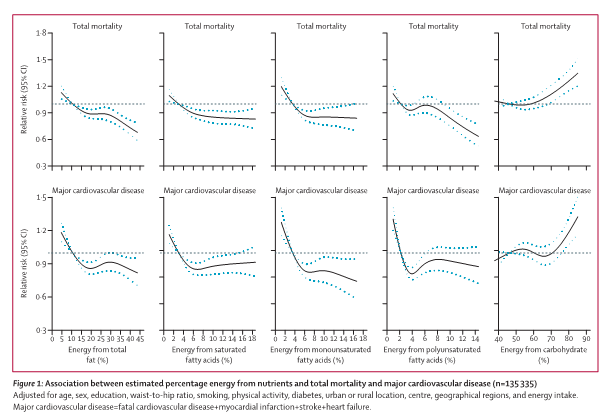
http://dx.doi.org/10.1016/S0140-6736(17)32252-3
135k people worldwide.
Increased dietary fat=decreased mortality.
Increase dietary carbohydrate=increased mortality
Higher dietary saturated fat=reduced risk of stroke
THere’s a catch. Increase fat, but don’t get big belly, diabetes, or too much energy. Only then it works.
Of course, but typically the big belly and diabetes hark from carbohydrates. Ditch the high fructose corn syrup and “chew the fat”.
This is a case of “Do as I say, not as I do”. That said, many people in India don’t eat meat, and they have survived for millenia. “Survived” may well be the key word – they are alive, but not well off. Whether it is because of their diet or other factors, I don’t know. I don’t see any Indian names in the list of authors.
Meat consumption in India, primarily poultry, is increasing slowly and life expectancy in India is also increasing slowly. Both may be related to slowing increasing wealth.
Fried Grasshoppers anyone?
Grasshopper pie aint bad.
Is there anything global warming can’t do??
Nope.
4 things that Global Warming Can’t do…
Make AlGore go away.
Silence the preachers of the Catastrophic AGW dogma.
Show Lewandowski for the conspiracy nut he truly is (everything is a conspiracy with him)
Awaken the Sheeple
It can’t make CO2 levels go down.
When all of the rest of the CAGW crowds catastrophes are shown to be false, for the umpteenth time, I’m sure they will find a way to blame lowering CO2 levels on GW… of course CO2 levels have to go down first (hopefully that won’t happen anytime soon)
I think this is slated for the script of the 13th movie installment of the hunger games series. Right?
Let them eat cake.
Carrot cake.
That’s not a real name but invented by vegetarians to ease their guilt.
Please feed them all the wrong foods. We NEED more global warming. Baby, it is COLD outside. It hasn’t been this cold in years!
Several of the things that got me deleted from a University of Aberdeen ‘food & nutrition’ online course.
1. Not least as alcohol was introduced as a noteworthy source of calories in the human diet.
I dared suggest that doctors says its OK to drink because they themselves are fond of a tipple.
How else would it be OK to allow people to take onboard 30ml or so of a Group 1 carcinogen per day.
Not the alcohol itself, bad enough, but the primary metabolite – acetaldehyde. Very unpleasant stuff that would get supermarket shelves cleared if found in products on those shelves.
Was my deletion fair…..
2. Balanced diet. In view of the fact that in Victorian England, it was possible to hire pineapples.
Not buy them. Borrow for a fee,
Reason being to ‘create an impression’ of wealth, good connections, taste and general well-to-do-ness at your posh party, reception whatever.
Similarly why folks surrounding the court of Elizabeth 1 would get their teeth painted black or removed. So they could appear to ‘be like the Queen’ in that they could afford/obtain refined sugar.
Likewise The Victorian Kitchen Garden usually attached to large wealthy stately piles.
Not so that the residents/owners of said pile(s) could enjoy a Balanced Diet but that they could show off their out-of-season vegetables and exotic fruits at likewise posh dinner parties/events.
All about status. Not health
Is this where the notion of a ‘balanced diet came from – the English Class System?
That got deleted too.
3. Salt – Again to do with the Class System.
Along the lines of
Swank. Money, Elitism. Status. Control.
(I’d left the course then, it was doing me head in)
And we’re missing all through this thread so far – Comfort Food.
You know what is is and what its for.
Because sugar = glucose = carbohydrate releases Dopamine in our brains.
Sugar works on our Reward System. It makes us feel good, warm, fuzzy, happy and content.
No matter what we’ve been up to, carbohydrate will reward us for it.
We could have spent the whole day helping old ladies cross the road and going home to a big plate of pasta will says to us ‘Well done. You did good there”
we could have spent the day racing around in a V8 pickup truck, blowing smoke and mowing down old ladies as they crossed the road.
The big plate of pasta will tell us “Well done, you did good there”
Booze obviously does the same, its just a load more potent. Haven’t we all been guilty of celebrating something good/happy or ‘drowning our sorrows’ Booze covers both. As does sugar
Now, does anyone see how crooks, villains and other mendacious types (esp inside Climate Science) actually do manage to live with themselves?
Also, Dopamine covers up the stress hormone Cortisol.
You get it now?? Why all the fat people?
They’re using Comfort Food.
To alleviate the stress brought on by a greedy boss, an unhappy spouse, a financial calamity and certainly not least, the endless tsunami rules. regulations, advice and guidance coming from the legions of well-intentioned goody goodies that now inhabit every crevice of Government, science and education.
Not for the first time does Government Policy have exactly the opposite effect to that intended.
you saw the fnords!
I would apply to go back on the course and remind them of recent UK government comments about free speech at Universities.
“Not only did Batali incorporate fresh vegetables and herbs from Michelle Obama’s White House Kitchen Garden, but he held a menu tasting with the first lady with dishes he knew were her favorites.
“I know she likes her steak,” Batali said at a preview of the dinner…”
https://www.usatoday.com/story/life/entertainthis/2016/10/18/mario-batali-michelle-obama-white-house-state-dinner-favorite-foods/92348274/
Interestingly, the authors are from the Netherlands, a huge manufacturer and exporter of animal proteins. All thanks to excessive EU subsidies.
This patronizing piece smells like using science to firm your existing trade advantages over your old colonies. Nice.
There is something no one is telling me.
What were the Baby Boomers saying about soy beans, and why is this appearing in everything as a filler? We even found it in tea a week or two ago.
I do know it was a hippy dietary mania at some point, because I was raised with tofu as an egg replacement. I will never get to the bottom of this one unless someone explains it to me.
“Let them eat cake”!
It is difficult to keep up with the self parody the climate extremists provide in their sekf-righteousness.
A lot of cattle feed is the cattle grazing on grasslands. Only a ruminant with four stomachs can turn grass into food, the rest of us would starve to death eating it. Also, grazing is good for the grassland to help maintain the structure and composition of the grassland. A win/win for both the earth and us meat eaters.
I come from Australia, where have huge areas that cannot be used for crops, but can be used for grazing.
I used to work in Indonesia. Indonesians are typically short. Indonesians used to ask, what is the difference in diet that makes there kids short and mine tall. The only difference, nutritionally, was the quantity of meat. It was telling that middle class Indonesians on high meat diets had tall kids.
The article supports my prejudice that the PC crowd are predominantly rich out of touch inner city lefties, who are very down on the poor.
They simply can’t imagine why poor people can’t live well off a small patch of carrots and soy beans.
“Peter December 27, 2017 at 3:21 pm
The article supports my prejudice that the PC crowd are predominantly rich out of touch inner city lefties, who are very down on the poor.”
That is certainly true for Australian green party voters. I have yet to meet a green voter that actually works the land.
You got that right.
It’s not meat per se that’s the issue, it’s complete proteins. That’s the point of the article Nuts and legumes are part of a complete protein; grains are the other – as long as they are whole grains. White rice doesn’t offer that, which is a problem when the diet of poor Indonesians is primarily white rice and veggies. It’s no surprise that adding meat changes things, but the author is saying that it doesn’t have to be meat to still provide balanced nutrition. Height is also dependent on other nutrients, calcium and vitamin A, for instance. Besides, I don’t think the article is recommending vegetarianism.
You are right – you have a prejudice. Changing recommendations to diets that include complete proteins from non-meat sources may be a way of helping the poor get the nutrition they need when they can’t afford meat, quite apart from the environmental impacts.
One of the Paleo arguments is that, seeing as we do not actually know that much about nutrition, we start by modelling on what we ate whilst evolving as humans. So it is not just about B12 this or protein that — there is the whole animal, nose to tail — and one does not have to look at nutrition long before realising it gets real complicated, real fast, with many pathways, and cycles, and basically, it is a highly complex system. And for the past 50 years, the science got not just a detail wrong, but entire food categories, wrong. Backwards even. So wrong that the more health conscious the person, the worse they ended up. So the best help we could probably give, is help people eat what their ancestors ate, as a general rule of thumb. And it is always funny when people have to add adjectives in front of words, like “healthy whole-grains” and “complete proteins” — you can bet that they are having to add that word because it does not actually belong there.
Vitamin B-12.
The only non-animal-derived source I’m aware is brewers yeast.
The symptoms of a vitamin B-12 deficiency can take 5 years to develop. It can resemble schizophrenia.
If you are a strict vegetarian, be sure you are getting B-12. A salad or a soy-burger won’t cut it.
“The study authors don’t suggest how poor people could be discouraged from eating environmentally harmful meat proteins. ” That seems to be the whole point of the article: changing dietary recommendations is the first step. Not the only step, but the author doesn’t contend that. Education would be the next step.
I don’t think the article is advocating vegetarianism, as some here seem to suggest.
oh, you’re right.
raising the specter the planetary destruction by meat is totally not the same as advocating vegetarianism –
where would anybody get that idea?
but it doesn’t really matter what these chubby useless authors think about how poor people should be deprived of food – the main thing is they have somebody who appreciates their wisdom
the point of the article is narcissism on a planetary scale.
if you gathered all their wit into a thimble, it would still just be a drop in the goatse.
Talking about livestock. We had a billboard here in the NW recently with a half-clad female who would rather go topless than “wear wool”.
So if she doesn’t like fibers from coal, oil, conventionally grown cotton or wool — I guess she is trying to tell herself something.
that was saweeeeet! amazing!
i’d settle for a sammich.