Map of the Gila River watershed-drainage basin — located in New Mexico and Arizona. By Kmusser (Self-made, based on USGS data.) [CC BY-SA 2.5], via Wikimedia Commons
Guest essay by Eric Worrall
Lecturer in Physical Geography Michael Singer has noticed that climate hasn’t brought greater precipitation, as Trenberth predicted it would – but he still worries about the impact of climate change on watersheds.
How understanding regional rainstorms will help the world manage climate change
Lecturer in Physical Geography (Hydrology and Geomorphology), Cardiff University
…
There is a theory in physics that tells us that a warmer atmosphere can hold more moisture (~7% more per 1°C increase), so we might expect that places with increasing temperatures will experience more water evaporation from the land, and also experience heavier rainfall. But we don’t have great evidence of more intense rainfall for many places across the world, even though the upward temperature trends are compelling for much of the globe.
It is actually very difficult to observe trends in rainfall, because we often rely on data and model outputs that are at the wrong scales. Global rainfall datasets and output from climate models are typically resolved on timescales of days or months and at spatial scales larger than most river basins.
…
In general, scientists have had a poor understanding of how a warming climate will affect the magnitude, timing, and spatial patterns of rainfall. Yet these aspects of the climate system are fundamental to assess the sustainability of water resources and even flood risks, especially in drier parts of the globe.
…
Several years ago, I came across a rich dataset on rainstorms for a place called Walnut Gulch, a watershed – an area of land that separates waters flowing into different rivers – near the city of Tombstone in south-eastern Arizona. The US Department of Agriculture has been collecting detailed information about every single storm that occurred from 1954 until the present day at 85 separate gauging locations. We already knew temperatures had been rising here, increasing by ~2°C in a matter of decades. And this trove of rainfall data enabled us to examine whether there were trends in rainstorms that corresponded to the rising temperatures.
Map of the Gila River watershed-drainage basin — located in New Mexico and Arizona. By Kmusser (Self-made, based on USGS data.) [CC BY-SA 2.5], via Wikimedia Commons
We were surprised to find that even while total rainfall slightly increased over this period and more rainstorms occurred over time, each storm was less intense and lasted longer. This means that less rainwater has run off the landscape into rivers since the 1950s, so more of the water from the sky has returned to the atmosphere and less of it contributed to regional water resources.
In other words, the theory which predicts heavier (more intense) rainfall due to warming does not hold for this region. We believe it breaks down here and in other dry environments because there is not enough moisture in the landscape to evaporate and satisfy the higher demand of the atmosphere. Our findings also suggest that water resources in this desert region may become increasingly strained due to changes in the regional climate.
…
The rainfall study quoted by Michael Singer is a 2011 Trenberth study;
Changes in precipitation with climate change
Kevin E. Trenberth*
National Center for Atmospheric Research, Box 3000, Boulder, Colorado 80307, USA
*Email: trenbert@ucar.edu
ABSTRACT: There is a direct influence of global warming on precipitation. Increased heating leads to greater evaporation and thus surface drying, thereby increasing the intensity and duration of drought. However, the water holding capacity of air increases by about 7% per 1°C warming, which leads to increased water vapor in the atmosphere. Hence, storms, whether individual thunderstorms, extratropical rain or snow storms, or tropical cyclones, supplied with increased moisture, produce more intense precipitation events. Such events are observed to be widely occurring, even where total precipitation is decreasing: ‘it never rains but it pours!’ This increases the risk of flooding. The atmospheric and surface energy budget plays a critical role in the hydrological cycle, and also in the slower rate of change that occurs in total precipitation than total column water vapor. With modest changes in winds, patterns of precipitation do not change much, but result in dry areas becoming drier (generally throughout the subtropics) and wet areas becoming wetter, especially in the mid- to high latitudes: the ‘rich get richer and the poor get poorer’. This pattern is simulated by climate models and is projected to continue into the future. Because, with warming, more precipitation occurs as rain instead of snow and snow melts earlier, there is increased runoff and risk of flooding in early spring, but increased risk of drought in summer, especially over continental areas. However, with more precipitation per unit of upward motion in the atmosphere, i.e. ‘more bang for the buck’, atmospheric circulation weakens, causing monsoons to falter. In the tropics and subtropics, precipitation patterns are dominated by shifts as sea surface temperatures change, with El Niño a good example. The volcanic eruption of Mount Pinatubo in 1991 led to an unprecedented drop in land precipitation and runoff, and to widespread drought, as precipitation shifted from land to oceans and evaporation faltered, providing lessons for possible geoengineering. Most models simulate precipitation that occurs prematurely and too often, and with insufficient intensity, resulting in recycling that is too large and a lifetime of moisture in the atmosphere that is too short, which affects runoff and soil moisture.
Michael Singer worries that less intense but more frequent rain will reduce available runoff. But the effect of more frequent rainfall on arid regions in a lot of cases is likely to be profound. Intense one off rain events mostly drain away – parched soil often can’t absorb water until it has been soaked repeatedly by rain. But more frequent longer lasting rainfall, in many regions, should make it possible for grasslands and even trees to establish in formerly extremely arid regions. Vegetation tends to establish and protect its own soil moisture – providing there is some moisture available to protect.
Actually, in that area, there has been NO trend. Unless it shot up in the last six years, which I truly doubt.
I took the data from the Tombstone station in 2011 for an exercise in college statistics (which kicked me over to the climate skeptic side). It shows absolutely NO trend from 1880 to 2011, unless you do a fourth order curve fit – and that shows a very slight DOWN trend (although not significant at all).
That was a very good station to use. It was in town, in the same place since 1880, so was read regularly – but the town is just about all wood buildings and dirt streets, for the tourists. Hardly any UHI at all.
Surprise, the station is now gone, as are its records on the web – the “official” records at the closest station are now all from Sierra Vista – which has seen extreme urbanization since about 1995. Now, THAT station has approximately a 1.8C rise showing.
So, for that particular area – bogus data. Rain, I don’t know, I haven’t looked. But the majority of the rain in this part of the country depends not on evaporation from land, but from the Gulf of Mexico – and the jet stream, for how much moisture actually comes up during the monsoon season.
Andy, interestingly they accept that the 30s-mid 40s in the US was pretty warm but US only is, what, 3%of the globe. Well Canada, Greenland,Scandinavia, Europe, Siberia added on are, what, 30% (the distance from Moscow to Vladivostok is the same distance as Moscow to Chicago!). But then I learned the Capetown, South Africa long term raw temperature chart looks just like the US one before fudging and then the Paraguay historical raw temperatures ditto, we can add on two more continents! Here is Capetown’s:
Here’s Capetown, South Africa’s raw temperature chart (also Canada, Greenland, Scandinavia, Europe, Siberia, Paraguay are the same). These corroborate the raw US temperatures giving them status:
“Capetown, South Africa long term raw temperature chart looks just like the US one before fudging”
Capetown needs adjustment. There was a station move from Observatory to the airport in 1961, which us responsible for the dip. But the Observatory continued on, with a diffrent station number. Here (from here) is a plot of the GHCN Cape Town record (in red) with GHCN adjusted (in green), and the continuing Observatory record inblue. Continued warming.
“Doesn’t meet regional expectations ???”
Nothing to do with regional expectations. We know the station moved, and when. And we know what the temperatures would have been without the move, because they were still measured in the old location. The blue curve in the graph. The “adjusted” curve is just the actually observed measures in a single location.
Seriously Nick, almost 1/2 degree of cooling is adjusted to 1/2 degree of warming in the first 40 years of your graph. That accounts for a lot of the overall warming claimed. UHI probably accounts for the rest – just imagine the changes Capetown has seen in the last 150+ years.
WO, “Surprise, the station is now gone, as are its records on the web”
Tombstone, AZ, has not dosappeared from the web. It is a station in GHCN V3, used by all indices. The data sheet page is here. The unadjusted data shows a strong uptrend.
“Seriously Nick, almost 1/2 degree of cooling is adjusted to 1/2 degree of warming “
Hard to see ½° of cooling. But the Cape Town data was claimed to show no warming. And, unadjusted for the Observatory site, it shows plenty. The early adjustment probably allows for the pre-Stevenson screen period.
Just eyeballing it, but either way, there’s more than a full degree of cooling the past in the adjustments. That’s bigger than the adjustment for the station move, as shown in these charts you posted here in January.
Rather spotty record. When you exclude years with more than 14 days of missing data you see trends of increasing temperature and declining precipitation.
This means that less rainwater has run off the landscape into rivers since the 1950s, so more of the water from the sky has returned to the atmosphere and less of it contributed to regional water resources.
…We believe it breaks down here and in other dry environments because there is not enough moisture in the landscape to evaporate and satisfy the higher demand of the atmosphere.
They jump from less measured runoff, to less water in the environment. The exact opposite happens, if less water runs off and more is allowed to soak in the soil, there is more water in the environment.
And it appears the region is actually gaining vegetation. http://www.drroyspencer.com/wp-content/uploads/co2_growth.jpg
Then they take that sophistry and make a belief out of it, which they then use to “make a finding.”
Our findings also suggest that water resources in this desert region may become increasingly strained due to changes in the regional climate.
It’s the complete opposite of empirical observations from deserts around the planet.
Roseanne Rosannadanna (Gilda Radner in early Saturday Night Live skits): “It’s like my daddy always said to me. ‘You know, Roseanne Rosannadanna, it’s always somethin'”
Somebody’s always saying we are “supposed” to have this mythical Goldilocks climate – – not too hot, not too cold, but always just right.
Agree with these comments – Are we supposed to be alarmed if there is ANY change, AT ALL? I suppose we are to assume the only GOOD weather (clouds, wind, rain, whatever…) is CONSTANT, UNCHANGING weather! Anything else is BAD, and the earth and its occupants will be unable to survive it?
Longer, less-intense rainfall events would increase absorption of water by the soil, replenish groundwater, and reduce erosion, compared to the opposite trend. What’s not to like about that??
It appears he doesn’t even consider absorption by the soil …
We were surprised to find that even while total rainfall slightly increased over this period and more rainstorms occurred over time, each storm was less intense and lasted longer. This means that less rainwater has run off the landscape into rivers since the 1950s, so more of the water from the sky has returned to the atmosphere and less of it contributed to regional water resources.
Mmmm … has he not heard of “wells” and the “water table” and the like?
He also doesn’t know how deserts work. Not only is groundwater crucial (think oasis), desert plants like cacti need to soak up and store that water in their tissues. They lost leaves and have waxy exterior photosynthetic surfaces except for their stomata to absolutely minimize evapotranspiration. The cactus spines are protection against animal predators who would otherwise eat cacti for the water content. In fact in west Texas droughts, one trick is to burn off the spines and let cattle munch on the remaining prickly pear pads as a water source.
My thoughts exactly.
I am pretty sure it is considered less beneficial when rain falls hard and fast, particularly on hard dry ground.
What is being described here should also reduce the frequency and severity of flash floods, which kill people every year.
It seems to be literally true that nothing is good news to a “climate scientist”.
“It appears he doesn’t even consider absorption by the soil “
No, that is exactly what he is talking about. It’s standard catchment hydrology. Heavy rain makes a lot of surface runoff which goes into streams. Prolonged rain infiltrates more into the soil, where most of it returns to the air via evapotranspiration. Some gets into streams via water table flow, but that is just a fraction.
Nick, you miss the point. Desert ecology DOES NOT rely on runoff into rivers. It relies on groundwater, whichnrelies on percolation into hot dry baked soil. At least those deserts in Arizona, with which I have more than a passing familiarity. Had a significant Arizona native cactus collection in the sunroom at one point. Even started saguaro cacti from seed and grew them to about 6 inches in two years as giveaways under supplemental grow lighting since sunroom was in Chicago, not Phoenix. And trust me, despite flash floods and impoundment dams on the Salt River, Phoenix and environs would not exist except for the Colorado compact, Lake Powell behind Glen Canyon dam and lake Mead behind Hoover dam, and the Rocky Mountain seasonal snow melt feeding both—which has about zero to do with Hadley cell circulation. This paper shows a fundamental ignorance of regional SW US hydrology. See also the water chapter of my ebook Gaia’s Limits for pictures and more details.
ristvan “Nick, you miss the point. Desert ecology DOES NOT rely on runoff into rivers.”
I didn’t say it did. There is nothing about that in the quote highlighted by Willis. It is just about where rainwater goes, and as they say, it’s heavy rain that fills the rivers and dams. Sustained rain makes more water available to plants, which return it to the air.
“This paper shows a fundamental ignorance of regional SW US hydrology.”
It isn’t a paper, it is an article in the Conversation. The author is a hydrologist who grew up in SW USA. I think he knows what he is talking about.
he grew up there, ergo he knows what he is talking about?
Excuse me, but that sounds like a spectacularly unscientific way to determine veracity.
How about we just stick to what he writes, and weigh that on the merits of the argument?
“OK, so where do you think he displays ignorance?”
Well, first let me say that personally, I am not going to use my extensive experience in growing xerophytic plants, nor my current collection of many dozens of species of cacti, of yucca, of agaves, or of succulents, as evidence that I know what I am talking about.
Or even the fact of having visited this area and camped out there, and seen the rains for myself.
Nope.
Simply the evidence, and the illogic of his conclusions.
There is no good reason to think he is doing anything more that taking a WAG, and then using poor reasoning to arrive at a speculative conclusion.
There are a lot of reasons to be dubious of a persons birthplace, or even their professional credentials, as any sort of evidence that they are correct in all of their pronouncements and ideas.
We all know that those things are completely irrelevant in a scientific frame of reference.
As proof of this assertion, I can point you a whole bunch of people who are from NYC, including a bunch of professional engineers, who are 100% sure that the Twin Towers could not have collapsed from being hit by planes and having fires burn for the short time that it took for the buildings to collapse.
Yep, and the more of the soaking into the ground = less running into the sea = less sea level rise = the more the glaciers can melt, to take up the slack.
Sounds ok to me.
Nick Stokes
December 9, 2017 1:53 pm
“climate hasn’t brought greater precipitation, as Trenberth predicted it would”
Trenberth pointed out that in general warmer atmospheres can hold more water. But he wasn’t predicting more rain in Arizona. From that quote:
” With modest changes in winds, patterns of precipitation do not change much, but result in dry areas becoming drier (generally throughout the subtropics) and wet areas becoming wetter, especially in the mid- to high latitudes: the ‘rich get richer and the poor get poorer’. This pattern is simulated by climate models and is projected to continue into the future.”
Arizona is a classic dry area in the subtropics. In fact, it has long been expected that a belt of landaround 30-35° which relies on W winds for rain will get drier. That is because the Hadley cells, which produce the band of westerly winds around 40° will expand, and move this wind pattern further North.
Well, Trenberth predicts dry areas to become drier. Singer shows that reality in Arizona is more rain.
Confidence in climate models increase? Adjust Arizona to be a rainforest type of landscape?
“Singer shows that reality in Arizona is more rain.”
He’s talking about a specific dataset from Walnut Gulch. He says: “We were surprised to find that even while total rainfall slightly increased over this period…”
It’s probably more complex than that Nick. While Southern Arizona gets frontal storms in the Winter some years, it also gets often violent Summer thunderstorms most years supported by inflows of humid air from the Gulfs of Mexico and California. I’m a bit skeptical that either the frontal storms or the Southwest Monsoon is much influenced by local temperatures in the very arid region. More likely the opposite I should think. On top of which the terrain is anything but flat. Tombstone is at 1383 meters. But the mountains in to the South near Sierra Vista top 2800 meters. They likely have a rain shadow that may affect Tombstone at times.
But, yes, a Northward shift in weather patterns would be a problem for the ever growing population in the US SouthWest. I’m skeptical there is sufficient fresh water averaged over the long run even today to fully support the population AND industry, AND agriculture. The dendrochronology folks tell us there have been numerous multidecade droughts in the region in the past. It’s not entirely clear that those dry spells are linked to temperature, but it’s not clear that they aren’t.
Canada OTOH would likely be a big winner. Second largest nation on the planet and hardly anyone lives there because it’s simply too freaking cold.
Don K “It’s probably more complex than that Nick”
Yes. It probably depends how far west. We have a similar thing in Australia. SW Australia, a big wheat region around 32-36°S, is getting drier. N Australia is getting wetter from the monsoons, which are extending further south. Somewhere in between breaks even.
Here is some of that complexity from a former Arizonan. Phoenix and north ordinarily receives it greatest precipitation in January from the southernmost tails of weather fronts crossing America’s west coast out of the Gulf of Alaska; while Tucson’s wettest month is usually August from monsoonal atmospheric water vapor coming north from the Gulf of California (Sea of Cortez). But while local atmospheric water vapor is an essential ingredient, it must be cooled in order to condense and precipitate. Phoenix’s winter rains occur as a leading moist warm front is overtaken by a cold front; but Tucson’s summer downpours follow the cooling convection of warm ground-heated water vapor laden air up into towering cumulus thunderheads that often also sport lightning.
Now when a multi-decadal “climatic” drift in temperature is referred to, I take it that these are daily averages of both highs and lows. Small problem: If these consist of actually little changed daily highs combined with significantly less cool nighttime lows in those consequently elevated averages, why do we imagine we are thus witnessing desperately soaring trends in baking daytime heat?
Seems to me that over my reasonably long lifetime what lately often passes for “science”, at least as widely portrayed to the public, has been transformed from the reporting of carefully recorded detailed observations into some facile narrative that suits a post-modern lack of care for teasing out resident truths (and lacking the humility to say “actually nobody knows a lot about that yet” but it’s interesting, isn’t it?) in favor of leaving self-aggrandizing impressions of mastery of a field well beyond the solid evidence. Have we become dumb as rocks about all this, or is this actually “anything to make a difference” for the CAUSE that justifies our existence before we drop? America wants to know.
Nick Stokes, from the press release written by climate scientist Michael Singer;
… In other words, the theory which predicts heavier (more intense) rainfall due to warming does not hold for this region. …
I agree Trenberth’s abstract doesn’t appear to say exactly this, but who are we to judge? Surely it would be Dunning Kruger of us to dispute the interpretation of an actual tenured climate scientist.
Don’t be silly, Nick. He’s with the ‘Consensus’ and is making claims to alarm. that makes him a ‘Climate Scientist’ regardless of whether he’s a Hydrologist, Biologist, Psychologist, or Cartoonist.
Now, if he had just found that droughts weren’t getting droughtier and stopped there, then you can bet the Climate Faithful would be coming out of the woodwork to decry that he isn’t a real Climate Scientist with Peer Reviewed papers in Computer Modeled CAGW induced Rainfall Changes, and therefor his opinion is worthless and he’s probably in the pay of the Koch Brothers anyway.
“That is because the Hadley cells, which produce the band of westerly winds around 40° will expand, and move this wind pattern further North.”
It so happens that Arizona gets most of its rain from the summer monsoon which is on the southern side of the Hadley Cell. August is the wettest (=least dry) month in Phoenix.
-Trenberth doesn’t say AZ will get wetter or have more intense storm events
-Singer is a hydrologist and knows what he’s talking about but is surprised to find this part of AZ has gotten wetter (as opposed to what Trenberth claims should happen) and has less intense storm events (apparently showing a poor understanding of what Trenberth claims should happen)
-even though Singer/data and Trenberth come to opposite conclusions for this study area, they agree
-if you still see that Trenberth and Singer/data disagree, then you have to realize that this study area is a tiny one and simply an exception
-hydrologists are not climate scientists, even though Singer claims one of his research subjects is climate change, one of his areas of expertise is climate, climate impacts on hydrology are well-covered by the IPCC, and hydrology has an immense impact on climate
Modern climate science, and those that purport to practice it ( and whom apparently needs lots more practice), is not given to being tied down by any need for consistency or even sticking to one story for long…except for two items: CO2 is bad, and all change is our fault and catastrophically horrible.
John Bell
December 9, 2017 1:53 pm
It is always what ever is worse for the area, more rain, less rain, hotter, colder, more snow, less snow, they have morbid imaginations.
The banal conclusion is that every change happensand all change is bad in the mind of climate conservatives which traditionally are called ‘progressives’ even when they’re not.
Angel Gabriel: “Good news, Debbie. The earth has been restored to perfection and you can live in everlasting joy.”
Debbie Downer, the Carbon Sinner: “We’re really going to have to pay for all of this happiness someday.”
My mother told me that in her youth in Yorkshire the standard response to “what a beautiful day!” was “we shall pay for it later!”. A mindset brilliantly captured by Monty Python.
Richard
December 9, 2017 1:57 pm
Before the coming of the Great Satan, humanity, earth was static and unchanging. Therefore every change is bad, because Earth was perfect before.
I’m looking forward to reading how terrible for earth’s myriad ecosystems that topical cyclones have declined in number. And intensity.
Well, technically, from a Biblical viewpoint, that is correct. Until Satan showed up, we were in the Garden of Eden. Oh, wait, you meant “the Great Satan” as in human beings…….
AndyG55
December 9, 2017 1:58 pm
If its from “climate models”
The chances of this “prediction” being correct are less than the toss of a coin.
Eric Simpson
December 9, 2017 1:58 pm
More frequent less intense rain is a problem.
And so is less frequent more intense rainfall. And drought. And abnormally extended periods of just totally normal amounts of rain. A joke.
And we need to campaign to get back to using “global warming” versus all the climate stuff.
I see nothing wrong with this group of posters using anecdotal data from real world gardening/ranching/fishing/hunting experiences gathered over a half a century or more. After all, it was observed phenomena and not produced by a model. Granted, the sample size is small, and there may be biases as we see from the warmists, but what the hell.
Gums
Bruce Cobb
December 9, 2017 1:59 pm
No matter what happens, we’re doomed. Because climate change.
markl
December 9, 2017 2:01 pm
Want to get published? Just mention Climate Change in whatever you’re writing.
Old44
December 9, 2017 2:03 pm
Obviously Michael Singer doesn’t live in Melbourne.
These articles are straying far too deep into the weeds. What does understanding regional rainstorms have to do with the price of tea in China? It has about the same merit as studying butterflies in Brazil to predict tornadoes in Texas and counting the number of polar bears dancing on ice floes. Focus on the understanding the basics. Can a chaotic event be predicted? All the other nonsense is noise. Working in the noise window is a waste of time and money.
Recently in southern Australia, there have been less frequent more Intense rainfalls which have not been an unusual problem, so I guess it depends on where you are at the time, as to what you think of it all.
“There is a theory in physics that tells us that a warmer atmosphere can hold more moisture (~7% more per 1°C increase), so we might expect that places with increasing temperatures will experience more water evaporation from the land, and also experience heavier rainfall.”
I thought this was why the Sahara was green some 8,000 years ago, because the world was warmer than now. And being greener and wetter with moisture to evaporate would mean local temperatures would be lower. Is that not so?
Extreme Hiatus
December 9, 2017 2:37 pm
“Claim: More Frequent Less Intense Rainfall is Now a Problem”
Wow, these new ‘scientific discoveries’ are becoming increasingly ridiculous. So now we have the more or less frequent and more or less intense rainfall theory of CAGW impacts. That pretty much covers everything.
I look forward to the ‘discovery’ that The Warming makes rain more wet, or less wet, or both.
F. Leghorn
December 9, 2017 2:37 pm
Are these people intentionally trying to out-stupid each other? Because they are succeeding in spectacular fashion.
To be accepted into the academic warmunist priesthood, you have to have scary research findings. All the low hanging fruit was picked long ago, stuff like more extremes, accelerating sea level rise, polar bears. So now the wanna be’s are into even more absurd second and third order stuff like this. For another example, see my Totten Glacier post over at Climate Etc. Or essays Last Cup of Coffee and Greenhouse Effects in ebook Blowing Smoke.
I thought this one about The Warming causing Australian lizards to become more stupid was pretty good. Now we have an exciting new threat called “mental dimming,” as reported in the ‘prestigious’ National Geographic:
“Reptiles were already facing steep odds from climate change—it’s estimated that one-fifth of all lizard species could be extinct by 2080. Mental dimming could further stack the deck.”
EH, yup, you spotted another great example in the mental dimming of bearded lizards paper. Talk about shoddy science. I recall JoNova shredded that one pretty thoroughly, now that you mention it.
“Reptiles were already facing steep odds from climate change—it’s estimated that one-fifth of all lizard species could be extinct by 2080. Mental dimming could further stack the deck.”
Well, it is true that something caused some problems for reptiles in the Cretaceous — which is believed to have been pretty warm, Of course, it took 80 million years to kill them off and snakes and lizards were among the survivors of the K-T extinction event. So maybe Australia’s lizards have some hope of lasting beyond 2080.
(BTW, how does one distinguish a stupid lizard from a smart lizard?)
“(BTW, how does one distinguish a stupid lizard from a smart lizard?)”
Excellent point Don K. Given how potentially catastrophic this may be there’s clearly an urgent need for massive funding to research this emerging problem. And since The Warming is the obvious cause, there should be plenty of cash available for this.
I am actually a bit confused by this disturbing news. In my experience with lizards and other reptiles I have found them to appear more stupid when its colder. Indeed, on a very cold day they often just sit there, motionless, with a vacant stare, even when approached. They appear to be morons. But then, as they say, ‘still waters run deep’ and they may simply be pondering the meaning of the universe or something.
Just this week I read that the K-T Boundary is now called the Cretaceous–Paleogene boundary. LINK to wikipedia
…and elsewhere: The Tertiary is no longer recognized as a formal unit by the International Commission on Stratigraphy, but the word is still widely used. The traditional span of the Tertiary has been divided between the Paleogene and …
I can’t keep up with this stuff. My old texts have to go.
Hysterically funny tombstone from Tombstone. Dunno if real or fake.
I just gave my two Army/Navy replica black powder civil war Colt .44 revolvers to my brothers middle son. A present rewarding his newly minted PhD in mathematics on a subject in topology that I definitely and totally do not understand after a two hour dissertation discussion at this years just past farm deer hunt. Kit Complete with bullet moulds, powder flasks, cappers, nipple wrenches and extra nipples, and a loading stand, all in a presentation box. Had to spend half a day teaching the young mathematician how to load and fire those things in my farm quarry rifle range. He was thrilled—and surprised how accurate they were. (No Les, No More). I educated yet another of the next generation in ways of the past. He had previously learned at my farm the utility of a peavy in making firewood from logs using chain saws and splitting axes. He has yet to learn how to run the diesel tractor and logging chains that brought the logs to the firewood production spot by the cabin.
“Lecturer in Physical Geography Michael Singer has noticed that climate hasn’t brought greater precipitation, as Trenberth predicted it would.”
As a Lukewarmer I’d expect there would have to be more precipitation if there were global warming. So if there is no moreprecipiatation I can only think of 2 possibilities 1) It’s not being measured correctly or 2) It hasn’t warmed and the temperature record is wrong (or manipulated into insanity).
Nigel S
December 9, 2017 3:42 pm
The quality of mercy is not strained;
It droppeth as the gentle rain from heaven
Upon the place beneath. It is twice blest;
It blesseth him that gives and him that takes:
‘Under the rocks, and stones there is water underground’
Nigel thanks for the Talking Heads ref. Gonna have that in my head all night now. (that’s a good thing 🙂
Gabro
December 9, 2017 3:53 pm
We know how warmer climate affects rainfall, because of the Holocene Climatic Optimum, which was at least 2 degrees C warmer than now globally. Probably more.
The good news is that it was better then than now for humans and other living things. Also during the previous interglacial, the Eemian, which was even balmier.
As an operational meteorologist, I have observed a noteworthy increase in high end rain events in the Midwest over the past 35 years. As evidence, I did a comprehensive study to use in an insurance claim(that resulted in a $15,000 settlement in my favor) for the Paducah Kentucky area of responsibility. The data below is for Evansville IN, going back to 1897. This is where I live:
Evansville IN Spring March-May
Top 10 Wettest
Rank Precipitation (inches) Year
1 25.48 2008-wettest ever for any season
2 25.01 2011-2nd wettest ever for any season
3 24.34 1996
4 23.46 1983
5 22.42 1927
6 22.10 1935
7 21.63 1995
8 21.45 1961
9 20.48 2002
10 19.74 1897
*6 of the top 10 wettest occurred since 1981
*The top 4 wettest since 1981
*The 2 wettest Springs since 1897 were in the past 10 years and these were also the 2 wettest seasons ever.
Up until 1981 Evansville had only exceeded 23 inches of rain in a season 1 time, during Winter of 1949-1950. Just since 1981, Evansville has exceeded 23 inches of rain 4 times.
++++++++++++++++++++++++++++++++++++++++++++++
Evansville IN Summer June-August
*6 of the top 10 wettest since 1981
*The 2 wettest were in the last 10 years going back to 1897
*3 wettest in the last 20 years
+++++++++++++++++++++++++++
*Note 1936-1937. This which included record rains in January 1937 and the historic flooding on the Ohio River that year.
*Only 2 of the top 10 have occurred since 1981
*Recent Winters, unlike the other 3 seasons of the year(especially Spring), have not featured much heavier precipitation in this area.
This data is only for one location but it confirms what I knew already from continual observations of the US Cornbelt and surrounding areas since the 1980’s.
Interestingly, I believe that part of the increase in precipitation during the growing season is the result of a “micro climate” created by many tens of millions of acres of tightly packed rows of corn(twice as dense as 4 decades ago) that contribute significantly to low level moisture from the increase in evapotranspiration.
This has also resulted in warmer minimums at night, with the elevated dewpoints. Astute NWS forecasters, aware of this dynamic, will sometimes adjust the local forecast to account for what stage the corn plants are in.
“GIVEN THE PEAK EVAPOTRANSPIRATION SETTING IN FOR THE CROPS AS CORN BEGINS TO TASSEL AND POLLINATE…MUCH MOISTURE WILL BE ADDED TO THE AIR AS WELL. WILL SEE DEWPOINTS LIKELY INTO THE LOWER 80S DURING THE WEEK…ESPECIALLY IN THE AFTERNOON AND EVENING HOURS.”
I would say that when this effect is maximized, in late June and July, dew points across half a dozen states will be elevated by 5 deg. F or more.
This is a different kind of human caused climate change. Is it detrimental?
I think it has reduced extreme heat/day time max’s and increased rains to the benefit of the crops.
Lows at night that stay well above 70, however during and especially after pollination(during kernel fill) cause accelerated maturation(often referred to as heat fill) which means the corn plant does not have as much time to fill kernels.
The longer it takes to mature after pollination, the more time and energy can be diverted into filling kernels(and the plumper they get)……….with the exception of an early damaging freeze that is an extraordinarily rare event(1 out of 25 years for a state like Indiana).
Despite the slight increase in heat fill in corn plantsfrom elevated night time temperatures(causing smaller kernels in some years, at some locations) and an increase in heavy down pours, the weather and climate for growing corn, especially when we dial in the additional CO2 over the past 4 decades has clearly been the best in at least 1,000 years…………when temperatures were likely similar.
Going from 1988 to 2012 between major widespread droughts in the Cornbelt was a record 24 consecutive seasons. Record corn and soybean production/yields continue to exceed expectations, not in spite of but because of “climate change”.
Boy, do I remember the ‘88 drought. Had just bought my Wisconsin dairy farm three years before. A Timber cruiser hoping for city boy luck came through winter before and offered $1000 per bole for 12 old mature white oaks on the off-odd 40 acres across from the ~1880s cabin core of the farmhouse. (white oaks are furniture wood plus crowns for bathroom tissue. Older ones are tall and straight and thick, ideal for furniture). I turned him down since already loved that little hunting section, not more than a few acres total. That summer drought, oak wilt set in on all 12 old stand trees and over the next year killed them all, Most expensive firewood I ever laid in on the farm—but lots of it. Next most expensive was a whole truckload of wild black cherry downed by a winter ice storm the next year. Had the cherry boles snaked out with tractor and logging chains and stacked as carefully measured 8’ pluss logs. Problem was, ‘only’ one semi truck load, so the logging company passed on expense of pickup. Made some beautiful furniture and firewood. A second dairy farm learning experience. There were many more this past 30 plus years.
Well it has been documented that urbanization tends to increase rainfall thanks to the urban heat island effect and possibly aerosols. The effect tends to be downwind, of course.
Can storms moving west-to-east across St. Louis (which seems to be the normal flow) affect Evansville? Enhanced by the St. Louis UHI and greater Mississippi River flows?
BallBounces
December 9, 2017 4:01 pm
IOW, the theory which predicts heavier (more intense) rainfall due to warming does not hold water.
prjindigo
December 9, 2017 4:02 pm
Isn’t a lack of increased rainfall proof that climate change isn’t happening?
The rainfall in Arizona is a no-brainer. It was, is, and will always be a desert climate in areas below 6000 feet MSL.
Local evaporation like you might get in Florida or the tropics of course is not involved in the precipitation production here in Arizona. The air is too dry.
The bulk of Arizona’s rainfall comes in atmospheric river-like flows from the Pacific. There has long been recognized a pressure pattern see-saw between the desert SW and the Pacific NW.
When Seattle to Portland is experiencing well below normal rainfall, the SW US is almost always getting drenched. And vice versa, like now.
If it’s less there, it’s more here.
Hence, my connection to the Tombstone grave marker “no Les, no more” pun.
But one also has to understand the role of surface heating that drives the unstable atmospheric lifting during monsoons in July-August. When sufficient moisture is pumped in from the Pacific during those months, the SW surface thermal heating drives explosive convective growth.
“parched soil often can’t absorb water until it has been soaked repeatedly by rain.’
Eric, I disagree with you at least here in Arizona. The rain water and snow meltwaters do mostly soak into the deep sandy soils to recharge the valley aquifers. The countless streams that flow out of the mountains and hills drains into sandy and rocky soil channels and disappears to the aquifers. The Spanish call the dry sandy river beds “arroyos.” The gringo name for them is “washes”.
130 years ago here in Arizona the aquifers in the valleys were only a few dozen feet below ground. Those rivers and larger streams like the Santa Cruz and San Pedro (and the now-dry Rillito River which flows to the Santa Cruz at Tucson), which were the lowest channels in the generally north running valleys to the Gila River were almost perennial flows. But ground water pumping and pumping for the mines has changed all that, forever. (Or at least until humans are no longer pumping the ground water.)
The mountains in Southern Arizona extend up to 9,000 feet plus (Mt Graham is just over 10,000ft). The valleys are filled to about 5,000 feet thick layers of sediments. Some places they extend down to almost 10,000 feet of sediments below the current day surface. Water fills the pore space. http://www.desertmuseum.org/images/nh_tucson_origin.gif
There is a vast amount of water under the sands and gravel deposits in the gravel filled valleys of So Arizona. Below a certain level (~1,000 feet) though the ground water turns too mineral- and salt-laden for fresh water use.
This all goes back to what geologists understand about how environments form over deep time. That is something that is lost on a physicist like Michael Singer. He sees the present, and doesn’t understand that knowing the deep past tells us that modern climate change is just very likely at natural variation.
But then there’s no sensationalist stories and/or grant money in a natural variation explanation of current day climate.


“It is actually very difficult to observe trends in rainfall..”
…well yeah, when you start off with this
“even though the upward temperature trends are compelling for much of the globe.”
….what happened to the pause/hiatus?
These morons are all over the place……no wonder
Their timeframe is “since 1954” (i.e., about sixty years). Over that time period I would not dispute their claim that there’s been an upward temperature trend:
http://www.woodfortrees.org/plot/hadcrut4gl/from:1954/plot/best/from:1954/offset:0.5/plot/gistemp/from:1954/offset:1/plot/crutem4vgl/from:1954/offset:1.5
Since 1940, might be a different matter
And please, no HadCrud graphs…. unreliable for the 1940’s due to agenda driven data changes.
true….still annoys me though…they might have good news, and it’s still bad news
Actually, in that area, there has been NO trend. Unless it shot up in the last six years, which I truly doubt.
I took the data from the Tombstone station in 2011 for an exercise in college statistics (which kicked me over to the climate skeptic side). It shows absolutely NO trend from 1880 to 2011, unless you do a fourth order curve fit – and that shows a very slight DOWN trend (although not significant at all).
That was a very good station to use. It was in town, in the same place since 1880, so was read regularly – but the town is just about all wood buildings and dirt streets, for the tourists. Hardly any UHI at all.
Surprise, the station is now gone, as are its records on the web – the “official” records at the closest station are now all from Sierra Vista – which has seen extreme urbanization since about 1995. Now, THAT station has approximately a 1.8C rise showing.
So, for that particular area – bogus data. Rain, I don’t know, I haven’t looked. But the majority of the rain in this part of the country depends not on evaporation from land, but from the Gulf of Mexico – and the jet stream, for how much moisture actually comes up during the monsoon season.
Andy, interestingly they accept that the 30s-mid 40s in the US was pretty warm but US only is, what, 3%of the globe. Well Canada, Greenland,Scandinavia, Europe, Siberia added on are, what, 30% (the distance from Moscow to Vladivostok is the same distance as Moscow to Chicago!). But then I learned the Capetown, South Africa long term raw temperature chart looks just like the US one before fudging and then the Paraguay historical raw temperatures ditto, we can add on two more continents! Here is Capetown’s:

Andy, my response to you wound up somewhere else (near the bottom):
Gary Pearse
December 9, 2017 at 4:19 pm
Here’s Capetown, South Africa’s raw temperature chart (also Canada, Greenland, Scandinavia, Europe, Siberia, Paraguay are the same). These corroborate the raw US temperatures giving them status:
Oops mods, screwed up.
“Capetown, South Africa long term raw temperature chart looks just like the US one before fudging”

Capetown needs adjustment. There was a station move from Observatory to the airport in 1961, which us responsible for the dip. But the Observatory continued on, with a diffrent station number. Here (from here) is a plot of the GHCN Cape Town record (in red) with GHCN adjusted (in green), and the continuing Observatory record inblue. Continued warming.
Australian temperatures were higher in the 1930s until the Bureau of Meteorology “homogenized” them down.
“Capetown needs adjustment”
Of course it does, Nick..
Doesn’t meet regional expectations ???
And we all know exactly which way that “adjustment™” would HAVE to be.

managing that which is unmanageable. yep.
“Doesn’t meet regional expectations ???”
Nothing to do with regional expectations. We know the station moved, and when. And we know what the temperatures would have been without the move, because they were still measured in the old location. The blue curve in the graph. The “adjusted” curve is just the actually observed measures in a single location.
Adjusting for that 1961 move seems to have had a dramatic effect on the 19th century trend.
Seriously Nick, almost 1/2 degree of cooling is adjusted to 1/2 degree of warming in the first 40 years of your graph. That accounts for a lot of the overall warming claimed. UHI probably accounts for the rest – just imagine the changes Capetown has seen in the last 150+ years.
WO,
“Surprise, the station is now gone, as are its records on the web”
Tombstone, AZ, has not dosappeared from the web. It is a station in GHCN V3, used by all indices. The data sheet page is here. The unadjusted data shows a strong uptrend.
“Seriously Nick, almost 1/2 degree of cooling is adjusted to 1/2 degree of warming “
Hard to see ½° of cooling. But the Cape Town data was claimed to show no warming. And, unadjusted for the Observatory site, it shows plenty. The early adjustment probably allows for the pre-Stevenson screen period.
“Hard to see ½° of cooling.”
Just eyeballing it, but either way, there’s more than a full degree of cooling the past in the adjustments. That’s bigger than the adjustment for the station move, as shown in these charts you posted here in January.

Writing Observer:
The Tombstone station is still reporting, as it apparently has since 1893 (not 1880):
https://www.ncdc.noaa.gov/cdo-web/datasets/GHCND/stations/GHCND:USC00028619/detail
Rather spotty record. When you exclude years with more than 14 days of missing data you see trends of increasing temperature and declining precipitation.
But the hiatus, like all things caused by CAGW, is extreme. That’s why everything is still so “weird” and unprecedented and worse than we thought.
Forgot to note, my comment was in response to Latitude’s “….what happened to the pause/hiatus?”
I agree.
They jump from less measured runoff, to less water in the environment. The exact opposite happens, if less water runs off and more is allowed to soak in the soil, there is more water in the environment.
And it appears the region is actually gaining vegetation.
http://www.drroyspencer.com/wp-content/uploads/co2_growth.jpg
Then they take that sophistry and make a belief out of it, which they then use to “make a finding.”
It’s the complete opposite of empirical observations from deserts around the planet.
So the California Oroville dam spillway disaster was caused by not enough rain ??
Got it ! I just knew there had to be a simple explanation.
G
No, but on the belief of less rain!
That might also explain why fires are out of control in California–they anticipated less rain, hence less vegetation, and certainly less fires.
The exact opposite appears to have happened–more rain on the land, which caused more vegetation to grow, and that produced more fuel for the fires.
Homes are destroyed and the overall loss is staggering!
Stupid conclusions that conform to a pre-determined theology can have serious and demonstrable consequences!
I prefer my porridge just so. Anything else is global warming.
Roseanne Rosannadanna (Gilda Radner in early Saturday Night Live skits): “It’s like my daddy always said to me. ‘You know, Roseanne Rosannadanna, it’s always somethin'”
Somebody’s always saying we are “supposed” to have this mythical Goldilocks climate – – not too hot, not too cold, but always just right.
But Mother Nature never read Goldilocks
CHANGE is the only constant
Agree with these comments – Are we supposed to be alarmed if there is ANY change, AT ALL? I suppose we are to assume the only GOOD weather (clouds, wind, rain, whatever…) is CONSTANT, UNCHANGING weather! Anything else is BAD, and the earth and its occupants will be unable to survive it?
Longer, less-intense rainfall events would increase absorption of water by the soil, replenish groundwater, and reduce erosion, compared to the opposite trend. What’s not to like about that??
Its not scary.
It might let food grow in the desert.
It appears he doesn’t even consider absorption by the soil …
Mmmm … has he not heard of “wells” and the “water table” and the like?
w.
He also doesn’t know how deserts work. Not only is groundwater crucial (think oasis), desert plants like cacti need to soak up and store that water in their tissues. They lost leaves and have waxy exterior photosynthetic surfaces except for their stomata to absolutely minimize evapotranspiration. The cactus spines are protection against animal predators who would otherwise eat cacti for the water content. In fact in west Texas droughts, one trick is to burn off the spines and let cattle munch on the remaining prickly pear pads as a water source.
My thoughts exactly.
I am pretty sure it is considered less beneficial when rain falls hard and fast, particularly on hard dry ground.
What is being described here should also reduce the frequency and severity of flash floods, which kill people every year.
It seems to be literally true that nothing is good news to a “climate scientist”.
“It appears he doesn’t even consider absorption by the soil “
No, that is exactly what he is talking about. It’s standard catchment hydrology. Heavy rain makes a lot of surface runoff which goes into streams. Prolonged rain infiltrates more into the soil, where most of it returns to the air via evapotranspiration. Some gets into streams via water table flow, but that is just a fraction.
Nick, you miss the point. Desert ecology DOES NOT rely on runoff into rivers. It relies on groundwater, whichnrelies on percolation into hot dry baked soil. At least those deserts in Arizona, with which I have more than a passing familiarity. Had a significant Arizona native cactus collection in the sunroom at one point. Even started saguaro cacti from seed and grew them to about 6 inches in two years as giveaways under supplemental grow lighting since sunroom was in Chicago, not Phoenix. And trust me, despite flash floods and impoundment dams on the Salt River, Phoenix and environs would not exist except for the Colorado compact, Lake Powell behind Glen Canyon dam and lake Mead behind Hoover dam, and the Rocky Mountain seasonal snow melt feeding both—which has about zero to do with Hadley cell circulation. This paper shows a fundamental ignorance of regional SW US hydrology. See also the water chapter of my ebook Gaia’s Limits for pictures and more details.
Does Nick actually think that streamflow and the amount of water in man made reservoirs dictates regional precipitation?
ristvan
“Nick, you miss the point. Desert ecology DOES NOT rely on runoff into rivers.”
I didn’t say it did. There is nothing about that in the quote highlighted by Willis. It is just about where rainwater goes, and as they say, it’s heavy rain that fills the rivers and dams. Sustained rain makes more water available to plants, which return it to the air.
“This paper shows a fundamental ignorance of regional SW US hydrology.”
It isn’t a paper, it is an article in the Conversation. The author is a hydrologist who grew up in SW USA. I think he knows what he is talking about.
he grew up there, ergo he knows what he is talking about?
Excuse me, but that sounds like a spectacularly unscientific way to determine veracity.
How about we just stick to what he writes, and weigh that on the merits of the argument?
“he grew up there, ergo he knows what he is talking about”
And Rud grows cactus. OK, so where do you think he displays ignorance?
Also my thoughts. A greater proportion of heavy rain runs off, so more evenly spread rainfall will contribute more to aquifers / water tables.
“OK, so where do you think he displays ignorance?”
Well, first let me say that personally, I am not going to use my extensive experience in growing xerophytic plants, nor my current collection of many dozens of species of cacti, of yucca, of agaves, or of succulents, as evidence that I know what I am talking about.
Or even the fact of having visited this area and camped out there, and seen the rains for myself.
Nope.
Simply the evidence, and the illogic of his conclusions.
There is no good reason to think he is doing anything more that taking a WAG, and then using poor reasoning to arrive at a speculative conclusion.
There are a lot of reasons to be dubious of a persons birthplace, or even their professional credentials, as any sort of evidence that they are correct in all of their pronouncements and ideas.
We all know that those things are completely irrelevant in a scientific frame of reference.
As proof of this assertion, I can point you a whole bunch of people who are from NYC, including a bunch of professional engineers, who are 100% sure that the Twin Towers could not have collapsed from being hit by planes and having fires burn for the short time that it took for the buildings to collapse.
Exactly. Common sense.
Yep, and the more of the soaking into the ground = less running into the sea = less sea level rise = the more the glaciers can melt, to take up the slack.
Sounds ok to me.
“climate hasn’t brought greater precipitation, as Trenberth predicted it would”
Trenberth pointed out that in general warmer atmospheres can hold more water. But he wasn’t predicting more rain in Arizona. From that quote:
” With modest changes in winds, patterns of precipitation do not change much, but result in dry areas becoming drier (generally throughout the subtropics) and wet areas becoming wetter, especially in the mid- to high latitudes: the ‘rich get richer and the poor get poorer’. This pattern is simulated by climate models and is projected to continue into the future.”
Arizona is a classic dry area in the subtropics. In fact, it has long been expected that a belt of landaround 30-35° which relies on W winds for rain will get drier. That is because the Hadley cells, which produce the band of westerly winds around 40° will expand, and move this wind pattern further North.
Perhaps, but Arizona also gets significant rain during their annual monsoon, when winds reverse and come from the southeast and south.
True. PHX is actually just fractionally above the traditional desert level of precip, ie 8″.
Average annual precipitation – rainfall: 8.04 inch
Days per year with precipitation – rainfall: 36 days
Well, Trenberth predicts dry areas to become drier. Singer shows that reality in Arizona is more rain.
Confidence in climate models increase? Adjust Arizona to be a rainforest type of landscape?
“Singer shows that reality in Arizona is more rain.”
He’s talking about a specific dataset from Walnut Gulch. He says:
“We were surprised to find that even while total rainfall slightly increased over this period…”
It’s probably more complex than that Nick. While Southern Arizona gets frontal storms in the Winter some years, it also gets often violent Summer thunderstorms most years supported by inflows of humid air from the Gulfs of Mexico and California. I’m a bit skeptical that either the frontal storms or the Southwest Monsoon is much influenced by local temperatures in the very arid region. More likely the opposite I should think. On top of which the terrain is anything but flat. Tombstone is at 1383 meters. But the mountains in to the South near Sierra Vista top 2800 meters. They likely have a rain shadow that may affect Tombstone at times.
But, yes, a Northward shift in weather patterns would be a problem for the ever growing population in the US SouthWest. I’m skeptical there is sufficient fresh water averaged over the long run even today to fully support the population AND industry, AND agriculture. The dendrochronology folks tell us there have been numerous multidecade droughts in the region in the past. It’s not entirely clear that those dry spells are linked to temperature, but it’s not clear that they aren’t.
Canada OTOH would likely be a big winner. Second largest nation on the planet and hardly anyone lives there because it’s simply too freaking cold.
Don K
“It’s probably more complex than that Nick”
Yes. It probably depends how far west. We have a similar thing in Australia. SW Australia, a big wheat region around 32-36°S, is getting drier. N Australia is getting wetter from the monsoons, which are extending further south. Somewhere in between breaks even.
Here is some of that complexity from a former Arizonan. Phoenix and north ordinarily receives it greatest precipitation in January from the southernmost tails of weather fronts crossing America’s west coast out of the Gulf of Alaska; while Tucson’s wettest month is usually August from monsoonal atmospheric water vapor coming north from the Gulf of California (Sea of Cortez). But while local atmospheric water vapor is an essential ingredient, it must be cooled in order to condense and precipitate. Phoenix’s winter rains occur as a leading moist warm front is overtaken by a cold front; but Tucson’s summer downpours follow the cooling convection of warm ground-heated water vapor laden air up into towering cumulus thunderheads that often also sport lightning.
Now when a multi-decadal “climatic” drift in temperature is referred to, I take it that these are daily averages of both highs and lows. Small problem: If these consist of actually little changed daily highs combined with significantly less cool nighttime lows in those consequently elevated averages, why do we imagine we are thus witnessing desperately soaring trends in baking daytime heat?
Seems to me that over my reasonably long lifetime what lately often passes for “science”, at least as widely portrayed to the public, has been transformed from the reporting of carefully recorded detailed observations into some facile narrative that suits a post-modern lack of care for teasing out resident truths (and lacking the humility to say “actually nobody knows a lot about that yet” but it’s interesting, isn’t it?) in favor of leaving self-aggrandizing impressions of mastery of a field well beyond the solid evidence. Have we become dumb as rocks about all this, or is this actually “anything to make a difference” for the CAUSE that justifies our existence before we drop? America wants to know.
Nick Stokes, from the press release written by climate scientist Michael Singer;
I agree Trenberth’s abstract doesn’t appear to say exactly this, but who are we to judge? Surely it would be Dunning Kruger of us to dispute the interpretation of an actual tenured climate scientist.
“to dispute the interpretation of an actual tenured climate scientist”
He’s actually a hydrologist.
Don’t be silly, Nick. He’s with the ‘Consensus’ and is making claims to alarm. that makes him a ‘Climate Scientist’ regardless of whether he’s a Hydrologist, Biologist, Psychologist, or Cartoonist.
Now, if he had just found that droughts weren’t getting droughtier and stopped there, then you can bet the Climate Faithful would be coming out of the woodwork to decry that he isn’t a real Climate Scientist with Peer Reviewed papers in Computer Modeled CAGW induced Rainfall Changes, and therefor his opinion is worthless and he’s probably in the pay of the Koch Brothers anyway.
~¿~
“That is because the Hadley cells, which produce the band of westerly winds around 40° will expand, and move this wind pattern further North.”
It so happens that Arizona gets most of its rain from the summer monsoon which is on the southern side of the Hadley Cell. August is the wettest (=least dry) month in Phoenix.
“August is the wettest (=least dry) month in Phoenix.”
Just. The weather data is here. 110 of the annual 204 mm fall Nov-March.
It may be a totally different story in other areas nearby.
In Summer, there are thunderstorms over the mountains around there nearly every afternoon.
So let’s summarize…
-Trenberth doesn’t say AZ will get wetter or have more intense storm events
-Singer is a hydrologist and knows what he’s talking about but is surprised to find this part of AZ has gotten wetter (as opposed to what Trenberth claims should happen) and has less intense storm events (apparently showing a poor understanding of what Trenberth claims should happen)
-even though Singer/data and Trenberth come to opposite conclusions for this study area, they agree
-if you still see that Trenberth and Singer/data disagree, then you have to realize that this study area is a tiny one and simply an exception
-hydrologists are not climate scientists, even though Singer claims one of his research subjects is climate change, one of his areas of expertise is climate, climate impacts on hydrology are well-covered by the IPCC, and hydrology has an immense impact on climate
Modern climate science, and those that purport to practice it ( and whom apparently needs lots more practice), is not given to being tied down by any need for consistency or even sticking to one story for long…except for two items: CO2 is bad, and all change is our fault and catastrophically horrible.
It is always what ever is worse for the area, more rain, less rain, hotter, colder, more snow, less snow, they have morbid imaginations.
The banal conclusion is that every change happensand all change is bad in the mind of climate conservatives which traditionally are called ‘progressives’ even when they’re not.
Progressives oppose any change other than the one they fight for.
And the change they oppose the most is changing their minds, at least for the better. It is always worse.
Angel Gabriel: “Good news, Debbie. The earth has been restored to perfection and you can live in everlasting joy.”
Debbie Downer, the Carbon Sinner: “We’re really going to have to pay for all of this happiness someday.”
Sad Trombone: “Wah wah”
My mother told me that in her youth in Yorkshire the standard response to “what a beautiful day!” was “we shall pay for it later!”. A mindset brilliantly captured by Monty Python.
Before the coming of the Great Satan, humanity, earth was static and unchanging. Therefore every change is bad, because Earth was perfect before.
I’m looking forward to reading how terrible for earth’s myriad ecosystems that topical cyclones have declined in number. And intensity.
Well, technically, from a Biblical viewpoint, that is correct. Until Satan showed up, we were in the Garden of Eden. Oh, wait, you meant “the Great Satan” as in human beings…….
If its from “climate models”
The chances of this “prediction” being correct are less than the toss of a coin.
More frequent less intense rain is a problem.
And so is less frequent more intense rainfall. And drought. And abnormally extended periods of just totally normal amounts of rain. A joke.
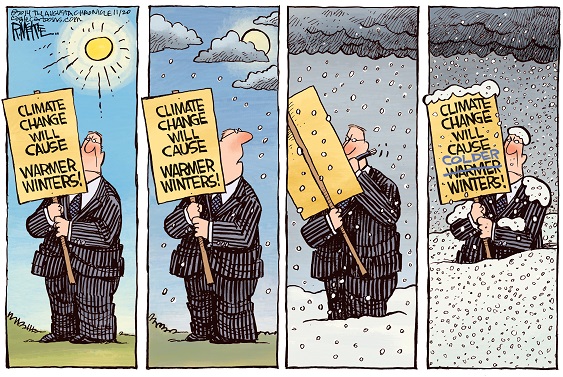
A poor mans Tim Flannery.
Outstanding!
And we need to campaign to get back to using “global warming” versus all the climate stuff.
I see nothing wrong with this group of posters using anecdotal data from real world gardening/ranching/fishing/hunting experiences gathered over a half a century or more. After all, it was observed phenomena and not produced by a model. Granted, the sample size is small, and there may be biases as we see from the warmists, but what the hell.
Gums
No matter what happens, we’re doomed. Because climate change.
Want to get published? Just mention Climate Change in whatever you’re writing.
Obviously Michael Singer doesn’t live in Melbourne.
These articles are straying far too deep into the weeds. What does understanding regional rainstorms have to do with the price of tea in China? It has about the same merit as studying butterflies in Brazil to predict tornadoes in Texas and counting the number of polar bears dancing on ice floes. Focus on the understanding the basics. Can a chaotic event be predicted? All the other nonsense is noise. Working in the noise window is a waste of time and money.
Recently in southern Australia, there have been less frequent more Intense rainfalls which have not been an unusual problem, so I guess it depends on where you are at the time, as to what you think of it all.
That woild be taken by warmunists as corroborating evidence, because Australia is down under and everything should therefore be upside down.
Soɯǝɥoʍ ʇɥɐʇ poǝsu,ʇ sonup ɹᴉƃɥʇ qnʇ ʎon pᴉp sɐʎ ʍɐɹɯnuᴉsʇs˙˙˙
“There is a theory in physics that tells us that a warmer atmosphere can hold more moisture (~7% more per 1°C increase), so we might expect that places with increasing temperatures will experience more water evaporation from the land, and also experience heavier rainfall.”
I thought this was why the Sahara was green some 8,000 years ago, because the world was warmer than now. And being greener and wetter with moisture to evaporate would mean local temperatures would be lower. Is that not so?
“Claim: More Frequent Less Intense Rainfall is Now a Problem”
Wow, these new ‘scientific discoveries’ are becoming increasingly ridiculous. So now we have the more or less frequent and more or less intense rainfall theory of CAGW impacts. That pretty much covers everything.
I look forward to the ‘discovery’ that The Warming makes rain more wet, or less wet, or both.
Are these people intentionally trying to out-stupid each other? Because they are succeeding in spectacular fashion.
To be accepted into the academic warmunist priesthood, you have to have scary research findings. All the low hanging fruit was picked long ago, stuff like more extremes, accelerating sea level rise, polar bears. So now the wanna be’s are into even more absurd second and third order stuff like this. For another example, see my Totten Glacier post over at Climate Etc. Or essays Last Cup of Coffee and Greenhouse Effects in ebook Blowing Smoke.
I thought this one about The Warming causing Australian lizards to become more stupid was pretty good. Now we have an exciting new threat called “mental dimming,” as reported in the ‘prestigious’ National Geographic:
“Reptiles were already facing steep odds from climate change—it’s estimated that one-fifth of all lizard species could be extinct by 2080. Mental dimming could further stack the deck.”
http://joannenova.com.au/2017/11/climate-change-will-make-bearded-dragons-dumber/
This may apply more to CAGW ‘scientists.’
EH, yup, you spotted another great example in the mental dimming of bearded lizards paper. Talk about shoddy science. I recall JoNova shredded that one pretty thoroughly, now that you mention it.
“Reptiles were already facing steep odds from climate change—it’s estimated that one-fifth of all lizard species could be extinct by 2080. Mental dimming could further stack the deck.”
Well, it is true that something caused some problems for reptiles in the Cretaceous — which is believed to have been pretty warm, Of course, it took 80 million years to kill them off and snakes and lizards were among the survivors of the K-T extinction event. So maybe Australia’s lizards have some hope of lasting beyond 2080.
(BTW, how does one distinguish a stupid lizard from a smart lizard?)
DK, with great difficulty. Hence the seminal significance of this ‘finding’.
“(BTW, how does one distinguish a stupid lizard from a smart lizard?)”
Excellent point Don K. Given how potentially catastrophic this may be there’s clearly an urgent need for massive funding to research this emerging problem. And since The Warming is the obvious cause, there should be plenty of cash available for this.
I am actually a bit confused by this disturbing news. In my experience with lizards and other reptiles I have found them to appear more stupid when its colder. Indeed, on a very cold day they often just sit there, motionless, with a vacant stare, even when approached. They appear to be morons. But then, as they say, ‘still waters run deep’ and they may simply be pondering the meaning of the universe or something.
Don K @ur momisugly 3:43,
Just this week I read that the K-T Boundary is now called the Cretaceous–Paleogene boundary.
LINK to wikipedia
…and elsewhere:
The Tertiary is no longer recognized as a formal unit by the International Commission on Stratigraphy, but the word is still widely used. The traditional span of the Tertiary has been divided between the Paleogene and …
I can’t keep up with this stuff. My old texts have to go.
Arizona is familiar with jokesters like Singer.
– Boothill Graveyard,
Tombstone, Arizona
Hysterically funny tombstone from Tombstone. Dunno if real or fake.
I just gave my two Army/Navy replica black powder civil war Colt .44 revolvers to my brothers middle son. A present rewarding his newly minted PhD in mathematics on a subject in topology that I definitely and totally do not understand after a two hour dissertation discussion at this years just past farm deer hunt. Kit Complete with bullet moulds, powder flasks, cappers, nipple wrenches and extra nipples, and a loading stand, all in a presentation box. Had to spend half a day teaching the young mathematician how to load and fire those things in my farm quarry rifle range. He was thrilled—and surprised how accurate they were. (No Les, No More). I educated yet another of the next generation in ways of the past. He had previously learned at my farm the utility of a peavy in making firewood from logs using chain saws and splitting axes. He has yet to learn how to run the diesel tractor and logging chains that brought the logs to the firewood production spot by the cabin.
V. good, every man should know how to build his own house (and defend it too I guess as my American son-in-law reminds me).
I inherited my great-grandfather’s Remington Model 1858 (so-called) revolver in .36 cal Navy.
Have never fired it, but believe it would hold up. A very durable pistol.
The full original inscription reads:
“Here lies the body of Lester Moore
Shot to death with a .44,
No less, no more.”
Don’t they mean “No Less; no Moore”?
“Lecturer in Physical Geography Michael Singer has noticed that climate hasn’t brought greater precipitation, as Trenberth predicted it would.”
As a Lukewarmer I’d expect there would have to be more precipitation if there were global warming. So if there is no moreprecipiatation I can only think of 2 possibilities 1) It’s not being measured correctly or 2) It hasn’t warmed and the temperature record is wrong (or manipulated into insanity).
The quality of mercy is not strained;
It droppeth as the gentle rain from heaven
Upon the place beneath. It is twice blest;
It blesseth him that gives and him that takes:
‘Under the rocks, and stones there is water underground’
Nigel thanks for the Talking Heads ref. Gonna have that in my head all night now. (that’s a good thing 🙂
We know how warmer climate affects rainfall, because of the Holocene Climatic Optimum, which was at least 2 degrees C warmer than now globally. Probably more.
The good news is that it was better then than now for humans and other living things. Also during the previous interglacial, the Eemian, which was even balmier.
Greatest observed point precipitation values for the USA. Interesting that all these extreme records below were set prior to 1983:
http://www.nws.noaa.gov/oh/hdsc/record_precip/record_precip_us.html
However, heavy downpours have increased, especially in the Midwest and Northeast US:
https://nca2014.globalchange.gov/report/our-changing-climate/heavy-downpours-increasing
As an operational meteorologist, I have observed a noteworthy increase in high end rain events in the Midwest over the past 35 years. As evidence, I did a comprehensive study to use in an insurance claim(that resulted in a $15,000 settlement in my favor) for the Paducah Kentucky area of responsibility. The data below is for Evansville IN, going back to 1897. This is where I live:
Evansville IN Spring March-May
Top 10 Wettest
Rank Precipitation (inches) Year
1 25.48 2008-wettest ever for any season
2 25.01 2011-2nd wettest ever for any season
3 24.34 1996
4 23.46 1983
5 22.42 1927
6 22.10 1935
7 21.63 1995
8 21.45 1961
9 20.48 2002
10 19.74 1897
*6 of the top 10 wettest occurred since 1981
*The top 4 wettest since 1981
*The 2 wettest Springs since 1897 were in the past 10 years and these were also the 2 wettest seasons ever.
Up until 1981 Evansville had only exceeded 23 inches of rain in a season 1 time, during Winter of 1949-1950. Just since 1981, Evansville has exceeded 23 inches of rain 4 times.
++++++++++++++++++++++++++++++++++++++++++++++
Evansville IN Summer June-August
Top 10 Wettest
Rank Precipitation (inches) Year
1 19.83 1977
2 17.60 2006
3 16.49 1958
4 16.32 1950
5 16.08 2005
6 15.98 1945
7 15.86 1959
8 15.60 2000
9 15.59 1969
10 15.45 2001
*4 of the top 10 wettest just since 2000!
+++++++++++++++++++++++++++++++++++++++++
Evansville IN September-November Fall
Top 10 Wettest
Rank Precipitation (inches) Year
1 19.16 2006
2 19.01 2011
3 17.64 1996
4 17.28 1925
5 17.15 1984
6 16.15 1945
7 15.97 1993
8 15.72 1919
9 15.71 1910
10 15.66 1985
*6 of the top 10 wettest since 1981
*The 2 wettest were in the last 10 years going back to 1897
*3 wettest in the last 20 years
+++++++++++++++++++++++++++
Evansville IN December-February Winter
Top 10 Wettest
Rank Precipitation (inches)
1 24.38 1949-1950
2 18.76 1936-1937
3 17.34 1915-1916
4 16.75 1999-2000
5 16.28 2007-2008
6 15.96 1948-1949
7 15.82 1922-1923
8 15.67 1951-1952
9 15.25 1961-1962
10 15.24 1906-1907
*Note 1936-1937. This which included record rains in January 1937 and the historic flooding on the Ohio River that year.
*Only 2 of the top 10 have occurred since 1981
*Recent Winters, unlike the other 3 seasons of the year(especially Spring), have not featured much heavier precipitation in this area.
This data is only for one location but it confirms what I knew already from continual observations of the US Cornbelt and surrounding areas since the 1980’s.
Interestingly, I believe that part of the increase in precipitation during the growing season is the result of a “micro climate” created by many tens of millions of acres of tightly packed rows of corn(twice as dense as 4 decades ago) that contribute significantly to low level moisture from the increase in evapotranspiration.
This has also resulted in warmer minimums at night, with the elevated dewpoints. Astute NWS forecasters, aware of this dynamic, will sometimes adjust the local forecast to account for what stage the corn plants are in.
https://www2.ucar.edu/atmosnews/perspective/4997/corn-and-climate-sweaty-topic
“GIVEN THE PEAK EVAPOTRANSPIRATION SETTING IN FOR THE CROPS AS CORN BEGINS TO TASSEL AND POLLINATE…MUCH MOISTURE WILL BE ADDED TO THE AIR AS WELL. WILL SEE DEWPOINTS LIKELY INTO THE LOWER 80S DURING THE WEEK…ESPECIALLY IN THE AFTERNOON AND EVENING HOURS.”
I would say that when this effect is maximized, in late June and July, dew points across half a dozen states will be elevated by 5 deg. F or more.
https://www2.ucar.edu/atmosnews/perspective/4997/corn-and-climate-sweaty-topic
This is a different kind of human caused climate change. Is it detrimental?
I think it has reduced extreme heat/day time max’s and increased rains to the benefit of the crops.
Lows at night that stay well above 70, however during and especially after pollination(during kernel fill) cause accelerated maturation(often referred to as heat fill) which means the corn plant does not have as much time to fill kernels.
The longer it takes to mature after pollination, the more time and energy can be diverted into filling kernels(and the plumper they get)……….with the exception of an early damaging freeze that is an extraordinarily rare event(1 out of 25 years for a state like Indiana).
Despite the slight increase in heat fill in corn plantsfrom elevated night time temperatures(causing smaller kernels in some years, at some locations) and an increase in heavy down pours, the weather and climate for growing corn, especially when we dial in the additional CO2 over the past 4 decades has clearly been the best in at least 1,000 years…………when temperatures were likely similar.
Going from 1988 to 2012 between major widespread droughts in the Cornbelt was a record 24 consecutive seasons. Record corn and soybean production/yields continue to exceed expectations, not in spite of but because of “climate change”.
This is not just a US Cornbelt phenomena either:
http://www.fao.org/worldfoodsituation/csdb/en/
Boy, do I remember the ‘88 drought. Had just bought my Wisconsin dairy farm three years before. A Timber cruiser hoping for city boy luck came through winter before and offered $1000 per bole for 12 old mature white oaks on the off-odd 40 acres across from the ~1880s cabin core of the farmhouse. (white oaks are furniture wood plus crowns for bathroom tissue. Older ones are tall and straight and thick, ideal for furniture). I turned him down since already loved that little hunting section, not more than a few acres total. That summer drought, oak wilt set in on all 12 old stand trees and over the next year killed them all, Most expensive firewood I ever laid in on the farm—but lots of it. Next most expensive was a whole truckload of wild black cherry downed by a winter ice storm the next year. Had the cherry boles snaked out with tractor and logging chains and stacked as carefully measured 8’ pluss logs. Problem was, ‘only’ one semi truck load, so the logging company passed on expense of pickup. Made some beautiful furniture and firewood. A second dairy farm learning experience. There were many more this past 30 plus years.
Well it has been documented that urbanization tends to increase rainfall thanks to the urban heat island effect and possibly aerosols. The effect tends to be downwind, of course.
Can storms moving west-to-east across St. Louis (which seems to be the normal flow) affect Evansville? Enhanced by the St. Louis UHI and greater Mississippi River flows?
IOW, the theory which predicts heavier (more intense) rainfall due to warming does not hold water.
Isn’t a lack of increased rainfall proof that climate change isn’t happening?
The increased rainfall is hiding in the deep oceans (:-))
The rainfall in Arizona is a no-brainer. It was, is, and will always be a desert climate in areas below 6000 feet MSL.
Local evaporation like you might get in Florida or the tropics of course is not involved in the precipitation production here in Arizona. The air is too dry.
The bulk of Arizona’s rainfall comes in atmospheric river-like flows from the Pacific. There has long been recognized a pressure pattern see-saw between the desert SW and the Pacific NW.
When Seattle to Portland is experiencing well below normal rainfall, the SW US is almost always getting drenched. And vice versa, like now.
If it’s less there, it’s more here.
Hence, my connection to the Tombstone grave marker “no Les, no more” pun.
But one also has to understand the role of surface heating that drives the unstable atmospheric lifting during monsoons in July-August. When sufficient moisture is pumped in from the Pacific during those months, the SW surface thermal heating drives explosive convective growth.
Eric Worrell also wrote this:
Eric, I disagree with you at least here in Arizona. The rain water and snow meltwaters do mostly soak into the deep sandy soils to recharge the valley aquifers. The countless streams that flow out of the mountains and hills drains into sandy and rocky soil channels and disappears to the aquifers. The Spanish call the dry sandy river beds “arroyos.” The gringo name for them is “washes”.
130 years ago here in Arizona the aquifers in the valleys were only a few dozen feet below ground. Those rivers and larger streams like the Santa Cruz and San Pedro (and the now-dry Rillito River which flows to the Santa Cruz at Tucson), which were the lowest channels in the generally north running valleys to the Gila River were almost perennial flows. But ground water pumping and pumping for the mines has changed all that, forever. (Or at least until humans are no longer pumping the ground water.)
Fair point.
The mountains in Southern Arizona extend up to 9,000 feet plus (Mt Graham is just over 10,000ft). The valleys are filled to about 5,000 feet thick layers of sediments. Some places they extend down to almost 10,000 feet of sediments below the current day surface. Water fills the pore space.
http://www.desertmuseum.org/images/nh_tucson_origin.gif
http://www.desertmuseum.org/images/nh_tuc_xsect.gif
There is a vast amount of water under the sands and gravel deposits in the gravel filled valleys of So Arizona. Below a certain level (~1,000 feet) though the ground water turns too mineral- and salt-laden for fresh water use.
This all goes back to what geologists understand about how environments form over deep time. That is something that is lost on a physicist like Michael Singer. He sees the present, and doesn’t understand that knowing the deep past tells us that modern climate change is just very likely at natural variation.
But then there’s no sensationalist stories and/or grant money in a natural variation explanation of current day climate.
Good posts Joel.
One of the great things about WUWT. Lots of good local information, observations and stories. Thanks to Joel and others.
Climate constipation from Cardiff has set in.
That would be a nice change from the diarrhea of the mouth we get from the CAGW crowd.