Note: This is a contentious subject, and I have often shied away from it because it often erupts in food fights. However, Mr. Gill is making a good-faith effort here, and asks some relevant questions that I consider worth discussing. His original essay was sans graphics, and I’ve added two relevant graphics to aid in the discussion. – Anthony
Do Wien’s Law and Quantum Physics 101 prove CO2 can’t warm anything?
Guest essay by Rod Gill
WUWT has happily demonstrated many ways CO2 fails to produce measurable warming. I’ve thought of another way. It’s so simple I must have missed something, but I simply can’t work out what. It goes like this…
Experts suggest there is a net down welling 2W/m2 of long wave infra-red radiation (LWIR) that is causing global warming. I suggest the quality of that 2W of radiation is crucial to determining whether or not it causes any atmospheric warming at all. First a few key points which I think are facts and not open to dispute.
My understanding of Thermodynamics and Radiation from CO2 is as follows:
In Thermodynamics, Temperature is the average kinetic energy of the particles in a body (solid or gas).
The temperature of a volume of air has nothing to do with the amount of radiation (sometimes mislabelled as heat by scientists) passing through it. Unless that radiation is at a frequency that can be absorbed by the air, its temperature is completely unaffected by the radiation (ignoring any convectional heating).For example at the top of Mount Everest, there is a lot of solar energy (long and short wave radiation) there when the sun is out but the temperature is still cold.
Different gases have different emission spectrums. For example Oxygen and Nitrogen do not absorb or emit Long Wave Infrared Radiation (LWIR) at all, so are not considered to be “Greenhouse” gases.
The temperature of a body (gas, liquid or solid) directly affects the wavelength of the radiation it emits and absorbs.
Wien’s Law defines the temperature – wave length relationship. The formula is Temperature (in degrees Kelvin) = 2898 / peak wave length in µm (micro metres). So for the average temperature of the Earth, lets call it 15C (=289 Kelvin), the wave length is 2898 / (15+274) = 2898 ÷ 289 = 10um.
The wavelength of the peak of the blackbody radiation curve decreases in a linear fashion as the temperature is increased (Wien’s displacement law). This linear variation is not evident in this kind of plot since the intensity increases with the fourth power of the temperature (Stefan- Boltzmann law). The nature of the peak wavelength change is made more evident by plotting the fourth root of the intensity. Source: http://hyperphysics.phy-astr.gsu.edu/hbase/wien.html
Carbon Dioxide’s absorption spectrum shows it absorbs LWIR at three different narrow wave lengths, sometimes called finger frequencies. Two of those wave lengths happen at temperatures too hot to exist in the atmosphere, the remaining wave length is 15um.
15um equates to 2898 ÷ 15 = 193K = -80C or -122F. In the atmosphere this temperature only occurs about 90-100Km high in the atmosphere.
Carbon Dioxide only emits and absorbs radiation at -80C from a narrow layer of atmosphere 90Km above the Earth’s surface.
So now we need to examine the quality of that 15um radiation and its ability to heat the lower atmosphere. To do this we need to understand basic Quantum Physics as taught in 101 classes to Physics and Engineering students at University. Confession: I’m an Engineer, but trained before Quantum Physics was introduced to University courses so I’m self-taught, hence my need for a sanity check. Which, dear reader, is where you come in.
The key points in basic Quantum Physics, regarding radiative heat transfer, are:
Molecules have one or more electrons circling them. Their orbital height is not variable, But fixed. The electrons only orbit at set altitudes, the closer to the molecule the lower the kinetic energy of the molecule and so the lower the molecule’s temperature.
For a molecule to “warm up” (have more kinetic energy) it needs its electrons to move to a higher, more energetic orbit. This can happen in one of two ways, get energy from a more energetic molecule via collision or receive energy via radiation.
For an electron to move to a higher orbit from radiation it must receive a photon with sufficient energy for an electron to reach that higher orbit.
Photons with too much energy raise the electron to the higher orbit then the molecule immediately re-radiates surplus energy.
Photons with not enough energy to raise the orbit of any of the electrons are either scattered or immediately re-radiated (effectively reflecting or scattering them) with no change to the molecule’s kinetic energy, or temperature.
The Photon must have a frequency that resonates with the molecule, otherwise the Photon is just scattered or reflected immediately with no temperature change to the molecule.
Carbon dioxide can only absorb Long Wave Infrared Radiation (LWIR) energy and radiate it at 15 micro metres, a fraction of the LWR spectrum.
Electrons orbiting molecules of a liquid or solid need more energy to boost an electron’s orbit than electrons in a gas, so require more energetic photons again to warm them.
Therefore it is my understanding that it is impossible for the LWIR emitted by a cold low energy CO2 molecule to have the energy required to warm any molecule in the atmosphere warmer than -80C and certainly no molecule in a liquid (EG water) or a solid body, as their electrons require even more energy.
LWIR from CO2 simply bounces around the atmosphere until it escapes into space and it causes no warming of the lower atmosphere at all. The energy level of that 2W of LWIR is too poor to have any affect. It needs to be closer to 10um to be energetic enough to warm anything.
So the idea of CO2 trapping heat in the atmosphere is all wrong. Yes LWIR from CO2 is retained in the atmosphere longer, but it simply bounces around until it escapes into space without causing any warming.
So am I right? I deliberately have not included any references because I want you to confirm or deny my understanding independently. If I gave you my references, which knowing the web may or may not be accurate, you might erroneously come to the same conclusions I have. However I have tried to limit my research to University papers and lecture notes hoping they are more reliable.
If I’ve got this right, CO2 caused global warming isn’t possible. If I haven’t got this right, then exactly how does LWIR radiated from CO2 warm anything?
Many thanks and please limit comments to specifics mentioned above. And if you disagree with the science above, please explain which sentences you disagree with and exactly how, at the Quantum Physics level, photons from a CO2 molecule at -80C can warm anything.
Willis, with all due respect it’s absolutely up to you to prove that the steel greenhouse theory is correct. If the work done by Wood was in isolation then I’d agree but it seems that the same conclusion is arrived by many others since. There are some things that are worth taking the effort doing but arguing about the steel greenhouse on here definitely isn’t one of them because of the fixed positions that all parties exhibit and the fact that when it comes down to it we are like minded on the issues. With all due respect Willis (and that is sincere), you have a very good brain but your positions on all issues are set in concrete.
Willis, with all due respect it’s absolutely up to you to prove that the steel greenhouse theory is correct.
Martin, with all due respect, you absolutely don’t understand how science works. There is no way in science to “prove” that something is correct, nor do scientist try to do so. Science works like this:
Someone puts up a scientific claim, complete with all of the data, math, observations, and the like that support the claim.
Then, other scientists try to poke holes in the claim, showing that the math is wrong or the logic doesn’t work or in any other manner.
If other scientists cannot poke holes in the claim, then it is accepted as scientifically valid … until such time as it is overthrown.
Note that this process is not about proof. It is about falsification.
Next, you claim that my positions are set in concrete. That’s madness. When I’m shown to be wrong I’m the first to admit it, although like anyone I don’t like it. I’m one of the few bloggers with posts titled things like “Wrong Again” and “Wrong Again, Again“. People had shown that I was wrong, and I not only admitted it, I wrote a whole post about it. And then a few years later it happened again, and I did the same.
So I totally reject your claim. As the man said, if the facts change, I change my opinion …
Anyhow, here is your opportunity to show everyone just how wrong I am and how right you are. Point out to us just which of my claims about the steel greenhouse is incorrect in any way. If you are right, I’ll be the first to say so.
Or you can just give us some flimsy excuse about why you don’t want to do that. Be forewarned, however, that at this point, and after the claims and untrue accusations you’ve made, and after your implication that you already know of some faults in my steel greenhouse analysis, at this point if you do not tell us just exactly what is wrong with my steel greenhouse claims, I’m going to assume that it’s because you can’t find one single thing wrong with it …
On the other hand, if you do want to dispute something I wrote in that post, please quote the exact words of my claim that you are disputing so we can all understand exactly where you think the error is.
Willis, I don’t mean prove in a legal basis only by repeatable and observational basis such as gravity can be. Should I say validated beyond reasonable doubt? Heating by cold downwelling radiation hasn’t passed that test yet, does it have a falsification test?
The tone of your response is the reason why I don’t want to get into a discussion. I used the wrong description perhaps in saying that your positions are set in concrete but you don’t communicate well with those who may have a different position. 🙂
Heating by cold downwelling radiation hasn’t passed that test yet, does it have a falsification test?
SB is well tested, it has not been falsified.
Heat never flows from cold to warm, but energy sure does. And SB describes energy flow between objects both hot and cold.
You can easily prove all solid objects radiate, whether hot or cold with an ir thermometer.
Martin, your position is not supported by over 100 years of evidence.
Frankly, “destruction” at Climate of Sophistry is a vote in favor of Willis’ theory.
PS, the error in the page you linked to starts with “The shell’s surface would emit on its interior as well, however, internal emission by the shell will always meet another interior side of the shell (or the sphere), and hence will not leave the shell.”
Up until this point, the the shell and the sphere were treated as two separate “systems” that can exchange energy. Suddenly the shell is not allowed to transfer energy to the sphere.
This error gets manifest in equation 3b. When the sphere is inside the shell, then the “universal ambient-temperature environment ” for the sphere is no longer T_0, but now is T_sh. With these corrections in understanding and math, the correct answer (Willis’ answer) pops up. Any physics or engineering professor will agree with Willis.
No, it’s demolished. And all your concerns, or even anything else you might be paid to invent, are all well and truly addressed. Done and dusted, dusted and done. That’s that!
Willis, I don’t mean prove in a legal basis only by repeatable and observational basis such as gravity can be. Should I say validated beyond reasonable doubt? Heating by cold downwelling radiation hasn’t passed that test yet, does it have a falsification test?
You still don’t understand. Science is not a process of “validation”, it is a process of falsification.
As to whether “heating by cold downwelling radiation” exists, the two-way model of radiation exchange is so well accepted that it is in all the thermo texts I’ve seen. There’s a good online calculator here that contains the actual equation used to calculate the effect. You might profitably spend some time studying that equation.
Sure, you could falsify it, all it would take is some thermometers and some radiation measuring instruments and you could falsify it in one day. Or you could just walk outside, measure the downwelling radiation, and consider the following question:
Since energy is neither created nor destroyed, only converted to a different form, if that downwelling radiation is not leaving the object it strikes warmer than it would be without the radiation … then what is happening to the absorbed radiative energy? What is it converted to if not thermal energy? It’s not converted to light, or chemical action, or motion …
The tone of your response is the reason why I don’t want to get into a discussion. I used the wrong description perhaps in saying that your positions are set in concrete but you don’t communicate well with those who may have a different position. 🙂
Oh, I see. Your excuse for not showing us the errors that you claim to have found in my work is that you don’t like my “tone” … let me quote what I said before:
Or you can just give us some flimsy excuse about why you don’t want to do that.
My “tone”? That’s hilarious. Come back when you care enough about science to get your hands dirty. Science is a blood sport, where people do their level best to destroy some other person’s treasured and precious ideas and claims. It’s not some appeal to your feelz. Nobody likes it when their scientific sacred ox is gored, whether it’s done gracefully as a ballet or not …
I deal with folks whose tone I don’t like all day long regarding scientific questions and answers, including your tone in this very discussion. Get over it. Either you can find errors in my work or not, and so far all I’ve seen is handwaving.
Like I said, it’s now time to either bet or fold …
No, it’s demolished. And all your concerns, or even anything else you might be paid to invent, are all well and truly addressed. Done and dusted, dusted and done. That’s that!
Oh, Tony, you are practicing my favorite kind of science … science by vehement assertion including exclamation marks and meaningless repetition of blanket statements. That’ll convince ’em!
Read tj’s objections again. They are clear and to the point. If you disagree with them, quote the one(s) you disagree with and tell us why they are wrong.
Tony, have you ever critically read that post? Let’s start with: “If the sphere does produce any power then its temperature will rise above T0 [the ambient temperature of the environment surrounding the sphere], and its energy production would then be given by
1b) Psp = 4π Rsp^2 σ(Tsp^4 – To^4)”
So for example, if the radius of the sphere were 0.282 m (ie an area of 1 m^2), then the power from the sphere to the surroundings would be
* 240 W/m^2 if Tsp = 255.1 K and To = 0
* 480 W/m^2 if Tsp = 303.3 K and To = 0
* 240 W/m^2 if Tsp = 255.1 K and To = 0
This is the standard physics of radiation transfer (assuming blackbody surfaces, of course). Do you accept this?
Silly little Willy. Read Postma’s articles, which refute the Steel Greenhouse conjecture, and stop practicing science by vehement assertion. It’s OK that you’ve lost.
Oops, that should have been:
* 240 W/m^2 if Tsp = 255.1 K and To = 0
* 480 W/m^2 if Tsp = 303.3 K and To = 0 * 240 W/m^2 if Tsp = 303.3 K and To = 255.1
Tim starts his process…all too familiar. Sorry Tim, it’s done. You’ll have to find another means of employment. You’ll be OK. Politics awaits…off you pop.
“Tim starts his process … ” — of using basic, established equations from physics to figure out how the universe shold work.
Meanwhile, Tony starts his process of avoiding equations and tough questions – instead using the very tactic he accuses others of: “practicing science by vehement assertion.”
Who’s tactic? Lol. Have a catch up and get back to me. You seem stressed…not like you to make so many mistakes. Have a couple of days holiday, you’ve earned them. They must have been paying you overtime these last few weeks. So many articles recently you have to comment on! Poor you.
We all get it Tony. You fear to respond meaningfully to basic questions about science so you deflect.
It is really very simple — assuming you are willing to make a good faith effort to defend your positions. Once again, if a sphere of radius 0.282 m (1m^2 surface area) is surrounded by an environment at an ambient temperature To, are the following accurate for the power from the sphere. (Again, remember — the equation came from your own link). Let me add one more for fun:
* 240 W if Tsp = 255.1 K and To = 0 K
* 480 W if Tsp = 303.3 K and To = 0 K
* 240 W if Tsp = 303.3 K and To = 255.1 K
* 240 W if Tsp = 282.3 K and To = 214.5 K
This is merely to establish that we can both do the calculations and can both agree that the SB law is valid here.
Ha ha, don’t be silly Tim. You don’t control the conversation, though I know you wished you did. But wishing something doesn’t make it so. Unfortunately, Postma refuted the Steel Greenhouse conjecture. You’ll just have to come up with something else to try to dupe your betters.
I am not “controlling the conversation — i am exactly following the conversion in your own link! And yet even agreeing with you is somehow too dangerous for you to engage with!
“I was just linking to the refutation” … and I was just pointing out the glaring errors in that rather feeble refutation. Sorry if you thought that some second-rate blog is actually the last word in science.
Tony, you talk about “my religion” and yet all I have done is try to discuss equations THAT COME FROM YOUR OWN LINK! That fact that you are not willing to engage in scientific discussions indicated clearly who is basing their position on faith.
I have absolutely no idea how you are going to pretend this up for discussion, but I understand that due to your profession, you are unable to refrain from responding. Amusing for me, though. Don’t let it get you down. You’ll find something else.
“SB is well tested, it has not been falsified.
Heat never flows from cold to warm, but energy sure does. And SB describes energy flow between objects both hot and cold.
You can easily prove all solid objects radiate, whether hot or cold with an ir thermometer.”
A very useful difference you brought up,that too many trip over.
“Heat never flows from cold to warm, but energy sure does”
When I first studied thermodynamics (at MIT), the professor insisted we spend the first several weeks rigorously defining systems and subsystems, and carefully tallying the energy flows in and out of each subsystem, plus the system as a whole, in doing energy balance calculations.
I grew impatient with this, as I was eager to get on to fun subjects like turbochargers and cogeneration, but I am very glad he did this, because it has kept me from making a fool of myself like the author of your linked post does.
Tim spotted a few of his key mistakes, such as when considering the shell as a subsystem, not counting emissions from one side of the shell as energy output from the subsystem. This is the type of mistake a weak student makes in the first weeks of an introductory undergraduate course. But anyone who wants to pass the course needs to stop making that kind of mistake.
It is one thing for an 18-year-old student to make that mistake on an early problem set. It is another thing completely for someone claiming professional expertise to make so basic an error, and still not be able to see it after it has been pointed out to him multiple times.
I note with amusement that you have not even attempted any kind of substantive argument.
I don’t think you’re capable of it.
Ed, where is your substantive argument? I’ve invited people to quote the exact words I wrote that they think is wrong. That’s the start of a substantive argument, when you clearly define what it is that you object to. Then you say just exactly what you think is wrong with those specific words, why they are not true.
So … you are welcome to quote whatever it was that I said in the Steel Greenhouse that you think is wrong, and tell us why you think it is wrong. Please don’t bother pointing to the arguments of others, I am interested in YOUR OPINION, not that of some random blogger who is not here to defend his claims.
Or not, you could do what the rest have done and come up with some feeble excuse why you don’t want to put your money where your mouth is … up to you.
That’s right. I haven’t made an argument and have no intention to. As you should have read and understood since it was made pretty clear in earlier comments. There is nothing Tim said which isn’t answered in the articles at CoS or the comments in the articles, and you’ve added nothing to what Tim said.
You guys are losing your cool, I get it, your religion is collapsing in on itself all around you. It must be scary. I try to sympathise, amidst the chuckles. Don’t worry though, your skills are transferable.
Now you say you can’t “prove” anything, but previously you claimed that you and Dr. Brown had shown “proof” of the correctness of your position on this question.
I am not disagreeing with anything YOU have said.Tony pointed to the ridiculous post at CoS that tried to refute your “steel greenhouse” analysis.
I specifically pointed out a key error made at CoS (which Tim also pointed out even before me) in analyzing the “shell” subsystem — namely the mistake that radiation from the inside of the shell does not “count” as an energy output from that shell.
Tony, on the other hand, has not made a single substantive point in all of this posts.
WIllis,
It is YOU who does not understand how science operates. The steps of the scientific method are generally as follows:
1. Define a question
2. Gather information and resources (observe)
3. Form an explanatory hypothesis
4. Test the hypothesis by performing an experiment and collecting data in a reproducible manner
5. Analyze the data
6. Interpret the data and draw conclusions that serve as a starting point for new hypothesis
7. Publish results
8. Retest (frequently done by other scientists)
You are at step 3. You have not performed any real science so far, so there is nothing to rebut, since all you have is a silly steel greenhouse thought experiment.
Anthony, thanks for hosting Rod Gill’s essay, the nearly 800 posts (with no screaming, SHOUTING or name calling) discussing this fundamental but complex subject, are testament to the interest & wealth of knowledge on this site.
May I suggest that you add to the Atmospheric page another sub-heading of ‘GHG/Radiative Gases’ where this thread & related info can be easily found (particularly by someone new to the site or unaware of the obtuse subject names & refs they need to look for).
Jorge Oliveira
November 22, 2017 3:39 am
Is it legitimate to apply the Stefan-Boltzman law to the Earth’s surface – what happens, for instance, in the Trenberth diagram – when this surface is covered by an (active) atmosphere some kilometres thick ?
Shouldn’t it be more accurate to displace the relevant surface a few kilometres out of the Earth’s surface ? If so, what distance should be appropriate ?
Blair Macdonald
November 22, 2017 4:13 am
Blair Macdonald
November 22, 2017 4:46 am
From first principles I offer my hypothesis of the atmosphere: I am currently writing up my discoveries.
1) The below diagram shows the complete (augmented) IR atmosphere; thermoelectric and Raman, with all the quantum mechanics (QM) predicted vibration modes.
2) The said ‘special’ GHGs (CO2 etc) are really only the thermo-electric gases (TEGs): first discovered by John Tyndall in 1859 using thermo-electric thermopile transducers. Here’s where the misconception begun – he interpreted them to be absorbs when they were really transducing an electromotive force (volts). N2 and O2 will not generate electricity at any temperature.
3) QM predicts N2 and O2 at 1556 and 2338 respectively; these Raman (non ‘electric’ dipole) modes can only be observed with modern (late 20th Century) laser dependent Raman spectrometers. Raman also detects CO2’s and CH4’s non TE (IR) modes.
Raman and Thermo-electric (IR) can both determine temperature of molecules and thus are not only complementary, but also equivalent: the temperature of O2 N2 H2O CO2 .. can all be determined from Raman alone as can the concentrations of the gases. The Keeling curve can be determined by Raman Spectroscopy
4) From the above: Raman spectroscopy is an instrument of choice on solar system space probes. It is also used in monitoring the Earths atmosphere – by means of Raman Lidar.
5) From the above it is implied O2 and N2 radiate IR: they emit and absorb as by the Boltzmann constant. A molecule of N2 in the thermosphere is 2500K – excited only from radiation. This temperature is measured from Raman Lidar.
6) In a CO2 laser, N2’s 2338cm mode is radiated by electron collisions (equivalent to photons) to ‘pump’ the CO2s 2349cm mode. If this did not happen, the CO2 laser would not operate and no cosmetic surgery.
Conclusion
N2 and O2 are GHGs – the whole atmosphere consists of GHGs, no special ones. It is the instruments we measure them with that makes them special.
Note: Raman spectroscopy is an instrument to detect vibrational spectra and should not be confused with the Raman effect – this is not my claim.
Yes N2 and O2 have Raman active vibrations (which are not IR active) and so can be detected if excited by a focussed laser beam, what possible relevance does this have to the atmosphere?
Everything: it ends the climate debate.
There are two sides to my theory: Tyndall discovered thermo-electric gases (what we know as the GHGs); and Raman shows what and why he didn’t measure, N2 and O2. Raman is a very good thermometer.
In the 21st Century, to understand IR behaviour of matter we use two instruments: Raman and thermoelectric-IR (thermoelectric, my words cause that is what they are). We do the same in the atmosphere, Raman is used already there, even NASA uses it; I am bringing them together, to solve the problem.
The standard model of GH theory can only hold with O2 and N2 are non-GHGs; that they are benign, that they are ‘forced’ by collision from the GHGs. With Raman spectroscopy we see they are IR radiation active – if a the molecule is radiated, the temperature will rise in accordance with the Stefan Boltzmann equation, Raman can measure that temperature of N2 and O2. In fact, it may even that N2 excites/ heats CO2 directly through its 2338/2349cm-1 close modes (my claim). Figure that?
How could we think anything else; the air is a near perfect insulator, it has a thermal conduction value of near 0 (0.024 – no units); air has to radiate on those grounds alone; not to mention that if it didn’t, it would contradict QM and thermal dynamics where all matter above absolute 0K radiates.
I am not creating anything new; only putting what we know together.
Lets do experiments and test. Actually, I have found the experiments; it holds.
Blair Macdonald November 22, 2017 at 12:39 pm
Everything: it ends the climate debate.
In your dreams, Raman spectroscopy is a technique for detecting certain species, only a very small proportion of the population undergo the transitions and usually a strongly focussed light source is needed and sophisticated filtering techniques to separate the dominant elastically scattered light. It’s certainly not an effect which is capable of transferring significant amounts of energy in the atmosphere.
The standard model of GH theory can only hold with O2 and N2 are non-GHGs; that they are benign, that they are ‘forced’ by collision from the GHGs. With Raman spectroscopy we see they are IR radiation active
No we do not we see that the vibrational modes of N2 and O2 are not IR active but are Raman active (something I was taught as an undergrad many years ago, so it’s nothing new). Which is exactly what the ‘standard theory’ accounts for, N2 and O2 can’t participate in absorbing the Ir emitted by the earth.
Argon is interesting; it does not transduce electricity from its IR radiation and it does not seem to have a clear Raman active mode or spectra – it must have. I’ll keep hunting that one.
Blair Macdonald November 23, 2017 at 4:48 am
Argon is interesting; it does not transduce electricity from its IR radiation and it does not seem to have a clear Raman active mode or spectra – it must have. I’ll keep hunting that one.
Yet more misunderstanding by you of Raman spectroscopy, Argon doesn’t have vibrational energy levels, neither IR active nor Raman active so don’t waste your time hunting.
Martin Mason
November 22, 2017 6:08 am
Very interesting Blair but what excites the non GHG molecules. What does it mean in real life?
Blair Macdonald
November 22, 2017 12:08 pm
“..what excites the non GHG molecules” They, N2 and O2( and H2 I believe?) are excited by the Sun, by photons, just as we understand QM radiation, nothing new there. It is just to say N2 and O2 have spectra lines predicted, and they are observed (with Raman) and they behave just as they should when excited; all in accordance, I would add to say, as the Stefan Boltzmann law.
What does it mean for real life? It updates the 150 year old, pre quantum understanding of the atmosphere. GH theory is updated, there are no special GHGs, but only GHGs – after that the 0th and 1st laws follow.
We cannot have the out standing pillar of science, QM, in contradiction over the non GHGs: they must radiate – and they do. Everything with temperature, and spectra lines, radiates – all and in compliance with Boltzmann’s constant. Else we have a catastrophe – what I term ‘the IR catastrophe’.
Blair, dividing gases into “GHGs” and “non-GHGs” is not intended to imply that non-GHGs don’t absorb at all. It is simply intended to sort into two broad categories — those that absorb well and those that absorb poorly. (much like materials are often divided into “conductors” and “insulators”, even though good conductors have some resistance, and good insulators have some conductance.)
The point is that a GHG like CO2 absorbs orders of magnitude more IR than a non-GHG like N2. Unless you are trying to predict IR intensities to within a few ppm, you can ignore N2 completely when dealing with atmospheric IR.
tjfolkerts No, N2 and O2 do not by GH theory emit or radiate any IR and not ‘poorly’, at any temperature – check the definitions. This is a catastrophe: all matter radiates.
You are relying on thermoelectrics as you paradigm of thinking: if we used Raman spectroscopy alone (as shown in the diagram) we would get a different set of gases; but they would be equivalent to the ‘GHG’s but for N2 and O2 and some others. The Raman gases all have (by early 20th Century quantum experiments – namely the Franck Hertz experiment) spectra lines, they all vibrate, and they have temperature.
As a thought experiment: take all the said GHGs out of the atmosphere leaving only N2 O2; would the air temperature change during the day change? Yes – just as it does today, and it would by radiation, and not conduction as N2 and O2 (the air) are near perfect thermal insulators.
Another thing, by current greenhouse reasoning; glass is a greenhouse solid: it is transparent to the eye, and ‘opaque’ to the IR – just like CO2. Why is there no issue with glass?
Water is – for the same reasons – a greenhouse liquid.
tjfolkerts No, N2 and O2 do not by GH theory emit or radiate any IR and not ‘poorly’, at any temperature – check the definitions.
We don’t have to “check the definitions” to know this is 100% wrong. The absorption bands for 02 are shown in the head post graphic … read’m and weep …
This is a catastrophe: all matter radiates.
While this is widely believed, it is not completely true. Monatomic gases (helium, neon, argon, etc.) neither absorb nor emit thermal radiation.
The only “catastrophe” is that you don’t seem to understand what you are talking about … or more accurately, the “catastrophe” is that you are firmly convinced you understand what you are talking about …
While I appreciate the passion with which you hold your views, that doesn’t make them correct …
“No, N2 and O2 do not by GH theory emit or radiate any IR”
This is not any key tenet of GH theory. All that is required is that
1) sunlight can get in easily and
2) “earthlight” cannot get out easily.
It turns out that for (2) (the blocking of IR)
* H20 is the most important gas
* CO2 is the next most important gas
* polyatomic molecules like CH4, O3, and NO2 are also fairly important.
* monatomic and diatomic molecules like Ar, N2 and O2 contribute almost nothing.
GH theory would still work if N2 or Ar absorbed significant amounts of IR — but experimentally they don’t. GH theory still works when N2 absorbs some IR. The key factor here is that even small changes in CO2 (from 300 ppm to 400 ppm) STILL has a MUCH greater effect than the entire 780,000 ppm of N2. So N2 can be pretty much ignored when doing calculations. (Or — you could include N2 and get an answer that differs by an imperceptible amount).
“You are relying on thermoelectrics as you paradigm of thinking “
By this, it seems you are referring to gases that cause a noticeable change in temperature when IR passes through (ie thermoelectric detectors that create voltages in response to changes in temperature show a signal). In this case, this is EXACTLY the sort of change we are interested in. If N2 happens to show some weak absorption using something like Raman spectroscopy but DOESN’T register when you are measuring actual temperature change due to actual IR, then — almost by definition — N2 is not contributing (in a measurable way) to the GH effect.
Blair Macdonald
November 22, 2017 11:55 pm
tjfolkerts ‘..dividing gases into “GHGs” and “non-GHGs” is not intended to imply that non-GHGs don’t absorb at all.’
That is not how it is read or interpreted, check any definition of a GHG or n – GHG and it reads clear, ‘N2 and O2 do not absorb or emit IR’.
The rest of your comment is all based on readings from thermoelectric transducers: then you have go back and again break it down into ‘first principles’; how does the device work that you have come to your conclusion with – it is all by thermoelectrics. You are just repeating the standard model, and it just does not stack up.
Watch my basic/nervous presentation I did a few years ago here: https://www.youtube.com/watch?v=T0IHKKkOwdU&t=860s
We must lose the IR from IR spectroscopy: and term it TE spectroscopy and the TE gases – ThermoElectric spectroscopy and gases.
Here’s a question: what if it was only Raman devices we had to measure the IR atmosphere, and not thermo electric (just as we do for Mars): what would the known GHGs be? They would be every gas (if I haven’t missed any non Raman gases), as all gases are Raman active (I’m pretty sure). They would be Raman active and equivalent to thermoelectric ‘IR’ through the equipartition principle.
What I have here is just the ‘tip of the iceberg’, and the truth shocking: what I have found is all radiation theory (black body, emissivity and the like) done by Kirchhoff, Stefan, Boltzmann and others is all based on 19th Century thermoelectric detectors/transducers – totally neglecting QM and laser Raman observations and measurements. It will be my life’s work – with help hopefully – to clear this up.
Blair, statements in science like “N2 and O2 do not absorb or emit IR” often mean “do not absorb or emit in sufficient amount to be significant”. So I might “Pyrex is an insulator and does not conduct electricity” — and most people would go along with that. But I can look up the resistivity (http://glassfab.com/wp-content/uploads/2015/08/Corning-Pyrex.pdf) and find that it is about 10^8 Ohm*cm. This makes it an extremely good insulator, but it does (at some infinitesimal level) conduct.
” check any definition of a GHG “
Well, wikipedia (the first hit when I searched) disagrees with you. “Hence they [non GHGs] are almost totally unaffected by infrared radiation. — Wikipedia
If this is your entire thesis (‘non-GHGs do actually absorb some small amount of IR’) then you are barking up the wrong tree.
Blair Macdonald
November 23, 2017 5:40 am
I need help: anyone reading my claims and and are interested and would like to support me, financially, or otherwise, I need it. I am doing this on my own, I have a paper nearing completion, and it now needs the best minds – I’ve done my best. The pay-off: the greatest upset in scientific history. Message me through my blog and otherwise.
Also, Anthony: this is the area of movement, of thinking, 870 in three days! This is first principles, and this is where the debate is, and where it will be settled, and where GH theory as we know it will collapse. Let it be aired: better out than in.
I need help: anyone reading my claims and and are interested and would like to support me, financially, or otherwise, I need it. I am doing this on my own, I have a paper nearing completion, and it now needs the best minds – I’ve done my best. The pay-off: the greatest upset in scientific history.
Whew, that’s a relief. I was afraid that your astoundingly brilliant breakthrough would only qualify as the second greatest upset in scientific history …
I was also curious as to who is the current record holder for the “greatest upset in scientific history” … curiously, the Guinness Book of World Records doesn’t list that one.
I’m glad, however, that all your fantastic scientific successes haven’t given you a swelled head.
Thanks, Gary. It appears that like many others, you don’t have the albondigas to point to one single statement in my post about the Steel Greenhouse and tell us what’s wrong with it. Not one.
No surprise there, lots of folks on this thread have more mouth than they have facts or brains … come back when you actually want to discuss the science, I’ll be happy to do it.
I do not have adequate qualifications to argue your steel greenhouse but I would like to ask a few layman’s questions if you don’t mind.
Do you believe in the Trenbeth diagram, ie do you believe that there’s around 333w/m2 of downward LWIR?
What value do you put on the equivalent Solar energy hitting the surface?
Why can the Solar Energy be made to perform work and the DWLWR can’t?
Yeah right Willis, remember this, ‘“That’s just a rounding error in the model”. when your model violated conservation of energy.
You had it it explained to you over and over, Joe may as well have been talking to a plank.
Further up the comments you scolded a commentator for taking offence to your forth-right attitude, that made made me chuckle remembering how you whined and whined about Joseph’s dismissive attitude to your ”citizen science”.
Why don’t you grow a set and finish the debate ?.
As for the rest here, the GHE fraud is on its knees you need to start re-aliening to the no GHE line because Anthony Spencer et al subtly are, and have been for months.
The 2nd law violation of energy from cold environs being unable to increase temperature in warm environs is the end of climatism and the climatists, once the blue/red team exercises into the science of CO2 get underway., they will schooled.
Quite a lot of enraged ranting and insults at first, but Postma does eventually get to a straightforward walk through of the main errors. Then there are 937 comments of further discussion on the matter. Yes, all objections you could pretty much imagine have been answered. Then there’s the most recent three articles at CoS as well to wrap it up, and the comments there too.
Hope that helps. Don’t expect anything from Willy, there will never be an admission of error on this matter, I doubt. He’s best just ignored at this stage.
Don’t expect anything from Willy, there will never be an admission of error on this matter, I doubt.
When I’m in a discussion and someone starts playing grade-school snarky games with my name, I know I’ve won. The only reason a man starts throwing mud like that is because he’s out of real ammunition …
I’ve invited Tony to point out here on this thread one single statement I made in the Steel Greenhouse that he thinks is wrong.
Instead of taking his chance and showing us how he can prove me wrong, instead of putting his brilliant claims out where they can be examined by all and judged fairly, he plays name games and wants me to talk about some mysterious discussion from years ago …
… and apparently, he actually mistakes that for winning the discussion.
Amazing. Ah, well, I suppose I should remember, DFTT.
Yeah right Willis, remember this, ‘“That’s just a rounding error in the model”. when your model violated conservation of energy.
You had it it explained to you over and over, Joe may as well have been talking to a plank.
Further up the comments you scolded a commentator for taking offence to your forth-right attitude, that made made me chuckle remembering how you whined and whined about Joseph’s dismissive attitude to your ”citizen science”.
Why don’t you grow a set and finish the debate ?.
Who is “Joe”, and what on earth are you babbling about?
As for the rest here, the GHE fraud is on its knees you need to start re-aliening to the no GHE line because Anthony Spencer et al subtly are, and have been for months.
And what is “re-aliening”, the only alien I see here is you.
The 2nd law violation of energy from cold environs being unable to increase temperature in warm environs is the end of climatism and the climatists, once the blue/red team exercises into the science of CO2 get underway., they will schooled.
“They will schooled”??? Don’t you want to buy a verb for that sentence?
All I can get from your cryptic message is:
1. You definitely need to cool down. None of this is worth getting your blood all angrified.
2. You don’t understand the difference between heat flows and energy flows. I’m writing a post on the subject right now, because you are far from the only one who doesn’t get it. Short version? Heat can’t flow from cold to hot … but radiated energy sure can.
3. You have a lot of trouble communicating clearly.
Gary, I’m more than happy to discuss any objections you might have to my post on the Steel Greenhouse. I will say that physicists that I admire, people who teach physics for a living, say there is no violation of the Second Law involved.
You seem to believe that thousands of scientists in dozens of countries are either ignoring an egregious Second Law violation in the greenhouse effect, or they are simply too stupid to see it … but you, you can see it …
I could give you the odds on that being true … but you’d probably just yell at me some more …
So to clarify, Tony supports this statement, taken directly from his site.
“Heat flow, which is typically denoted as “Q”, is produced by the difference in energy emission between two objects. If we wish that positive Q(sp-sh) means heat flow from the sphere to the shell, then the heat flow equations are
So if we use this equation for a sphere a radius Rsp = 1m and temperature Tsp = 300K inside a larger, cooler shell of radius Rsh = 2m and temperature Tsp = 290 K, we get
Q(sp-sh) = 5770 W – 20160 W = -14390 W
As stated above, a positive Q(sp-sh) means heat flow from the sphere to the shell, so this negative result predicts a heat flow the other way — from the shell to the sphere. Yes, heat flows from the cooler shell to the warmer sphere according to these esteemed scientists.
So, like I say, any and all objections are covered at CoS, in the articles and comments. So that’s that. Poor old Willy, and poor old Tim. But what’s done is done,
“Why can the Solar Energy be made to perform work and the DWLWR can’t?”
The main reason is that solar energy arrives as a near-parallel beam and can be focussed. So you can get a very high temperature relative to terrestrial sinks.
DWLWIR is diffuse, and can’t be focussed. The only way it could be made to do work is if a sink colder than where it comes from could be found.
That doesn’t mean that DWLWIR doesn’t add heat to the surface it falls on. It just means that that surface must be fully exposed to the source region, and so loses more heat than it gains. So no work. But it doesn’t lose as much heat as it would have if exposed to space.
So do tell, Tony! How was this objection handled? Which comments justify an equation that clearly predict heat flowing from large, cool objects to small warm object?
Tim, you are referring to equation 4a from the article at CoS that Gary linked to (as did I, further up in a different discussion). All anyone needs to do is read through that article in its entirety to see where you’ve “gone wrong”. Your “misunderstanding” would be amusing if I thought it wasn’t deliberate. However, I’m aware that you have indeed read the entire article, so it’s unlikely you would make that mistake genuinely. As it is, I suspect it’s simply an attempt to bait me into a discussion whereupon your usual deception can take place.
It’s funny, you and Willy are so alike. You just approach it from two different angles. Willy plays the game of insisting everyone has to discuss things under the terms of his original article. “Quote my exact words! Tell me where I’m wrong!”
Then when somebody does just that, and indeed writes a whole series of articles about it, responding to a huge variety of different objections and “misunderstandings” in the comments below, Willy can deflect from any of that by simply insisting that anyone talking to him now has to go through the whole thing again. The whole discussion must be had again! Lol. Meanwhile, people like Tim are on hand to take a snippet from that discussion completely out of context, in an attempt to bait people into once again repeating the whole discussion…
“Tim, you are referring to equation 4a “
Yes.
Exactly.
The equation that says heat flows from large cool objects to small hotter objects. It’s right there for all the world to see. No ‘context’ can fix that sort of blatant error.
So you are going to continue to be deliberately obtuse?
Well, let’s take the bait. If nothing else, your responses will serve to demonstrate the folly of entering into further discussion, with folk such as yourself…
When Q=0 (i.e at equilibrium), equation 5a shows the temperature of the shell (Tsh) in relation to the temperature of the sphere (Tsp), and the radius of both sphere and shell. From this equation it’s clear that the temperature of the sphere is always going to be higher than the shell, at equilibrium. This is because the shell is necessarily larger in size than the sphere, and will therefore (possessing a larger surface area) always emit more energy in total than does the sphere, if they were at the same temperature, all else being equal. Energy is conserved, not temperature.
You have “arbitrarily” chosen a value for the temperature of the shell which would not be reached spontaneously were the shell introduced at 0 K, when the sphere is at 300 K (as you also specify). Equation 5a shows that with the sphere at 300 K and with the radius of the sphere and the shell as you specify, the shell would equilibrate at a lower temperature than 290 K. So, for the shell to be at 290 K, it would require a source of additional (external) energy besides what it receives from the sphere. Which is why you get the result you do when you insert those temperature and radius numbers into equation 4a.
You know, for practical purposes you can consider a light bulb as a physical implementation of the steel sphere.
The filament isn’t a sphere, but being mostly 2d I think it serves the purpose of a sphere for an example that can be tested.
“When Q=0 (i.e at equilibrium) …
… and this is the next error. (Not that it fixes anything in the previous error– it was derived as a general result and still predicts heat from large cool shells to small warm spheres.)
When Q=0, then there is no heat flowing from the sphere to the shell. But the discussion starts by positing “a power-generating sphere”. We are told that power goes IN to the sphere, but now we are asked to accept that no power goes OUT from the sphere. If the sphere has power in but no power out, it must be warming. But a warming sphere by definition is not at equilibrium.
The errors just keep cascading into more and more contradictions — contradictions not only with every thermodynamics textbook, but internal contradictions within the so-called ‘proof’ itself.
“we are told that power goes IN to the sphere, but now we are asked to accept that no power goes OUT from the sphere”
Yes, great demonstration, Tim. As soon as your (no doubt deliberate) error is exposed you immediately change tack onto something completely different…something you just absolutely fabricate out of thin air. I’m glad I took the bait, I knew you would immediately show your true colours. It’s like I said before, though, you’ll be OK. Politics beckons.
Rob G
November 23, 2017 12:18 pm
This is not for any fights, but I am surprised that after four years when I came back to this site, I still see the same old skeptical discussions essentially on whether or not humans are playing a role in climate change, or even more basic, whether CO2 is a greenhouse gas that even most skeptics of AGW don’t question. On the other side, countries like China and India are well ahead of their targets set by Paris agreement even without the US. Although they had some setbacks from nuclear issues, Germany is well on its way to have almost all of their energy from renewable sources. US on the other hand is going back, making knowledgeable people around the world laugh at the US’s ideologically based skepticism coming mainly from those with little training and no real credentials in the area – which seems to start with the new EPA head.
Yes, water vapor has a major role, but excess water vapor (determine by pressure, temperature) will condense. CO2 doesn’t do that at earth’s temperatures, hence serve as the cause for temperature change. Most scientsts from Arrhenius onwards (from 1895) accepted CO2’s greenhouse capability.
When was the last time Earth’s atm didn’t have any water vapor? But besides that, you didn’t understand the significance of net radiation dropping by over 60% in the middle of the night. Same thing scientists since Arrhenius have all missed.
micro6500
November 23, 2017 at 12:51 pm: You are darn right there. Latent heat, half the density of air, massive lifting power. Well-measured, non GH mechanism. The arch warmista rely on water to get them over the line because they cannot claim CO2 has the oomph. Little realising water was doing it all anyway, without any GH. And plenty of capacity to spare…..
Small wonder deserts are hotter than jungles, and the Models have failed. They do after all use GH factors
micro6500, “When was the last time Earth’s atm didn’t have any water vapor? But besides that, you didn’t understand the significance of net radiation dropping by over 60% in the middle of the night. Same thing scientists since Arrhenius have all missed.” I don’t know what any of that has to do with the effect of CO2? With or without CO2 change, there will be greenhouse effect from water. Increasing temperature from increased CO2 will increase water vapor in the atm that in turn will further heat the globe – as a simple explanation. The reality is more complcated but the effect is the same. I am not sure what you mean by the radiation drop, such variations are there with or without water vapor in atmosphere like in deserts. In any case, we don’t have much control over water vapor and even if we all change to hydrogen fuel giving water vapor as the reaction product, unlike CO2 this is not going to change anything since there are limits how much water atmosphere can carry. Excess water will precipitate. So I am not sure what you are suggesting. All scientists account for the effect of water vapor since it is significant.
No, Micro6500, I said it is more complcated, there are both positive and negative effects and that is why I did not want to go into the details of it. But when you publish your work showing “….not co2, and in fact any additional warming from Co2 has to be lost to space, before the change to the slower cooling rate….” in a real journal with statistical data, I will certainly pay more attention.
Did you see that Min T follows dew point temp with a 97% correlation, over 75 million station records.
And my code is published for you can validate my work
You see, my work is published there, everything anyone needs to confirm my work. It’s just not to many ppl understand the signals in a regulator. If they did, they would see that’s what happens at night under clear skies. Can you explain why the temp stops dropping in the middle of the night, while T zenith is still 90F colder than aur temps? But you can’t, or won’t because you know it ends AGW concerns. As a regulating mechanism, water vapor has well over 10x the power co2 has, we will never burn enough fossil fuels to alter temps with co2, the condensing water vapor never runs out!
Well… Micro6500, I would strongly encourage you to send your work to a journal. If it is important, people who don’t read blogs (this is the first time I came here in five or six years, that goes for all other climate related blogs) needs to read it, and if there are problems with your work, the reviewers will hopefully address that. Everyone knows that water vapor has a substantial effect, especially because there is more of that than CO2. But most researchers will object to your other characterization, that CO2 effect is somehow negated by water vapor, or calling them fools.
Then you do not note that net radiation drops significantly while it’s still dark out? If you’ve looked at night time temp data you’ve seen it before. That how I found it, 4am clear skies, and the temp isn’t dropping, and yet my IR thermometer says the sky is -40° or -50°F.
Radiatively, that’s about what the optical window sees from the surface. It has to be dumping 40 or 50W/m^2.
Why doesn’t the temp keep dropping?
And what air temp does it stop near?
I don’t expect there are any amount if changes I could make in writing a paper, that would get it accepted.
It’s available on the internet, and a lot of ppl read WUWT, and Climate Etc, so I know a lot of climate scientists have seen it.
Did you see that Min T follows dew point temp with a 97% correlation, over 75 million station records.
And my code is published for you can validate my work
You see, my work is published there, everything anyone needs to confirm my work.
Thanks, Micro. The problem with that 97% correlation is that it is expected, since dewpoint is a function inter alia of temperature. There are various ways to calculate dewpoint from temperature and relative humidity. Here’s one from the Bulletin of the American Meteorological Society:
Td = T – ((100 – RH)/5.)
where Td is dewpoint, T is temperature, and RH is relative humidity.
Now, relative humidity is not too useful to us here, because it changes with temperature. But RH is a function of the absolute humidity, the actual amount of water in the air.
Now, what this says is that Td, the dewpoint temperature, is a function of T, the temperature, and AH, the amount of water in the air. However, the actual amount of water in the air doesn’t change all that fast, particularly when temperatures are dropping. And this means that if the amount of water in the air doesn’t change, that dewpoint is a function solely of temperature, and that the correlation will be best at minimum temperature.
Finally, whenever a falling temperature causes the dew to form, the dewpoint is equal to the temperature. So of course they vary in tandem, as the temperature drops below dewpoint they both move downwards in lockstep.
Given all of that, we would absolutely expect a very good correlation between Td and T, simply because Td is a function of T and AH, and AH changes slowly.
So while your finding is true … it is also exactly what we’d expect to find. And as a result, it’s not at all clear what use that might be. How does finding something that we’d expect to find advance our knowledge?
Willis, there is an energy barrier as air temps drop to dew point. That forces the release of stored energy, the water has to release it to condense. What RH really means, is the percentage of water vapor condensing is a vol of air increases, it has to be giving up energy, and QM requires that distribution. So some is droplets, most is still gas, but as it cools to dew point that ratio changes.
It’s all that latent energy radiating from the condensing atm water vapor that’s supplying the surface energy that compensates for energy going out the optical window.
Just like you found water regulates ssts by breaking out into cooling thunderstorms, thus process kicks in only after the air has cooled, then there’s a large increase in IR, latent heat.
That’s how it stops cooling in the middle of the night
Or
And everyone just thought it has reached equilibrium, but in reality it’s quite active, and it’s being regulated.
Willis,
Since you didn’t respond, I’m not sure if we are done yet. Did you check out the paper I linked yet?
And why doesn’t air temp drop below dew point(rhetorical)? There’s at least 35W/m^2 to space even when temps are not falling at all in the data collected there.
Can we agree there’s an energy barrier, ie that more radiation has to be lost to maintain an equal temp drop once air temps are at dew point temp?
That by definition is a non-linear function.
Given all of that, we would absolutely expect a very good correlation between Td and T, simply because Td is a function of T and AH, and AH changes slowly.
And conversely this is proof Tmin is a function of dew point, not co2.
It also is a negative feedback to water vapor amplification that is a requirement for catastrophe.
In fact it is non-linear enough to remove most of the energy accumulated by co2 before morning mist nights.
Where there’s enough water vapor to work with. Why deserts have such a large range, dew point is low, max T is high.
Willis,
Since you didn’t respond, I’m not sure if we are done yet. Did you check out the paper I linked yet?
And why doesn’t air temp drop below dew point(rhetorical)? There’s at least 35W/m^2 to space even when temps are not falling at all in the data collected there.
Sorry, Mike, I’m on the road right now. I haven’t answered because I’m not clear exactly what your point is about dew point and min temp. You seem to think it is significant that min temp and dew point are often either close or the same … which is true but I don’t see the relevance.
There’s an energy barrier to air temps dropping below dew point, because most of the cooling is radiative, and when it radiates, half or more runs into water or co2 and is captured. The higher % of the water
“The higher % of the water” that has cooled to dew point, but for every photon it can emit, it captures another photon.
You’re exchanging money analogy, thus us putting some in the bank during the day, and withdrawals it only to keep air temps from falling too much below dew point.
What I can’t explain to people is it acts like a switching power supply regulating min T, which is normal climate that you explained. It’s just they are dependant functions, consuming about 10x the energy of co2, and it’s regulated by temp, it doesn’t slow cooling until after it gets near dew point, the same fixed point whether Tmax was 75, or 76. If you look at the rate temp changes at dusk, it’s 3-4°F/hr, some clear nights it stops cooling, others it slows. On the slow nights, if temps are warmer, say 1° as my example, the transition switches at the same absolute temp in either case. In effect, all you do is exchange cooling that 1° at the high cooling rate, for the time required to drop 1°, for that time at the slowest cooling before sunrise. And on nights that’s 0, well all the excess is lost, ie min T is entirely dependent on water vapor, co2 had zero affect.
“Germany breaks renewables record with coal and nuclear power responsible for only 15% of country’s total energy” Link posted above … there are many other links one can look into.
No, Gabro: It says “At one point on the sunny and breezy Sunday, sustainable energy from wind, solar, biomass and hydro power provided a record 85 per cent of the country’s total energy.” There are not there yet, but with proper conditions they are already close.
No, Gabro: It says “At one point on the sunny and breezy Sunday, sustainable energy from wind, solar, biomass and hydro power provided a record 85 per cent of the country’s total energy.” There are not there yet, but with proper conditions they are already close.
You guys are talking at cross purposes, and both of you are right.
Rob, you have the curious idea that because on a Sunday when no industry is running and it is sunny and breezy so there is no need for either heating or air conditioning, for ONE INSTANT renewables were providing 85% of the power, that that has some meaning. But all it means that the demand was really, really low, and the sun plus wind was at its highest.
However, Andy is showing the long-term reality, which is that sun plus wind in Germany generates 3.3% of the energy used.
After billions of dollars have been spent on solar and wind in Germany … THREE POINT THREE PERCENT.
Now it’s clear that you are both right. Average of wind and solar is 3.3% over the whole year. On the other hand, on one day when conditions were perfect, demand at its lowest, wind and solar at their highest, for one instant they got 85% … but so what?
Rob, do you make business decisions based on a best case ever scenario, or an average scenario?
Because me, when I want to judge how something is doing, I would NEVER just consider how she sails on a good day with a following wind … I want to see what the long-term situation is.
So while both of you are right, I know which numbers I pay attention to, and it is not how it did on the best day of the year. Hyping that kind of data is a cheap salesman’s trick …
W., Germany is still not there, but they are still investing and they have a plan to get the average energy supply from renewable sources high. On your question “Rob, do you make business decisions based on a best case ever scenario, or an average scenario?” Germany had already made that decision, but they made that based on the average anticipated power generation, not current average power supply, from such sources. The advantage here is, apart from the capital investments (which is required for any power plants) there are no expenses for buying the sources of energy (like coal, natural gas, uranium, etc.) except for biogas. Maintainance expenses are there for all plants. So overall it works out much cheaper to have renewable sources, and it is a wise business decision for consumers and corporations.
W., Germany is still not there, but they are still investing and they have a plan to get the average energy supply from renewable sources high.
Indeed they do have a plan, and after spending billions and billions of dollars on the plan, solar plus wind supply 3.3% of their energy. Look, even the Germans admit that their “energiewende” has been a colossal and expensive failure that has made their electricity prices skyrocket …
So yes, they have a plan, and they are now in the process of abandoning that plan as an expensive failure.
w.
PS—You describe 3.3% of energy coming from solar and wind as “still not there” … a more accurate description would be “still barely begun”.
W. That link is one person’s opinion. I know there are some issues with energy conversion in Germany, even NY Times reported that, but it is not a failure and there are no plans of abandoning it. We will see what happens in the next 10 years. I predict you will see substantially more solar and wind based energy production in Germany in that time. CO2 is harmful or not is one side of the story, when solar panels are becoming more efficient with falling cost, it simply becomes a better/cheaper route. Fusion energy is still an iffy solution for the growing energy needs. Availabilty of fossil fuel will only last so long, whether it is 36 years or 100 years. So alternate energy sources are going to come up, and as calculators kicked slide rules out, these new sources are eventually going to make fossil fuel obsolate. Even with friendly policies for coal, coal power plants in the US are still shutting down because of other reasons, and that trend will continue. https://www.nytimes.com/2017/10/07/business/energy-environment/german-renewable-energy.html
No, W., the basis for everything they wrote there comes from various reports, which one can verify, and I have not seen anyone offering data to counter it.
No, W., the basis for everything they wrote there comes from various reports, which one can verify, and I have not seen anyone offering data to counter it.
Rob, you are welcome to believe the NYT. I don’t trust a word they say. And yes, they always base what they claim on “various reports” … me, I prefer news organizations that base their work on “various facts“. Their reporting was so bad during the last election that the Editor famously APOLOGIZED for it.
Of course, the apology was as fake as their “news”, they just kept doing the same thing … no surprise there.
In addition, the article is not available, I’ve used up my two free views for the month.
So you’ll have to argue with yourself on this one. Inter alia, however, I would note that China didn’t agree to much at Paris except to have their CO2 emissions peak by 2030 … and if you believe that will happen, you’re beyond my poor power to add or detract …
I do not have adequate qualifications to argue your steel greenhouse but I would like to ask a few layman’s questions if you don’t mind.
Do you believe in the Trenbeth diagram, ie do you believe that there’s around 333w/m2 of downward LWIR?
What value do you put on the equivalent Solar energy hitting the surface?
Why can the Solar Energy be made to perform work and the DWLWR can’t?
Excellent questions all.
Regarding downward longwave infrared (LWIR), this is routinely measured by scientists all around the world. You can measure it yourself (with admittedly poor accuracy) with an infrared standoff thermometer. The CERES satellite data puts it at about 345 W/m2 on a global 24/7 average.
Again per ceres, solar hitting the surface is on the order of a 186 W/m2. However, about 24 W/m2 is reflected by the surface.
Finally, both solar and LW can be made to do work. Any heat can be used in a heat engine. However, for any heat engine to work, you need to discharge the rejected heat into a cooler environment … and the atmosphere, in general, is cooler than the surface—so there is nowhere on the surface to discharge the waste heat.
What about photovoltaics? The problem is that there is not enough energy in thermal radiation to bust loose an electron and kick it up to a higher orbital, as required for the photoelectric effect … so no photovoltaics as far as anyone has found so far.
Best regards, and if you have further questions I’m happy to discuss them.
Well the question is now that Solar can be used for work on the surface as demonstrated by any Solar Still or Solar Array like Ivanpah.
Ivanpah Generates almost 1000Gw per year according to Wiki by collecting, focusing and using the miserely 186W/m2 and yet it can’t Generate anything from the 345W/m2 of LWIR.
So why is that?
Aren’t all Watts created equal?
A. C. Osborn, another good question. The answer is, solar stills and solar arrays are not driven by average solar energy. They are driven by instantaneous solar energy,
At the tropics at noon, that’s over a thousand watts per square metre … and at 38°N where I live, peak solar is on the order of 750 W/m2.
Bear in mind that 30°C (86°F) equates to a S-B blackbody radiation of 480 W/m2 … so the sun is much stronger than ambient. That’s why the sun can do useful work at the surface, while the radiation from the cold atmosphere cannot.
Not exactly, it’s delivered at near 1,000W,m^2, Not 186, and whatever the lwir amount is, it’s not different from the exhaust, other that radiative cooling to space, and it too would need concentrated. But Ivanpah doesn’t run at night because when you look up it’s cold, not hot.
Sorry, that won,t quite do as an answer, because even if it was 900W you should still be able to get 1/3 of the energy by concentrating 300W of DWLIR.
With a simple 3″ hyperbolic reflector I can raise temperature of a piece of steel to 450C in UK and yet a Solar still extracts the heat from an object at night, cooling it to around -5C.
So why can’t we heat anything by concentrating 300+ W/m2, but instead it cools it?
These experiments have been done countless times with the same results.
My response was to Willis, not you micro.
But perhaps you can answer the question of why a Solar Still or Oven becomes a Refrigerator at night?
I have come to understand that we do not understand energy as much as some like to think, for instance why hot objects cool quicker than cooler objects.
Or why a surface with an LED light shining on it Frost’s over quicker than an area of it shaded from that same light.
1000s of degrees Sun!
You are having a laugh.
Watts are Watts, that is how ghgs work isn’t it?
So you are confirming that all Watts are NOT EQUAL, thank you.
“Ivanpah Generates almost 1000Gw per year according to Wiki by collecting, focusing and using the miserely 186W/m2 and yet it can’t Generate anything from the 345W/m2 of LWIR.
So why is that?
Aren’t all Watts created equal?”
AC, Let me expand on what Willis said (here and before). The word “focusing” is critical.
The 100’s of W/m^2 of sunlight comes in the form of a very intense beam from a small part of the sky. With a lens or mirror, you can focus in sunlight from other directions, multiplying the total to many 1000’s of W/m^2. Basically, you can make it look like there are thousands of suns all around.
The 100’s of W/m^2 of thermal IR comes in the form of a very diffuse glow from every part of the sky. As such it is impossible to focus that IR. If you put up a mirror to reflect IR, you are blocking an equal amount of IR that was already coming from that direction.
Wrong, you can focus it, that is precisely what a Solar still does and it makes objects at the focal point colder.
Let me provide you with a thought, suppose it makes them colder because it is coming from a colder place?
Can you prove that to be wrong?
“Aren’t all Watts created equal?”
Of course they aren’t. That’s what the second law of thermo is about. There is energy (Watts), which is conserved, and associated free energy (Watts), which can be dissipated (or used). Free energy is the capability of doing work. The Watts of electricity that you might use to warm your house are valuable. The warmth they are converted to has much reduced utility.
Thank you, you have just blown GHG theory out of the water, because obviously DWLIR Watts are not equal to REAL watts either.
Watts that can’t do any work are worthless.
AC I am confused by what you mean by a “solar still”. Google searches reveal devices designed to distill water by warming it. Perhaps you mean something akin to this idea: https://en.wikipedia.org/wiki/Radiative_cooling#Nocturnal_ice_making This is the same reason front can form on the tops of cars parked outside, even when the air temperature stays above freezing. I have seen this principle extended to roof-top panels.
If this is what you mean, then yes, some “focusing” is possible. in this case, “warm” IR from the warm ground (or roof) below is blocked and “cool” IR from the sky is substituted.
Sorry, that won,t quite do as an answer, because even if it was 900W you should still be able to get 1/3 of the energy by concentrating 300W of DWLIR.
With a simple 3″ hyperbolic reflector I can raise temperature of a piece of steel to 450C in UK and yet a Solar still extracts the heat from an object at night, cooling it to around -5C.
So why can’t we heat anything by concentrating 300+ W/m2, but instead it cools it?
I’ve never heard of a way to do that. The problem is that unlike sunlight, longwave IR doesn’t arrive at the surface as a beam of radiation. You can focus and concentrate and reflect a beam of radiation.
But the longwave infrared is coming from the entire hemispherical dome of the sky, in all directions. I know of no way to focus or concentrate that kind of radiation
These experiments have been done countless times with the same results.
I don’t know what this means. What experiments?
Let me know if this is not clear.
w.
Philip Mulholland
November 24, 2017 2:49 am
In the headline to this post is the following question:- “what’s the quality of your radiation?”
Now here’s a thing. When I was young in the 1960s and before the political parasites had debased the currency, it used to be possible to collect bronze pennies from the reign of Queen Victoria. The oldest coin in my collection was one dated 1860, faint, worn and of no numismatic value, but it was fascinating to me that something minted one hundred years previously was still in circulation. My coin set was a lesson in the past of my country and gave a perspective of history that no modern child can experience.
My historical coin collection was also an economics lesson, silver sixpences minted before 1920 really were just that, sterling coins containing 92.5% silver, while none of the sixpence coins minted after 1946 contained any silver at all (how the mighty were fallen). But the key point I learned from my collection was this, no matter how many bronze pennies I collected, and no matter how large the sum became, none of these pennies ever turned into a silver sixpence.
Now will someone please explain to me how “cold” low quality, low frequency electromagnetic radiation can spontaneously turn into “hot” high quality, high frequency rays? The Wein’s displacement law proves that this is impossible. In order to raise temperature of a surface you need to add high frequencies, adding more low frequency energy, no matter how much, never works. You can never turn bronze pennies into silver sixpences and certainly never bright silver into glowing gold.
Good to introduce discussion on the ‘quality’ of the energy
I think that in all quoted instances of this kind the source of energy is still pumping away.
An example would be an electric light bulb.
Without shading it would glow at a certain temperature
With a reflecting partial covering it would glow brighter or more ‘blue’
Now one interpretation of this favoured by warmists is that reflected low quality energy is converted to a higher quality energy.
The way I would interpret this is that additional radiative resistance is introduced by the reflective covering reducing the energy loss of the bulb.
To continue with your ‘coin’ metaphor electrical energy is the ‘gold ‘ standard.
“You can never turn bronze pennies into silver sixpences and certainly never bright silver into glowing gold.”
Electrical energy is of the highest quality and can be used to top up the higher frequencies.
With no electric power however.
“You can never turn bronze pennies into silver sixpences and certainly never bright silver into glowing gold.”
Holds true
Well expressed! CO2 can only emit (and absorb)in the waveband 13 to 17 microns, according to MODTRAN6. These are line spectra, and if you spread them out somehow into a continuous black body Planck spectrum, such as Earth produces, the warmest “Wien” temperature you could get out of the mix would be -79 degrees C, corresponding to the most intense line at 14.95 microns, and this is way below normal Earth surface temperatures. Cooler objects (here, CO2) can’t transfer heat to warmer ones (here, Earth’s surface), so the radiative argument for a greenhouse effect for CO2 on Earth is nonsense. In any case, gases actually derive their temperature much more from from pressure than from radiation, and that applies to ALL atmospheric gases, not just CO2, and even here, due to the lapse rate, atmospheric CO2 is never warmer than Earth’s surface. CO2 radiation can retard Earth’s infrared output (that of 13 microns wavelength and above), slowing heat loss, but heat addition can only come from Sun or from ozone creation/destruction reactions in the stratosphere.
These are line spectra, and if you spread them out somehow into a continuous black body Planck spectrum, such as Earth produces, the warmest “Wien” temperature you could get out of the mix would be -79 degrees C, corresponding to the most intense line at 14.95 microns, and this is way below normal Earth surface temperatures. Cooler objects (here, CO2) can’t transfer heat to warmer ones (here, Earth’s surface), so the radiative argument for a greenhouse effect for CO2 on Earth is nonsense.
What you leave out is if absorbed, energy is energy, and if there are more photons, there’s more energy. So your assumption is incorrect, co2 can warm the surface, it just takes more 15u photons to do so.
And if you look at the y axis of a atm spectum, it’s in energy, not photon count.
micro6500, that’s an older and outmoded way of looking at things. In reality, EMR doesn’t contain photons at all, but is simply a frequency field devoid of energy. Photons arise when the energy field impinges on matter, resonantly inducing increased bond vibrations at fundamental or harmonic frequencies.The increased motion of bonded atoms generates kinetic energy, and this is what Einstein correctly interpreted as “Lichtquanten” (photons), except that he made the mistake of thinking that the Lichtquanten came in with the EMR instead of being resonantly generated on the spot (resonant vibrations in frictionless bonds require no energy input, but Einstein couldn’t have known this in 1905).
Energy is really a property of matter, and in every case except that of the supposed radiation-borne photon, its dimensions contain, or can be converted to contain, a mass term. We know that EMR is massless and that it travels at light speed, neither of which would be possible if it contained energy. All our detection devices are material, so we can only detect photons after they’ve interacted with matter. We can’t detect them in massless contexts such as outer space. All energy is mass-bound, and therefore contains a mass term, which is far more reasonable than a situation in which all energy is mass-bound except for the kind that goes whizzing through space like some protean chimaera and is somehow mass-independent.
Be that as it may, any back-radiation from CO2 must be in the range 13 to 17 microns. These wavelengths would correspond to Wien temperatures of -51 and -103 degrees C if they were in a continuous Planck distribution, and their most intense line is 14.95 microns, corresponding to a Wien temperature of -79 degrees C, all temperatures well below those characteristic of Earth’s surface, in consequence of which they can’t transfer heat to the warmer surface of Earth but are reflected away instead.
I think it can, reduce cooling by about 3.7W/m^2, but that’s not what really slows cooling, that’s from water vapor.
And you can see it in net radiation.
And if you look at the cooling curve, it’s also not the expected exp decay.
Why should it keep cooling? Because the sky is 40 or 50 below F.
Sure. Top chart just has Temp, Rel humidity, and net radiation, covers about 3 days, and in general they were mostly clear, the temps change smoothly except in the afternoon. You can see how temps fall at night, and once rh gets over about 50%, you can see a bend in the temp curve, and at the same time net radiation drops. This was recorded by the group that wrote the paper I mentioned to Willis, in Australia.
As air cools, and nears dew point more water has to condense, but there a lot of energy that water vapor has to release before it can do that. And is a gas like this, as it does, some of that energy is given to water that just condensed, causing it to reevaporate.
The second was taken by me in Ohio, you can see the distinctive cooling rate slow down under clear dark skies, and in the upper section you see IR thermometer readings from the same night showing the BB temp for the optical window to be about -50°F.
SB equations show about 80W/m^2 for that difference in temp. I think the optical window is about 40% of that, so 32W/m^2 Is radiating to space, and temps are not changing.
Net rad can drop because the window closes, or more energy comes from the surface.
And the evidence is in more energy, and that aligns with water vapor having to dump energy to cool.
Sure. Top chart just has Temp, Rel humidity, and net radiation, covers about 3 days, and in general they were mostly clear, the temps change smoothly except in the afternoon. You can see how temps fall at night, and once rh gets over about 50%, you can see a bend in the temp curve, and at the same time net radiation drops. This was recorded by the group that wrote the paper I mentioned to Willis, in Australia.
As air cools, and nears dew point more water has to condense, but there a lot of energy that water vapor has to release before it can do that. And is a gas like this, as it does, some of that energy is given to water that just condensed, causing it to reevaporate.
The second was taken by me in Ohio, you can see the distinctive cooling rate slow down under clear dark skies, and in the upper section you see IR thermometer readings from the same night showing the BB temp for the optical window to be about -50°F.
SB equations show about 80W/m^2 for that difference in temp. I think the optical window is about 40% of that, so 32W/m^2 Is radiating to space, and temps are not changing.
Net rad can drop because the window closes, or more energy comes from the surface.
And the evidence is in more energy, and that aligns with water vapor having to dump energy to cool.
micro6500, I definitely think you’re on to something here. I’ll have to spend some time with your blog to appreciate it fully, but the importance of H2O in radiative exchange has been sorely neglected, IMHO.
Be that as it may, any back-radiation from CO2 must be in the range 13 to 17 microns. These wavelengths would correspond to Wien temperatures of -51 and -103 degrees C if they were in a continuous Planck distribution, and their most intense line is 14.95 microns, corresponding to a Wien temperature of -79 degrees C, all temperatures well below those characteristic of Earth’s surface, in consequence of which they can’t transfer heat to the warmer surface of Earth but are reflected away instead.
So what, application of a nonexistent ‘inverse Wien’s Law’ means nothing. The surface of the earth quite happily absorbs 15 micron light whether it originates from T=400K or T=230K, in fact the surface is not aware of the source temperature.
“Now will someone please explain to me how “cold” low quality, low frequency electromagnetic radiation can spontaneously turn into “hot” high quality, high frequency rays?”
They don’t. No one claims it does.
“In order to raise temperature of a surface you need to add high frequencies, adding more low frequency energy, no matter how much, never works.”
Tell that to people who use CO2 lasers to melt steel. You need to be much more precise in your thinking, since a simple couter-example shows your throught process is faulty here.
So tjf, if I said that water cannot run uphill and you said yes it can, here is a pump storage scheme that proves that it can, would I not be correct in questioning your faulty thinking? After all is a laser not a precisely designed machine that need to consume power in order to work?
Phillip, you specifically claimed “adding more low frequency energy, no matter how much, never works [to raise temperatures]”. Now you seem to have reversed your position, accepting that lots of low frequency energy (ie 15 um photons) can indeed raise temperatures to quite high level. This simply shows how challenging all this can be so state ideas precisely and accurately.
Certainly it is impossible to use thermal photons from a source at T1 (and only those photons) to raise an object to a temperature T2 where T2 > T1. But those photons from the source at T1 PLUS other power inputs can raise the temperature above T1.
Philip Mulholland November 24, 2017 at 10:30 am
So tjf, if I said that water cannot run uphill and you said yes it can, here is a pump storage scheme that proves that it can, would I not be correct in questioning your faulty thinking? After all is a laser not a precisely designed machine that need to consume power in order to work?
It’s your faulty thinking which tries to apply a nonexistent ‘inverse Wien’s Law’, your logic is akin to saying red hot steel is at 650ºC, therefore the rose of the same color in your garden must also be at 650ºC.
Now will someone please explain to me how “cold” low quality, low frequency electromagnetic radiation can spontaneously turn into “hot” high quality, high frequency rays? The Wein’s displacement law proves that this is impossible. In order to raise temperature of a surface you need to add high frequencies, adding more low frequency energy, no matter how much, never works.
This is based on the false use of Wien’s Law, which proves no such thing. Wien’s law just tells you at what wavelength the peak of the distribution will be, however both higher and lower wavelengths will be present.
Using an ‘inverse Wien’s Law’ does not work, you can not take the wavelength and infer what temperature it must have been emitted at. This is a common mistake which many who have posted in this thread have made!
An example of their error is that they assume that via Wien’s Law a 10.6 micron photon originated at 273K and therefore cannot raise the temperature of a 300K object, and yet a laser beam of 10.6 micron photons can melt steel. The ability to heat an object is not related to the frequency of the light (other than via the reflectivity of the object).
micro6500 November 27, 2017 at 8:50 am
“Using an ‘inverse Wien’s Law’ does not work, you can not take the wavelength and infer what temperature it must have been emitted at.”
No, but IMO it is a useful measure of energy and potential work that can be extracted.
You’re welcome to your opinion but I see no basis for it.
Martin Mason
November 24, 2017 6:58 am
tj, that is what flummoxed me but surely lasers have a heat input and work by amplifying and focusing low energy light into high energy. I don’t believe that it’s an example of cold transferring heat to warm.
Martin Mason
November 24, 2017 7:44 am
Another question that I’ve never had a sensible answer to is that if there is a downwelling radiation which has the “energy” to significantly raise the temperature of the planet, why can’t we recover what is apparently a real and significant heat? One answer I had was that it is low grade energy and that is surely the point
I have just asked Willis that very question up post, Inanpah and other Solar collectors convert it to heat and electricity and yet they do not convert the higher wattage lwr at all.
Watts Up With That then?
Brett Keane
November 24, 2017 11:15 am
tj is an inveterate troll of the sort who can produce formulae and seeming facts at will which, on inspection, always turn out to be deliberately misleading. We know him of old…..
Brett Keane
November 24, 2017 11:32 am
tj deceptively leaves out that CO2 does not laser anything. His tone displays his intent. I t can respond to large voltage differences, and transfer that to another gas (Argon IIRC). This gas can produce stimulated emissions at steel-cutting power..


Willis, with all due respect it’s absolutely up to you to prove that the steel greenhouse theory is correct. If the work done by Wood was in isolation then I’d agree but it seems that the same conclusion is arrived by many others since. There are some things that are worth taking the effort doing but arguing about the steel greenhouse on here definitely isn’t one of them because of the fixed positions that all parties exhibit and the fact that when it comes down to it we are like minded on the issues. With all due respect Willis (and that is sincere), you have a very good brain but your positions on all issues are set in concrete.
Martin Mason November 22, 2017 at 1:12 am
Martin, with all due respect, you absolutely don’t understand how science works. There is no way in science to “prove” that something is correct, nor do scientist try to do so. Science works like this:
Someone puts up a scientific claim, complete with all of the data, math, observations, and the like that support the claim.
Then, other scientists try to poke holes in the claim, showing that the math is wrong or the logic doesn’t work or in any other manner.
If other scientists cannot poke holes in the claim, then it is accepted as scientifically valid … until such time as it is overthrown.
Note that this process is not about proof. It is about falsification.
Next, you claim that my positions are set in concrete. That’s madness. When I’m shown to be wrong I’m the first to admit it, although like anyone I don’t like it. I’m one of the few bloggers with posts titled things like “Wrong Again” and “Wrong Again, Again“. People had shown that I was wrong, and I not only admitted it, I wrote a whole post about it. And then a few years later it happened again, and I did the same.
So I totally reject your claim. As the man said, if the facts change, I change my opinion …
Anyhow, here is your opportunity to show everyone just how wrong I am and how right you are. Point out to us just which of my claims about the steel greenhouse is incorrect in any way. If you are right, I’ll be the first to say so.
Or you can just give us some flimsy excuse about why you don’t want to do that. Be forewarned, however, that at this point, and after the claims and untrue accusations you’ve made, and after your implication that you already know of some faults in my steel greenhouse analysis, at this point if you do not tell us just exactly what is wrong with my steel greenhouse claims, I’m going to assume that it’s because you can’t find one single thing wrong with it …
On the other hand, if you do want to dispute something I wrote in that post, please quote the exact words of my claim that you are disputing so we can all understand exactly where you think the error is.
Time to bet or fold, Martin …
Regards to you and yours,
w.
OK, well the Steel Greenhouse has been comprehensively demolished here, and in numerous other posts, so that’s that.
https://climateofsophistry.com/2017/10/19/the-steel-greenhouse-in-an-ambient-temperature-environment/
Willis, I don’t mean prove in a legal basis only by repeatable and observational basis such as gravity can be. Should I say validated beyond reasonable doubt? Heating by cold downwelling radiation hasn’t passed that test yet, does it have a falsification test?
The tone of your response is the reason why I don’t want to get into a discussion. I used the wrong description perhaps in saying that your positions are set in concrete but you don’t communicate well with those who may have a different position. 🙂
I may
SB is well tested, it has not been falsified.
Heat never flows from cold to warm, but energy sure does. And SB describes energy flow between objects both hot and cold.
You can easily prove all solid objects radiate, whether hot or cold with an ir thermometer.
Martin, your position is not supported by over 100 years of evidence.
Frankly, “destruction” at Climate of Sophistry is a vote in favor of Willis’ theory.
PS, the error in the page you linked to starts with “The shell’s surface would emit on its interior as well, however, internal emission by the shell will always meet another interior side of the shell (or the sphere), and hence will not leave the shell.”
Up until this point, the the shell and the sphere were treated as two separate “systems” that can exchange energy. Suddenly the shell is not allowed to transfer energy to the sphere.
This error gets manifest in equation 3b. When the sphere is inside the shell, then the “universal ambient-temperature environment ” for the sphere is no longer T_0, but now is T_sh. With these corrections in understanding and math, the correct answer (Willis’ answer) pops up. Any physics or engineering professor will agree with Willis.
No, it’s demolished. And all your concerns, or even anything else you might be paid to invent, are all well and truly addressed. Done and dusted, dusted and done. That’s that!
Tony November 22, 2017 at 3:39 am
If you believe that analysis, I have a bridge I’d be happy to sell you.
w.
Nice to see you conceding the point, finally. You couldn’t carry on lying forever.
Martin Mason November 22, 2017 at 4:22 am
You still don’t understand. Science is not a process of “validation”, it is a process of falsification.
As to whether “heating by cold downwelling radiation” exists, the two-way model of radiation exchange is so well accepted that it is in all the thermo texts I’ve seen. There’s a good online calculator here that contains the actual equation used to calculate the effect. You might profitably spend some time studying that equation.
Sure, you could falsify it, all it would take is some thermometers and some radiation measuring instruments and you could falsify it in one day. Or you could just walk outside, measure the downwelling radiation, and consider the following question:
Since energy is neither created nor destroyed, only converted to a different form, if that downwelling radiation is not leaving the object it strikes warmer than it would be without the radiation … then what is happening to the absorbed radiative energy? What is it converted to if not thermal energy? It’s not converted to light, or chemical action, or motion …
Oh, I see. Your excuse for not showing us the errors that you claim to have found in my work is that you don’t like my “tone” … let me quote what I said before:
My “tone”? That’s hilarious. Come back when you care enough about science to get your hands dirty. Science is a blood sport, where people do their level best to destroy some other person’s treasured and precious ideas and claims. It’s not some appeal to your feelz. Nobody likes it when their scientific sacred ox is gored, whether it’s done gracefully as a ballet or not …
I deal with folks whose tone I don’t like all day long regarding scientific questions and answers, including your tone in this very discussion. Get over it. Either you can find errors in my work or not, and so far all I’ve seen is handwaving.
Like I said, it’s now time to either bet or fold …
w.
Tony November 22, 2017 at 7:15 am
In regards to tjfolkerts comment …
Oh, Tony, you are practicing my favorite kind of science … science by vehement assertion including exclamation marks and meaningless repetition of blanket statements. That’ll convince ’em!
Read tj’s objections again. They are clear and to the point. If you disagree with them, quote the one(s) you disagree with and tell us why they are wrong.
w.
Tony, have you ever critically read that post? Let’s start with:
“If the sphere does produce any power then its temperature will rise above T0 [the ambient temperature of the environment surrounding the sphere], and its energy production would then be given by
1b) Psp = 4π Rsp^2 σ(Tsp^4 – To^4)”
So for example, if the radius of the sphere were 0.282 m (ie an area of 1 m^2), then the power from the sphere to the surroundings would be
* 240 W/m^2 if Tsp = 255.1 K and To = 0
* 480 W/m^2 if Tsp = 303.3 K and To = 0
* 240 W/m^2 if Tsp = 255.1 K and To = 0
This is the standard physics of radiation transfer (assuming blackbody surfaces, of course). Do you accept this?
Silly little Willy. Read Postma’s articles, which refute the Steel Greenhouse conjecture, and stop practicing science by vehement assertion. It’s OK that you’ve lost.
Oops, that should have been:
* 240 W/m^2 if Tsp = 255.1 K and To = 0
* 480 W/m^2 if Tsp = 303.3 K and To = 0
* 240 W/m^2 if Tsp = 303.3 K and To = 255.1
Tim starts his process…all too familiar. Sorry Tim, it’s done. You’ll have to find another means of employment. You’ll be OK. Politics awaits…off you pop.
“Tim starts his process … ” — of using basic, established equations from physics to figure out how the universe shold work.
Meanwhile, Tony starts his process of avoiding equations and tough questions – instead using the very tactic he accuses others of: “practicing science by vehement assertion.”
Who’s tactic? Lol. Have a catch up and get back to me. You seem stressed…not like you to make so many mistakes. Have a couple of days holiday, you’ve earned them. They must have been paying you overtime these last few weeks. So many articles recently you have to comment on! Poor you.
We all get it Tony. You fear to respond meaningfully to basic questions about science so you deflect.
It is really very simple — assuming you are willing to make a good faith effort to defend your positions. Once again, if a sphere of radius 0.282 m (1m^2 surface area) is surrounded by an environment at an ambient temperature To, are the following accurate for the power from the sphere. (Again, remember — the equation came from your own link). Let me add one more for fun:
* 240 W if Tsp = 255.1 K and To = 0 K
* 480 W if Tsp = 303.3 K and To = 0 K
* 240 W if Tsp = 303.3 K and To = 255.1 K
* 240 W if Tsp = 282.3 K and To = 214.5 K
This is merely to establish that we can both do the calculations and can both agree that the SB law is valid here.
Ha ha, don’t be silly Tim. You don’t control the conversation, though I know you wished you did. But wishing something doesn’t make it so. Unfortunately, Postma refuted the Steel Greenhouse conjecture. You’ll just have to come up with something else to try to dupe your betters.
I am not “controlling the conversation — i am exactly following the conversion in your own link! And yet even agreeing with you is somehow too dangerous for you to engage with!
I was just linking to the refutation to let people know that was all finished with. Sorry if you thought there was anything left to discuss.
“I was just linking to the refutation” … and I was just pointing out the glaring errors in that rather feeble refutation. Sorry if you thought that some second-rate blog is actually the last word in science.
I’m sorry that your religion is falsified. Still, humanity has taken a step forward, despite you, so it’s not all bad.
Tony, you talk about “my religion” and yet all I have done is try to discuss equations THAT COME FROM YOUR OWN LINK! That fact that you are not willing to engage in scientific discussions indicated clearly who is basing their position on faith.
I have absolutely no idea how you are going to pretend this up for discussion, but I understand that due to your profession, you are unable to refrain from responding. Amusing for me, though. Don’t let it get you down. You’ll find something else.
Micro, writes,
“SB is well tested, it has not been falsified.
Heat never flows from cold to warm, but energy sure does. And SB describes energy flow between objects both hot and cold.
You can easily prove all solid objects radiate, whether hot or cold with an ir thermometer.”
A very useful difference you brought up,that too many trip over.
“Heat never flows from cold to warm, but energy sure does”
Tony:
When I first studied thermodynamics (at MIT), the professor insisted we spend the first several weeks rigorously defining systems and subsystems, and carefully tallying the energy flows in and out of each subsystem, plus the system as a whole, in doing energy balance calculations.
I grew impatient with this, as I was eager to get on to fun subjects like turbochargers and cogeneration, but I am very glad he did this, because it has kept me from making a fool of myself like the author of your linked post does.
Tim spotted a few of his key mistakes, such as when considering the shell as a subsystem, not counting emissions from one side of the shell as energy output from the subsystem. This is the type of mistake a weak student makes in the first weeks of an introductory undergraduate course. But anyone who wants to pass the course needs to stop making that kind of mistake.
It is one thing for an 18-year-old student to make that mistake on an early problem set. It is another thing completely for someone claiming professional expertise to make so basic an error, and still not be able to see it after it has been pointed out to him multiple times.
It’ll be OK, Ed.
Tony:
I note with amusement that you have not even attempted any kind of substantive argument.
I don’t think you’re capable of it.
You have trouble reading? Or understanding?
Still not a single actual substantive argument.
Yep, you have no capabilities whatsoever. You don’t even do snarky trolling well.
Ed Bo November 22, 2017 at 2:51 pm
Ed, where is your substantive argument? I’ve invited people to quote the exact words I wrote that they think is wrong. That’s the start of a substantive argument, when you clearly define what it is that you object to. Then you say just exactly what you think is wrong with those specific words, why they are not true.
So … you are welcome to quote whatever it was that I said in the Steel Greenhouse that you think is wrong, and tell us why you think it is wrong. Please don’t bother pointing to the arguments of others, I am interested in YOUR OPINION, not that of some random blogger who is not here to defend his claims.
Or not, you could do what the rest have done and come up with some feeble excuse why you don’t want to put your money where your mouth is … up to you.
w.
That’s right. I haven’t made an argument and have no intention to. As you should have read and understood since it was made pretty clear in earlier comments. There is nothing Tim said which isn’t answered in the articles at CoS or the comments in the articles, and you’ve added nothing to what Tim said.
You guys are losing your cool, I get it, your religion is collapsing in on itself all around you. It must be scary. I try to sympathise, amidst the chuckles. Don’t worry though, your skills are transferable.
Yeah, Ed! Put up or shut up! Lol. Poor old Willy.
Willis,
Now you say you can’t “prove” anything, but previously you claimed that you and Dr. Brown had shown “proof” of the correctness of your position on this question.
Which is it? Proof or no proof?
Willis:
I am not disagreeing with anything YOU have said.Tony pointed to the ridiculous post at CoS that tried to refute your “steel greenhouse” analysis.
I specifically pointed out a key error made at CoS (which Tim also pointed out even before me) in analyzing the “shell” subsystem — namely the mistake that radiation from the inside of the shell does not “count” as an energy output from that shell.
Tony, on the other hand, has not made a single substantive point in all of this posts.
Poor Ed. Still unable to read, or understand. Or both. He’s almost as confused as Willy.
WIllis,
It is YOU who does not understand how science operates. The steps of the scientific method are generally as follows:
1. Define a question
2. Gather information and resources (observe)
3. Form an explanatory hypothesis
4. Test the hypothesis by performing an experiment and collecting data in a reproducible manner
5. Analyze the data
6. Interpret the data and draw conclusions that serve as a starting point for new hypothesis
7. Publish results
8. Retest (frequently done by other scientists)
You are at step 3. You have not performed any real science so far, so there is nothing to rebut, since all you have is a silly steel greenhouse thought experiment.
Anthony, thanks for hosting Rod Gill’s essay, the nearly 800 posts (with no screaming, SHOUTING or name calling) discussing this fundamental but complex subject, are testament to the interest & wealth of knowledge on this site.
May I suggest that you add to the Atmospheric page another sub-heading of ‘GHG/Radiative Gases’ where this thread & related info can be easily found (particularly by someone new to the site or unaware of the obtuse subject names & refs they need to look for).
Is it legitimate to apply the Stefan-Boltzman law to the Earth’s surface – what happens, for instance, in the Trenberth diagram – when this surface is covered by an (active) atmosphere some kilometres thick ?
Shouldn’t it be more accurate to displace the relevant surface a few kilometres out of the Earth’s surface ? If so, what distance should be appropriate ?
From first principles I offer my hypothesis of the atmosphere: I am currently writing up my discoveries.
1) The below diagram shows the complete (augmented) IR atmosphere; thermoelectric and Raman, with all the quantum mechanics (QM) predicted vibration modes.
2) The said ‘special’ GHGs (CO2 etc) are really only the thermo-electric gases (TEGs): first discovered by John Tyndall in 1859 using thermo-electric thermopile transducers. Here’s where the misconception begun – he interpreted them to be absorbs when they were really transducing an electromotive force (volts). N2 and O2 will not generate electricity at any temperature.
3) QM predicts N2 and O2 at 1556 and 2338 respectively; these Raman (non ‘electric’ dipole) modes can only be observed with modern (late 20th Century) laser dependent Raman spectrometers. Raman also detects CO2’s and CH4’s non TE (IR) modes.
Raman and Thermo-electric (IR) can both determine temperature of molecules and thus are not only complementary, but also equivalent: the temperature of O2 N2 H2O CO2 .. can all be determined from Raman alone as can the concentrations of the gases. The Keeling curve can be determined by Raman Spectroscopy
4) From the above: Raman spectroscopy is an instrument of choice on solar system space probes. It is also used in monitoring the Earths atmosphere – by means of Raman Lidar.
5) From the above it is implied O2 and N2 radiate IR: they emit and absorb as by the Boltzmann constant. A molecule of N2 in the thermosphere is 2500K – excited only from radiation. This temperature is measured from Raman Lidar.
6) In a CO2 laser, N2’s 2338cm mode is radiated by electron collisions (equivalent to photons) to ‘pump’ the CO2s 2349cm mode. If this did not happen, the CO2 laser would not operate and no cosmetic surgery.
Conclusion
N2 and O2 are GHGs – the whole atmosphere consists of GHGs, no special ones. It is the instruments we measure them with that makes them special.
Note: Raman spectroscopy is an instrument to detect vibrational spectra and should not be confused with the Raman effect – this is not my claim.
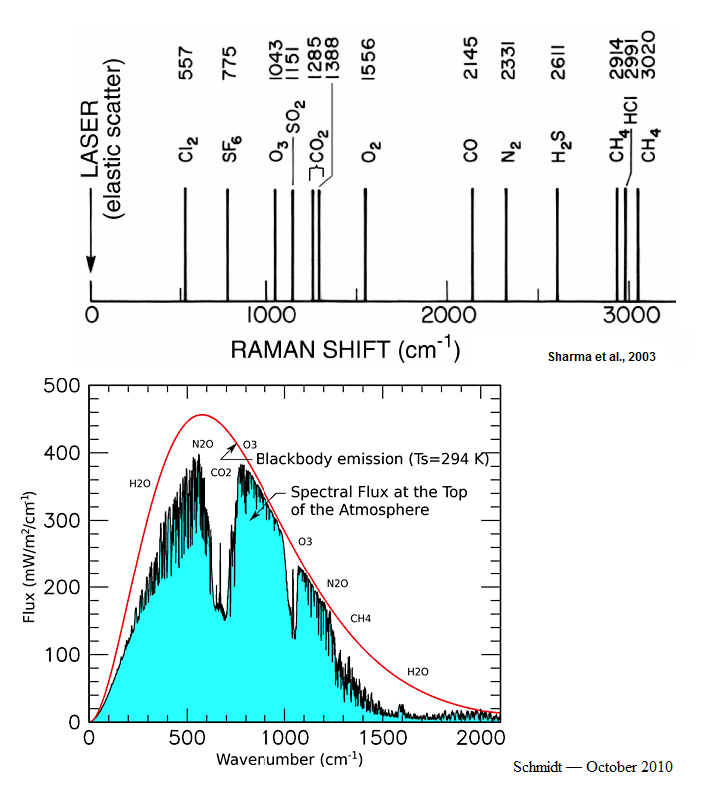
Yes N2 and O2 have Raman active vibrations (which are not IR active) and so can be detected if excited by a focussed laser beam, what possible relevance does this have to the atmosphere?
Everything: it ends the climate debate.
There are two sides to my theory: Tyndall discovered thermo-electric gases (what we know as the GHGs); and Raman shows what and why he didn’t measure, N2 and O2. Raman is a very good thermometer.
In the 21st Century, to understand IR behaviour of matter we use two instruments: Raman and thermoelectric-IR (thermoelectric, my words cause that is what they are). We do the same in the atmosphere, Raman is used already there, even NASA uses it; I am bringing them together, to solve the problem.
The standard model of GH theory can only hold with O2 and N2 are non-GHGs; that they are benign, that they are ‘forced’ by collision from the GHGs. With Raman spectroscopy we see they are IR radiation active – if a the molecule is radiated, the temperature will rise in accordance with the Stefan Boltzmann equation, Raman can measure that temperature of N2 and O2. In fact, it may even that N2 excites/ heats CO2 directly through its 2338/2349cm-1 close modes (my claim). Figure that?
How could we think anything else; the air is a near perfect insulator, it has a thermal conduction value of near 0 (0.024 – no units); air has to radiate on those grounds alone; not to mention that if it didn’t, it would contradict QM and thermal dynamics where all matter above absolute 0K radiates.
I am not creating anything new; only putting what we know together.
Lets do experiments and test. Actually, I have found the experiments; it holds.
Blair Macdonald November 22, 2017 at 12:39 pm
Everything: it ends the climate debate.
In your dreams, Raman spectroscopy is a technique for detecting certain species, only a very small proportion of the population undergo the transitions and usually a strongly focussed light source is needed and sophisticated filtering techniques to separate the dominant elastically scattered light. It’s certainly not an effect which is capable of transferring significant amounts of energy in the atmosphere.
The standard model of GH theory can only hold with O2 and N2 are non-GHGs; that they are benign, that they are ‘forced’ by collision from the GHGs. With Raman spectroscopy we see they are IR radiation active
No we do not we see that the vibrational modes of N2 and O2 are not IR active but are Raman active (something I was taught as an undergrad many years ago, so it’s nothing new). Which is exactly what the ‘standard theory’ accounts for, N2 and O2 can’t participate in absorbing the Ir emitted by the earth.
How about Argon?
Argon is monatomic, so it doesn’t absorb or emit longwave IR.
Argon is interesting; it does not transduce electricity from its IR radiation and it does not seem to have a clear Raman active mode or spectra – it must have. I’ll keep hunting that one.
Blair Macdonald November 23, 2017 at 4:48 am
Argon is interesting; it does not transduce electricity from its IR radiation and it does not seem to have a clear Raman active mode or spectra – it must have. I’ll keep hunting that one.
Yet more misunderstanding by you of Raman spectroscopy, Argon doesn’t have vibrational energy levels, neither IR active nor Raman active so don’t waste your time hunting.
Very interesting Blair but what excites the non GHG molecules. What does it mean in real life?
“..what excites the non GHG molecules” They, N2 and O2( and H2 I believe?) are excited by the Sun, by photons, just as we understand QM radiation, nothing new there. It is just to say N2 and O2 have spectra lines predicted, and they are observed (with Raman) and they behave just as they should when excited; all in accordance, I would add to say, as the Stefan Boltzmann law.
What does it mean for real life? It updates the 150 year old, pre quantum understanding of the atmosphere. GH theory is updated, there are no special GHGs, but only GHGs – after that the 0th and 1st laws follow.
We cannot have the out standing pillar of science, QM, in contradiction over the non GHGs: they must radiate – and they do. Everything with temperature, and spectra lines, radiates – all and in compliance with Boltzmann’s constant. Else we have a catastrophe – what I term ‘the IR catastrophe’.
Yes Blair, the IR Catastrophe is the fox in the henhouse for all warmista.
Blair, dividing gases into “GHGs” and “non-GHGs” is not intended to imply that non-GHGs don’t absorb at all. It is simply intended to sort into two broad categories — those that absorb well and those that absorb poorly. (much like materials are often divided into “conductors” and “insulators”, even though good conductors have some resistance, and good insulators have some conductance.)
The point is that a GHG like CO2 absorbs orders of magnitude more IR than a non-GHG like N2. Unless you are trying to predict IR intensities to within a few ppm, you can ignore N2 completely when dealing with atmospheric IR.
tjfolkerts No, N2 and O2 do not by GH theory emit or radiate any IR and not ‘poorly’, at any temperature – check the definitions. This is a catastrophe: all matter radiates.
You are relying on thermoelectrics as you paradigm of thinking: if we used Raman spectroscopy alone (as shown in the diagram) we would get a different set of gases; but they would be equivalent to the ‘GHG’s but for N2 and O2 and some others. The Raman gases all have (by early 20th Century quantum experiments – namely the Franck Hertz experiment) spectra lines, they all vibrate, and they have temperature.
As a thought experiment: take all the said GHGs out of the atmosphere leaving only N2 O2; would the air temperature change during the day change? Yes – just as it does today, and it would by radiation, and not conduction as N2 and O2 (the air) are near perfect thermal insulators.
Another thing, by current greenhouse reasoning; glass is a greenhouse solid: it is transparent to the eye, and ‘opaque’ to the IR – just like CO2. Why is there no issue with glass?
Water is – for the same reasons – a greenhouse liquid.
Blair Macdonald November 23, 2017 at 5:16 am
We don’t have to “check the definitions” to know this is 100% wrong. The absorption bands for 02 are shown in the head post graphic … read’m and weep …
While this is widely believed, it is not completely true. Monatomic gases (helium, neon, argon, etc.) neither absorb nor emit thermal radiation.
The only “catastrophe” is that you don’t seem to understand what you are talking about … or more accurately, the “catastrophe” is that you are firmly convinced you understand what you are talking about …
While I appreciate the passion with which you hold your views, that doesn’t make them correct …
w.
“No, N2 and O2 do not by GH theory emit or radiate any IR”
This is not any key tenet of GH theory. All that is required is that
1) sunlight can get in easily and
2) “earthlight” cannot get out easily.
It turns out that for (2) (the blocking of IR)
* H20 is the most important gas
* CO2 is the next most important gas
* polyatomic molecules like CH4, O3, and NO2 are also fairly important.
* monatomic and diatomic molecules like Ar, N2 and O2 contribute almost nothing.
GH theory would still work if N2 or Ar absorbed significant amounts of IR — but experimentally they don’t. GH theory still works when N2 absorbs some IR. The key factor here is that even small changes in CO2 (from 300 ppm to 400 ppm) STILL has a MUCH greater effect than the entire 780,000 ppm of N2. So N2 can be pretty much ignored when doing calculations. (Or — you could include N2 and get an answer that differs by an imperceptible amount).
“You are relying on thermoelectrics as you paradigm of thinking “
By this, it seems you are referring to gases that cause a noticeable change in temperature when IR passes through (ie thermoelectric detectors that create voltages in response to changes in temperature show a signal). In this case, this is EXACTLY the sort of change we are interested in. If N2 happens to show some weak absorption using something like Raman spectroscopy but DOESN’T register when you are measuring actual temperature change due to actual IR, then — almost by definition — N2 is not contributing (in a measurable way) to the GH effect.
tjfolkerts ‘..dividing gases into “GHGs” and “non-GHGs” is not intended to imply that non-GHGs don’t absorb at all.’
That is not how it is read or interpreted, check any definition of a GHG or n – GHG and it reads clear, ‘N2 and O2 do not absorb or emit IR’.
The rest of your comment is all based on readings from thermoelectric transducers: then you have go back and again break it down into ‘first principles’; how does the device work that you have come to your conclusion with – it is all by thermoelectrics. You are just repeating the standard model, and it just does not stack up.
Watch my basic/nervous presentation I did a few years ago here: https://www.youtube.com/watch?v=T0IHKKkOwdU&t=860s
We must lose the IR from IR spectroscopy: and term it TE spectroscopy and the TE gases – ThermoElectric spectroscopy and gases.
Here’s a question: what if it was only Raman devices we had to measure the IR atmosphere, and not thermo electric (just as we do for Mars): what would the known GHGs be? They would be every gas (if I haven’t missed any non Raman gases), as all gases are Raman active (I’m pretty sure). They would be Raman active and equivalent to thermoelectric ‘IR’ through the equipartition principle.
What I have here is just the ‘tip of the iceberg’, and the truth shocking: what I have found is all radiation theory (black body, emissivity and the like) done by Kirchhoff, Stefan, Boltzmann and others is all based on 19th Century thermoelectric detectors/transducers – totally neglecting QM and laser Raman observations and measurements. It will be my life’s work – with help hopefully – to clear this up.
Blair, statements in science like “N2 and O2 do not absorb or emit IR” often mean “do not absorb or emit in sufficient amount to be significant”. So I might “Pyrex is an insulator and does not conduct electricity” — and most people would go along with that. But I can look up the resistivity (http://glassfab.com/wp-content/uploads/2015/08/Corning-Pyrex.pdf) and find that it is about 10^8 Ohm*cm. This makes it an extremely good insulator, but it does (at some infinitesimal level) conduct.
” check any definition of a GHG “
Well, wikipedia (the first hit when I searched) disagrees with you.
“Hence they [non GHGs] are almost totally unaffected by infrared radiation. — Wikipedia
If this is your entire thesis (‘non-GHGs do actually absorb some small amount of IR’) then you are barking up the wrong tree.
I need help: anyone reading my claims and and are interested and would like to support me, financially, or otherwise, I need it. I am doing this on my own, I have a paper nearing completion, and it now needs the best minds – I’ve done my best. The pay-off: the greatest upset in scientific history. Message me through my blog and otherwise.
Also, Anthony: this is the area of movement, of thinking, 870 in three days! This is first principles, and this is where the debate is, and where it will be settled, and where GH theory as we know it will collapse. Let it be aired: better out than in.
You may find this paper to be of interest:
http://www.academicjournals.org/journal/IJPS/article-full-text-pdf/E00ABBF60017
All the best.
Thank you.
B
Link doesn’t work for me Tony
OK, try this link: https://orcid.org/0000-0002-3340-3063
Then scroll down to the “Works” section and click on the URL under “The thermal behaviour of gases under the influence of infrared-radiation”.
Blair Macdonald November 23, 2017 at 5:40 am
Whew, that’s a relief. I was afraid that your astoundingly brilliant breakthrough would only qualify as the second greatest upset in scientific history …
I was also curious as to who is the current record holder for the “greatest upset in scientific history” … curiously, the Guinness Book of World Records doesn’t list that one.
I’m glad, however, that all your fantastic scientific successes haven’t given you a swelled head.
w.
Why do you not debate your fantasy phizzacks here Willis, https://climateofsophistry.com/2017/10/19/the-steel-greenhouse-in-an-ambient-temperature-environment/#comment-32084 oh that’s right you did, and you slowed/delayed cooling thought car wreck experiment got flushed and you along with it.
PS Jesus was a carpenter aswell, stick to hanging doors Willis.
Thanks, Gary. It appears that like many others, you don’t have the albondigas to point to one single statement in my post about the Steel Greenhouse and tell us what’s wrong with it. Not one.
No surprise there, lots of folks on this thread have more mouth than they have facts or brains … come back when you actually want to discuss the science, I’ll be happy to do it.
w.
I do not have adequate qualifications to argue your steel greenhouse but I would like to ask a few layman’s questions if you don’t mind.
Do you believe in the Trenbeth diagram, ie do you believe that there’s around 333w/m2 of downward LWIR?
What value do you put on the equivalent Solar energy hitting the surface?
Why can the Solar Energy be made to perform work and the DWLWR can’t?
Yeah right Willis, remember this, ‘“That’s just a rounding error in the model”. when your model violated conservation of energy.
You had it it explained to you over and over, Joe may as well have been talking to a plank.
Further up the comments you scolded a commentator for taking offence to your forth-right attitude, that made made me chuckle remembering how you whined and whined about Joseph’s dismissive attitude to your ”citizen science”.
Why don’t you grow a set and finish the debate ?.
As for the rest here, the GHE fraud is on its knees you need to start re-aliening to the no GHE line because Anthony Spencer et al subtly are, and have been for months.
The 2nd law violation of energy from cold environs being unable to increase temperature in warm environs is the end of climatism and the climatists, once the blue/red team exercises into the science of CO2 get underway., they will schooled.
[tone it down -mod]
A C Osborn, here is a link to the first article at CoS on the steel greenhouse.
https://climateofsophistry.com/2013/03/08/the-fraud-of-the-aghe-part-11-quantum-mechanics-the-sheer-stupidity-of-ghe-science-on-wuwt/
Quite a lot of enraged ranting and insults at first, but Postma does eventually get to a straightforward walk through of the main errors. Then there are 937 comments of further discussion on the matter. Yes, all objections you could pretty much imagine have been answered. Then there’s the most recent three articles at CoS as well to wrap it up, and the comments there too.
Hope that helps. Don’t expect anything from Willy, there will never be an admission of error on this matter, I doubt. He’s best just ignored at this stage.
(Keep it civil) MOD
Tony November 23, 2017 at 3:59 pm
When I’m in a discussion and someone starts playing grade-school snarky games with my name, I know I’ve won. The only reason a man starts throwing mud like that is because he’s out of real ammunition …
I’ve invited Tony to point out here on this thread one single statement I made in the Steel Greenhouse that he thinks is wrong.
Instead of taking his chance and showing us how he can prove me wrong, instead of putting his brilliant claims out where they can be examined by all and judged fairly, he plays name games and wants me to talk about some mysterious discussion from years ago …
… and apparently, he actually mistakes that for winning the discussion.
Amazing. Ah, well, I suppose I should remember, DFTT.
w.
I am keeping it perfectly civil. Thank you.
Gary Ashe November 23, 2017 at 2:59 pm Edit
Who is “Joe”, and what on earth are you babbling about?
And what is “re-aliening”, the only alien I see here is you.
“They will schooled”??? Don’t you want to buy a verb for that sentence?
All I can get from your cryptic message is:
1. You definitely need to cool down. None of this is worth getting your blood all angrified.
2. You don’t understand the difference between heat flows and energy flows. I’m writing a post on the subject right now, because you are far from the only one who doesn’t get it. Short version? Heat can’t flow from cold to hot … but radiated energy sure can.
3. You have a lot of trouble communicating clearly.
Gary, I’m more than happy to discuss any objections you might have to my post on the Steel Greenhouse. I will say that physicists that I admire, people who teach physics for a living, say there is no violation of the Second Law involved.
You seem to believe that thousands of scientists in dozens of countries are either ignoring an egregious Second Law violation in the greenhouse effect, or they are simply too stupid to see it … but you, you can see it …
I could give you the odds on that being true … but you’d probably just yell at me some more …
w.
So to clarify, Tony supports this statement, taken directly from his site.
”
So if we use this equation for a sphere a radius Rsp = 1m and temperature Tsp = 300K inside a larger, cooler shell of radius Rsh = 2m and temperature Tsp = 290 K, we get
Q(sp-sh) = 5770 W – 20160 W = -14390 W
As stated above, a positive Q(sp-sh) means heat flow from the sphere to the shell, so this negative result predicts a heat flow the other way — from the shell to the sphere. Yes, heat flows from the cooler shell to the warmer sphere according to these esteemed scientists.
So, like I say, any and all objections are covered at CoS, in the articles and comments. So that’s that. Poor old Willy, and poor old Tim. But what’s done is done,
Tony, I do not need any help from you thanks, I have read both sides of this debate at both sites.
Willis, I realise that you have been sidetracked by Gary & Tony, but could you find the time to answer my questions?
Or anybody else?
Yes, A C Osborn, Willy did answer your questions, further below. Just keep scrolling down. Happy to help.
“Why can the Solar Energy be made to perform work and the DWLWR can’t?”
The main reason is that solar energy arrives as a near-parallel beam and can be focussed. So you can get a very high temperature relative to terrestrial sinks.
DWLWIR is diffuse, and can’t be focussed. The only way it could be made to do work is if a sink colder than where it comes from could be found.
That doesn’t mean that DWLWIR doesn’t add heat to the surface it falls on. It just means that that surface must be fully exposed to the source region, and so loses more heat than it gains. So no work. But it doesn’t lose as much heat as it would have if exposed to space.
So do tell, Tony! How was this objection handled? Which comments justify an equation that clearly predict heat flowing from large, cool objects to small warm object?
Tim, you are referring to equation 4a from the article at CoS that Gary linked to (as did I, further up in a different discussion). All anyone needs to do is read through that article in its entirety to see where you’ve “gone wrong”. Your “misunderstanding” would be amusing if I thought it wasn’t deliberate. However, I’m aware that you have indeed read the entire article, so it’s unlikely you would make that mistake genuinely. As it is, I suspect it’s simply an attempt to bait me into a discussion whereupon your usual deception can take place.
It’s funny, you and Willy are so alike. You just approach it from two different angles. Willy plays the game of insisting everyone has to discuss things under the terms of his original article. “Quote my exact words! Tell me where I’m wrong!”
Then when somebody does just that, and indeed writes a whole series of articles about it, responding to a huge variety of different objections and “misunderstandings” in the comments below, Willy can deflect from any of that by simply insisting that anyone talking to him now has to go through the whole thing again. The whole discussion must be had again! Lol. Meanwhile, people like Tim are on hand to take a snippet from that discussion completely out of context, in an attempt to bait people into once again repeating the whole discussion…
“Tim, you are referring to equation 4a “
Yes.
Exactly.
The equation that says heat flows from large cool objects to small hotter objects. It’s right there for all the world to see. No ‘context’ can fix that sort of blatant error.
So you are going to continue to be deliberately obtuse?
Well, let’s take the bait. If nothing else, your responses will serve to demonstrate the folly of entering into further discussion, with folk such as yourself…
When Q=0 (i.e at equilibrium), equation 5a shows the temperature of the shell (Tsh) in relation to the temperature of the sphere (Tsp), and the radius of both sphere and shell. From this equation it’s clear that the temperature of the sphere is always going to be higher than the shell, at equilibrium. This is because the shell is necessarily larger in size than the sphere, and will therefore (possessing a larger surface area) always emit more energy in total than does the sphere, if they were at the same temperature, all else being equal. Energy is conserved, not temperature.
You have “arbitrarily” chosen a value for the temperature of the shell which would not be reached spontaneously were the shell introduced at 0 K, when the sphere is at 300 K (as you also specify). Equation 5a shows that with the sphere at 300 K and with the radius of the sphere and the shell as you specify, the shell would equilibrate at a lower temperature than 290 K. So, for the shell to be at 290 K, it would require a source of additional (external) energy besides what it receives from the sphere. Which is why you get the result you do when you insert those temperature and radius numbers into equation 4a.
You know, for practical purposes you can consider a light bulb as a physical implementation of the steel sphere.
The filament isn’t a sphere, but being mostly 2d I think it serves the purpose of a sphere for an example that can be tested.
“When Q=0 (i.e at equilibrium) …
… and this is the next error. (Not that it fixes anything in the previous error– it was derived as a general result and still predicts heat from large cool shells to small warm spheres.)
When Q=0, then there is no heat flowing from the sphere to the shell. But the discussion starts by positing “a power-generating sphere”. We are told that power goes IN to the sphere, but now we are asked to accept that no power goes OUT from the sphere. If the sphere has power in but no power out, it must be warming. But a warming sphere by definition is not at equilibrium.
The errors just keep cascading into more and more contradictions — contradictions not only with every thermodynamics textbook, but internal contradictions within the so-called ‘proof’ itself.
“we are told that power goes IN to the sphere, but now we are asked to accept that no power goes OUT from the sphere”
Yes, great demonstration, Tim. As soon as your (no doubt deliberate) error is exposed you immediately change tack onto something completely different…something you just absolutely fabricate out of thin air. I’m glad I took the bait, I knew you would immediately show your true colours. It’s like I said before, though, you’ll be OK. Politics beckons.
This is not for any fights, but I am surprised that after four years when I came back to this site, I still see the same old skeptical discussions essentially on whether or not humans are playing a role in climate change, or even more basic, whether CO2 is a greenhouse gas that even most skeptics of AGW don’t question. On the other side, countries like China and India are well ahead of their targets set by Paris agreement even without the US. Although they had some setbacks from nuclear issues, Germany is well on its way to have almost all of their energy from renewable sources. US on the other hand is going back, making knowledgeable people around the world laugh at the US’s ideologically based skepticism coming mainly from those with little training and no real credentials in the area – which seems to start with the new EPA head.
No, they’re fools.
Water vapor regulates surface temps, not co2.
Yes, water vapor has a major role, but excess water vapor (determine by pressure, temperature) will condense. CO2 doesn’t do that at earth’s temperatures, hence serve as the cause for temperature change. Most scientsts from Arrhenius onwards (from 1895) accepted CO2’s greenhouse capability.
When was the last time Earth’s atm didn’t have any water vapor? But besides that, you didn’t understand the significance of net radiation dropping by over 60% in the middle of the night. Same thing scientists since Arrhenius have all missed.
micro6500
November 23, 2017 at 12:51 pm: You are darn right there. Latent heat, half the density of air, massive lifting power. Well-measured, non GH mechanism. The arch warmista rely on water to get them over the line because they cannot claim CO2 has the oomph. Little realising water was doing it all anyway, without any GH. And plenty of capacity to spare…..
Small wonder deserts are hotter than jungles, and the Models have failed. They do after all use GH factors
micro6500, “When was the last time Earth’s atm didn’t have any water vapor? But besides that, you didn’t understand the significance of net radiation dropping by over 60% in the middle of the night. Same thing scientists since Arrhenius have all missed.” I don’t know what any of that has to do with the effect of CO2? With or without CO2 change, there will be greenhouse effect from water. Increasing temperature from increased CO2 will increase water vapor in the atm that in turn will further heat the globe – as a simple explanation. The reality is more complcated but the effect is the same. I am not sure what you mean by the radiation drop, such variations are there with or without water vapor in atmosphere like in deserts. In any case, we don’t have much control over water vapor and even if we all change to hydrogen fuel giving water vapor as the reaction product, unlike CO2 this is not going to change anything since there are limits how much water atmosphere can carry. Excess water will precipitate. So I am not sure what you are suggesting. All scientists account for the effect of water vapor since it is significant.
That’s because you do not recognize a regulator when you see one.
https://micro6500blog.wordpress.com/2016/12/01/observational-evidence-for-a-nonlinear-night-time-cooling-mechanism/
And while you are quick to claim positive water vapor feedback, you forget about the negative feedback response at night. Thing is, it cancels out the excess days warming, if there is any. Read the link, understand it. Then we’ll talk.
No, Micro6500, I said it is more complcated, there are both positive and negative effects and that is why I did not want to go into the details of it. But when you publish your work showing “….not co2, and in fact any additional warming from Co2 has to be lost to space, before the change to the slower cooling rate….” in a real journal with statistical data, I will certainly pay more attention.
Did you see that Min T follows dew point temp with a 97% correlation, over 75 million station records.
And my code is published for you can validate my work
You see, my work is published there, everything anyone needs to confirm my work. It’s just not to many ppl understand the signals in a regulator. If they did, they would see that’s what happens at night under clear skies. Can you explain why the temp stops dropping in the middle of the night, while T zenith is still 90F colder than aur temps? But you can’t, or won’t because you know it ends AGW concerns. As a regulating mechanism, water vapor has well over 10x the power co2 has, we will never burn enough fossil fuels to alter temps with co2, the condensing water vapor never runs out!
Well… Micro6500, I would strongly encourage you to send your work to a journal. If it is important, people who don’t read blogs (this is the first time I came here in five or six years, that goes for all other climate related blogs) needs to read it, and if there are problems with your work, the reviewers will hopefully address that. Everyone knows that water vapor has a substantial effect, especially because there is more of that than CO2. But most researchers will object to your other characterization, that CO2 effect is somehow negated by water vapor, or calling them fools.
Then you do not note that net radiation drops significantly while it’s still dark out? If you’ve looked at night time temp data you’ve seen it before. That how I found it, 4am clear skies, and the temp isn’t dropping, and yet my IR thermometer says the sky is -40° or -50°F.
Radiatively, that’s about what the optical window sees from the surface. It has to be dumping 40 or 50W/m^2.
Why doesn’t the temp keep dropping?
And what air temp does it stop near?
I don’t expect there are any amount if changes I could make in writing a paper, that would get it accepted.
It’s available on the internet, and a lot of ppl read WUWT, and Climate Etc, so I know a lot of climate scientists have seen it.
micro6500 November 24, 2017 at 7:06 am
Thanks, Micro. The problem with that 97% correlation is that it is expected, since dewpoint is a function inter alia of temperature. There are various ways to calculate dewpoint from temperature and relative humidity. Here’s one from the Bulletin of the American Meteorological Society:
Td = T – ((100 – RH)/5.)
where Td is dewpoint, T is temperature, and RH is relative humidity.
Now, relative humidity is not too useful to us here, because it changes with temperature. But RH is a function of the absolute humidity, the actual amount of water in the air.
RH = 75.2 AH e^(-((17.6 T)/(243 + T))) (273 + T)
Substituting above, we get:
Td = T + AH e^(-((17.6 T)/(243 + T))) (4110 + 15 T) – 20
Now, what this says is that Td, the dewpoint temperature, is a function of T, the temperature, and AH, the amount of water in the air. However, the actual amount of water in the air doesn’t change all that fast, particularly when temperatures are dropping. And this means that if the amount of water in the air doesn’t change, that dewpoint is a function solely of temperature, and that the correlation will be best at minimum temperature.
Finally, whenever a falling temperature causes the dew to form, the dewpoint is equal to the temperature. So of course they vary in tandem, as the temperature drops below dewpoint they both move downwards in lockstep.
Given all of that, we would absolutely expect a very good correlation between Td and T, simply because Td is a function of T and AH, and AH changes slowly.
So while your finding is true … it is also exactly what we’d expect to find. And as a result, it’s not at all clear what use that might be. How does finding something that we’d expect to find advance our knowledge?
Best to you,
w.
Willis, there is an energy barrier as air temps drop to dew point. That forces the release of stored energy, the water has to release it to condense. What RH really means, is the percentage of water vapor condensing is a vol of air increases, it has to be giving up energy, and QM requires that distribution. So some is droplets, most is still gas, but as it cools to dew point that ratio changes.
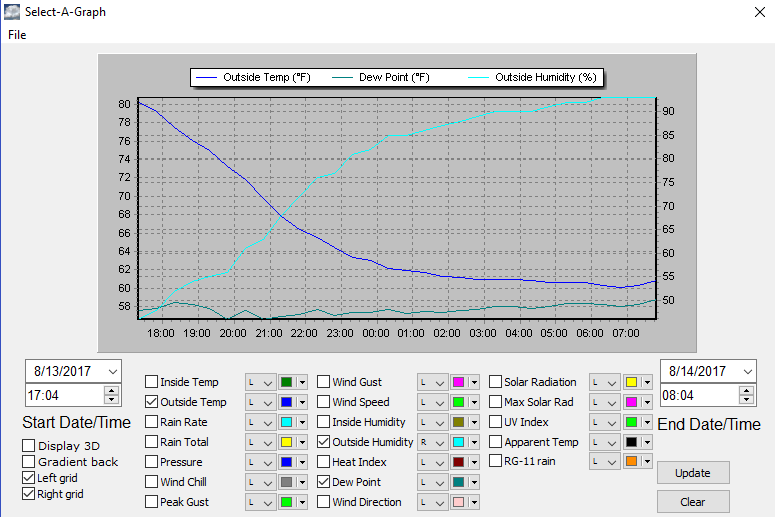
It’s all that latent energy radiating from the condensing atm water vapor that’s supplying the surface energy that compensates for energy going out the optical window.
Just like you found water regulates ssts by breaking out into cooling thunderstorms, thus process kicks in only after the air has cooled, then there’s a large increase in IR, latent heat.
That’s how it stops cooling in the middle of the night
Or
And everyone just thought it has reached equilibrium, but in reality it’s quite active, and it’s being regulated.
Have you read this https://www.researchgate.net/publication/253127549_What_determines_the_nocturnal_cooling_timescale_at_2_m
?
Willis,
Since you didn’t respond, I’m not sure if we are done yet. Did you check out the paper I linked yet?
And why doesn’t air temp drop below dew point(rhetorical)? There’s at least 35W/m^2 to space even when temps are not falling at all in the data collected there.
Can we agree there’s an energy barrier, ie that more radiation has to be lost to maintain an equal temp drop once air temps are at dew point temp?
That by definition is a non-linear function.
And conversely this is proof Tmin is a function of dew point, not co2.
It also is a negative feedback to water vapor amplification that is a requirement for catastrophe.
In fact it is non-linear enough to remove most of the energy accumulated by co2 before morning mist nights.
Where there’s enough water vapor to work with. Why deserts have such a large range, dew point is low, max T is high.
Mike
RobG,
this GERMAN website (In English) has a lot of information about the failing Solar and Wind power.
http://notrickszone.com/?s=Energiewende#sthash.DrHJHget.dpbs
micro6500 November 25, 2017 at 6:59 pm
Sorry, Mike, I’m on the road right now. I haven’t answered because I’m not clear exactly what your point is about dew point and min temp. You seem to think it is significant that min temp and dew point are often either close or the same … which is true but I don’t see the relevance.
What am I missing here?
w.
There’s an energy barrier to air temps dropping below dew point, because most of the cooling is radiative, and when it radiates, half or more runs into water or co2 and is captured. The higher % of the water
“The higher % of the water” that has cooled to dew point, but for every photon it can emit, it captures another photon.
You’re exchanging money analogy, thus us putting some in the bank during the day, and withdrawals it only to keep air temps from falling too much below dew point.
What I can’t explain to people is it acts like a switching power supply regulating min T, which is normal climate that you explained. It’s just they are dependant functions, consuming about 10x the energy of co2, and it’s regulated by temp, it doesn’t slow cooling until after it gets near dew point, the same fixed point whether Tmax was 75, or 76. If you look at the rate temp changes at dusk, it’s 3-4°F/hr, some clear nights it stops cooling, others it slows. On the slow nights, if temps are warmer, say 1° as my example, the transition switches at the same absolute temp in either case. In effect, all you do is exchange cooling that 1° at the high cooling rate, for the time required to drop 1°, for that time at the slowest cooling before sunrise. And on nights that’s 0, well all the excess is lost, ie min T is entirely dependent on water vapor, co2 had zero affect.
Sorry, I hit send in the middle of writing this on my phone, and had to figure where I was before I coukd continue.
“Germany is well on its way to have almost all of their energy from renewable sources.
ROFLMAO
Of course they are, Rob. 😉
Get some actual FACTS before you comment next time.
wind, 2.1%

Solar 1.2%
Biomess 7.3%
http://www.independent.co.uk/news/world/europe/germany-renewable-energy-record-coal-nuclear-power-energiewende-low-carbon-goals-a7719006.html
“Germany breaks renewables record with coal and nuclear power responsible for only 15% of country’s total energy” Link posted above … there are many other links one can look into.
Rob,
You left out natural gas and oil.
No, Gabro: It says “At one point on the sunny and breezy Sunday, sustainable energy from wind, solar, biomass and hydro power provided a record 85 per cent of the country’s total energy.” There are not there yet, but with proper conditions they are already close.
Rob G November 23, 2017 at 5:05 pm
You guys are talking at cross purposes, and both of you are right.
Rob, you have the curious idea that because on a Sunday when no industry is running and it is sunny and breezy so there is no need for either heating or air conditioning, for ONE INSTANT renewables were providing 85% of the power, that that has some meaning. But all it means that the demand was really, really low, and the sun plus wind was at its highest.
However, Andy is showing the long-term reality, which is that sun plus wind in Germany generates 3.3% of the energy used.
After billions of dollars have been spent on solar and wind in Germany … THREE POINT THREE PERCENT.
Now it’s clear that you are both right. Average of wind and solar is 3.3% over the whole year. On the other hand, on one day when conditions were perfect, demand at its lowest, wind and solar at their highest, for one instant they got 85% … but so what?
Rob, do you make business decisions based on a best case ever scenario, or an average scenario?
Because me, when I want to judge how something is doing, I would NEVER just consider how she sails on a good day with a following wind … I want to see what the long-term situation is.
So while both of you are right, I know which numbers I pay attention to, and it is not how it did on the best day of the year. Hyping that kind of data is a cheap salesman’s trick …
w.
W., Germany is still not there, but they are still investing and they have a plan to get the average energy supply from renewable sources high. On your question “Rob, do you make business decisions based on a best case ever scenario, or an average scenario?” Germany had already made that decision, but they made that based on the average anticipated power generation, not current average power supply, from such sources. The advantage here is, apart from the capital investments (which is required for any power plants) there are no expenses for buying the sources of energy (like coal, natural gas, uranium, etc.) except for biogas. Maintainance expenses are there for all plants. So overall it works out much cheaper to have renewable sources, and it is a wise business decision for consumers and corporations.
Rob G November 24, 2017 at 6:53 am
Indeed they do have a plan, and after spending billions and billions of dollars on the plan, solar plus wind supply 3.3% of their energy. Look, even the Germans admit that their “energiewende” has been a colossal and expensive failure that has made their electricity prices skyrocket …
So yes, they have a plan, and they are now in the process of abandoning that plan as an expensive failure.
w.
PS—You describe 3.3% of energy coming from solar and wind as “still not there” … a more accurate description would be “still barely begun”.
W. That link is one person’s opinion. I know there are some issues with energy conversion in Germany, even NY Times reported that, but it is not a failure and there are no plans of abandoning it. We will see what happens in the next 10 years. I predict you will see substantially more solar and wind based energy production in Germany in that time. CO2 is harmful or not is one side of the story, when solar panels are becoming more efficient with falling cost, it simply becomes a better/cheaper route. Fusion energy is still an iffy solution for the growing energy needs. Availabilty of fossil fuel will only last so long, whether it is 36 years or 100 years. So alternate energy sources are going to come up, and as calculators kicked slide rules out, these new sources are eventually going to make fossil fuel obsolate. Even with friendly policies for coal, coal power plants in the US are still shutting down because of other reasons, and that trend will continue. https://www.nytimes.com/2017/10/07/business/energy-environment/german-renewable-energy.html
https://www.nytimes.com/2017/05/22/opinion/paris-agreement-climate-china-india.html For example.
Gosh … you meant the New York Times said it?
Sorry, Rob, but these days, if the NYT said it, that actually reduces the odds that it’s true …
w.
No, W., the basis for everything they wrote there comes from various reports, which one can verify, and I have not seen anyone offering data to counter it.
Rob G November 24, 2017 at 6:22 am
Rob, you are welcome to believe the NYT. I don’t trust a word they say. And yes, they always base what they claim on “various reports” … me, I prefer news organizations that base their work on “various facts“. Their reporting was so bad during the last election that the Editor famously APOLOGIZED for it.
Of course, the apology was as fake as their “news”, they just kept doing the same thing … no surprise there.
In addition, the article is not available, I’ve used up my two free views for the month.
So you’ll have to argue with yourself on this one. Inter alia, however, I would note that China didn’t agree to much at Paris except to have their CO2 emissions peak by 2030 … and if you believe that will happen, you’re beyond my poor power to add or detract …
w.
I have been to India and China looking at their solar initiatives, in India you will see solar panels in many homes, it is becoming a trend. China is slightly behind but they will be investing a lot of money and within five years you will see China ahead of India. Those people are not really being silly, I think in a decade you will see US far behind those contries for cheaper energy sources (as well as in technical capabilities related to solar panels, China already has the dominant market share for solar panel manufacturing) https://economictimes.indiatimes.com/industry/energy/power/india-ranked-second-in-renewable-energy-attractiveness-index/articleshow/58698180.cms
https://www.reuters.com/article/us-china-energy-renewables/china-to-plow-361-billion-into-renewable-fuel-by-2020-idUSKBN14P06P
A C Osborn November 23, 2017 at 2:58 pm
Excellent questions all.
Regarding downward longwave infrared (LWIR), this is routinely measured by scientists all around the world. You can measure it yourself (with admittedly poor accuracy) with an infrared standoff thermometer. The CERES satellite data puts it at about 345 W/m2 on a global 24/7 average.
Again per ceres, solar hitting the surface is on the order of a 186 W/m2. However, about 24 W/m2 is reflected by the surface.
Finally, both solar and LW can be made to do work. Any heat can be used in a heat engine. However, for any heat engine to work, you need to discharge the rejected heat into a cooler environment … and the atmosphere, in general, is cooler than the surface—so there is nowhere on the surface to discharge the waste heat.
What about photovoltaics? The problem is that there is not enough energy in thermal radiation to bust loose an electron and kick it up to a higher orbital, as required for the photoelectric effect … so no photovoltaics as far as anyone has found so far.
Best regards, and if you have further questions I’m happy to discuss them.
w.
Well the question is now that Solar can be used for work on the surface as demonstrated by any Solar Still or Solar Array like Ivanpah.
Ivanpah Generates almost 1000Gw per year according to Wiki by collecting, focusing and using the miserely 186W/m2 and yet it can’t Generate anything from the 345W/m2 of LWIR.
So why is that?
Aren’t all Watts created equal?
Oh, I forgot, of course DWLIR can do a sort of work because at night a Solar still extracts the heat out of objects and makes them colder, don’t they?
A. C. Osborn, another good question. The answer is, solar stills and solar arrays are not driven by average solar energy. They are driven by instantaneous solar energy,
At the tropics at noon, that’s over a thousand watts per square metre … and at 38°N where I live, peak solar is on the order of 750 W/m2.
Bear in mind that 30°C (86°F) equates to a S-B blackbody radiation of 480 W/m2 … so the sun is much stronger than ambient. That’s why the sun can do useful work at the surface, while the radiation from the cold atmosphere cannot.
Best regards,
w.
Not exactly, it’s delivered at near 1,000W,m^2, Not 186, and whatever the lwir amount is, it’s not different from the exhaust, other that radiative cooling to space, and it too would need concentrated. But Ivanpah doesn’t run at night because when you look up it’s cold, not hot.
Sorry, that won,t quite do as an answer, because even if it was 900W you should still be able to get 1/3 of the energy by concentrating 300W of DWLIR.
With a simple 3″ hyperbolic reflector I can raise temperature of a piece of steel to 450C in UK and yet a Solar still extracts the heat from an object at night, cooling it to around -5C.
So why can’t we heat anything by concentrating 300+ W/m2, but instead it cools it?
These experiments have been done countless times with the same results.
Because you are concentrating the many thousands of degree Sun, vs air temp.
My response was to Willis, not you micro.
But perhaps you can answer the question of why a Solar Still or Oven becomes a Refrigerator at night?
I have come to understand that we do not understand energy as much as some like to think, for instance why hot objects cool quicker than cooler objects.
Or why a surface with an LED light shining on it Frost’s over quicker than an area of it shaded from that same light.
1000s of degrees Sun!
You are having a laugh.
Watts are Watts, that is how ghgs work isn’t it?
So you are confirming that all Watts are NOT EQUAL, thank you.
Goes with the nearly 1,000 W/m^2 near the equator.
“Ivanpah Generates almost 1000Gw per year according to Wiki by collecting, focusing and using the miserely 186W/m2 and yet it can’t Generate anything from the 345W/m2 of LWIR.
So why is that?
Aren’t all Watts created equal?”
AC, Let me expand on what Willis said (here and before). The word “focusing” is critical.
The 100’s of W/m^2 of sunlight comes in the form of a very intense beam from a small part of the sky. With a lens or mirror, you can focus in sunlight from other directions, multiplying the total to many 1000’s of W/m^2. Basically, you can make it look like there are thousands of suns all around.
The 100’s of W/m^2 of thermal IR comes in the form of a very diffuse glow from every part of the sky. As such it is impossible to focus that IR. If you put up a mirror to reflect IR, you are blocking an equal amount of IR that was already coming from that direction.
Wrong, you can focus it, that is precisely what a Solar still does and it makes objects at the focal point colder.
Let me provide you with a thought, suppose it makes them colder because it is coming from a colder place?
Can you prove that to be wrong?
“Aren’t all Watts created equal?”
Of course they aren’t. That’s what the second law of thermo is about. There is energy (Watts), which is conserved, and associated free energy (Watts), which can be dissipated (or used). Free energy is the capability of doing work. The Watts of electricity that you might use to warm your house are valuable. The warmth they are converted to has much reduced utility.
Thank you, you have just blown GHG theory out of the water, because obviously DWLIR Watts are not equal to REAL watts either.
Watts that can’t do any work are worthless.
AC I am confused by what you mean by a “solar still”. Google searches reveal devices designed to distill water by warming it. Perhaps you mean something akin to this idea: https://en.wikipedia.org/wiki/Radiative_cooling#Nocturnal_ice_making This is the same reason front can form on the tops of cars parked outside, even when the air temperature stays above freezing. I have seen this principle extended to roof-top panels.
If this is what you mean, then yes, some “focusing” is possible. in this case, “warm” IR from the warm ground (or roof) below is blocked and “cool” IR from the sky is substituted.
A C Osborn November 24, 2017 at 2:47 pm Edit
I’ve never heard of a way to do that. The problem is that unlike sunlight, longwave IR doesn’t arrive at the surface as a beam of radiation. You can focus and concentrate and reflect a beam of radiation.
But the longwave infrared is coming from the entire hemispherical dome of the sky, in all directions. I know of no way to focus or concentrate that kind of radiation
I don’t know what this means. What experiments?
Let me know if this is not clear.
w.
In the headline to this post is the following question:- “what’s the quality of your radiation?”
Now here’s a thing. When I was young in the 1960s and before the political parasites had debased the currency, it used to be possible to collect bronze pennies from the reign of Queen Victoria. The oldest coin in my collection was one dated 1860, faint, worn and of no numismatic value, but it was fascinating to me that something minted one hundred years previously was still in circulation. My coin set was a lesson in the past of my country and gave a perspective of history that no modern child can experience.
My historical coin collection was also an economics lesson, silver sixpences minted before 1920 really were just that, sterling coins containing 92.5% silver, while none of the sixpence coins minted after 1946 contained any silver at all (how the mighty were fallen). But the key point I learned from my collection was this, no matter how many bronze pennies I collected, and no matter how large the sum became, none of these pennies ever turned into a silver sixpence.
Now will someone please explain to me how “cold” low quality, low frequency electromagnetic radiation can spontaneously turn into “hot” high quality, high frequency rays? The Wein’s displacement law proves that this is impossible. In order to raise temperature of a surface you need to add high frequencies, adding more low frequency energy, no matter how much, never works. You can never turn bronze pennies into silver sixpences and certainly never bright silver into glowing gold.
Good to introduce discussion on the ‘quality’ of the energy
I think that in all quoted instances of this kind the source of energy is still pumping away.
An example would be an electric light bulb.
Without shading it would glow at a certain temperature
With a reflecting partial covering it would glow brighter or more ‘blue’
Now one interpretation of this favoured by warmists is that reflected low quality energy is converted to a higher quality energy.
The way I would interpret this is that additional radiative resistance is introduced by the reflective covering reducing the energy loss of the bulb.
To continue with your ‘coin’ metaphor electrical energy is the ‘gold ‘ standard.
“You can never turn bronze pennies into silver sixpences and certainly never bright silver into glowing gold.”
Electrical energy is of the highest quality and can be used to top up the higher frequencies.
With no electric power however.
“You can never turn bronze pennies into silver sixpences and certainly never bright silver into glowing gold.”
Holds true
Well expressed! CO2 can only emit (and absorb)in the waveband 13 to 17 microns, according to MODTRAN6. These are line spectra, and if you spread them out somehow into a continuous black body Planck spectrum, such as Earth produces, the warmest “Wien” temperature you could get out of the mix would be -79 degrees C, corresponding to the most intense line at 14.95 microns, and this is way below normal Earth surface temperatures. Cooler objects (here, CO2) can’t transfer heat to warmer ones (here, Earth’s surface), so the radiative argument for a greenhouse effect for CO2 on Earth is nonsense. In any case, gases actually derive their temperature much more from from pressure than from radiation, and that applies to ALL atmospheric gases, not just CO2, and even here, due to the lapse rate, atmospheric CO2 is never warmer than Earth’s surface. CO2 radiation can retard Earth’s infrared output (that of 13 microns wavelength and above), slowing heat loss, but heat addition can only come from Sun or from ozone creation/destruction reactions in the stratosphere.
What you leave out is if absorbed, energy is energy, and if there are more photons, there’s more energy. So your assumption is incorrect, co2 can warm the surface, it just takes more 15u photons to do so.
And if you look at the y axis of a atm spectum, it’s in energy, not photon count.
micro6500, that’s an older and outmoded way of looking at things. In reality, EMR doesn’t contain photons at all, but is simply a frequency field devoid of energy. Photons arise when the energy field impinges on matter, resonantly inducing increased bond vibrations at fundamental or harmonic frequencies.The increased motion of bonded atoms generates kinetic energy, and this is what Einstein correctly interpreted as “Lichtquanten” (photons), except that he made the mistake of thinking that the Lichtquanten came in with the EMR instead of being resonantly generated on the spot (resonant vibrations in frictionless bonds require no energy input, but Einstein couldn’t have known this in 1905).
Energy is really a property of matter, and in every case except that of the supposed radiation-borne photon, its dimensions contain, or can be converted to contain, a mass term. We know that EMR is massless and that it travels at light speed, neither of which would be possible if it contained energy. All our detection devices are material, so we can only detect photons after they’ve interacted with matter. We can’t detect them in massless contexts such as outer space. All energy is mass-bound, and therefore contains a mass term, which is far more reasonable than a situation in which all energy is mass-bound except for the kind that goes whizzing through space like some protean chimaera and is somehow mass-independent.
Be that as it may, any back-radiation from CO2 must be in the range 13 to 17 microns. These wavelengths would correspond to Wien temperatures of -51 and -103 degrees C if they were in a continuous Planck distribution, and their most intense line is 14.95 microns, corresponding to a Wien temperature of -79 degrees C, all temperatures well below those characteristic of Earth’s surface, in consequence of which they can’t transfer heat to the warmer surface of Earth but are reflected away instead.
I think it can, reduce cooling by about 3.7W/m^2, but that’s not what really slows cooling, that’s from water vapor.

And you can see it in net radiation.
And if you look at the cooling curve, it’s also not the expected exp decay.
Why should it keep cooling? Because the sky is 40 or 50 below F.
micro6500, I think I get your drift, but a little more explanation of your graphics would be helpful. Thanks.
Sure. Top chart just has Temp, Rel humidity, and net radiation, covers about 3 days, and in general they were mostly clear, the temps change smoothly except in the afternoon. You can see how temps fall at night, and once rh gets over about 50%, you can see a bend in the temp curve, and at the same time net radiation drops. This was recorded by the group that wrote the paper I mentioned to Willis, in Australia.
As air cools, and nears dew point more water has to condense, but there a lot of energy that water vapor has to release before it can do that. And is a gas like this, as it does, some of that energy is given to water that just condensed, causing it to reevaporate.
The second was taken by me in Ohio, you can see the distinctive cooling rate slow down under clear dark skies, and in the upper section you see IR thermometer readings from the same night showing the BB temp for the optical window to be about -50°F.
SB equations show about 80W/m^2 for that difference in temp. I think the optical window is about 40% of that, so 32W/m^2 Is radiating to space, and temps are not changing.
Net rad can drop because the window closes, or more energy comes from the surface.
And the evidence is in more energy, and that aligns with water vapor having to dump energy to cool.
Sure. Top chart just has Temp, Rel humidity, and net radiation, covers about 3 days, and in general they were mostly clear, the temps change smoothly except in the afternoon. You can see how temps fall at night, and once rh gets over about 50%, you can see a bend in the temp curve, and at the same time net radiation drops. This was recorded by the group that wrote the paper I mentioned to Willis, in Australia.
As air cools, and nears dew point more water has to condense, but there a lot of energy that water vapor has to release before it can do that. And is a gas like this, as it does, some of that energy is given to water that just condensed, causing it to reevaporate.
The second was taken by me in Ohio, you can see the distinctive cooling rate slow down under clear dark skies, and in the upper section you see IR thermometer readings from the same night showing the BB temp for the optical window to be about -50°F.
SB equations show about 80W/m^2 for that difference in temp. I think the optical window is about 40% of that, so 32W/m^2 Is radiating to space, and temps are not changing.
Net rad can drop because the window closes, or more energy comes from the surface.
And the evidence is in more energy, and that aligns with water vapor having to dump energy to cool.
Oh, if you haven’t, follow the url in my name.
micro6500, I definitely think you’re on to something here. I’ll have to spend some time with your blog to appreciate it fully, but the importance of H2O in radiative exchange has been sorely neglected, IMHO.
davidbennettlaing November 25, 2017 at 11:57 am
Be that as it may, any back-radiation from CO2 must be in the range 13 to 17 microns. These wavelengths would correspond to Wien temperatures of -51 and -103 degrees C if they were in a continuous Planck distribution, and their most intense line is 14.95 microns, corresponding to a Wien temperature of -79 degrees C, all temperatures well below those characteristic of Earth’s surface, in consequence of which they can’t transfer heat to the warmer surface of Earth but are reflected away instead.
So what, application of a nonexistent ‘inverse Wien’s Law’ means nothing. The surface of the earth quite happily absorbs 15 micron light whether it originates from T=400K or T=230K, in fact the surface is not aware of the source temperature.
“Now will someone please explain to me how “cold” low quality, low frequency electromagnetic radiation can spontaneously turn into “hot” high quality, high frequency rays?”
They don’t. No one claims it does.
“In order to raise temperature of a surface you need to add high frequencies, adding more low frequency energy, no matter how much, never works.”
Tell that to people who use CO2 lasers to melt steel. You need to be much more precise in your thinking, since a simple couter-example shows your throught process is faulty here.
So tjf, if I said that water cannot run uphill and you said yes it can, here is a pump storage scheme that proves that it can, would I not be correct in questioning your faulty thinking? After all is a laser not a precisely designed machine that need to consume power in order to work?
Phillip, you specifically claimed “adding more low frequency energy, no matter how much, never works [to raise temperatures]”. Now you seem to have reversed your position, accepting that lots of low frequency energy (ie 15 um photons) can indeed raise temperatures to quite high level. This simply shows how challenging all this can be so state ideas precisely and accurately.
Certainly it is impossible to use thermal photons from a source at T1 (and only those photons) to raise an object to a temperature T2 where T2 > T1. But those photons from the source at T1 PLUS other power inputs can raise the temperature above T1.
Philip Mulholland November 24, 2017 at 10:30 am
So tjf, if I said that water cannot run uphill and you said yes it can, here is a pump storage scheme that proves that it can, would I not be correct in questioning your faulty thinking? After all is a laser not a precisely designed machine that need to consume power in order to work?
It’s your faulty thinking which tries to apply a nonexistent ‘inverse Wien’s Law’, your logic is akin to saying red hot steel is at 650ºC, therefore the rose of the same color in your garden must also be at 650ºC.
That would be it’s color temp.
micro6500 November 27, 2017 at 8:53 am
That would be it’s color temp.
For the steel yes, for the rose no.
Philip Mulholland November 24, 2017 at 2:49 am
Now will someone please explain to me how “cold” low quality, low frequency electromagnetic radiation can spontaneously turn into “hot” high quality, high frequency rays? The Wein’s displacement law proves that this is impossible. In order to raise temperature of a surface you need to add high frequencies, adding more low frequency energy, no matter how much, never works.
This is based on the false use of Wien’s Law, which proves no such thing. Wien’s law just tells you at what wavelength the peak of the distribution will be, however both higher and lower wavelengths will be present.
Using an ‘inverse Wien’s Law’ does not work, you can not take the wavelength and infer what temperature it must have been emitted at. This is a common mistake which many who have posted in this thread have made!
An example of their error is that they assume that via Wien’s Law a 10.6 micron photon originated at 273K and therefore cannot raise the temperature of a 300K object, and yet a laser beam of 10.6 micron photons can melt steel. The ability to heat an object is not related to the frequency of the light (other than via the reflectivity of the object).
No, but IMO it is a useful measure of energy and potential work that can be extracted.
micro6500 November 27, 2017 at 8:50 am
“Using an ‘inverse Wien’s Law’ does not work, you can not take the wavelength and infer what temperature it must have been emitted at.”
No, but IMO it is a useful measure of energy and potential work that can be extracted.
You’re welcome to your opinion but I see no basis for it.
tj, that is what flummoxed me but surely lasers have a heat input and work by amplifying and focusing low energy light into high energy. I don’t believe that it’s an example of cold transferring heat to warm.
Another question that I’ve never had a sensible answer to is that if there is a downwelling radiation which has the “energy” to significantly raise the temperature of the planet, why can’t we recover what is apparently a real and significant heat? One answer I had was that it is low grade energy and that is surely the point
I have just asked Willis that very question up post, Inanpah and other Solar collectors convert it to heat and electricity and yet they do not convert the higher wattage lwr at all.
Watts Up With That then?
tj is an inveterate troll of the sort who can produce formulae and seeming facts at will which, on inspection, always turn out to be deliberately misleading. We know him of old…..
tj deceptively leaves out that CO2 does not laser anything. His tone displays his intent. I t can respond to large voltage differences, and transfer that to another gas (Argon IIRC). This gas can produce stimulated emissions at steel-cutting power..
I they lase at 10.6u.