Guest essay by Roger Graves
Anyone taking any notice of the mainstream media and more technical climate-related journals will no doubt be aware of the predictions of doom and gloom due to rising CO2 levels in the atmosphere, and the resultant catastrophic anthropogenic global warming. The desire to control CO2 levels is the ostensible reason for the vast amount of money being poured into renewable energy, mainly wind and solar.
Of course, an alternative point of view is that in the last 30 years, while CO2 levels have increased by about 14%, the Earth has greened significantly, i.e. there is more vegetation cover now than there was 30 years ago. Crop yields, moreover, are much improved, for which the increased level of CO2 must take some credit. Rather than predicting doom and gloom, perhaps we should be predicting that the world will become a better place in which to live.
One topic that is rarely mentioned by those advocating the control of CO2 is just what effect measures such as switching to renewable energy are likely to have. Will this have any noticeable effect on CO2 levels? Is there anything we can do to stop CO2 levels rising, assuming this is something we would want to do anyway? What levels of CO2 are we likely to see in the future? This article attempts to answer some of these questions.
CO2 and Population
Figure 1 plots atmospheric CO2 level as a function of world population, encompassing the period 1960 to 2015. CO2 levels are from those published by NOAA, population figures are from those published by the UN Population Division. Note that although each data point represents an individual year in sequential order, time is not explicitly represented on this graph, which merely shows how CO2 levels are related to overall world population.
 |
It will be seen from figure 1 that population and CO2 appear to move in lockstep. (This correlation was first noticed by Newell and Marcus in 1987.) No evidence is shown of any significant decrease in the rate of rise of CO2 from beginning to end of this curve. We can conclude from this that none of the measures taken by industrialized countries to reduce CO2 output seem to have had any noticeable effect, at least up to 2015.
Whether population causes CO2 or CO2 causes population is another matter, but if we assume that this lockstep will continue for the foreseeable future, then if population goes up, so will CO2. Since the world population is quite certain to increase, at least in the short term, then CO2 levels will presumably also increase.
Since CO2 and population seem to be linked, the question that now arises is whether population is driving the CO2 level, or CO2 is driving population.
There are five possibilities to be considered:
1. There is no connection between the two, population and CO2 are completely unrelated phenomena and the apparent lockstep is just a fluke. Possible, but unlikely. While it is certainly true that correlation does not necessarily imply causation, it is also true that the better the correlation the more likely it is that some form of causation is involved. As shown below, the correlation in this case is sufficiently good that the possibility that there is no causal link can reasonably be ignored.
2. Population drives CO2. This is the ‘obvious’ explanation that most people would give. The more people there are on our planet, the more CO2-generating activities there will be, such as electric power generation, industrial activity, transport, domestic heating, and so on.
3. CO2 drives population. Much of the population growth in the foreseeable future will come from sub-Saharan Africa. Population growth in these regions is dependent to a large extent on the food supply, and as we know, more CO2 makes the world a greener place with greater crop yields. The greater the food supply, the more children will survive to maturity.
4. The connection between CO2 and population arises from both 2 and 3 acting together. The more people there are, the more CO2 they produce, and the more CO2 there is, the more food can be produced and hence the more children will survive to maturity.
5. Both CO2 and population are driven by a third, as yet unknown, quantity. While this cannot be dismissed out of hand, it must be considered as merely a theoretical possibility until this unknown quantity is identified.
My personal view, and this is only an unsupported guess, is that possibility 4 is the most likely. Larger populations produce more CO2, and more CO2 in turn results in larger populations.
But what of the future? Can we reasonably predict what CO2 levels will be like in ten, twenty or thirty years?
We can do this by superimposing a trend line on figure 1, which is simply a mathematical function which fits the data. The trend line can then be extended to make predictions of future CO2 levels based on predicted future population levels, assuming the relationship between CO2 and population remains constant.
Choice of Trend Line
It may easily be demonstrated that a polynomial function provides the best fit to the data. The question that remains is which order of polynomial to use (ax3+ bx2 + cx + d, for example, is a third order polynomial). Figure 2 shows the population/CO2 data of figure 1 (with extended axes) and trend lines ranging from 2nd-order to 6th-order polynomials. All five trend lines shown have an R2 value of not less than 0.999, i.e. the trend line correlates with the data to an accuracy of at least 99.9%. The data supporting this is on an MS Excel spreadsheet which is available on request.

Population Predictions
The United Nations Department of Economic and Social Affairs, Population Division, publishes a series of world population predictions up to the year 2100. Three different estimates are provided, high, medium and low, as shown in figure 3. (To access the source data, go to http://esa.un.org/unpd/wpp/Download/Standard/Population/, then download the spreadsheet called Total Population – Both Sexes.)
 |
CO2 Predictions
Future CO2 levels can be predicted using the CO2/population trend lines shown in figure 2 together with the population predictions shown in figure 3.
The 5th– and 6th-order trend lines of figure 2 have been rejected since there is no reasonable physical mechanism whereby the CO2 level would drop precipitously at a population of about 8 or 9 billion.
Predicted future CO2 levels based on the remaining three trend lines, i.e. the 2nd-, 3rd– and 4th-order polynomials, are shown in figures 4, 5 and 6 respectively. Each figure shows three separate CO2 predictions based on the high, medium and low population estimates of figure 3. While the UN population predictions extend to the year 2100, it is considered that CO2 trend lines are unlikely to be a reliable guide this far in the future, so CO2 predictions have been arbitrarily limited to 2050.
 |
 |
The results of these predictions for CO2 levels in the year 2050 are shown in table 1.
| 2nd-order trend | 3rd-order trend | 4th-order trend | |
| Low population estimate | 439 | 445 | 460 |
| Medium population estimate | 471 | 487 | 534 |
| High Population estimate | 508 | 540 | 659 |
|
The results shown span a broad range, from 439 ppm to 659 ppm. However, this can be narrowed down somewhat. The 4th-order polynomial trend line shown in figure 2 is considered somewhat suspect because, unlike the 2nd– and 3rd-order trends, the rate of increase of CO2 beyond the historical data is significantly greater than that of the historical data itself. While this may be not be impossible, it appears to introduce a change in the CO2/population mechanism for which there does not appear at this time to be any justification. Consequently, the 4th-order trend line data will provisionally be ignored. If one then assumes that the medium population estimate given by the UN is the most likely, the most probable range of CO2 levels for 2050 becomes 471-487 ppm, within a total probable range of 439-540 ppm.
These results depend on two fundamental assumptions:
1. There is a causal relationship between CO2 and world population, which is represented by one of the trend lines discussed above, and this relationship will continue until at least mid-century.
2. Efforts to reduce CO2 will have little or no effect until that year, or indeed beyond it.
The second assumption is worth considering further. Certainly, significant efforts have been undertaken to reduce CO2 emissions in the Western world, but how effective these have been or will be is debatable. Much of the apparent reduction in Europe, for example, has resulted from shutting down carbon-intensive operations such as steel-making, but this has only resulted in those operations being transferred to other parts of the world such as China and India, so the total steel-making capacity of the world has not changed. Furthermore, while the introduction of renewable energy in the Western world has to some extent reduced carbon emissions (although to a lesser extent than was generally expected), in other parts of the world the use of fossil fuels is not decreasing and is often increasing.
Summary
The world’s population is growing. While the actual amount of population growth in the next few decades is a matter of debate, the fact that there will be at least some growth is not. Assuming that the CO2/population relationship still holds good, then based on the UN population estimates we can predict a most likely CO2 level in the range 471-487 ppm by the middle of this century, within a total probable range of 439-540 ppm, regardless of anything we do now. Whether the human race then disappears in a deluge of climate change catastrophes, or the world enters a golden age of unsurpassed crop yields, remains to be seen.
An earlier version of this article was published in WUWT in 2016. However, it was felt that the first version was not rigorous enough, so it is hoped that this version will be more satisfactory.
There is no justification to assume that the lockstep will continue unless population causes CO2. If CO2 increase is not dominated by human activities (fossil fuels, land use …), falling back to Neanderthal level (both population and technology wise) won’t change a bit.
Thank you Roger Graves. So far the misanthropogenic scare faith (yet to name itself sustainably), has been operating under elusive and relative terms of outside air temperature fraction anomalies and dollars per CO2 emission tons. Good to see it illustrated and quantified in more absolute terms.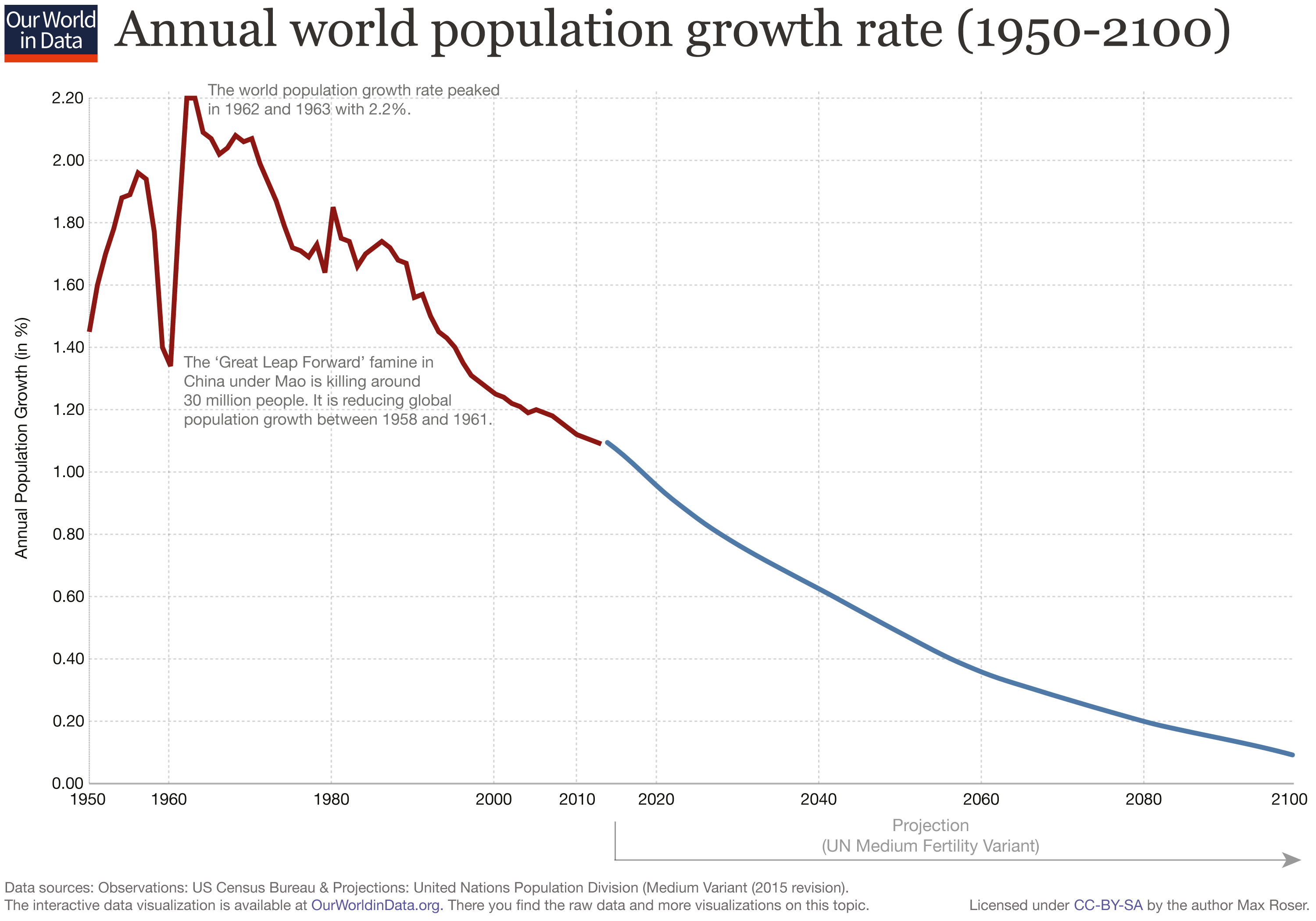
Whether there is any causality or not, it would be informative to calculate with UN logic, if e.g. “the Great Leap Forward” already cooled the planet enough to meet the UN targets.
I’m willing to give a prediction….
Up!
My opinion…
Point 2 is the main driver: more people means more CO2 emissions as every individual in most countries uses fossile fuels directly or indirectly for heating, cooling, transport, comfort,…
Point 2A should not be forgotten: As people get richer the per capita use of fossil fuels gets up and total CO2 release of a country goes up.
Point 3 is reverse: more easely obtained food means wealthier people leading to less population growth, not more.
Again, due to 2A, richer people have less children, but increased CO2 emissions…
There is a direct link between CO2 emissions and CO2 increase in the atmosphere:
http://www.ferdinand-engelbeen.be/klimaat/klim_img/dco2_em6.jpg
All the variability in the rate of change is due to short-term temperature variability, while the overall trend is caused by human emissions, which are about twice the increase in the atmosphere. The red line in that graph is the theoretical response of the oceans to any extra CO2 pressure in the atmosphere based on a 16 ppmv/K response to temperature in dynamic equilibrium per Henry’s law and an observed about 51 years e-fold decay rate for CO2 pressure above that equilibrium.
Further, a lot of other indications show that human emissions are the main cause of the increase in the atmosphere:
http://www.ferdinand-engelbeen.be/klimaat/co2_origin.html
That being said, what will bring the future?
Human population probably will follow the peak 9.5-10.5 billion people scenario, as in most countries the human reproduction rate is already the minimum 2.1 or below. Exceptions are India and most of black Africa. The latter is the main unknown.
Even if the population growth will get a peak, the increase of wealth in all countries will not stop and as long as there is no cheap, abundant alternative, fossil fuels will remain the main source of energy. There is enough coal to provide 10 billion people for hundreds of years with all energy needed and the shale revolution moved the “end of oil” and gas also forward with many decades.
Thus my guess: CO2 will go up beyond population growth, as more people get richer and per capita energy use increases. At least up to 2050, as cheaper non-fossil fuel alternatives may come in (fusion, thorium reactors,…).
Gas pressure, volume, mass and temperature are part of the equation pV=nRT, not the composition. This is reproducible in a laboratory, upscaled in industry and can be observed on the planets of the solar system. Presuming run-away greenhouse overrides it at planetary scale, why has solid CO2 been reported to snow down from the CO2 atmosphere of Mars? https://www.jpl.nasa.gov/news/news.php?feature=3515
Planetary scale figures at ppm/year level defy metrology. Thank you for providing the source.
Henry’s law presumes all the other parameters remain constant, which may be doable in a laboratory. Why do you think decay rate e-folding is sufficient to upscale it at planet-scale?
Jaakko,
Mars atmosphere is 95% CO2, earth has 0.004% CO2. In the first case it is possible to reach low enough temperatures at the Mars poles to freeze CO2 out of the atmosphere, despite the much lower atmospheric pressure. On earth that is impossible…
Henry’s law is applicable for every point of the ocean’s surface. There were over 3 million samples taken where the pCO2 of the ocean surface was measured and compared with the atmosphere. The partial pressure difference between ocean surface and atmosphere gives the direction and the CO2 flux is directly in ratio to that difference. As the diffusion of CO2 within the water mass is extremely slow, mixing speed with the atmosphere by wind is also very important. Using both factors, Feely e.a. have calculated the in/out fluxes between oceans and atmosphere:
https://www.pmel.noaa.gov/pubs/outstand/feel2331/maps.shtml
That shows that the oceans are a net CO2 sink at the current CO2 levels in the atmosphere. The same for the biosphere (based on δ13C and δO2).
What if some other parameters change?
– Higher temperatures at the surface: especially at the upwelling and downwelling zones with the deep oceans, will give more emissions at the equator and less uptake near the poles. That increases the CO2 levels in the atmosphere. The increase in the atmosphere gives the opposite reaction (Le Châtelier’s Principle) and ultimately the same dynamic (dis)equilibrium is reached at a CO2 pressure increase of ~16 ppmv/K. Not by coincidence the same change per Henry’s law as for a single sample in a laboratory.
– Wind speed increase/decrease: only gives a change in exchange speed. That doesn’t influence the ultimate equilibrium, only the speed with which that is reached.
– More upwelling from the deep oceans and/or higher CO2 concentration of the deep: temporary increase in natural emissions at the upwelling, leading to increase in the atmosphere, leading to increase in sink rate and decrease in source rate. New equilibrium gets up in ratio to increase in CO2 emissions from the upwelling. An improbable 10% increase in upwelling will give some 30 ppmv increase in the atmosphere.
– More emissions in the atmosphere (humans, volcanoes,…): increase in pCO2 reduces natural emissions at the upwelling zones and increases the sink rate at the poles. Increase in the atmosphere depends of the difference between emissions and extra sink rate. At the current emissions of ~9 GtC/year (~4.3 ppmv/year) of CO2 the sink rate for 110 ppmv extra pressure in the atmosphere above steady state is ~4.5 GtC/year (2.15 ppmv/year). Not enough to remove all human CO2 emissions in the same year as emitted, thus the remainder accumulates in the atmosphere.
The above decay rate of ~51 years was remarkably constant over the past near 60 years of accurate measurements. That means that the IPCC Bern model with increasing saturation of the deep oceans is not (yet) proven and there still is plenty of room in the deep oceans. The bottleneck is the exchange speed between the deep oceans and the atmosphere, as these are largely isolated from each other.
Your answers are appreciated Ferdinand. You are the first taking the effort to answer me these questions professionally. Had you been the first to encounter, I’d perhaps be elsewhere now. Thank you again. Some questions rather for information/consideration only, not necessarily expecting an answer in this chain.
“Mars atmosphere is 95% CO2, earth has 0.004% CO2. In the first case it is possible to reach low enough temperatures…”
In my view this favours pV=nRT over GHG model. If even carbon dioxide atmosphere temperature can lower, why couldn’t the nitrogen/oxygen mixture atmosphere temperature lower too?
“Henry’s law is applicable for every point of the ocean’s surface”
Based on the numbers declared in the related article, each measurement seems to represent about 15,000 square kilometres of ocean/year. How can “every point” be defined or measured accurately, let alone representatively for an entire year of the ocean? After all Henry’s law states: “At a constant temperature, the amount of a given gas that dissolves in a given type and volume of liquid is directly proportional to the partial pressure of that gas in equilibrium with that liquid.” Biological processes are excluded from Henry’s equation by its own definition. How has this been taken into account in the ocean measurements?
“The bottleneck is the exchange speed between the deep oceans and the atmosphere, as these are largely isolated from each other.”
How can lithosphere-ocean-atmosphere interfaces be isolated e.g. fast eroding chalk-cliffs (CaCO3, presumably one of the most common stones) and volcanic activity, including the ring of fire. How can they be measured separately or excluded from s.c. fossil fuel signal?
Jaakko,,
My pleasure to give you all information I know (but still don’t know everything I like to know…)
The main points in this case is radiation balance and pCO2 in the Mars atmosphere vs, vapor pressure of solid CO2 at ambient temperature.
At the Mars poles, little sunlight comes in and a lot of heat is radiated out of the surface as a 4th power function of the surface temperature. On earth that can give temperatures down of -80ºC, which is the condensation temperature of CO2 at 1 bar pressure. As the CO2 pressure on earth is only 0.0004 bar, you need extreme low temperatures to condense CO2. As Mars is farther from the sun, less sunlight is reaching the poles and temperatures can drop much lower. On the other side, the CO2 pressure is much less than 1 bar, so it depends of temperature and pressure if the solidification temperature will be reached.
I doubt that the CO2 “greenhouse” effect will have much influence on the Mars poles (and little on earth too), it only delays the cooling in Mars polar winters, so ultimately it will make little difference for reaching the solid state of CO2…
I agree that 3 million samples over time is not much over the wide oceans, but all of them did show the same basic chemistry: if you measure two variables, one can calculate all others. And everywhere temperature and pCO2 are closely coupled.
While Henry’s law is about a fixed ratio of a gas between atmosphere and liquid at a fixed temperature, in the CO2 case it is the change in Henry’s rate constant with temperature which is important. That translates in an equilibrium pressure between ocean sample and atmosphere at the surface temperature and thus direction and CO2 flux between surface and atrmosphere.
In overall exchange speed between ocean surface and atmosphere is less than a year, where the “surface” is the “mixed layer” of 50-200 m depth influenced by wind and waves.
Biological processes seems to be excluded, but as they influence the amount of bicarbonates, they influence the whole chain of reactions and thus are included in the pCO2 measurements.
In general the ocean’s inorganic content doesn’t change that rapid and even for long term sampling 4 samples per year are sufficient to show all (seasonal) variation as needed, including the influence of temperature and bio-life.
There are a few stations which have longer, continuous data. That shows seasonal and longer term parameters, here for Bermuda:
https://www.biogeosciences.net/9/2509/2012/bg-9-2509-2012.pdf
The main difference between fossil and recent organic CO2 at one side and inorganic CO2 is in the δ13C levels: practically all fossil and recent organics are low (C4-plants) to extremely low (natural gas) in 13C/12C ratio, while near all inorganic CO2 from oceans, carbonate rocks, volcanoes,… is higher in 13C/12C ratio.
To differentiate between fossil and recent organics, one can use the oxygen balance: fossil fuel use needs oxygen, while vegetation growth/decay produces/needs oxygen. By subtracting the oxygen use from burning fossil fuels from the change in oxygen level, that shows a small deficit: less oxygen is used than calculated. Thus recent organics are a source of oxygen and thus a sink for CO2 and preferential of 12CO2 and thus not the cause of the decline in δ13C…
Your argument is somewhat faulty — fossil fuel use is not that high up to around 1990’s over several developing countries — in 80’s I travelled Ethiopia with a truck filled with diesel as there was internal war with poor road connectivity; in Mozambique there was no way to travel except through Air as roads are full of mines. Also, the figure indicates higher growth in CO2 during the same period. Also, WMO fact sheet showed the CO2 measurements were very sparse in 1960s.
Dr. S. Jeevananda Reddy
Dr. S.,
Most increase started in the 1940’s with WWII and the following boost in industrialisation. Emission figures originally were based on the statistics departments of countries for their fossil fuel sales, nowadays under “environment” and required by the UN, still relatively accurate, as far as some countries aren’t cheating (China?). Probably more underestimated than overestimated as for the human tendency to avoid taxes…
See:
http://cdiac.ess-dive.lbl.gov/trends/emis/tre_glob.html up to 2008
and
https://www.iea.org/newsroom/news/2016/march/decoupling-of-global-emissions-and-economic-growth-confirmed.html for later years
There is an apparent relationship where 2% of excess co2 concentrations are sunk. Given emissions of 5ppm, expected excess is 250 ppm or 530ppm total.
Between 134,000 and 128,000 years ago in at the start of the Eemian interglacial CO2 concentrations increased by 80 ppm and then declined by the same amount between 112,000 and 85,000 years ago. During these periods it is inconceivable that the driving force could have been changes in human population which was minuscule at all those times.
Between 450MY ago and 300MY ago CO2 concentrations fell from +/- 4500 ppm to +/- 500ppm and then rose again to 3500ppm by 175MY ago. There was no human population at all during these periods.
To draw conclusions on the rise in CO2 over the last handful of decades is hopelessly absurd.
The probable cause of the two rising together is that the recovery of temperatures since the last Glacial Maximum has caused the rise in CO2 concentration and the benign climate and increased fertility from rising CO2 allowed the great increase in human population.
catbirdgoblin,
You can’t compare the earth of many million years ago with the earth today. CO2 of 60 miilion years ago was taken out of the atmosphere by calcifying plankton (Ehux) and now sits in thick layers of chalk in South England and many places on earth.
Over the past few million years, there was a rather fixed ratio between CO2 levels and temperature: about 8 ppmv/K for the poles (as seen in ice cores), that translates to ~16 ppmv/K for the whole earth taking into account the polar magnification effect of temperature changes.
The about 16 ppmv/K is not by coincidence what Henry’s law gives for the solubility of CO2 in seawater at different temperatures. That is what is seen in ice cores over the past 800,000 years. Since ~1850, the CO2 levels are increasingly higher than that fixed ratio, where human emissions are average twice as much in quantity as what is seen as increase in the atmosphere. Seems rather obvious that temperature is not the cause and humans are at the base…
http://www.ferdinand-engelbeen.be/klimaat/klim_img/antarctic_cores_010kyr.jpg
Ice phases are dynamic – there may be 18 from ice under normal atmospheric pressure to possible crystal structures when progressively crushed under high pressure. It would be reasonable to expect the type of lattice influencing the amount of gas it can contain.
Source: http://www1.lsbu.ac.uk/water/ice_phases.html
How has this been taken into consideration when analysing, calculating and reporting carbon dioxide concentrations at ppm level in the Arctic ice cores presumably spanning over 800,000 years?
Jaakko,
CO2 in ice cores is not in the ice matrix. When snow falls on the surface, it contains more air than ice with the air at ambient composition. When it compacts, the density of the loose ice (firn) increases and air is squeezed out, with decreasing pores between the ice crystals. Meanwhile there still is diffusion of air in both directions, which gets slower with decreasing pore diameter. At a certain depth the pores are too small and exchange ceases and at last only fully enclosed small bubbles of air remain in the ice. That is not air from one year, but a mix of several years: 10 to 600 years, depending of the accumulation speed of snow and thus the speed with which the air bubbles are fully isolated.
The form of the ice thus is not important. What is important is that at a certain depth clathrates between CO2 and ice and deeper between O2 and N2 and ice are formed. Thus no visible air bubbles left. For that reason the ice cores recovered from the deep are put near te surface during at least a year at -20ºC for relaxation. During that time the ice cores expand a lot and the air bubbles come back.
See for a nice overview:
http://courses.washington.edu/proxies/GHG.pdf
Thanks for your essay, Roger.
But there’s one mistake in it. You presume a CO2/population relationship, disregarding there is a vast more quantity of CO2 in oceans and land mass controlled by temperature.
Manmade CO2 is absolutely negligible versus the whole CO2 content of the planet.
What you’ve made up, is a stork/babies fallacy.
But at least, I agree your #1.
Petermue,
How much CO2 is in other reservoirs is not of the slightest interest for any increase of CO2 in the atmosphere, as long as that stays there.
How much CO2 is exchanged with other reservoirs is not of the slightest interest for any increase of CO2 in the atmosphere, as long as the inputs equal the outputs.
Currently humans emit ~9 GtC/year. Currently the difference between natural inputs and outputs is ~4.5 GtC/year more output than input.
Thus the other reservoirs are increasing and not the cause of the increase in the atmosphere…
How much CO2/year do Seven Sisters chalk cliffs in East Sussex emit?
There’s that awful, pseudo-mass balance argument again.
@Bartemis
what’s awful in that argument? it makes perfect sense.
Jaakko,
Not much… Estimates of global rock weathering by CO2 (making soluble bicarbonates from the chalk rocks) are around 1% of human emissions. Look at how many millions of years it needs to carve the beatiful caves in carbonate rock everywhere…
paqyfelyc – it’s just awful. Very naive. An elementary mistake in dealing with dynamic systems. I explain why here.
paqyfelyc,
Bart’s response in his reference contains several basic errors (*), but that was discussed here on WUWT many times in the past. The only way that his theory may be right is that the natural carbon cycle is very huge and increased over time, dwarfing human inputs to not important.
Since 1960, when accurate measurements at Mauna Loa (and the South Pole) started, human emissions per year increased a fourfold. So did the increase in the atmosphere and so did the net sink rate. The latter is the difference between human input and observed increase in the atmosphere per mass balance.
The simplest conclusion is: based on the mass balance, human emissions are the cause of the increase and the difference sinks somewhere in nature, wherever that may be. That fits all observations.
Bart’s conclusion is that the natural cycle (due to temperature increase) is the main cause of the increase.
The only way that can be true, is if the natural cycle also increased a fourfold since 1960, or you violate the equality of CO2 for the sinks, whatever the origin. Sinks don’t differentiate between CO2, no matter if that is of human or natural origin. Thus if human CO2 quadrupled, natural CO2 input (and output) must have quadrupled too (or not at all), to give a fourfold increase in net sink rate.
That is not observed at all: to the contrary, all indications show a rather stable natural cycle (+/- 2%) with an increasing average residence time (while one may expect a fourfold decrease for Bart’s theory), decreasing δ13C (while one may expect an increase),…
(*) Bart’s reasoning starts already with a false assumption:
0.5*Ea := Ea + En + U
There is no reason at all that the increase in the atmosphere is half of human emissions for any given year or not even in average over decades. The sinks don’t depend on the emissions (natural and/or human), they only depend on the momentary CO2 level (pressure) above equilibrium, the latter influenced by the momentary surface temperature.
@ur momisugly Ferdinand Engelbeen
I agree that “The sinks don’t depend on the emissions (natural and/or human), they only depend on the momentary CO2 level (pressure)”. Period.
I mean, you cannot (and don’t need to!) assume any equilibrium. Indeed, we have hints that the whole system is out of equilibrium, just as living beings are. That is just what the Gaia hypothesis is all about (not some sort of goddess).
“There is no reason at all that the increase in the atmosphere is half of human emissions for any given year or not even in average over decades.”
Of course there is. That is the observation. It’s not saying it has to be. It is just what is observed.
This is really dumb. The pseudo-mass balance argument is really dumb.
Bart, human emissions of CO2 is roughly 26.4 Gt per year. How much stays in the atmosphere per year and how much goes into sinks per year?
@ur momisugly Mark S Johnson
your question is very dangerous, and irrelevant
Dangerous because it is open door to some idea that human emitted CO2 behave in nature somehow differently from other CO2 (not saying you fell to that, but other may and did)
Irrelevant, because it could very well be 264 or 2640 Gt (if it was absorbed and re-emitted 10 or 100 time during the year), this is not important; what is important is how much the total is increased (if it is; sometimes, increasing input actually reduce the output)
Bart,
The sinks react on the total pressure of CO2 (pCO2) in the atmosphere, not (only) on the extra pressure from one year’s emissions.
In your formulation you take the 0.5*Ea as fixed, while the sinks don’t react on Ea, they react on
pCO2(actual) – pCO2(equilibrium) where the latter depends of the ocean surface temperature.
The net sink rate is:
U = k(pCO2(act) – pCO2(eq)) where k ~0.02, surprisingly linear in the past 60 years.
pCO2(eq) does change with temperature at ~16 ppmv/K on a year by year basis.
The increase in the atmosphere then is:
dCO2/dt = Ea – U or
dCO2/dt = Ea – k(pCO2(act) – pCO2(eq))
The increase in the atmosphere depends on the height of the emissions in a given year and the net sink rate of the total increase in the atmosphere above equilibrium, not only of the emissions.
dCO2/dt thus can be positive, negative or zero.
If the current emissions would stabilize at 4.3 ppmv/year, the increase in the atmosphere would stabilize at 4.3 / 0.02 = 215 ppmv above equilibrium or just over 500 ppmv.
There is nothing dumb in assuming that the mass balance must be obeyed at any moment in time…
@bartemis
Your explanation in your link is just out of scope. No physical assumption whatsoever is needed to just observe that, if, during a period of time, a source net produced 9 while the result only increased by 4, then all other source+sink must have net reduced by 5 (because sinks ramped up or appeared, other source dwindled, or any combination). In any case, other sources/sink cannot have net produced, too.
paqyfelyc,
Bart’s escape route is that the natural cycle dynamically increased over time: if the natural cycle increased a fourfold since 1960, then the residual of the sinks would go up a fourfold (that is observed), as the resistance increases with a higher circulation speed. Because of the much larger quantities circulating in nature, the small addition by a fourfold increase of human emissions in the same period doesn’t play much role.
Problem for that theory is that there is not the slightest indication of an increased natural carbon cycle, to the contrary: recent estimates of the residence time of any CO2 (whatever the source) in the atmosphere gives an increase compared to older estimates, which is consistent with a rather stable carbon cycle in an increased mass of CO2 in the atmosphere.
This may be the most ridiculous and unrealistic prediction of future CO2 levels, Evah! It makes the same colossal blunder almost all of the doomsday scenarios make : it ignores the imminent appearance of a energy revolution that will be brought about by molten salt nuclear reactors, , which will commercialize within 10 years,at most. These reactors will replace existing generators for purely economic reasons. There will be no need for subsidies for these nuclear reactors. Or any need to convince people that they will be the safe and physically incapable of causing harm. And can burn Thorium is need be. And if you are looking for more good news about electric cars, 120 models have been announced by the world’s automakers – due in showrooms over the next 3 years. And, if that isn’t enough, Toshiba just completed testing a new variation battery that can be recharged in 6 minutes (32kWhr battery) and can retain 90% of its capacity after 5,000 recharge cycles. That amounts to over 1 million miles. It also resists the effects of cold temperatures.
hm …. Any new energy will takes decades just to appear in the energy picture. Current powerplants will remanin for decades.
Besides, if CO2 stop to rise or even flatten, we are doomed. Warmunists will take credit, pretend they succeed in stoping a disaster, and strenghen their power. We need CO2 to rise to drive warmunists and doomsayers back in the dark age they belong.
And. Dont make so much fuss about batteries. These things are just tank, you still have to fill them up with something. Charging a 30kWh battery in 6 minutes require a 300kW power, just compare that to your house power…
I’m going with a 6th possibility, that CO2 and population are each affected (“driven” is such a presumptive term) by a number of factors, many of which are unrelated to each other while some of which are.
Roger, like the UN’s favorite climate model, the disaster scenario RPC 8.5, their population stats are similarly exaggerated. Growth rates of population peaked in 1990 (90million added /yr) and projected to drop to 40million a year by 2050. Population should peak at or below ~10million and if prosperity can be spread unhindered by stopping the interference of neomxist мisаитнгорisт economy wreckers, it could fall to below the 10million peak. Folks, we are 85% there! With greening of the planet, big harvests, a healthy prosperous population, we will be approaching Garden of Eden Earth. This itself will mark the end of аlагмisм, dуsторiaisм, and maybe, finally, global магхisм.
https://www.census.gov/population/international/data/idb/worldpopchggraph.php
Roger, you may also wish to take into account the following:
“Here, we study the questions why we still live in an interglacial world and when we should expect the end of the Holocene under natural conditions (no anthropogenic influence) or under anthropogenic perturbations (also referred to as “Anthropocene”), questions which attracted considerable interest in recent years. It was argued that without earlier anthropogenic activity we would live already in glacial world (Ruddiman’s hypothesis). Tzedakis et al. (Nature Geoscience, 2012), using MIS 19 as the best analogy in terms of the orbital parameters for the Holocene, suggested that the new glacial inception would start within the next 1500 years, assuming natural CO2 level of 240 ppm. However, 240 ppm is much lower than preindustrial CO2 level and CO2 concentrations during several most recent interglacials (starting from MIS 11). Here, using the comprehensive Earth system model of intermediate complexity CLIMBER-2, carefully calibrated for the simulations of the past eight glacial cycles, we show that (i) although climate conditions during late Holocene were very close to the bifurcation transition to the glacial climate state (Calov and Ganopolski, Geophys. Res. Lett., 2005), it is very unlikely that under pre-industrial CO2 level (280 ppm) glacial inception would occur within the next several thousand years; (ii) it is likely that the current interglacial, even without anthropogenic CO2 emission, would be the longest interglacial during the past million years; (iii) current CO2 level makes new glacial inception virtually impossible within the next 50,000 years; (iv) in agreement with earlier result of Archer and Ganopolski (Geochem. Geophys. Geosyst., 2007) based on a conceptual model of glacial cycles, we found that consumption of a large portion of available fossil fuel could postpone the next glacial inception by hundreds of thousand years.”
http://adsabs.harvard.edu/abs/2013EGUGA..15.1666G
The last part of the final sentence is a real corker.
too simple: you just cannot connect atm CO2 directly to anything (population or whatever), you have to connect flux, out and in. Population may (or not…) drive human CO2 outgasing, but you have to make assumption about the way extra CO2 is sucked up by other process. Which may be flat, linear, quadratic (for instance: more CO2 -> more photosynthesis x more plants -> square less CO2) or even exponential.
Besides, i think we should be far more worried by the impact if AI and information control, than climate. Humanity will thrive whatever the climate turns to be, it may not survive an AI take over
These calculations ignore the most fundamental wisdom. First of all, CO2 sinks consume about 1,8% of elevated atmospheric CO2 p.a.. Next fyi, one ppm in the atmosphere corresponds to 7.79Gt of CO2.
So at 550ppm that would mean CO2 sinks will consume like (550-280)*7.79 * 0.018 = 38Gt of CO2 p.a. That would be a long term target to achieve in a distant future, if we continue to emit like we do at the moment.
CO2 predictions in the “4th order Polynomaial Trend” is completely absurd for that reason. First the “high estimate” indicates an increase of 16ppm per year in 2050. That would require emissions of 16*7.79 = 124.6Gt p.a. But furthermore we would need to compensate for the effect natural CO2 sinks, which amounts to (660-280)*7.79*0.018 = 53.3Gt. So mankind would need to emit 177.9Gt p.a. in 2050.
For the same reasons, even the “medium estimate” would require 74.4Gt p.a., which may not seem impossible, but rather unlikely.
The “low estimate” however would be consistant with about 29Gt emissions in 2050, which may seem low by todays standards. As developing nations do and will not care about the emissions, that seems unlikely too.
So realistically we will see something between the low and medium estimate, which of course will be completely irrelevant for climate anyhow.
Maybe we should look at Henrys Law from 1803.
The amount of gases in the atmosphere, including CO2, is a function of the air temperature.
The warmer it gets, the more CO2 there is in the atmosphere.
The only true statement we can make about the climate, is that is always changing.
With ice-age as one extreme, we can only speculate about the other extreme.
The atmosphere is warmer now than during The Little Ice Age.
Consequently, there will be more CO2 in the atmosphere now than 200 years ago regardless of the number of people emitting CO2 one way or another.
Since it is a lagging function, we will still see an increase even if the temperature curve is relatively flat now.
Kjell,
The solubility of CO2 in seawater changes with about 16 ppmv/K. That means that the increase of CO2 since the LIA for 0.8 K temperature increase is about 13 ppmv at the new equilibrium. For the current average ocean surface temperature, that means a CO2 level of ~290 ppmv in the atmosphere. We are at 400+ ppmv. The extra 110 ppmv can’t be from the increased ocean surface temperature…
Jim Ross, October 8, 2017 at 1:26 pm
“Take the δ13C decline:
That definitely excludes the oceans as source of the increase of CO2 in the atmosphere.”
I disagree. The literature is not very helpful on this, and seems incapable of addressing the biological pump, but we know (or think we know) that phytoplankton discriminate against 13C in the same way (and proportion) that land-based plants do.
That is true, but the net effect is an increase of 13C at the surface: when phytoplankton produces organics, it prefers 12CO2, thus 13CO2 is relative left in the ocean surface, where most biolife is present. Via the food chain, a lot of bio-CO2 returns in the waters (and air), but some drops out into the deep oceans.
As that is low-13C, the ocean surface remains higher in δ13C than the deep oceans. The latter are around zero per mil δ13C, while the ocean surface is between 1-5 per mil δ13C, depending on the abundancy of biolife…
Thus any oceanic CO2, either circulation or addition would increase the δ13C level of the current atmosphere (at -8 per mil), while we see a firm decrease.
Of course, it is always more complicated than said here: there is a discrimination between 13CO2 and 12CO2 at the border between water and air and reverse: heavier isotopes tend to move slower into another medium. That makes that over the pre-industrial Holocene, the equilibrium δ13C level was about -6.4 +/- 0.2 per mil in the atmosphere. Human emissions dropped the δ13C level with 1.6 per mil to below -8 per mil in current times:
http://www.ferdinand-engelbeen.be/klimaat/klim_img/sponges.jpg
Free access to the pre-print: http://www.boehmf.de/Boehm_et_al_g_cubed_preprint.pdf
As you can see, the same drop is visible in surface waters (coralline sponges) as in the atmosphere (ice cores, firn, direct measurements), because both are in close contact and exchange CO2 with a rapid mixing rate of less than a year.
That drop is larger than during the glacial-interglacial transitions and reverse and not coupled with huge temperature/ice/land/biosphere changes as during the transitions:
http://science.sciencemag.org/content/336/6082/711.full and
http://science.sciencemag.org/content/296/5567/522.full
Thanks for showing this plot again. It’s funny how no-one mentions the scales, which obviously were chosen by the author to show the match between CO2 and δ13C.
The left scale is linear in δ13C but, in order to get alignment with the CO2 data, the author has quite rightly used a right-hand scale that is linear in the reciprocal of CO2. Such a relationship reflects a constant δ13C value for the incremental CO2! Further, we can compute that value simply by comparing the two scales: taking 1/CO2 values of, say, 0.0035 and 0.0029 (right scale) and reading off the equivalent δ13C values (outer left scale) of -6.47 and -7.56 respectively gives a constant δ13C value (on average) for the incremental CO2 since 1750-1800 of -12.8 per mil. Close enough to -13 (as demonstrated by the measurements at the South Pole I showed above) I think you’ll agree. Of course, the match from 1950 onwards is simply showing the same thing as my plot, but it is the alignment prior to 1950 that adds to our knowledge about the growth of atmospheric CO2.
So, this plot supports a view that all the growth in atmospheric CO2 since 1750 or thereabouts has had a δ13C content of close to -13 per mil. It is the apparent constancy of this value that interests me and, of course, the implications of this for any proposed model. However, I suspect that most people looking at the plot are not aware of the significance of the choice of scales.
Jim Ross,
In the upthread discussion you plotted the O2/N2 ratio vs. CO2. That shows a high correlation. That can be explained as follows.
The emissions – increase ratio in the atmosphere also is almost linear:
http://www.ferdinand-engelbeen.be/klimaat/klim_img/acc_co2_1960_cur.jpg
That is just by coincidence, as human emissions increased more or less linear per year, giving a slightly quadratic emissions total over time and so does the residual increase in the atmosphere. That gives a highly linear correlation between the two.
As the constant increasing CO2 level is mainly caused by fossil fuel burning, that uses a constant increasing amount of oxygen, as long as the quantities and the mix don’t change too fast.
In this case, the mix did slowly move from coal (1 O2 for 1 C) to oil (1.5 O2 for 1 C + 2 H) to natural gas (2 O2 for 1 C + 4 H). That means that the per molecule use of fossil fuels the oxygen may double over a longer period of time (and back again at gas).
If the shift in fuel mix happens gradually, that will not change the linearity of the correlation, it only will influence the slope, which gets steeper as gradually more O2 is used by the increase in fossil fuel use + the increase from the change in fuel mix.
The same is true for the comparison δ13C and 1/CO2: only the slope changes with a gradual change in fuel mix towards lower-13C fuels, not necessary the linearity.
Thus one need to look at the total and mix of all the fuels used, calculate the total oxygen use and average drop in δ13C of that mix. Then add in the ~40 GtC (deep) ocean exchanges at -6.4 per mil (which is the pre-industrial average caused by the ocean-atmosphere exchanges)…
Eventually one can add in the increasing uptake by the biosphere, and the shift in isotopes by the biosphere as Ralph Keeling did to fit the details…
Will be a nice job for you…
Ferdinand,
Hmmm, a straight line with (only) changes in slope. Interesting!
I have no interest in developing my own models as I am not trying to prove an alternative hypothesis. I started looking at the data and the published models in an effort to convince myself that the very logical sounding hypothesis that all (or most) of the growth in atmospheric CO2 is from anthropogenic emissions. Given the level of support for such a view, I thought this would be an easy task, but the reality has been very different and I remain unconvinced that the hypothesis has been proved.
Since you are convinced about this, based on a great deal of your own research that you share here on WUWT, could you tell me if the CDIAC “global carbon budget” (which I believe is also the IPCC view) is consistent with your analysis. Based on the latest release (http://cdiac.ess-dive.lbl.gov/GCP/, November 2016), it would seem to be their view that:
1. All (100%) of atmospheric CO2 growth is from emissions. This is evident from the fact that they subtract the atmospheric growth from total emissions and then “assign” the rest to either the “ocean” sink or the “land” sink, in the same year.
2. Roughly 27% of total emissions (give or take 3 or 4%) is absorbed by the oceans each year, regardless of the estimated size of total emissions that year and, even more strangely (to me at least), showing no correlation whatsoever with ENSO.
3. The remainder (emissions minus atmospheric growth minus ocean sink) is absorbed by the land sink. Simple arithmetic calculation as shown in the published spreadsheet: no independent verification as far as I can see.
4. In two years (1987 and 1998), the land sink is calculated as negative, i.e. there is a net release of CO2 – this is within the quoted error margin, however, so perhaps it is simply their view that in these two years the land sink did not remove any emissions at all.
5. In other years, the land sink removes anything up to over 50% of emissions.
6. In some years, then, the two sinks combined can remove 80% of anthropogenic emissions (La Niña or Pinatubo). In other years, as little as 21% is removed (El Niño).
Of course, we know that annual variations in atmospheric CO2 growth rate correlate extremely well with temperature/ENSO, but CDIAC’s model puts all of this variation down to the land sink alone (with higher temperatures leading to less uptake). Do you agree with this aspect of the hypothesis?
Jim Ross,
1. That simply is the mass balance. As long as human emissions are higher than the increase in the atmosphere, all increase (in total mass, not from the original human molecules) is from the emissions and nature acts as a sink.
Bart has a mathematical possible alternative, with high turnover of huge natural fluxes, dwarfing human emissions. That is only possible if the natural fluxes increased a fourfold since 1960, as human emissions and the increase in the atmosphere did. There is no evidence for any increase in natural cycle, to the contrary…
2. and 3. Ocean uptake is simple physics: just a matter of temperature and CO2 pressure over the equilibrium level for that temperature. That process is much more pressure sensitive than temperature sensitive.
Take e.g. the uptake at the polar oceans (~40 GtC/year):
The pCO2 difference between atmosphere and the polar waters is 400-150 = 250 µatm difference, pushing 40 GtC into the deep oceans.
See Feely e.a. at: https://www.pmel.noaa.gov/pubs/outstand/feel2331/exchange.shtml
If the seawater temperature near the poles increases with 1 K, that gives a local increase of the equilibrium pCO2 of the waters from 150 to 166 µatm and the local pCO2 difference drops to 234 µatm and the output drops from 40 GtC to 37.4 GtC/year, a 6.5% drop. Together with the increase in output at the equator at warmer temperatures that gives an initial net input of CO2, but in a few years the resulting increase in the atmosphere pushes more CO2 in the sinks and less out of the sources. At 16 ppmv extra in the atmosphere, everything is back in (dis)equilibrium as before the temperature increase.
Uptake by the biosphere can be calculated from the oxygen balance, which shows much more variability, the uptake by the biosphere is far more temperature sensitive than pressure sensitive.
The oxygen balance can be found at:
http://www.bowdoin.edu/~mbattle/papers_posters_and_talks/BenderGBC2005.pdf
Especially Fig. 7, which gives the opposite view: net uptake/release by the biosphere and the residual is what the oceans do…
That it is mainly the biosphere and not the oceans which are responsible for a fast reaction of CO2 on (ocean) temperatures like El Niño and Pinatubo can be seen in the opposite δ13C and CO2 changes. If the CO2 changes were mainly from the ocean surface, δ13C and CO2 changes would parallel each other:
http://www.ferdinand-engelbeen.be/klimaat/klim_img/temp_dco2_d13C_mlo.jpg
4. In the above graph, the huge influence of the 1998 El Niño on vegetation is visible as good as in the O2 balance of FIg. 7. Detailed investigations showed that the negative uptake is almost all in tropical forests, where changed rain patterns dried out large parts of the forests with more release (from debris) than uptake and more forest fires as result.
5. A La Niña reverses the effect of an El Niño on tropical vegetation, which restores the loss in 1-2 years…
6. The Pinatubo had an extra effect besides a drop in temperature: due to far more scattered sunlight from the stratospheric aerosols, photosynthesis was enhanced, as leaves which were normally in the shadow of other leaves during part of the day, now received enough sunlight all day long to remain active…
Thus indeed, land based CO2 sinks are the main reactant on temperature changes and CDIAC did a good job…
Ferdinand,
A simple “yes” would have sufficed! I am familiar with your arguments, but am also very aware that models: (i) provide no more than a single, non-unique, possible explanation of the observations; (ii) the results depend critically on the input assumptions; and, (iii) there is a real danger of getting into circular arguments. You refer to Bender et al (2005). It contains a number of key assumptions, fails to explain certain characteristics of the data and provides a conclusion regarding the relative size of the two sinks that differs from CDIAC by up to a factor of four!
I am surprised that you are still using the misleading derivative plot to suggest that it demonstrates that vegetation (δ13C of circa -25 per mil) dominates the variability instead of showing the actual CO2 and δ13C values. These data demonstrate the fact that there are times when both CO2 and δ13C values are increasing in parallel, as you know. More specifically, what we do know is that the long term decrease in atmospheric δ13C reflects an average value for incremental CO2 of -13 per mil and that this value decreases during El Niño and increases during La Niña. This point cannot even be controversial, since the “thinning” model would fail otherwise (see Randerson et al, 2002, Figure 5, and consider the implications of varying the size of the land sink due to ENSO):
http://www.onlinelibrary.wiley.com/doi/10.1029/2001GB001845/pdf
But then this is still only one possible solution and it requires that all of the input parameters/assumptions that are the basis for Figure 5 must remain more or less constant over the longer term, or vary in a way that maintains the known long-term value of δ13C for the incremental atmospheric CO2 (the black arrow on Figure 5), which brings us back to Ralph Keeling’s problem and his proposal which would add yet another variable to the Figure 5 diagram.
Since about 95% of carbon dioxide in the atmosphere is from natural causes it would seem that 95% of the increase in CO2 would be caused naturally. . The global warming that began around 1850 is most likely the major reason for the increased greening of the Earth. This greening would appear to be the primary reason for the global CO2 increase. The satelite CO2 measurements show the three most dense areas of CO2 to be the Brazilian rainforest, the jungles of Central Africa and the heavily vegetative area of Southeast Asia and Southeast China.
Your first sentence is obviously false. Most systems grow out adding something else, not out of linear increase of the already there. For instance, +98% of the population is made of people born more than 1 year ago, while more than 100% (no error!) of the increase is due to people born last year
Your second is plausible but unproven (and impossible to prove)
Your third is weird hypothesis (why would greening increase CO2, when green things eat CO2?).
Bill Everett,
Based on the δ13C level in the atmosphere, human CO2 now is about 9%, natural is around 91%. Natural cycle is around 150 GtC/year bidrectional, human emissions are around 9 GtC/year one-way.
That is the problem for your theory: even if natural emissions increase a tenfold, that doesn’t influence the increase in the atmosphere, as long as the sinks increase equally. Since 1959 in every year the sinks are larger than the natural sources, thus not the cause of any increase in the atmosphere…
The satellite shows CO2 levels, not CO2 fluxes. CO2 levels over the equator are higher due to deep ocean upwelling, while the polar sinks take a lot of CO2 with them. That is a flux of ~40 GtC/year from equator to poles, again more sink than source…
The author of this claim did not talk about how much of a difference switching to renewable energy sources would have on CO2 levels in the atmosphere. The author states that none of the measures taken by industrialized countries to reduce CO2 levels seem to have any noticeable effect up to 2015. However, he is not considering the use of future technological advancements such as the electric car, in society, which can reduce CO2 levels greatly. Also, he is not considering Earth’s natural processes as possibility for increasing CO2 levels. For example, according to the article published in the Journal Nature, it was found that the soil releasing CO2 into the atmosphere is the main problem, not humans (Fang, 2010). Also, he does not talk about the issue in terms of major CO2 emitting countries, rather as an entire world, but this is questionable as smaller countries and cities contribute minimally.