By Javier
A year ago I wrote an article at WUWT analyzing the recent upward trend in summer Arctic sea ice extent. Despite challenges of statistical irrelevancy, the trend has continued another year. Arctic ice experts, that have repeatedly predicted the demise of summer ice, don’t have an explanation for a 10-year trend that contradicts their predictions, beyond statistical variability or unexplained natural variability. They believe the upward trend will end any year, and there were high expectations that 2017 was going to be that year, due to the low maximum in March. As we will see a low maximum has no predictive value.
However, the upward trend was predicted by Divine & Dick in 2006, based on the analysis of Nordic sea melt-season ice changes for the period from 1750-2002, where they identified two periodicities of ~60-80 years and ~20-30 years.
“… our results suggest that the Arctic ice pack is now at the periodical apogee of the low-frequency variability. This could explain the strong negative trend in ice extent during the last decades as a possible superposition of natural low frequency variability and greenhouse gas induced warming of the last decades. However, a similar shrinkage of ice cover was observed in the 1920s– 1930s, during the previous warm phase of the LFO [Low Frequency Oscillation], when any anthropogenic influence is believed to have still been negligible. We suppose therefore that during the decades to come, as the negative phase of the thermohaline circulation evolves, the retreat of ice cover may change to an expansion.”
So, when nearly every expert was predicting the collapse of Arctic summer ice, these two Norway-based researchers correctly predicted the trend observed for the past 10 years.
In science your hypothesis can only be correct if it not only explains, but also predicts the behavior of the studied phenomena. Therefore, the hypothesis of Divine & Dick is superior to the more popular hypothesis that assigns sea-ice behavior to the anthropogenic effect. For this year’s article I have decided to examine the hypothesis of Divine & Dick to analyze the importance of natural variability on summer Arctic sea ice evolution.
I am using NSIDC monthly Arctic sea ice data for March and September available here. The data are plotted in figure 1.

Figure 1. Arctic sea ice extent
Then I define the melt value for the year X as the September X value minus the previous March X value, resulting in a negative number. The refreeze value for the same year X is the March (X+1) value minus the previous September X value, resulting in a positive number.
Plotting the Melt and Refreeze curves on the same graph produces the amazing result shown in figure 2.

Figure 2. Arctic sea ice melt-refreeze cycle.
Both curves are very close. So close that the winter growth in Arctic sea ice is >80% predictable based only on the ice extent lost in the previous melt season. In fact, I can predict that the Arctic will gain between 9.3 and 9.7 million square kilometers from this past September to March 2018.
I’m not sure how surprised you are by this result. I don’t doubt this must be known by plenty of ice researchers, but I haven’t seen it reported anywhere despite reading a great deal about Arctic Sea Ice. This result leads up to some very important conclusions:
-
Arctic sea ice dynamics are driven by unpredictable melting. Freezing is reactive and largely predictable.
-
This indicates a very strong negative feedback in action. A small melting is followed by a small refreezing, and a huge melting by a huge refreezing. Surprisingly this is not known by many ice experts that expressed surprise after the huge refreezing that followed the huge 2012 melting.
-
The negative feedback stabilizes sea ice. Alarmism and spirals of death are unjustified.
-
The much-touted albedo effect can only have a small effect in the Arctic, as the lost ice is recovered during the following “dark” season, during which albedo has no role. An example that evidence always trumps logic.
-
Inter-annual changes in sea ice are due to the small residuals indicated in the figure by the colored areas. Red for decrease and blue for increase.
- Around 1998 Arctic sea ice changed its dynamics and entered a period of higher volatility. One possibility is that below a certain size the Arctic sea ice sheet becomes more unstable and sensitive to weather phenomena.
To continue, we must concentrate on the annual difference between melt and refreeze. I define the anomaly for a year as the summation of the melt that occurs on that year and the refreeze that starts on that year and ends in the next year. This produces another amazing chart.

Figure 3. Arctic sea ice extent anomaly
The anomaly graph is very homogeneous for the 38-year period analyzed, despite huge changes in Arctic sea ice. So, there are more interesting conclusions to be extracted from the data:
-
The yearly anomaly appears to be range bound. No positive or negative changes bigger than 600,000 square kilometers are observed.
-
Despite periods when the anomalies are skewed towards one side, overall the observed linear trend is flat at –53,000 square kilometers/year. This means no acceleration of the Arctic sea ice loss is observed for the 38-year period, during which atmospheric CO2 levels have increased enormously to values not observed in over a million years.
- This result supports the hypothesis that cyclical changes in ice cover, over time, average out. As opposed to the hypothesis that ice cover loss is accelerating due to an increasing anthropogenic effect.
Since the loss of ice during the melt season is the driving factor in the Arctic sea ice dynamics, I have constructed a very simple model to explore the relationship between natural and anthropogenic factors in Arctic changes. The model rests on unproven assumptions and is not intended to represent or predict Arctic sea ice changes. It is simply a learning tool that uses several of the proposed mechanisms acting on ice. The main assumption is that to be observable above the high noise of September ice data, the four main factors, thought to participate in the process, must be between 15 and 33% responsible for the observed changes.

Figure 4. Components of the Arctic sea ice melt model
The first component (A) is a 21.33-year sinusoidal oscillator that is set to explain 25% of the observed variability.
y = (-0.25) sin 0.2944 (x)
The lows of the cycle are identified at 1990 and 2012 based on local minimum ice values.
The second component (B) is a 65-year sinusoidal oscillator that is set to explain 33% of the observed variability.
y = (-0.35) sin 0.096664 (x+24) – 0.306
The low of the cycle is placed at 2007, when the current upward trend started, and when North Atlantic sea-surface temperatures started to decrease.
The third component (C) is the anthropogenic factor based on atmospheric CO2 changes. It is set to explain 24% of the observed variability.
y = 0.5 – 3.2 Ln ([CO2]/290)
The fourth component (D) represents the long term natural variability, since the end of the LIA. It is essentially the ~ 1000-year cycle. Since it is very long term, it can be adequately represented for a short period with a line that is set to represent 17% of the observed variability.
y = (-0.34/32) x + 21.04
The model is initiated at 1980 at a melt of –8.1 million square kilometers
Such a simple model is not expected to adequately represent a complex phenomenon that likely responds to many more factors, but it reproduces the general shape and behavior of Arctic sea ice melt, and compares well with a polynomial fit to the data.

Figure 5. Arctic sea ice extent melt.
By comparing figure 5 and figure 1 we can see that the melt graph is extraordinarily similar to the September extent graph. As we have seen, Arctic sea ice dynamics are driven by the melting. The model therefore can be set to reproduce and project September Arctic sea ice data into the future. For that I have used RCP 4.5 scenario that contemplates a stabilization of CO2 levels at around 540 ppm soon after 2100.

Figure 6. September Arctic sea ice extent.
While I don’t expect future Arctic sea ice data to follow the model, I do expect it to perform better than the models that are based mainly on anthropogenic factors. As I said the goal of the model is to examine the possible effect of the different natural and anthropogenic factors on sea ice dynamics. It can be seen as a graphical representation of Divine & Dick hypothesis with fictitious but reasonable values.
I do believe we are entering a period of Arctic sea ice stabilization, and even expansion, that should last until around 2042, and this is a prediction in stark contrast with IPCC’s ice models that see an end to summer Arctic sea ice by 2040-2080 for most scenarios and near constant decline until then.
High sea ice variability could produce some ice-free summers around 2075, but the conditions for the existence of summer Arctic sea ice are likely to remain for the foreseeable future. By 2100, atmospheric CO2 levels are expected to stabilize in the more credible RCP 4.5 scenario, and the millennial cycle is expected to change phase, so there won’t be a net negative ice driver. From then on, Arctic sea ice should start growing for many centuries to come.
So you seem to be saying that if the ice disappears in summer then the winter recovery would be a record large amount? – and we should therefore be overjoyed ?
Ghalfrunt,
Your choice of emotional response (“…We should therefore be overjoyed?”) is irrelevant. Javier is illustrating physical relationships in summer arctic ice melting and winter arctic ice freezing rates.
The world would be far better off with less summer Arctic sea ice rather than more, but that’s unfortunately probably not what is going to happen in the next 30 years as in the previous three decades or so.
The 2014 Wyatt and Curry stadium wave paper concluded something similar. So did Akasofu’s 2010 paper. This is an excellent additional contribution. IMO Arctic ice is one of the major memes that will prove fatal to CAGW
But, but … The “world’s foremost expert on sea ice” (Peter Wadhams) says “A Farewell To Ice”. (But I think his well-wishes are disingenuous.)
vukcevic
seems you have picked up on the relationship between earth’s magnetic field strength and the arctic melt.
Hence to explain my results showing warming in the NH and no warming in the SH: i.e the inner core of earth has shifted….
Very much like a magnetic stirrer effect – the sun being the source of the change.
My question is still the same: what moves the solar polar magnetic field strengths, as per the known SC’s
My results indicate a correlation with the planets’ position and the solar polar magnetic field strength but is it caused by the [position of the] planets?
Ja, maar hier word nie hier bespreek nie
You are learning Afrikaans? Why?
It is like a dialect of Dutch.
Oh dear.
Let me guess.
Your daughter still here in SA?
Love…
Henry, Google translator does it, it’s I who mistakenly put word ‘here’ twice.
Javier, thank you for the essay.
How exactly did you “set” the parameter values to obtain the target R^2 values? Or is it not R^2 but something like the % of the amplitude?
That’s within the model. What is the R^2 value for the fit of the model to the data?
Hi Matthew,
I assigned the percentages of variability. I don’t know enough about the variables involved in sea ice melting and I saw no point in running a multiple regression that would be as incorrect as my quick and dirty approach. I didn’t bother calculating their correlation. It is bound to be very low and improve slightly if I start smoothing the data to eliminate weather variability, but why bother? The model is incorrect from design. Its purpose is just to illustrate the effect of the oscillations discovered by Divine & Dick so people can have a visual image on how they can affect future Arctic ice evolution.
We noticed this trend several years ago: Each extremely low-Sept Arctic sea ice extent has been followed by a very high March-April Sea ice extent.
Now, the reverse is true most years: Low sea ice in March-April-May causes increased heat loss from the now-open water through the summer, and subsequently higher-than-recent-normal September sea ice recoveries.
Now. low sea ice in June-July-August DOES increase the heat received into the open Arctic waters, and DOES tend to cause somewhat more sea ice levels during the Sept minimum. But those low Sept sea ice extents cause more cooling Sept – Oct – Nov – Dec – Jan – Feb _ Mar and parts of PAril, and so sea ice goes back up.
Realize that I am addressing sea ice “normals” based on recent years. How high sea ice was 38 years ago when the satellite record began in 1979 can have nothing to do with recent 2006 – 2017) sea ice levels. The ocean waters mix through the Arctic too much for 38 years for long-term average levels to matter.
Example of trends using the 2015 Arctic Sea Extents charts.
http://i67.tinypic.com/zin11l.jpg
http://i64.tinypic.com/90q5o6.jpg
Yes, very interesting RACookPE1978. The jumps in 1998 and 2007 are very noticeable in the data. These climate shifts are not well understood, and impossible to explain in terms of a constantly increase in CO2 forcing.
Javier
What is sobering about the +3 million sq kilometers jumps (after the admitted record low points in Sept of the preceeding year!) is that the recoveries alone were 1-1/2 times the ENTIRE area of Greenland.
In June 2014, at the days of record-breaking highest-ever Antarctic sea ice area, the “excess” anomaly around Antarctica alone was larger than the entire area of Greenland.
Now, granting that the CAGW alarmist propaganda was able to completely ignore that increase, it is not surprising they chose to ignore the spring rebound after their 2006 and 2012 well-advertised low points. (However, they then subsequently managed from April 2016 through today to erase 1.3 million sq kilometers of Antarctic sea ice (The Cryosphere staff at University of Illinois Urbana retired/quit at this same time, but I will NOT claim any conspiracies).
Regardless, the Antarctic sea ice has continued to its steady increase after its sudden drop in 2016 when the Cryosphere sensors failed at 3.16 Mkm^2. Coincidentally, the sudden loss of 1.3 Mkm^2 of Antarctic sea ice equals the total area of the Antarctic shelf ice – previously specifically excluded from the Antarctic sea ice totals by all ice labs. A program difference is likely.
Javier,
The pronounced growth in Antarctic sea ice from 1979 to 2014 is also inexplicable if CO2 has any effect on sea ice extent.
Willy Pete,
Observations in one of the poles are not very applicable to the other pole. Antarctica is climatically isolated and surrounded by oceans and the Southern Annular Mode. Then there is the issue of the polar seesaw. There is the observation that sea ice appears to follow opposite trends in both poles. Whether they are connected or not remains unknown at present.
Javier,
If the man-made GHG warming hypothesis were valid, Antarctica is where it should be most noticeable, but it’s not at all. Indeed, just the opposite has occurred there. Antarctic sea ice has a much greater effect on planetary albedo than Arctic sea ice.
If there is a seesaw, then obviously natural factors totally swamp out whatever minor effect comes from having four rather than three molecules of CO2 per 10,000 dry air molecules, and 400 water vapor molecules in the tropics.
The repeatedly falsified hypothesis of significant global warming from 88 more ppm of CO2 in 57 years should have been laughed out of the room long ago. If increasing CO2 causes Arctic sea ice to diminish, then why did it grow from the 1940s to 1970s, while CO2 rose?
RACook,
There are times I have wondered if El Nino is simply a response to high Antarctic sea ice levels.
RACookPE1978 Says “Regardless, the Antarctic sea ice has continued to its steady increase after its sudden drop in 2016 “ ?itok=aqjpPUDr
The “Combined Sea Ice Trend” graphic is wrong. Antarctic sea ice, because its latitude is closer to the equator every day of the year, and because the Arctic sea ice is exposed to what little sunlight arrives at the earths surface in May-June-July (when TOA radiation levels are at their minimum), absorbes or reflects 1.7 times the yearly energy that Arctic sea ice reflects. Arctic sea ice is also darker (lower albedo) during its summer months than Antarctic sea ice does during its summer months in Dec-Jan-Feb. Arctic sea ice tends to melt from above rather than below, so there is almost no second and third year (thick) Antarctic sea ice.
You are drawing a simple, flat-earth linear extrapolation for the arctic. Why? For ten years now, the Arctic sea ice anomalies have been oscillating about a steady average, NOT decreasing. Drawing a straight line 30-year-everybody-knows-climate-uses-a-thirty-year-average just because everybody uses a thirty year straight line average is a grade-school stunt. Not “science”.
Now, granted, we do not have enough information to even plot a complete half-cycle of the visible short-time cycles. But there is NO evidence of ANY linear trend.
RACookPE1978 – I gather you are unaware that 30 years is the standard for the WMO when considering climate. I expect that the meterologists at WMO have more that grade-school education.
Jack Dale
And I am well aware of how many trillions of dollars of carbon futures trading, how many trillions of dollars of new tax revenues, and how many billions of dollars of their future grants, travel allowances, lab budgets, and promotions depend on the “assistance” and support of the EPA, the NSIDC, the NOAA, Mann, Hansen, and their tens of thousands of academic-government cohorts in government-paid research industrial complexes. Yes, thirty years is the definition of “climate”. So why are they not using the most recent years of sea ice areas for their “average” sea ice extents? Because it makes their propaganda less effective.
Why are they ignoring the 216 MKm^2 of “excess” Antarctic sea ice in June 2014? That “little area” was larger than Greenland. But they promote one tiny crack – that didn’t float off. It moved sideways a bit because of pressure from behind due to increases in land ice!
Those who chose to deliberately ignore (potential) 70 year cycles and extrapolate straight lines using only 30 years of data would have to argue against elliptical orbits in favor of perfect circles around the earth, wouldn’t they?
Long term linear trend (with a few cycles) of Arctic Sea ice Extent
http://nsidc.org/arcticseaicenews/files/2017/10/monthly_ice_09_NH_v2.1-350×270.png
The linear rate of sea ice decline for September is 86,100 square kilometers (33,200 square miles) per year, or 13.2 percent per decade relative to the 1981 to 2010 average. For comparison, the decline rate was calculated at 13.7 percent after the 2013 minimum, and 13.4 percent in 2016. Although sea ice shows significant year-to-year variability, the overall trend of decline remains strong.
http://nsidc.org/arcticseaicenews/
And what is the nice, neat straight-line projection for temperatures from December through July? Makes the next December very high doesn’t it?
What is the nice, neat pretty straight line approximation for energy reflected from each sq meter of sea ice at 60 degrees north latitude from March through late May? Makes the total energy reflected very large (huge, even!) by late July, doesn’t it?
But there is NO sea ice south of latitude 70 by the middle of July. It all melts away every year in the Hudson Bay, Bering Strait, and Sea of Okhotsk. There is NO energy reflected (or absorbed) by sea ice after Hudson Bay clears up each summer.
How much sea ice does your simple little straight line show was present in 1975? In 1965? 1935? In 1925? You do realize that, once your theoretical linear straight line for Arctic sea ice is drawn larger than 14 Mkm^2, there is no more room for sea ice in the Arctic Basin. You MUST “add” sea ice – according to your simple little nice straight line – to regions south of the arctic basin. And those areas are very, very small until you reach regions below Iceland, Greenland, and Alaska, Kamchatka Peninsula and Japanese Sea.
That nice simple straight liine is easy to use for propaganda. It is also dead wrong.
RACookPE1978 says: “I am well aware of how many trillions of dollars of carbon futures trading…”
…
Really, please show me your data displaying “trillions” of dollars, specifically the market(s), the volume and the recent pricing information.
That nice simple straight line is a simple trend line of actual data. All your other digressions don’t matter.
Nice straight line is a mark of deception through IGNORANCE
late 1970s was an extreme up there with the extremes of the LIA.
Current levels are actually above what they have been for 90-95% of the last 10,000 years.
Those graphs are the ultimate in Climate Change DENIAL, because they show the farcical DENIAL that the current Earth temperature is still only just above the COLDEST period in the last 10,000 years.
Ignorance and DENIAL is all the arctic sea-ice bed-wetter have in their mindless yapping
It’s basic. It’s 101.
If you step back and ask fundamental questions
You will see.
If you can’t see it…when I point it out you will deny it.
You have to look.
Just look.
Why is winter growth so predicable.
Look.
Twas bryllyg, and ye slythy toves
Did gyre and gymble in ye wabe:
All mimsy were ye borogoves;
And ye mome raths outgrabe.
[Twas broken, the mod’s spellchecker, and their rath’s tumbled the gymbling wabe. 8<) .mod]
😀
I must admit I don’t follow Game of Thrones.
“It’s basic. It’s 101.”
And mosh reaches his limit.
Mosh,
If you point something out with evidence to support your 101 assertion, then we’ll talk.
Hi Steven
“It’s basic. It’s 101”
My daughter is currently travailing along west coast, only couple of hours ago she got off route 101 at Legget now driving to Mendocino,
basic no sir, “very impressed” she said in her whats app comment
Thank you for once again demonstrating that you either can’t, or won’t defend the claims you make.
I must also give you credit for an excellent attempt to move the goal posts.
The issue is not the fact that ice increases when it gets colder, it’s how the extents of the ice vary from year to year. As you already know.
oooh , an unfalsifiable statement. where did you learn that ? you are not a politician are you ?
Winter growth is predicable because it gets cold. Do I win the prize?
I admit I don’t have the time to research everything to find if this has already been done… With Arctic and Antarctic Poles having opposite Winters and Summer’s. How much ice does one gain in Winter and the other lose in its Summer. With the Axis tilt and the changing elliptical orbit from more eliptical to a rounder elliptical that occurs periodically effect the ice more at one pole than the other? Solar Magnetic Reversals effect planet orbits. Active Cores like Earths Magnetic Core move when the Magnetic Poles of the Sun change and they have their own reversals or partial reversals that effects our magnetic field by reducing it and then increasing it to a different level of stability. Something occurred that made our Magnetic Poles move more rapidly in the past decade. You cannot expect that to not change how the Solar Radiation enters the Atmosphere.
In Canada, ice scientists invite artists…
Barber, the “rotten ice” guy… with millions in grants…
http://www.cbcmusic.ca/first-plays/534/winnipeg-symphony-orchestra-shaman-vincent-ho
Propaganda at every corner
Am I missing something or is Javier not predicting a “death spiral” for Artic Ice? His model has a number of
oscillating terms which average to zero plus two terms which are monotonically decreasing and so the only long term trend in his model is the complete disappearance of artic sea ice.
He indicated the Millennial cycle would peak in 2100 which would then change the direction of that decreasing trend. I suspect we are at the peak of that cycle at the present time so would change the direction of that cycle right now.
Generally, I disagree – when refuting a hypothesis – that an alternate explanation is required. Why provide the “one possibility is…” segue into a separate discussion? That way, your alternative explanation can be attacked without addressing your core points.
As for another possibility, how about ocean floor volcanoes? So far as I can see, no real effort has gone into determining whether or not have millions of tons of molten rock under the ice might have an effect. In either the Arctic or Antarctic.
http://news.nationalgeographic.com/news/2008/06/080626-arctic-volcano.html
http://volcano.si.edu/region.cfm?rn=17
Take a look at this from 2015
http://climatechangedispatch.com/heat-from-deep-ocean-fault-punches-hole-in-arctic-ice-sheet.html/
Unless I am missing something Javier is predicting a “death spiral” of the Arctic sea ice. His model has
a number of oscillating terms which average out to zero plus two monotonically decreasing terms and so
the only long term trend is downwards leading to the complete disappearance of sea ice at about 2100 or
so which agrees with all the other climate models based on rising CO2 levels.
Germinio, you have looked at the figures but have not read the article. I believe lower summer ice extent will be taking place around 2080-2100 if the assumptions are correct, but by 2100 the CO2 levels are expected to stabilize and the millennial cycle will change to a cooling phase, so from then on summer sea ice should start growing for centuries. While an occasional “free-ice” summer could take place, I believe summer Arctic ice is in no risk of disappearing.
Where’s Griff? If I recall, he was predicting a new low minimum this year.
Not just predicting it, guaranteeing it.
Along with Tony Mcleod and he bet on it and is gone now, but Griff as usual was not willing to put his money where his mouth is.
Griff was busy on the Clothing store advocating hate has billboard of Trump depicted as Hitler removed in a day post telling Anthony what was not suitable for him to post on his blog.
Or he’s just reading the Guardian and plotting Socialist revolution.
Javier,
I am surprised that the AMO isn’t mentioned in this article! Isn’t this the longer 65-year +/-cycle that you refer to?
The AMO, AMOC, PDO, etc appear to have good explanatory power for both temperatures and ice extent. CO2 not so much. A very simple hypothesis is that as the AMO turns to a negative cycle over the next 30+ years that Arctic ice extent will increase to levels seen in the late 70’s. My reading of the ARGO data is that the North Atlantic is cooling from below, as a consequence, the ice extent in the artic and snow accumulation in Greenland are increasing.
Hi Nelson,
I discussed the AMO in relation to Arctic sea ice in last year article. I even cited Miles et al., 2014 that have analyzed precisely that issue.
AMO is one of the several records that display the 65-year periodicity. However I am convinced that both AMO and Arctic sea ice are responding to the same cause rather than one being the cause of the other. Perhaps it is the NAO, or perhaps it is the AMOC. We don’t lack candidates. The “Stadium wave” theory that I subscribe suggests me that this is simply a climate resonance that travels through the system, created and timed by some external forcing, but amplified and modified by the energy within the system. Just a thought.
The most likely cause of the North Atlantic cooling is increased upwelling, coupled to lower solar forcing. Another explanation not necessarily incompatible is a higher contribution from the subpolar gyre versus the subtropical gyre to AMOC.
We always have the comments to increase the level of the discussion, but I wanted to keep the article simple and to the point.
“stadium wave” is an accurate description…..of all things that are naturally buffered
…that’s exactly what they do….wax and wane around some set point
“The most likely cause of the North Atlantic cooling is increased upwelling, coupled to lower solar forcing.”
But the North Atlantic has warmed since 1995 ‘coupled to lower solar forcing’.
When I say lower solar forcing, I mean lower than average, not decreasing. Lower than average solar forcing started around 2005, coinciding with the extended Eddy solar minimum (2008-2032?) that is currently taking place.
Solar wind strength has weakened from the mid 1990’s, from when the AMO shifted to its warm phase. And the North Atlantic continues warm:
https://www.esrl.noaa.gov/psd/data/correlation/amon.us.data
“the ice extent in the artic and snow accumulation in Greenland are increasing”. Just a thought. Could it be that low arctic ice extent would result in an increase in Greenland snow accumulation due to sea effect snow (like lake effect snow) ?
exactly what it is
And no mention that current levels are still in the top decile fro sea ice extent for the last 10,000 years
The ONLY time sea ice extent has been higher was during the Little Ice Age.
According to Icelandic sea ice charts, the late 1970’s extent was up there with those LIA extremes.
Arctic sea ice is still anomalously HIGH compared to most of the Holocene.
It’s still wiggle-matching in which both wiggles are semi-constrained–geographically on the upside, zero on the downside.
∆ = Xmar2017 – Xsep2016 + Xsep2016 – Xmar2016 = Xmar2017 – Xmar2016
The wiggles match horizontally because Mar and Sep are 6 months apart.
The variation is small because Xmar doesn’t vary much from year to year.
You have it backwards. Xmar doesn’t vary much from year to year because the variation in melting and refreezing is small.
Xsep2016 – Xmar2016 approximately equal to Xmar2017 – Xsep2016.
Separating cause from consequence is often difficult, but not in this case.
Xsep2016 – Xmar2016 is a large negative number. Xmar2017 – Xsep2016.is a large positive number. No way are they “approximately equal.” Xmar is the independent variable; variation in Xmar is a dependent variable and does not exist independent of Xmar(n) and Xmar (n-1). You’re right, though; separating cause from consequence is not difficult in this case.
I didn’t check every five year interval since 1978-82 and 1983-87, but am pretty sure that 2013-2017 is the first such period to show an increase over the preceding one, 2008-12. (Sea ice for 1978 is available from non-dedicated satellites and other estimates.)
The article is O.K., as far as it goes, but it is like the vast majority of the climate doomsday predictions. Data points are collated and analysed, trends are identified, then predictions are made.
There is very little understanding of the factors involved and it is, at root, yet another exercise in curve-fitting. The article’s predictions may well be correct but, lacking a fundamental understanding of the processes involved (and how they all interact), it is likely that, as time passes, the predictions will deviate ever further from observed reality.
The point of the article is not to make an accurate prediction, Sceptical lefty, but to highlight the importance of natural oscillations on Arctic sea ice, to provide an explanation for the current upward trend, and to predict that the new trend could last until around 2022, and that Arctic sea ice could be stable until around 2045.
It is a very different Arctic ice scenario than the one postulated by the consensus hypothesis of IPCC.
“This indicates a very strong negative feedback in action. A small melting is followed by a small refreezing, and a huge melting by a huge refreezing. Surprisingly this is not known by many ice experts that expressed surprise after the huge refreezing that followed the huge 2012 melting.”
Surprisingly this is not known by many ice “experts”… fixed it. Al Gore is an ice “expert” dontchaknow…
Much of the 2012 refreeze came from the fact that ice hadn’t really melted. The late summer storm merely turned a lot of it to slush, which the satellite sees as water.
Slush refreezes a lot faster than does open water.
Just for reference, here is the melt from maximum to minimum amounts over the last 10 years. (NSIDC)

And the day 244-273 (September except leap years) gain of sea ice in the last 10 years
Long term trend
That’s hardly a long-term trend. It doesn’t show the shockingly low ice of the interwar years, for starters.
Long-term, as in the past 3000 to 5000 years, land and sea ice have been increasing.
That is because, according to Milankovitch cycles, we should be in a cooling period which we are not.
Jack,
Milankovitch only cares about very long time frames in human terms. You cannot measure temperatures for 150 years and say that they go against Milankovitch theory. Such multi-centennial warming periods are common in Holocene temperature records. What matters to Milankovitch is that the first millennium AD was colder than the previous one, and the second millennium AD was colder than the first, despite last century warming, because it contains the coldest period in the Holocene, the multi-centennial LIA. As long as the third millennium AD is colder than the second, Milankovitch theory will be intact. We are only 17 years into the third millennium. It is ridiculous to claim that the third millennium is going to be warm at this point.
Nor the pronounced growth of Arctic sea ice since the record low year of 2012.
Jack wants to get smashed again !!
AndyG55 – the onetrickpony sycophant.
That is an AGW FABRICATION, Jack.
You KNOW that.. yet you keep posting manic mis-information.
i think jacks middle name is griff.
Says the guy from contextomy central.
And you KNOW that current levels are in the top decile of Holocene sea ice levels.
What scam are you trying to push ???
Gee -about 2.5 centuries we started to dumped 1.5 trillions tonnes of CO2 a known GHG, into the atmosphere. Using carbon isotope analysis the 40% can be directly attributed to the burning of fossil fuels.
Poor Jackass.
Still ZERO evidence of any CO2 warming
You really are at the very bottom of that deep, deep hole, aren’t you.
Jack,
Some LT trends for you.
Arctic sea ice lower than now in circa:
6000 BC (Holocene Climatic Optimum resumed after 8.2 Ka cold event)
5000 BC
4000 BC
3000 BC (End Holocene Optimum)
2000 BC (Egyptian Warm Period)
1000 BC (Minoan Warm Period)
BC/AD (Roman WP)
AD 1000 (Medieval WP)
A pattern emerges.
Stein summarised a whole heap of proxy studies , based on very solid biodata in the following graph.
(Some text added for the nil-informed, yes, you, Jack)
And the Icelandic sea ice charts clearly show the late 1970s as an EXTREME , up there with some of the EXTREMES of the LIA.
Andy,
Why the 18th and 19th centuries were so high is a bit of a mystery. Global LIA temperature was lowest during the late 17th and early 18th centuries, ie the Maunder Minimum.
Things changed about 2.5 centuries ago when we dumped 1.5 trillions tonnes of CO2, a known GHG, into the atmosphere. Using carbon isotope analysis the 40% can be directly attributed to the burning of fossil fuels.
Come on Jack… 250 year’s ago even Steam power was in it’s infancy and few used it. How could a global population of a few billion produce the amount of CO2 you say happened when the majority was still burning wood?
Friends, have you noticed that Jack Dale ignores everything you post?
He also has made statements about how much CO2 has been emitted,but doesn’t make any case on why that is relevant.
He wrote this at least twice now:
“Things changed about 2.5 centuries ago when we dumped 1.5 trillions tonnes of CO2, a known GHG, into the atmosphere. Using carbon isotope analysis the 40% can be directly attributed to the burning of fossil fuels.”
He has no idea what he is talking about since he didn’t explain why we should worry.
Jack
Probably the optimum atmospheric CO2 concentration is in the region of 700-1400 ppm for plant vigour and ecosystem health, so lets all just hope there are enough fossil fuels in the ground to take us over the line. With clear evidence of CO2 starvation at the last glacial maximum, we’ve started returning fossil carbon to the atmosphere just in time to revitalise the biosphere. The wild is greening. This is GOOD NEWS. Urban “progressives” hide themselves from this fact seeing only grey and listening only to dystopia.
Why does everyone ignore that after the last glacial maximum ended and Earth began a warming period that evolution has increased flora and fauna and that increases fauna and flora exponentially increasing CO2 in the environment creating more flora that supports more fauna that produce more CO2 for the flora exponentially. The last glacial maximum killed most of the flora and fauna on land and in water depleting CO2 and thereby Oxygen production too. As the ice melted the trapped CO2 has been releasing back into the environment as well. Volcanic activities have increased too, so although one volcano doesn’t add much CO2 and aerosols… hundreds do. So even before the industrial age the Earth was recovering all by itself to create a more populated flora and fauna. Fossil fuels advantages are under appreciated because of the scientific community that has demonized them for political ideologies against Capitalism. We are not polarized enough in our messages against their demonizing of fossil fuels and our support of their benefits. Without the increase of Carbon Dioxide the Earth could not support the population of fauna that rely upon the increase of flora that rely upon the increase of fauna… Without the added CO2 it would have stunted the population of flora that by cause and effect would have stunted the population of fauna. We have been in the Defense Mode far too long and need to be in a Offensive Mode promoting the benefit of Carbon Dioxide. Global Warming failed to happen as predicted by the alarmist with the increase of Carbon Dioxide, proving their ideologies wrong. It’s time to educate the masses with a media that can counter the current media.
“CO2, a known GHG, ”
Poor Jackass.
Still ZERO evidence of any CO2 warming
You really are at the very bottom of that deep, deep hole, aren’t you. Yet yo keep yapping.
Jack can always move to Siberia if he wishes to go back to the freezing cold of the LIA.
But I bet he chooses a warm inner city ghetto, powered by fossil fuels, right Jack.!
Longer term trend from the different source: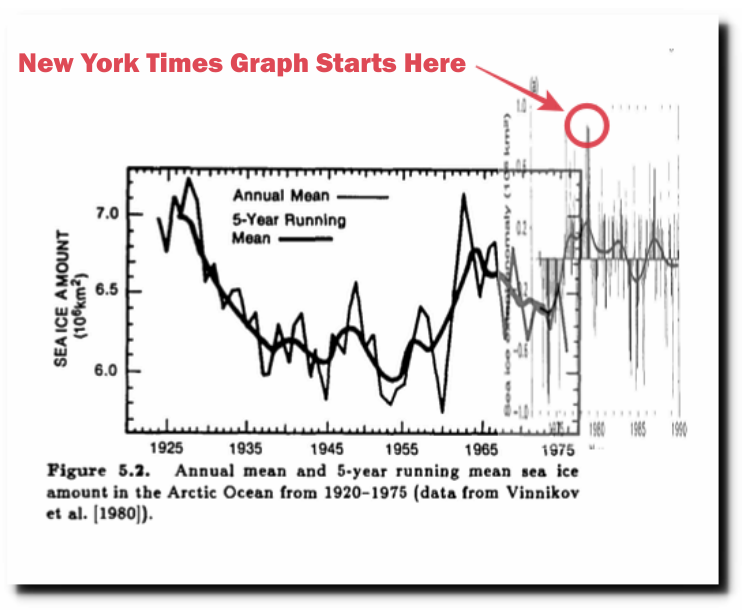
“The model rests on unproven assumptions and is not intended to represent or predict Arctic sea ice changes.”
Just as well because Arctic warming is associated with negative AO/NAO, and rising GHG’s are modeled to increase positive AO/NAO/ So on that basis there is no connection between rising CO2 and Arctic warming anyway.
http://www.ipcc.ch/publications_and_data/ar4/wg1/en/ch10s10-3-5-6.html
Javier,
Thanks for putting in all the hard work. I appreciate this input. It seems a step in the right direction, because you seem more interested in what is “shown” than in “showing”. The problem with some of the early studies was they were seemingly far too enthusiastic about proving a particular point. Even an initial probe of their ideas tended to suggest bias was involved.
As questions continued the bias was increasingly exposed. This swiftly separated the wheat from the chaff. The more classy people tried to answer the questions, and took steps to reduce bias. The “chaff” just got mad they were questioned. This resulted in all the silly stuff, where one was called a “denier” for asking a perfectly sensible question.
Hopefully we are moving past all that. We can drop needing to only use data that politicians approve of. Instead we are getting down to the real business at hand. What is that? It is getting a handle on what to expect, weather-wise, so we can advise our fellow man whether they should buy more or less fuel, and advise fishermen where the fish may be found and farmers when to expect frosts. Such knowledge, if we grasp it, benefits all.
I do have one reservation about focusing on “cycles” too much that I’d like to share. It involves the fact knowing that cycles occur doesn’t mean we understand the engineering involved. By “engineering” I mean the cause and effect, the nuts and bolts of why the sea-ice increases and why it decreases. It involves how the sea-ice is shifted by winds above and currents below, and also whether such winds and currents hurry or slow the melt.
I myself have focused on “cycles” too much, in my curiosity, and have seen cycles utterly fail to produce the results I expected. Without going into the details of my botched forecasts, what I seemed to fail to do was understand the engineering. You can see, focusing on cycles, that opposite results can occur when a 30-year cycle hits bottom, and some other cycle is at a high point in one case, and at a low point in another. What you cannot see is what perhaps is a cycle we haven’t yet discovered, and is therefore described as a “rouge.” It manifests as an exception-to-the-rule. It happens outside our expectations, if we only see in terms of cycles.
I think we also need to focus on what is actually the present tense, in terms of currents and ice and wind. The more buoys the better, in my book. Why? Because if we can learn more about the mechanics, we will be quicker to see when a “cycle” is not proceeding as expected.
Javier may have his own comment, I’m speaking for myself. But, I agree to a point with your comments. Good science begins with observation and measurements, progresses to speculation of what the causes are, and finally to experimentation and the generation of a theory. We are in the very beginning of this process with climate. We are observing and trying to measure what climate does. We have no idea what the causes are, just speculating at this point. A focus on measuring cycles, at this stage of the scientific process, is total appropriate IMHO. Climate science is not only not “settled.” It is barely even born.
“Climate science is not only not “settled.” It is barely even born.” That Andy May is what I’ve been saying most of my life. No one knows what it going on and yet all these scientist have the answer to the problem as Carbon Dioxide emissions from fossil fuels. Science cannot prove CO2 does anything to the climate, they can only observe what effects are and the correlating CO2 amount in that time frame. We have all these scientist that have been taught by scientist that formed their ideologies decades ago and made them into reality by teaching it to others and calling themselves “Climate Experts”…and yet they cannot prove what happened in a test tube in a lab, happens in our environment that has thousands if not millions of variables. Climate Science is less than a century old with thousands studying some fraction separate from others studies and each comes to the same conclusion theirs is the most accurate and of the most importance to do something about it ASAP because of CO2. Even in my 1953 2nd edition Basic College Chemistry textbook by Joseph A. Babor professor of chemistry, College of the City of New York. Page 512 it says “There is a balance between the carbon dioxide liberated by animal life and other sources and that absorbed by plant life, so that the amount of carbon dioxide in the air does not vary to any great extent.” This comment is what was being taught back then. So student of those days, alive today, may still think that way and believe that the only way CO2 can increase is by burning fossil fuels as the media says it does.
Caleb,
I agree that quasi-cycles are not to be trusted too much. Those of unknown causes can come and go or even change periodicity so an expected change might not happen when expected. However ignoring them because we don’t understand their causes and mechanisms is unwise. Quasi-cycles lead to quasi-predictability which is a step up from the unpredictability that comes from ignoring them. The unexpected pause, the unexpected lack of Arctic melting, all very embarrassing to science.
If we accept their importance we can start learning what causes them. My hunch is that the tide example applies. Tides cannot be deduced from first principles despite understanding very well what causes them. They are specific for each port due to basin geometry and a host of other factors, so the only way to predict them is through frequency analysis at each port, something that it is now done by computers, and previously by “brass brains” machines, the first built by Lord Kelvin.
The climate system is so complex and contains such chaotic elements, that understanding the cause of the climate oscillations might not lead to a good predictability. After all there is a reason why weather forecasts are not good after a fortnight.
However while we are set in the CO2 hypothesis frame, we cannot accept the importance of natural climate oscillations, because they reduce the importance of the GHG effect and that is resisted by an important part of the climate community that has found a very good way of life from it.
Thanks for those insights. You’ve got me thinking, and I enjoy having something good to ponder.
Folks you are making this far too complicated for the likes of Griff and Steve M. The whole “game” depends on selling the peons very simple statements. (1) We are burning every more fossil fuel. It increases the amount of carbon dioxide. Since humans are doing it it must be very bad. And (2) It is getting warmer so ice must melt wherever it is found. Remember a group of environmentalists got egg on their face when they announced that the melting of Arctic Ice was going to raise sea levels even faster than had been predicted. Then someone pointed out that their drink was about to overflow because the ice in their glass was melting. Not!