An eminent atmospheric scientist says that natural cycles may be largely responsible for climate changes seen in recent decades.
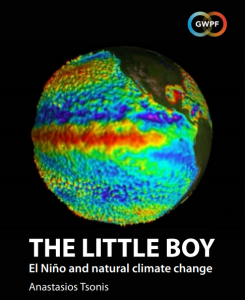
In a new report published by the Global Warming Policy Foundation, Anastasios Tsonis, emeritus distinguished professor of atmospheric sciences at the University of Wisconsin-Milwaukee, describes new and cutting-edge research into natural climatic cycles, including the well known El Nino cycle and the less familiar North Atlantic Oscillation and Pacific Decadal Oscillation.
He shows how interactions between these ocean cycles have been shown to drive changes in the global climate on timescales of several decades.
Professor Tsonis says:
“We can show that at the start of the 20th century, the North Atlantic Oscillation pushed the global climate into a warming phase, and in 1940 it pushed it back into cooling mode. The famous “pause” in global warming at the start of the 21st century seems to have been instigated by the North Atlantic Oscillation too.”
In fact, most of the changes in the global climate over the period of the instrumental record seem to have their origins in the North Atlantic.
Tsonis’ insights have profound implications for the way we view calls for climate alarm.
It may be that another shift in the North Atlantic could bring about another phase shift in the global climate, leading to renewed cooling or warming for several decades to come.
These climatic cycles are entirely natural, and can tell us nothing about the effect of carbon dioxide emissions. But they should inspire caution over the slowing trajectory of global warming we have seen in recent decades.
As Tsonis puts it:
“While humans may play a role in climate change, other natural forces may play important roles too.”
Full paper: The Little Boy: El Niño and natural climate change (pdf)
Two thirds of the Earth’s surface is covered in a thick layer of liquid that moves about and has a specific heat of 4.179 (or thereabouts), and you expect us to believe that has an effect of climate and temperature?
Naaaah.
CO2. Gotta be.
The two main sources of heat on the planet are the sun and the earth’s core.
Even during the North American eclipse many mentioned it was cooler during the eclipse. Any 24 hour chart of temperature shows the effect of the sun. Did you see how the temperature dipped during the eclipse?
Anyone who has spent time in a hot tub or a jacuzzi bath tub, and also has seen the active volcano on the big island of Hawaii and the geysers in Yellowstone can also imagine the earth’s core heating up the earth from below the surface on the ocean floor. The ring of fire of active volcanoes is not only above ground, but at the bottom of the sea.
The sun’s radiation is not a constant. It is variable. The heat from the earth’s core is also variable. The amount of radiation and the location of the radiation are variable.
Find a way to detect the radiation from the earth’s core, then add that into your climate model.