Foreword by Anthony Watts.
This essay is written by a student at the University of Wyoming, who finds herself in the middle of a set of circumstances that are pushing her further into the realm of being a climate skeptic. It is an eye-opening read. I have verified the identity of the student, but per her request (due to the backlash she fears) I am allowing her to write under the pen name of “Clair Masters”
Guest essay by Clair Masters
The class was languid, most kids were on their phones, or surfing Facebook on their laptops. I sat with my notebook open in front of me, empty except for the lecture title at the top of the page. The professor put a slide up on the projector showing a chart relating CO2 and temperature over the course of a few million years, the one we’ve all seen by now. The CO2 curve lags after the Temperature one, and anyone’s first reading of the chart would probably be that temperature is driving the CO2 changes, not the other way around, if there is any trend at all. I perked up slightly, it was new for a professor to show alternate data, and looked around expectantly at other students, waiting for some kind of reaction—confusion, frowns, anything to show they’re seeing something that fights what we’ve been told since elementary school. I saw a few yawns, dull stares, people on their phones, though one loud girl who was a religious global warming fanatic was glaring at the slide, slouching in her seat so her hand could pet her (dubiously trained) service dog.
Besides her, no one cared, and certainly I was the only one who glanced up in surprise when our professor began to talk about the chart as if it didn’t matter, something like “This trend suggests the opposite of what we know to be true” before moving on. I looked down at my notebook—friends and family tell me my face does not hide emotions well, and I didn’t want my professor to know I was annoyed. I don’t know why he even included it in the lecture, but that’s what happens in these courses. It was incredible to me at the time, but my professors would often include evidence contrary to the anthropogenic climate change theory before quickly sweeping it aside with some short remark. It doesn’t matter this data exists, it doesn’t matter that there is debate in the climate science community—not here. This is a University, after all.
College wasn’t when I first started questioning the “acceptable” views of climate change. As far back as middle school I was a tough case for teachers trying to push global warming. It was fashionable back in 2008 to rabidly teach the “polar bears are drowning” narrative after those photographs from 2007 that showed the bear standing on a single hunk of ice. Tragic! A picture like that was all it took to have most of my classmates nodding solemnly along while our teachers taught us about our carbon footprint—about how we were contributing to the plight of the poor polar bears with our gluttonous use of electricity, by our parents having more than one car.
An animal fanatic, I spent hours paging through my Zoobooks and animal encyclopedia collections, reading all about polar bears. A number stood out to me; 60 miles. Polar bears often swim for 60 miles to get from one body of solid ground to the next. Proud of myself, I brought it up to my science teacher, and instead of getting the glowing pat on the head I was used to when I did outside research for classes, I was chastised.
“You’re wrong,” she said, looking surprisingly angry, “polar bears can’t swim that far. Global warming is melting their home, and they’re dying off.”
At the time, I thought of myself as a teacher’s pet, the good student, so her tone took me completely by surprise. I wasn’t trying to say global warming wasn’t killing the bears, as far as I knew it was. My teachers told me so, so it must be true. Her denial about the swimming capabilities of the bears is what threw me off, and for the first time I was faced with doubting a teacher. Who do I trust, the books I’ve read or this teacher? Something changed in me around that time, and that seed of doubt she unknowingly planted ended up making me who I am today—a skeptic. Not just for climate change and the like, but for everything. I abruptly stopped believing everything my teachers told me, it was a hard wake up call to the real world as I realized that adults had agendas.
This idea was reinforced when one of the books in a beloved young adult series by James Patterson abandoned the original plot and conflict to go fight against global warming—essentially like rewriting the X-Men as Captain Planet. Horrified and disgusted that the characters would rather go protect those (at this point, goddamn) polar bears than stop the original mad scientist threat, I recognized the real propaganda element of this whole global warming deal. I started fighting back in small ways, mostly in the form of asking questions; “Don’t we breathe out CO2?”, “Warmer weather will help some animals, won’t it?”. I was not popular with my seventh-grade teachers. My friends were oblivious to my small insurrection; I was always the kid who raised her hand in class anyway.
It wasn’t until my senior year of high school that I finally got the scientific background to really combat the ideas that were being pushed on me. I took a high level environmental science class that pushed me to dig deep and question what I thought I knew about the way our climate works. I loved that class, and for once I had a teacher who didn’t try to shut me up. She acknowledged and engaged me, didn’t brush away my questions, and every year since my graduation from high school I’ve given a short presentation over Skype to her class about Petroleum engineering, petroleum geology, a little paleontology, and college life.
I distinctly remember two specific moments in that class that were “a-ha” moments for me. The first is when we watched that required documentary: Gasland. Some of the claims made in that documentary were beyond absurd, and like the skeptical jerk I am, I fact checked while watching it in class. On the school-administered iPad, I googled every single thing Josh Fox presented that got my spider-sense tingling. Antelope in Wyoming are going extinct? Not even close. Fracking fluid is in people’s water, letting them light it on fire? Try naturally occurring methane. At this point, I was already toying with the idea of going into some kind of geological science, and I was intrigued by the idea of fracking technology. We did a short lab in that class where we tried to get oil out of sand, and I thought it was cool. It was my love of all fields of science, not to mention the thrill of being involved in such a villainous industry, that helped me decide on Petroleum Engineering.
The other moment was when we were focusing on alternative energy, including a lengthy discussion about Hydrogen powered cars. I raised my hand quickly.
“If we’re worried about CO2 causing global warming, wouldn’t it be much worse if we were all driving cars that had water vapor as their exhaust?”
She paused, thinking it over. “I think you might be right, that’s a very interesting observation.” She said, before re-explaining to the class what I was talking about, how water vapor captures much more heat than carbon dioxide. I felt good about being able to apply what I learned about climate and our atmosphere to challenging popular “green” narratives. The best part was that my teacher was so supportive, and was willing to admit when something our textbook claimed wasn’t entirely true.
It has been a very different ride in college. Exhausting, as now I’m surrounded by professors and students who promote anthropogenic climate change predictions with such intensity, it makes the most zealous cultist fanatics look calm and reasonable. Again and again I’m surprised by the reactions of my peers to my skepticism, sometimes I even prompt truly angry reactions from people. One crunchy granola geology guy engaged me in a conversation about alternative energy, he tried to argue that hemp oil would soon overtake our need for fossil fuels. Right. Somehow the conversation got to land use, and I expressed an opinion that the states probably could deal with their environmental problems and land use better than federal agencies—he quoted something about the Koch Brothers, and I left him for class. Maybe a week later, he handed me a piece of notebook paper with “research” written up on it—mostly a series of bullet points about the American Lands Council which he somehow connected to white supremacy, right wing fanaticism, and most bizarrely of all the Kim Davis controversy. I couldn’t believe that someone who was a “scientific” person felt the need to use the guilt by association trap, the screeching leftist “Racist! Sexist! Homophobe!” nonsense in a discussion about land use. I gave up my favorite study spot after that, opting to avoid him instead of giving him the what-for I’d so like to. I don’t have time for that—I have school to worry about.
There have been plenty of times that I wondered if it’s my perspective that is wrong, I’ve done some soul searching on the topics I’m passionate about. College has challenged my views, while it seems to only confirm the ideas that the “warmists” hold. Some of my previously held beliefs have changed, like much of what I understood (or thought I understood) about climate, but I’ve still yet to be presented solid evidence for primary anthropogenic climate change that isn’t either refuted by another study, or backed with accusations like the ones crunchy granola guy lobbed my way. I’ve stopped being shocked by the way my professors obediently tow the party line—as I learned a few years ago that at least here, federal funding is dependent on a certain amount of global warming acceptance. I’m thankful for the engineering courses I’m taking, because if my geology and earth sciences were not balanced out by the dry technical calculations of engineering, I’d probably lose my mind. (Just imagine how bad it would be if I were in sociology or women’s studies!) I am disappointed by the quality of the “science” taught at University though—when theory is presented as fact, and computer models are regarded as gospel despite their infamous unreliability, it’s not actual science.
It’s propaganda—dogmatic as any religion.
It’s my 5th year since heading west for my engineering degree. This year I’m taking a handful of great little petroleum classes, and finishing off my geology minor. Of course, it’s my geology class that is giving me a headache. A mineral resource course sounds pretty straightforward… except of course our professor managed to turn it into a climate change/ humans are killing everything/ we’re all going to die class. We even have a section of the class towards the end of the semester dedicated to social justice, because that’s why I’m getting a science degree. In retrospect, I should have known what I was getting into when I looked around and saw several students with either half shaved heads or hair colors that in nature scream “I’m toxic”.
It’s gonna be a fun semester, and I’ll try to keep you updated.
This was a really well written article. I had a similar experience in college. It’s not easy being a millennial (I’m 29) who doesn’t conform to the popular narrative on AGW. Unfortunately this debate gets personal all too often and it even gets to the point where friendships and relationships are strained because of it.
I just wish reasonable people could still disagree.
Much more interesting in my opinion is how climate change costs are going to be assigned to the fossil fuel companies that have caused them.
There are now law suits taking place against the big oil companies. It will be interesting to see how this plays out:
https://www.theguardian.com/commentisfree/2017/sep/07/big-oil-must-pay-for-climate-change-here-is-how-to-calculate-how-much
(You are waaaay off topic,you do this again,I will snip you out of the thread) MOD
Way more interesting will be to see which climate pseudoscientists pushing fake science, like Mann and his ilk will actually be doing jail time in the future. It will fascinating to watch the whole “climate” mythology collapse under the weight of its own lies.
Well when it comes to the damage caused by climate change exacerbated natural events it should be the Big Oil companies who pay for this rather them tax payers. I can see the public getting behind these law suits and Dr Michael E. Mann will be praised – rather than villified – for raising public awareness to AGW.
Ivan,
you forgot the /sarc tag.
Ivan, how would food and other goods be delivered to stores and other distribution points without oil to provide the fuel for the delivery vehicles? Go a month without using anything delivered via the use of oil and then tell us how evil “big oil” is
The lawsuit seeks damages caused by SLR in Marin and San Mateo Counties, along
with the City of Imperial Beach.
From the press release:
“The best available science shows billions of dollars of homes, businesses, roads and other facilities, as
well as thousands of acres of beaches, wetlands and habitat areas, are at risk from rising seas
and more severe storms. The cost of trying to protect them, and the human anguish over
those that will be lost, will be shocking and crippling.”
I’m no lawyer, but how can you sue for hypothetical damages that haven’t occurred?
I reckon Big Oil will eventually do a deal against class action law suits similar to Big Tobacco.
Although I know that you will not investigate it, Ivan, the “Big Tobacco” lawsuits were an example of both a bill of attainder and ex post facto law (civil, unfortunately, so the courts do not apply the US Constitutional prohibition to both). The cases were a gift to the liability bar by their allies in the various state governments.
So the point being here?
That you consistently use themes in the press that are unfounded. Are you a vegan, too?
Nothing I really quite is unfounded if in a mainstream newspaper that has to use proven sources.
No afraid not. I don’t knit my own clothes or am a vegan. Not sure why you have a jaundiced view of pro climate changers. Arnold Schwarzenegger is one, Michael Bloomberg is one, Barrack Obama is one … all highly successful in their different fields. No specific profile in my opinion.
I have been following the record of the various flavors of greens since the late 1960’s, and they have been consistently wrong in many of their claims. So if I seem to have a jaundiced view of climate change advocates, it is a matter of history.
The other reason is the politics of the IPCC. My family tended towards various types of radical politics, with Birchers, Irish Republican Army supporters, Socialist Labor Party members, to ordinary labor union activists.
I am mostly immunized to silly political arguments, having been exposed to a wide range of weirdness from an early age.
Ivan, you are something of a sucker on not paying attention to the politics of your sources, and how they influence the reporting. You just might not be old enough.
At the age of 55 I am pretty certain about what is valid and what isn’t. If I wasn’t convinced in what I say and post I wouldn’t spend so much time in WUWT; could be doing other stuff.
As a European, I think Europeans see this whole issue of AGW from an environmental perspective whereas in the US it has become highly politicised one. A shame because it obscures much of what is important.
Ivan,
Can you please talk to Big Oil about my missing fat payment checks for being one of their shills.
ivankinsman September 7, 2017 at 10:58 am
Nothing I really quite is unfounded if in a mainstream newspaper that has to use proven sources.
From the article:
“On 29 October 2012, when Hurricane Sandy slammed into America’s east coast”
———-
Sandy was tropical storm, not a hurricane when it made landfall. Your proven source can’t even get that part right. LOL
Reg,
I have labored under the idea that in order to demonstrate “standing” and have a case go forward to trial, it must be demonstrated that the plaintiff has actually suffered a loss.
In the absence of an actual loss, perhaps damage might be awarded as a ratio based on the probability of a loss? This reminds me of a recent movie where future-criminals were arrested before they committed their crimes — based I think, on a computer model.
ivankinsman,
I’m easily old enough to be your father (don’t worry I haven’t been to Europe) and I too am convinced about what I say and post, which seems to be the opposite of you. So, who is right? I think the facts should determine it, not who is the more experienced.
Personally, I think that the MSM makes too much of the supposed correlation between the position on CAGW and political party affiliation. Yes, there might be a bias that can be demonstrated, but in the absence of good evidence, I’d be inclined to comment that the way that one sees and interacts with the world is more likely an independent influence on both political leaning and belief in CAGW. That is, those who are less gullible, more inclined to question things, have higher standards for evidence, and are less influenced by transient emotions are also likely to be conservative rather than progressive, and certainly likely to demand evidence about the changing climate that is more difficult to criticize than what we are provided.
It’s not about blame—it’s about another pocket to pick. Drug manufacturers are being sued for making addictive drugs—to relieve pain, but who cares (except the people who are in pain)? Pharmaceuticals have deep pockets. So do oil companies. The absolute proof it’s about money is none of the industries involved will be shut down, even though they are “killing us”. If they are shut down, there’s no money to abscond with. It’s always about the money, never about the truth.
The place to post tidbits like that is in “Tips & Notes,” which has a tab in the bar at the top.
Lass I love your talent for critical thinking. I was was lucky to do my first degree (Ecology) under Prof. Amyan Macfadyen FRS who was the father of British animal ecology and Prof. Palmer Newbould FRS a champion of nature conservation….these have been the most influential people in my life, as they honed my skills as a critical thinker. After a Masters in Hydrobiology I was forced in the early 80’s to change tack to Dentistry….a profession which is sadly based on rote learning. But as someone wanted to study ceramics in art college the combination of craft and science has enabled me to be a leader in general dental practice in my career. You may wonder where this is going!
What I want to say is that do not fight a brick wall…life is too short. Use your talents to progress where you do not hit impediments. This will let you establish yourself and you can use you critical talents to attack those who follow this absurd dogma. Daily I educate my patients on on the nonsense preached by the warmists!
Good luck in the future!
The world needs voices of reason like yours, asking the challenging questions that everyone else doesn’t bother to think about, don’t want to consider, or are too afraid to ask. I too was one of those students who asked questions of my professors, most of whom didn’t like it, although a few were open minded enough to engage politely. It’s very important that people like you are willing to have this discussion across the aisle, instead of everyone only discussing things with like-minded people, as is becoming too common here in our modern politically-polarized society. Best wishes to you, Claire, as you finish school, and beyond!
Very good choice. I think you will do very well.
Your progression in becoming skeptical is similar to mine (I was an engineer) and, I’m sure, many others on this site.
Excellent Essay. I have danced many of these dances. It is very dangerous to attempt to point at the other side of the equation. Realizing that Water Vapor is more deadly than Carbon Dioxide is overly obvious. Because it is obvious, it is below talking about.
The obvious is always on the table for me. That makes it a danger. Anyone can steer the conversation a different direction by pointing to the obvious and making it the discussion point. There are lots of obvious things.
Whether it be an essay, a comment, or a tweet, there is never enough room to talk about all of the parts of one obvious thing.
As I’ve mentioned in other threads, Disinformation Campaigns and the lies wrapped around a truism, and Climate Change is a Disinformation campaign to be clear, do NOT have to be anywhere near 100% accepted to be successful as propaganda.
The indoctrination with the climate change lie starting in elementary school by Progressives is a powerful planted idea that will greatly diminish the Millennial generation’s ability to move forward on real scientific progress for at least the next 50 years.
The Millennials will be mired in these climate propaganda memes for most, if not all, of their lives, even as cold climate cycles return again, as they will.
Great Article! The same thing happened to me in the 70’s at MSU in Bozeman Montana of all places, only it was Global Cooling back then. Fool me once shame on you, fool me twice…
As someone who was at the University of Wyoming, and then went on to teach in another state, I can say that UW is one of the least dogmatc global warming universities out there. If Claire moves to another state/university, it will only get worse.
There are a few old professors at UW who think global warming is generally bunk, but they have learned to mostly keep it to themselves.
My advice for Claire is to gently push back enough to feel people out. Stick to the experimentalists, they hands on types. Most people will not be worth talking to, as they are so far in the tank for their belief they they won’t even be able to present arguments/evidence to back up their belief. Eventually, you will find those who think as you do, or are open to debate without getting offended. Hold tight to the latter, as they are rare, and getting rarer.
Surveyed skepticism……
WSJ
Americans Losing Faith in College Degrees, Poll Finds
Men, young adults and rural residents increasingly say college isn’t worth the cost
Americans are losing faith in the value of a college degree, with majorities of young adults, men and rural residents saying college isn’t worth the cost, a new Wall Street Journal/NBC News survey shows.
The findings reflect an increase in public skepticism of higher education from just four years ago and highlight a growing divide in opinion falling along gender, educational, regional and partisan lines. They also carry political implications for universities, already under public pressure to rein in their costs and adjust curricula after decades of sharp tuition increases.
Thanks everyone for your thoughts– I love how this site always attracts constructive (and often good humored) commentary.
I do feel lucky that the university I attend isn’t nearly as bad as some others. Sometimes it seems the admin is trying to “catch up” to other universities’ “standards”, but overall I think the people of Wyoming generally have little tolerance for nonsense, so I do have hope.
I’m going to stick with this resource class, keeping my head down to pass. Once I am finished with this class I might drop the nom de plume and speak even more openly about my experiences. It’s really something though, isn’t it, that I might even need to worry about my opinions affecting the outcome of a science course?
-Clair
Given current politics on the issue, do not go public until you have enough money to tell the True Believers to perform some unlikely act. Given search engines, being public on a controversial issue is not a safe choice.
Clair,
It is indeed a sad state of affairs that you feel you have to keep a low profile at an institution that, at its core, is intended to expand the intellectual horizons of the students. However, I suspect that there are many professionals who also feel that they have to toe the line until they retire.
Part of the irony here is that, if I were a hiring manager for a company that depended on creativity to be successful, I’d look for someone that can think ‘outside of the box.’ Yet, higher education is actively suppressing non-conformal thinking. It does not bode well for American society.
Miss Masters
You are very intelligent person so it is a bit odd, as some have pointed out, that you gave enough personal details to be identified by your institution with a very little effort.
Also, I’m somewhat puzzled by the purpose of inclusion of the paragraph quoted in my comment further above (vukcevic September 7, 2017 at 7:44 am)
Answer to your question about water vapor can be found here, among other places: https://skepticalscience.com/water-vapor-greenhouse-gas.htm. After you read the Basic tabbed pane, read the Intermediate one. Answer to your question about people exhaling CO2 can be found here, among other places: https://skepticalscience.com/breathing-co2-carbon-dioxide.htm. Answers to many more questions can be found on the same site.
Tom Dayton, That’s not sceptical and it’s not science.
For example, glancing at the first link you give on water vapour the article misses the fact (yes fact!) that water vapour is not necessarily a positive feedback. Sometimes it is a negative feedback.
Have you ever been outside when a cloud passes over?
That website hasn’t. Or rather they ignore inconvenient truths.
Consider this: Over millennia there have been volcanoes and forest fires that have increased CO2 levels. The oceans still had water in them so the effect should be amplified.
But… throughout the lifespan of planet Earth… the warming was never amplified to dangerous levels.
These events never coincided? Proof of a benevolent God and disproof of plate tectonics?
Or QED: It’s not a problem.
Many of the reasons to be sceptical can be found at that website if you read it with some technical knowledge, an open mind and the realisation that they are on the make.
M Courtney: Clouds are not water vapor. They are liquid water. Here is an introduction to increase your knowledge up to the basic level: http://www.first-school.ws/activities/science/drippy.htm. If you manage to understand that, read this: https://water.usgs.gov/edu/watercyclecondensation.html
Sorry Tom Dayton, you are confused.
Where do you think the clouds come from? You seem to think that as clouds are liquid water that they must form from liquid water. You seem to imply that clouds are formed from mists rising or inverse waterfalls.
Both are ridiculous. But the latter would be nice to see.
Clouds are formed from water vapour seeding out. More water vapour – more clouds.
Still not sceptical and not science.
M Courtney: Clouds form from water vapor only when water vapor condenses to form liquid water. Water vapor condenses when there is more water vapor in the air than the air’s temperature can support. Increasing the air’s temperature increases the air’s carrying capacity of water vapor, so if all else is equal, there will be less condensation into clouds, and existing clouds will evaporate. In other words, regardless of the role of clouds, water vapor itself acts only as a positive feedback.
You asserted that water vapor can act as a negative feedback. I showed you were wrong. Now you are trying to distract from being wrong, by switching the topic to clouds. (That’s called a “Gish Gallop.”) Of course clouds form from water vapor. But oceans, too, form from water vapor via precipitation. So what? If you now want to discuss clouds, here is a summary of the probably nearly zero NET effect of changes in clouds with global warming (read Basic and Intermediate tabbed panes): https://skepticalscience.com/clouds-negative-feedback.htm
I’ve often wondered if I should go to skepticalscience.com to read through the explanations and counter arguments…
Well, after having read through the borderline silly explanation for water vapor feedback, I can ease my conscience on this regard. Sure, it’s a single data point, but I have other things I’d rather do with my time than read through material that offers no scientific validity.
By way of explanation, the water vapor feedback argument as described by skepticalscience offers only part of the story. The pieces of what’s happening that aren’t addressed make all the difference. For example, the role of airborn particles in the formation of clouds is not addressed. Another example is the unstated conflation of atmospheric air temperature with sst. These failures, amongst many many others, render the explanation useless to all but the most close minded, ignorant, and scientifically illiterate CAGW supporters.
So, thus will I conclude that there’s no value in reading through any of their other arguments. To be clear, I was actually hoping for a robust explanation that could withstand more than a mere modicum of critical thought. Oh well…carry on.
rip
ripshin: Particulates do not in any way affect the atmospheric water vapor capacity’s dependence on the atmosphere’s temperature. For any given amount of particulates, increasing the atmospheric temperature increases the atmosphere’s capacity for water vapor. Likewise, sea surface temperature does not in any way affect the atmospheric water vapor capacity’s dependence on the atmosphere’s temperature. Therefore in a post explaining narrowly and specifically that water vapor is a feedback rather than a forcing, there would be zero relevance of mentioning particulates and sea surface temperature. You are trying the classic Gish Gallop–changing the topic to get the audience to forget that you were wrong.
An excellent way to quickly learn the fundamentals of global warming and the context of the creation of our scientific knowledge of it, is to read physicist and science historian Spencer Weart’s The Discoery of Global Warming: https://history.aip.org/history/climate/index.htm
That article is fundamentally flawed. It ignores the fundamental climatology made by Hubert Lamb. Conveniently.
Pseudoscience masquerading as authoritative. You get fairground barkers claiming that magnets cure horses with the magical effects of “chaos”.
Chaos actually means that the system is irreducibly complex.
An inconvenient fact for climate modelers.
But let’s just debunk the article simply.
That refers to using O18 as a proxy for temperature (dubious) and claiming that local effects on Greenland are global (very dubious) and assuming that the ice firn on the glacier seals in less than half a century to pin the O18 in position (wrong – it’s not trapped until about 50 metres down).
The best we can say is that natural causes have historically overwhelmed the current impact of man. 10 degrees in a century is an order of magnitude greater change than the 20th Century.
M Courtney: No, the scientific and mathematical meaning of chaos is NOT “the system is irreducibly complex.” Its relevance to weather and climate is that although instantaneous states of the weather-climate system cannot be projected with much accuracy, STATISTICS about that system can be. By definition, “climate” is the statistics of the system over long terms such as 30 years. Weather is short term statistics and instantaneous states. Weather can be forecast usefully accurately in many places up to about 5 days in the future, then still pretty accurately up to about 10 days. Climate can be projected well as statistics of periods of about 30 years or longer. Projecting weather is an “initial values” problem. Projecting climate is a “boundary conditions” problem. As explained at Science of Doom:
“- With even a minute uncertainty in the initial starting condition, the predictability of future states is very limited.
– Over a long time period the statistics of the system are well-defined.”
For an introduction, read the Basic and Intermediate tabs here: https://skepticalscience.com/chaos-theory-global-warming-can-climate-be-predicted-basic.htm.
For more specifics but in plain language, see http://www.realclimate.org/index.php/archives/2008/04/butterflies-tornadoes-and-climate-modelling/. For more technical specifics see http://www.realclimate.org/index.php/archives/2005/11/chaos-and-climate/
For technical detail see the comprehensive series at Science of Doom: https://scienceofdoom.com/roadmap/natural-variability-and-chaos/.
For more resources see http://www.realclimate.org/wiki/index.php?title=Chaotic_systems_are_not_predictable
M Courtney: You are astonishingly, totally wrong about Spencer Weart’s “Discovery of Global Warming” ignored “the fundamental climatology made by [sic] Hubert Lamb.” Simply using the Search function in that book (not merely an article) instantly reveals a picture and description of his work: https://history.aip.org/climate/xLamb.htm
As a retired public school teacher I have some experience with the lack of real science education. In 2014 the year I retired only 51% of science teachers had science degree. I now live in Florida and know that in my county you can have a history degree and be teaching a science class. Unless we teach critical thinking and the scientific method how can we expect an outcome different that what we have.
This article is most uplifting to me and reinforcing of the idea that they can’t fog everybody, even after an unremitting blitz during K-12. Abraham Lincoln understood this.
I’ve expressed some thoughts about the imfamous 97%. Although I know that study was seriously Cooked, I do believe it is a huge percentage of people who don’t do any deep questioning and thinking. I hasten to add that this includes people of all political persuasions. University used to be a place where “followers” were at least exposed to questioning and rumination. Not anymore.
Reinforcement of the 97% idea, can be found in the brave few who, even more deeply brainwashed than today, were openly dissident under the ultra repressive Soviet regime. Adding to these the passively resistant and 3% may be a reasonable estimate of the naturally unbrainwashable population.
It’s facile to conflate sceptics with right wing politics and it is true there is a substantial political component on both sides, but the real sceptic is apolitical in his dissidence. “Followers”, who come to this site are exposed to information and interpretations not normally available to them and they come armed with official bullet points and insults when the going gets tough. However, I’ve seen some of these become more thoughtful.
Miss Masters, you are one of the thoughtful, thinking <3%.
‘The class was languid, most kids were on their phones, or surfing Facebook on their laptops.’ What sort of university is this? Or at least, what sort of class?
Clair, it seems like UW has changed quite a bit since ’75-’78 when I too was in Petroleum Engineering there. I don’t remember having to put up with professors who pushed their agendas on the students. The closest I came to that was in communications class, one of my arts and parties electives, where the prof was trying to guess what our majors were. It was a summer class and as that short season is the only time you can wear tank tops, cut-offs, and sandals. When he got to me he tried three times to figure out my major but all were some liberal type arts and parties major. He didn’t want to believe me when I told him it was Petroleum Engineering. I guess I didn’t fit his idea of what an engineer should be. It might have been the shoulder length hair and beard the aided in the confusion.
I made to the bust in the mid-eighties, worked in construction for five years, and finally got on w/a state agency in a program remediating leaking underground storage tanks and dry cleaners. I have sort of come full circle since for the last nine years I have been at another agency where work is cleaning up abandoned oil field sites, and believe me there is no shortage of them. It is hard to believe what were acceptable practices in the past. Being in the environmental field over 25 years I have seen my fair share of enviros who don’t tolerate anyone who doesn’t accept what they believe in, be it AGW or fracing (their was no k in it when I was in the bidness). Most of the time it is a waste of time to try and make any point but not a waste of breath since the air we breathe out is ~40,000 ppm C02!
I hope you enjoy your remaining time there at UW. I will be over in Evanston the first week of October for my mother’s 90th. Looking forward to a little cool weather.
This reminds me of a fourth grade student many years ago, who was instructed to write a paper on the ozone hole. He got onto the internet and researched how ozone is made—by one set of UV rays, that it is an unstable chemical that naturally breaks down, faster where there’s higher humidity, and another set of UV rays also breaks it down. So what will you get over the poles during winter when there are no UV rays to create ozone?
The student came to me with his data saying “This doesn’t make sense.” He had been instructed to follow the Weekly Reader format telling how evil ClFlCs were destroying the ozone. Just then a couple of facts from Organic Chemistry Class (what was a philosophy major doing taking organic chemistry? Don’t ask.) popped into mind: Freon is a very heavy molecule, very unlikely to get into the stratosphere. Some of the strongest chemical bonds known are the lighter halides (chlorine and fluorine) and carbon, so strong in fact that they will even disassemble other molecules to bond to carbon. (That’s why chlorine is added to tap water, to kill little nasties.) To top it off, the atmospheric ozone was made the thinnest shortly after major volcanic eruptions injected megatons each of CO2, HCl and HFl into the ozone bearing stratosphere. Just follow the chemical reactions.
That boy gave a very different paper than what the teacher expected.
Today the young man is a software engineer—at least that still follows logic.
Richard: So many mistakes; so little time.
“Freon is a very heavy molecule, very unlikely to get into the stratosphere.”
Have we measured the amount of Freon in the stratosphere? Yes, about a much as at the surface per unit weight. Why is there just as much? The troposphere and stratosphere are mixed by convection faster than heavier molecules tend to sink and lighter ones rise. Above about 100 km, vertical convection is negligible and gases do start to fractionate by molecular weight.
“Some of the strongest chemical bonds known are the lighter halides (chlorine and fluorine) and carbon, so strong in fact that they will even disassemble other molecules to bond to carbon.”
C-F bonds are the strongest single bonds to carbon. C-Cl bonds are not usually strong or unreactive. They are the bonds broken by UV in the stratosphere that cause ozone depletion. In our strongly oxidizing atmosphere, C-H bonds are the most vulnerable bonds to reactive oxygen species. Unlike other organic gases, this makes chlorofluorocarbons inflammable (burning = reaction with oxygen). Today we use hydrofluorochlorocarbons (HCFC’s) which are relatively inflammable, but with a C-H that often oxidizes before reaching the stratosphere. Today, we have HFO (hydrofluoroolefins), which are not toxic, practically non-flammable, and have half life in the atmosphere of only 10 days – no ozone depletion or global warming potential.
” so strong in fact that they will even disassemble other molecules to bond to carbon.”
CFC’s are unreactive, so they don’t dissemble other molecules.
“That’s why chlorine is added to tap water, to kill little nasties.”
We add bleach (sodium or calcium hypochlorite) or chlorine gas to water to make HOCl (hypochlorous acid) with a very reactive O-Cl that chlorinates and thereby kills bacteria and viruses.
“So what will you get over the poles during winter when there are no UV rays to create ozone.”
No creation OR destruction of ozone when their is no UV during winter darkness.
Being able to think for yourself is a very important skill to learn. So is recognizing the LIMITATIONS of your own knowledge. The increasing disdain for experts in our society today is a sensible reaction the abuse of abuse of experts in politics – especially those whose experts who have abandoned traditional academic/scientific principles to achieve political goals. This doesn’t mean the experts are wrong. Moulina’s initial studies on ozone depletion were grossly wrong in magnitude, but the idea that chlorine radicals from CFC’s can destroy ozone in the stratosphere is correct. Since the ozone hole still appears every spring in Antarctica, I’ve look long and hard at the early data saying the ozone hole isn’t a natural phenomena. It sure looks like it first appeared in the 1970’s. Atmospheric levels of CFCs are still well above the 1970’s.
Frank:
You didn’t get the part about raw materials and reactions in the upper atmosphere:
When major volcanoes erupt, they inject megatons each of the raw materials out of which freon or CFCs are made. Then natural reactions combine those raw materials into freon. There’s no need to posit that any freon wafted up from the earth’s surface to the stratosphere to account for the CFCs in the stratosphere.
There were two major volcanic eruptions after the 1970s, Pinatubo in the Philippians, and Raboul volcanoes. Each was violent enough to inject megatons each of the raw materials out of which CFCs are created. It wouldn’t surprise me if it takes decades for the results of those volcanic eruptions to precipitate out.
Ozone is an unstable molecule with a half-life measured from minutes to hours, depending on external conditions. So even without active destruction, ozone levels tend towards zero without continuous replenishment. Over the poles in the winter, when and where there’s no active replenishment, the ozone levels tend to thin out. Hence the “ozone hole”. It is at its thinnest near the end of winter.
The ozone hole was first measured in the 1970s because no one looked for it before then. It could have been there all along.
Freon was used in fire extinguishers for decades because it sinks even at the earth’s surface. That’s not the only example of heavier gases sinking even in the troposphere. Let alone before wafting up into the stratosphere.
Frank, did you take any chemistry?
Richard: Can you read, or does one thought stay stuck in your mind forever?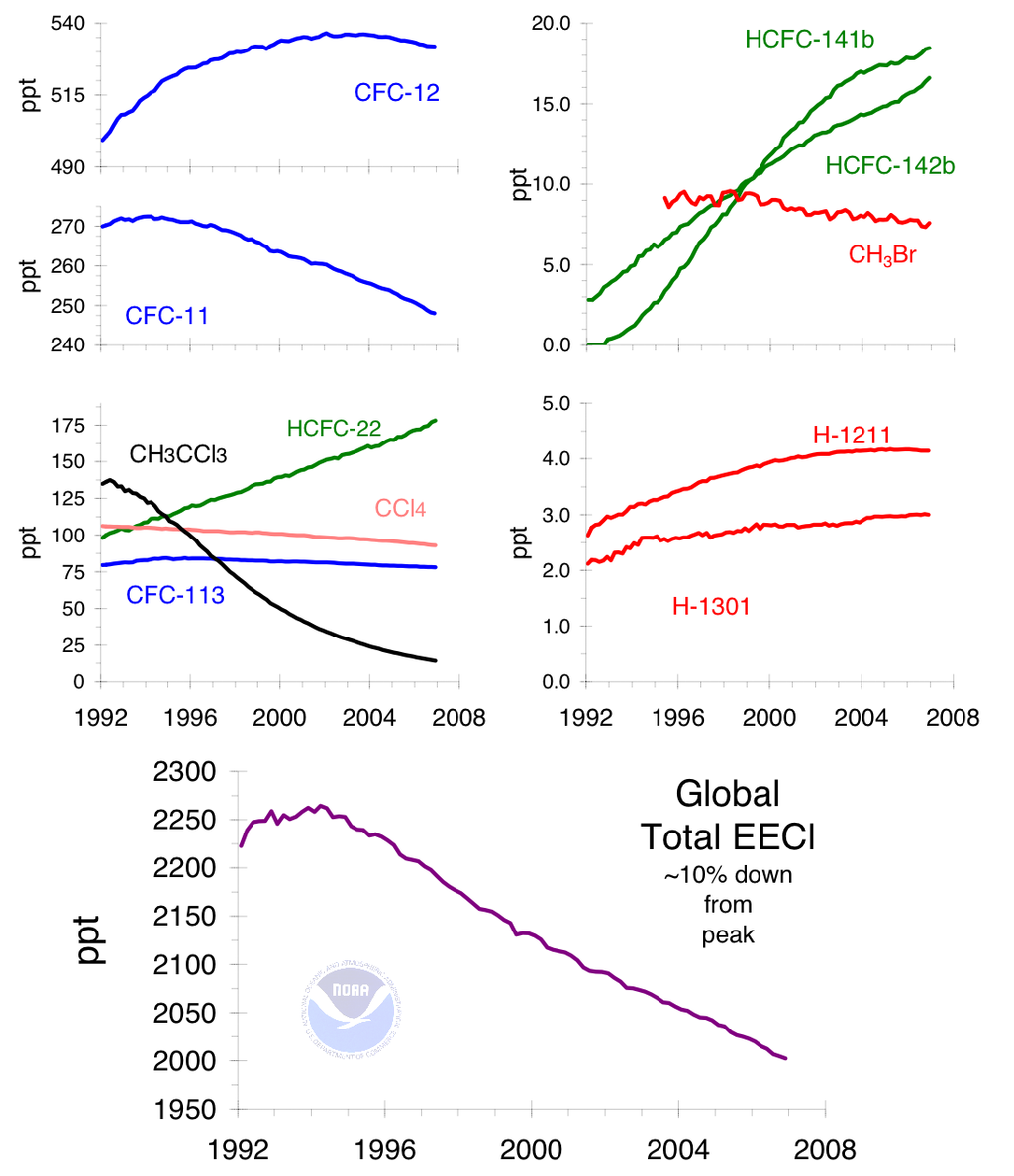
Saying CFC’s are denser than other gases in the atmosphere and therefore must sink to the lowest altitude is a rational thought. Let’s try an analogy. Take a bottle of vodka. Do the denser water molecules sink to the bottom? Of course not. On the other hand. you are correct that Freon fire extinguishers – and CO2 extinguishers – temporarily deposit a layer of denser gas near the surface. So, how does a sensible person decide if his rational thoughts are correct or not?
You read, and then try to understand the principle that applies. I provided you clear answers about measurement and rational. CFC’s haven’t sunk into the lower troposphere.
However, above 100 km, gases do begin to fractionate by molecular weight. Why? Because mixing by vertical convection occurs faster than settling under the force of gravity. (This also happens to explain why the thermogravity folks are wrong).
https://en.wikipedia.org/wiki/Turbopause
If you put your bottle of vodka in a high speed centrifuge and increase the force of gravity and speed of settling, you can probably separate the ethanol and water. Biologists make salt/density gradients using CsCl in water to separate molecules by buoyancy. Centrifuges are used to separate U-235 from U-238 in UF6 gas. But CFCs below the tropopause are relatively uniformly dispersed – because mixing is faster than settling.
Richard writes: “Each [volcano] was violent enough to inject megatons each of the raw materials out of which CFCs are created.”
Surely you are joking. CFCs don’t get made in the stratosphere. Nor are they present in volcanic gases. They don’t form in magma. Industrially, CFC-12 is made from CCl4 (man made) and HF and a strong Lewis acid. Scientists bring back samples of gas from the stratosphere which they analyze by GC/MS. Chlorine containing compounds are trivial to identify because the Cl-35/37 isotope pair. We know the majors source of Cl atoms in the stratosphere.
Richard: “The ozone hole was first measured in the 1970s because no one looked for it before then. It could have been there all along.”
Another great thought. We certainly didn’t have today’s satellites continuously monitoring every aspect of the formation of the ozone hole. Did you check out your great thought with Google Scholar and see if you are correct (as I did)? Or did you read it somewhere on the Internet alongside of an article John Podesta’s child sex ring at the Cosmic Ping Pong Pizzeria in Washington DC?
Oops wrong again! Ozone measurement were made at three different stations in Antarctica long before the ozone hole began to form.
http://onlinelibrary.wiley.com/doi/10.1029/2005JD005917/full
http://onlinelibrary.wiley.com/store/10.1029/2005JD005917/asset/image_n/jgrd12151-fig-0001.png?v=1&t=j7c7lzt9&s=e1ad2fe0f4268123bffeaf2a9616fa55290079ec
The biggest problem with website like WUWT is so many poorly informed people repeat “common sense” or ignorance read elsewhere and repeat it over and over. As with John Podesta’s child sex ring at the Cosmic Ping Pong Pizzeria in Washington DC. Do you want WUWT to become a place where rumors like this one circulate? Aren’t you sick of trying to distinguish “fake news” from fact? Then think or even provide a link before you write.
Did I take any chemistry? Yes. In high school, college, grad school, post doc, and continued my education to this day as a professional. And you?
Though people traveled to the South Pole in the 19th Century, the first times folks stayed in the Antarctica was the 20th Century. Real scientific exploration, i.e., collecting data, etc, didn’t happen to any great extent until the 1950s. And ozone holes were not their primary or even secondary interest.
Your claims of having studied chemistry don’t sound plausible when you liken how water holds some molecules in solution to how gas molecules are distributed in the atmosphere. Even first year freshmen college students should be able to see flaws in that argument.
Your graphs conveniently start in 1992, after the 1991 eruption of Mount Pinetubo that injected megatons each of HFl, HCl, CO2, the raw materials that can be combined into CFCs + H2O, and other highly reactive compounds into the ozone bearing stratosphere. The reactions to create atmospheric CFCs wouldn’t happen all at once, but over a period of months to years.
Your arguments are coming across as those of a troll. Therefore I see no reason to continue this discussion.
Richard wrote: “Your graphs conveniently start in 1992…”
My graphs showed that we know how to measure the amount of CFC in the lower atmosphere and stratosphere. It is insane to suggest CFC settle out of the stratosphere when we are measuring how much is present there.
Richard continued: after the 1991 eruption of Mount Pinetubo that injected megatons each of HFl, HCl, CO2, the raw materials that can be combined into CFCs + H2O, and other highly reactive compounds into the ozone bearing stratosphere. The reactions to create atmospheric CFCs wouldn’t happen all at once, but over a period of months to years.
There are no CFC is volcanic gases. Synthesis of CFCs in the stratosphere is extremely unlike. Fluorine is relatively rare in nature and natural fluorinated gases are unknown in nature. The sulfate aerosols left over from injection of SO2 into the stratosphere are gone in about 3 years. Water soluble gases like HCl are washed out much faster. If, by some miracle, a significant amount of CFC was injected into the atmosphere by volcanic eruption, it would have been causing an ozone hole before the 1970’s.
Figure 1 from this reference shows measurements of ozone over Antarctica at three sites beginning around 1960. According to all three sites (including the South Pole, there was no ozone hole back then. I tried to paste an image of Figure 1 above. I’ll try again. Otherwise click on the &&$$%* link. Or are you afraid of what you might learn?
http://onlinelibrary.wiley.com/doi/10.1029/2005JD005917/full
http://onlinelibrary.wiley.com/store/10.1029/2005JD005917/asset/image_n/jgrd12151-fig-0001.png?v=1&s=1a0fdeec2090ab42240228742143201b4f047dee
The other phenomena I described showing that heavier molecules sink to the bottom of a liquid or a gas under some conditions but not others must be beyond your understanding. However, there is no excuse for not clicking on a link to the turbopause in wikipedia and reading that the atmosphere is homogeneous in the molecular weight of gases below the turbopause, but fractionates above. I could add that the average water molecule remains in the atmosphere for 9 days, at which point it condenses. Vertical convection in the troposphere is reasonably fast.
I sorry you feel I’m trolling. The Internet is littered with fake new and false information. I’m just doing my part to make sure that wrong information doesn’t spread from this site (which is important for opposing CAGW). When I began skeptical about climate change and the ozone hole wasn’t shrinking, I investigated to see if I had been fooled about CFCs and ozone depletion.
Edwin wrote: “Though people traveled to the South Pole in the 19th Century, the first times folks stayed in the Antarctica was the 20th Century. Real scientific exploration, i.e., collecting data, etc, didn’t happen to any great extent until the 1950s. And ozone holes were not their primary or even secondary interest.”
The ozone layer and its importance to protecting life from damaging UV first became apparent around 1930. For that reason, there are several sites around the globe at which ozone has been continuously measures dating back to 1930. (Think of it as being like Keeler’s CO2 record at Mauna Loa). However the production and destruction of ozone is a fairly complicated phenomena that depends on circulation of air through the stratosphere. That circulation is from the equator to the poles, where models thought ozone would be the lowest. For that reason, some scientists became interested in measuring ozone near both poles. The circulation today is called the Brewer-Dobson circulation. Dobson was the discoverer of the ozone layer and the Dobson unit of ozone is named after him.
At the same time, the beginning of the space age was also creating a great deal of interest in the upper atmosphere. The Van Allen radiation belt was discovered in 1958. An international geophysics year was held to promote scientific cooperation in exploring the upper atmosphere and the poles, among other subjects. Of course, no one knew that a “hole” in the ozone layer was going to appear a quarter-century later, but once the instrumentation was set up in the Antarctic, measurements continued at three permanent stations.
It’s sad that this young woman actually – and probably rightly – fears a backlash – that’s the henpecking nature of the conformity police.
It’s difficult to stand one’s ground against a crowd – particularly at that age – and I admire her for her independence and courage.
Since we’re all born climate skeptics, this post should really be tagged Human Reproduction, like the recent article about The Making of an Atheist.
A blog by Scott Adams, of Dilbert fame, that most of you might find interesting: http://blog.dilbert.com/post/165048861836/are-the-hurricanes-and-temperature-records
Nice article, Claire.
Please to see some commenters making reference to Richard Feynman. Here’s a critical piece on science inquiry from Feynman, https://www.youtube.com/watch?v=OL6-x0modwY
One of my favorite WUWT posts is where they looked to the homes of various climate change proponents to see if they used “green” solutions such as solar or wind. Most didn’t. I always chuckle when I walk by one of my neighbors, he’s a high muckily-muck with NCAR down here in Colorado. No wind turbine in his back yard or solar in his roof.
Want to push buttons? Ask your professors what alternative energy solutions that are using.
This was a very interesting read. I’m in a very similar situation. I’m 17, turning 18 on the 14th of this month. Many of the tactics you used at my age are fairly similar to what I do. I just bring up small, innocent enough questions. I know better than to try and start an argument. My goal is to pick at their brains and see how they react to certain “stimuli” (in this case, my various questions). My freshman year teacher was actually a “lukewarmer”, in that she accepted that CO2 has a warming effect but it’s influence is overstated. Ironically, she had some debates with my English teacher who was full on alarmist. Long story short, they strongly disagreed with eachother. I’m a senior now, and not much has changed between them. This is what truly got me thinking about the issue, as before I met my freshman science teacher I had assumed that Earth was just eventually doomed and I didn’t really question it.
Well done Clair! I hope that you continue to be skeptical, and don’t let the lemmings discourage you.
Cheers!
Joe
Good read, thank you. Would look forward to updates.
“our professor began to talk about the chart as if it didn’t matter, something like ‘This trend suggests the opposite of what we know to be true. before moving on.” It is, unfortunately, hardly surprising.
As Dr. Tim Ball has often commented, it was Maurice Strong, a prominent Canadian socialist who took the lead in climate change politics. So every part of the dogma clearly shows its collectivist pedigree if you know and look for it.
It is with scant doubt behind today’s corrective about what is “the truth.” Friedrich A. Hayek, a Nobel Prize winning economist and former European socialist, explained it in “The Death of Truth,” Chapter 11 in his “Road to Serfdom,” paraphrasing:
Truth itself ceases to have its old meaning. It no longer describes how an individual, as sole judge of evidence, decides if it warrants belief based on experience and good conscience. Instead there is only the authorized “truth,” which must be accepted, even defended, in the interest of organized society’s unity (though it may need alteration as the social effort’s exigencies require).
Hayek, who had witnessed and recorded the rise of Nazi Germany and Communist Russia, described how, when differing opinions about knowledge become political issues and solely the property of authority, a grim Orwellian anxiety emerges when the old evidentiary sense of what “truth” means is discarded, and replacing it brings a dispiriting cynicism from the loss of competitive independent inquiry and the disappearance of rational analysis and conviction.
For all of knowledge, differences of opinion become political issues for an authority alone to decide. Perhaps most alarming, Hayek adds, is that contempt for intellectual liberty does not wait for a completed totalitarian system. Socialist “truth,” he wrote is everywhere today among intellectuals who embrace, even if unconsciously, a collectivist faith and, by championing doctrinal purity, are acclaimed and rewarded as intellectual leaders even in still liberal countries.
The smartest, most knowledgeable students are shut down when they question the blatherings of the climate change cult.
Even formerly safe from propaganda engineering courses are now full of social justice and climate change nonsense.
This drives the best and brightest out, rather than leading to their acceptance of obvious agenda driven propaganda.
I saw this nonsense begin in the 70’s with the environmental movement’s acceptance of Rachel Carson’s ” Silent Spring” as documented fact.
I had biology professors back then that were no different than today’s climate change cultists. I called bullsh*t on Dr. Carson’s claims in class.
I was so annoyed by the obvious propaganda that I changed majors- went from wanting to be a wildlife biologist to a mechanical engineering major.
At that time none of the social justice nonsense was present in the engineering fields, and the enviro whackos weren’t present as professors in engineering depts.
This young lady’s story should be spread far and wide- maybe it can help stop this nonsense from driving more students out of science fields.