Sarah Knapton, Science Editor
24 August 2017 • 7:00pm

A 3,700-year-old clay tablet has proven that the Babylonians developed trigonometry 1,500 years before the Greeks and were using a sophisticated method of mathematics which could change how we calculate today.
The tablet, known as Plimpton 332, was discovered in the early 1900s in Southern Iraq by the American archaeologist and diplomat Edgar Banks, who was the inspiration for Indiana Jones.
The true meaning of the tablet has eluded experts until now but new research by the University of New South Wales, Australia, has shown it is the world’s oldest and most accurate trigonometric table, which was probably used by ancient architects to construct temples, palaces and canals.
However unlike today’s trigonometry, Babylonian mathematics used a base 60, or sexagesimal system, rather than the 10 which is used today. Because 60 is far easier to divide by three, experts studying the tablet, found that the calculations are far more accurate.

“Our research reveals that Plimpton 322 describes the shapes of right-angle triangles using a novel kind of trigonometry based on ratios, not angles and circles,” said Dr Daniel Mansfield of the School of Mathematics and Statistics in the UNSW Faculty of Science.
“It is a fascinating mathematical work that demonstrates undoubted genius. The tablet not only contains the world’s oldest trigonometric table; it is also the only completely accurate trigonometric table, because of the very different Babylonian approach to arithmetic and geometry.
“This means it has great relevance for our modern world. Babylonian mathematics may have been out of fashion for more than 3000 years, but it has possible practical applications in surveying, computer graphics and education.
“This is a rare example of the ancient world teaching us something new.”
The Greek astronomer Hipparchus, who lived around 120BC, has long been regarded as the father of trigonometry, with his ‘table of chords’ on a circle considered the oldest trigonometric table.
A trigonometric table allows a user to determine two unknown ratios of a right-angled triangle using just one known ratio. But the tablet is far older than Hipparchus, demonstrating that the Babylonians were already well advanced in complex mathematics far earlier.

The tablet, which is thought to have come from the ancient Sumerian city of Larsa, has been dated to between 1822 and 1762 BC. It is now in the Rare Book and Manuscript Library at Columbia University in New York.
“Plimpton 322 predates Hipparchus by more than 1000 years,” says Dr Wildberger.
“It opens up new possibilities not just for modern mathematics research, but also for mathematics education. With Plimpton 322 we see a simpler, more accurate trigonometry that has clear advantages over our own.
“A treasure-trove of Babylonian tablets exists, but only a fraction of them have been studied yet. The mathematical world is only waking up to the fact that this ancient but very sophisticated mathematical culture has much to teach us.”
HT/TA
I got a bit intrigued by all this.
Let’s assume that Babylonians had a notion of square root, than Pythagoras’s theorem is a peace of cake.
In our decimal system, whole numbers square roots (1, 2, 3,4, etc) the radicands (1,4,9,16,25 etc to 144) are separated by sequence of odd numbers and grouped in blocks of 5 (half of base 10)
1….11….21
3….13….23
5….15….etc
7….17
9….19
Now let’s assume that the Babylonians used as base not 10, not 60, but simply 6
So what is base 6, sequence of above numbers written in Arabic numbers when regrouped in blocks of 3 (half of base6)
1……11……21……31…….etc
3……13……23……33
5……15……25……35
If zero was not known than the first number (1 shown in bold) is simply dropped.
Knowing this simple relationship of differences between radicands that give whole number sq. root then calculating hypotenuse from two catets or any other combination becomes an easy task.
Whether this holds for base 6 three digits blocks series (radicand more than 10,000+ in decimal system) more research required, grant money run out.
(assuming all this is correct and makes sense to any of you)
‘then’
you don’t need a notion of sqrt to do that, just a square, which is rather obvious.
difference of two squares: x^2-y^2 = (x-y)*(x+y) ; (x-y)=1
so the column method will hold for all even based number systems , as far as you wish to go.
In decimal system yes, but what I had in mind is in the base 6 system
If first 3 digits is 100 yes, but if it is 111 then maybe not when shown in Arabic.
However if 6 symbols for 6 numbers are say: ■ ♦ ▲►▼◄ only god only knows.
The algebra is independent of number base and the symbols used for the digits. The only condition is that the number base is even, for the columns to repeat.
As you noted you need the concept of zero and 0^2=0 to get the initial 1
There seems to be an attitude among people that all those old dudes were “stupid” because we know more now. Yet, we’re just now learning what they already found out.
Kind of like a teenager mistaking the lack of knowing how to “twitter” for a lack of wisdom.
Well, on the face of it, it seems a refreshing discovery although it could have been even better if they explained just what it was. Today’s scientists are loathe to reveal any data. This is the post normal world and maybe the geometry is just unknown to University of NSW.
They still have an anachronistic center of exultance in climate science – originator of the Ship of Climate Fools – and they seem unaware that Donald Trump cancelled global warming science. Reminds me of lost platoons of Japanese soldiers sighted over a couple of decades after the war was over, dashing around in the jungles of Indonesia unaware of the armistice.
20 minuye video with two of the authors that goes into more detail
I’m suspicious of any putative “science” with the acronym BEST.
here’s another video by the same folks
1+24/60.+51/360.+10/360./60. = 1.54212962962963
root 2 ??
Thanks for the video links. I learned quite a bit from the explanations.
ralfellis August 25, 2017 at 3:24 pm
So there is no “2 X Pi” in that at all … just something that kinda sorta approximates Pi? Why didn’t you just say so?
I’m sorry, Ralph, but 22/7 is NOT Pi, no matter how you want it to be.
In addition, as far as is known, the approximation 22/7 was NOT used by the Egyptians, it was used by Archimedes. See here and here for more.
w.
It is not what I wanted, it is what the designer of the pyramid wanted.
If you read “Complete Pyramids” by Lehner, the Great Pyramid is 2 x 22 / 7 (ie: 2 x Pi).
(The height is 7 units. The circumference 2 x 22 units.)
(Using the fractional Pi, and scaled up by a factor of 40).
Engineered to the nearest 4 cms – in a building over 146 m tall and 230 m base length.
And using the Rind papyrus for evidence of the Pi fractional used is not entirely relevant, as this is a Hyksos document dating from the 17th century BC. The pyramid was 800 years before this time – if you believe the dating and the attribution to Khufu.**
And yes, information and knowledge was being lost over the centuries, rather than gained, as the increasingly smaller and poorly built ‘pyramids’ of later dynasties attest. Some hardly deserve to be called pyramids. The megalithic pyramids stand apart as being something quite unique. And since they are uninscribed, they were not tombs. No burial has been found in a pyramid. They are better described as cathedrals, perhaps, but certainly not tombs. We have many fine cathedrals in Europe, but they were not built as tombs. And every Christian cathedral contains an empty tomb, the same as the pyramids do. Do you know where it is?
** Khufu does not exist. His name on the Abydos king-list is Ufura. But Howard Vyse misspelled the hieroglyphs.
Ralph
ralfellis August 25, 2017 at 4:31 pm
Awesome! What was the designer’s name, and how do you know what he wanted?
w.
Willis,
https://en.wikipedia.org/wiki/Hemiunu
Among the evidence for the GP’s use as a tomb is this sarcophagus in the “King’s Chamber”: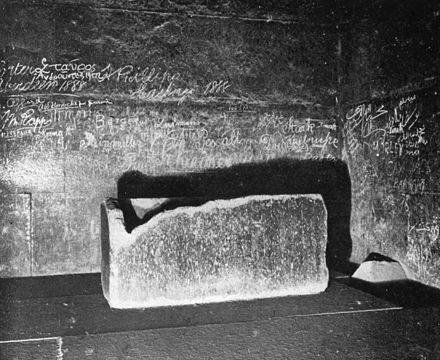
Gloateus August 25, 2017 at 4:50 pm
He is BELIEVED to be the architect … meaning that he’s the likeliest suspect. I find:
… “is considered to be the architect” …
And I’m still waiting for Ralph’s answer as to how Ralph knows that Hemiunu wanted Pi to be 22/7 as he claimed …
w.
Willis , you are being very picky. He did show you can get a ratio of 2*pi . All values of pi are approximations and 22/7 was well known and often given when I was at school before the age of electronic calculators.
pi -22/7 / pi = 0.000402 or 402 ppm
That is certainly good enough for an engineering project like a pyramid.
You pedantic carry on after that looks rather dishonest.
Whether that ratio shows they had knowledge of the ratio pi, seems less clear but is interesting.
Thanks for the clarification Ralph.
Sorry, Willis, you are becoming tiresome here.
If the largest building in the world is demonstrably made to 2 x 22 / 7 (formula for circle) and the building next door is made to a 3-4-5 (pythagorean triangle), I think we can rightly assume that the architect was embodying items of mathematics for future generations. Or simply showing off.
But the evidence from history suggests the former. Josephus Flavius says that two pillars (pyramids) were made to record the wisdom of the ancients, one of brick and one of stone. (The Egyptian and Sumerian pyramids, of stone and brick.) So we have an ancient tradition that says the same thing – that wisdom was being encoded into architecture.
Look, if we measure the Pantheon, and find that the hemisphere of the dome has the same radius as its height above the ground, I think we are rightly justified in saying that the architect was designing a giant sphere. And since the heavens above were seen as a hemisphere, and it was already known in this era that the Earth was a sphere, I think we can also assume that the architect was encoding this knowledge into his or her design. See Architecture and Mathematics from Antiquity to the Future by Kim Williams, 6-83.
.
As I said before, every church and cathedral contains an empty sarcophagus – it is called an altar (covered by a cloth that is symbolic of the winding sheet of Jesus). This is because an empty sarcophagus is the foundation for this creed. Masonry is likewise based upon the symbolism of an empty sarcophagus (of Hiram Abif). This is because an empty sarcophagus is the foundation for this creed.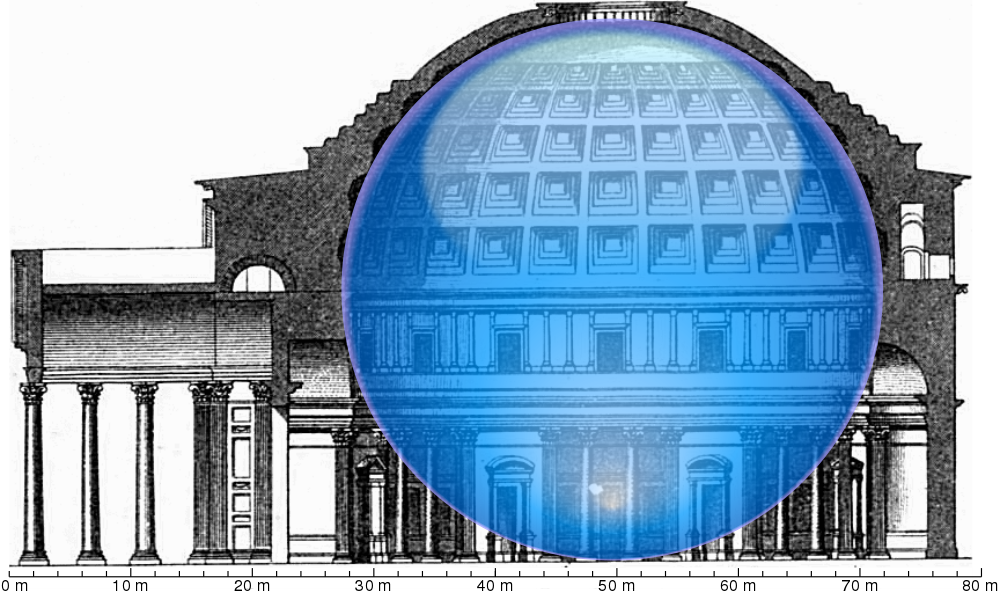
An empty sarcophagus in the Great Pyramid is more likely to be evidence for a resurrection cult, like Christianity and Masonry. And since every Masonic temple is supposed to have a double-square floorplan, the same as the King’s Chamber has, there are yet more similarities.
And no self respecting pharaoh would EVER be buried in an uninscribed tomb that did not glorify his name. It is unthinkable. Witness the 18th dynasty tombs in the Valley of the Kings. But if these were pyramidal cathedrals, dedicated to whole dynasties of pharaohs, this would explain the lack of inscriptions. Westminster Abbey may contain some royal burials (which pyramids do not), but you would still not call Westminster Abbey a tomb.
Ralph
The Pantheon:
https://sites.math.washington.edu/~greenber/PiPyr.html
http://egypt.hitchins.net/pyramid-myths/khufus-pyramid-does-not.html
And it gives a nice symmetry too, so the perimeter of the G.P. can be 1760 cu and the height 280 cu. And which architect does not like symmetry?
And the 280 and 7 measurements were embodied into the cubit sub-units. The cubit was subdivided into 7 hands and 28 fingers, which is symbolic of the 22 / 7 Pi fractional, and the 280 height of the pyramid. While the 22 numerator formed the basis of the ‘pyramid mile’ and the imperial mile (just multiply by a factor of 40 and by the 2 in the formula for a circle). And of course 1/4 of 22 is that famous 5.5 rod, that Willis is continually stumbling over (there is evidence that 5.5 cubits was used in the G.P.)
And do remember that this was the sacred cubit. The profane cubit only had 6 hands and 24 fingers, which did not embody anything. But the priesthood had 7 hands and 28 fingers, because they knew what the fractional approximation of Pi was. And since knowledge is power, they were keeping this to themselves…..
R
“An empty sarcophagus in the Great Pyramid is more likely to be evidence for a resurrection cult”
With a constant 68°F in the Kings chamber, that could well be a brewing vat for ale. The salt deposits in the Queens chamber would be the barrel sterilization room, and the barrels get rolled down the grand gallery and put into the subterranean chamber to mature. 😉
ralfellis August 26, 2017 at 2:54 am
I get tiresome when someone doesn’t answer my questions. You claimed that some off the wall ratio was “what [the designer of the Great Pyramid] wanted”.
I asked how you knew what he wanted … and you’ve responded with bafflegab.
How about you admit you don’t know what he wanted, nobody does? Read Mosher’s link and second link below. You’re just repeating 19th century numerology, and poor numerology at that.
w.
ralfellis August 26, 2017 at 2:54 am
My reply didn’t post, perhaps because it too included the apparently banned name of P.e.t.r.i.e.
The short version is that the sarcophagus is empty because all the pyramids were looted. Tomb raiders took virtually everything, and anything they might have left rotted.
On pyramids as tombs:
https://www.quora.com/What-was-the-purpose-of-the-pyramids-of-Giza
And as launching pads for souls to Sirius, Orion and other stars, with shafts aimed toward their positions at time of construction:
https://www.theguardian.com/world/2001/may/14/humanities.highereducation
But that is not really true, is it.
The entrances to the Second and Third Pyramids at Giza are obvious, so everyone knew where they were. Which is not secure for a tomb. But it is fine for a cathedral. The entrance to the Great Pyramid was also open, as Strabo desribes it, and the stone door that closed it.
However, there were hidden chambers in the Great Pyramid. Possibly with mummies and treasures??? But these were first discovered by Caliph al Mamoun in the 14th century (?), but history appears to record that the chambers were empty, and Mamoun went away empty handed.
Ralph
Mosher.
That table of pyramid angles is uninformed.
Firstly, they should be looking for 22/7, not pure Pi. And the GP is accrurate to about five decimal places when using 22/7. There is no point making a monument to fractional measurements, as it is almost impossible for the architects to follow the plans, and almost impossible for anyone to work out what measurements are ‘meaningfull’. A nice whole 1760 cubits and 280 cubits related to 22 / 7 is much more meaningfull that decimal places.
And then he goes on to comparing the 5th to 7th dynasty pyramids, without realising that these are not megalithic, and not made to the same standards whatsoever. The only pyramids worth investigating are those at Giza and Dahshur.
R
ralfellis August 27, 2017 at 12:21 pm
Gosh, Ralph, you mean that if you throw out all the pyramids that do NOT fit your goofy theories, the remainder show that you are 100% correct?
There’s a job for you in the tree-ring scam, that’s for sure.
w.
ralfellis August 27, 2017 at 12:21 pm
Despite requests, you have NOT shown the slightest scrap of evidence that the ancient Egyptians used 22/7 as an estimate of Pi. Provide a link, or your claims are busted … because your unsupported word is worthless.
w.
PS—As is my unsupported word, for that matter …
The Babylonians may also have created rudimentary batteries and used them to experiment with electrolysis, based on artifacts consisting of small urns with metal rods and chemical traces inside.
Those jars most likely used as batteries were Parthian or Sassanian, ie from long after the Babylonians.
However, some copper vessels found in Sumerian remains, ie from before the Babylonians, show signs of having been plated, whether electrically or not.
But archaeologists today doubt that the artifacts are indeed batteries.
https://en.wikipedia.org/wiki/Baghdad_Battery
Thanks for clarification.
I saw this in the comments over at The Independent on this same story:
“I learned on my 1979 Open University History of Mathematics course from a 1930’s book on Babylonian mathematics that the sexagesimal base 60 also had Place Notation for numbers less than one, the first column being, sixtieths, the second column being three thousand six hundredths and the third column being two hundred and sixteen thousandths. A fourth column would be accurate to 1.29 millionths, all written with just two symbols, a wedge at one end of a stylus and a round circle from the other end of the same circle, arrange in tight patterns, rather like dots on a dice, being easy to read,which is pretty economical.
Not only that, but kids learned their sine, cosine and tangent tables to rhyming verse, so could solve any triangle knowing one side and an angle. They also used lines, squares and cubes like Leggo sticks, squares and cubes to solve quadratic and cubic equations, posed as a verbal question. Obvious square roots and cube roots were easy to them and there is a well known tablet around giving the square root of two to about fourteen sexagesimal places…”
That’s pretty cool if true
And AFAIK, we’ve yet to recreate exactly some well-known historical materials, like “Roman concrete” (could set and cure underwater, used among other things for bridge-building) and “Greek fire” (oily liquid that ignited on contact with water, used as a fearsome naval weapon by the Byzantines).
The properties of Roman have been attributed to including volcanic ash in the mixture, and using larger aggregate than normal in modern concrete, so large in fact as to amount to rubble. Hence, Roman concrete was laid rather than poured. The dome of the Pantheon is remarkable for its use of pottery shards as “aggregate”.
It is being copied today by adding fly ash in lieu of volcanic “ash”.
You’re right that the precise composition of Greek fire remains unknown. Remarkable that the Byzantine state could keep a secret for over 1300 years. But then the price of bread remained the same there for a millennium.
The secret to Roman concrete was discovered recently. It was seawater
All concrete can set and cure underwater. Concrete curing is a hydration reaction.
Lime mortar requires CO2 which is where this whole thing got started I guess. Concrete made with lime mortar won’t set under water (unless you’ve used broken bricks or tiles as the aggregate which act as a pozzolan to form a crude cement mortar). Confusion between ‘cement’ and ‘concrete’ is common. US calls concrete blocks ‘cement’ blocks for instance. Cement is like the flour in a fruit cake and concrete the cake.
‘Roman Cement’ reinvented by Rev. James Parker (patent 1796) after picking up some Septaria on a walk along the beach on Isle of Sheppey (Kent, UK). This is close enough for now https://en.wikipedia.org/wiki/James_Parker_(cement_maker)
For those interested in the history of structural engineering Sheppey also has the world’s first modern framed building built in 1860 by Royal Navy at Sheerness dockyard.
http://www.tandfonline.com/doi/abs/10.1179/tns.1959.005?journalCode=yhet19
In the middle column, fourth row down, the third decimal place is wrong. No wonder Babylon fell…
Perhaps it was their invention of EVs …
If the tablet was found near Larsa and dates from ~1700 BC then strictly I’m not sure it can be described as “Babylonian” implying from Semitic-speaking origin.
The southern Euphrates plain was still occupied by Sumerians, thought to be from a different ‘West Asian’ language group maybe proto-Indo-European.
Pretty sure that the table is Semitic, although the Babylonians appropriated and improved the Sumerian Base 60 system.
Transition from Sumerian to Babylonian is usually given as c. 1900 BC.
Very interesting stuff, and, yes, we do often underestimate the knowledge and skills of the ancients. That is why theories about ancient accomplishments being done by extra-terrestrials are so popular. However, I am quite skeptical about the article’s conclusions.
First, for all we know, this “trigonometry” may have been invented/discovered by a few very bright chaps who used it only rarely for the benefit of the ruling class, and it was then forgotten. Today, largely thanks to the Greeks, every high school sophomore is “supposed to” understand trigonometry, how many Sumerian teenagers understood it or its applications (granted, probably more than American teenagers, but that is another issue)? Besides, how good is technology if it is lost for 3,000 years only to be discovered later by a society smart enough to interpret it? At least what the Greeks created they preserved.
Second, I am always skeptical about predictions. The article opines that we could learn soooo much from this discovery, that we can lern soooo much from an ancient, non-Western society. Really? Aren’t these the people who promised us flying cars?
Well, I’m a life long fan of base 12! I wish we used it as I’d like the base to be divisible by 2 and 3 exactly! Actually, the oldest “abacus” is the human hand. The thumb is used to count the division on each finger, three on each of the four fingers. The other hand is used to keep the total, starting with thumb symbolising 1 dozen, followed by each of the five fingers giving a total of 60; naturally! 😉
Should be: “The thumb is used to count the divisions on each finger, three on each of the four fingers. “
Ancient Egyptians and Babylonians ‘invented’ plane geometry and trigonometry. They used it for practical purposes of land area measurements and astronomy and astrology to predict seasons for agriculture and future events. The ancient Greeks developed these crude knowledge into formal theories. It’s like Egyptians and Babylonians were great auto mechanics. The Greeks invented mechanical engineering.
‘the calculations are far more accurate’. Hm, the representation of fractions in base 60 is more precise. Trigonometry is trigonometry, whatever base is used. We use base 2 in calculators. The sine of 30 degrees is still 0.5.
I think the ancient Greeks developed a sort of worship for logic, which, though it took them a long way, failed them once they discovered irrational numbers. The concept of complex numbers involving calculations using the square root of negative one would have been quite beyond them, requiring more “can-do” thinkers. I also believe this conceptual failure is the main reason Greek maths stagnated, with the inevitable knock-on effect on further scientific and technological progress.
However the Greeks did bring about that logical mathematical machinery involving theorems, proofs and so on, which far surpassed the achievements of other civilizations, which only had collections of useful algorithms at best.
Harking back to earlier comments regarding Roman concrete; and moving off on a tangent…..
As a consequence of a recent discussion in my local pub, I understand that the ancient Egyptians had developed an aggregate of crushed granite and quartz, with some kind of binder, to make “artificial” granite.
This granite was then poured into forms, or shaped like pottery.
Once it cured, it was/is indistinguishable from “real” granite.
Does anyone know anything about this? Or was it just the cheap liquor talking?
I don’t know, William. But, you get a clink of the (rootbeer) stein for moving off on a tangent.
#(:))
It’s a French materials scientist and amateur archaeology theorist talking. This guy argued that the blocks of the Great Pyramid were cast on site from a concrete or cement-like mixture, not cut and hauled there from a quarry. This has been shown false by Eocene fossils in the limestone, among other evidence.
https://en.wikipedia.org/wiki/Joseph_Davidovits
However, the Egyptians did use a cement-like mixture between some of the blocks, in which Davidovits claimed to have found a hair. This story morphed into his having found hairs inside the rock blocks.
Fossils in Egyptian stone monuments:
http://www.abc.net.au/science/articles/2008/04/28/2229383.htm
Gloateus: thanks for the links; they made for interesting reading.
If the guy’s theory were correct, it would certainly answer a lot of questions!
Back to the pub…… (for more tangents)
Hmmm…. This sounds like ancient cultural appropriation to me.
/wink
ralfellis August 26, 2017 at 2:05 am Edit
Ralph, what you said was what I quoted:
That was said, not to “all WUWT”, but to me. So once again, piss off. You have no clue what I am or am not familiar with.
IDID quote your words. I’ll quote them again. You said:
And as I said above, if you meant 5.5 yards in a rod, then you should say so … but you didn’t say a word about yards.
Congratulations. Your momma must be proud.
w.
This entire subject of “inventor of trigonometry” needs a closer look. Does it mean anything?
Trigonometric functions had to wait for series approximation techniques us to really understand and use them. Is that the “real” trigonometry? “Functions” of a variable don’t exist for these ancient blokes either, or for anyone else until the 17th C. A.D. so far as anyone can tell. Much of ancient geometry from Eudoxus (4th C. B.C.) revolves around triangles. What distinguishes “trigonometry” from general geometry?
Pythagorean triples, i.e. the A, B, & C of standard right triangles, are ancient, and they find them everywhere completely devoid of the method used to derive them. Nobody knows whether they were calculated or physically measured using ropes. Pythagoras, the man we associate with this right triangle theorem, was trained in Egypt. Thus, the contest for inventor of math has never been between the Greeks and Mesopotamians, it’s always between the Egyptians, Mesopotamians, Pre-Vedics, Pre-Druids, Yellow River civilization, and the civilizations that are currently underwater due to the end of the last ice age.
This Telegraph article is a puff piece.
look at the remainders of the hypotenuse first minus the long side, and second minus the short side.
Row 1:
169 – 120 = 7^2.
169 – 119 = 2 x 5^2.
Row 2:
4825 – 3456 = 37^2.
4825 – 3367 = 2 x 27^2.
Row 3:
6649 – 4800 = 43^2.
6649 – 4601 = 2 x 32^2.
Row 4:
18541 – 13500 = 71^2.
18541 – 12709 = 2 x 54^2.
Row 5:
97 – 72 = 5^2.
97 – 65 = 2 x 4^2.
Row 6:
481 – 360 = 11^2.
481 – 319 = 2 x 9^2.
Row 7:
3541 – 2700 = 29^2.
3541 – 2291 = 2 x 25^2.
Row 8:
1249 – 960 = 17^2.
1249 – 799 = 2 x 15^2.
Row 9:
769 – 600 = 13^2.
769 – 481 = 2 x 12^2.
Row 10:
8161 – 6480 = 41^2.
8161 – 4961 = 2 x 40^2.
Row 11:
75 – 60 = 15. {no square]
75 – 45 = 30. {no square]
Row 12:
2929 – 2400 = 23^2.
2929 – 1679 = 2 x 25^2.
Row 13:
289 – 240 = 7^2.
289 – 161 = 2 x 8^2.
Row 14:
3229 – 2700 = 23^2.
3229 – 1771 = 2 x 27^2.
Row 15:
106 – 90 = 4^2.
106 – 56 = 2 x 5^2.
To calculate the hypotenuse, example Row 4:
Add the short side and the long side:
13500 + 12709 = 26209,
minus the product of the square roots and the two:
(71 x 54 x 2) = 7668:
26209 – 7668 = 18541.
And it then follows that the hypotenuse plus the short side, then divided by two, is a square, and the hypotenuse minus the short side, then divided by two, is also a square.
Also in each case, the hypotenuse plus the long side, is also a squared number.
e.g. 18541+13500 = 179^2.
So the short side is the product of the square root of the hypotenuse plus the long side, and the square root of the hypotenuse minus the long side.
71 x 179 in Row 4.
The apparent values in the first column on the tablet are the short side divided by the long side, then squared, I don’t get see the relevance of them yet though.
Further, each short side is divisible by the square root of the remainder of the hypotenuse minus the long side, e.g. Row 4; 12709 / 71 = 179.
oops sorry about the chaotic comment nesting!
Apparently this is not new at all. Mario Livio in oneof his books referred to this already.
It begs the question, from whom did the babylonians learn this information?
“The largest number that always divides abc is 60”
https://en.wikipedia.org/wiki/Pythagorean_triple#General_properties