by Rud Istvan,
EPA administrator Pruitt wants to “Red Team” the catastrophic anthropogenic global warming (CAGW) consensus best reflected in the IPCC assessment reports (AR). At its core, CAGW rests on just three propositions:
1. CO2 is a ‘greenhouse’ gas retarding radiative cooling. This should not be in serious dispute since Tyndall experimentally proved it in 1859.
2. The Earth is warming. Although the details are in dispute because of temperature data quality problems and ‘adjustments’, the general fact is not. The Earth has been intermittently warming since the Little Ice Age (LIA) ended. For example, the last Thames Ice Fair was in 1814.
3. CO2 and its knock-on effects caused the recent warming, and climate models (such as the CMIP5 archive for IPCC AR5) predict this will continue to catastrophic levels. This is an extremely dubious proposition.
This guest post addresses proposition 3. It does so in a short sound bite ‘abstract’ useful for debating warmunists, and then in a typical WUWT full climate science guest post. It is a modest Red Team contribution.
Sound bite ‘abstract’
Climate models have run hot since 2000. Except for the 2015-16 now fully cooled El Nino blip, there has been no warming this century except by Karlization or (newly) Mearsation. Yet this century comprises about 35% of the total increase in atmospheric CO2 since 1958 (Keeling Curve). The climate models went wrong on attribution. The warming ~1920-1945 is essentially indistinguishable from that of ~1975-2000. AR4 figure SPM.4 said the earlier period was mostly natural (because not enough change in CO2). The CMIP5 archive assumes the latter period is mostly CO2 (and other GHG). That assumption is fatally flawed; natural variation did not magically cease in 1975.
Fully documented post
CMIP5 climate models have run hot since before 2000, and the divergence of CMIP5 from observations is highly statistically significant. Details are in Dr. Christy’s 29 March 2017 Congressional written testimony (available on line), from which Figure 2 provides sufficient up-to-date evidence.

This divergence is rooted in the attribution problem between natural and anthropogenic warming. It is unavoidably inherent in CMIP5 models for a very basic reason.
To properly model essential climate features like convection cells (thunderstorms), a grid cell needs to be less than 4km on a side. The finest resolution in CMIP5 is 110km at the equator; the typical resolution is 280km. This is because halving grid size requires an order of magnitude more computation. So adequately simulating such atmospheric processes from first principles is computationally intractable. Details are in my 8/9/2015 WUWT guest post “The Trouble with Climate Models”.
The solution is to parameterize such processes (for example, put a number on the probability of how many thunderstorms per grid cell per time step –a conceptual rather than actual example as parameters are a bit more complicated). Parameters are obviously just guesses. So they are tuned to best hindcast compared to observations; for CMIP5 the ‘experimental design’ was from yearend 2005 back three decades to 1975.[1]
Parameter tuning implicitly drags the attribution problem into CMIP5.
Dr. Richard Lindzen, MIT professor emeritus, first made the observation that the period of warming from ~1920-1945 is essentially indistinguishable to that from ~1975-2000. This is readily apparent visually, and is also true statistically.

IPCC AR4 WG1 figure SPM.4 and the accompanying text make clear that the earlier period (circled in blue) was mostly natural; there simply was insufficient change in atmospheric CO2 to explain the rise in temperature without natural variability. A portion of figure SPM.4 (readily available via the IPCC) is reproduced below as sufficient evidence.

The IPCC intent of AR4 WG1 figure SPM.4 was to convince policy makers that the second warming (circled in red) had to be AGW. But that IPCC logic is fatally flawed. The SPM did not tell policy makers about model parameter tuning, which clearly drags natural variation into the model parameter tuning period assumed by IPCC to be AGW. So the warming is falsely attributed only to CO2. Note also the subtle “cheat” in Fig SPM.4 of models using only natural forcings. The issue is not guessed natural forcings. We do not know why natural variation occurs, only that it does (no model of ENSO periodicy, for example). Natural forcings are not the issue; only the resulting natural warming variation is. Natural temperature variation, not ‘forcings’, is the proper statement of the attribution problem. The AR5 WG1 SPM makes IPCC’s erroneous and unscientific belief explicit:
§D.3 This evidence for human influence has grown since AR4. It is extremely likely that human influence has been the dominant cause of the observed warming since the mid-20th century. [Bold mine]
Natural variation did NOT stop in the mid-20th century. And that is why CMIP5 models now run hot.
[1] Taylor et. al., An Overview of CMIP5 and the Experimental Design, BAMS 93: 485-498 (2012).
Discover more from Watts Up With That?
Subscribe to get the latest posts sent to your email.
Does anyone really know what the temperature trends are anyway????
Temperature adjustment impact study
Thanks for the link – very interesting reading…
That is the one quibble I have with ristvan on this one. The world has warmed (when you have a suitable start point – choosing other start points indicate that it has cooled considerably).
What it is doing is actually unknown at this point in time.
CO2 can’t even stop massive cooling overnight in high altitude dry deserts, where water vapor is essentially absent from the atmosphere.
The specific Spectral Absorption Lines that make up the various CO2 absorption bands; most notably the roughly 13.5 to 16.5 micron band, are not also occupied (to any extent) by other GHG components, including water vapor.
Ergo, the heat confining properties of CO2 in the atmosphere, right outside my front door; or at any other place, are NO different from the heat confining properties of CO2 in those high, and dry deserts; namely virtually imperceptible.
In the very coldest of places, such as the Antarctic highlands around Vostok Station, the spectral peak wavelength of the surface emitted LWIR radiation is right on the 15 micron center of the CO2 absorption band, so the warming effect of CO2 should be a maximum at such places.
That’s why it frequently gets down to -94 Deg. C in those regions. Well of course it so happens that there is not too much atmospheric water vapor around Vostok Station either.
Somehow, I don’t get the picture of CO2 causing it to warm much, if at all, virtually anywhere on this planet.
Now having said that; I do not dispute that CO2 is an effective absorber of LWIR EM radiation energy in that 13.5 to 16.5 micron wavelength band, and is also in the region around 4.0 microns; where there is actually very little surface emitted radiation, and also very little incident solar radiation, in that band. It doesn’t seem to be what is controlling our stable Temperature comfort zone.
There is somewhat more solar emission in the region around 1.0 micron to perhaps 2.5 microns, so CO2 in the atmosphere can absorb some of that.
But that is a SUBTRACTION from the surface incident solar irradiance that is what is actually being converted to heat at the earth’s surface, and keeping us warm.
So in those near IR CO2 bands, the presence of more CO2 in the atmosphere is a net cooling effect at the surface.
G
George,
It doesn’t need high or dry… even in California, the daily cycle is roughly symmetrical.
When there is variation (not due to precipitation) it directly tracks clouds, with more cloud causing cooler days. Sunny days hotter.
https://chiefio.wordpress.com/2017/06/26/is-the-average-variation-of-clouds-co2/
CO2 is functionally static over a few weeks, (as is solar power and more), so has no explanatory power for the observed variation. Clouds do. Now if one grid cell over a few weeks is explained by clouds, how can averaging more of them over time or space be only CO2?
Well the only reason I said high , was that generally leads to drier.
The point being that when CO2 is free to do its thing by itself, sans backup helpers, it is seen to be woefully incapable of keeping anything warm.
The Antarctic highlands (during winter’s night) of course is an extreme condition. The surface radiant emittance is about one twelfth of the surface emittance of the hottest dry deserts under the noonday sun, which is where the earth is really cooling big time, at nearly twice the rate for the global average Temperature of 288 K.
In the Arctic, there is the added factor of petawatt streams of energy fed to the poles from the tropics, by either ocean currents or atmospheric circulations; but the Temperatures there are still low enough that the radiant cooling surface emittance is unable to get rid of all that imported heat, which is why the polar regions warm more than the tropical regions.
Despite the importation of all that tropical heat energy, the north polar Temperatures are still very low.
Of course that could be a consequence of much less solar incident energy density in the polar regions.
Just imagine how cold the north polar region would be without the gulf stream and other heat importation paths. So much for the CO2 keeping anything warm.
G
BINGO
Mars is a good illustration. Whilst it has only a small atmosphere, this atmosphere is composed nearly entirely of CO2. 96% of a small atmosphere equates to many more molecules of CO2 than does 0.04% of a large atmosphere.
In fact, on a numerical basis, Mars has approximately 10 times as many molecules of CO2 in its atmosphere, as does planet Earth, and yet there is no measurable GHE on Mars, and these molecules of CO2 do not slow down the rapid loss of temperature as the sun sets.
In practice one would expect to see an even greater GHE on Mars if CO2 is truly a GHG since not only is there on a numerical basis more than 10 times as many CO2 molecules in the Martian atmosphere, these CO2 molecules are much more densely packed (ie., much closer to one another) given that Mars has a radius of approximately 1/2 that of the Earth, and thus the surface area over which the Martian CO2 acts is about 1/4 of the surface area of planet Earth.
The Tyndall experiment is far removed from real world conditions, and establishes nothing of importance. We would do well to stick to the facts. CO2 is a radiative gas, whether it is a GHG is moot, and this can only be determined by way of observational evidence of how it behaves in Earth’s atmosphere and what if any Climate Sensitivity there is to CO2.. Such evidence we have is of poor quality and not fit for scientific purpose, but to the extent that one can draw conclusions it would appear that the Climate Sensitivity to CO2 is little, if any at all.
Hi George,
In 2009 I raised the issue of planetary cooling by discussing the effect on world temperature of the high altitude ice desert of Antarctica, a place where in winter radiative cooling can easily generate air temperatures below -50C. My purpose was to explain the source of the cold deep water that exists in the modern world ocean. This cold ocean water is formed by a linked process of air movement off the Antarctic ice-cap by katabatic winds, these cold winter winds freeze the surface waters of the Southern Ocean and also form dense saline water in the coastal latent heat polynya of the Weddell Sea. The high altitude Antarctic ice desert, the katabatic winds and the coastal latent heat polynya are the key parts of a continuous process of dense saline cold water generation that has filled the world ocean with 4C abyssal water for at least the last 20 million years.
At that time you stated that “I always learn something from other people’s posts” and I am pleased to see that you have done so in your acknowledgement of the role that the Antarctic ice-cap has in generating super-cold air.
I will now return the compliment to you. You pointed out to me in your comment in 2009 that the Sahara Desert is a much more important region of the planet that at night radiatively cools by emitting surface heat directly to space, when you stated:-
I now know how profound this comment of yours actually is. You see the standard explanation for the Hadley circulation is that air that has been lifted to the top of the troposphere dries by rain water fall-out in the thunderstorms of the ITCZ, cools by radiation to space at the tropopause and then descends over the Horse Latitudes as hot dry air. The implication is that this descent is due to increased air density caused by radiative cooling at the top of the atmosphere. This is not true. The air aloft is forced back to the surface by the rotational of the Earth and that it is the speed of a planet’s rotation determines the size of its Hadley Cell and not planetary air temperature.
Since your comment in 2009 I have found two papers that prove that this angular momentum mechanism for the latitudinal reach of the Hadley Cell is correct. See:-
From the abstract of Del Genio, A.D. & R. J. Suozzo 1987: A Comparative Study of Rapidly and Slowly Rotating Dynamical Regimes in a Terrestrial General Circulation Model. Journal of the Atmospheric Sciences, Vol. 44 (6), 973-986.
From the abstract of Hunt, B.G. 1979: The Influence of the Earth’s Rotation Rate on the General Circulation of the Atmosphere. Journal of the Atmospheric Sciences, Vol. 36 (8), 1392-1408.
The take home message is this:- The location and size of the climate zones on planet Earth are controlled by its daily rotation. In order to extend the latitudinal reach of the Hadley Cell towards both poles simultaneously, it is necessary to slow down the Earth’s daily rate of rotation. Carbon Dioxide cannot do that. Climate change by increased air temperature cannot alter the size of these climate zones which on Earth are controlled by planetary momentum.
Of course radiative cooling during ice ages is another story. By providing more high elevation land surface during ice buildup our fast rotating planet is more prone to cooling than to warming. As far as I am concerned it’s game over for Carbon Dioxide.
Thank you George for correcting me with your fascinating insight.
“””””…..
Philip Mulholland
July 10, 2017 at 3:37 am
Hi George,
“
CO2 can’t even stop massive cooling overnight in high altitude dry deserts, where water vapor is essentially absent from the atmosphere. …..”””””
Phillip the point of my mention of the Sahara and other tropical dry deserts, is NOT that at sundown, somebody tells the desert ” OK it is ok to radiate now that the sun has gone to sleep.
MY point is ….. The Deserts are ‘Radiatively Cooling’ the fastest, NOT at night, but in the hottest part of the day, when the solid surface can be well in excess of sixty deg. C, some say it gets to 90 degrees C.
At those mid day to early afternoon Temperaures the deserts are radiating at almost twice the 590 W/m^2 that one calculates from a 288 K global average Temperaure for a BB radiator.
Yes the polar regions are cold, specially the Antarctic highlands during winter midnight, because there is nothing (including CO2) to stop them from cooling ad infinitum; BUT they do so at a pitifully slow rate if the surface Temperature is -94 deg. C as satellite measurements suggest is common at such times. The radiative cooling rate is about 1/12th of the tropical desert cooling rate.
Among the reasons the south gets colder than the north, besides longer colder winters, is that there isn’t any gulf streams bringing vast quantities of warmer tropical waters close to the south pole, like happens in the Arctic.
Antarctic winters are colder because the sun is more distant, and by Kepler’s laws, it spends more time in that more remote region, but there also is not the high heat flux from the tropics making it much inside the Antarctic circle.
G
Thanks a lot. Hopefully ths report will be the subject of a WUWT post soon.
Measurement error alone on the surface network is +/- .15C and there are obviously other errors that have likely crept into the calculation so it is almost certainly greater. Then there’s methodology. If you search back for old GISS announcements you get the 1997 “it’s this much hotter than the average was” and then you find out what that average is, do the math…and realize that using their methodology the “world” was over 1C warmer back then than it is using today’s methodologies.
What the heck would you even say is an “average” temperature of the earth? In what way would it be remotely descriptive of the wild daily, seasonal, and century scale changes? They talk about energy balance…but how do we even know what the REAL energy balance is? How much energy is the earth trying to reach equilibrium after the little ice age? What would a half a watt per square meter drop in solar output for a couple centuries back then impact what it looks like today?
My gut feeling is that it is truly unknowable and that the way they stitch together the surface record to make it continuous…gives a false sense of accuracy where none exists.
“Does anyone really know what the temperature trends are anyway????”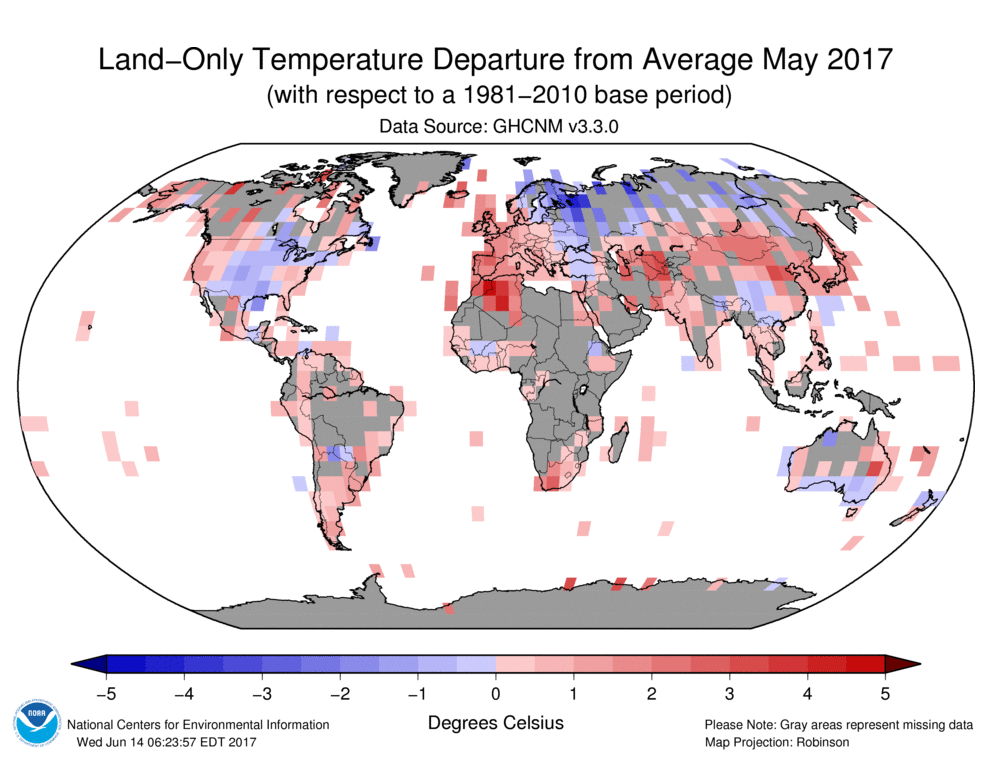
Sampling bias gives us trends for areas of humans preferred habitat: Riparian and Maritime regions. Does this reflect the earth’s true terrestrial aspect? I think not.
Note that this map’s gray areas represent missing data.
Some how NOAA gets from this map:
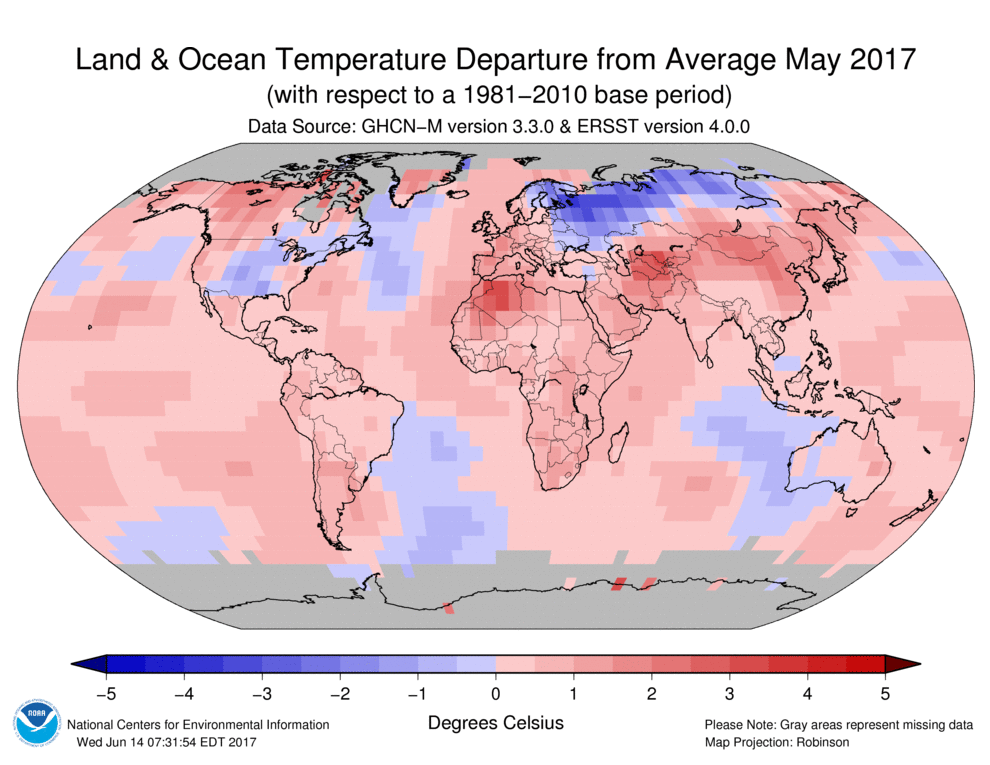
to this map:
Where did the missing data go? Or should that be where did the missing data come from?
Tony Heller has even more egregious examples. Counter, he cherry picked months. Counter to counter, the point remains generally true irrespective of the month used for the illustration. Nice comment.
They like it hot, hot, hot. Sorry, couldn’t resist.
I don’t know… the lowest CHIMP5 model that is tracking below current temperature observations past 2020 looks OK… but when and how are they going to get it to ‘hockeystick’?
AND can anyone tell me which model that is as I’m red green colorblind. Thanks.
Russian INM-CM4
Got it. Thanks!
I’ve long maintained that they should only fund those that are close to reality. Cut the funding to the other 30 and watch the real science start.
Well, I don’t know about that, but certainly Some Like It Hot.
Although now the world is looking to the Chinese for leadership, perhaps the following is HOT, HOT, HOT.
There is an outlier model closer to the other datasets. Is it worth anything?
Can they repeat the run and get the same results?
Repeatedly?
The outlier model following reality is the Russian INM-CM4. It has three salient feature: higher ocean thermal inertia, lower water vapor feedback, and for both reasons also lower sensitivity.
Thanks Rud. In my last post https://climateaudit.org/2017/06/19/the-effect-of-atlantic-internal-variability-on-tcr-estimation-an-unfinished-study/ we tried to find the source of the for the overestimation of TCR in CMIP5.
best Frank
In its latest run the sensitivity is 1.4degC. Sounds right-ish to me!
“However, these are strong mitigation scenarios (RCP 2.6, 4.5)”
The scenarios do not differ much in effect in the years 2005 to now. You can see this in the trajectories, which do not start to sort by color until about 2030. It is convincing evidence that the CMIP5 runs are consistent with observations.
Late back. Frank IMO long time since oceans are the key. And before ARGO, we have no good data. (Trade route, laden depth, biased.) So dunno. Read your and Nic Lewis post at Climate Audit ( now that Steve has moved to twitter), but dunno. I am expert enough to recognize dunno. Highest regards. Skeptic Rud.
Rud, of course nobody can be quite sure about our climate system. That’s why I wrote: “We tried” and this is the contrast: A realistic admits the uncertainty in everything he does and makes more or less doubtful approaches. Some others shout out loude, i.e. https://www.eurekalert.org/multimedia/pub/144866.php . 😉
best Frank
Some of the CMIP5 model runs are fairly close to the observed temperature data…
However, these are strong mitigation scenarios (RCP 2.6, 4.5).
Any way you slice the models, they all either incorporate or result in a climate sensitivity that is far too high.
Your graph shows a 1986 start point in the middle of the herd. Dr. Christie’s Figure 2 lines up the beginning of the satellite era with the average of the CMIP5 Models at that time. By 1986 the observations were well below the average of the 102 models. I can’t help but wonder why a 1986 start point was chosen and were the models in that close of agreement at that time? Dr. Christie’s data says they weren’t.
The two model comparisons used different model ensembles and different starting points.
The starting point for the CMIP5 ensemble is actually 2006. All of the models are CMIP5 using various RCP scenarios, compared to HadCRUT surface temperatures. 1986-2005 (gray curves) are historically constrained. The predictive mode starts in 2006 and immediately runs way too hot.
Dr. Christy uses 1979 as a starting point and compares satellite & balloon temperature data to a range of CMIP5 models run by various different groups.
The failure of the models is more apparent on Dr. Christy’s presentation.
“The failure of the models is more apparent on Dr. Christy’s presentation.”
One reasonable interpretation of that is that Christy is wrong.
While setting the starting point in 1979 is subjective, how could it be wrong?
If you have enough models, all producing different projections, surely at least one or two of them will happen to run close to reality?
I think the thing to look for is one that runs close to reality backwards, forwards, and repeatedly, yes?
“One reasonable interpretation of that is that Christy is wrong.”
Perhaps it would be better to look at absolutes rather than anomalies.
The later version of models had been hind casted to show better correlation with observations.
The models presented at the Hansen climate change hearing 1988, showed scenario A at around 1.6c by 2019.
Scenario B 1.2c by 2019 and Scenario C 0.6c by 2019.
CIMP5 show none at 1.6c and none at 1.2c, yet all average around 0.6c which was the scenario C range.
That is back tracking and hind casting in one, to con the public into thinking the models were even remotely accurate.
The real issue with the models is how they are used to sway public opinion. How many news stories have we seen that use the above chart as the source for a statement like “climate models point to possible warming as high as 2.5 degrees by 2050 which will lead to the mass extinction of all life in the universe!!!!”.And if someone tries to point out that the more likely scenario is much less warming they are instantly branded as a danger to all life in the universe who should be arrested and locked in jail…..
The models presented at the Hansen climate change hearing 1988 up to year 2005 were not even close to what was shown in the CMIP5.
CMIP5 Historical (42 models) had increases by 2000 only about +0.2c and +0.3c by 2005. The historical models never showed such little warming and have been adjusted to match observation in making them appear there were not far off.
1988
Scenario A, 2000 0.8c, 2005 1.0c
Scenario B, 2000 0.5-0.6c, 2005 0.7c
Scenario C, 2000 0.5-0.6c, 2005 0.6c
Therefore 0.3c-0.6c out by 2000 and about 0.4c-0.7c out by 2005.
Regarding Hansen et al., 1988…

To quote Bob Uecker, “Juuuust a bit outside!”
Only reason it is not much outside is because GISS has been adjusted that many times to match it. What I have mentioned still applies regarding the difference between CMIP5. Technically it is still well outside because it generally matches scenario C.
On this planet there has never been a year ~0.4c warmer than the strong El Nino 1997/98. Generally GISS with this exaggerated warming still matches scenario C.
Scenario C – Drastically reduces trace gas emissions between 1990 and 2000.
Yep. Apart from the recent El Nino, GISS matches scenario C.
C holds CO2 flat at 368 ppm after 2000 IIRC.
“Juuust a bit outside” was a reference to this scene from the movie Major League…
https://youtu.be/Jdv2Wp9MzY0
Tyndall’s Experiment occurred inside a glass bell jar, which had absolutely no relationship to the atmosphere of planet Earth, nor did he represent it as such!. The lifespan of CO2 in the atmosphere is reasonably well known from balloon and satellite measurements and photographs of planet Earth have yet to show a sealing glass bell jar over the planet! The CO2 experiments only work in sealed environments where CO2 is allowed to build higher concentrations without any losses. The entire concept of “Greenhouse” gases is a misnomer because the heating that occurs in a typical greenhouse is due to solar radiation and evapo-transpiration (i.e. water vapor) and would remain even if you sealed the greenhouse and replaced the air inside with pure oxygen or nitrogen (which would harm the plant life, but you could substitute pans of water to provide the evaporating water). Ice cores have proven the relationship between temperature and CO2 levels – CO2 rises ONLY after temperatures rise, mostly due to the increased vegetation that occurs when temperatures remain well above Freezing!
Actually, greenhouses warm and stay warm due to lack of convection.
The mechanism of the so-called “greenhouse effect” doesn’t even hold true in a greenhouse, let alone in a convective atmosphere.
I thought the rise in CO2 after warming was due to release of CO2 from warmer oceans. Vegetation uses CO2 and produces O2. Do I misunderstand what I have read here?
SRI, warming oceans will cause a rise in CO2 per Heny’s law. But ice cores show this is with a lag of about 800 years corresponding to the thermohaline circulation. The rise the past century can be shown to be anthropogenic using the changing C12/C13 isotope ratios. See also my Salby guest post a few months ago which disproves and ‘fast’ carbon sink temperature moderated atmospheric CO2 change.
The oceans are not directly warmed by the air above them. So warming due to CO2 should have no noticeable affect on the temperature of the oceans. There may be secondary effects, but the lags would be high.
ristvan,
I’ve seen references to Tyndall, 1859 on many occasions. I have always wanted to read it, but could never find a copy in internet searches. Mostly I keep getting links to a Mike Hulme article on Tyndall. Do you by any chance have a copy that you could link to?
ristvan – thanks for your comment. I will look up your references.
Mr. Penrose – I referred to increased CO2 due to warmer oceans, not warming of the oceans by CO2.
SRI,
Sorry for the misunderstanding.
Plant’s Produce O2 during daylight hours during photosynthesis. At night, they consume O2 and respire CO2 just like almost every other living thing on the planet.
Phil R, his paper was read to the Royal Society (London) in 1860. I believe their records are called the RS Transactions. It is there. Wikipedia has this covered in some detail under Tyndall’s biography, including an illustration of his IR experimental apparatus. IIRC, the apparatus illustration footnote links directly to the original paper. The whole thing is quite famous in physics circles, so there are probably reliable secondary sources as well.
ristvan,
Thank you for your response. I have a copy of his 1861 paper in the Philosophical Transactions. I just always see references to Tyndall 1859 but could never find the paper. Not a physicist (or member of the RS) so that might be part of my confusion. I like his attempt to explain his results in light of the ether theory predominant back then. This might make for an interesting discussion on how even currently accepted theories might be wrong, and how solid, empirical observations might still be attributed to the wrong cause.
Phil R. The experiments were done in 1859. So far as I know, there is no 1859 paper. The first report of the experiments was to the RS.
According to Google Scholar there are two publications by J Tyndall in 1859.
https://scholar.google.co.uk/scholar?q=Tyndall%2C+1859&btnG=&hl=en&as_sdt=0%2C5
Tyndall, J., 1859. Note on the transmission of radiant heat through gaseous bodies. Proceedings of the Royal Society of London, 10, pp.37-39.
http://rspl.royalsocietypublishing.org/content/10/37.full.pdf
There is also in 1861:
Tyndall, J., 1861. The Bakerian Lecture: on the absorption and radiation of heat by gases and vapours, and on the physical connexion of radiation, absorption, and conduction. Philosophical Transactions of the Royal Society of London, 151, pp.1-36.
http://rstl.royalsocietypublishing.org/content/151/1.full.pdf
Tyndall, J., 1861. XXXVI. On the absorption and radiation of heat by gases and vapours, and on the physical connexion of radiation, absorption, and conduction.—The bakerian lecture. The London, Edinburgh, and Dublin Philosophical Magazine and Journal of Science, 22(147), pp.273-285.
Don’t tell me no one has tried to replicate Tyndall’s experiment since 1859. Surely others have confirmed it.
Thank you sz939!
If indeed this greenhouse gas notion was “proved in 1859”, then why haven’t we extended what we know about it since then? We should be building upon this established fact. I want to see any axiom, law, postulate, formula, or anything to reason with, instead we have a dead end theory. Since we haven’t advanced this theory, the whole notion should be under serious dispute.
Perhaps we could change the name to:
Screenhouse Gas – It doesn’t actually trap much and what it does trap we can’t quantify.
Thomas
Al Gore in his movie confirmed that the basis of CO2 warming,is that that in the depth of a glacial phase the CO2 rises, increasing relative density which causes the warming, and the change of state into interglacial. And becuase the CO2 stops increasing at 280ppm, the temperature stops increasing..
This is the foundation stone to the current belief system that more CO2 is going to cause more warming.
This is what the models are based on. Inclusive of the 1859 theory.
The problem is they did not prove or provide evidence that their own theory, that the CO2 saturation increases during the warming period. There is no evidence that the relative density of CO2 increases during the transition from glacial to interglacial. In fact quite the reverse occurs, the relative saturation decreases.
So you have the theory of 1859, which nobody has attempted to replicate.
and you have the theory that CO2 density increases during the glacial to interglacial change of state not proven or qualified. Just talk..
This only proves one thing – incompetance.
Regards.
We could count the bugs.
Come on boys, take any textbook about radiation and absorption and learn something about that topic before commenting…
Here is a scientific explanation by fellow skeptic Jack Barett in E&E:
http://www.warwickhughes.com/papers/barrett_ee05.pdf
A whole world of analyses is based on IR spectroscopy, which wouldn’t exist if there wasn’t the so-called greenhouse effect. Neither would exist the CO2 lasers, which can cut steel at 1200 C:
https://en.wikipedia.org/wiki/Carbon_dioxide_laser
Ferdinand
The paper is good and clear, thanks, agreed.
The warming effects are minimal, but they occur. This has been my understanding.
The paper reports on a continuous state, where only the ppm changes to measure the effects of warming.
However it does not discuss the saturation or density issue during the glacial to interglacial change of state.
To my knowledge no-one has produced a relative saturation curve based on the Vostok or other ice core data, using ppm and temperature. Relative saturation is judge, jury and executioner. Any movement in temperture alters the relative saturation before it moves the PPM. This is a fact of life.The ppm wont move until the relative saturation is in negative equilibrium state creating the need for volume movement. PPM is volume. It has nothing to do with saturation or density, unless you factor in the temperature
CO2 relative saturation reduces during the warming phase, as it does in all similar dynamic equilibriums.
That is the main point.
So, if CO2 density is lower, the warming effect is less, not more. And yet the state changes to interglacial.
If the folks doing the models do not understand this basic movemnt in equilibrium dynamics, the results that they get from the models is nothing like reality. Plus all the other unknowns..
Regards
Ferdinand Engelbeen – from early in the article you linked:
“Their absorption characteristics allow them to act in the retention of heat in the atmosphere”
That is a spurious proclamation with no supporting science. Once that is introduced, any conclusion can be drawn to bolster your claim. But the conclusions are then also spurious.
Please provide any single axiom, postulate, law, etc. … i.e. any actual science.
ozonebust, in An Inconvenient Truth, Al Gore was showed his temperature and CO2 charts next to each other, not overlayed, which would have made more sense to the viewer if his purpose were to educate. But if you freeze frame and look closely, you will see that the temperature went up first. CO2 was a lagging indicator, not a leading indicator as Gore wanted you to think.
ozonebust,
Not direct my area of knowledge, except for measurements of chlorine in air (alarms for an eventual leak) and Cl2 in HCl vapor (HCl production from Cl2 and H2) to maintain an excess H2 in the production unit…
If I did understand what you mean, the real density of the air in glacial periods is higher than during interglacials, thus the relative aborption at low CO2 levels (glacial) was higher than during interglacials at higher CO2.
That is true, but at the other side, the volume of air is higher during interglacials and thus the pathway for IR to pass the atmosphere will be longer and the point where relative more absorption by CO2 turns into relative more outgoing IR will be higher too.
Thus in my (not so informed) opinion, the difference will not be large enough to have much influence…
Thomas Homer,
Their absorption characteristics allow them to act in the retention of heat in the atmosphere
Any EM radiation contains energy. If a foton is absorbed, that increases the energy of the molecule that absorbed the foton. That can be translated into rotational energy, vibrational energy,… With other words, a “temperature” increase of that single molecule.
If the extra energy is re-emitted, that energy is lost. If that is redistributed over other molecules by collissions, the whole lot of molecules will gain a little energy, thus the average temperature and the energy/heat content of the atmosphere rises… That is a matter of conservation of energy.
Thus retention of heat (energy) in the atmosphere depends of the ratio between re-emissions and collissions.
Take the CO2 laser as real life example: An external source gives energy to CO2 molecules, which get into excited state. Much of that energy (~80%) is wasted as heat and the laser needs (water) cooling. 20% leaves the laser as IR radiation and that energy is concentrated enough to melt steel…
Ferdinand
At the bottom of the glacial cycle the CO2 relative saturation is higher. This is a positive state of equilibrium when comparing the atmosphere tyo the sinks.
The atmosphere has remained in a state of positive disequilibrium through most of the transition into glacial state.
The first rise in atmospheric temperature moving out of glacial state causes the atmospheric CO2 relative saturation to reduce and a state of negative disequilibrium occurs in the atmosphere, (the atmosphere is proportionally short of CO2). That is why the ppm follows temperature.
The sinks are colder relative to the atmosphere, so there is a time lag on sink release, despite a receptive atmosphere. With increasing heat the biospheres start digesting CO2 adding to the negative disequilibrium.
It requires this change of temperaure to create volume movement (ppm) out of the sinks.
During ALL warming phases out of glacial state, the atmospheric CO2 relative saturation / density is lower. If it is lower the warming effect is lower.
Therefore any claim to higher density by the CAGW crowd is nonsense. However this is the basis of their theory.
Tim Maguire
You are correct. They relied on the fact that few people actually understand equilibriums, and fewer undestand relative saturation / density as a function of temperature movement.
Right at this moment I am running a system that is changing the depth and characteristics of an equilibrium, by changing the relative saturation relationship between the sink and the fluid at temperature..
Relative Saturation is king.
Ferdinand Engelbeen – Thank you for your response. You described your theory but still haven’t provided any axioms, laws, postulates, formulae, or anything to reason with. We would not be able to derive any of these methods to apply science from a flawed theory. You cannot distinguish your theory from a flawed theory. You’re left describing the details of today’s celestial spheres.
Thomas Homer,
I think that conservation of energy is one of the fundamentals of physics…
If a photon (why English remains on ph for f…) is absorbed by a molecule, its energy is fully absorbed by that molecule. The potential energy of a foton is transformed into the kinetic energy of the molecule.
That is all what can be said: if a certain type of molecule absorbs certain photons with specific wavelengths, that increases the kinetic energy of a gas where that kind of molecules is present and where photons of the right wavelength are passing by and reverse for re-emitting photons at the same wavelength.
What the net effect of this all is, is mainly a matter of ratio between re-emissions and collissions. All other variables being equal.
Convection, condensation, clouds, rain,… all play a role in the ultimate result…
Ferdinand,
English uses “ph” instead of “f” for all words coming from Greek with the letter “phi”. Hence photography, philosophy, physics, etc.
and Philip
sz939,
Tyndall’s experiment had nothing to do with a glass bell jar or a greenhouse, see the description at:
https://en.wikipedia.org/wiki/John_Tyndall
What Tyndall did was quantitatively measuring the IR absorption by different gases and mixtures, with as conclusion that water vapor was the strongest IR absorber.
Both the increasing absorption of IR by increasing CO2 as good as the backradiation to ground are measured: the former by satellites measuring the outgoing spectrum, the latter at two stations (Barrow and ?) over time.
No matter how the extra heat radiation retention is further distributed, enhanced or reduced by feedbacks, the effect of more CO2 is more warming of the lower atmosphere.
While calling that a “greenhouse” effect is indeed a misnomer, it is the nearest simple explanation of the effect for lay people. Not to be taken literally…
Ferdinand,
What you say is true, but the ramifications of the increased IR absorption by the additional CO2 is the real point of contention. The max daytime temperatures, which is what is most important to the vast majority of the biosphere, is capped by the solar input and the density of the atmosphere. Changes in energy transport can only reduce this maximum, and in this role, CO2 is a bit player. It is swamped by H2O, conduction, and convection. The most it can do is slightly retard the night time cooling. And this is exactly what we see when we examine the min and max temperatures separately; the max has remained quite steady, but the mins have increased. Translation: no disaster. This is what we need to be talking about, not the Tyndall strawman argument.
Paul,
Largely agreed…
The problem is that (too) many skeptics use these wrong arguments in discussions, while that undermines their credibility where the real discussion should be: the (minimal) effect of all that extra CO2…
Ferdinand Engelbeen July 6, 2017 at 2:01 pm says
the (minimal) effect of all that extra CO2…
“Extra” CO2? What baseline are you referring to?
Just how much of the problem with the models is due to the changes in reported temperatures from the 1980’s and early 1990’s reporting, showing a marked decline from the 1940’s to 1975, and the post 2000 reporting of temperatures showing much less decline?
Spot on. Since there is no way to run a “controlled” experiment on planet Earth, there is no way to untangle natural variation from anthropogenic forcing. You are then left with a conjecture – an untestable guess – as to the effects of CO2 on temperature. It could be less than equal to or greater than what the models project, depending on whether the underlying natural variation is warming, not effecting or cooling the planet.
Trebla:
You make this mistaken assertion
Sorry, but such a guess is NOT the proper scientific conclusion.
To date no recent global climate behaviour is observed to differ from previous behaviour(s) of global climate in the holocene. And there is no reason to postulate any novel effect when a system’s behaviour is not observed to differ from previous observed behaviour of the system (i.e. parsimony).
Therefore, the ONLY scientific conclusion which can be made concerning observed recent climate changes is that there are no discernible effects on global climate that differ from the previous and natural effects that have operated on global climate in the holocene.
This is an important finding because it indicates, for example, that there are no significant effects of the observed recent increase to atmospheric CO2 concentration.
This indication is because an effect that cannot be observed is too trivial for it to have discernible consequences (discernment of its consequences would be observation of the effect).
Richard
I think, “We don’t have anywhere near enough good data to have any idea what is going on.” , is a valid conclusion as well.
Just how “concentrated” is 4 parts per 10,000, anyway.
In such conditions, if you were an IR photon that was emitted from a molecule that was a part of the surface of the planet, how high would you fly on average before you had an opportunity to “stimulate” a molecule of atmospheric CO2? What are the odds that you would reach outer space (in a few microseconds) as a missed opportunity?
“an effect that cannot be observed is too trivial for it to have discernible consequences (discernment of its consequences would be observation of the effect).”
Well said Richard!
Jean parisot, no! Richard is correct. That there is no difference detected that climate is acting any different today at the higher concentration of CO2 than previously. Either CO2 has only a marginal effect or none at all on temperature. That is the only conclusion one can make at present.
You elevate an hypothesis of AGW too high on a lab experiment. It is a better supported hypothesis, accepting Tyndal’s experiment, that other factors in the planet’s dynamics counteract the change that a sIgnificant increase in CO2 was expected to cause. Look up Bertrand Russell’s Tea pot.
There is no physical reason why 35%more CO2 would delay its temperature response now to hit us later. There is zero reason to think that natural variation doesn’t exist. So we know for sure that the effect of CO2 must not be near as strong as proponents make it our to be.
Now consider the observation that the planet is greening substantially (14% more forested area than a decade ago, plus growing fringes around arid areas, plus growth in phytoplankton populations in the sea). Obviously a substantial reduction in rate of CO2 growth in the atmosphere due to photo synthesis. Note this growth is exponential and is an endothermic (cooling) reaction! Add plants to Tyndal’s experiment. Let Tyndal’s bell jar heat and evaporate water to rise and emit infrared to outer space. There is also the energy of winds and currents driven by heating that should be subtracted.
Now maybe there is a very small residual effect remaining, but not necessarily so. That is what the evidence tells us every day.
The plankton aren’t waiting around for the debate to end. Neither are the trees.
“When the map and the terrain differ, believe the map” — Warmists.
Excellent analogy!
Yes, there are far too many knobs and dials that control climate ‘models’ and with this many degrees of freedom I can make any model behave any way that I want it to.
Yes, it is just a multivariable curve fit. You can always fit it to the past. But, there is no basis to presume that it has predictive power.
I also strongly suspect that an absurdly high sensitivity is baked into the models, either directly or indirectly and that to accurately curve fit the past to a high sensitivity means that the model must be too warm in the future to account for the unmanifested warming trend that a high sensitivity predicts.
Sounds like another falsification test to me …
That is correct. It is indirect, and was made explicit by AR4 WG1 backmbox note 8.2. Details in the long footnoted climate chapter of ebook The Arts of Truth. In short, the models are programed to produce constant relative humidity so the water vapor feedback is too high. See also essay Humidity is still Wet in ebook Blowing Smoke.
clearly articulated, thanks
It seems to me (just logical = I don’t know) that even with grid cell size reduction and less parameter tuning, the attribution issue can’t go away until we know about natural variation.
BC, that is correct. But the grid size thing is about 6 orders of magnitude. The new superest duperest Chinese supercomputer is one order of magnitude faster than the US current best. So parameterization and the attribution problem highlighted will exist for a very long time.
Its because that’s literally the direction they’re being biased to turn and being pushed in.
A linear progression IS NOT A MODEL OR A MODELE’, IT IS A PLAN.
,
Well if the person opposite is “watermelon” communist, there is little value in your arguments. You will not change thier mind with facts because their opinion is not based on facts, it is a political position : a motivated agenda.
However, all this terminaology does is underlines your own political bias and prejudice against anyone who has been fooled by the hype.
As I have pointed out before should reign in the smug name calling if you want to advance a scientific point.
This kind of information may be useful in talking to people who have bought into the constant barrage of disinformation but who are NOT” warmunists”.
The term honors past Czech president Vaclav Klaus, who pointed to the analogy in his 2007 book Blue Planet in Green Chains.
Most of the people pushing the climate alarmist agenda are not scientists and have no understanding of The Science. Their motivation is political. E.g. The recent election campaign by US Dems. Anyone on the receiving end of their propaganda and “info-memes” will attest this. An attempt to debate them will, generally be greeted with insults like shill or denier.
In any debate, the purpose is to convince the audience, not your opponent. As such, you are advised to never take the bait. Stay calm, reasonable and win the moral argument by keeping one’s temper.
1920-1945 is essentially indistinguishable to that from ~1945-2000
That should be 1975-2000
Correct. My bad.
Fixed. I hate typos. Rud, thanks for an interesting post
w.
Double thanks. For the fix and the (from you) high praise. Highest regards.
“2. The Earth is warming. …”
Yes, but it started much earlier then the ending of LIA. It started to warm ‘near’ the end of the last ‘Ice Age’ ~28 000 years ago.
By that standard we can say that the Earth has been cooling since the end of the Holocene Climate Optimum.
Agree and according to previous cycles, it’s a relatively fast process … Hopefully not in near future, as where I live will be inhabitable again …
… but we really don’t know for sure …
Some people can’t deal with, that in perspective, humans and other species are small, very small, in several ways. It causes dents in their ego.
Although 35% of the CO2 increase so far took place this century, a slightly smaller percentage of the increase (I figure 30-31%) of its effect took place this century, because its effect is logarithmic.
Once again – the first figure is deficient in that it should have a vertical line on the date the models are run. Otherwise it is unclear which portion of the model run represents hindcasting and which represents forecasting/predictions/output/data/results (whatever term is being used these days). Without such a vertical line it appears the models were valid instead of simply tuned to known data. Any graph showing model output should have a vertical line on the year they were run.
Huffpo seems to think that ‘red’ team and ‘blue’ team are something to do with republicans and democrats.
See here:
http://www.huffingtonpost.com/entry/epa-climate-red-blue_us_59568718e4b05c37bb7e126f“
“Huffpo seems to think”
Well there’s your first mistake.
fake news if there was ever fake news
And R. W. Wood disproved it in 1909.
That’s the scientific reason. Then there’s the funding reason that without hot models projecting dire consequences there is no increase in funding. And the political reason that without a fake crisis demands of more government don’t stand a chance.
Both the temperature record and the satellite sea level record have been adjusted to support the viewpoint of government funded science. Anyone with modest Excel abilities can prove this to themselves with a short trip to the Internet Archive: Wayback Machine
Additionally NOAA’s Climate at a Glance website has temperature and precipitation data for the United States back to 1895 making it fairly easy to demonstrate that not all of what is claimed in the popular press is exactly so.
1) Per IPCC AR5 Figure 6.1 prior to year 1750 CO2 represented about 1.26% of the total biospheric carbon balance (589/46,713). After mankind’s contributions, 67 % fossil fuel and cement – 33% land use changes, atmospheric CO2 increased to about 1.77% of the total biosphere carbon balance (829/46,713). This represents a shift of 0.51% from all the collected stores, ocean outgassing, carbonates, carbohydrates, etc. not just mankind, to the atmosphere. A 0.51% rearrangement of 46,713 Gt of stores and 100s of Gt annual fluxes doesn’t impress me as measurable let alone actionable, attributable, or significant.
2) Figure 10 in Trenberth et al 2011jcli24, in addition to substantial differences of opinion, i.e. uncertainties, 7 of the 8 balances considered, 87.5%, showed more energy leaving ToA than entering, i.e. atmospheric cooling.
3) Even IPCC AR5 expresses serious doubts about the value of their AOGCMs (IPCC AR5 Box TS.3) and Key Uncertainties (TS.6) (IPCC AR5 Box TS.3).
The sea ice and sheet ice is behaving as usual for decades (DMI) and does not affect sea levels. Polar bear population is the highest in decades, the weather (30 years = climate) is less extreme not more, the sea level rise is not accelerating, the GCM’s are repeat failures, the CAGW hypothesis is coming unraveled, COP21 turned into yet another empty and embarrassing fiasco, IPCC AR6 will mimic SNL’s Emily Letilla, “Well, neeeveeer mind.”
The BEST effort, although compromised by depending on unreliable surface temperature measurements, nonetheless provided one of the strongest arguments for natural variability–the measurements pushed back the beginning of the warming to 1800, adding about 50-80 years of warming to the other surface temperature databases. If I remember correctly, the BEST warming from 1800-1880 was on the order of 0.7 C.
See also this article in Geophysicla Research Letter:
Attribution of extreme weather and climate events overestimated by unreliable climate simulation
https://upcommons.upc.edu/bitstream/handle/2117/85869/Attribution%20of%20extreme%20wather%20and%20climate.pdf
Models run hot as a result of biased parameterization. Maybe, but that should be easy to fix. Just “tune to the balloons”. Seemingly that could be done in a week.
My sense is the problems are bigger than that. Baked in misconceptions regarding CO2 saturation, and treating water as “feedback only” come readily to mind…
Rud, thanks for the post. I have been asking you for some details about the average of 102 models graph.
A question about the warming period circled in red. I recall reading a comment (or a post by Lindzen here at WUWT) about Ross McKitrick weather station drop-out paper saying that most of that warming was due to a change in the number of weather stations used to calculate the temperature. During the nineties the number of weather stations used to calculate the surface temperature anomaly located at airports went from 40% or so to about 80%. I am guessing that the vast majority of the drop-outs were from the northern hemisphere since there were fewer weather stations in the southern one. So, is there any difference between the warming of the northern and southern hemisphere during the 1980-2000 period? and if there is, can this difference of warming be used to calculate the fraction of (artificial) warming introduced during the weather station drop-out?
I read McKitrick’s analysis. His argument is that the ‘recent’ station drop out biases the global record toward a lower latitude average having a higher averagetemperature. Here is the problem with that. What is plotted above is the anomaly, not the temperature. And the way the global anomaly is calculated is as a sum of individual GHCN anomalies. This is essntial. So his argument, while true, doesn’t matter to the global anomaly record. There are plenty of other problems with both the blue and red circled eras. See essay When Data Isn’t for a number of examples.
There is a difference between NH and SH temp histories, true. But how much is just insufficient SH coverage dunno. Parts of South America and southern Africa have very poor GHCN long term coverage.
Forget ‘during the 90s’. I recall an animation I saw, probably here, showing the sites on a wirld map over time. IIRC in 1990 there is a dramatic cut-off, and I mean dramatic. Watching the animation is evidence that someone deliberately selected ‘useful’ sites, and by ‘useful’ I mean useful to the narrative.
Solar variability and anthropogenic forces acted together to increase heat on the planet for over a century, and the whole of a system is often greater than the sum of its parts.
A confluence of processes and events, interacting with progressive complexity or chaos.