From IOP PUBLISHING and the “our way or the highway” department:
Global diet and farming methods ‘must change for environment’s sake’
Reducing meat consumption and using more efficient farming methods globally are essential to stave off irreversible damage to the environmental, a new study says.
The research, from the University of Minnesota, also found that future increases in agricultural sustainability are likely to be driven by dietary shifts and increases in efficiency, rather than changes between food production systems.
Researchers examined more than 740 production systems for more than 90 different types of food, to understand the links between diets, agricultural production practices and environmental degradation. Their results are published today in the journal Environmental Research Letters.
Lead author Dr Michael Clark said: “If we want to reduce the environmental impact of agriculture, but still provide a secure food supply for a growing global population, it is essential to understand how these things are linked.”
Using life cycle assessments – which detail the input, output and environmental impact of a food production system – the researchers analysed the comparative environmental impacts of different food production systems (e.g. conventional versus organic; grain-fed versus grass-fed beef; trawling versus non-trawling fisheries; and greenhouse-grown versus open-field produce), different agricultural input efficiencies (such as feed and fertilizer), and different foods.
The impacts they studied covered levels of land use, greenhouse gas emissions (GHGs), fossil fuel energy use, eutrophication (nutrient runoff) and acidification potential.
Dr Clark said: “Although high agricultural efficiency consistently correlated with lower environmental impacts, the detailed picture we found was extremely mixed. While organic systems used less energy, they had higher land use, did not offer benefits in GHGs, and tended to have higher eutrophication and acidification potential per unit of food produced. Grass-fed beef, meanwhile, tended to require more land and emit more GHGs than grain-fed beef.”
However, the authors note that these findings do not imply conventional practices are sustainable. Instead, they suggest that combining the benefits of different production systems, for example organic’s reduced reliance on chemicals with the high yields of conventional systems, would result in a more sustainable agricultural system.
Dr Clark said: “Interestingly, we also found that a shift away from ruminant meats like beef – which have impacts three to 10 times greater than other animal-based foods – towards nutritionally similar foods like pork, poultry or fish would have significant benefits, both for the environment and for human health.
“Larger dietary shifts, such as global adoption of low-meat or vegetarian diets, would offer even larger benefits to environmental sustainability and human health.”
Co-author Professor David Tilman said: “It’s essential we take action through policy and education to increase public adoption of low-impact and healthy foods, as well the adoption of low impact, high efficiency agricultural production systems.
“A lack of action would result in massive increases in agriculture’s environmental impacts including the clearing of 200 to 1000 million hectares of land for agricultural use, an approximately three-fold increase in fertilizer and pesticide applications, an 80 per cent increase in agricultural GHG emissions and a rapid rise in the prevalence of diet-related diseases such as obesity and diabetes.
Professor Tilman added: “The steps we have outlined, if adopted individually, offer large environmental benefits. Simultaneous adoption of these and other solutions, however, could prevent any increase in agriculture’s environmental impacts. We must make serious choices, before agricultural activities cause substantial, and potentially irreversible, environmental damage.”
###
“organic’s reduced reliance on chemicals…”
Got that everyone? Cow poop isn’t chemicals. That sort of rigor-free thinking infects all of the sustainability field. Cow-poop fertilizer also leaches nitrogen year-round, unlike ammonia fertilizer.
Then then this, which follows the above, “ … with the high yields of conventional systems…” But the high yields of “conventional systems” (read, high-technology farming), requires the use of chemical fertilizers applied at just the right time during the high-growth phase of crop plants.
Sustainability studies: unsustainable.
Pat Frank says, “Got that everyone? Cow poop isn’t chemicals. That sort of rigor-free thinking infects all of the sustainability field. Cow-poop fertilizer also leaches nitrogen year-round, unlike ammonia fertilizer.”
And not only have chemical fertilizers been systematically and increasingly targeted by the European Union and the EPA, but environmentalists have instantly forgotten what they have wrought, as usual.
They are now busying themselves with legislation to require cattle ranchers to purchase expensive equipment in California to turn the cow manure into…wait for it…
fuel.
Every other plant could be a Chrysanthemum* flower.
The world would be a prettier place.
*Pyrethrins are nonspecific insecticides. What could go wrong?
Minnesota, as well as Washington State (others?), have a sales tax but it does not include grocery food.
It should.
Folks that want $20/pound beef will pay more tax than those that buy pork or chicken.
This will be an incentive to decrease beef consumption. Thus, the world will be saved.
The additional tax on poverty types could be adjusted for via the Supplemental Nutrition Assistance Program (SNAP), once called food stamps, or another program.
Great idea, great. That’s the easiest way to shape and direct human behavior. The taxes on liquor and tobacco have eliminated the consumption of those products entirely. Taxes, a marvelous tool for shaping the behavior of the masses. And a program to ameliorate their impact on the poor shows that the government can’t be truly characterized as a bloodsucking leech. They may have to tweak some other taxes to pay for their mitigation programs but that’s alright. It is a humanitarian cause after all. And if the taxes really bring in the revenue they can use the money to develop new and better tools for the management of their citizen/subjects. Here’s how you could demonstrate how that would work. Select a tax rate that is in your opinion appropriate. Apply it to all your food purchases and write a check for the amount you have calculated payable to your state’s department of revenue. Mail the check within 24 hours of your food purchase. In other words put your money where your mouth is, literally. Even if it doesn’t catch on you can take pride in your virtuous conduct.
Ruminant animals have 5 stomachs. They can eat grass as their dietary staple and thrive; humans can’t do this. As far as land use my sheep graze hillsides mostly, areas rejected for use as “cropland”. The best part is the average female produces 4 lambs per year; twins in the spring and twins in the fall. If you didn’t kill the lambs, your flock would multiply so fast that they would soon denude the landscape of forage and their population would crash through starvation. My argument against the vegans has always been that sheep have 5 stomachs and humans don’t…and “would you care to try the fresh mint sauce?”
“As far as land use my sheep graze hillsides mostly, areas rejected for use as “cropland”. The best part is the average female produces 4 lambs per year; twins in the spring and twins in the fall”
Wow – what is this super breed? A sheep that cycles within 4 weeks of giving birth? I have never heard of it. The best I have heard of is one crop every 9 months (e.g. the Dorset breed), but this is unusual.
But you are right IMO. Sheep improve fertility, eat many weeds and don’t kill most shrubs, unlike goats – they are really destructive.
Cheers
M
You sir are full of sh*t
Is that your final answer?
I know WUWT goes light on moderation, but Voisin’s fully articulated thought process was certainly a candidate.
[The mods did seriously consider that entry – for full pruning, for partial pruning (though “sh*t” was starred itself by the original writer), or for removal entirely. But, considering the considerable amount of “BS” and the number of replies about “BS” in this article on farming and manure and fertilizers, it was felt that short, succient replies such as this more fully reveal the true value of the original writer’s “fully articulated thought process” all the better with its original words and letters intact. .mod]
On this subject matter see my book “Green” Green Revolution: Agriculture in the perspective of Climate Change [2011] available at http://www.scribd.com/Google Books, 160p — the revised version is under printing from a publisher.
One of the figure in the present presentation is similar to Figure 1 in my article “Discussion: Over-emphasis on energy terms in crop yield models”, Agricultural and Forest Meteorology, 77:113-120, 1995 [Elsevier]. The figure “Variation of relative growth or relative yield with relative radiation stress, relative water stress or relative nutrition stress: An hypothetical case”.
The following is my recent article published in a daily newspaper:
http://www.thehansindia.com/posts/index/News-Analysis/2017-01-30/For-a-workable-Green-Revolution–/276832
For a workable Green Revolution
THE HANS INDIA | Jan 30,2017 , 02:12 AM IST
India is an agrarian country providing employment directly or indirectly to around 60 percent of the rural population. Even with heavy input subsidies, loan waivers schemes and minimum support prices, among other things, farmers’ suicides are rampant while agricultural growth remains sluggish.
Ironically, it is the middlemen who are reaping dividends. Why it is so and what is the remedy?
The traditional agriculture was a soil and climate driven farming system that encompassed animal husbandry and provided socio-economic, food and nutrient security. Those were the ‘golden days’ in the history of farming. It was an environment-friendly system and was highly successful and sustainable. No pollution, no worry about seeds and fertilizer adulteration as they used good grain as seed and compost of farmyard manure and green manure as fertilizer.
The 1960s saw “profit-driven western chemical inputs tailored-mono crop technology” that came to be known as Green Revolution Technology [GRT], increased the production substantially in terms of quantity but failed to achieve the quality of traditional agriculture. Unfortunately, our scientists get paid from public money but serve western multinational companies. It is all like the present demonetization scheme wherein government and people lost through new notes printing, importing Chinese Machines, using US Cards and losing livelihood.
On an average, around 65 percent of cultivated area is at the mercy of “rain gods”. The remaining 35 percent of the area under irrigation presents high year to year fluctuations. The present rulers are diversifying lakhs of acres for non-agriculture activities; yet our land statistics are not changing.
When GRT was introduced nobody knew that this would create an environmental catastrophe – air, water [particularly non-point source], soil and food pollution. Even the Nobel Prize awarding organization was not aware of this while conferring it to Norman Borlaug.
The traditional technology was evolved over hundreds of years’ experience of farmers and whereas the GRT was evolved over few years research farm experience with large yield gap between on farm and research station. To make it viable entered government’s input subsidy, a huge component. Around one-third of the fertilizer finds its way in to black market. In accordance with my proposal, the then UPA government initiated to pay cash subsidy directly to farmers with Aadhaar link, instead of retailers or industry. However, this subsidy does not include organic fertilizers. This needs to be addressed.
In India Bt-cotton, the Genetically Modified [GM] Seed is in use since 2002-03. The productivity has been stagnant for the past five years – in the case of GRT it is stagnated since 1984-85. With the no crop rotation and changes in climate, in the five Bt-Cotton states, the farmers’ suicides are rampant with the high investments. The 2nd Green Revolution must be farming system. To achieve this goal, governments must create a mechanism to collect traditional inventions of progressive farmers and integrate them into traditional technology to achieve the 2nd Green Revolution that safeguards the environment and provide food safety, bio-safety, food and nutrient security.
To achieve sustainable agriculture, therefore, the governments must change the policy. It must include low input costs, pollution-free quality food technology such as organic inputs under cooperative farming setup. This not only brings down the cost of production but also reduces man-hours spent on procuring basic inputs by individual farmers, improves the utilization of natural resources and thus helps to reach sustainable agriculture. Better water management plays a crucial role – diversifying through less water intensive crops under micro irrigation systems. We need crop rotation and intercropping system to reduce the risk under cash crops.
However, the success depends upon: better post-harvesting technologies including sufficient storage facilities, export facilities, transport facilities, food processing industries, better education and health care facilities, which might reduce the migration to urban centers.
(The writer is a former Chief Technical Advisor of WMO/UN)
By Dr S Jeevananda Reddy
Cattle graze land unsuitable for farming and convert horrid weeds and brush into palatable food. Greens are against mining, but think turning harsh land into a farm has no effect on the environment? Of course, the only safe way to farm is organic. I’d be interested in research on what it would take to convert land from grazing to a profitable or even a self sustaining organic farm.
Leafy green plants. They are what my food eats.
One billion hectares is a tiny square on the planet a mere 200×200 miles.
I’ll go with 1 MILLION, but not one billion
200 x 200 = 40,000 square miles ≈ 10359952 hectare
meant 10 Million… doh !!
1 BILLION hectares is close to a square 2000 x 2000 miles (1965 miles square to be a bit more precise.)
On a related topic:
MARKO, SOON, ET AL: To Put America First Is to Put Our Planet’s Climate First
http://www.breitbart.com/big-government/2017/06/16/america-first-climate/
It’s a good ‘take down’ – Enjoy the read!
J Mac
I tried to look at this but some of the script was missing.
Anywhere else it can be found?
http://www.breitbart.com/big-government/2017/06/16/america-first-climate/
and completely no mention of dirt.
no idea of what it is, how it works, where it comes from.
a fat load of nothing.
Even Rud, a seemingly sensible intelligent sort, attempts to protect his own ass with his own tale about ethanol distillers waste.
This is the recycling fallacy. Maybe recycling is good but take a moment to actually THINK.
Does it not need a ‘rich’ somebody/thing somewhere to produce the original item.?
Every time something/anything goes round the loop , some of it is lost. Recycling is not sustainable for that reason. The ting that is lost in th ethanol ‘thing’ is soil organic carbon.
It controls/defines soil fertility, water retention, soil mechanical strength etc etc. And water controls the local temperature. Get enough ‘locals’ and you’re ‘global’
Rud, please get yourself a CO2 datalogger and put it out in your fields. Run it for at least 12 months. Please.
And do not believe or swallow to patter put out by the snake salesmen. I thought you were above that 🙁
e.g. The wheat to biofuel factory in NE England could ONLY justify its energy flows by counting the calories the animals gained from eating the mush that came out of it. It could not even justify itself without that. Incredible. And then, if the cows’ diet consisted more than 19% of that sh1t, it killed them.
This endless stream of craziness is starting to get worrisome, not least as this si the new panic that is going to follow on from CO2 – once a few more people than DJT and some/most of us here realise what an utter and total scientific crock it actually is.
But the ozone/CFC thing has to die first and when ‘even’ NASA are still convinced of that sh1t science, we’ve some time to wait…….
and everybody/anybody, do not give me any garbage ‘science’ about cow poop.
Again, it falls at the recycling hurdle. Not sustainable.
What actually sustained the buffalo herds was their feet and their liking for sugar/glucose. The mother cows need it to make fat=milk=new cows.
The sugar was found in new growth (leaves only) of the grass plants. That is what they selectively ate and used their feet to trample the stalks (cellulose and quite indigestible) back into the dirt.
When cows burp, that is the indigestible cellulose fermenting (read = rotting) in their stomachs.
They fed the dirt as they moved around feeding themselves.
An that is what is totally lacking in almost every (apart from arguably organic) farming system developed & used by mankind.
And why do vegetarians f4rt so much?
WebMD tells me its normal/natural for a human to drop 30 per day and less than 10 means you should be seeing a doctor. Are You Fooking Crazy?
You f4rt because you have turned your insides into a rotten stinking compost heap – it is the uncontrolled anaerobic breakdown of cellulose and whatever else garbage you recently pushed into your face.
And they think that that is normal and actually good.
Lord help us.
I’m a vegetariantarian.
Is that a variant?
It looks to me like a variation on the spelling of predator.
“It’s essential we take action through policy and education to increase public adoption of low-impact and healthy foods”
There is something seriously wrong with people who presume to know what we should be eating. What’s healthy for one person isn’t necessarily healthy for another. People eat what their systems can digest. And some people are a lot more sensitive than others.
That said, there is a little issue of whether or not we need to change how we get our food – there are some very surprising answers and this man provides some convincing evidence for what needs to be done. https://www.scientificamerican.com/article/can-livestock-grazing-stop-desertification/
I remember once attending a lecture by a physician who claimed, without reservation, that if people were to eat only meat they would die. I then asked him how Eskimos had managed to survive for so long.
To get vitamin C from meat, you need to eat it raw. Eskimos also eat caribou stomach contents. Where possible, they add berries to their diet.
I recall reading that they learnt to eat a specific organ of a marine species to stay healthy. Research established that it contained Vitamin C
Clyde my wife went to the University of California, graduated, and used their medical system. The one in Sacramento, and in Davis, some of the most liberal people on the planet.
She’s had car wrecks and had to get her neck pinned. The pins pulled out, she had them redone, all this time laying up crippled, later in life, big viking woman, she started to store fat and gain weight, she thought she’d check on those stomach shrinking operations.
Got into the class, I came along because they recommend it, this is a teaching hospital so they want to do it all as intelligently as possible, so – to use their weight loss surgery program, you have to take a psychological assessment, and go to some classes.
FIRST DAY: Woman says: I’m sorry to tell those of you this, who are thinking about getting the most complete version of this surgery but if you don’t have a diet, after this, consisting almost entirely of meat,
you’ll get sick and die.
For two hours she explained why vegetables and non meats simply can not provide proper nutrition and that if you try to live on food, and only have such tiny amounts as the operation eventually causes you to want to eat – you’ll have to eat meat, mostly chicken but other meats too – no negotiation, no nothing.
If you think you’re gonna be a vegetarian or vegan you’re so wrong – you’re going to STOP – eating most plant material so the food you DO put in your stomach has enough nutrition to keep you alive. You STILL have to take nutritional supplements BIG way because there’s just not enough nutrition coming in.
Sacramento California about six months ago I sat in a class with a doctor – a doctor – University of California’s NUTRITIONALIST – explaining to a room full of about a DOZEN women and three husbands,
that if you don’t eat some meat: you’ll get sick and DIE.
She was of course talking about two types of operation and the one that she said the above, about – that’s the one where they shrink your stomach down to only an ounce.
But in any case, if you think I’m joking or that I’m exaggerating, not only am I not exaggerating – when I was a kid I had some elderly family we all took turns taking care of and they made them eat chicken too because they were eating so little. It has to do with plants simply not having the same nutritional profile as an animal so the components of an animal’s makeup just can’t be synthesized from vegetables alone, in small amounts.
Now- being an athlete myself and always interested in long term fitness I also remember when the guy or gal crossed some ocean on a pedal powered plane: these people were training as vegetarians. Maybe even as vegans. They were trying to get their bodies used to running high octane fuel that immediately turned into energy because they needed to take nutrition with them.
And – this is part of the point. When you have a mammal you can feed it for different reasons, so you can achieve different ends. For example, this is so well known in nutrition that it’s an accepted trueism: if you want a mammal to live longer with everything else being variable, – feed it 25% short of a fully nutritional diet.
And there are a whole bunch of these ”on the OTHER hand…” stories about diet.
So I’m not going to go into why I personally feel comfortable telling this story past, the fact it happened to me about six or seven months ago. The wife decided not to get the operation and is trying to starve out and make it on supplements and obviously she’s miserable and not losing too much weight.
The point of my adding the story about the vegetarian/vegan sorta super-athletes trying to live only on those is to demonstrate generally – this is blogging after all, long posts are discouraged – that I understand about varying activity and genetics profiles, demanding differing nutritional regimes.
What I’m saying’s supposed to be tucked appropriately – into a LARGE cache of personal knowledge. That knowledge is supposed to include a grasp of ”more vs less” ”all vs none” etc, and actually be able to ponder bionutritional profiles without emotional disorder popping up.
If you’re one of those unlucky liberals who’s read everything the government handed and demanded of you
and nothing more
because thinking makes you hurt, then you may disregard any or all of the above until you’re slightly less dangerous.
For earthly greenhouse effect to be stopped mankind must learn to survive with vegetables only? Holy cow!
I already am vegetarian by accident, for about one day a week. So that’s my contribution.
‘Using life cycle assessments – which detail the input, output and environmental impact of a food production system – the researchers analysed the comparative environmental impacts of different food production systems (e.g. conventional versus organic; grain-fed versus grass-fed beef; trawling versus non-trawling fisheries; and greenhouse-grown versus open-field produce), different agricultural input efficiencies (such as feed and fertilizer), and different foods.’
Word salad devoid of meaning. Meant to impress the naive.
The biggest impact an has had on the environment is agriculture.
STOP FARMING TO SAVE THE PLANET!
In the US, concentrated animal feeding operations (CAFO) are regulated. There is no run off. Farmers must show via a nutrient management plan how the manure is used to grow crops.
We are currently in semi-arid eastern Washington State where dairy cows outnumber people in most counties. I have been on a dairy farm where the computer controlled feed is delivered to the cow based on milk samples. While the cows are in the milking barn, stalls are automatically washed and the manure flushed to lagoons. The net result is more milk per cow at a lower cost.
We are currently at our boat 10 miles from a 100,000 feedlot. Next door is the meat packing plant. The only noticeable environmental impact is more cars on the road at shift change.
The bottom line is affordable protein.
“Grass-fed beef, meanwhile, tended to require more land and emit more GHGs than grain-fed beef.”
Why would grass-fed beef emit more GHGs? Grains are farmed and require the clearing of land, fertilizers, planting and harvesting with farm equipment, transportation, etc. Cows on grass lands, at least here in the West, eat the grass and plants that spring up on their own. If the cows don’t eat it, what isn’t eaten by other animals dries up and decomposes or burns in wild fires. It all gets converted back to GHGs in the end. So I fail to see how cows make GHG emissions any worse by acting as a middle man in the process. Plants, whether they be grasses, grains, or vegetables, take carbon out of the air and release it back when they are digested or decomposed. Is there really much difference in the end? Did these researchers take everything into consideration, or just the things that were convenient?
Green house gases aren’t pollution Louis. It’s a scam. Complete, in fact CO2 in particular isn’t pollution. Ever.
Even on our nuclear submarines they run 10,000 ppm CO2 fairly regularly. 8,000 ppm more often.
They don’t have to strip it from the air because it does no harm to humans or to any mammal for that matter.
“Why would grass-fed beef emit more GHGs?”
Did you read the study?
Kit think for yourself on this:
– cow eats carbon containing grass. – – – – Cow makes carbon containing meat – – cow drops most of the carbon it eats as manure
– cow breathes out CO2
– cow flatulates carbon containing gas
More than half the carbon is dropped on the pasture where it adds carbon and other good stuff to the soil. However, the grass grows back taking up a 100% of the carbon from the atmosphere that the cow ORIGINALLY ate! Of course man eats the meat (replaces the steer) and and breathes out CO2, poops some of the carbon and sequesters the rest.
Basically, the cow is a pump that continually pumps carbon OUT OF THE ATMOSPHERE.
“Cow-poop fertilizer also leaches nitrogen year-round, unlike ammonia fertilizer.”
“in California to turn the cow manure into…wait for it…
Fuel.”
Some basic misconceptions here. Bacteria eat plant and animal waste to grow more bacteria. Bacteria have a high nitrogen to carbon ratio so the bacteria is storing nitrogen and micronutrients.
Bacteria ‘glue’ soil particles together reducing wind and water erosion. When the weather warms, other microorganisms (with a lower N:C ratio) eat the bacteria and poop (a technical term) the excess nitrogen and micronutrients.
A friend who is a conventional farmer explains why he used compost. The way he explained it, if a crop needs x amount N, if 25% of the N comes from composted dairy farm manure, then the total amount of N needed decreases by 50%, of a 50% reduction in his N fertilizer needs.
I asked why he does not use more compost. The demand exceeds the supply which is surprising considering the number of feedlots.
Bacteria do something else, excess C is volatilized to CO2 and CH4 or biogas.
As far as expensive equipment is concerned, millionaire California dairy farmers are the only segment of society that can cause eye water pollution and call it agricultural odor. The odor is caused by poor manure management practices.
One dairy farmer told me his biggest concern is another dairy farm moving in a stinking up the area. I could not smell any cows from the road but could parked next 1000 dairy cow.
“Cow-poop fertilizer also leaches nitrogen year-round, unlike ammonia fertilizer.” ~Pat Frank
He is just referring to the fact that all of the decomposers that break down the compost require the same nutrients that plants do. N, K, P. It is true of compost chemistry that a soil can be depleted of Nitrogen, Potassium and Phosphorous by the decomposers themselves. In fact, add miracle-gro to your compost heap and the decomposers will accelerate their composting activity.
So stop the war on Nitrogen you bullys.
How does compost deplete soil of nitrogen? Soil includes organic matter (aka compost). I like to think of bacteria as time release capsules for nitrogen.
If you are growing something, the compost should be designed for the crop. Another we had clay. In the fall we had lots of leaves. Since we did not have a dairy cow as a source of nitrogen, we mixed grass clippings with the leaves. It took a few years to get rich soil.
A corollary to what Zeke is saying is that farmers who do not do it right go out of business. I attended a extension class on the agricultural use of compost. While the right amount of the right compost increase crop yeild, too much will kill the plants. Duh!
Feed lots are great for providing meat for the poor. Mono culture crops turn scrub land into the world’s bread basket. What’s not to like.
Retired Kit P says, “How does compost deplete soil of nitrogen? Soil includes organic matter (aka compost). I like to think of bacteria as time release capsules for nitrogen.”
Yes sir, but in some instances the bacteria require as much nitrogen as is available to decompose the compost. Some of us amateurs with clay soil learned this when we tried to add saw dust to the clay soil.
“A corollary to what Zeke is saying is that farmers who do not do it right go out of business. I attended a extension class on the agricultural use of compost.” Kit P
Yes and a tangent to the corollary is that adding even aged manure to row crops is not nearly as safe as adding fertilizers from canisters. The reason is that microorganisms such as salmonella can survive in manure for long enough to go on the crops. People who do not want to buy organic food have many reasons for it.
What we should really be doing is working to control our human population. If Mankind does not control his own population then Mother Nature will, catistrophically
You first.
LmaO dred I’ve seen that joke dozens. Waaaaaaay down here, that’s what I run into, pretty much pronouncing full stop to hundreds of informative and witty posts. Hilarious!
[You have 5 different user-id’s. Chose one. .mod]
willhaas June 17, 2017 at 8:53 pm
Thanks, willhaas, but I fear that you’ll have to take a number and wait in line. People have been making your same claim ever since Robert Thomas Malthus made it famous in 1798. The claim is that our population is on the verge of outstripping the earth’s resources, and when that happens, nature will reduce our numbers catastrophically.
However, in the event, Malthus has been proven wrong not once, but over and over and over. The latest incarnation is Paul Ehrlich, who wrote the wildly incorrect “The Population Bomb” back a half century ago. It predicted mass starvation in the 1970s … never happened. Despite that, Ehrlich has been peddling the same line of BS over and over. He predicted food riots in the streets would happen in the 1980s. He predicted the end of civilization by the year 2000. And despite being a total failure as a serial doomcaster, guess what?
Ehrlich is still a full Professor at Stanford, and he’s still trying to sell the same line of snake oil. His latest claim is that he was 100% right in all of his past predictions that Mother Nature would catastrophically step in. Yep. He claims he was totally correct. Who knew?
He says his only minor error was that he got the timing a bit wrong … but population catastrophe will absolutely definitely happen within the next twenty years.
However, guess what?
He says that the fact that it hasn’t happened yet means that when it does happen it will be Worse Than We Thought™!
I’m sorry, willhaas, but Malthus has been proven wrong, his 19th and 20th-century followers have been proven wrong, Ehrlich has been proven wrong … and I fear your claim of impending doom will fare no better. Population DOUBLED in my lifetime, and people are eating better than ever.
Best regards,
w.
The growth rate of human population has nosedived since Ehrlich prophesied doom. In the developed world, it’s below replacement. In the developing world, it’s headed that way.
‘Die off’ is based on curves of exponential bacteria growth. Rather than be a catastrophe, the dead bacteria just become plant food. The cycle goes on.
Catastrophe is a human concept. It is our choice to see nature as a catastrophe or the miracle of life.
Gabro June 18, 2017 at 1:11 pm
And despite that, both Ehrlich and willhaas are prophesying doom … go figure.
w.
Willis,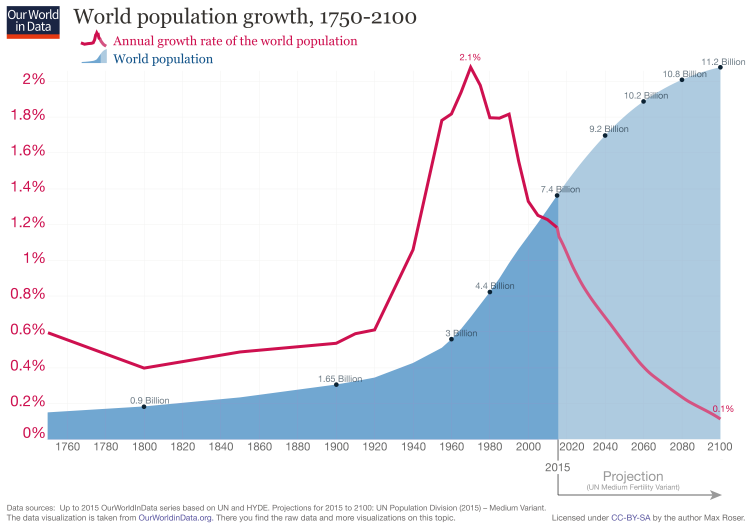
Lots of people who should know better are stuck in the 1960s. Uncanny how Ehrlich hit the peak in growth rate precisely. On the Street, he’d be a perfect counter-indicator:
Retired,
Yet there have indeed been catastrophes in earth history, such as the Great Oxygenation Event, in which the build up of O2 from cyanobacteria wiped out most other microbes, which of course then were anaerobic. But life recovered.
Human advances in technology, agriculture and medical sciences insure that the claims of Malthus, Ehrlich, et al are complete crap. Same holds true for the screechers of the religion of Human Caused Globall Warmining. They are all one trick ponies, and the trick that pony does is to lie on the ground, dead and bloated, as they whip it.
I grant you that past predictions have been wrong. But the Earth’s resources are finite as is the livable area. The Earth cannot support an infinite population. Science and technology has made available huge new resources of fossil fuel but the Earth’s supply is still finite. Mankind has to convert to alternate sources of energy before the Earth’s supply of fossil fuels runs out. We must also lower our population enough so that the alternate sources will be enough.
Will,
Resources aren’t finite, given human ingenuity. We are far from exhausting those available even with present technology.
Humans occupy only a tiny area of the planet. There is a lot of land left, not to mention the sea.
Clearly, our population isn’t going infinite. It will stabilize around ten to eleven billion.
Not to worry. That’s so last century. Indeed, so 1960s.
At the density of Los Angeles County, which has lots of open space, the population of the whole world would fit into less area than the USA.
There still may be a lot of resources and space available but they are still finite. I live in Orange County, California and every year there is less land availabe for new housing and less land available for food production. The city is fignting battles over high density appartment compleses. There are less new housing projects going on there were 40 years ago because there is very little vacant land left. Water supply has become a big problem.
Willhaas, it might seem like there are too many people, to you, but in fact, there aren’t.
It’s the fact willhaas, that people, just LOVE to team together like a bunch of snakes all coiled up around each other, in a giant felled tree, or in a hollowed out place within some rocks. They’ll get in there and it’ll look like there are hundreds when in fact it’s only about 40 or 60 having a big, slow-motion orgy.
Which, I guess you might say about the people in these various, disgustingly – to Western sensibilities- ghetto metropolises where millions upon scores of millions of people are packed into places like Sardines.
People,
like to do that.
They don’t do it quite so much because they like it, but because overall, it’s simply easier, to stay alive, clothed, and interested.
Everybody knows, there are ways to hack humanity along, into a wilderness area and not completely destroy the place. The main way is to simply leave the waterways coursing through the area, and don’t develop every square inch.
That alone – access to water and cover and some modest food – stops nearly all extinctions. Couple that with putting in actual parks, and major extinctions can easily be stopped altogether when humanity moves into an area.
Indeed one of the CHECKS – when you’re asking yourself just as an aside, what the wildlife situation is like in a place – is ”is mankind there?”
IF mankind IS there – the biodiversity will just go up. Everywhere man goes, he loves to bring animals with him, and furthermore, since nearly all mammals survive and more importantly thrive within similar environmental bands they generally, do oK as long as someone doesn’t kill out the introduced species. Why?
Because of kids and moms who go get books and figure out how to make whatever critter it is, a little haven in the metro. This is the course of human history. Tribe of adults going along, bunch of kids,
some of the kids have a little string on a baby animal they found or caught.
Now. As far as how many people the planet can actually sustain? The most common estimate you see,
is FOUR TIMES as many people. FOUR TIMES, before the world would actually be as populated as it could be without creating some serious expansion of the livable area
It’s simply, SIMPLY NOT TRUE, that there are too many people. Professors at schools, whose idiocy is well tracked, are CONSTANTLY making this claim, and it’s simply, NOT true.
You can look it up yourself if you want to, I doubt you will since you are – sadly – probably a liberal if you’ve been fed that lie and never even checked.
The reason I say that is because even the most cursory check shows you – not just in someone elses’ opinion but you can sort it out yourself – science isn’t complicated although liberals claim it is – that it’s not true, there are too many people.
It”s just that people like to fight, and steal and get things the easy way, rather than each individual human determining to learn the absolute most possible and make the world a better place. Lazy primates would simply rather lie cheat and steal than work, and this has been proven in zoos over, and over.
Primates have a criminal streak and they’ll start predating as SOON as it becomes more convenient. Which may be another reason people don’t spread out through the environment more.
It doesn’t PAY
the educated self-assessed ‘illuminati’ types – whatever the ________ that actually is LoL – the educated predator who gets a slip of paper saying he or she is above work and that they must – MUST be telling others to work or something has gone completely wrong in the world – these people NEED to have people CLUSTER UP so they can be more easily FLEECED.
So there are a LOT of reasons people – like termites, and ants, and snakes, and birds and bees – and pretty much any other critter that runs in fairly large batches –
congregate themselves into these tightly nested sardine-can situations. When you think about it – the amount of space between critters, etc – isn’t it JUST LIKE an ant-hill or a termite nest in some ways?
Samuel
[You have 5 different user-id’s. Chose one. .mod]
LoL I do agree to some degree being a biology major however the first thing that pops into my mind is ”I suspect in-depth interviews with those bacteria would reveal another opinion about ‘catastrophe’ vs ‘just another day inside a dead skunk on the road’ !
Maybe it was funnier in my head
[You have 5 different user-id’s. Chose one. .mod]
“adding even aged manure to row crops is not nearly as safe as adding fertilizers from canisters. ”
Zeke is correct, if fact it is down right dangerous. At the risk of being condescending, there are good bacteria and bad ones (aka pathogens). If you take properly produced dairy farm manure and spread it on your kitchen counter and then cut up a raw chicken, the good bacteria will out compete salmonella bacteria.
Bad news Zeke, it a dangerous world. Many years ago I took an environmental chemistry class. One of the lab requirement involved taking sample of drinking water, roof runoff, river water, and water from a park with duck and geese after the grass was watered. We tested for the level of pathogen bacteria. Except for chlorine treated tap water, it was bad.
Food safety is important. Some organic farmers are loons. Most is just big business with good quality assurance. I would not pay more for the ‘word’ organic on the label.
I buy nothing that has “organic” on the label. Simply a marketing strategy, or worse, a total rip off.
“Kit think for yourself on this:”
So Gary what you are saying and doing is that one should avoid studying science and just make simplistic and stupid statements.
Gary maybe you should avoid thinking for yourself.
“Yet there have indeed been catastrophes in earth history, such as the Great Oxygenation Event, ”
Gabro thanks for making my point. The evolution of life on earth is a very interesting scientific topic.
It is a human concept to use wildly dramatic and inaccurate language (catastrophes, wiped out). I have a theory that such language is not necessary for a true catastrophe. I looked up Pompeii on wiki and then searched for ‘catastrophes’. Only one hit, in the title of a recent research paper.
Researchers using hyperbole, who knew!
Some mass extinction events
Hadean/Archaean: Protocells totally wiped out by modern prokaryotes.
Paleoproterozoic: Most anaerobic organisms wiped out by oxygen-producing cyanobacteria.
Neoproterozoic: Ediacaran biota wiped out by its members’ consuming the bacterial slime mats upon which they fed, leading to the Cambrian Explosion.
Ordovician/Silurian: Ice age wiped out ~1/3 of brachiopod and bryozoan families, plus many groups of conodonts, trilobites and graptolites.
Late Devonian: Probable anoxic oceans wiped out around 20% of marine families and more than 50% of all genera, especially brachiopods, trilobites and reef-building organisms, which latter almost completely disappeared.
Permian/Triassic: Still unsure about cause(s) of this “Great Dying”, but up to 96% of marine species, 70% of terrestrial vertebrate species, 83% of all genera, 57% of all families, and even many insect groups were wiped out,
Triassic/Jurassic: A whole class of marine organisms (conodonts), 34% of all marine genera, all archosaurs other than two crocodylomorph groups and pterosaurs and dinosaurs, some remaining therapsids (“mammal-like reptiles”) and many large amphibians were wiped out.
Cretaceous/Paleogene: Except for some cold-blooded groups (turtles and croc relatives), no tetrapods weighing more than 55 pounds survived, as the whole subclass of ammonites and a host of other sea creatures and plankton were wiped out.
Yet each of these catastrophes led to the eventual evolution of ever more complex and diverse ecosystems.
The only good beef smuggler is a dead one.
http://www.hindustantimes.com/india-news/jharkhand-man-accused-of-carrying-beef-beaten-to-death/story-3fuowiHpgloxAbERlouZ4M.html