Weather and climate: in the eye of the storm
By Julio Slingo, published in the Financial Times, 13 April 2017 (h/t to Larry Kummer)
Julia Slingo is the former chief scientist of the Met Office.
In 1972, fresh from a physics degree at Bristol University, I joined the UK’s national weather service, the Met Office. I liked meteorology because I could look out of the window and see physics in action. Clouds forming in a blue sky, and the wind blowing so often from the west
— it was not immediately obvious why that should be, and I was intrigued. (I learnt later that the UK lies right in the path of the jet stream, a band of westerly winds that circles the mid-latitudes. The jet stream arises from the rotation of the Earth — the Coriolis Force — and because the planet is heated at the equator and cooled at the poles.)
I joined a team building the first climate models, simulating the evolution of the Earth’s atmosphere on the basis of fundamental physical principles. Elsewhere, and based on very similar science, numerical weather forecasting was taking off. I made some of the early calculations of how sensitive the climate might be to increasing levels of carbon dioxide. Little did I know then that this would become one of the defining problems of the 21st century.
In the decades since, simulations produced by these models have become the bedrock of our understanding of how the weather and climate work. With the help of new technologies, such as satellites and supercomputers, these models have revolutionised our thinking: we use them for forecasting from hours to years ahead, and they are central to assessing future climate change and its impacts.
But more than that, for scientists like myself, these models are our laboratories. With them we can find out why our climate varies, and why it now seems to be changing.
It has only been through simulating what the world would have been like without greenhouse gas emissions that we can say with confidence that humans have been the dominant cause of the observed warming since the mid-20th century.
Yet even as our capabilities improve, the challenge for meteorologists is increasing. Our planet’s population is rising, cities are growing rapidly, often along coastlines, and our world is increasingly and intricately interdependent — relying on global telecommunications, transport systems and the resilient provision of food, energy and water. All of these are vulnerable to adverse weather and climate. The additional pressure of climate change poses new questions about how secure we will be in the future.
***
In early 2009, some 37 years after first joining the Met Office, I returned as its chief scientist, attracted by a desire to see my science working for society. It was clear to me that the weather and climate would have considerable direct and indirect impacts on us, perhaps more so than ever before — on our livelihoods, property, well-being and prosperity. It was equally clear that the benefits of access to the best weather and climate science and predictions would be profound.
The Earth’s atmosphere is massively complex and, as a result, the weather we experience varies hugely from place to place and over different times of the year. We cannot understand and forecast our weather in the UK without seeing it in the context of the global atmosphere and, increasingly, the global oceans.
Our forecasts now embrace timescales from a few hours to a decade ahead, and our climate change projections give us scenarios, out to the end of the century and beyond, of how the weather and climate may change in fundamental ways as the Earth responds to rising levels of greenhouse gases.
Increasingly, we look to these simulations to understand the likelihood of hazardous or extreme weather such as storms, heatwaves or prolonged drought — and what these represent in terms of risks to society. In the UK, as in many other parts of the world, we are well aware that nearly all the highest-impact weather events are localised. Flooding regularly costs the country millions of pounds, and can take a huge toll on the lives of those worst affected — yet the areas involved are often only a few kilometres wide.
During my time as chief scientist we were able to implement a new forecasting system based on a model that works at the scale of our local weather. We had been striving for this for many years
— we knew it was feasible scientifically, but the computational power was just not available. With the latest advances in supercomputing and investment by the government, this has become a reality. Now, for the first time, the cloud systems that deliver our rainfall are captured by the model with the level of fidelity needed to predict severe, localised events.
This has proved to be a landmark in weather research and forecasting. It has meant that we could provide the detailed severe weather warnings that were so essential in recent winters for protecting lives and livelihoods against the winds, waves and floods that battered the country. In the St Jude’s Day storm of 2013, for example, and again for Storm Desmond in 2015-16, we were able to alert emergency services, transport providers and local authorities, often more than 24 hours in advance. This meant that temporary flood defences could be deployed, bridges closed, train services rescheduled and plans put in place for rapid post-event recovery.
Beyond the weather, we are also exposed and vulnerable to the Earth’s natural variations in the climate, such as El Niño, the intermittent warming of the tropical East Pacific Ocean that has profound effects around the world, including droughts and wildfires in Indonesia, poor monsoon rains in India and floods in California.
We need to be better prepared for such events, so that we can manage the risks they pose more effectively. The good news is that it’s now possible to predict an El Niño event at least six months in advance. Nearer to home, for the UK and Europe, we have developed the capability to assess the likelihood of a particular kind of winter several months beforehand, so that we can predict, say, a mild, wet winter or a drier, cooler winter — something considered unlikely a few years ago.
Advances in modelling the ‘Earth system’ are bringing about a new age in our science, enabling us to probe in greater detail than ever before the processes and phenomena that shape the world
This has only come about because we have rigorously explored processes in the atmosphere and oceans that determine our seasonal climate, and pushed the resolution of our models to provide much greater realism at the regional scale, again enabled by more powerful supercomputers. As a result there have been major advances in what we call seasonal forecasting, and the potential for further advances is huge.
Within the next few years we should be able to provide early warnings of extended cold spells and heatwaves that will enable health services, energy suppliers and transport providers to be better prepared. We are still learning how best to communicate and utilise the wealth of information in our seasonal forecasts, but recent scientific breakthroughs give us confidence that their potential value is high.
***
And then there is climate change. Temperatures have risen by about 1.0C since pre-industrial times; Arctic sea ice extent has declined by 3 per cent every decade since records began in 1979
— and at a faster rate in summer; sea levels have been rising by about 3mm a year since the early 1990s; each of the past three decades has been successively warmer at the Earth’s surface than any preceding decade since 1850. We are more confident than ever that humans have been the dominant cause of the rise in temperatures since the 1950s.
While no extreme weather or climate event can be attributed solely to climate change, after the terrible damage of the 2013-14 winter storms and again the flooding in 2015-16, people inevitably and rightly ask: is this climate change?
There is as yet no “definitive answer” to this question, partly due to the highly variable nature of the UK’s climate (ie our “British weather”), but the evidence we do have, such as increasingly heavy daily rainfall and rising sea levels, suggests that the risks of serious flooding and coastal inundation are growing with climate change. Our job now is to say in greater detail what this might mean for the UK’s weather patterns, so that we can make wise choices about investing in infrastructure to increase our resilience.
We do know that some level of climate change is inevitable regardless of what happens to carbon emissions in the future, because of the accumulation of carbon within the atmosphere. This
means that some level of adaptation will be necessary. How we adapt is a key question. The scale of potential spending on, say, flood defence systems, the risks associated with failure, and the long lifetimes and lead-times involved mean that such investments are likely to be highly sensitive to how climate change evolves over the next two to three decades. We need to be sure that we climate-proof our cities and our infrastructure.
There is no doubt that new and more robust climate projections will be required on a country-by- country level if we are to adapt to the challenges and even exploit the opportunities presented by climate change.
In 2018, the Met Office will deliver its latest assessments of what the UK’s weather might be like in the coming decades, using the same local-scale model that we have recently deployed in weather forecasting. The outputs of this model should help us understand far more about the volatility of our weather in the future, and how extreme weather at the local scale, such as flash floods and storm surges, may affect us.
Looking beyond the next few decades, we also need to assess the longer-term risks of irreversible or dangerous climate change, such as the loss of the Greenland ice sheet, huge releases of methane — a potent greenhouse gas — from melting permafrost, long-term sea level rise and acidification of the oceans. Remarkable progress has been made in building a new generation of models that represent many more components of the Earth, such as ice sheets, vegetation and marine life — now known as “Earth system” models. We need to understand the future evolution of the whole Earth system and how it has evolved in the past under major climatic changes.
This landmark system meant we could provide the warnings that were so essential recently to protect lives against the winds and floods that battered the country
This knowledge will be critical for deciding the pace and depth of climate change mitigation actions. We are learning, for example, that melting permafrost has the potential to release large amounts of carbon into the atmosphere, effectively reducing what we can emit in the coming decades — our allowable carbon budget — if we are to stay within the limit of a global surface temperature increase of 2C, or even 1.5C, as agreed in Paris in December 2015.
Advances in modelling the Earth system are bringing about a new age in our science, enabling us to probe in greater detail than ever before the processes and phenomena that shape the world.
These new capabilities have begun to unlock the benefits of weather and climate intelligence, but much more can be achieved. The science is never “done”; there is always more to learn, and the complexity of our world means that there will always be things we don’t know.
Increasingly, our actions and our responses to environmental change, such as landscape management and flood defences, will influence the environment itself. For this reason, we need to make significant advances in the end-to-end evaluation of environmental risks and benefits. This will require the integration of the physical simulation of weather and climate with areas
such as advanced modelling of the built environment; quantification of the value of natural capital and ecosystem services; understanding of human dynamics; modelling of ecological systems; and new approaches to modelling financial and socioeconomic impact.
***
Last December, I retired after nearly eight years as Met Office chief scientist. It was a pleasure and privilege to lead one of the best environmental research organisations in the world at a time when, more than ever, we depend on skilful, comprehensive predictions of the weather, climate and the broader environment.
It is worth reflecting on the words of vice-admiral Robert FitzRoy, the captain of the Beagle who took Charles Darwin on his momentous voyages but who was also the founder of the Met Office. After the wreck of the Royal Charter in a terrible storm in 1859, he wrote to The Times:
“Man cannot still the raging of the wind, but he can predict it. He cannot appease the storm, but he can escape its violence, and if all the appliances available for the salvation of life [from shipwreck] were but properly employed the effects of these awful visitations might be wonderfully mitigated.”
More than 150 years ago, FitzRoy embarked on the long journey of making predictions as a means of reducing and managing the impacts of severe weather and climate change, and his words speak across the years to us today.
From the global to the local and from hours to decades, our understanding of weather and climate and the predictions we make will enable us to plan for the future and keep us safe.
Discover more from Watts Up With That?
Subscribe to get the latest posts sent to your email.
So many experts opinions here expressed with such confident vehemence. So many must have spent decades studying the physics of meteorology, astonishing.
“tony mcleod April 18, 2017 at 5:14 am
So many must have spent decades studying the physics…”
I did. Did you Tony?
What makes you think that none of us have?
Pathetic little troll acting trollish.
Ah yes, the UK Met Office – that’s the one that lost its BBC weather forecasting contract because it was routinely so inaccurate ….. predictions of a ‘barbecue summer’ confounded by one of the wettest summers in years … and as Julia Slingo so proudly misclaims that based on the Met Office’s short term forecasting accuracy (Not) you can have faith in their century ahead climate predictions !!
Its the script for a comedy show – except the self-delusion she shows is actually quite sad and rather tragic.
The Met Office lost it’s TV contract not because of inaccuracy, but because they do not have a commercial bone in their collective body. They lost most of the UK county council road ice and UK transport contracts because they had no idea how to deal with commercial rivals.
Having worked in the UK Met Office as a forecaster, I can tell you that it is a classic public service govt organisation where there are proceedures that must be followed no matter what. If you don’t follow these you are reprimanded or considered a troublemaker. Trying to suggest or implement change is like wading through treacle and not encouraged. This is why they struggle to come up with innovative ideas and lose bidded contracts.
There are lots of good things that come out of the UK Met Office though. Their global model is very good as is some of the Met research. The National Hurricane Centre routinely uses the UK Met Office model over their own models because it is much better at forecasting Hurricanes.
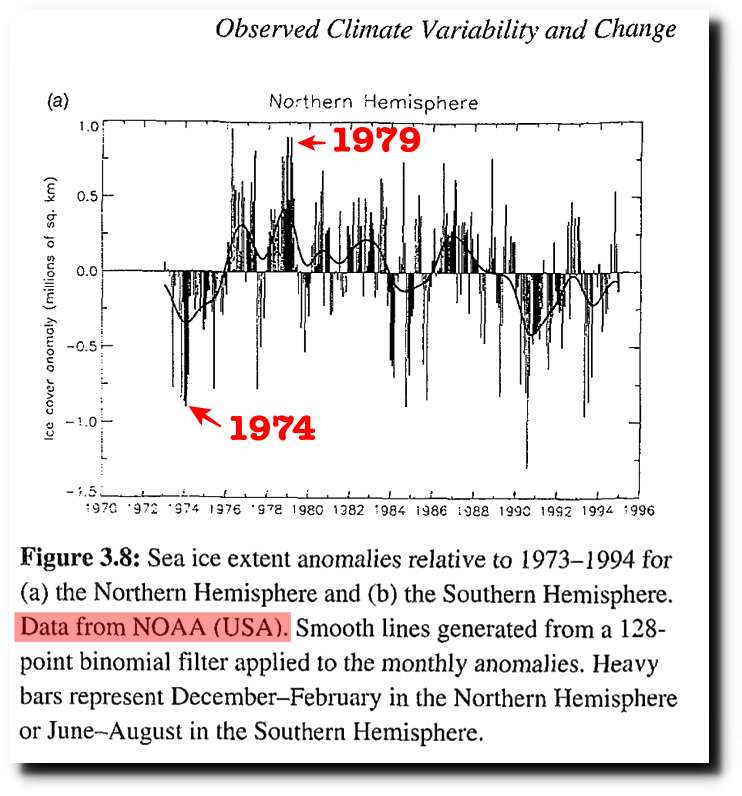
“Arctic sea ice extent has declined by 3 per cent every decade since records began in 1979”
I liked this part for a good laugh.
I wonder what Julia would say if someone told her we actually have records of arctic sea ice that go back before 1979. For example, 1972 had less arctic sea ice than 2016. So arctic sea ice actually increased from 1972 to 1979, and then it declined, but still hasn’t declined as much as 1972. How about that, Griff?
Yeah, and let’s not forget the observational records of Arctic sea ice decline in the early twentieth century.
Care to share those records TA?
While you do that, here is one I prepared earlier:
and since it stops before 2016, here is the satellite period to help us up to date:
Here you go, tony
Models are laboratories?!
Only in our dreams.
Lets’ build more models that forecast a fantasy world for which we can allot huge sums of money to fund the futile attempts to engineer into a false reality. Hey, it creates jobs, I guess, … just like the motion picture industry.
Nothing quashes the impact of an authoritative career recap like an authoritative delusion.
Utter nonsense from Slingo
This character has more misconceptions and false information than Obama. It’s disappointing to know that such an uninformed person would ever rise (?) to the level of chief scientist in the Met office.
Very interesting view of her career, in her own words;
“Good enough for government”.
Indeed she had a “successful” government career, good thing for her, tough luck for the taxpayers.
Christ! 44 years at the same place! Government bureaucracy run wild.
Slingo is a most dishonest person!
Yes, I noticed her use of “the Coriolis Force” as though it was something real. Coriolis Effect is almost as bad, if used to imply that it is actually “effecting” something. The Coriolis “Effect” is an optical illusion.
https://malagabay.wordpress.com/2013/01/29/inventions-and-deceptions-coriolis-effect/
explains it well, and calls out many examples of its mis-use in the ‘sciences’.
http://milesmathis.com/corio.html (linked in the above) also has a good discussion.
“after the terrible damage of the 2013-14 winter storms and again the flooding in 2015-16, people inevitably and rightly ask: is this climate change? There is as yet no “definitive answer” to this question, partly due to the highly variable nature of the UK’s climate (ie our “British weather”), but the evidence we do have, such as increasingly heavy daily rainfall and rising sea levels, suggests that the risks of serious flooding and coastal inundation are growing with climate change.”
Sure, but that’s been true for thousands of years, really since the last glacial maximum about 25K years ago. That’s the big disconnect in policy — there’s almost no real evidence to support the notion that the emissions control agenda will actually have positive ROI.